AI makes SEO faster, but human expertise still wins


AI has made SEO more efficient than ever. Tasks that once took hours now take minutes, and it’s tempting to let that efficiency extend from research all the way through content production.
But there’s a tradeoff. The faster AI makes it to publish, the easier it becomes to sacrifice the original thinking, firsthand experience, and distinctive perspective that Google increasingly rewards. At some point, efficiency stops helping your SEO and starts hurting it.
The solution isn’t to stop using AI. It’s to use it where it creates leverage while keeping human expertise at the center of your content.
Where AI belongs in your SEO workflow
Yes, you can use AI for SEO strategy and junior-level work, but your level of investment in a prompt or chat directly affects the quality of the output. The more context and data you provide, the more useful the results become. That makes AI highly effective for brainstorming strategy, analyzing data patterns, and organizing project frameworks.
For example, Gemini grouped more than 2,000 declining Page 1 keywords into topical clusters, condensing hours of manual analysis into minutes.

After importing Google Search Console data, Gemini mapped those keyword themes to the URLs losing visibility, producing a focused list of pages to optimize.
That’s where the human takes over.
The line between helpful efficiency and search problems depends on where you stop using the tool. When AI supports the background strategy, it gives you more time to create a better page. When you let AI write the entire copy, the strategy fails.
What happens when AI writes the page?
To see the true cost of choosing quantity over quality, you can track performance across three common writing methods using first-party data from Google Analytics 4 (GA4) and Google Search Console (GSC). The following GSC data compares blog articles using each approach.
1. Pure AI content
This content is written entirely by AI from a simple prompt, with no human review before publication.
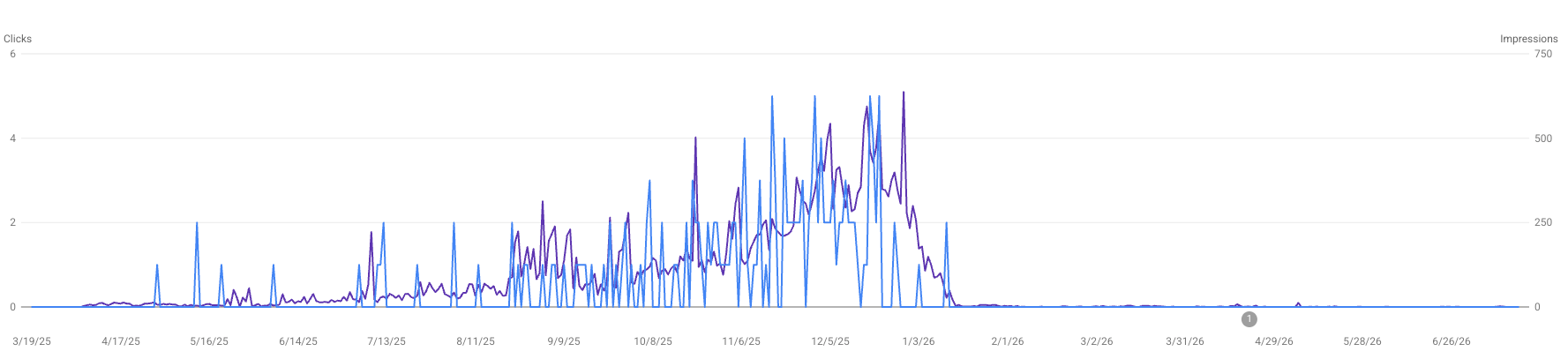
The result: Published in April 2025, these three pages generated some organic performance after launch. By January 2026, however, they had almost completely disappeared from search results.
2. AI-generated, human-edited content
This is a common middle ground. AI generates the first draft, and a human editor updates the headings, cleans up the grammar, and adjusts the formatting.
Industry data shows that more than 86% of marketers use this editing workflow to reduce production costs.

The result: These five articles were originally published using this hybrid approach, then rewritten entirely by hand earlier this year. That human revision drove modest year-over-year growth over the last three months, increasing clicks by 12% and impressions by 27%.
3. Human-written content
This content starts with a real human perspective, such as messy internal notes or a documented customer solution. AI is used only for brainstorming or proofreading.

The result: Published with Google’s helpful content guidelines in mind, this article demonstrates the value of original authorship.
Instead of declining over time, it continued to gain visibility through the winter before peaking with substantial click growth in early April. Investing more time upfront created a long-term asset that was eight times more likely to rank in the No. 1 position.
Dig deeper: How AI-generated content performs in Google Search: A 16-month experiment
The industry’s trusted source for essential news and analysis.
Sign up for our newsletter to receive exclusive insights and updates directly to your inbox.
- Daily breaking news
- Expert analysis from industry veterans
- Join over 200k subscribers
- Covering SEO, PPC and AIO
How Google changed the rules for mass content production
The benchmark reflects a broader shift in how Google evaluates content. Since AI writing tools became common, Google has continued updating its ranking systems to address scaled content abuse. What started with the helpful content system is now part of Google’s core ranking systems.
The March and May 2026 core updates reinforced that direction, rewarding sites with original research, firsthand experience, and distinctive brand voices while reducing the visibility of large volumes of low-value content.
Google’s systems are designed to surface new information. When your publishing process prioritizes output over originality, your content becomes harder to distinguish from everything already published.
Human readers notice the same things search engines reward
While search engines look for unique information, human readers can spot automated writing almost instantly. When every content team relies on the same tools, the same repetitive vocabulary starts to appear.
Words like “delve,” “surge,” and “paramount” quickly signal that AI played a significant role in writing the copy. Corporate marketing was already full of buzzwords like “synergy,” “paradigm shift,” and “holistic” before AI arrived. AI has made that language more common, forcing readers to work through paragraphs of empty copy before they understand what a company actually does or sells.
AI humanizer tools don’t solve the problem. While they may rewrite automated copy to avoid detection, they often replace one recognizable pattern with another. Readers still notice the awkward phrasing these tools create. Using one machine to hide another’s work doesn’t make the writing more useful.
Dig deeper: AI can write SEO content, but it can’t replace real experience
Common AI terms to exclude from your prompts
If you’re using an LLM to organize your thoughts or build an initial outline, include a negative prompt that bans these specific words and phrases. This prevents the machine’s repetitive habits from bleeding into your foundational ideas:
delve, synthesize, semantic, surge, tapestry, paramount, vital, sustain, velocity, deploy, underscore, pivotal, synergy, realm, harness, illuminate, holistic, facilitate, refine, bolster, differentiate, streamline, revolutionize, innovative, cutting-edge, game-changing, transformative, robust, arguably, typically, at its core, that being said, to put it simply, key takeaway, broader perspective, generally speaking, to some extent, broadly speaking, seamless integration, scalable solution, indelible mark, stark reminder, nuanced understanding, complex interplay, unwavering commitment, pivotal moment, navigate the complex, turning point, transformative power, relentless pursuit, multi-faceted approach, significant milestone, pave the way, step forward, far-reaching implications, comprehensive framework, unique blend, delicate balance, path ahead, laid the groundwork, root cause, ongoing dialogue, paradigm shift, diverse perspective, comprehensive overview, potentially lead to, particularly noteworthy, in stark contrast
Dig deeper: The AI writing tics that hurt engagement: A study
Keep human expertise at the center
The benchmark makes the tradeoff clear. AI delivers the most value when it accelerates research, organization, and analysis. The strongest-performing content still begins with human expertise and original thinking.
Protecting your time shouldn’t cost your brand its voice. As Google continues rewarding original content, the most successful SEO strategies won’t come from publishing more pages. They’ll come from publishing pages that offer something AI can’t: firsthand experience, original insights, and a distinctive perspective.
Use AI to tackle the repetitive work. Save your own time and attention for the thinking, expertise, and creativity that differentiate your content from everything else on the web.
Explore more on
Editorial disclosure
Contributing authors are chosen for their expertise and work under the oversight of the editorial staff. Search Engine Land is owned by Semrush. The contributor was not asked to mention Semrush; the opinions expressed are their own.
About the author