Google Ads expands customer acquisition and retention controls

Google Ads is introducing new customer acquisition and retention features across Performance Max, Shopping and Search campaigns, giving advertisers more control over how they reach new customers and re-engage existing ones.
The update includes high-value customer acquisition for Shopping campaigns, expanded retention goals and percentage-based bidding multipliers.
What’s new. Google is rolling out three updates designed to help advertisers manage different stages of the customer journey.
1. New Customer High Value Mode expands to Shopping campaigns
Google is extending New Customer High Value Mode to Shopping campaigns after previously introducing it for Search and Performance Max.
The feature allows advertisers to prioritize acquiring new customers who are expected to bring greater value to their business.
Rather than focusing exclusively on new customers, campaigns can continue reaching their broader audience while bidding more strategically for valuable new customers.
The feature is rolling out to Shopping campaigns this month.
2. Customer Retention Goals become more widely available
Google is expanding retention goals following earlier beta testing, giving advertisers three ways to engage existing customers.
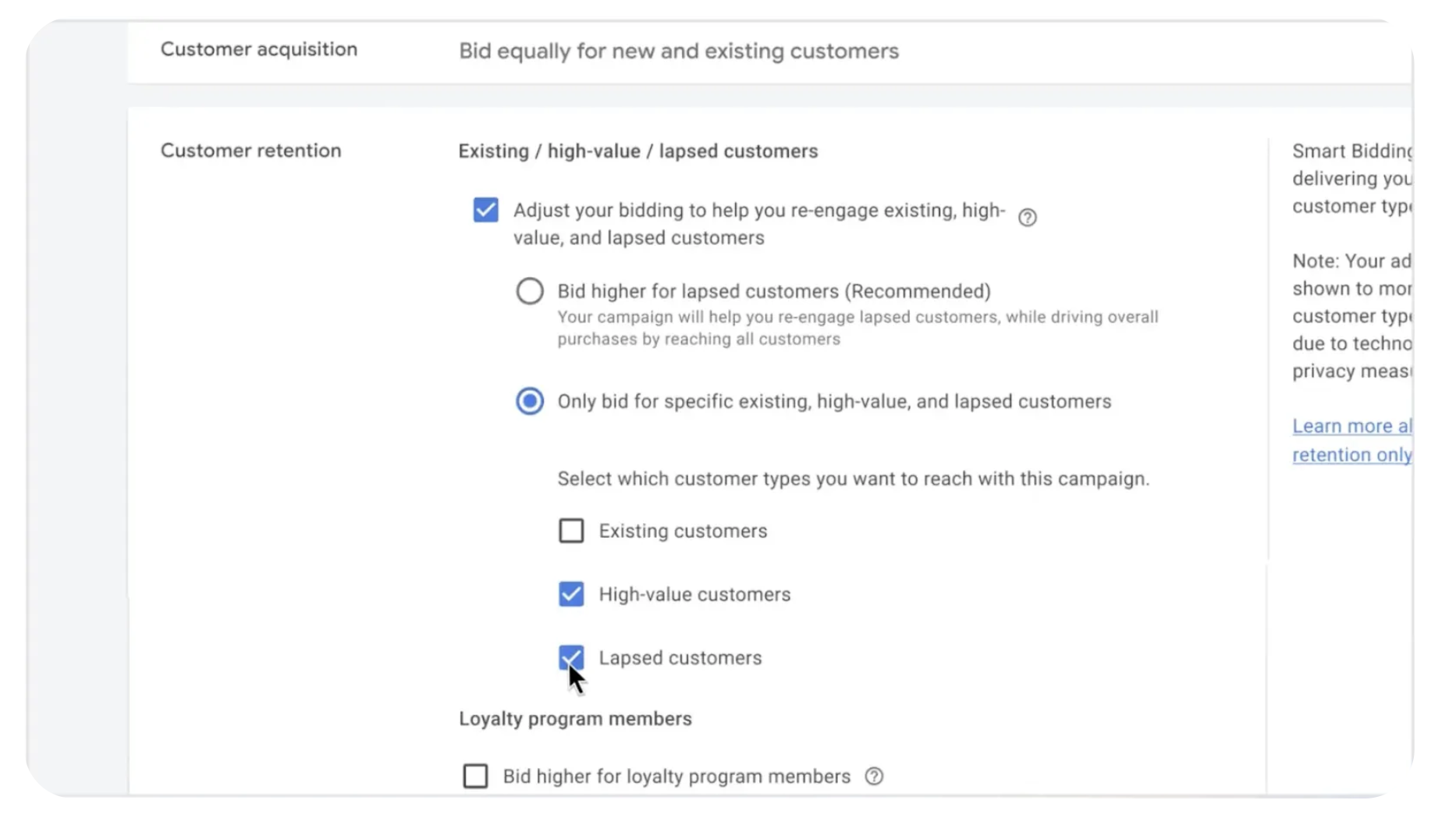
- Re-engagement Mode: Prioritizes customers who haven’t purchased recently while continuing to reach the campaign’s broader target audience.
- Loyalty Mode: Helps advertisers reach loyalty program members with relevant messaging or member-only pricing.
- Retention Only Mode: Allows advertisers to run campaigns focused exclusively on specified existing-customer segments.
These retention goals are rolling out this month across Performance Max, Search and Shopping campaigns.
3. Percentage Multipliers offer more flexible bidding
Google is also introducing percentage-based customer value multipliers as an alternative to fixed monetary adjustments.

Previously, advertisers using a flat value adjustment could struggle to account for customers making purchases of different sizes.
With percentage multipliers, the value adjustment scales proportionally with the customer’s order value.
For example, a retailer applying a 20% multiplier (1.2x) would increase the value used for bidding by the same proportion whether the customer makes a $50 purchase or a $500 purchase.
This gives advertisers a more flexible way to reflect the value of acquiring or retaining customers across different order sizes.
Why we care. The updates provide more options for tailoring campaign strategies to specific business objectives.
Retailers looking to grow their customer base can prioritize high-value new shoppers, while businesses with established customer relationships can focus on re-engagement and loyalty.
Percentage multipliers also make it easier to account for differences in order value without relying on a single fixed adjustment.
Together, the changes could help advertisers allocate budgets more strategically across customer acquisition and retention.
The catch. These features depend on advertisers being able to identify and distinguish relevant customer segments.
Businesses will need reliable customer data and appropriate campaign settings to make effective use of acquisition and retention goals.
Percentage multipliers also influence the value signals used by Google’s bidding systems. They don’t guarantee a particular bid increase, acquisition cost or campaign outcome.
The bottom line. Google Ads is giving advertisers more control over customer acquisition and retention with new Shopping campaign capabilities, expanded retention goals and percentage-based value multipliers. The updates aim to help businesses reach the right customers and bid according to their value during the holiday season and beyond.
Explore more on
Editorial disclosure
Search Engine Land is owned by Semrush. We remain committed to providing high-quality coverage of marketing topics. Unless otherwise noted, this page’s content was written by either an employee or a paid contractor of Semrush Inc.
About the author