Google Ads tool is automatically re-enabling paused keywords
Some advertisers are reporting that a Google Ads system tool designed for low-activity bulk changes is automatically enabling paused keywords — a behavior many account managers say they haven’t seen before.
What advertisers are seeing. Activity logs show entries tied to Google’s “Low activity system bulk changes” tool that include actions enabling previously paused keywords. The log entries appear as automated bulk updates, with a visible “Undo” option.

Historically, the tool has been associated mainly with pausing inactive elements, not reactivating them.
What we don’t know. Google hasn’t publicly documented the behavior or clarified whether this is an intentional feature, a limited experiment, or a bug.
It’s also unclear what triggers the reactivation or how broadly the behavior is rolling out.
Why we care. Unexpected keyword reactivation can quietly alter campaign delivery, affecting budgets, pacing, and performance — especially in tightly controlled accounts where paused keywords are intentional.
For agencies and in-house teams, the change raises new concerns about automation overriding manual controls.
What advertisers should do now. Account managers may want to review change histories regularly, watch for unexpected keyword activations, and use undo functions quickly if unintended changes appear.
Until Google provides clarification, closer monitoring may be necessary for accounts relying heavily on paused keyword structures.
First seen. The issue was first flagged by Performance Marketing Consultant Francesco Cifardi on LinkedIn.
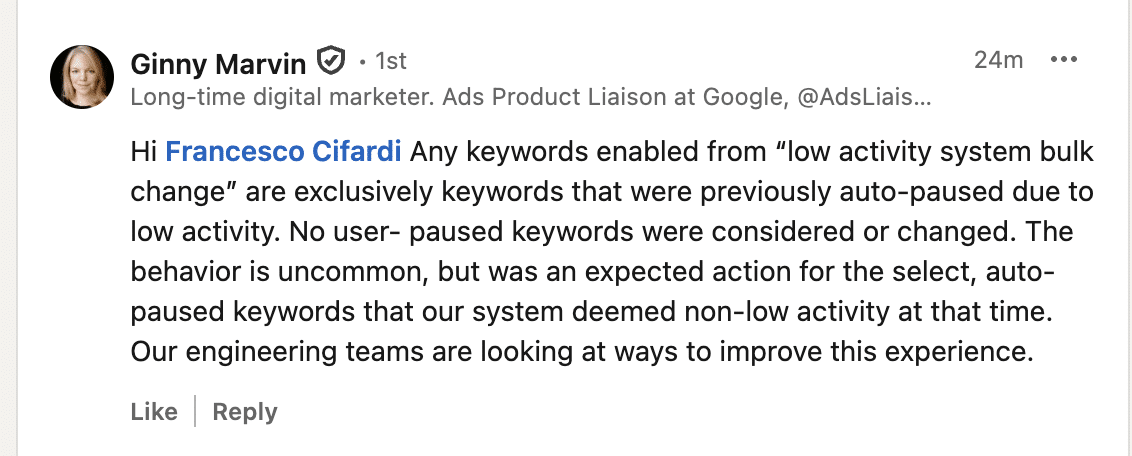
Update on February 19th. Google Ads Liaison, Ginny Marvin, responded to this update saying keywords reactivated by Google’s “low activity system bulk change” were exclusively auto-paused keywords that the system deemed active again — no user-paused keywords were touched. She said the behavior was uncommon but expected, and engineering teams are working on improvements.
Explore more on
Add Search Engine Land as a preferred source on GoogleEditorial disclosure
Search Engine Land is owned by Semrush. We remain committed to providing high-quality coverage of marketing topics. Unless otherwise noted, this page’s content was written by either an employee or a paid contractor of Semrush Inc.
About the author