Agentic AI and SEO: How autonomous systems redefine search
Explore how agentic AI changes SEO. Learn how autonomous AI agents reshape search, ranking logic, and optimization strategies for the next era of visibility.
Agentic SEO is the deployment of AI agents—powered by large language models (LLMs) like ChatGPT, Claude, and Gemini—to autonomously execute complex SEO workflows, in combination with human oversight and validation.
Traditional AI marketing tools are efficient but often create a lot of editing and prompting work. Agentic systems can save time because they act independently.
The financial implications of agentic AI are staggering: One study projects the global AI agents market will explode from $5.40 billion in 2024 to $50.31 billion by 2030.
They don’t just generate content—they research competitors, identify content gaps, map keyword clusters, and orchestrate multi-step processes that require hours of manual work. These agents can execute actions using available tools while continuously adapting, based on your feedback.
Rather than replacing strategic thinking, agentic workflows amplify it—they allow you to focus on high-level strategy and quality validation, which combines human creativity with AI’s computational power.
But let’s be clear about what agentic SEO isn’t: It’s not AI SEO, aka Generative Engine Optimization (GEO), which focuses on optimizing for LLM-powered search visibility (e.g., AI SEO helps you rank in AI Overviews and chatbot responses).
Let’s dig into agentic AI and SEO.
Why agentic AI matters for SEO teams
Most SEO teams jumped on the AI bandwagon expecting streamlined workflows but instead found themselves drowning in a different kind of work: prompting, editing, and quality control. There’s a productivity gap between AI adoption and actual efficiency gains in SEO.
But agentic AI can change everything. The key difference is intelligence, not just generation. Agentic AI isn’t just about working faster, but smarter.
Unlike passive tools that wait for instructions, agentic systems think, plan, and execute complex workflows autonomously. Instead of being an AI prompt engineer, you become a strategist who guides autonomous systems toward business outcomes.
An agentic workflow can do many tasks all in one automated sequence—pulling data, analyzing trends, clustering opportunities, and delivering a ready-to-execute strategy.
The SEO toolkit you know, plus the AI visibility data you need.

The productivity gains are real: Research from BCG consulting firm shows that AI-powered workflows can accelerate business processes by 30-50% while reducing human error rates and cutting low-value work time by 25-40%.
On top of all of this, agentic systems learn your specific workflows and get better over time. They remember which competitor analysis frameworks work for your industry, which content structures perform best for your site, and which SEO tactics drive results for your business model.
What makes AI agentic?
Agentic AI systems autonomously plan, decide, and execute multi-step tasks using reasoning capabilities, tool access, and persistent memory rather than simply generating responses to prompts.
Where traditional AI is reactive, agentic systems proactively work toward defined goals through complex processes meant to mirror human cognitive workflows at a computational scale.

Think of it this way: ChatGPT generates content when asked, but an agentic system can identify content gaps across your site, research competitor strategies, draft outlines, validate against search intent, and schedule publishing—all from a single prompt or objective like “improve organic visibility for keywords.”
AI agents excel at:
- Keyword research: Agents can take keyword research to the next level, all while learning from your specific industry context and success patterns. They can:
- Autonomously explore search landscapes using seed terms
- Identify long-tail opportunities through SERP analysis
- Cluster keywords by intent
- Validate search volumes across multiple data sources
- Generate content briefs
- Content optimization: Agents can analyze top-ranking pages, identify semantic gaps in your content, suggest internal linking opportunities from your existing content strategy, and monitor performance changes post-optimization.
- Adaptability: When Google releases algorithm updates, agentic SEO systems don’t just follow predetermined scripts, they analyze impacts across your content portfolio, identify emerging patterns, and adjust strategies based on new ranking signals.
Here are five components of agentic AI:
- Tools: These give agents hands to act in the world. Instead of generating keyword lists, agents can directly query APIs, scrape SERPs, analyze competitor backlinks, and push data to spreadsheets or content management systems. For SEO, this means agents can pull search volumes from Semrush, analyze SERP features from Google, cross-reference with your current rankings, and update tracking dashboards seamlessly.
- Memory: Agents remember previous analyses, track pattern changes over time, and build comprehensive understanding of your specific SEO landscape, keeping context consistent across conversations and tasks. When an agent notices declining rankings for target keywords, it can recall historical performance, make correlations with recent algorithm updates, and factor in previous successful optimizations.
- Instructions: Rather than one-off prompts, agents operate under standing directives like “Monitor competitor content gaps weekly” or “Flag technical SEO issues requiring dev intervention.” These instructions shape decision-making without requiring constant human input.
- Knowledge: SEO agents can be trained on domain expertise and factual accuracy, and understand ranking factors, algorithm behavior, and industry best practices. This prevents hallucinations and false recommendations that could harm search visibility.
- Persona: An SEO agent can adopt a communication style and expertise level. For example, the persona of a senior technical consultant, who can speak confidently about crawl budget optimization while hedging uncertain predictions about algorithm changes.

Understanding agentic SEO workflows
An agentic SEO workflow is a logical chain of interconnected subtasks that AI agents execute autonomously. This can include data gathering, analysis, action execution, and quality validation.
An agentic workflow can connect these steps through decision nodes that automatically route information between tasks. The agent reasons through each step, makes decisions based on data, and hands off refined insights to the next phase, treating SEO tasks as an interconnected system rather than isolated activities.
Here’s an example of a typical content ideation workflow:
- Agent A scrapes SERP data and identifies content gaps
- Agent B clusters related topics using semantic analysis
- Agent C generates content briefs based on competitor insights
- Agent D then hands off those briefs to human writers—who can then inject brand voice, original research, and nuanced perspectives that AI can’t replicate.
The agents handle the heavy lifting of data analysis and pattern recognition, so humans can focus on what they do best—strategic thinking and creative execution.
Other tasks an agent can perform include:
- Monitoring content performance post-publication
- Flagging pieces that are losing rankings
- Identifying opportunities for updates
An agent can surface data and recommend an action, but a human strategist needs to make the final call on whether to refresh, redirect, or retire content based on broader business priorities and audience needs that an algorithm can’t fully grasp.
Each agent operates with its own reasoning engine, but the workflow orchestrator—the human—ensures a smooth data flow and decision continuity.
The human-AI agent collaboration model
This collaboration allows you to do higher value work, and to delegate the busy work to an AI agent. The agent handles the research heavy lifting, but your strategic thinking guides what research questions to ask and how to interpret the results.
Here’s how humans can work with AIs in SEO.
The “human in the loop” principle
The most successful agentic SEO implementations operate on the “human in the loop” principle—a collaboration model where AI handles the grunt work while human expertise guides strategy and validates output.
This isn’t about replacing SEO professionals—it’s about amplifying their strategic impact by removing tedious, repetitive tasks.
Think of it as strategic intervention points where human judgment adds maximum value. When an AI agent pulls together competitive keyword data, you’re not just rubber-stamping its findings—you’re applying years of industry knowledge to spot patterns the AI might miss.
The key is designing workflows that leverage each party’s strengths: agents excel at comprehensive data analysis and pattern recognition, while humans excel at strategic interpretation and creative application.
Quality validation
AI agents excel at processing massive datasets and finding connections, but they can’t understand your brand voice or catch subtle factual errors that could damage credibility.
That’s where your expertise transforms good output into exceptional results. You’re the one who knows that mentioning a competitor’s recent acquisition changes the context entirely, or that certain industry terminology resonates better with your audience.
The best results come from a clear division of labor: Let agents handle data gathering, pattern recognition, and initial content structuring, and reserve your energy for strategic decisions, creative refinement, and a final quality review.
Prompt refinement
Use your domain expertise to iterate on the prompts themselves. Think of this as teaching the AI agent to speak your language—the more specific you get, the more valuable the output becomes.
For example, you might start with “analyze competitor content gaps,” but refine it to “identify content gaps in [topic] for a mid-market company, focusing on [subtopic].”
Publishing
AI can draft, but you decide what actually goes live. Publishing means making the final call on whether content is ready for your audience, fits your brand voice, and represents your site in search results. It’s also where you handle the technical side—meta descriptions, internal links, featured images—that AI can miss or get wrong.
This isn’t just about catching errors, it’s about ensuring every piece advances your broader SEO strategy and maintains the human insights that separate great content from generic fluff.
Ideation is the entry point for agentic AI
The ideation stage is great for using an AI agent because it’s low-risk and high-impact. Using agents at this early stage of the process allows SEOs to experiment and see immediate results.
Agentic AI can accelerate the process of mapping out content opportunities, identifying keyword gaps, and brainstorming topics that align with user intent by analyzing search trends, competitor content, and semantic relationships at scale, surfacing insights that would take hours to uncover manually.
And because you’re still in ideation mode, there’s room to test, refine, and redirect strategy, as you’re not locked into a rigid plan yet. If an agentic system identifies an emerging search opportunity or a content cluster with high potential, you can pivot quickly at this early stage in the process—something harder to do once you’re deep into execution.
It’s not just about speed, though. These systems can propose content angles you might not have considered, drawing connections between topics that expand your strategic options.
Starting at the ideation stage is also forgiving—if an AI agent misinterprets search data or suggests an off-target keyword cluster, the worst outcome is spending a few minutes reviewing and refining the output. Compare this to having an agent automatically publish content or modify site structure—the stakes are dramatically different.
Here are some functions that agents excel at during ideation.
Topic discovery
Agentic AI tools—such as Google’s Deep Research—can map entire topic landscapes, identify content gaps, and surface emerging search trends through recursive exploration.
Feed an agent a seed topic and competitive landscape constraints and then it can systematically explore related entities, analyze SERP patterns across dozens of related queries, and build comprehensive topic maps that would take human researchers weeks to compile.
This recursive exploration capability proves particularly powerful for developing SEO personas aligned with real search behavior. Agents can analyze thousands of related queries, group them by intent patterns, and surface user journey stages that traditional keyword tools often miss.
Generate content clusters from competitor data
Agentic systems shine when tasked with competitive analysis at scale. Instead of manually reviewing competitor content strategies, agents can systematically crawl competitor sites, analyze their content clusters, and identify structural patterns in how they organize topical authority.
The workflow typically involves three phases:
- Data collection
- Pattern recognition
- Opportunity mapping
The agent can scrape competitor content, analyze internal linking structures, map topic relationships, and generate cluster recommendations based on gaps in your current coverage.
Traditional competitive analysis tools show you what competitors rank for, but agentic workflows can reveal how those competitors structure authority around topic clusters.
Identify emerging trends through recursive exploration
Perhaps the most exciting application involves using agents to identify emerging search trends before they hit mainstream keyword tools. By recursively exploring related entities, analyzing question patterns, and monitoring search suggestion changes, agents can surface opportunities while competition remains low.
This process leverages trend archaeology—agents systematically explore the periphery of established topics, analyze search patterns in related spaces, and identify emerging vocabulary before it solidifies into high-competition keywords.
This approach can be used to identify terminology months before it becomes mainstream, allowing you to build authority around emerging language before competitors.
Tools for agentic AI ideation
These AI-powered tools can help give SEOs the technical infrastructure to transform fragmented research tasks into autonomous, goal-driven processes. Unlike simple prompt-and-response tools, these platforms can orchestrate complex multi-step workflows, gather data, analyze patterns, and generate actionable insights without constant human intervention.
Successful agentic SEO implementation usually doesn’t rely on a single tool, but a combination of many.
Topic exploration
Agentic systems can automatically generate topic maps that visualize how concepts connect across your site and surface competitor insights by analyzing public data sources to identify gaps in your strategy. Think of it as having a research analyst who can digest hundreds of sources in minutes and spot patterns you might miss.
Google’s Gemini Deep Research excels at processing competitor content and generating comprehensive topic maps, but what makes it genuinely agentic is that it formulates its own research questions, follows citation chains, and builds knowledge graphs that reveal unexpected topical connections.
OpenAI’s Deep Research uses advanced reasoning capabilities to systematically investigate topics, following chains of inquiry across multiple sources much like a human researcher would. The system can spend extended periods analyzing search results, cross-referencing information, and synthesizing findings into comprehensive reports that would typically require hours of manual work.
A modern workflow for AI-enhanced digital marketing often follows the path:
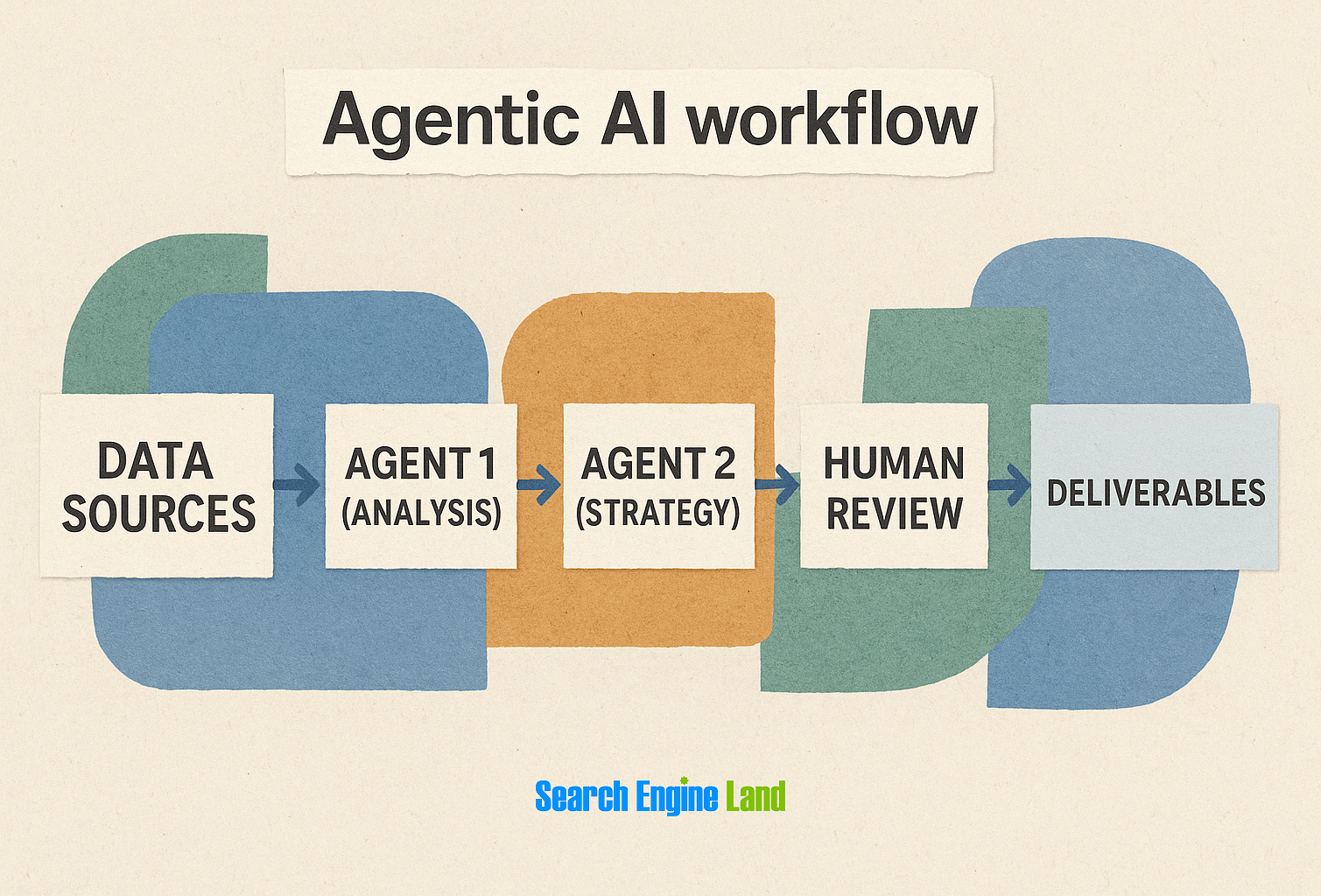
To visualize this process, tools like Miro and Lucidchart offer customizable templates that map each stage using standardized shapes for sources, processes, and decision points.
Workflow customization platforms
For teams ready to build custom agents, n8n and CursorAI enable sophisticated automation sequences. Think of these as the plumbing that connects different AI models, data sources, and output formats into coherent workflows.
A typical agentic ideation workflow might look like:
- Monitor competitor RSS feeds for new content
- Extract key topics and entities using Claude (or other AI)
- Cross-reference against your existing content using semantic analysis
- Identify gaps and generate content brief suggestions
- Validate opportunities against search volume and SERP features
N8n particularly shines for teams with some technical capability who want visual workflow building. You’re essentially creating flowcharts where each node represents an AI task, API call, or data transformation. The platform handles the complex orchestration while you focus on defining the logic.
No-code agentic builders
No-code platforms can transform ideation from scattered manual research into systematic intelligence gathering. The goal is structured exploration that uncovers opportunities you’d miss with manual brainstorming alone.
DNG.ai and similar no-code platforms democratize agentic workflows for teams without technical resources. These tools provide pre-built templates for common SEO tasks—keyword clustering, competitor analysis, content gap detection—while allowing customization through simple dropdown menus and form fields.
The trade-off is less flexibility than custom-built workflows, but significantly faster deployment and lower maintenance overhead. For most SEO teams, this is the sweet spot between automation and operational simplicity.
Challenges and ethical guardrails using agentic AI
Despite all of the benefits AI agents can provide, there are also questions of transparency and accountability when they make strategic decisions on your behalf. Also, there’s a risk that these systems can inadvertently create spammy content or violate search engine guidelines, which can tank your rankings fast.
Review processes can’t be an afterthought—they need to be built into your workflows from day one. This means defining clear approval gates where human expertise adds maximum value, not just rubber-stamping AI output.
The goal isn’t perfect automation, but collaboration between humans and AIs. Your agents should make the process faster and more efficient, not replace your strategic thinking.
Data quality
When you’re automating complex SEO workflows, the garbage-in-garbage-out principle can multiply. And we’re not just talking about typos in a spreadsheet—AI agents can confidently present fabricated data or invent keywords that don’t exist.
The challenge is that bad data doesn’t always announce itself. An AI might pull outdated search volume figures from a stale API, merge datasets incorrectly, or hallucinate metrics that look plausible enough and can slip past a quick review. And because these tools operate at scale, a single flawed data source can contaminate hundreds of data points downstream before anyone notices.
It’s imperative to validate your sources, cross-check AI outputs against known benchmarks, and build in human checkpoints at critical stages.
It’s also good to be skeptical of perfect-looking data—real SEO data is messy, inconsistent, and full of gaps. If your automated workflow is producing suspiciously clean results, that’s often a red flag worth investigating.
Hallucination risk
Hallucinations can cause havoc to your SEO process if agents mix data from different sources. AIs can create something that feels like a fact and that sounds perfectly reasonable but is totally wrong. Imagine that happening at scale and how fast it could sideline your analysis.
The tricky part is that hallucinated data can sit alongside accurate information, making it hard to spot. An agent might pull real traffic numbers from your analytics but then fabricate conversion rates or user behavior patterns.
That’s why validation checkpoints and source verification are so important when using AI agents for SEO analysis. When you’re making strategic decisions about content priorities or budget allocation, these phantom insights can send you down completely wrong paths.
Over-reliance on automation
Successful implementations treat agentic AI as intelligence amplification, not a replacement. Think of it like having a really smart research assistant who needs clear instructions and regular check-ins, but who has an endless amount of energy.
The danger lies in the fact that agents appear so capable. Have a good understanding of how your AI agents work, always check their work, and never skip the validation step. It can be easy to allow errors to creep into your SEO work.
Track, optimize, and win in Google and AI search from one platform.
Building ethical guardrails that work
Build accountability mechanisms into your agentic AI workflows:
- Schedule regular audits of your agent outputs—not just for accuracy, but for bias, data freshness, and source reliability
- Set up automated alerts when your agents pull from sources that haven’t been validated in a certain number of days
- Create a review process where human strategists spot-check AI recommendations before they become action items
Your team also needs clear escalation protocols for when an agent produces something that feels off, even if it technically follows the rules. The best guardrails combine technical constraints with human know-how and the ability to question the AIs.
The future of agentic SEO
Agentic SEO is just the beginning of a broader transformation in how search marketing operates—where AI agents don’t just assist with tasks, but autonomously orchestrate entire workflows from strategy to execution. Unlike basic generative AI that just responds to prompts, these systems actually think through problems, make decisions, and remember what they’ve learned.
Soon, agents won’t just help you brainstorm content clusters or identify keyword gaps. They’ll continuously monitor your site’s technical health, automatically diagnose ranking declines, and implement fixes without human intervention.
The competitive advantage will come from having smarter workflows that adapt faster than purely human teams can manage manually. Agentic SEO helps small teams compete with enterprise resources by automating the research and analysis phases, while keeping human creativity and strategic judgment at the center of the process.
Learn more about the quickly evolving world of AI SEO, and adopt agentic SEO now.
About the Author