Twitter Search Adds “Expand” Option For Shortened URLs
Twitter Search has added a new “expand” option that allows you to turn a shortened URL into back into its original longer version. That’s handy to know where the URL is taking you to. It may also help increase the relevancy matching of some tweets. NOTE: Apparently this isn’t new. Sorry. Still interesting to examine, […]
Twitter Search has added a new “expand” option that allows you to turn a shortened URL into back into its original longer version. That’s handy to know where the URL is taking you to. It may also help increase the relevancy matching of some tweets.
NOTE: Apparently this isn’t new. Sorry. Still interesting to examine, however, I hope.
Twitter Search’s Expand Feature
You can see the new feature in action below:
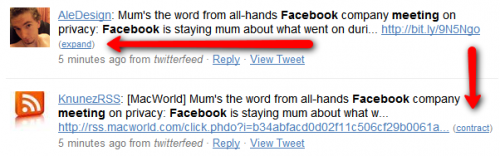
The top arrow points to how URLs in tweets are normally displayed, shortened as they were tweeted, but with an “expand” option next to them. Click on that, and the second arrow shows what happens — the link “opens” up, so that you can see where it leads you to.
That’s handy, since some people can’t tell from shortened links where they’ll end up at. Are you being directed to a good site, or is someone trying to send you to a lesser-known site that might have malware, be loaded with ads or have other issues. Seeing the “real” destination URL can sometimes help.
This only happens using the Twitter Search site, not if you do a Twitter search at Twitter.com.
Expanding URLs Elsewhere
Twitter’s not alone in offering this type of feature. For example, at Bing Twitter Search:

The screenshot above shows how after a shortened URL, the destination domain is shown, such as “(bbc.co.uk)” — that’s nicely done.
Over at Google, it’s even nicer — you get the title of the article or page you’re going to read along with the domain. Nicer, that is, when it works:

The first arrow shows a shortened URL that’s not expanded. The second shows a tweet talking about a BBC article, and that URL was expanded to be:
BBC News – Facebook downplays privacy crisis meeting – bbc.co.uk
Super handy. But then see the third example below that? That link isn’t expanded, despite also leading to the exact same BBC story that did get expanded in the second example.
Over at Tweebus, a new Twitter tracking service I was introduced to this week, they also do a nice expansion to show the name of the page you’re going to:

Shortened Links & Relevancy Matching
Chris Pirillo spotted the Twitter Search changes last night, and he highlights another important aspect. Twitter seems to be adding the words from the expanded link into the tweet itself, making it relevant for additional information.
For instance, using his example, I did a search for pirillo:
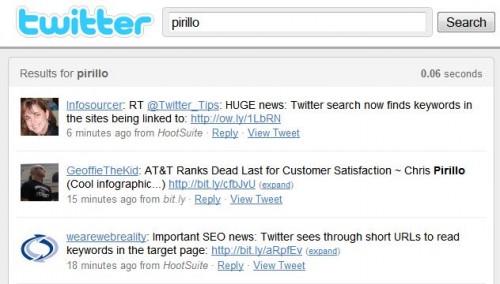
In the second item listed, it’s clear that it matches his name — the word “pirillo” is bolded to indicate why the match happened. But the first and third items don’t mention his name at all. Why are they coming up?
Expanding the shortened links helps explain this:
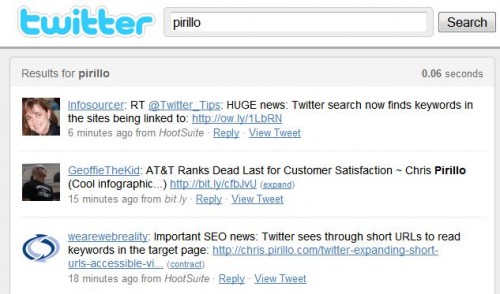
I expanded the link in the third listing. Now you can see that the URL contains the word “pirillo” in it. It seems words within expanded links now get included with a tweet, when Twitter Search decides what items to show in response to a search.
Bing, by the way, goes beyond this. Its Twitter Search service follows any links that are tweeted, then indexes the content of that page and associates that content with the tweet, the service has said. Then again, when I tested a search for pirillo there, every tweet included the word “pirillo” in the tweet and some like shown above, where “pirillo” shows only in the URL, did not appear. So, I don’t think thing are working right.
At Google, it seems to match words within any URLs that it has expanded into the title of the page. I can’t tell if it matches words in the URLs that remain shortened, and I’m not sure if it associates the content of a destination page with a tweet that references it. I’ll check on this.
More more about Twitter Search it its many flavors, see my recent post, The Twitter Search Revolution.
Contributing authors are invited to create content for Search Engine Land and are chosen for their expertise and contribution to the search community. Our contributors work under the oversight of the editorial staff and contributions are checked for quality and relevance to our readers. The opinions they express are their own.

Related stories
About the author
