AI agents and agentic AI vs. traditional automation


Traditional automation follows rigid, predefined rules to handle repetitive tasks. Modern AI agents use large language models (LLMs) to interpret context and make autonomous decisions toward specific goals. Agentic AI takes automation further, coordinating multiple agents to plan, adapt, and execute complex, multistep workflows.
Understanding the differences between these options will help you choose the right approach based on your task, resources, and goals.

What is traditional automation?
Traditional automation refers to rule-based systems that execute routine tasks without human intervention. It operates on if-then logic — when X happens, do Y — to ensure speed and consistency in predictable environments.
Also called robotic process automation (RPA), common examples of automation include factory robotics, scheduled email campaigns, invoice processing, and payroll calculations.
Traditional automation works well for high-volume, repeatable tasks where rules remain consistent and data has a structured format.
But the moment something unexpected happens (an unusual invoice format, a missing field, or a process change), automation breaks. It can’t adapt or make judgment calls. Instead, it just stops working.
What are AI agents?
AI agents use machine learning (ML) and natural language processing (NLP) to understand what you’re asking, decide how to respond, and take action — all within the guardrails you’ve set for them.
Unlike traditional automation, AI agents can handle unstructured data and adapt when conditions change. They can reason through ambiguity, working in the gray areas where traditional automation fails.
AI agents can manage situations where the right answer depends on context. For example:
- Parsing unstructured customer emails
- Analyzing sentiment in chat conversations
- Evaluating whether a support request is routing or needs escalation
For example, a customer service AI agent might resolve a billing dispute by accessing account history, identifying the issue, and processing a refund, all without following a rigid script. It interprets the customer’s intent, evaluates the situation, and decides on the best course of action within its boundaries.
What is agentic AI?
Individual AI agents are great at handling specific jobs, but they don’t communicate with each other or coordinate their efforts. That’s where agentic AI comes in.
Instead of just completing tasks one at a time, agentic AI manages entire processes from start to finish. It determines what needs to happen, decides which agents should handle each piece, and even adjusts as it gets results.
Think of it this way:
- An AI agent is a skilled specialist handling one job
- Agentic AI is the project manager coordinating multiple specialists, setting priorities, and ensuring the entire workflow delivers results
For instance, an agentic marketing system can autonomously analyze campaign performance across channels, identify underperforming segments, reallocate budget to high-performing channels, and adapt messaging. In this case, humans only need to set initial goals and guardrails.
How do AI agents and agentic AI differ from traditional automation?
AI agents, agentic AI, and automation differ in terms of how they operate, what they can do, and how much work they take to set up and manage.
| Traditional automation | AI agents | Agentic AI | |
| How it operates | Executes predefined scripts | Interprets and responds to inputs | Coordinates multiple agents toward outcomes |
| Flexibility | None (rigid rules) | Moderate (adapts within task) | High (adapts entire workflow) |
| Learning capability | Can’t learn | Limited (improves from feedback) | Continuous (improves through monitoring, tuning, and feedback loops) |
| Scope | Single, isolated tasks | Goal-directed tasks | End-to-end processes |
| Example | Scheduled report sent every Monday | Chatbot resolving customer inquiries | Autonomous campaign management across all channels |
How to choose between AI agents, agentic AI, and traditional automation
The right choice comes down to three factors: how predictable your tasks are, how complex they get, and how much autonomy you need the system to have.
Traditional automation is best when you’re dealing with high-volume, repetitive work that follows the same steps every time. Think scheduled reports, invoice processing, or lead routing based on form fills.
AI agents work better when tasks involve raw data or require judgment calls. They can interpret context, handle exceptions, and make decisions within their defined scope. Like resolving customer support tickets or analyzing unstructured feedback, for example.
Agentic AI is for multistep workflows that need coordination and continuous adaptation. These systems plan their own approach, route work between specialized agents, and improve over time with minimal human oversight.
Key selection factors
When you’re weighing your options, these following factors matter most. Use them to begin the process of deciding what level of automation will work best for you.

Predictability
If the process is predictable with a logical format, use traditional automation. But if the input is unstructured and context-dependent, use AI agents. And if the process involves multiple unpredictable steps that need coordination, use agentic AI.
The deciding factor is whether your data and processes are structured or unstructured. Traditional automation needs clean, consistent inputs. AI agents work with ambiguous data and can adapt to variations. Agentic AI handles scenarios where the steps aren’t always the same and the system needs to coordinate across multiple agents to reach the outcome.
For example:
- Sending a welcome email when someone fills out a form? That’s structured and predictable, so use traditional automation.
- Analyzing customer feedback from emails, chat transcripts, and social media to identify sentiment trends? That’s unstructured and varies wildly, so use AI agents.
- Monitoring customer feedback across channels, identifying emerging issues, and routing them to product teams? And then tracking resolution progress and adjusting your support strategy based on the patterns you find? That requires coordinating multiple unpredictable steps, so use agentic AI.
Autonomy
Agentic AI sets its own subtasks and dynamically adapts workflows, while AI agents work toward a goal with some autonomy. Traditional automation requires hard-coded instructions for every scenario.
Ask yourself:
- Can you map every possible scenario in advance? If yes, use traditional automation. For example, traditional automation can route support tickets based on keywords in the subject line.
- Does the task require some decision-making but within a defined scope? Use AI agents. For instance, an AI agent can read the ticket, understand the issue, and respond with a solution.
- Does the system need to figure out its own approach and coordinate multiple steps based on what it discovers? Use agentic AI. Agentic AI can read the ticket, determine it needs information from three different systems, pull that data, synthesize a response, escalate to a human if confidence is low — and follow up two days later to check satisfaction.
Cost structure
Traditional automation has medium upfront costs (developer time to build rules and workflows) but low ongoing costs because it runs on a schedule or trigger with minimal compute expense.
AI agents have medium upfront costs (configuration and training) and medium ongoing costs. You typically pay per API call each time the agent processes a request.
Agentic AI has medium-to-high upfront costs (building multi-agent systems and orchestration) and high ongoing costs. Each agent interaction incurs API charges. When you’re coordinating multiple agents across thousands of tasks, those charges add up fast.
For example:
- If you’re processing 10,000 invoices per month that always arrive in the same format, traditional automation makes sense because you’ll recoup the setup cost quickly.
- If you’re handling 500 support tickets per day that need interpretation and personalized responses, AI agents would work well. The per-query API costs would stay reasonable and there would be more flexibility over traditional automation.
- If you’re running dynamic marketing experiments where you’re constantly testing new channels, audiences, and creative assets, agentic AI’s variable costs are worth it because reprogramming automations for each test would be prohibitively expensive.
Adaptability
How often do your processes change? What level of adaptation do you need when your workflows evolve?
If your processes are stable (same steps and same format month after month), traditional automation’s rigidity isn’t a problem. If the overall workflow stays consistent but you need flexibility in how individual tasks get handled, AI agents provide that. If your entire process needs to evolve frequently, agentic AI can work through that restructuring.
For example, say your company launches a new product category. Suddenly, customer support tickets include questions about features, compatibility, and use cases that don’t yet exist in your knowledge base.
- Traditional automation would send these tickets to a default queue or provide irrelevant canned responses until someone manually creates new rules and routing logic.
- An AI agent could draft appropriate responses using available product documentation, adapting how it handles each individual ticket without needing a lot of manual updates.
- Agentic AI could recognize patterns across multiple tickets, extract information from product docs and internal systems, route complex questions to specialists, monitor which responses work best, and restructure the support workflow to handle this new category efficiently going forward.
| Decision factor | Traditional automation | AI agents | Agentic AI |
| Best for | Predictable, high-volume work | Variable tasks needing human judgment | Complex workflows requiring orchestration |
| Cost structure | Low-to-medium upfront, low ongoing | Medium upfront, medium ongoing | Medium-to-high upfront, high ongoing |
| Risk tolerance | Low risk (fully controlled) | Medium risk (monitored autonomy) | Higher risk (requires strong guardrails) |
| Maintenance needs | Manual updates for every change | Periodic retraining and tuning | Continuous monitoring and optimization |
| Time to value | Immediate once configured | Days to weeks | Weeks to months (but improves continuously) |
Limitations of AI agents and agentic AI (autonomous systems)
While they have advanced capabilities, AI agents and agentic AI also come with significant reliability and operational challenges that can limit their effectiveness.
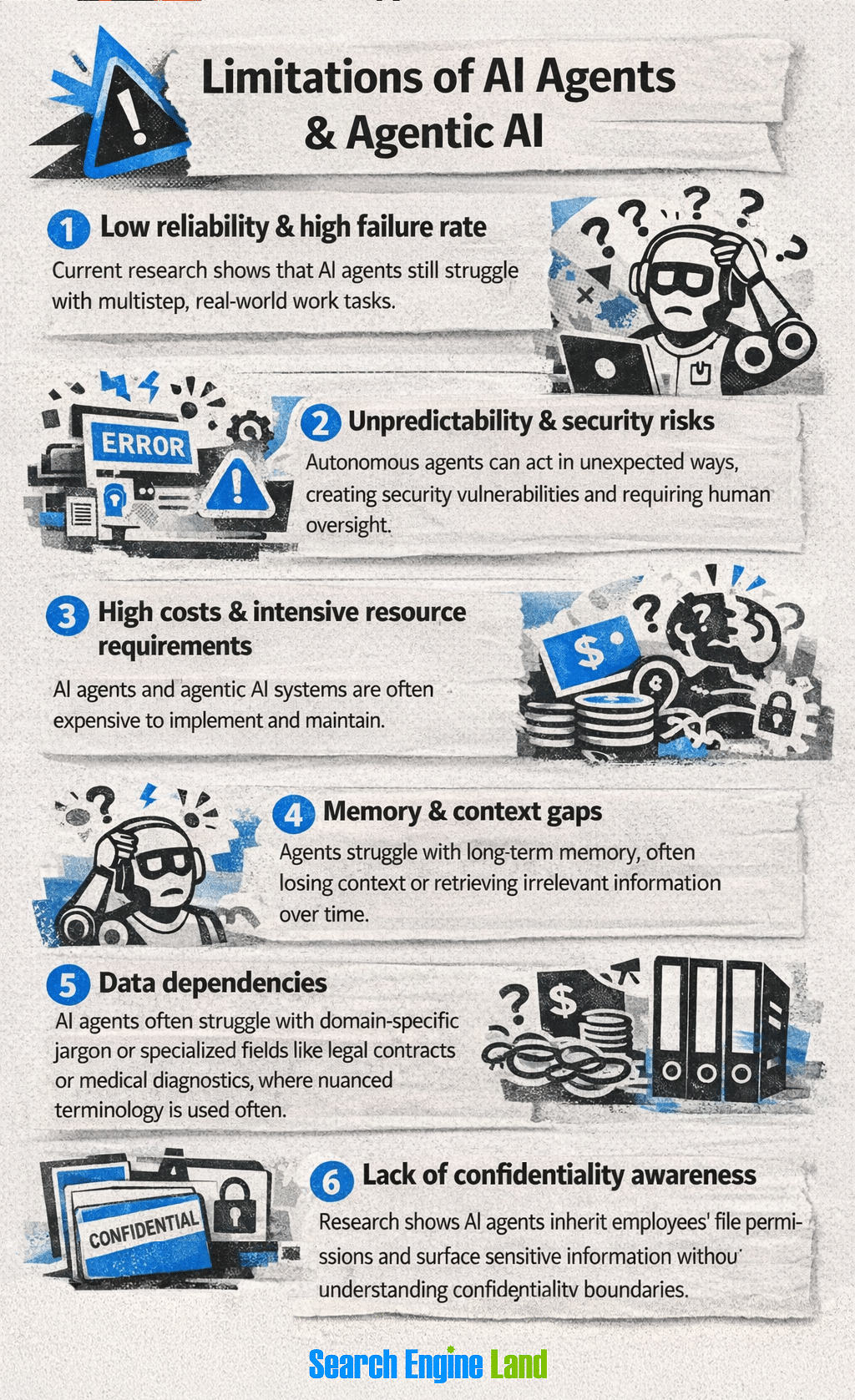
Low reliability and high failure rate
Current research shows that AI agents still struggle with multistep real-world work tasks. In a simulated office environment developed by researchers at Carnegie Mellon University, leading AI agents partially or fully completed only 34.4% of assigned tasks, This means they failed to finish over 65% of those tasks under realistic conditions.
These tests included routine workplace functions like closing pop-up windows, searching file directories, finding colleagues in chat platforms, interpreting datasets, and coordinating multistep actions. Even the best-performing agents (from OpenAI, Google, and Anthropic) rarely completed more than a quarter of the tasks without mistakes.
The problem tends to get worse as tasks become more complex. Simple single-step actions might work some of the time. But when you chain together five or six steps, the success rate drops dramatically, as one broken link breaks the entire chain.
If employees spend the time they’ve saved cleaning up after the agent, they just shift where the work happens instead of increasing overall efficiency.
These reliability issues make it difficult for companies to justify the investment in AI. When failure rates are too high, it’s hard to prove any positive effect on return on investment (ROI). In fact, a Gartner forecast indicates more than 40% of agentic AI projects are expected to be canceled by the end of 2027, largely due to unclear business impact and rising complexity in implementation.
Similarly, MIT’s Project NANDA research indicates that as many as 95% of early AI pilot programs struggle to demonstrate meaningful ROI. These figures highlight that while agentic AI shows promise, many organizations find translating experimental pilots into scalable, value-creating deployments remains difficult.
Unpredictability and security risks
Autonomous agents can act in unexpected ways, creating security vulnerabilities and requiring human oversight.
They might misinterpret instructions and take actions you didn’t intend. They could access data they shouldn’t touch. Or they might make decisions that seem logical to the AI but violate business rules or compliance requirements.
The security challenges are real and growing. 90% of AI agents hold far more permissions than they need — often up to 10 times the privileges they require, according to research from Obsidian Security.
These agents also move 16 times more data than human users. In one documented case, a single agent downloaded over 16 million files. Together, all other users and applications downloaded just 1 million.
Attackers are already exploiting these vulnerabilities. A Lakera analysis found that bad actors are targeting agents through poisoned data sources like malicious documents or compromised web pages rather than direct prompt manipulation. These indirect attacks are harder to detect.
High costs and intensive resource requirements
AI agents and agentic AI systems are often expensive to implement and maintain. API costs add up quickly, especially when agents make multiple calls per task. They also require technical expertise to build, monitor, and optimize.
API usage is one of the largest ongoing expenses for production AI agents. Monthly operating costs (model calls, infrastructure, monitoring, and maintenance) typically range from $3,200 to $13,000 per month, according to research from Azilen Technologies. As agents scale and handle more multi-step tasks, token consumption increases, driving recurring API costs higher over time.
Upfront development adds to the investment. Azilen Technologies data shows that basic AI agent builds range from $10,000 to $50,000, while enterprise-grade, multi-agent systems can exceed $400,000, depending on complexity and integrations.
If you handle development in-house, compensation becomes another major cost factor. Data from Glassdoor shows AI engineers in the US report a typical annual base salary around $140,000, while ZipRecruiter reports AI data scientists average about $129,000 per year.
Memory and context gaps
Agents struggle with long-term memory, often losing context or retrieving irrelevant information over time. In some cases, they generate errors or fail to complete tasks.
For example, an agent might start a customer onboarding process and gather information across multiple interactions. But it might forget key details from earlier in the conversation when it comes time to complete the final setup step. This might mean the customer ends up repeating information or the agent completes the setup incorrectly.
Data dependencies
Input quality can constrain agentic AI performance and outcomes. AI agents often struggle with domain-specific jargon or specialized fields like legal contracts, medical diagnostics, financial compliance, or highly technical manufacturing processes.
Without clean, well-structured data and proper training on industry-specific terminology, agents can misinterpret inputs and produce unreliable outputs.
You can address these concerns through fine-tuning on domain-specific data, implementing retrieval-augmented generation (RAG) with internal documents, or requiring human approval for specialized decisions. But each solution adds cost and complexity that undermine the automation benefits you’re seeking.
Lack of confidentiality awareness
LLMs lack built-in knowledge of what data or content is considered confidential.
This is a problem because a CybSafe and National Cybersecurity Alliance study found that 38% of employees share confidential data with AI platforms without company approval. And research shows AI agents regularly inherit employees’ file permissions and surface sensitive information without understanding confidentiality boundaries.
In testing, agents routinely expose private information, fail to recognize confidential data, and make inappropriate sharing decisions that would violate compliance requirements in regulated industries. The average organization now experiences 223 data policy violations involving AI applications each month, according to Netskope.
In addition to direct costs, organizations can face regulatory fines (the EU AI Act allows penalties up to €35 million or 7% of global revenue), compliance violations that can shut down operations in regulated industries, and reputational damage that drives customers to competitors.
Dig deeper: AI Governance in SEO: Balancing automation & oversight
Limitations of traditional automation (deterministic systems)
Traditional automation is great at solving specific problems efficiently. But it comes with rigid constraints that limit what it can step in and do for your business.
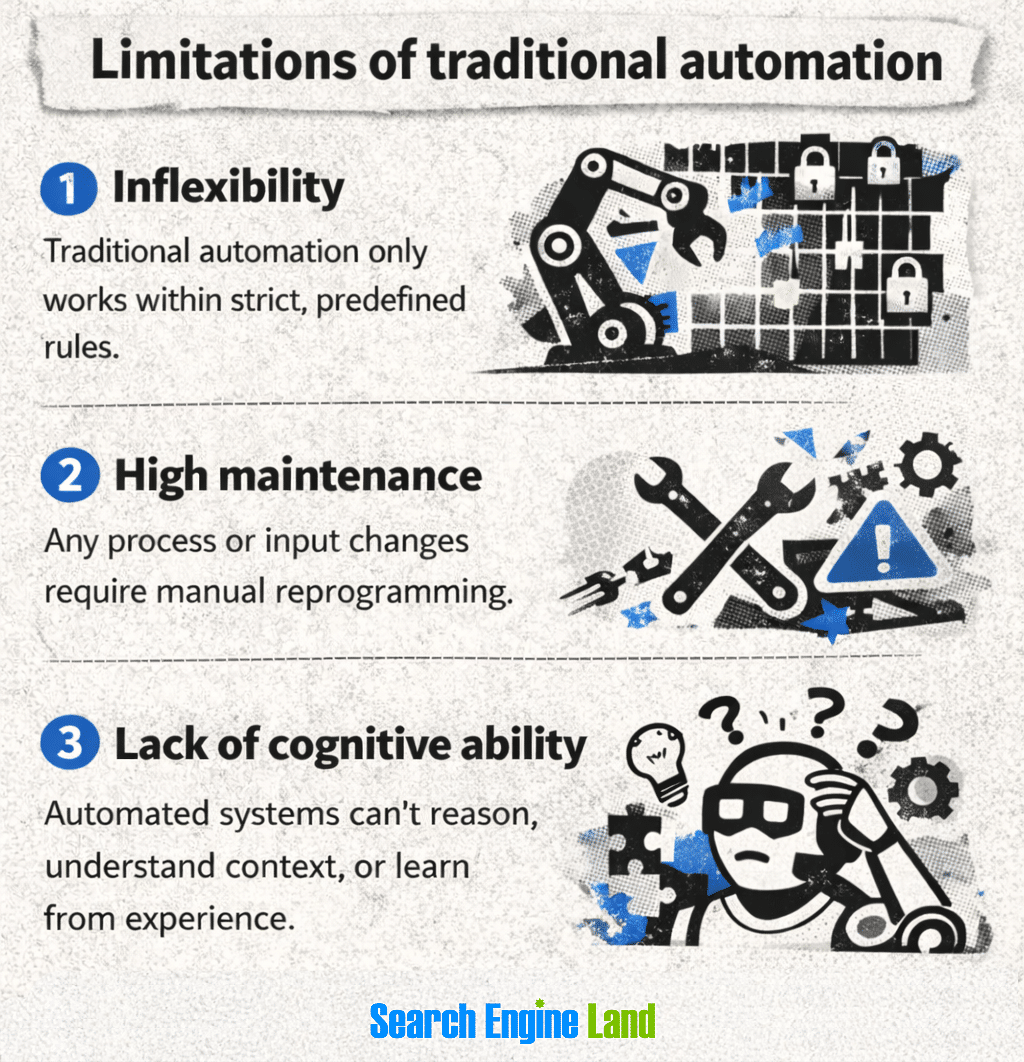
Inflexibility and rigidity
Traditional automation only works within strict, predefined rules. It can’t adapt to unexpected changes or handle unstructured data.
Say a vendor changes their invoice format or a customer submits a request that doesn’t match the predefined template. The automated process will fail, requiring someone to intervene and complete the task.
High maintenance requirements and low scalability
With traditional automation, any process or input changes require manual reprogramming.
Say your business launches new products, updates regulations, or adjusts workflows. You’ll need to modify the automation each time. This can create bottlenecks, making traditional automation difficult to scale.
The problem compounds as you add more automations.
For example, you might start with five automated workflows that are easy to maintain. Fast forward two years, and you’ve got 50 interconnected automations. Now a single change to your process requires updating multiple automations, testing all the dependencies, and hoping nothing breaks.
Lack of cognitive ability
Automated systems can’t reason, understand context, or learn from experience. They execute commands without judgment.
Traditional automation doesn’t recognize nuance. It can’t tell the difference between a routine request and an exceptional case that needs human intervention. This limits its utility in complex or dynamic environments where context matters.
For example, an automated system might close support tickets that haven’t had a response in 48 hours. It can’t tell the difference between a satisfied customer who’s moved on and a frustrated customer who gave up. Both look identical to rule-based automation.
High-level decision tree
Follow this decision tree to determine whether AI agents, agentic AI, or traditional automation best fits your use case.
1. Does the task follow the same steps every time?
Ask yourself: Can you write out the exact steps from start to finish without any contingencies?
Examples of well-defined tasks with repeatable steps:
- Sending a confirmation email when someone submits a form
- Moving files from one folder to another on a schedule
- Updating a CRM field when a deal closes
- Generating weekly performance reports
- Setting up new employee accounts with standard permissions
If YES → Use traditional automation.
If NO → Continue to question two.
2. Does completing this task require understanding context or making judgment calls?
Ask yourself: Would two different employees handle this task differently based on the specifics of each situation?
Examples of tasks requiring interpretation:
- Responding to customer complaints with personalized solutions
- Prioritizing which leads to follow up with first
- Determining the sentiment and urgency of incoming messages
- Creating customized recommendations based on user behavior
- Deciding whether to escalate an issue or resolve it directly
If YES → Continue to question three.
If NO → Traditional automation works best.
3. Does the system need to figure out its own approach, or can you tell it exactly what to do?
When deciding between AI agents and agentic AI, it doesn’t just matter if the task is complex. Instead, it’s whether you can map out all the steps in advance.
Ask yourself: Can you create a flowchart that covers every possible scenario? Or does the system need to assess the situation and choose its approach based on what it discovers?
If you can map all the steps in advance → AI agents
If the system needs to choose its approach dynamically → Agentic AI
Say you need to route customer support tickets.
AI agents use a predefined approach. The system reads each ticket, categorizes it (billing, technical, sales), determines urgency, and routes to the appropriate queue. You’ve defined the categories and routing rules, so the agent just interprets which rule applies.
Agentic AI uses a dynamic approach. The system reads the ticket, determines it needs information from the billing system and the order history, pulls that data, and analyzes whether this is part of a larger behavioral pattern. Then, it decides whether to auto-resolve, route to tier-one support, or escalate directly to a specialist — and monitors the resolution to learn for next time.
4. How much risk are you willing to tolerate?
Different automation approaches have different amounts of risk. Traditional automation operates within fixed boundaries you define.
AI agents make contextual decisions but stay within specific tasks. Agentic AI operates with the most autonomy — and the highest potential for unexpected outcomes. Your risk tolerance should match the system you deploy.
Ask your leadership team:
- Can this system take action without someone reviewing it first?
- What’s the worst-case scenario if it does something wrong?
- Are we in a regulated industry where mistakes create compliance risk?
Low risk tolerance (mistakes are expensive or dangerous) → AI agents with human-in-the-loop approval
Moderate to high risk tolerance (mistakes are fixable and you have good guardrails) → Agentic AI with monitoring
Does the task follow the same steps every time?
│
├─ YES → Traditional automation
│
└─ NO
   │
   ├─ Does it require understanding context or judgment?
   │ │
   │ ├─ NO → Traditional automation
   │ │
   │ └─ YES
   │    │
   │    ├─ Can you map all the steps in advance?
   │    │ │
   │    │ ├─ YES → AI agents
   │    │ │
   │    │ └─ NO
   │    │    │
   │    │    ├─ What's your risk tolerance?
   │    │    │
   │    │    ├─ LOW → AI agents (with human approval)
   │    │    │
   │    │    └─ MODERATE TO HIGH → Agentic AI (with guardrails)
The simplest way to decide: Ask yourself what the damage would be if the system made a bad call at 2 a.m. when nobody’s watching.
If the downside is minimal and you have proper monitoring and guardrails in place, agentic AI might work. If the outcome involves wasting money, losing customer trust, or facing compliance issues, you may want to stick with AI agents that require human approval for key decisions.
How agentic AI operates across the marketing funnel
Here are some ways companies can deploy agentic AI in marketing operations.
Cross-channel strategy and execution
Agentic systems can plan and execute campaigns across paid search, email, and social media simultaneously. They track performance signals like click-through rates and trending search terms, then adjust strategy based on what’s working.
Instead of building separate campaigns for each channel and hoping they align, the system coordinates them. It might shift budget from underperforming Facebook ads to high-converting Google search campaigns, then adjust email messaging to reinforce what’s resonating in paid channels.
Automated testing and optimization
Agentic AI can set up and run A/B tests without manual configuration for each variant. It launches tests, monitors results in real time, and adjusts variables based on what’s performing best for specific audience segments.
The system can automatically implement the winner, set up follow-up tests to refine further, and apply learnings across similar campaigns.
Real-time budget management
Instead of setting monthly budgets and waiting to see results, agentic AI can shift spend throughout the days and weeks based on performance. When one channel outperforms, it can automatically reallocate budget to help maximize marketing ROI.
Its ability to continuously monitor and iterate drives ongoing improvements. For example, agents can track competitor activity and industry news to generate real-time market insights and recommend tactical improvements to marketing strategy.
Personalized customer experiences
Agentic AI tailors offers, recommendations, and messaging to individual customers based on their behavior and preferences. It handles these interactions in the customer’s preferred language and resolves issues autonomously when possible.
The result? Faster, more consistent customer experiences that don’t require human support agents to manually personalize every interaction.
Dig deeper: Agentic AI and SEO: How autonomous systems redefine search
Make the right choice for your business
Want to ensure your brand appears when customers use AI agents to search LLMs? As AI platforms like ChatGPT and Perplexity become your customers’ primary research tools, tracking your brand’s visibility in AI responses is critical.
Semrush One monitors how AI engines describe your brand, benchmarks your AI visibility against competitors, and identifies content gaps that affect your presence in AI-generated recommendations.
Explore more on
Editorial disclosure
Search Engine Land is owned by Semrush. We remain committed to providing high-quality coverage of marketing topics. Unless otherwise noted, this page’s content was written by either an employee or a paid contractor of Semrush Inc.
About the author