AI Overviews optimization guide: How to rank in generated results


The introduction of AI Overviews left a lot of SEOs wondering how to get their websites cited in AI-generated search results. With AI Overviews appearing in as many as 25% of searches, it’s time to make sure that you know how to take advantage of these powerful and prevalent new search features.
This guide provides an in-depth tutorial for AI Overview optimization. Whether you’re brand new to SEO or you’ve been doing it for decades, you’ll find the practical information and detailed steps you need to capture visibility in AI-generated results.
How do AI Overviews work?
AI Overviews are generated by Gemini, Google’s large language model (LLM), based on information pulled from indexed websites and other sources of data, such as the Knowledge Graph.
The SEO toolkit you know, plus the AI visibility data you need.

In short, Google uses natural language processing (NLP) to understand a search query and user intent. Next, it looks for relevant information in its index. Gemini then produces the AI-generated summary of useful answers that respond to the query without requiring users to click through to many different sites.
Let’s dig a little deeper into the specifics.
Key mechanics of AI Overviews
AI Overviews appear when Google determines that this type of response can provide users with the information they’re looking for. But how they show up and what they look like is a bit different than other features in the search engine results pages (SERPs).

Here’s the process Google goes through:
1. Query understanding
Before it can decide what SERP features to include, Google needs to determine what users are looking for. It parses the query with NLP, identifies the entity or entities involved, and engages parts of the algorithm like RankBrain to understand user intent of the search.
2. Source selection
Once it knows what to look for, Google sources information from authoritative web pages, videos, and other content relevant to the query. It may also pull information from other data sources like the Knowledge Graph, a large database of facts and entity relationships obtained from public and private sources, or the Shopping Graph, which includes merchant product data.
3. Triggering
Next, Google decides how to present information and rank results. AI Overviews are triggered when the algorithm deems that an AI-generated answer may be more helpful than traditional results. This often happens with complex or multi-step queries.
Historically, AI Overviews are triggered most often on informational searches. However, AI Overviews on searches with commercial, transactional, and even navigational intent have increased over time. (See Focus on AI Overview triggers below for more on this.)
4. Synthesis
When triggered, Gemini uses the gathered sources to generate a summary about the query topic. Because of its understanding of user intent and entity relationships, the AI model compiles responses that provide more information than single-answer featured snippets or webpages on specific topics.
Gemini can also use passage indexing to incorporate specific sections of a website to fill out its AI Overview response. This provides more context-specific relevance.
5. Citations and links
The generated text includes citations with links to the original source(s) used in the generation of each AI Overview section. These elements give users a way to dig deeper into the details of a particular part of the response. They also provide content creators with a way to attract searchers to their sites.
Here’s a quick example of what this looks like for a specific search:
- Query understanding: A user submits a query for “how to grade pokemon cards.” Google uses NLP to understand entities like “pokemon card” (object), “grading” (concept or activity), and “how to” (ordered process), as well as the user intent for an informational guide.
- Source selection: Google scours its index to find webpages, videos, and other content related to the query topics. It also looks for information on closely related topics, like the existence of professional grading companies and the factors that go into grading a collectible trading card.
- Triggering: Recognizing that a how-to response requires more than simple factual information, Gemini is tapped to give a more complete answer.
- Synthesis: Gemini summarizes the information found across the various sources, providing a paragraph describing what grading Pokémon cards is, plus a five-step process on how to go about getting cards graded.
- Citation and links: Throughout the AI Overview, link icons provide access to a list of sources. They give access to the original sources in case searchers want to learn more about a particular part of the grading process.

If you rank organically can you also rank in the AI Overview for the same SERP?
Yes, you can rank both organically and in the AI Overview at the same time.
Google pulls content sources from its index before ranking or using them in SERP features. Google’s algorithm also does a number of other things at that stage, such as assess content quality, relevance, and trustworthiness.
This means the sources Google pulls can appear in multiple places throughout the SERPs. For example, they can appear in standard organic search listings, knowledge panels, People Also Ask (PAA), and other features.
Let’s look at “how to grade pokemon cards” as an example. One of the sources cited in the AI overview is Professional Sports Authenticator (PSA).

Scrolling below the AI Overview to the traditional search listings shows that PSA also ranks on the first page of results.

This makes sense, since both AI Overviews and traditional search listings typically include high-quality sources. Having a large percentage of citations from the top results seems like a natural situation.
At the same, it makes sense that some of the information in an AI Overview would come from sources further down in rankings — or even from sources that don’t rank at all.
That’s because, while such sources might be less directly relevant to the main topic of the query, they may be more relevant to a closely related topic or entity that’s mentioned in the AI Overview. This might make it a good citation for that specific part of the overview. This is known as “query fan-out,” which we’ll discuss below.
Ultimately, achieving the top traditional organic ranking isn’t guaranteed to get your website cited in the AI Overview. However, ranking higher does seem to correlate with having a better chance at being cited. Links in the first position had a 53% chance of appearing in AI Overviews, while those in the 10th position dropped to 36.9%, according to a study by Rich Sanger and Authoritas.
AI Overview ranking factors
Broadly speaking, the top ranking factors for AI Overviews are the same as those for traditional search rankings. The top AI Overview ranking factors include:
- Follow SEO best practices
- Rank well organically
- Build brand authority
- Earn mentions in top sources
- Focus on AI Overview triggers
- Create credible website content
Many of the details for these factors will be familiar to veteran SEO professionals. But if you’re looking to increase visibility and organic traffic from AI-generated results, you may need to make a few adjustments to how you approach them.
Let’s take a closer look at the list.
Follow SEO best practices
The best way to prepare your content for AI Overviews is to follow SEO best practices that have proven to work over the long term.
AI Overviews offer a new way to present information to search engine users. But while that presentation is different from other SERP features, the broad strokes of how Google crawls, indexes, and assesses content hasn’t changed.
Google’s own advice on appearing in AI-generated results recommends starting with the things that apply to all search optimization:
- Meet the technical SEO requirements for Google search, such as allowing Googlebot to crawl the site and making sure there are no indexing or HTTP status errors
- Follow all of Google search’s content policies, including avoiding thin, spammy, malicious, dangerous, or harassing content
- Focus on building helpful, user-centric content that’s based on experience, expertise, authority, and trust (E-E-A-T)
Some SEOs have also speculated that using structured data can improve the chances of content being cited in AI Overviews. The argument goes like this:
- Google has stated that structured data helps it gather information about entities (e.g., books, people, companies, etc.) relevant to the content
- Gemini relies heavily on entity-relationship information to generate AI Overviews
- Therefore, the more you can help Google understand the entities and topics related to your page through structured data, the more likely it is that your content will appear in AI-generated results
This is a plausible argument. As of yet, though, Google hasn’t confirmed that structured data improves the likelihood of appearing in AI Overviews.
The company has, however, doubled down on the importance of structured data in the age of AI search. At the Google Search Central Live conference in April 2025, John Mueller shared a slide encouraging people to use structured data.
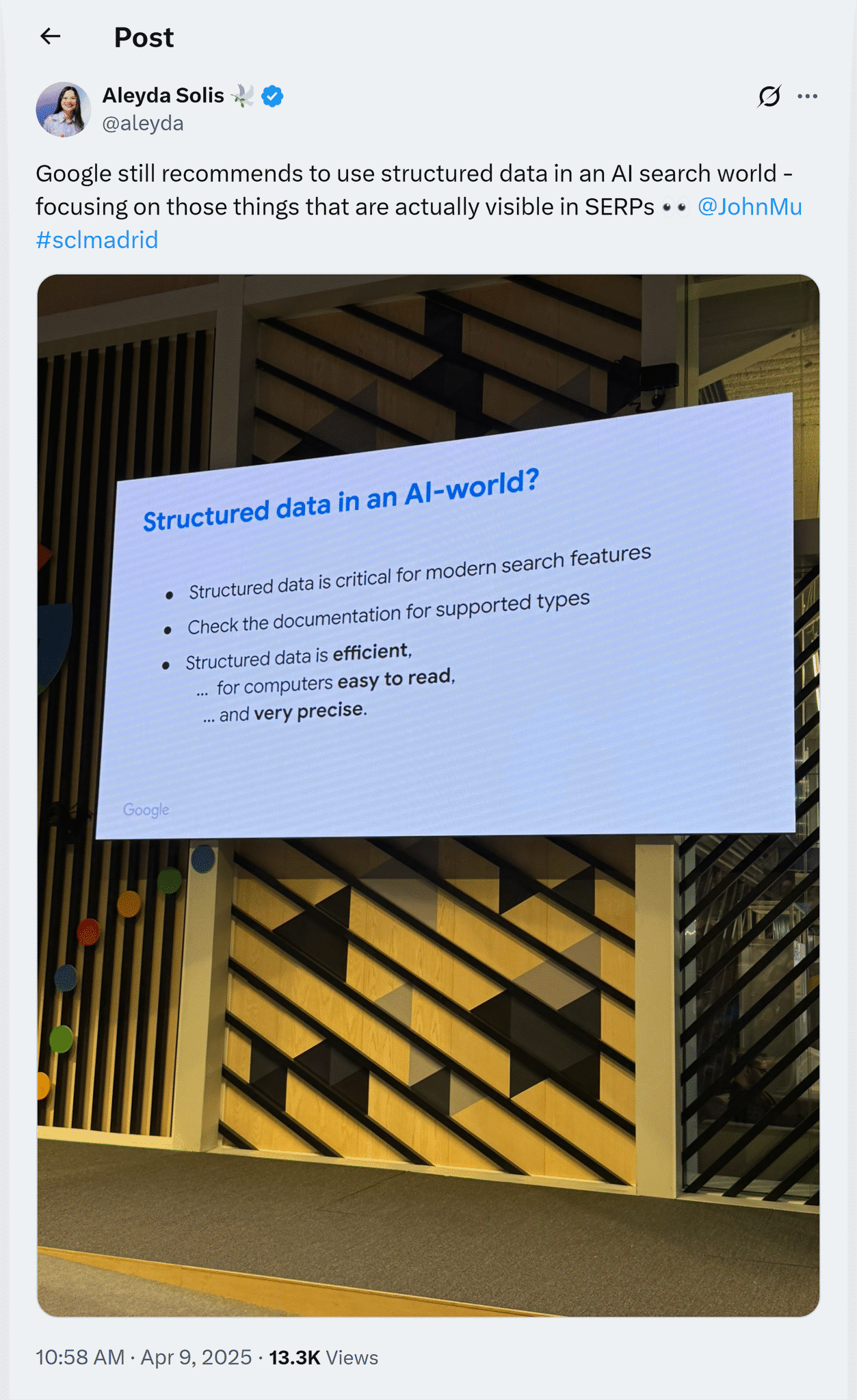
Using structured data with schema markup is an SEO best practice. So, even if it doesn’t specifically help with AI Overviews, it can still improve your visibility in zero-click search results by helping your content appear in other SERP features, as well as click-through rates.
Rank well organically
Ranking in the top 10 search results correlates with being cited in AI Overviews. Likewise, the higher your content ranks within the top 10, the more likely it is to be pulled as a source for AI-generated results.
The correlation between ranking the top 10 and appearing in AI summaries is well grounded. Studies from Rich Sanger and Authoritas and Optimizely have shown that anywhere from 40–76% of citations in AI Overviews also appear in the top 10 search results.
While those percentages will change over time, the fact is that high-quality content is best suited for both the top organic results and AI source material.
Some studies, like this one from Writesonic, have also shown that pages ranking in the first position have a greater chance of showing up as a citation than results further down the first page.

Interestingly, AI Overviews seem to appear in places where featured snippets have historically displayed. As AI Overviews began to increase after their initial rollout, the number of featured snippets for the same searches dropped drastically, according to research by Glenn Gabe.
This isn’t to say that featured snippets and AI Overviews are the same thing — they definitely are not. Featured snippets provide quick answers with quotations from single sources. In contrast, AI Overviews provide a broader synthesized summary of a topic from multiple sources.
But like featured snippets, AI Overviews can show up in position zero at the top of the SERPs. They can also appear within certain SERP features like PAA, which can move up and down among the organic results.
From a ranking perspective, this indicates that if a piece of content was selected for a featured snippet in the past, it’s likely to be a good candidate for citation in AI Overviews as well.
While there are no guarantees here, improving the organic ranking of your content will likely improve the chances of that content showing up in AI-generated features.
Build brand authority
Brand authority translates into brand visibility within AI Overviews, via both mentions and citations. The more you can associate your brand with relevant entities and topics, the more likely it is to show up in generative summaries for relevant searches.
Digital PR
One of the quickest ways to build these associations is through standard digital PR tactics. For example, issuing press releases gives you control over the content. Press releases have been shown to improve SERP feature visibility, including AI Overviews, especially in local results.
In fact, getting brand mentions anywhere across the web can improve your visibility in AI-generated results. Press releases can kick-start brand mentions on news sites and blogs. But don’t ignore the value of other PR strategies such as:
- Strategic partnerships that allow your brand to be mentioned alongside partnering brands
- Industry events and webinars where you can showcase your brand’s expertise through presentations, panels, and workshops
- Community and charitable projects that demonstrate your brand’s engagement beyond the business world
These activities can generate brand mentions that work even without getting any backlinks.
Link-building
Of course, backlinks are still good to aim for when you can get them. Backlinks that have branded anchor text specifically may help with ranking in AI Overviews. Use targeted link-building strategies like creating linkable assets, guest posting, and broken link building.
You can ask websites with unlinked brand mentions to add a link, too. You may stumble on these from time to time in the normal course of searching.
Branded search
There’s also a correlation between monthly search volume for branded terms and AI mentions. In fact, it’s been reported that branded search volume is the third-highest factor correlating with brand visibility in AI Overviews.
This impact may only apply to known brands, as the study looked at websites with a domain score greater than 40 and keywords with a volume 800 or greater. Still, the correlation could be significant for brands and branded keywords that reach those thresholds.
Increasing brand awareness can improve brand search volume as well. As more people become aware of your brand, they’ll be more likely to search for your site and products using branded keywords. All of the PR tactics above will help with building that awareness.
In summary, anything you can do to get people mentioning your brand may increase the opportunities for additional visibility in AI-generated summaries.
Earn mentions in top citation sources
All relevant brand mentions in AI Overviews are good. But getting mentioned by the top-cited domains will do more to improve your brand’s visibility in AI Overviews.
According to a study by Surfer SEO, the top five domains cited in Google AI Overviews are:
| Domain | Citation share |
| youtube.com | 23.29% |
| wikipedia.org | 18.41% |
| google.com | 16.38% |
| reddit.com | 9.37% |
| linkedin.com | 8.80% |
Brand mentions in pages on these domains are likely to increase the citations of those brands in AI Overviews.
However, the story doesn’t end there. Both the Surfer SEO study and an earlier study from Amsive show that the top-cited domains can change significantly across industry.
For example, in the health industry, Surfer SEO indicates that the top five domains cited in AI Overviews are:
| Domain | Citation share |
| nih.gov | 38.89% |
| youtube.com | 27.91% |
| healthline.com | 15.06% |
| mayoclinic | 14.80% |
| clevelandclinic.org | 13.82% |
Wikipedia comes in at number seven, Google is pushed way down to 20, and Reddit and LinkedIn don’t even appear in the top 20.
Thus, when establishing your brand mention strategy, make sure to consider the top-cited domains from both general and industry-specific perspectives.
Focus on AI Overview triggers
If you want to appear in more AI Overviews, you have to target the types of queries that trigger them.
This means targeting keywords that:
- Are three to five words long but under a total length of 30 characters
- Are relatively low volume
- Are non-branded
- Have informational intent
- Have a low cost-per-click (CPC) value
- Have a low-to-medium keyword difficulty
Let’s break that down.
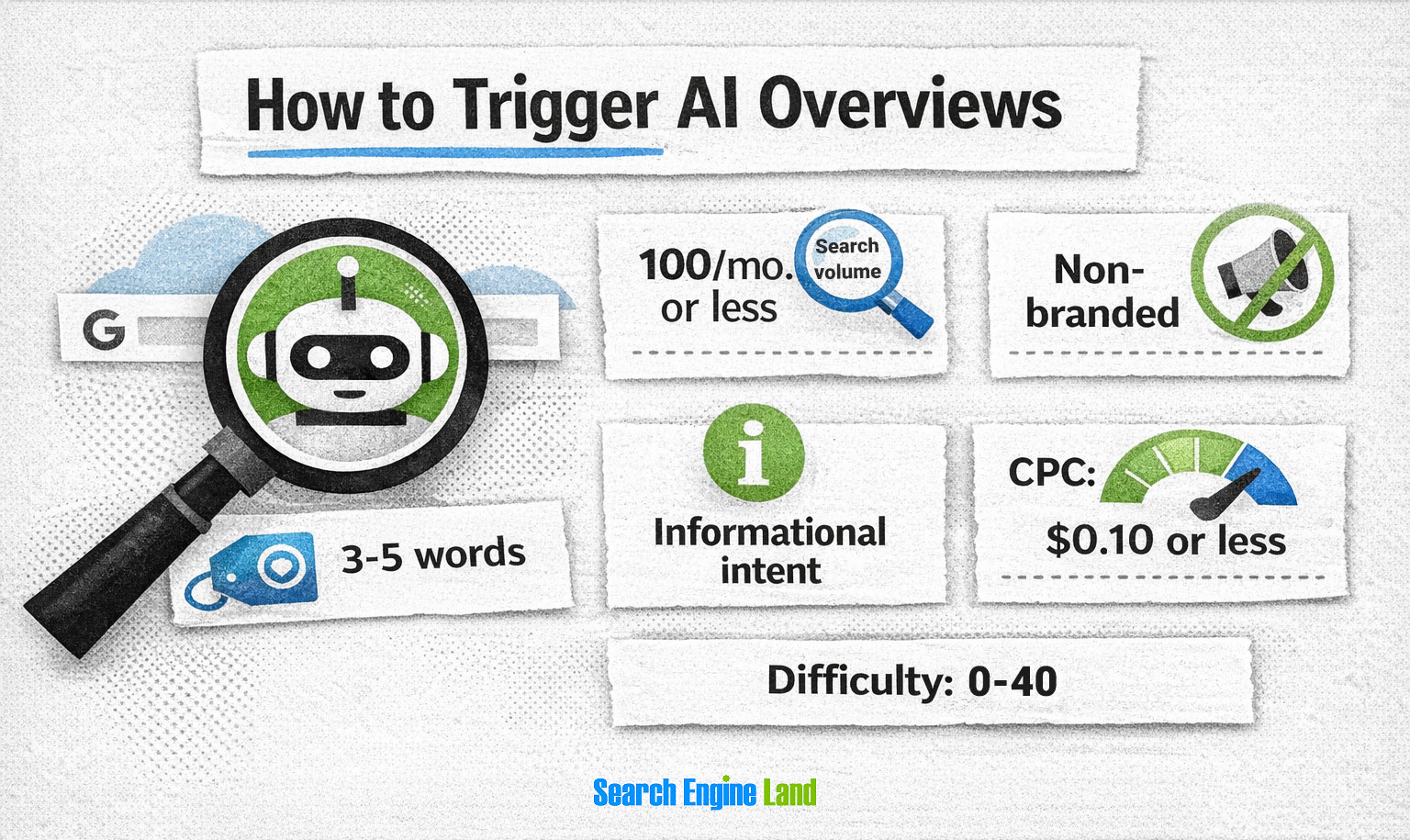
According to a Semrush study of AI Overviews, these are the common characteristics that contribute to the appearance of generative summaries:
- Keyword length: Longer and more specific keywords tend to have AI Overviews, with the optimal length peaking at around three to five words and 21–30 characters
- Search intent: When AI Overviews were relatively new, more than 90% of queries with AI Overviews had informational intent. By the fourth quarter of 2025, the overall share of informational queries with AI results dropped to about 57.1%, with overviews appearing more frequently in commercial and transactional searches than they had previously.
- Keyword volume: The average search volume for triggering AI Overviews has increased to around 2,200 searches per month on average. However, low-volume keywords still prompt generative results far more often than larger-volume terms, with about 60% having 100 or fewer searches per month.
- CPC: About 72% of keywords that trigger AI Overviews have a CPC of $0.10 or less. This shows that non-monetized keywords are far more likely to get an AI summary than higher-value terms.
- Keyword difficulty: Most keywords that trigger AI Overviews fall within the middle range (0–40) of Semrush’s Keyword Difficulty score. Very low and very high difficulty keywords have far fewer AI-generated results.
It’s important to understand that these are just averages based on trends. So while these are the most common ways that AI Overviews are triggered, certainly AI Overviews can be triggered outside of these observations. Also, the specifics will change over time as Google refines how AI Overviews are triggered.
One last point to consider is that AI Overviews have historically been suppressed for sensitive queries, including your money or your life (YMYL) topics. This seems to be changing. However, when AI Overviews do appear in these areas, the citations typically come from highly authoritative and expert sources like the National Institutes of Health or large financial institutions.
Create credible website content
High-quality, useful content aimed at humans is an important factor for being cited in AI Overviews, just as it is for ranking in traditional results and other SERP features.
SEO has always been a balance between writing for humans and optimizing for machines. With that in mind, here are some ways to create credible, human-focused content that’s more likely to be cited in AI summaries.
Unique, valuable content that follows E-E-A-T guidelines
Great content follows the principles of E-E-A-T.
Google has always encouraged delivering content that fits users’ needs. E-E-A-T is the search giant’s way of expressing the principles behind that type of content.
As a refresher, here’s a quick summary of what each part means:
- Experience: Demonstrating that you and your brand have hands-on experience and background in the topics you’re talking about
- Expertise: Certification (formal or informal) of the skills and knowledge necessary to deliver what you say you will
- Authority: Public recognition of your reliability from industry experts, peers, customers, and thought leaders through mentions, links, interviews, and awards
- Trust: A combination of the three elements above showing your credibility in the areas where you possess experience, expertise, and authority
The good news is that it’s possible to exhibit all of these principles in a single piece of content.
For example, publishing an in-depth case study can:
- Highlight your experience by showing how you handled a particular scenario
- Showcase your expertise by describing the technical methodologies you used
- Build authority by receiving mentions, links, and commentary from others about the study
- Increase trust because you produced something valuable for others to rely on
And with any luck, that case study will show up in AI Overviews for months and even years to come.
Comprehensive website content optimized for query fan-out
A query fan-out refers to how Google uses multiple searches to pull in sources from closely related topics before generating an AI Overview.
Query fan-out is why AI Overviews can include sources beyond those that rank for the primary keyword. It’s actually pulling sources and data from other related searches to generate a more comprehensive answer.

Sources covering only one of the subtopics in the fan-out may be less likely to be cited in the AI Overview. However, if your content covers the main topic and all of the subtopics in a single article, you may be cited more consistently.
It’s hard to know what questions to answer specifically. But looking at the topics covered in an AI Overview for a given search can offer a clue about what Gemini thinks is important for a searcher.
iPullRank has identified eight types of subqueries (or synthetic queries) used in query fan-out.
The following table provides examples of how Google might generate subqueries for each type.
| Main query: “how to grade pokemon cards” | ||
| Subquery Type | Description | Example |
| Equivalent query | Semantically similar query with different phrasing | “how to get pokemon cards graded” |
| Follow-up query | A logical next question to ask | “how much does it cost to grade a pokemon card” |
| Generalization query | A broader version of the query | “how do you get cards graded” |
| Specification query | A more specific version of the query | “can you grade jumbo pokemon cards” |
| Canonicalization query | A standardized way of phrasing the query | “pokemon cards grading” |
| Translation query | Translation of the query for multilingual results | “cómo calificar las cartas pokemon” (Spanish) |
| Entailment query | Implied or follow-up questions (beyond the immediate next question) | “how long does it take to get pokemon cards graded” |
| Clarification query | Presented to the user to verify intent | “are you looking for pokemon card grading near you?” |
Crafting your content to include answers for each subquery type can be a good way to optimize content and improve the chances of that content being cited in AI Overviews.
Great page experience
Providing an excellent user experience is as important as producing valuable content when it comes to visibility in AI Overviews.
You could have content that would make literally everyone in the world healthier, wealthier, and happier. But if it’s saddled by slow page speeds, pop-ups, and render errors, nobody’s going to stick around long enough to read it. And Google likely won’t include it in search results, generative or otherwise.
Start improving page experience by focusing on Core Web Vitals:
- Largest Contentful Paint (LCP): The length of time it takes for the main content of a page to load
- Interaction to Next Paint (INP): A page’s response time over the course of a user’s interactions with it
- Cumulative Layout Shift (CLS): How much a page’s layout shifts unexpectedly while a user is on it
Pro tip: To get Core Web Vitals for multiple pages on sites you own, use Search Console’s Core Web Vitals report.
Once the vitals are squared away, you can turn to other aspects of a good user experience:
- Security: Make sure you’re using HTTPS with a current SSL/TLS certificate
- Mobile: Prioritize the mobile experience of your site, given that most users now surf and search on their phones
- Ad control: You can have ads, but ensure they’re not taking over the page and distracting users from enjoying the content you worked so hard to create
- Interruptions: If you’re using pop-ups, interstitials, or dialogs, make sure they follow Google’s guidelines, such as not covering the entire page or blocking main content without the need for user interaction
- Clarity: The main content of your page needs to be easily distinguishable from other content, such as user-generated content (UGC) or sponsored blocks
Remember, with great content comes great experientiality. If your content isn’t appearing in AI Overviews, a poor user experience could be a major contributing factor.
Content age and freshness
Content freshness does seem to play a role in whether your content appears in AI Overviews.
Some studies have found that well-established content can perform strongly. At the same time, other research shows a clear leaning toward newer sources.
One analysis found that roughly 44% of AI Overview citations came from 2025 content, about 30% from 2024, and around 11% from 2023 — meaning roughly 85% of citations were from content published within the last few years. That aligns with how Google has historically treated freshness as a relevance signal.
Keeping content current may improve your chances of being cited, especially for topics where accuracy and recency matter.
Factual specificity
Including specific facts, numbers, percentages, and data points increases the probability of your content being cited in generative searches.
This comes directly out of an academic paper on generative engine optimization (GEO) from researchers at Princeton and the University of Delhi.
Specifically, the researchers say:
“Among other things, we find that including citations, quotations from relevant sources, and statistics can significantly boost source visibility, with an increase of over 40% across various queries.”
These techniques offered greater benefit than other tactics they tested, such as keyword stuffing and using unique wording.
To be clear, the researchers didn’t look at Google AI Overviews specifically. They used a framework known as G-Eval, which is a method of evaluating GPT-4 (one of the OpenAI engines behind ChatGPT).
Still, real-world tests show that Google also seems to prefer clear, specific factual information and data. And having those specifics are likely to help users better understand your content, as well.
So, when in doubt, be specific 100% of the time.
Structural clarity and formatting
Providing a clear structure and formatting your content for easy scanning have been tenets of good SEO for a long time. It’s likely that these best practices also help content find its way into AI Overviews.
That said, there have been no significant studies showing the impact of page structure on AI Overview citations. Nor has Google stated that certain page structures are more likely to help content find its way into AI-generated summaries.
Nonetheless, a clear page structure is better for both humans and crawlers to navigate. And that in itself is worth focusing on.
One bit of SEO lore that has cropped up in the age of AI search is the idea of chunking. This refers to breaking up content into small, bite-sized pieces that AI engines can easily take in.
Google has reiterated that it doesn’t want content creators to chunk content as a way to game LLM results. Even if chunking seems to work for the time being, it’s better to focus on providing long-term value to users, rather than formatting content for AI navigation and ingestion.
Even so, content chunking has its roots in usability. As long as you focus on chunking for humans rather than machines, your content should be good to go.
Writing sentences as semantic triples (subject-predicate-object) may increase AI citations as well. For example, HubSpot has claimed that using semantic triples led to a whopping 642% rise in AI citations.
However, it’s important to keep your writing feeling natural when using this technique. Human language has variation and cadence to it, and using semantic triples over and over can make your content feel artificial.
It’s also not clear that it’s entirely necessary. Machine learning techniques like NLP are very good at tokenizing and extracting semantic relationships from complex sentences.
To err on the side of caution, use semantic triples to highlight your main points. But don’t be afraid to use more complex sentence structures to explain additional ideas. Some ideas simply require more complex structure.
Dig deeper: Semantic SEO: How to optimize for meaning over keywords
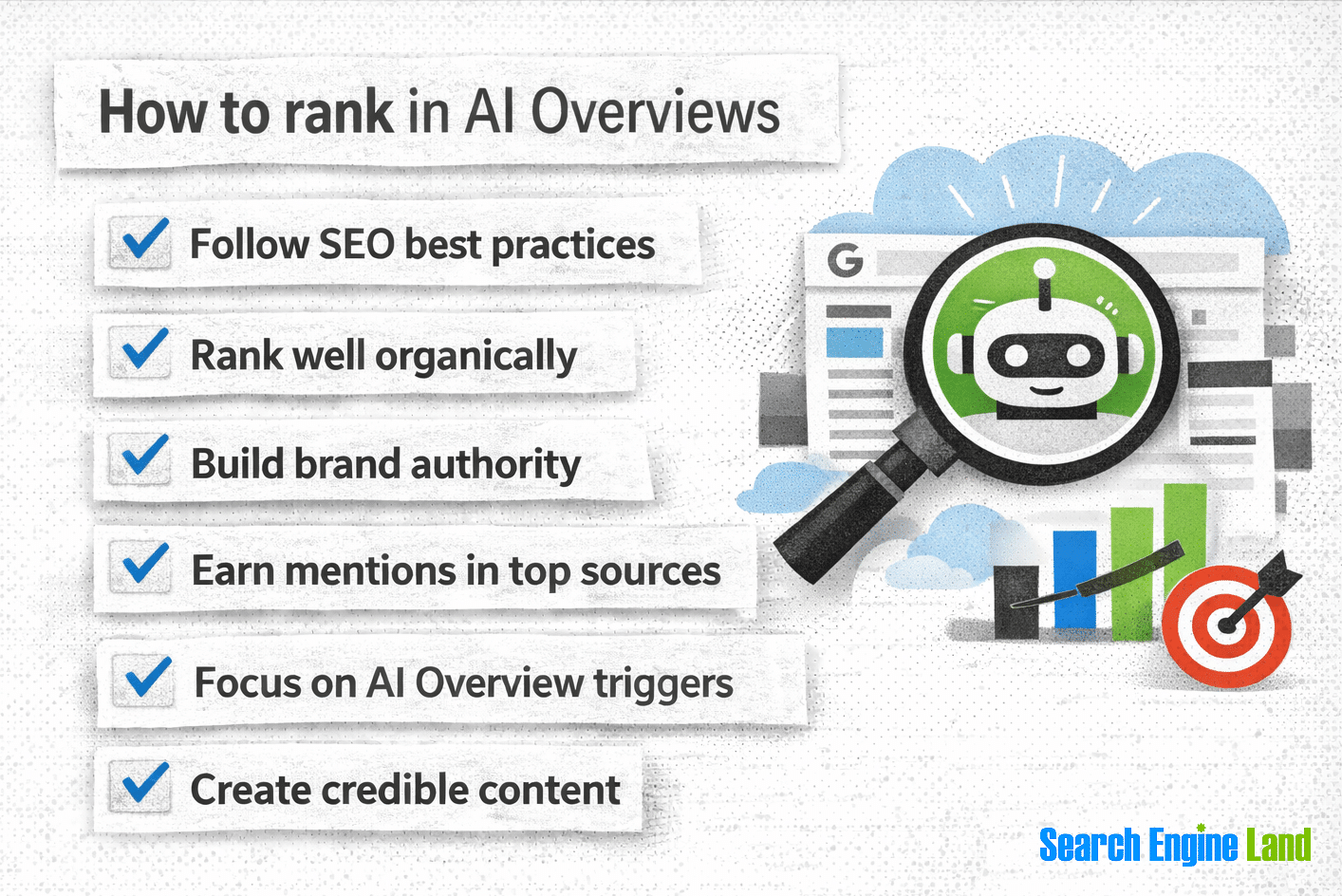
How to rank in AI Overviews: A checklist
Here’s a quick AI Overview optimization checklist that covers the main ways to ensure your content is ready for citation in AI-generated results.
- Follow SEO best practices: Everything that applies to standard SEO also applies to GEO. Get started by reviewing the key elements of on-page SEO.
- Rank well organically: Prioritize high SERP positions by aiming for top rankings in Google search results. The higher your content ranks, more likely it will be included in an AI Overview.
- Build brand authority: Look for opportunities to increase brand mentions, branded backlinks, and general brand awareness that can drive up search volume for branded queries
- Earn mentions in top sources: Look at the sites and platforms Google cites most often for queries related to your industry and the topics you cover. Then, try to get mentions on those domains to bolster your likelihood of getting citations of your own.
- Focus on AI Overview triggers: Look for informational, low-volume, non-branded keywords approximately three to five words long that have a low CPC and a low-to-medium difficulty score. Avoid sensitive topics and YMYL queries — unless that’s the focus of your entire site, in which case make sure your content follows E-E-A-T principles to a tee.
- Create credible website content: Build comprehensive, user-focused pages that follow E-E-A-T guidelines, offer a seamless customer experience, are fresh while also standing the test of time, offer specific facts and information, and have clear structures.
This list is deceptively short. Every item on the checklist has multiple things to consider, and it’ll take time to go through them all.
But when you see those citations start to pop in the AI Overviews, it’ll all have been worth it.
Track, optimize, and win in Google and AI search from one platform.
Is your content being featured in Google AI Overviews?
Optimizing for AI Overviews doesn’t have to take much more effort than traditional SEO. In a lot of ways, it builds on existing SEO best practices with a few tweaks that take into consideration how AI-powered results use multiple sources and link to citations beyond the pages included in the standard search listings.
Keeping up with both dimensions of search visibility is easier when your tools work together. Semrush One lets you manage traditional SEO and AI search performance in one place, so nothing falls through the cracks.
Ready to get started? Sign up for Semrush One today, and explore our guide on tools and software for AI Overviews for a deeper look at optimizing and tracking your results.
Explore more on
Editorial disclosure
Search Engine Land is owned by Semrush. We remain committed to providing high-quality coverage of marketing topics. Unless otherwise noted, this page’s content was written by either an employee or a paid contractor of Semrush Inc.
About the author