Zero-click search: The search revolution transforming digital marketing


Zero-click searches occur when users get their answers directly on the search results page without needing to click through to any website. It’s zero-click searches that are responsible for declining website clicks.
Nearly 60% of Google searches on mobile now end without a click, and SEO professionals are experiencing challenges such as plummeting organic traffic and downtrending reports that erode stakeholder confidence. Traditional metrics like click-through rates don’t tell the whole story anymore; you might rank in position one, but see minimal traffic.
In this article, we’ll show you what zero-click search is, where it’s happening, how it’s reshaping SEO, and—most importantly—the proven strategies SEO specialists are using to turn this organic search challenge into an opportunity while still driving real business results.

The anatomy of zero-click search features
Due to substantial declines in clicks, zero-click search is a buzzword right now.
But it’s not new.
Google has historically used AI and/or machine learning to synthesize information from multiple sources, creating instant answers through SERP features, such as:
- Featured snippets
- Knowledge panels
- People Also Ask
- Local packs
- Image carousels
And now, there’s AI Overviews.
So where did it all begin? Featured snippets.
Featured snippets and the fight for position zero
Featured snippets claimed the throne above all organic results.
That position zero spot wasn’t just about ego—it was about dominating the visible real estate before users even consider scrolling.
But what makes the featured snippet significant today?
They trained an entire generation of searchers to expect instant answers. Whether it’s a definition box, a numbered list for how-to queries, or a comparison table, these snippets became the default way people consume quick information online.
The SEO toolkit you know, plus the AI visibility data you need.

Unlike AI Overviews, Featured Snippets garnered clicks directly to the ranking website. It was great for search.
But featured snippets were also the beginning of the brand’s content being used without attribution.
The kicker?
Featured snippets serve as the primary source for voice search. So when someone asks their smart speaker a question, there’s a strong chance your featured snippet becomes the definitive answer.
No attribution, no brand mention—just your content speaking through Alexa’s voice.

Regardless of its impact on clicks, winning featured snippets was seen as essential for SEO. It required a different content approach from traditional SEO, and specialists adapted.
At the time, future-thinking SEO specialists who embraced featured snippets weren’t just optimizing for comprehensive coverage; they crafted laser-focused answers that Google’s algorithms could easily extract and display in prime position.
Think:
- Clear, concise definitions: Short, standalone explanations that directly answer “what is X?” without needing extra context. (e.g., “SEO is the process of improving a website’s visibility in search engines.”)
- Step-by-step instructions: Ordered lists that break down a process into bite-sized actions. Google loves cleanly structured how-to steps that it can lift and present directly.
- Simple comparison tables: Side-by-side data that makes differences instantly scannable. The more structured and consistent your rows and columns, the more snippet-friendly your table becomes.
The evolution doesn’t stop there. What began as Google’s attempt to surface quick facts has now morphed into something far more sophisticated, AI that not only extracts answers but also creates them.
AI overviews reshaping search results
AI Overviews represent the next evolutionary leap from simple extraction (like the featured snippet)—where search engines pull exact text from web pages—to intelligent synthesis (seen in AI overviews), where AI combines and reinterprets information from multiple sources.
Google’s AI Overviews now appear in approximately 30% of informational queries. Examples of informational queries include queries like “how to improve page load speed for SEO” and “what are the latest Google algorithm updates.” These searches return AI overviews.
Why?
Google recognizes that searchers want synthesized information from multiple authoritative sources rather than having to piece together insights from individual articles.
But for those of us who’ve spent years optimizing content to drive clicks, this shift feels like the ground moving beneath our feet.
And it’s not small.
It’s the most fundamental change in search behavior since mobile overtook desktop.
Unlike featured snippets that display verbatim content from a single website, these AI-generated responses blend insights from across the web into cohesive, conversational answers that often eliminate the need to click anywhere at all.
The attribution challenge here cuts deep.
Search Engine Land’s analysis reveals that while AI Overviews may reference multiple sources in their synthesis process, the attribution mechanisms often fail to provide meaningful traffic or visibility to original content creators. You might see your site listed as a source, but that tiny citation link generates a fraction of the traffic a featured snippet would deliver.

We’re watching tension between visibility and traffic play out in real-time. Sure, having your content synthesized into an AI Overview means millions might read your insights. But if they never visit your site, never see your calls-to-action, never enter your conversion funnel—what’s the actual value? The harsh reality: it’s brand awareness at best, but zero direct business impact.
The opportunity lies in understanding what triggers AI Overviews versus other SERP features. Complex informational queries that benefit from nuanced explanations generate AI responses. Simple factual questions may still trigger featured snippets or knowledge panels. Commercial queries often skip both and show shopping results.
Smart content creators are adapting by layering their content strategy—providing the clear, authoritative information that AI systems crave, while embedding unique data, tools, or resources that compel users to click through for the full experience. But here’s the thing: This isn’t a job for SEO teams working in isolation. The most successful approach requires holistic marketing where SEO collaborates with paid media, email, and social teams.
Think about it: you can use targeted ads to drive traffic to your best-performing landing pages, share your most valuable guides with email subscribers, or amplify content insights across social channels. It’s not about fighting the AI; it’s about becoming indispensable to it while maximizing every piece of content across all your marketing channels.
Different query types trigger entirely different zero-click experiences, and the implications hit different depending on your business model. Ecommerce sites might celebrate product carousels that showcase their inventory directly in search. Publishers? They’re watching their traffic evaporate as AI-generated summaries of their articles appear without attribution.
Local searches operate on their own set of rules.
Local packs and immediate business information
Local packs deliver instant gratification for location-based searches, serving up:
- Maps
- Business hours
- Reviews
- Contact information
And without requiring a single click to individual business websites.
Dream Local highlights how these features provide immediate access to essential business information, fundamentally changing how local businesses think about online visibility.
The local three-pack—Google’s SERP feature that displays the top three local businesses with map pins, reviews, and key details—has become the most valuable real estate in local SEO. Users can view ratings, click to call, get directions, or read reviews without needing to visit your website.

For many local businesses, especially service providers, this zero-click visibility has replaced traditional website traffic as their primary digital acquisition channel.
Local packs have trained consumer behavior.
People no longer search for your business name; instead, they search for the service plus “near me” and expect Google to deliver credible options. The businesses that win these spots through optimized Google Business Profiles, consistent citations, and strong review signals essentially own their local market’s digital foot traffic.
The question now becomes: How do we measure success when the old metrics no longer apply?
Strategic implications for modern SEO professionals
The shift to zero-click searches fundamentally changes how SEO professionals measure success and justify their work to stakeholders.
So here’s the thing: when only 36% of searches actually send clicks to websites, we’re not just dealing with a minor trend. We’re looking at a complete rewiring of how search traffic works.
This isn’t a temporary blip that’ll sort itself out next quarter.
Think about what this means for your monthly reports. You’re optimizing content, building authority, improving technical health—and yet traditional click metrics might show you’re flatlining, or worse, declining. Meanwhile, your brand could be appearing in AI Overviews, featured snippets, and knowledge panels more than ever before.
The disconnect between visibility and measurable traffic has never been wider.
Is there any good news?
Yes!
This is just an evolution that demands we think differently about visibility, value, and how we measure success.
The journey from confusion to clarity starts with understanding exactly what we’re dealing with, then adapting our strategies to thrive in this new landscape where being seen matters as much as being clicked.
Below are some tactics you can deploy to demonstrate SEO success in a new search era.
Rethinking success metrics beyond click-through rates
The old playbook is dead.
The new search era demands new KPIs entirely.
For example:
- Answer inclusion rate is the percentage of AI-generated responses that mention or reference your brand when users ask relevant questions. This metric tracks your brand’s visibility across AI platforms.
- SERP features, such as featured snippets earned, become as important as ranking position and show your brand’s coverage in SERPs.
- Entity association strength measures how closely search engines link your brand with specific topics or keywords. This metric reveals whether Google and other search engines recognize your site as an authority on your target subjects, which directly impacts your visibility for related searches.
- Freshness visibility is a metric that tracks how well recently published or updated content ranks in dynamic SERP features like news boxes, featured snippets, and “top stories” carousels. It shows you whether your fresh content is actually capturing those time-sensitive search opportunities that favor newer information.
We’re building measurement frameworks from scratch while trying to prove value in real-time.
We can’t keep showing up to quarterly reviews with CTR reports and organic traffic graphs when those metrics only tell a part of the story. The attribution nightmare that Search Engine Land highlighted in their AI Overviews research keeps getting worse—your content powers AI responses, but you can’t prove it drove a single conversion.
This measurement crisis is what keeps SEO pros up at night.
You know web visitors are consuming your content. You see it synthesized in AI Overviews. Your structured data feeds knowledge panels. Your optimized paragraphs become featured snippets. But when the Chief Financial Officer (CFO) asks for Return on Investment (ROI), what do you show them? A screenshot of your brand mentioned in an AI-generated response?
These visibility metrics sit alongside metrics that matter most to the business, and that’s conversion and revenue. And tracking this in SEO has never been simple, but it is possible.
You need to get into the data and see what’s happening.
Get into the details and tell a story
Sitewide click and impression graphs won’t cut it anymore. SEO professionals need to dig deeper and filter their reports to show what actually matters.
If clicks to your blogs are tanking because it’s informational content, filter that noise out.
It’s an improvement to how we measure SEO overall.
Consider this: Informational content generally doesn’t drive revenue within a session. If someone clicks a blog and visits your website, they’re unlikely to purchase or inquire at that moment. Clicks are, and always have been, a vanity metric.
Now, SEO teams are in a position where they’re forced to focus reports on the things that matter: the pages that generate clicks, leads, and revenue.
Other marketing channels, such as pay-per-click (PPC) and email, have always been under pressure to demonstrate ROI. But SEO has managed to hide behind vanity metrics for too long.
But it doesn’t have to be this way. You can connect revenue to SEO.
Pages that generate revenue will likely be your service pages, product pages, and landing pages. Look specifically at engagement metrics and revenue generated from these needle-moving pages versus those that don’t impact the bottom line.
When you can’t report on revenue directly, report on conversions, like contact forms filled, or downloads to guides and whitepapers. Follow up with sales teams to inquire about the status of potential leads, so you can inform stakeholders about how you obtained the lead initially.
This filtered approach reveals the real stories hiding in your data.
Aside from creating a better view of how SEO is performing, this story-led data extraction is more tangible to stakeholders who are not SEO experts.

It’s a lot more exciting to hear: “Ten contact forms came in this week. Sales qualified one as a $10,000 opportunity, and the lead told us they found us via ChatGPT.”
Compared to: “Clicks are up by 57% this week.”
That said, visibility still matters, and visibility on SERPs is like a modern-day billboard.
Brand visibility versus website traffic trade-offs
Here’s the brutal math every SEO professional faces: You have to accept lower traffic for higher visibility.
Or, watch competitors dominate AI Overviews and SERP features while you cling to traditional metrics.
The data makes this crystal clear. 40.7% of voice search answers pull directly from featured snippets. When someone asks Alexa about your industry, they’re either hearing your content or that of your competitors.
This creates an impossible conversation with stakeholders.
You win a citation in AI overviews for every high-value query, and traffic to that page drops 20% because users get their answer without clicking. Did you win or lose?
By traditional metrics, you failed.
In modern reality, you have just become the default answer for thousands of voice searches and AI-generated responses.
The trade-off gets more complex when you factor in user intent.
People who do click through from AI search are often higher quality clicks—they’ve seen the summary and want more.
Your traffic volume drops, but conversion rates can improve because you’re attracting users who specifically chose to dig deeper after seeing your preview content.
Some brands are embracing this new reality completely.
They’re optimizing for maximum SERP real estate rather than click-through. They format content specifically for snippet capture. They build brand authority through consistent appearances in AI responses.
The real skill of maximizing both visibility and strategic traffic will dominate the next era of search.
Optimization strategies for the zero-click era
Zero-click optimization strategies are the tactical methods SEO professionals use to capture visibility and brand presence in search results where users never click through to external websites.
So here’s the deal: We’re no longer fighting Google’s evolution into an answer engine. The most astute SEO professionals have already shifted gears, treating zero-click features as opportunities rather than obstacles.
With People Also Ask appearing in 78% of search results, the scope for optimization is massive.
Yeah, traditional traffic metrics might look different, but visibility in these features creates brand recognition moments that compound over time. Think of it like billboard advertising, except your billboard shows up exactly when someone needs your expertise.

Pro tip: While optimizing for visibility is a critical component of modern-day SEO, you must carefully manage it by ensuring strategic pages rank for searches that drive clicks and conversions, too. For more information on driving clicks, read 3 SEO priorities to win organic traffic in 2025.
Next, we’ll break down practical optimization strategies for thriving in the zero-click era and turning these moments of visibility into lasting brand impact.
Content formatting for snippet capture
Snippets don’t just refer to featured snippets. When AI overviews present answers on SERPs, they often present short paragraphs of text, lifted from multiple authoritative sources and synthesized using natural language. Winning brand visibility through AI overviews and other SERP features requires structuring your content exactly how Google wants to consume it. In doing so, you create a higher chance that Google will cite your content within its SERP features, including AI overviews, and AI search engines will use your content and website within citations. The magic happens in your formatting choices:
- Start with concise paragraph snippets: Write 40-60 word blocks that answer the query in the opening sentence. Deliver the answer, clean and immediate. Then, you can elaborate further if needed.
- Use comparison tables for competitive queries: When someone searches “marketing automation platforms comparison,” a structured table with three to five key differentiators gets pulled more often than prose.
- Keep headers simple: Create clear, scannable headers that help both readers and search engines quickly understand your content structure. Match your H2s and H3s to common query phrasing; if Google Search Console (GSC) shows people searching “how to identify content decay,” that exact phrase should be a heading.
- Structure definitions: Start with an “X is…” before defining something. For example, if a heading two says, “What is Content Decay?” You would write something like: “Content decay is the gradual decline in search visibility and traffic that occurs when content becomes outdated or less relevant.” This clear, extractable format makes your content snippet-friendly and easier for LLMs to surface.
- Use definitional style writing: Definitional-style writing is a structured approach that helps both traditional search algorithms and AI-powered search tools quickly parse and understand your content hierarchy. For example, a numbered step-by-step guide clearly indicates what should be done first, second, or third.
- Use schema markup: Schema markup reinforces your content structure; FAQ schema and HowTo schema are accessible starting points if you’re new to schema.
- Try the inverted pyramid approach: The inverted pyramid is the writing technique we use at Search Engine Land. We present the most important information first, then add supporting details, and finish with background context.
Building topical authority in answer engines
Topical authority in the zero-click era means becoming the source that AI systems repeatedly reference across related queries.
And how do you do this?
By demonstrating experience, expertise, authority, and trust (E-E-A-T).
AI systems weigh E-E-A-T signals when selecting sources for synthesis. You can demonstrate E-E-A-T in many ways, but some accessible and strong signals include:
- First-party data and original research includes data that you’ve sourced or studied and researched from sources like independent surveys, polls, data within your CRM, or polls sent to your customer base. Search engines reward fresh insights that can’t be found elsewhere, while users view it as a credibility booster. These data-backed findings position your brand as an authority rather than just another voice repeating consensus.
- Incorporating expert quotes from subject matter experts (internal leaders, external partners, or industry thought leaders). Quotes show topical expertise and real-world experience behind your content.
- Use author schema. Author schema highlights who wrote the content, their credentials, and links to professional profiles. This signals transparency and expertise to both readers and search engines.
- Showcase your experience and expertise with things like case studies and real-world examples, and other trust markers like testimonials and accreditations.
Building this authority requires a sophisticated approach to SEO. It’s not about traditional SEO, which focuses on individual keywords and writing pages that exist in isolation.
Instead, create interconnected content that answers every relevant question within a topic cluster.
Freshness also plays a bigger role than most realize. Content that you consistently update with new examples, such as refreshed statistics and evolved perspectives, gets preferentially selected for AI Overviews. Set quarterly reviews for your cornerstone content; even minor updates signal relevance.
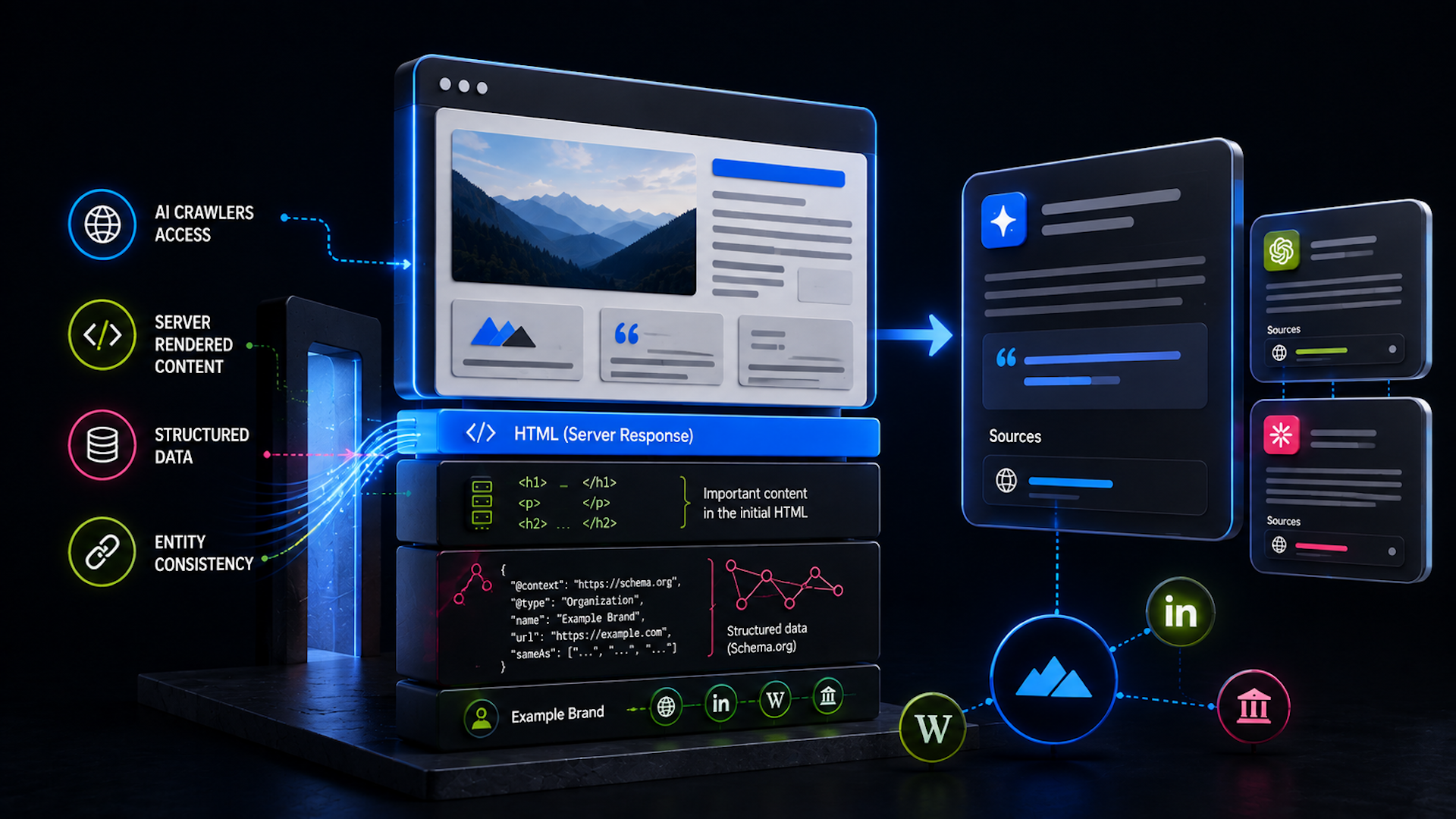
The way you organize and format the content on your site is one thing, but what about content that exists elsewhere? Your brand has other digital entities, including social media profiles like LinkedIn or YouTube, Google My Business listings, third-party review sites, industry directories, and guest posts on other websites.
Managing these entities can help build authority across the web.
Entity optimization
In SEO, entities are the people, places, things, and concepts that search engines recognize and understand. Think Netflix, New York City, or content marketing. These aren’t just keywords, they’re distinct entities with defined attributes and relationships.
But here’s why this matters:
Google’s Knowledge Graph maps connections between these entities. When you mention “email marketing,” Google understands its relationship to broader concepts, such as digital marketing, customer retention, and marketing automation.
Your content needs to make these relationships explicit.
So, how do you effectively connect entities? You interlink between them. You can connect entities through in-line links within text, or you can do it with schema.
For example:
- If you have a relevant YouTube videos that complement written content, you can embed them within your content for increased chances of ranking. Your YouTube video description can also link to the relevant content on your website.
- Podcasts should reference relevant blog posts and vice versa.
- Use infographics that visualize your frameworks within written content.
- In written content, if you reference a concept, link it directly to your definitive resource on that topic. Or, if you mention a methodology, connect it to your step-by-step implementation guide.
- When you discuss industry leaders or tools, establish clear relationships to their professional entities, like their LinkedIn profile.
Pro tip: Look into the “SameAs” schema, which allows you to connect entities related to people, places, or organizations. It’s covered in this article: Why schema markup matters for B2B
All of the above helps Google understand not just what you’re talking about, but how your content fits into the broader knowledge ecosystem.
Voice search integration and conversational queries
Voice search rewires how people interact with search engines again.
When someone types a query, they’re thinking in keywords and shortcuts.
But when they speak?
They’re having a conversation.
People don’t type “What’s the best way to track marketing attribution across multiple touchpoints?” expecting a traditional search.
They’d probably just search “marketing attribution tools” and call it good.
But with voice assistants, or AI search, that full question feels natural.
This shift means your content strategy needs to evolve. You can’t just optimize for those clipped, keyword-heavy queries anymore. You need to capture the way people actually talk when they’re asking questions out loud.

So what can you do to stay ahead of voice search?
Focus on local intent and voice optimization:
The integration between voice search and local SEO creates unique opportunities.
For example, “Call [business name]” voice commands pull directly from Google Business Profile data.
Keeping your business Name, Address, and Phone number (NAP) consistent across all online listings, directories, and citations is crucial to avoid confusion.
When search engines find matching NAP information everywhere, they gain confidence that your business is legitimate and accurately represented online.
Other examples of local intent optimization for voice queries include spoken searches like.
- Who offers…
- Where can I find…
- What’s the best…
To get a snippet or citation in voice optimization, use definitional style writing. The conversational starters listed above should appear naturally in your content.
For example, above your address, add “Where to find us:” and if someone asks, “Where can I find…,” you may be cited.
Use simple sentence structures:
Voice assistants understand short, clear sentences best. Keep one main idea per sentence. Avoid long sentences with multiple parts connected by words like “and,” “but,” or “because.”
Think about it: when you speak naturally, you pause between thoughts.
Write the same way, aiming for an eighth-grade reading level so voice responses sound natural and clear.
Pro tip: Use Hemingway Editor to assess your content’s grade.
Anticipate context stacking or follow-up questions:
Voice searches often come in sequences. Structure your content to flow naturally from one topic to the next—like explaining email marketing automation, then covering setup, platforms, and tracking results.
Test responses out loud:
Response testing involves reading your content aloud to assess whether it sounds natural and conversational. This simple technique helps you catch awkward phrasing, overly complex sentences, or sections that feel stilted when spoken.
If reading it aloud feels robotic or awkward, it will sound the same when Alexa or another assistant delivers it.
Track, optimize, and win in Google and AI search from one platform.
Embracing the answer engine future
Zero-click searches represent the fundamental shift from Google as a search engine to Google as an answer engine—and fighting this transformation is like trying to stop the tide.
Here’s what we know: AI search visitors are set to replace traditional search by 2028. As AI models become increasingly sophisticated and search experiences evolve, the percentage of searches that end without a click is expected to rise.
Yes, it’s intimidating, but it’s also an exciting evolution in search once you shift your perspective.
So where do you start?
Our comprehensive guide to SERP features breaks down every type of zero-click opportunity and exactly how to capture each one. Because honestly, the answer engine future isn’t coming. It’s already here, and the sooner you embrace it, the better positioned you’ll be when the next wave of search evolution hits.
Feel equipped to rank in SERP features already, and want the next thing?
- Read this article on SEO reporting, which will help you sophisticate your reporting so you’re not just reporting on vanity metrics like clicks and click-through rate.
- Read this article on engaging stakeholders, as this will become more important when you can’t show success like you used to with traditional methods.
Explore more on
Editorial disclosure
Search Engine Land is owned by Semrush. We remain committed to providing high-quality coverage of marketing topics. Unless otherwise noted, this page’s content was written by either an employee or a paid contractor of Semrush Inc.
About the author