How to rank for high keyword difficulty queries: A strategic guide

Getting to the top of the search results is tough no matter what target keyword you’re trying to rank for. But for some highly competitive terms, it can feel like trying to reach the summit of Mt. Everest.
This guide provides a base camp from which you can plan your ascent to the top spot of the high-difficulty keywords you dream of.
Note: In this guide, “keyword,” “term,” and “query” are used interchangeably.
Why chasing difficult keywords is still worth it
There’s value in ranking for high-volume, high-intent keywords, plain and simple.
Real value. Monetary value.
Keyword difficulty tends to increase for high-volume, high-intent queries.
What constitutes “high volume” will vary. A few hundred searches per month might be high for some products and services, while others might garner thousands of searches per month or more.
For example:
- “Skincare products” and its close variant “skin care products” have a combined 45,200 searches per month
- “Buy glasses online” has 22,000 searches per month
“High intent” corresponds to transactional intent. That is to say, high-intent keywords often include words that indicate an immediate willingness to make a transaction.
As the oversimplified graph below shows, keywords tend to get harder to rank as the number of monthly searches increases and the terms become more transactional.

The takeaway here is:
When many potential buyers use the same search query, there’s a lot of money to be made.
A Backlinko study using Semrush data showed that the top three results in Google searches receive 54.4% of clicks on average.
Getting your page to show up at the top of the search engine results pages (SERPs) will dramatically increase your opportunity to convert those searchers into customers.
And if they love your product, those customers will be more likely to buy again—which helps you build brand loyalty.
That’s the real value—for both you and them.
When to pursue high difficulty keywords—and when to pivot
You shouldn’t pursue top ranking for every difficult keyword you stumble on. That would be a waste of time chasing the impossible.
As a rule of thumb, you should only pursue high difficulty terms that:
- Match closely to your product or service offerings
- Have supporting content from other levels of the marketing funnel
- Are proven to convert organic traffic into sales, qualified leads, or other high-value goals

If you struggle to execute in any of these areas, you may need to consider pivoting your strategy.
More details on how to rank for high difficulty queries are provided below. Before we get to that, here are a few other thoughts.
Does high domain authority (DA) help high difficulty keywords rank?
No. But also yes, kind of.
Confused? Here’s some clarification.
Metrics like “website authority” or “domain authority” have been developed by various SEO software companies like Semrush, Moz, and Ahrefs.
The goal of these authority scores is to help website owners understand at a very high level how their sites measure up against competitors.
But it’s important to remember that Google does not use authority scores in its algorithms. You can read about more in this deeper look at SEO ranking factors.
In fact, Google has long said it does not employ a sitewide authority metric. (It does have a Quality Score for paid search campaigns, which is an entirely different thing.)
The SEO toolkit you know, plus the AI visibility data you need.

That said, a good website authority score can indicate that you’re doing the things you need to do to rank well in Google. It might not be a metric Google uses, but it’s a metric you can use to quickly gauge how your site compares to others.
So while website or domain authority isn’t itself going to improve your search rankings, such a score can definitely help you make sure you’re moving in the right direction.
Note: You can use Search Engine Land’s free website authority tool to check your site’s authority score.
What makes a keyword “difficult”?
Difficult keywords are targeted by a lot of websites, and therefore they have a lot of organic search competition.
Generally, the difficulty of a keyword is determined by:
- How many web pages are ranking for the keyword
- How many backlinks point to those pages
- Where those pages rank in Google search
- The keyword’s search intent and monthly search volume

Based on their own descriptions, the most popular SEO tools calculate keyword difficulty as follows:
- Semrush calculates keyword difficulty percentage using a mix of backlink metrics, website authority scores, keyword search volume, SERP feature presence, brand impact, and word count of the keyword itself
- Moz calculates difficulty using its own authority scores—which are calculated using many variables—plus click-through rate (CTR)
- Ahrefs looks mainly at referring domains
When looking at keyword difficulty, you may also want to consider other factors based on your individual situation.
For example:
- Does your site already rank for similar keywords (even if long-tail keywords), or is this a whole new keyword category?
- How long will it take—and how much will it cost—to produce the content required to rank?
- What CTR, conversion rate, and other metrics can you expect from high-volume, high-intent pages?
- Is your industry highly technical or part of a “Your Money or Your Life” (YMYL) field?
Keep in mind that keyword difficulty isn’t meant to tell you that it’s impossible to rank your content for a given term.
Rather, it’s there to help you determine whether the reward will be worth the effort.
How to rank for high keyword difficulty terms
Ranking for high difficulty keywords takes time, skill, and grit. SEO quick wins and overnight successes rarely happen.
Nobody said this was going to be easy. But it is possible.
As a general rule, there’s nothing special about ranking for high-difficulty keywords. You need to follow all the same principles of creating useful, optimized content that you would for any other keyword.
The trick is to do it better, faster, and more consistently than your competitors.
Here are some specific things you can do to aim for the top of high-difficulty keyword results.
1. Pick the right difficult keywords
To succeed with high-difficulty keywords, it’s important to choose terms that coincide with the products and services you offer.
The best way to do that is to look at what keywords your site already ranks for. Then you can create or update content to capture related terms with higher difficulty scores.
Here are some ways you figure out which high-difficulty keywords to target.
Find keywords that already rank
Unless your website is brand new, you’re likely gaining organic traffic from existing pages that rank on your site.
You can check which particular keywords are sending traffic to your site in Google Search Console. Simply log in and click “Search results” from the left menu to see a list of keywords with additional information.

You can adjust the time period and look at specific types of searches, including web, image, video, or news.

You can also add other filters:
- “Query” lets you filter by keywords containing (or not containing) certain words and phrases, exact match keywords, or regular expressions (regex)
- “Page” also lets you filter by partial or exact URL and regex
- “Country” lets you see keywords coming from a single area
- “Device” lets you choose desktop, mobile, and tablet traffic
These filters are important because they help you identify what keywords your content is already ranking for.
This can be a good indicator that your site may be able to rank for semantically related queries that have a high level of difficulty.
Once you know what specific keywords your site is already ranking for, you can use a tool like the Semrush Keyword Magic Tool to find high-difficulty terms related to your topic area.
Simply log in and enter a keyword in the field at the top, then press “Enter.”
As the example below shows, the keyword “skincare products” has a high ranking difficulty percentage with transactional intent. If your site is already pulling in traffic related to skincare products, it’s probably worth going after this term.

On the other hand, “buy makeup online” has an extremely high keyword difficulty percentage. If you sell skincare but not makeup, then it’s probably best not to go after this keyword, even if the audiences overlap significantly.

Choosing the right keywords to target can be a challenge. But it’s worth spending extra time up front ensuring the difficult keywords you want to target align with the things that earn you money, since you will be spending a lot of time and effort trying to rank for those keywords.
Look for keywords with ambiguous intent in Google SERPs
As mentioned above, high-intent keywords tend to include words or phrases indicating a willingness to buy in the near future.
Examples include:
- Purchase words like “buy,” “order,” “reserve,” “hire,” or “book” (as in booking an appointment)
- Product words like “products,” “services,” or “solutions”
- Time-sensitive words like “today” or “now”
- Expense and quality words like “price,” “cost,” “deals,” “coupons,” “cheap,” “affordable,” and “luxury”
- Some local SEO phrases like “near me,” “in [city/area name],” or “locations”
Note that including one of these words or phrases in a keyword doesn’t always indicate transactional intent.
For example “best makeup to buy for halloween” more likely indicates commercial intent. That is, the user is still researching what to buy at some point, not necessarily right now.
And the Google results may reflect this ambiguity, as this screenshot of Google results shows.
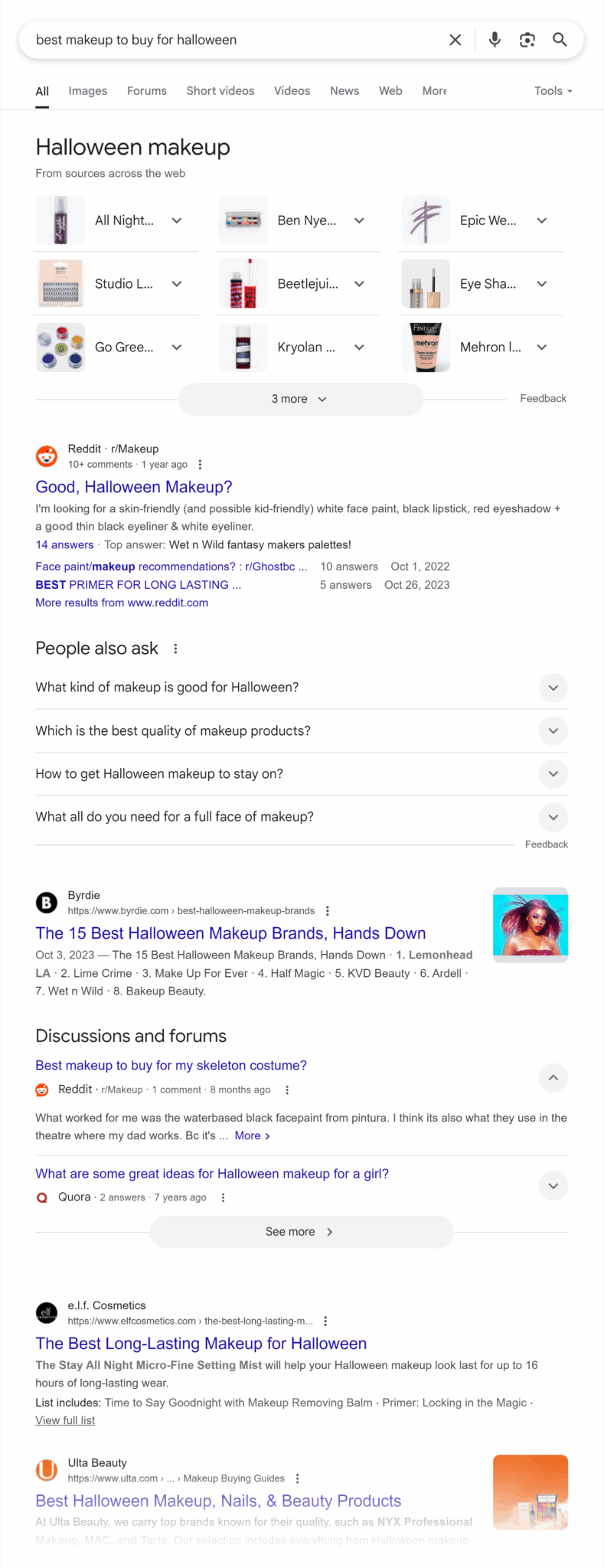
Google frequently tests different pages in search results to see which ones perform best, which means the top results in ambiguous SERPs can move around.
If you can produce high-quality content based on your expertise, you may be able to capture high-difficulty terms that show this type of ambiguity while Google tests this out.
A note on seasonal keywords
It’s worth noting that seasonal terms are going to see increased traffic and as the season draws closer.
For example, according to Google Trends, interest in Halloween starts edging up in late July and peaks at Halloween (obviously).

Keyword search volume is typically calculated as an average over 12 months. But for Halloween-related terms, most of that traffic actually takes place in about three months’ time.
Furthermore, as the holiday draws near, intent is likely to become more transactional. That’s because people will want to make their purchase before the event, and there’s greater pressure to buy as time goes on.
Getting your content ranking before search volume starts to go up will position your site well for capturing most of a year’s worth of traffic in a fraction of the time.
Note: The actual time frame will differ depending on the holiday, observance, season, or event.
Of course, not all high-difficulty keywords are seasonal. But reviewing trend data can help you know when to focus on them in addition to knowing which ones to go after.
Use your experience to find relevant keywords
It’s better to rank at the top of the SERPs for one or two topic areas you know really well than to rank further down for a range of topics outside of your wheelhouse.
For example, say you’re a home inspector who specializes in electrical inspections. It can be tempting to build a website that ranks for many kinds of home inspections (plumbing, roofing, etc.), with the belief that the more traffic it draws, the more leads you’ll get.
However, spreading yourself too thin can result in wasted time, effort, and money.
Bringing in people who are searching for a plumbing inspector, for example, isn’t going to garner leads for your electrical inspection business. More likely, you’ll get a bunch of people asking for recommendations to your competitors.
However, when people search for an electrical inspector, if they find your site at the top, you’ll stand out because that’s the area where you excel.

This is exponentially true with keywords that see a lot of competition.
You don’t need to spend time competing in spaces dominated by people with more experience and interest. Rather, focus on your experience and dive deep into the things you know a lot about.
When looking for keywords to target, try to find keywords that relate to:
- Common questions you get from customers
- Routine mistakes you see less experienced businesses make
- Common issues that crop up in your specialty, industry, or geographical area
- Tips and tricks you’ve offered to customers over the years
- Stories that are unique to your experience and offering
More information on how to create content for these keywords is provided in the sections below.
Once you have some ideas on good keywords that highlight your experience, you can make better decisions about how and where to spend your content budget.
Align keywords with sales and business goals
Avoid trying to rank for keywords that don’t directly align to downstream goals like conversion, leads, sales, and revenue. It’s expensive and it wastes time.
It may also wind up turning people away from your site when they realize they need to go somewhere else to get what they’re searching for.
When building out your keyword and content strategy, focus your time and budget on producing content that helps users move along the customer journey.
In addition to standard SEO metrics, make sure to consider metrics that benefit your business goals:
- Click-through rate (CTR): As your content starts to improve in rank, are you seeing the clicks you expect to see on those high-intent keywords?
- Conversion rate (CVR): Are you turning clicks into sales, leads, and other high-value goals?
- Return on investment (ROI): Are you getting enough revenue from sales to justify the cost of producing content that ranks for difficult keywords?
- Lifetime value (LTV): What’s the average amount that a customer will spend over the lifetime of their relationship with you?

If you already have content on your site that isn’t fulfilling your business objectives, consider pruning or refreshing content to better align it with your goals.
The bottom line is that it’s better to take time creating high-quality content that leads to the outcomes you want, rather than producing more content that underperforms.
Select keywords with strategic backlinking potential
Certain backlinks can provide a boost to your page’s ability to rank. An important aspect of earning value from such links is ensuring they have relevant anchor text.
When considering which high-difficulty keyword to target, ask yourself the following questions:
- Would someone be likely to use the keyword as anchor text for a link to my page?
- Does it sound natural? Not all keywords can be used easily in a sentence.
- If you ran across a link with that keyword as the anchor text, would you know it was going to take you to a page like yours?
If the answer to any of these questions is “No,” you may want to choose a different keyword to target.
For more information on backlinking, see “4. Use link acquisition tactics to boost signals” below.
2. Construct your site to win in competitive spaces using E-E-A-T
If you want to attract high-difficulty keyword traffic, your website should be prepared to make the best use of that traffic.
To do that, your site needs to demonstrate:
- An exceptional user experience (UX)
- Informed expertise
- Genuine authoritativeness
- Validated trustworthiness
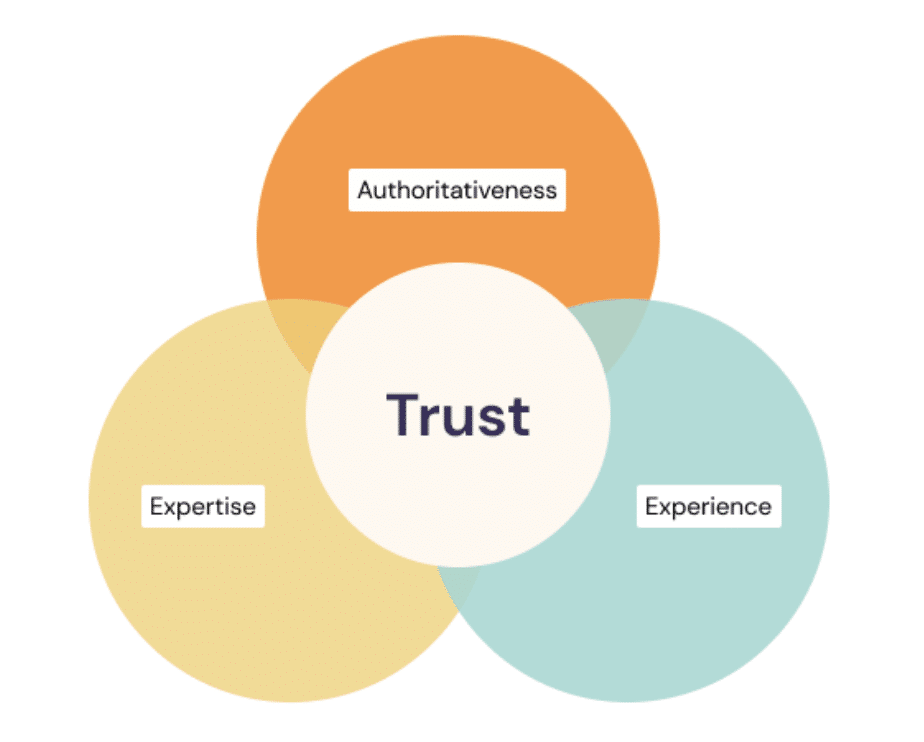
Together, those four things—Experience, Expertise, Authoritativeness, and Trustworthiness—are commonly known as E-E-A-T.
Experience: Highlight your experience
Experience is at the forefront of E-E-A-T because without experience, you’re unlikely to have expertise and authority—which means, people probably aren’t going to trust whatever you’re offering.
To differentiate your transactional pages from competitors, highlight your (or your company’s) experience with the products and services you offer.
One way to do this is by telling stories about those products and services. You can:
- Describe the research, development, and production process
- Provide background on how the product was inspired
- Show customers you understand their frustrations by describing the problems your product or service can solve
These stories should be relatively short, and they should generally be placed below the primary product details.
Such stories can be a strong way to show customers that your products are built on a depth of experience.
Two examples of such stories appear on True Botanicals product pages like the one shown below.

In this example:
- The “Clinical Results” section provides a high-level overview of the testing that went into creating the product.
- The “What It Is” section is more than a simple product description. It tells the story of combining ancient medicinal practices with modern extraction to produce an award-winning product.
Adding a little bit of experiential copy to your pages can go a long way toward helping you achieve higher page authority and reinforce your E-E-A-T—and ranking for high-difficulty keywords.
Expertise: Demonstrate product and category expertise
Customers want outcomes, not just products.
But a lot of transactional pages focus only on the details of the product or service being offered, rather than highlighting how it helps the customer.
True expertise involves showing customers that you understand how this product will help them achieve the outcomes they want.
In other words, it’s not enough to present basic facts about a product. Customers are also looking for some kind of emotional connection.
For example, skincare company cocokind takes pride in its ethical and sustainable business practices. And they integrate those values into their entire site, including product pages.
Take a look at this screenshot of cocokind’s “daily spf” product page.

It has all of the usual things you’d expect: product facts, reviews, benefit and usage information, an “ADD TO CART” button, etc. It even includes links to lab results from scientific testing.
But if you scroll down further, you’ll see an expandable section labeled “sustainability.”

At a glance, this may just seem like more facts. However, it’s actually demonstrating expertise.
How?
By showing that cocokind understands the ethical implications of their business. They add this type of information to every product page, which illustrates how much they care about their core values, as well as how much they know about those core values.
That gives customers who care about those same values a way to connect with the brand that most other companies don’t offer.
Here are a few tactics you might consider for conveying expertise on transactional pages:
- Include quotes and links from expert product testers like Consumer Reports or industry-specific organizations
- Add inspirational, motivational, or educational ideas about alternative (safe) uses of the product to exhibit your understanding of how customers employ it in real life
- Offer curated product bundles to show how customers can get even more value by purchasing complementary products
When it comes to high-difficulty keywords, highlighting your expertise in these ways can give your pages the edge that helps them rank at the top of the search results.
Authoritativeness: Boost your authority signals
Expertise is what someone can do. Authority, on the other hand, relates to how much someone is recognized as an expert.
When it comes to building authoritativeness, you can leverage your networks to help spread the word in a few different ways:
- Engage in digital public relations (PR)
- Collect testimonials and reviews
- Earn media mentions with natural backlinks
- Work with thought leaders, influencers, and other individuals with large public platforms—or become one yourself!

The above tactics are general. They’re often used to build individual or brand authority, which can slowly boost your website’s E-E-A-T signals over time.
It’s a long game.
However, you can also tailor these tactics to boost your authority in relation to specific products or services.
For example, you can:
- Issue a press release about a new or relaunched product that details the experts involved, the development process, and the improvements made.
- Solicit testimonials from business leaders, celebrities, or others who use your products.
- Make yourself available for interviews, or offer yourself as a quotable subject matter expert to journalists.
- Engage a person or brand with a large platform to promote your product.
The more you can get others to publicly acknowledge your expertise, the more authority you’ll have in the eyes of potential customers.
In terms of ranking for high-difficulty keywords, some of the value of this authority comes from brand awareness and name recognition. As more people get to know your brand and trust, the more likely they are to click on your search results, which can send positive signals to Google that can boost your page’s rank.
It can also lead to more opportunities for building backlinks to your domain, and specifically to the pages that rank for competitive terms. See section 4 below for more on building links.
Trustworthiness: Partner with worthy people and organizations
If you expect customers to spend money on your products and services, you have to get them to trust you.
Unfortunately, gaining trust is hard, while losing it is easy. That’s just how it goes.
Trustworthiness for a website means that it is:
- Legitimate: There are real people and organizations behind it
- Reliable: It has accurate information and follows through on its claims and promises
- Accessible: It considers the needs and backgrounds of its entire user base
- Secure: It takes appropriate measures to protect customer information, transactions, and other sensitive data

Google sees trust as the point where the three other E-E-A-T elements overlap.
In fact, Google says that trust is so important, a site can have low E-E-A-T simply for being untrustworthy—even if the site does a good job with the other elements of experience, expertise, and authoritativeness.
Here are some ways you can apply trustworthiness to your pages targeting high-difficulty keywords:
- Ensure your page is accurate and reliable
- Allow reviews only from real people who make verifiable purchases
- Employ secure online payment methods that enforce current safety standards and practices
- Provide easy ways for customers to contact your company to resolve issues
- Cite only dependable sources, such as peer-reviewed studies and dependable editorial content, instead of heavily biased opinion pieces or studies with unverifiable claims
- Avoid conflicts of interest, even ones that may be genuine, such as reviews from paid reviewers or close family members
- Display certification and regulatory information prominently, such as International Standards Organization (ISO) certification or adherence to the appropriate safety standards
- Highlight any awards or other recognitions the product has received
In addition, if you operate in a YMYL area, you should make doubly sure to adhere to Google’s tougher E-E-A-T standards for YMYL sites.
3. Employ content strategies that focus on depth
Content targeting high-difficulty keywords shouldn’t exist in a vacuum.
Even the most transactional ecommerce sites need supporting informational content to attract users throughout the marketing funnel.
Some ways to deepen content on your site include:
- Performing competitive and SERP analyses to uncover gaps
- Employing engaging content formats
- Using topic clusters to organize your content
Uncover content gaps
Content gap analysis is a standard tool in the SEO toolkit.
When it comes to ranking for high-difficulty keywords, your gap analysis should take the following into consideration:
- What products do competitors offer that you don’t, and vice versa?
- Which of your products are not showing up in the SERPs?
- What content related to your products is missing from the SERPs?
- What content can you create to support your transaction pages?
Keep in mind that content can appear in SERPs a lot of different ways. You may be able to fill any content gaps simply by ensuring that your search listings are as complete as they possibly can be.
For example, this Sephora skincare products snippet includes a lot of information pulled from different parts of the page it links to.

The numbers in this screenshot indicate:
- Site name and favicon
- Breadcrumbs
- Title link using the title tag or other relevant text
- Snippet pulled from the page’s content or meta description
- Product or merchant listing details
- Image
All of this information can be influenced on your page’s visible content or by properly setting up structured data in the page’s HTML code.
The availability of blended SERP features creates many possibilities for getting our pages in front of users’ eyes. Make sure you’re not ignoring potential SERP visibility while chasing the traditional top spot.
Fortunately, it’s easy to check the SERP appearance for live pages or preview potential updates by using Google’s free structured data testing tools.
Employ engaging content formats
Building engaging and interactive content that supports your product pages is a great way to keep customers coming back.
Furthermore, users are more likely to share engaging pages with their family, friends, and audiences, giving you more opportunities to connect with additional people.
Visual content
When people think of visual content, they often think of things like infographics, charts, maps, and other images that let users share data-driven insights.
When it comes to transactional pages with higher difficulty scores, the visual content that works best tends to be:
- Product pictures
- Infographics with product details
- Images that demonstrate or explain product usage
- Before and after photos
- “Lifestyle” shots of the product in use
- Setup or explainer videos
For example, on its product pages, The Inkey List includes an image carousel of not only standard product images, but also graphics that explain why the product is good, when to include it in a skincare routine, and how to use it.

Further down the same page, The Inkey List includes images and videos from its Instagram feed to highlight various features and uses of that specific product.

In addition to being more engaging and interesting for visitors, these types of graphics provide shareable assets for people to share with their audiences. They may even garner some natural backlinks, which will help boost your overall page.
User-generated content (UGC)
The most common type of user-generated content for transactional pages is ratings and reviews.
As noted above, product ratings can be shown in Google search listings along with other product and merchant data. When people love your product, seeing the positive ratings can encourage clicks through to your product page.
You may also want to allow customers to provide reviews of your products. In addition to helping other customers, reviews offer some additional benefits:
- Customers can share tips and tricks on how they use the product, along with their own images and videos
- You can respond to customer questions and concerns brought up in the reviews
- You can gain valuable insights to improve your product descriptions by using AI to find common themes and key features from customers’ perspectives
The Inkey List provides ratings and reviews with several features as shown in the screenshot below:
- Ratings summary
- AI-generated reviews summary based on 100 most recent reviews
- Gallery of user-submitted images and videos
- Reviews in order of most recent at the top

On other pages or areas of your site, user-generated content might include blog comments, community forums, or user-submitted knowledge base and support questions.
For example, Sephora has an active “Beauty Insider Community” forum.

As forum content continues to fill out product-related searches—especially Reddit reviews—these types of communities have the opportunity to pull in traffic for supporting keywords that you might not otherwise have the opportunity to target.
Quizzes and interactive guides
There are a lot of ways to help users get personalized suggestions. One of the more interactive ones is to provide a quiz or an interactive walkthrough that provides details about their lifestyle, intended usage, or other things that can impact which products they buy.
One such example is cocokind’s “routine builder.” It walks through a few prompts to gather information about what products might work best for a customer.

When complete, the quiz suggests an array of products with the option to add them to their shopping cart, as well as instructions on how to use the products together.

Before the results, customers can choose to enter an email address to continue receiving product suggestions and a coupon.
Finding unique ways like this to engage customers in finding the right products for themselves can be a good way to go after some hard-to-rank keywords.
AI-enabled interactive content
With the increase in AI functionality in recent years, there’s more opportunity than ever to stand out.
Using AI to create content can be problematic. But with some time, care, and attention to accuracy, AI can enhance your content and provide new, engaging functionality that wasn’t possible in the past.
For example, Maybelline has a “Virtual Try On” module that lets people see how different products will look before they buy.

La Roche-Posay has a bit of a different approach. Customers can upload a selfie to have AI analyze their skincare needs and provide a recommended routine.

The company claims 95% accuracy based on a proprietary database of 50,000 graded photos.
For customers who still have questions, they provide contact information and an AI-enhanced chat.

Spending some time considering how to put AI to effective use can be the difference between reaching the top of the SERPs for highly competitive keywords—or languishing unseen several pages down.
Further reading: Why interactive content is key to AI-optimized search success
Use topic clusters to organize content
Your difficult-keyword content should be attached to a topic cluster (sometimes called hub and spoke) that provides information at every level of the marketing funnel.
This makes it more likely that users will find your products early in their journey and then return when they’re ready to buy.
Here’s how to start building a topic cluster:
- Identify the high-level topic you want to cover
- Find keywords related to that topic that apply to your brand (as covered in Section 1 above)
- Build a pillar page that covers the topic broadly
- Create topic cluster pages that go deeper into specific aspects of the topic
- Add interlinks between the pillar and cluster pages for easy navigation and to distribute link equity
- Build in appropriate calls to action (CTAs) that direct customers to the page you want to rank for your high-difficulty keyword
For example, if you wanted to build out a topic cluster around skincare products, you might end up with something that looks like the following.

This is an overly simplistic example to illustrate the idea. A topic cluster that shows deep expertise might have dozens or more pages related to a given topic.
If the topic is very large, you may want to break them into subtopics. Then, build clusters around each subtopic, and make certain that the subtopics link back to the main topic page.
As you’re building out your topic clustering strategy, be sure to keep good site architecture design in mind so both Google and users can easily navigate your site.
If you’re looking for ideas on what to include in your topic clusters, use a keyword research tool like Semrush’s Keyword Magic Tool.
Don’t forget to try different variations of the keyword.
For example, researching “skincare products” and “skin care products” will result in distinct keyword ideas.

Cluster pages are particularly good for answering more specific questions about the topic.
To find suitable questions, click the “Questions” tab in the Keyword Magic Tool report.

The goal here isn’t to answer every possible question that pops up. Rather, focus on those questions that highlight your experience and expertise.
You can dig deeper into the keyword suggestions using the filter on the left to focus questions with specific words in them.
Then, once you have a list of the questions you want to cover, you can incorporate them into the appropriate pages, or make a standalone FAQ page that covers them all in one place. (See below for more on FAQs.)
Dig deeper: Search terms: The foundation of every successful SEO strategy
4. Use link acquisition tactics to boost signals
Every year, there’s speculation about the value of link-building efforts. And every year, SEOs continue building links and seeing benefits.
Linking strategies are as important as they’ve ever been in search engine marketing (SEM). Not only for SEO reasons, but to ensure that customers can easily navigate to the areas of your site they want to find.
Links can help you rank high-difficulty keywords in two ways:
- Build beneficial backlinks to your site
- Optimize internal linking for link equity
Build beneficial backlinks
Not every kind of backlink is a good backlink. It’s important to know what types of backlinks are beneficial, and which might be irrelevant or even doing harm to your backlink profile.
When it comes to pages focused on high-difficulty keywords, here are some ways you can gain links to your site:
- Include share buttons that allow users to easily copy and send links to the page
- Create engaging visual assets, infographics, or other images that users can share (See Section 3 above.)
- Provide interesting data or facts about how your products are made, the materials used, or other tidbits people may want to share
- Encourage customers to write reviews, how-tos, or inspirational ideas on their own blogs or websites about your products that they can link back to the product pages
- Engage in digital PR
If you want to build manual backlinks, you can use a tool like Semrush’s Link Building Tool to get suggestions for sites to reach out to.
When setting up your link building project, the tool will prompt you to add keywords and competitors you want to target in your link-building efforts.
- Add your chosen keywords and click “Competitors”
- On the next screen, enter the domain names of your competitor(s) and click “Start Link Building”

Once the analysis is complete, select “Prospects” to see a list of potential websites you can reach out to for potential linking opportunities.

You can select sites to reach out to by selecting the checkboxes on the left.
Then, you can add those sites to a list based on what type of email outreach you want to perform.

Gaining backlinks to your pages targeting challenging keywords can make the difference between ranking at the top versus falling lower in the SERPs.
Keyword Overview can give you an idea of how many backlinks to aim for with. Just type in your keyword, and review the text below the difficulty score.

Keep in mind that a specific number of backlinks will not guarantee top rankings for your pages targeting high-difficulty keywords. It might not even guarantee they reach the first page of the SERPs.
But getting more natural backlinks from reputable, relevant websites will greatly improve their likelihood of capturing high-volume, high-intent terms in the long run.
Optimize internal linking for link equity
Since it’s harder to get direct backlinks to pages with transactional intent, optimizing how link equity flows through your site is critical for helping them rank.
Link equity—upon a time called “link juice”—stems from Google’s first algorithm known as PageRank. While PageRank is much less important than it once was, it still influences Google’s ranking algorithm in an evolved form.
By following internal linking best practices, you can help direct the flow of link equity to your transactional pages to help them rank better for high-difficulty keywords.
Some key things to keep in mind when linking between pages of your site:
- Use links to guide users along the customers journey
- Write anchor text that’s clear, informative, and accurate
- When linking on images, add descriptive alt text (such as the product name)
Dig deeper: Internal link building for an E-E-A-T-focused content strategy
5. Pinpoint search intent and target it precisely
Search intent is not always easy to decipher. As mentioned in Section 1, even Google sometimes gets confused about what intent a certain keyword might have.
Terms like “transactional intent,” “commercial intent,” and “informational intent” are descriptions used by the SEO community based on the older—read: pre-internet—concept of the marketing funnel.
Side note: Google always refers to user intent, not search intent, in its Search Quality Rater Guidelines. And it applies different names for informational intent, as well, like “Do Queries” for transactional intent and “Know Queries.”
However, customers don’t always think within the boxes marketers and tech companies create. And because of that, there are many other ways to understand search intent.
Capturing those other, finer types of intent can be a great way to stand out in the SERPs. Let’s look more deeply at ways to accomplish this.
Build content with “micro-intents” in mind
You can understand search intent more granularly with micro-intents, which are more specific versions of the primary search intents.
For example:
- Informational: Does the searcher want a quick fact or a deep dive? Are they looking for step-by-step instructions or general information about a topic?
- Commercial: Does the user want a side-by-side comparison, an in-depth review of a single product, or to browse a category of different styles?
- Transactional: Is the person looking for a particular brand? Do they want to buy online or at a physical location?
- Navigational: Does the searcher want to log in? Are they looking for customer support information or investor relations? Do they want to view the newest products?
Google acknowledges a version of user micro-intent called a “Know Simple Query.” This is basically a more specific query than a standard Know query.
For example:
- Know Query: “ulta” brings up general information about the company and its stores, including a knowledge panel
- Know Simple Query: “ulta founded” provides the company’s founding date as the top result with a link to the source

When it comes to transactional and commercial content that can capture high-difficulty keywords, there are four micro-intents you should be aware of:
- Comparison: Broad comparisons like “best skincare products with spf” mean the customer is still investigating options. However, more specific comparisons like “sunscreen vs spf lotion” or “lip stain vs lip gloss” might mean the customer is getting closer to making a purchase.
- Category: Even without transactional words like “buy” or “get,” keywords that indicate a product category, such as “active serum” or “exfoliating mask” can indicate a readiness to buy.
- Service or product name: Searching for the exact or nearly exact name of a product like “instant puffiness reducer” (a Mary Kay product) or “age miracle eye cream” (from Ponds) can be a strong indicator someone wants to purchase it.
- Brand: The brand name combined with a product type, such as “roc skincare” or “loreal moisturizer,” often indicates a transactional intent.
Including content that targets these types of micro-intents can improve your ability to rank for high-value keywords and related terms.
Format pages for quick scanning
Most people who are ready to buy want to get in, make the transaction, and get out.
And it’s in your best interest to help them do exactly that.
Here are some ways you can make your product and category pages more useful:
- Make product descriptions clear and 100% correct. Customers will avoid your brand if they’re unsure what a product actually is or if they receive something different than expected.
- Help users complete the transaction quickly. People entering your site from transactional keywords already want what you’re selling—help them get it fast.
- Provide access to additional information and help. Make it easy to find product manuals, service options, and any other information a user might reasonably need.
- Present useful filters on category and list pages. Make it simple for users to narrow down the results.
As the screenshot below illustrates, beauty product retailer Credo Beauty does a great job of making their product pages scannable with these sections:
- Product information and purchase functionality at the top of the page
- Supplemental information below that
- Recommended product pairings
- Product reviews—not shown here, but there’s a link just beneath the product name to the reviews further down the page

Dig deeper: Product page SEO: A complete guide
Add FAQs with schema to capture search questions
Ranking for related long-tail, lower-competition keywords can boost a page’s ability to rank for high-difficulty terms. One way to rank for those low-competition keywords is with search questions.
Search questions include queries that use interrogative words, that is, the words that typically start questions such as: “who,” “what,” “where,” “when,” “why,” “how,” and “which.”
For example:
- “who should use suntan lotion”
- “what is active serum”
- “where to buy skincare products”
- “when is the best time to moisturize”
- “why should you use a cleanser first”
- “how to use exfoliators”
- “which lotion is best for dry skin”
In addition to having their own sets of SERPs, search questions can appear in a “People Also Ask” (PAA) SERP feature for other queries. Google often uses PAA sections to help users refine their queries and provide feedback on the user intent of the initial search.
PAA features include the top answer to each question with a link to the page containing the text. If your page answers the question best, it will drive more organic traffic and signal the page’s usefulness to visitors.
Here’s an example from the query “skincare products”:

A good way to capture search questions is to include FAQs on your page targeting high-difficulty keywords. Be sure to add FAQ structured data (schema) so Google can parse them.
Returning to the cocokind example from above, the company provides FAQs that offer further education, as well as clarifications about their products.

These FAQs are unique to each product page, which shows that the company is truly committed to providing expert content based on their customers’ queries.
FAQs can also signal experience and expertise, which, in turn, helps build trust with customers. And customers who trust you are more likely to become loyal customers who refer their family, friends, and acquaintances.
As for the search results, in addition to pulling results from FAQs, Google sometimes pulls answers to related questions from sections within an article. Having a well structured page with question subheadings can also get information into PAA and other SERP features.
Deeper Dive: How to drive SEO growth with structure, skimmability and search intent
6. Measure progress and iterate
Reaching the top of the search results can be an incredible feeling—that is, until someone knocks you down into the unvisited depths of the SERPs again.
And of course, there’s no guarantee you’ll reach the top at all.
It’s important to continue monitoring and measuring your progress as you improve your target page, build supporting content, and optimize on-site and off-site SEO signals.
If you don’t keep tabs on things, you may be doomed to those never-seen search result depths indefinitely.
Focus on leading indicators over lagging indicators of success
Lagging indicators are metrics that show what has already happened, while leading indicators predict what is likely to happen.
The table below provides some examples of leading and lagging indicators of success in terms of SEO.
| Leading Success Indicators | Lagging Success Indicators |
| Number of ranked keywords | Organic traffic |
| Keyword positions | Number of backlinks |
| Search impressions | Conversions / Leads / Sales |
| Search visibility | Revenue |
Leading indicators are helpful because they point to the likelihood of success or failure.
For example, if you’re seeing more ranking keywords at higher positions with more search impressions and greater visibility, your page is more likely to rise in the SERPs for the high-difficulty keyword you’re targeting.
Lagging indicators can help confirm this success. As keyword number, rankings, impressions, and visibility increase, you might also see more organic traffic, earn more backlinks, get more conversions (leads, sales), and generate more revenue.
Track, optimize, and win in Google and AI search from one platform.
But lagging indicators can also be affected by things beyond SEO, such as poor conversion rate optimization (CRO) or problems with the sales process. So while they’re important for business purposes, they won’t necessarily help you understand how your page is performing in search results.
When trying to rank for challenging keywords, it’s important to keep your eyes on the leading metrics that will actually show you’re winning.
And warn you when you’re not.
Further reading: How to measure SEO success when AI is changing search
Understand ranking plateaus and algorithm updates
Overcoming stalls and setbacks are part of the everyday life of an SEO marketer. Unfortunately, they can be extra frustrating when dealing with high-difficulty keywords.
A ranking plateau (or “SEO plateau”) occurs when a page that’s rising through the SERPs suddenly stops making progress. The page’s rank may move around a little, but it will typically hover within a few spots for a significant period of time after it plateaus.

There can be one or more causes of a ranking plateau, including:
- More pages ranking for the keyword
- Increased search volume for the term
- User intent for the keyword has changed
- Technical difficulties on your website
- Content gaps on a page or across your site
- A lack of backlinks from reliable domains
- Google algorithm updates
Keep in mind that hitting a plateau doesn’t necessarily mean you’re doing anything wrong. It can take awhile for the work you do to reflect in the SERPs.
In fact, according to a Semrush study of new domains, only about 41% of domains had pages ranking in top 10 search results after 6 months.

Also, while you’re working on improving your pages to rank well, so is everyone else. The people behind those high-ranking websites are just as busy trying to keep their pages in the top spots as you are trying to overtake them. It’s a never-ending game.
If you find your pages have plateaued in their rankings, here are a few questions to ask yourself:
- Are you targeting the right keywords and user intents?
- Is there more you can do to optimize sitewide and on-page signals?
- Have you used all the tools at your disposal, including A/B testing, user focus groups, and backlink outreach?
- Have you exhausted all potential outreach opportunities to get backlinks from new referring domains?
Over the years, Google has consistently updated its algorithm to encourage improvements to user experience and to discourage low-quality content.
Many of Google’s large-scale updates focus on specific aspects of its algorithm. Understanding recent updates can help you focus your efforts to overcome stalls or setbacks in your page’s ranking progress.
When in doubt about how to begin pushing past a plateau, head back to the top of the list in this guide and start from there.
Dig deeper: Google algorithm updates
Use data to target the most difficult keywords
As mentioned at the beginning of this guide, quick wins rarely happen. SEO is a long-term digital marketing strategy, not a solution for immediate gratification.
One way to get there faster is to have the right data. Up-to-date data will help you with every step above, from finding the right competitive keywords to optimizing the on-page and off-page signals that can make your content soar in the SERPs.
Set up scheduled site audits today to get the data you need to rank for the high-difficulty keywords that will help your business grow.
Explore more on
Editorial disclosure
Search Engine Land is owned by Semrush. We remain committed to providing high-quality coverage of marketing topics. Unless otherwise noted, this page’s content was written by either an employee or a paid contractor of Semrush Inc.
About the author