TOFU keywords: Meaning, importance, and use

You’ve probably seen the image of a marketing funnel before: wide at the top, narrow at the bottom. At the top, you’re speaking to the most people. By the time you reach the bottom, fewer people remain, but they’re the ones most likely to become customers.

The top of the funnel isn’t always celebrated. After all, this is the stage of the customer journey where people aren’t ready to buy yet. At this stage of the funnel, they’re curious, exploring, and trying to make sense of something new.
But that’s actually where the magic happens. TOFU keywords (top-of-the-funnel keywords) are where conversations begin long before money ever changes hands.
At this stage, no one is expecting a sales pitch. What they’re looking for is understanding, guidance, and a sense that you’re trustworthy. When you appear at this stage with content that genuinely helps, you’re planting the seeds for customer relationships that can grow and flourish.
TOFU shouldn’t be about chasing clicks. Instead, think of it as nurturing the very beginning of a brnd awareness journey that, if handled with care, leads to loyal customers who stick with you for the long haul.
What is a TOFU keyword?
Simply put, a TOFU keyword is a search phrase that someone uses when they’re in the information-gathering and awareness stage of the customer journey.
What’s on their mind?
They’ve noticed a problem, or they’re curious about something new, but they’re not yet comparing solutions or products. Think of it as the very first spark of interest—that moment before someone knows what the next step should be.
The role of a TOFU keyword isn’t to sell. It’s to meet people right at that spark, so offer them something genuinely useful, as you’re laying the foundation of trust.
The SEO toolkit you know, plus the AI visibility data you need.

By showing up with clear, thoughtful answers, what you’re saying is, “We understand what you’re going through, and we’re here to help.” That sense of credibility and thoughtfulness is what gently nudges them deeper into the funnel.
A few simple examples bring this to life:
- B2B example: “What is marketing automation?” This person isn’t looking for software yet. They’re simply learning the basics, trying to get their head around the concept.
- B2C example: “How to train for a half marathon.” They’re looking for training guidance, but they don’t want a running shoe ad… at least not yet.
Although these early questions may feel far from closing a sale, trust that they’re the opening chapters of a relationship. In that user’s mind, if you can be the brand that answers their questions with warmth, authority, and clarity, you’ll earn their trust and be top of mind when they are ready to buy later in their customer journey.
Why do TOFU keywords matter in SEO?
Let’s pause for a second and zoom out. Why should you even care about TOFU keywords?
If someone isn’t ready to buy, wouldn’t it make more sense to spend all your energy on the people further down the funnel (MOFU stage or even better the BOFU stage), the ones already shopping around?
It’s tempting to think that way.
But here’s the thing: If you only focus on the “ready to buy now” crowd, you’re leaving an enormous audience untouched—and you’re missing the chance to build real, long-term relationships with potential customers.
TOFU is the largest pool of potential searchers and is critical for traffic growth
Imagine an upside-down pyramid. At the very top, it’s wide—and that’s where TOFU lives. More people search here than at any other stage. These searches might look broad, even a little casual, but they’re golden because they represent future customers. Here you reach the widest scope of people, ideally including—but not limited to—your target audience.
Think of the funnel as the journey a customer takes while deciding when and what to buy:
- At the wide top of the funnel (TOFU) are broad searches such as “how to stay organized as a freelancer,” which reach the largest audience. This is where awareness of your brand begins when they find your helpful content.
- In the middle of the funnel (MOFU), searches get more specific and solution-focused. Think, “tools to help freelancers stay organized.” People in the middle of the funnel are exploring options and considering solutions.
- The narrow bottom of the funnel (BOFU) represents ready-to-buy searches, such as “best project management tool for freelancers,” or even searches for specific pages. These high-intent searches are a small, limited group.
A strong, wide base at the top supports everything below—more visibility, more engagement, and more opportunities as people move down the funnel. Importantly, as you publish TOFU content and comprehensively cover your topic, linking those articles to your MOFU content and BOFU content, Google begins to recognize your topical authority. In other words, the more TOFU keywords you rank for, the more likely your valuable BOFU pages are to climb the search results.
Traffic from TOFU keywords doesn’t always convert right away, and that’s okay. What matters is that you’re showing up early, making introductions, and letting people get comfortable with your voice before they ever reach the point of purchase.
TOFU cultivates a seed audience for retargeting and lead nurturing
Here’s the beauty of TOFU: Even if someone doesn’t buy on day one (and most won’t), you’ve still started a connection. This is your seed audience—the people who have shown curiosity about your topic, visited your site, or clicked on a link. Think of them as your “first followers,” whom you can gently guide over time.
Retargeting is simply a way to reach these people again. With tracking (like Google Analytics), you can “remember” that visitor and show them helpful content later—maybe a display ad, a follow-up article, or a friendly email.
Lead nurturing is the process of slowly building trust with that seed audience. You’re not selling immediately. Instead, you provide tips, guides, or resources that help them solve a problem—like showing a freelancer an article on staying organized before pitching your project management tool. Over time, they start thinking, “These people really get what I need.”
Example: Someone reads your TOFU article “How to stay organized as a freelancer.” Later, they see a helpful checklist you shared via email or a post about the best project management apps. That guidance nudges them closer to considering your solution as they move through your marketing funnel.
TOFU keywords build topical authority with Google and AI search
Topical authority is a fancy way of saying “Google trusts you because you consistently provide the best, most comprehensive answers on a topic.” The more quality TOFU content you create around a subject, the more search engines and AI platforms see you as a go-to source for that topic and its keywords.
Why it matters: If your content marketing is known for explaining the basics really well—like project management for freelancers—your site becomes the trusted reference. That not only helps your TOFU content rank but also makes it easier to rank for the deeper, revenue-driving keywords later on.
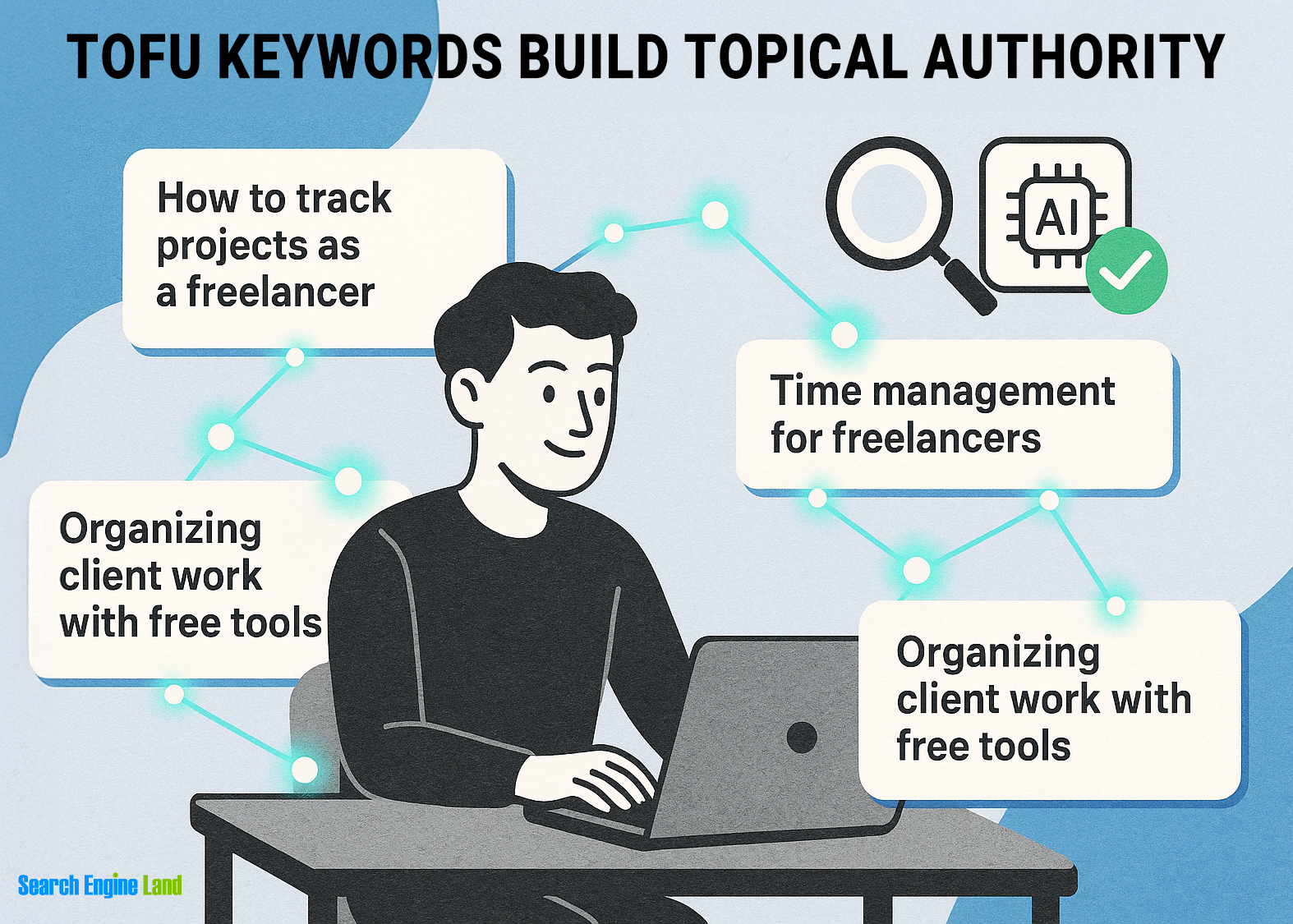
Example: You publish several beginner-friendly articles: “How to track projects as a freelancer,” “Organizing client work with free tools,” and “Time management for freelancers.” Over time, Google starts recognizing your site as an authority on freelancer productivity, boosting your overall visibility and making it easier to rank for keywords within that topical cluster.
High-value TOFU content naturally generates backlinks
A backlink is when another website links to your content. Think of it as someone vouching for you.
Good TOFU content naturally attracts these links if it’s helpful, clear, and well-researched. Backlinks are valuable because they bring in more traffic and tell search engines that your content is trustworthy. Ideally, your content strategy can naturally support these votes of confidence instead of your having to manually engage in link building.
Example: You create “Beginner’s guide to project management for freelancers.” Other bloggers, online magazines, or tools that review articles might link to your guide as a resource. Those links not only send visitors your way but also boost your site’s credibility with search engines.
TOFU fills the top of remarketing lists for paid campaigns
When you run paid ads, you want them to be seen by people who are likely to care—not indifferent strangers who will simply scroll past. TOFU content helps you build remarketing lists: groups of visitors who have already interacted with your content. Existing engagement helps drive future conversion rates.
Why it matters: Your ads now speak to an audience that is warm, familiar, and interested—not cold leads. That makes your campaigns more effective and cost-efficient.
Example: A freelancer reads your TOFU guide on staying organized. Later, you run a paid ad highlighting your project management tool’s features. Because this visitor already knows and trusts your content, they’re far more likely to click and explore further than someone who’s never heard of you.
How TOFU keywords fit in
Here’s where it all comes together. TOFU is the very first step of the customer journey through your marketing funnel.
A freelancer might land on your TOFU guide, “How to stay organized as a freelancer.” They’re curious and not yet ready to buy, but they do want answers that help them work better and more efficiently.

From there, you can present them with a MOFU page, like “Top 5 project management tools for freelancers.” Here, they’re comparing options, learning the pros and cons, reading testimonials, and starting to think about what might actually work for them.
Eventually, they reach your BOFU product page, where they’re ready to take action—maybe starting a free trial or signing up for your tool.
Along the way, you can strategically offer lead magnets: a free checklist for organizing client projects, an ebook on time management, white papers on best practices for managing client operations, or a mini project tracker tool. If they’re not yet ready to grab it, that’s okay—you can retarget them later with paid ads that remind them of your helpful content and keep your brand top of mind.
The key takeaway? TOFU isn’t about instant results. It’s about building the foundation. Every blog post, guide, and helpful answer grows awareness, trust, and momentum, confidently guiding freelancers from curiosity to consideration and eventually toward a decision—all while making them feel supported along the way.
Types of TOFU keywords (with examples)
TOFU keywords can sound a bit abstract if you’ve never worked with them before, so think of this as a little tour. We’ll walk through the main categories one by one, and you’ll see how each one connects to the kinds of questions real people ask every single day.
By the end, you’ll not only recognize the different types of TOFU keywords, you’ll start spotting them everywhere.
Informational: “What is” and “how to”
This is the most straightforward TOFU keyword category—the pure curiosity searches. People type in these queries when they’re learning something new. They’re not ready for advanced details or product pitches. They’re asking, “What even is this?” or “How do I do that?”
Examples:
- “What is content syndication?”: Someone is dipping their toes into B2B marketing and needs a simple, jargon-free explanation.
- “How to change a bike tire”: A practical, everyday problem. They don’t want a history of bicycles; they want to get back on the road.

When you create content around these keywords, your role is teacher and guide. Break things down simply, use plain language, and leave the reader feeling, “Oh, I get it now.”
Pro tip: When writing for “what is” and “how to” searches, imagine that you’re explaining it to a smart 12-year-old. Keep it plain, avoid jargon, and use short steps. If the reader feels like they could explain it to someone else afterwards, you’ve nailed it.
Problem/solution awareness
This type of TOFU keyword originates in that moment when someone notices something isn’t quite right. They’re not looking for brands yet—they’re trying to name and understand the problem. Think of it like googling symptoms before you book the doctor’s appointment.
Examples:
- “Why do plants turn yellow?”: They’re not shopping for fertilizer yet; they’re simply trying to rescue their poor, drooping monstera.
- “Signs you need a new mattress”: They’re waking up sore, and they’re wondering if it’s time to replace their bed.
Your content here should reassure and explain: Yes, this is a common issue; here’s why it happens, and here are steps to fix it. You’re solving small puzzles for people—and in the process, earning their trust.
Pro tip: Lead with the solution first so readers and search engines immediately see the answer they’re looking for. Then, briefly acknowledge the problem to show empathy and build trust. For example: “Remove yellow leaves from your plant by adjusting its watering schedule. Yellow leaves can be frustrating, but this simple change helps your plant thrive.” This way, you can satisfy search intent while still connecting with your audience on a human level.
Educational guides and explainer content
These are the bigger “teach me” searches. Instead of a quick answer, the searcher is ready to sit down and learn. Think of them as signing up for the 101 version of a course.
Examples:
- “Beginner’s guide to investing”: They want the whole picture, laid out gently so they don’t feel silly for not knowing the basics.
- “Introduction to yoga”: They’re curious about the practice, but they need the confidence to take the first step onto the mat.
Guides and explainer content give you the chance to go deeper, to organize information into something clear and supportive. The goal isn’t to overwhelm—it’s to help someone feel like they’re in safe hands.
Pro tip: Use visuals and clear subheadings to break up longer guides. Beginners often skim before committing to reading. A simple diagram, checklist, or summary box makes a big guide feel less overwhelming.
Trends and emerging topics
Finally, we’ve got the “shiny new thing” searches. These keywords are all about what’s fresh, exciting, and buzzing right now. People searching these topics want to stay ahead, learn first, or join the conversation; they’re curious, engaged, and ready to explore.
Examples:
- “AI in education 2025”: They’re fascinated by where the technology is headed, not which software to buy.
- “New coffee brewing methods”: They’re the coffee enthusiasts eager to try the latest trend before anyone else does.
Covering emerging topics shows that you’re not just answering today’s questions; your marketing strategy and its content has a finger on the pulse of tomorrow. You’re the guide who keeps them in the know, and that builds authority in a lively, approachable way.
Pro tip: Add your perspective. Anyone can repeat the news, but sharing your take—”Here’s what this could mean for freelancers managing projects next year…”—makes your content stand out. Suddenly, you’re not just informative; you’re memorable, confident, and worth following.
TOFU optimization best practices
We’ve talked about what TOFU keywords are and why they matter. Now let’s roll up our sleeves and talk about how to actually make them work for you.
Match intent
Here’s the golden rule: Meet people where they are. At the TOFU stage, they’re not ready for the hard sell, so don’t try to sneak one in. Your job is to teach, reassure, and guide. Think of yourself as the helpful friend who always clearly explains things without making anyone feel silly.
For example:
- Bad: Writing “How to train for a half marathon” and slipping in constant reminders to “buy our running shoes now.”
- Good: Actually laying out a training plan, with milestones, rest days, and maybe a gentle note about how good shoes can support the process (without pushing a specific product).
Pro tip: Read your draft out loud. If it sounds like an ad, strip it back. If it sounds like advice you’d happily give a friend over coffee, you’re on track.
Content format ideas
People learn in different ways—some like to read, some watch videos, and others prefer listening while cooking dinner. TOFU content is your chance to experiment with formats and meet people where they naturally spend their time.
Examples:
- A blog post for searchers who like reading
- A short video explainer for YouTube or TikTok
- An infographic that makes a complex idea simple and shareable
- A podcast episode for those who learn on the go
Pro tip: Don’t feel like you have to do everything at once. Start with one format you can do well, then expand. Quality beats quantity every time.
Structure for success
Even the best content can flop if it’s hard to read. People skim, especially online. They scroll, they glance, and they hop around. A good structure makes your content feel approachable instead of overwhelming.
What helps:
- Use clear headings (H2, H3) so readers can find the section that matters to them.
- Add images, charts, or quick summaries to break up text walls.
- Use schema markup (like FAQ or HowTo) so search engines understand your content and reward you with extra visibility.
Example: A blog post titled “Emerging Project Management Tools for Freelancers in 2025” could use H2s like, “Step 1: Explore AI-powered task automation” and “Step 2: Compare new collaboration platforms.” Add a simple chart comparing features or pricing, and suddenly the content feels actionable instead of overwhelming.
Pro tip: Pretend your reader only has 30 seconds. Could they still leave with one useful insight? If yes, your structure is perfect.
Trust-building elements
This part is crucial. People don’t just want answers to their problems; they want confidence that the answers are coming from someone who understands their world. In SEO terms, this is where E-E-A-T (experience, expertise, authoritativeness, and trustworthiness) comes in.
Google uses E-E-A-T as a framework to assess the quality and reliability of content, so the stronger your E-E-A-T signals, the more likely your content is to perform well. It’s about showing the human behind the content and backing up your guidance with credible, real-world evidence.
Ways to build trust:
- Author bio with credentials or experience: Let readers know you’ve been in their shoes
- Cite reputable sources and data: Show that your advice is grounded in facts
- Use real-world examples or case studies: Demonstrate that you’ve tackled these challenges firsthand
Example: If you write a TOFU post like, “How to stay organized as a freelancer,” include a note that your content is informed by your experience managing multiple clients. Add a simple chart showing time saved using different project management methods, or link to a study showing how freelancers improve efficiency with certain tools.
Pro tip: Honesty goes a long way. If you don’t know something, admit it. If your advice comes from personal experience, share that openly. Transparency builds trust faster than polished sales language ever could—and when readers trust you, they’re far more likely to follow your guidance down the funnel and eventually become customers.
How to measure TOFU keyword success
So, you’ve created some lovely TOFU content and sprinkled in the right keywords. Now the big question: Is it actually working?
Measuring success at this stage isn’t about sales or sign-ups just yet—it’s about early signals that people are finding you, learning from you, and beginning to trust you. Think of it as checking whether the seeds you planted have started sprouting.
Traffic and impressions
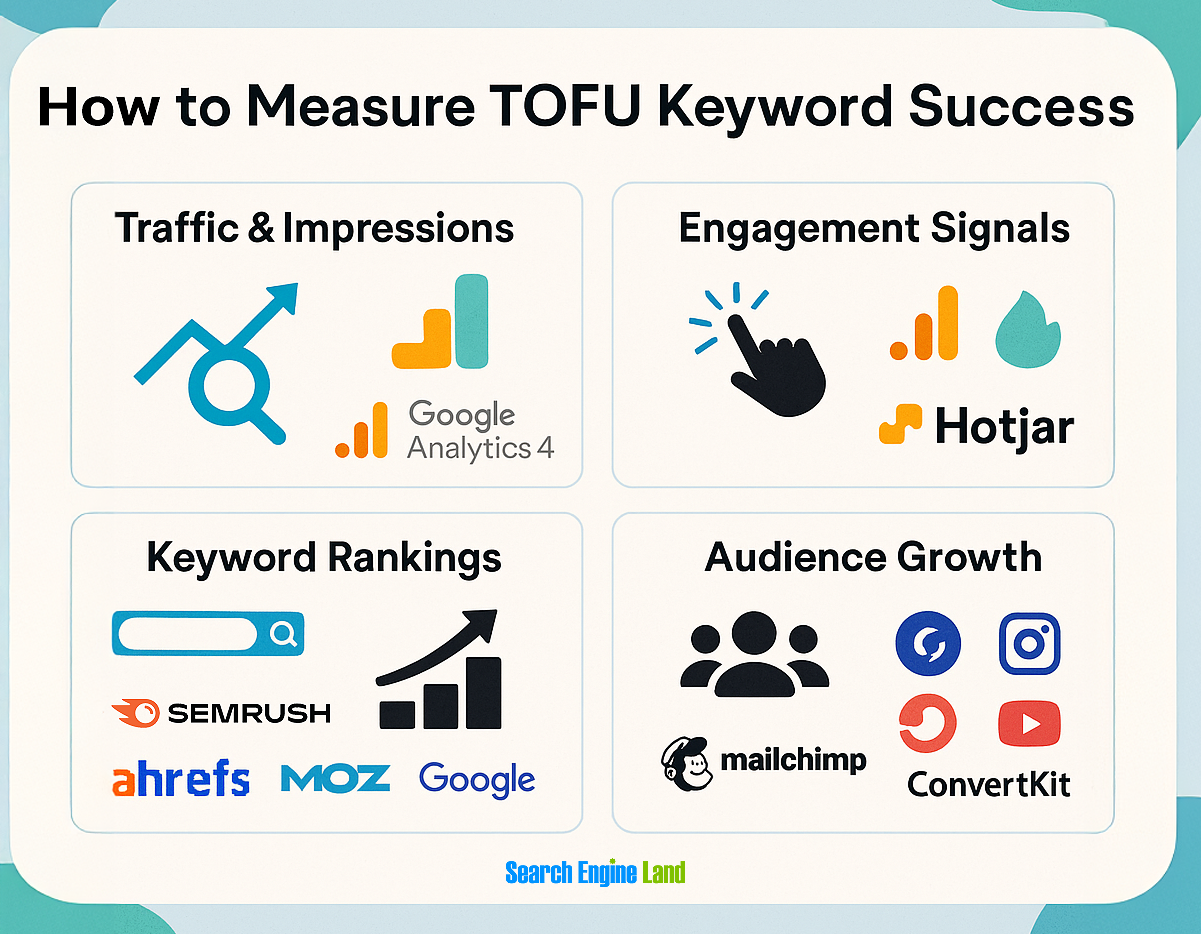
This is your visibility check. Traffic measures how many people clicked and visited your content. Impressions are how many times your content appeared in search results, even if nobody clicked.
Why it matters: If impressions are rising, it shows your content is showing up in front of more people. If traffic is also rising, it means your words are pulling them in. Both are early signs that you’re breaking through the noise and getting discovered.
Example: You write “Why do plants turn yellow?” and see impressions go from 100 per week to 500 per week. That’s hundreds more people noticing you exist. Your TOFU garden is growing.
Helpful tools: Google Search Console (free) measures both impressions and clicks. Google Analytics 4 shows you where visitors come from and what they do once they land on your site.
Engagement signals
Once people arrive, the question is: Do they care enough to stick around? A few clues can help you determine this:
- Time on page: How long do visitors stay? Longer usually means they’re reading and finding value, and that’s what you want.
- Scroll depth: How far down the page do they go? The further they scroll, the more invested they are.
- Bounce rate: This sounds harsh, but it’s just the percentage of people who leave straight away without exploring further or engaging with your site. A lower bounce rate is better.
Why it matters: These signals show whether your content is simply attracting visitors or actually holding their attention. Attention is the first step toward building trust.
Example: Someone lands on your “Beginner’s guide to yoga” and spends four minutes reading, then clicks over to “Best yoga mats for home practice.” That’s proof your content is gently guiding them along a path, from curiosity to connection.
Helpful tools: Google Analytics 4 is your go-to here. Tools like Hotjar can even show you heatmaps of where people scroll and click, a peek into how they move through your page.
Keyword rankings
Your keyword rankings indicate where your content sits in Google’s results. Moving from page three to page one may feel small, but it’s huge. Improved rankings are Google’s way of saying, “We trust your answer more now.”
As you publish TOFU content and more comprehensively cover your topical niche—linking those articles to your high-intent BOFU pages—you make it easier to rank for high-competition keywords. In other words, the more TOFU keywords you rank for, the more of an authority your site becomes, and the more likely you are to see ranking improvements for your most competitive, revenue-driving BOFU keywords.
Why it matters: The higher you climb, the easier it is for people to discover you. Even a jump from position 30 to position 12 is a win because it means momentum is building.
Example: You publish “What is content syndication?” and see it go from nowhere to ranking in the top 20. That’s encouragement that you’re on the right track.
Helpful tools: Free options like Google Search Console show you keyword positions, while paid tools like Semrush, Ahrefs, or Moz make it easier to track rankings over time and compare with competitors.
Audience growth
This is the “relationship check.” Are people choosing to stick with you? Growth in your email subscribers, social followers, or even returning visitors is a big signal that your content is worth coming back for.
Why it matters: This is where strangers turn into community. Someone who joins your mailing list after reading your “How to change a bike tire” guide is saying, “I want more from you.” That’s the true heart of TOFU success—you’re not selling, you’re connecting.
Track, optimize, and win in Google and AI search from one platform.
Example: You post a guide on “AI in education 2025” and 50 new LinkedIn followers arrive after sharing it. That’s proof your content struck a chord.
Helpful tools: Your email platform (like Mailchimp or Kit) will show subscriber growth. Social platforms like LinkedIn, Instagram, or YouTube have built-in analytics to track new followers.
Taking their first steps, guiding TOFU visitors toward MOFU
So far, we’ve been working at the very top of the marketing funnel, where people first notice you, peek inside, and start feeling comfortable with your content. That’s the magic of TOFU. It has nothing to do with pressure and has everything to do with planting trust and giving value freely. When you choose the right keywords, share genuinely helpful answers, and watch those early signals of engagement, you’re setting the stage for what comes next.
Now comes the exciting part: helping those curious visitors take the next step. This is the middle of the funnel—MOFU—where interest begins to deepen, curiosity turns into consideration, and your audience starts leaning in closer.
What does that look like in practice? In MOFU, you’re not starting from scratch—you’re building on the trust you planted with TOFU. This is where you might offer:
- Comparison guides that help them weigh options without feeling sold to
- Checklists or worksheets that let them apply what they’ve just learned
- Webinars or mini-courses that give them more in-depth guidance and a chance to engage with your expertise
In the next article on MOFU, we’ll walk you through exactly how to nurture these early connections, leading your visitors from “I’ve heard of them” to “I want to learn more.”
Explore more on
Editorial disclosure
Search Engine Land is owned by Semrush. We remain committed to providing high-quality coverage of marketing topics. Unless otherwise noted, this page’s content was written by either an employee or a paid contractor of Semrush Inc.
About the author


