How AI forms opinions about your brand


AI forms opinions about your brand from what it can see online. That’s your digital footprint.
The problem is that AI often sees only fragments of your business. It sees your website, content, reviews, and mentions, but much of the expertise, customer insight, and operational knowledge that makes your business valuable never makes it into the digital footprint.
The solution is to surface that knowledge, organize it into a single source of truth, and turn it into machine-readable signals. Here’s how to collect it, organize it into a single source of truth, and distribute it across the channels AI uses to understand, evaluate, and recommend brands.
What you feed the machines is understandability, credibility, and deliverability (UCD)
Everything you put into your footprint is fodder for three things AI has to decide about you. Together, they provide the fodder for the whole funnel.
Understandability
Does AI know who you are, what you do, and who you serve? You already know where your understandability comes from:
- Your about page.
- Your product pages.
- Your structured data.
What often gets missed is the operational detail that explains what you actually do once a client is inside.
Credibility
Does AI believe you’re good at it? This is N-E-E-A-T-T credibility — notability, experience, expertise, authoritativeness, trustworthiness, and transparency, an extension of Google’s E-E-A-T.
You know what credibility signals you currently feed: your case studies, your credentials, and your testimonials. What many businesses don’t realize is how much N-E-E-A-T-T credibility is already embedded in their day-to-day operations.
Deliverability
Does the AI engine have the content to hand you to the subset of its users who are your audience?
You know where your deliverability comes from: the topical content, the marketing, and the authority pieces you commission. Deliverability is often hiding in plain sight, in the content generated by your business operations and offline activities.

5 streams of business data feeding every commercial surface
All three elements of the UCD trio are fed by the five inputs below, and how much each contributes varies by business.
The point isn’t to file each input under one letter. Organized and codified, the five together give AI the fodder it needs from top to bottom of the funnel.
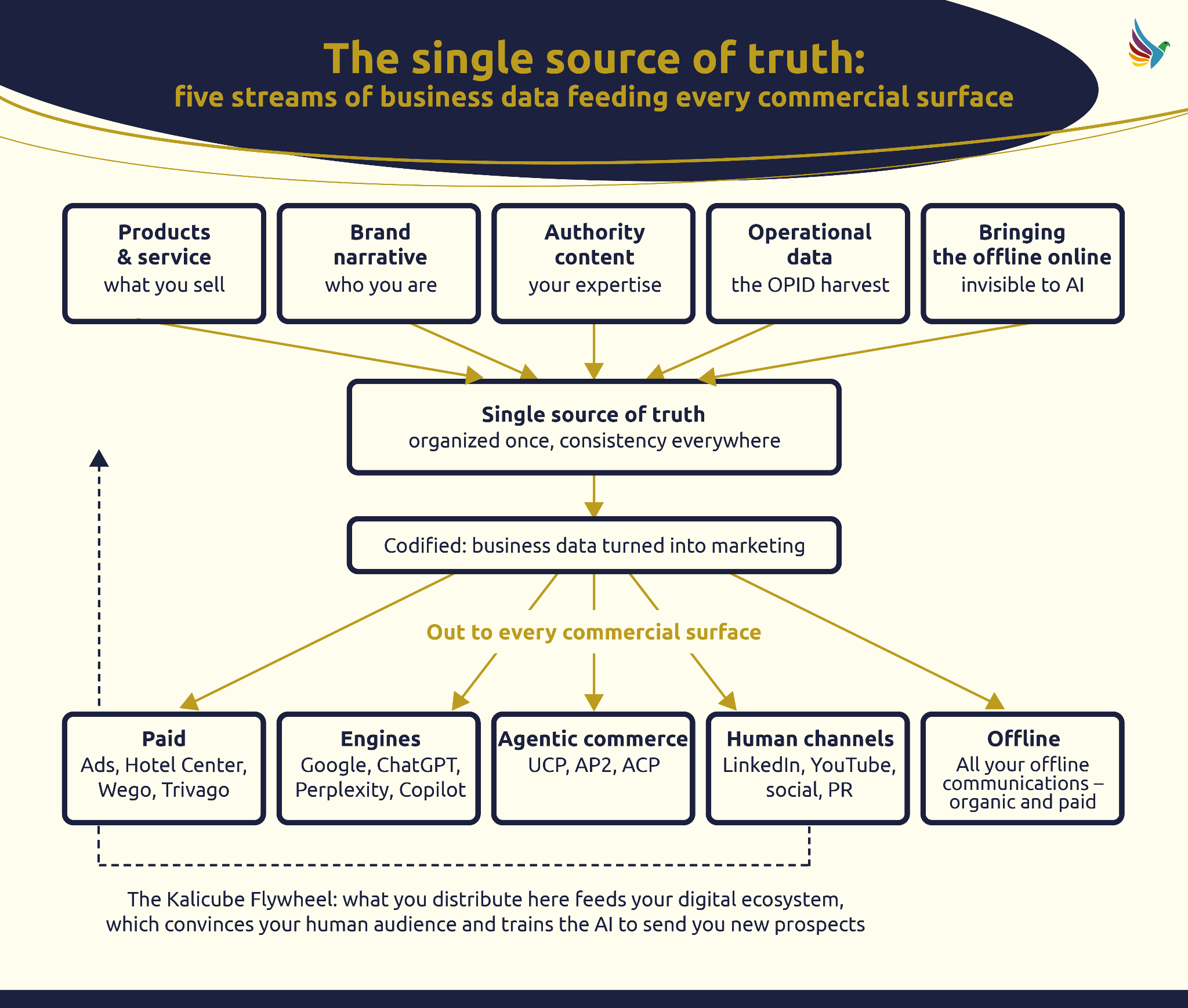
1. Products and services: What you sell, and you already do it
Your products and services data: what you sell, at what price, under what conditions, and with consistent names and identifiers. This is mostly about understandability, with credibility riding alongside it.
Most businesses already do this, so the work is in the depth, not the effort. Don’t just list what you sell. Describe who each offering is for, what problem it solves, what it costs, what it doesn’t do, and how it differs from the next option.
A thin product page tells AI a product exists. An exhaustive one tells it when to recommend that product and to whom.
Keep it accurate, complete, and consistent with everything else in your footprint. A price or product name that differs across pages reads as doubt.
2. Authority content: Your expertise, and almost everybody does it
This is the marketing you already create to show you know your field: your articles, videos, guides, data studies, and the thought leadership you publish to tick the box marked “content created.”
People put effort into it to build authority, rank, do SEO, and position themselves as experts. That’s fine. It leans toward deliverability because it’s what tells AI which territory to surface you in.
But everybody does it, which is exactly why it’s the least differentiating of the five on its own. It earns its weight only when it’s tied to the rest: the same expertise proven by your operations and corroborated by third parties, not just asserted in a blog post.
It’s necessary, but it’s not where your advantage hides.
3. Brand narrative and voice: Who you are, who you serve, and why you’re the best
All marketers create brand narratives, so the work here is about consistency and clarity rather than invention. Everybody communicates who they are, what they do, and who they serve, and keeping that clear and consistent matters enormously.
But three things are often left out, and AI needs all of them.
- Intent: It isn’t enough to name your ideal customer profile (ICP). You have to pair your ICP with what they’re after: the cohort-to-intent combinations from the funnel query pathway. AI has to know not just whose problem you solve, but which problem, and at which moment, before it can hand you to them.
- Credibility: The thing that feeds your N-E-E-A-T-T. Many people leave it out because they feel awkward saying it. You have to set it out because AI won’t work out your true value on its own. Be clear and bold about why you’re credible, then make sure you can back it up with evidence.
- Making the relationship with your clients explicit: Validation from the people you serve that you deliver on what your narrative and cohort-to-intent mapping promise. Say who you are, what you do, and who you serve. Then explain why a customer should choose you and prove it.
Voice is the part corporations get wrong most often. Narrative is what you say. Voice is how you say it. One team may write the narrative once, but voice escapes through every rep, every support reply, every social post, and every deck.
When it drifts, and in most large companies it drifts constantly, AI reads the same brand as five different brands and loses confidence in all five.
So standardize your voice and keep it consistent everywhere. Consistency is a credibility signal in itself. Inconsistency is a tax you pay without seeing the bill.
In short, make sure your brand narrative clearly sets out your ICP, who you are, and why you’re the best fit for them, in a voice that stays consistent wherever AI finds it.
4. OPID business operations: The stream almost nobody harvests
This is everything your business generates by running: onboarding, performance, integration, devotion, and all the day-to-day activity around them.
It’s the most powerful of the five because the material comes from your clients and from the work your team does to serve them, which is exactly the material that rarely makes it online. It sits behind closed doors, buried in a CRM, parked on a platform nobody values, and almost nobody harvests it.
It feeds all three elements of understandability, credibility, and deliverability more effectively than anything else you own.
- Understandability comes from the granular detail of what you actually do and the exact circumstances in which you help. Most of that is only ever discussed inside the business. A review where a client describes precisely what they got from you puts something on the record you’d never say about yourself, and the machine reads it as fact.
- Credibility is your N-E-E-A-T-T, and this is the most convincing kind because it comes from clients themselves, not from your marketing.
- Deliverability comes from the match. The content here aligns exactly with your cohort-to-intent combinations because it was created around the clients you attracted and served well. Whether it comes from you or from them, it fits the audience and intent you need to communicate to the engines.
Once you start looking, you’ll find the richest material you own:
- Customer voice is the highest signal because it’s real questions in real language: reviews across every platform, written and video testimonials, FAQs, unpublished support questions that should become FAQs, support and sales call transcripts, onboarding and churn-exit interviews, and free-text survey responses.
- Evidence and outcomes provide the proof you need: case studies with real before-and-after numbers, patent filings, academic deposits that are public but underused, and independent third-party studies that corroborate your claims.
- Methodology covers the rest. SOPs, playbooks, training materials, glossaries you currently keep private, and long-form spoken content such as webinars, keynotes, and podcast appearances, transcribed.
Look for material that answers a question an assistive engine or agent actually gets asked, in the questioner’s own words, with a verifiable fact attached.
A support ticket, churn interview, or sales call transcript will often outperform polished marketing copy in that test because it’s already phrased the way real people ask questions.
That’s the whole point of harvesting OPID business operations: taking information from a place AI can’t see and moving it to a place where it can, while making it visible to your human audience, too. It’s convincing to both because it’s true and because it matches the cohort-to-intent combination exactly.
5. Bringing the offline online: The stream almost nobody runs
This section is all about the marketing and audience engagement you do offline: the talks you give, the festivals or hackathons you sponsor to support your community, the interviews, the panels, and the rooms full of clients. It’s obvious to you, but largely invisible to AI.
Bring the offline online and feed it to the machines by publishing self-reporting content and linking to the social posts and summary articles others write. That’s a huge win most brands miss.
But it works the other way, too. Your codified source of truth can feed your offline communication, so the story a client hears from you at a conference, in a newspaper, on the radio, or face to face is consistent with the story you’re telling AI on the web.
That matters more than it seems. If the two differ, you lose the person because the gap reads as doubt to a human and as low confidence to a machine.
Clarity and consistency over time, online and offline, is the name of the game.
The industry’s trusted source for essential news and analysis.
Sign up for our newsletter to receive exclusive insights and updates directly to your inbox.
- Daily breaking news
- Expert analysis from industry veterans
- Join over 200k subscribers
- Covering SEO, PPC and AIO
Organize and codify the five into one source of truth
Once you’ve harvested all five streams, organize and codify them into a single source of truth: a database you build to output whatever format each surface needs, including HTML, schema, MCP, RDF, prose, audio, video, and images.
Organize the data once, centralize it, set up a system that codifies it on the way out, and from there you can distribute it in a few clicks while your digital footprint stays clear and consistent as it grows.
Then distribute it across your digital ecosystem in the format your human audience expects and packaged so machines can ingest it cleanly.
Where you publish affects how much the machine believes you, and the rule is simple: the less of you there is in it, the more it trusts it. You’re working across three tiers.
First-party: You claim
You publish on your own properties, in your own voice. You state who you are and set the frame. It’s the baseline, and on its own it proves nothing because you wrote it and you published it.
Second-party: You corroborate
Here, you’re still publishing, but across a broader footprint and with other voices in the mix. Two things widen here.
- The platform: In addition to your own entity home website, you publish on platforms where you own the account, such as YouTube, LinkedIn, Medium, and press releases. You’re stating your case the same way you would on your website, just on another property you control.
- The voice: You can publish your own words, or you can publish what a client or user said, such as a review, quote, or case study, on your own site and across those other accounts.
It’s a step up from first-party because the substance is no longer solely your own assertion, even though you’re still the one choosing it and publishing it.
Third-party: They prove you
A third party publishes in its own voice, on its own site or social accounts, or on a neutral platform such as Trustpilot, with no involvement from you.
Think clients and partners sharing their experiences, journalists, analysts, academics, and the long tail of user-generated content that assistive engines lean on.
It’s the strongest evidence because you had no hand in creating it.
You can’t write that third tier, but you can feed it. Your clients publish because you’ve served them well enough that they want to, so earn it.
Independent publishers can’t see inside your business, so give them something to work with: a client story they can build on, a view into your operation, or data about your business and industry they can cite.
Giving outside parties a true, detailed version of your business to publish is what PR, marketing, and content teams have always done. The only thing that’s changed is that now you do it so machines read the result as proof, not just so humans read it as coverage.
Point all three tiers at the same picture — you, your audience, and the independents — and they align into one answer the machine can’t miss.
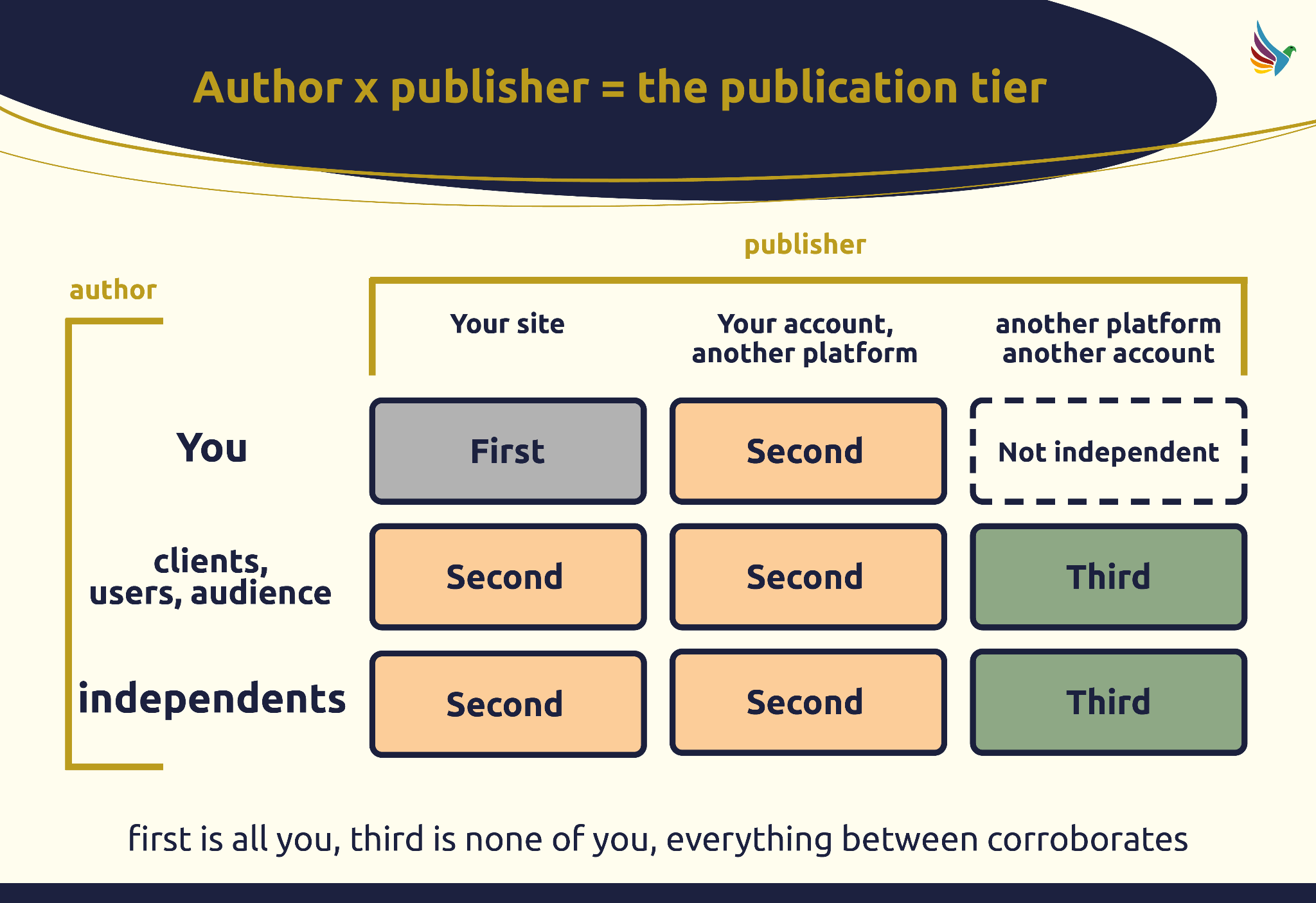
Read the grid by how much of you is in the publication.
- First-party is all you. Your words on your own site. It’s pure claim, and the machine treats it as the baseline because you wrote it and you published it.
- Third-party is none of you. Someone else’s words on a platform you don’t control. That’s why it’s the strongest proof.
- Everything in between is second-party corroboration. Your own words carried onto an account you run elsewhere, or someone else’s words that you chose to publish on your own page.
The same review is second-party when you surface it on your site and third-party when the client publishes it on their own account. The words are identical. The weight is different. The difference is determined entirely by who publishes it.
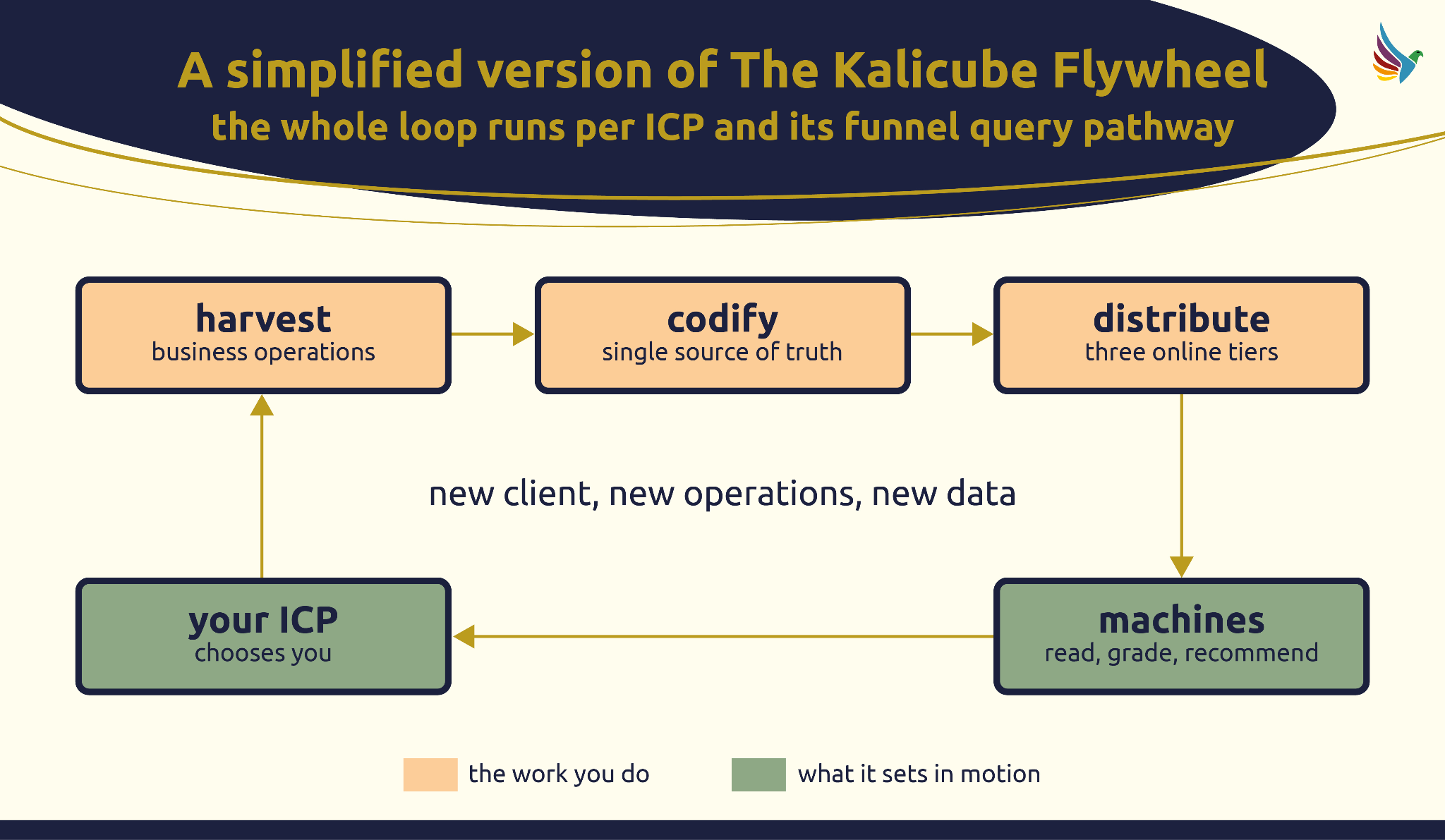
Step back, and you have a powerful loop: You harvest your operations, codify them into a single source of truth, and distribute them across the tiers machines read. Then the machines recommend you, your ICP arrives, and serving them generates the next round of operations to harvest.
Each turn feeds the next, so your digital footprint compounds instead of resetting.
The mirror principle is why this is the whole game
At the moment it recommends a brand, think of the AI engine as an honest broker — the impartial intermediary of business and diplomacy, the one with no stake in who wins, whose entire value to the person asking is that it can’t be bought.
Much as a travel agent carries every airline or a mortgage broker has the whole market on screen, the honest broker carries every brand in your category and recommends whoever it judges to be the best solution for the person in front of it. That impartiality is the entire reason the buyer trusts it, and it’s the reason the engine recommends your competitor without a flicker of disloyalty: it was never on your side, it’s on the buyer’s.
This is good news once you see it the right way. An honest broker wants to recommend you. It can only recommend what it clearly understands and trusts. So you don’t have to trick a rigged system. You have to give the broker the organized facts: hand it the most detailed, best-corroborated picture of who you are, what you do, who you serve, and why you’re the best fit for them, better and more often than your competitors manage.
Brief it better than they do, build a clearer and more convincing case, and on merit, you become the name it reaches for at the top, middle, and bottom of the funnel. The brands losing today mostly aren’t outbid. They’re out-briefed because the only picture the broker ever had of them was thin.
The briefing comes from your digital footprint. The broker forms its view of you from the world’s view of you: the reviews, the coverage, the corroboration scattered across the market, and what it shows about you is its opinion of the world’s opinion of you. That’s the mirror principle.
You can try to flatter the broker, trick it, lean on it, and it might even work for a while, but an honest broker reads the world, so the thing that holds is changing what the world can see. Do that, and you’re not manipulating anything. You’re showing the broker proof: something that was always true, just underrepresented, or simply never visible.
Briefing the honest broker is the whole job. Harvest the five streams, organize and codify them into one source of truth, distribute them across the tiers the broker reads, and you’ve handed it the fullest, truest, best-corroborated picture of you in the market, at the one moment that pays: when someone is in the market for what you sell and the broker is about to be asked who it recommends.
Do that consistently enough, across everything the broker reads, and you stop merely briefing it and start training it. That’s the finale: how you train the honest broker rather than just brief it, what an under-briefed broker costs you, and when paid placement pushes you versus when it backfires.
For now, hold onto one idea: the broker recommends based on what the world shows it, so change what the world shows it. AI is laying foundations now that will hold for years, and the incumbent wins, so don’t leave it until tomorrow.
This is the 17th piece in my AI authority series.
- Part 1, “Rand Fishkin proved AI recommendations are inconsistent, here’s why and how to fix it,” introduced cascading confidence.
- Part 2, “AAO: Why assistive agent optimization is the next evolution of SEO,” named the discipline.
- Part 3, “The AI engine pipeline: 10 gates that decide whether you win the recommendation,” mapped the full pipeline.
- Part 4, “The five infrastructure gates behind crawl, render, and index,” walked through the infrastructure phase.
- Part 5, “5 competitive gates hidden inside ‘rank and display’,” covered the competitive phase.
- Part 6, “The entity home: The page that shapes how search, AI, and users see your brand,” mapped the raw material.
- Part 7, “The push layer returns: Why ‘publish and wait’ is half a strategy,” extended the entry model.
- Part 8, “How AI decides what your content means and why it gets you wrong,” covered annotation, the last gate where you’re alone with the machine.
- Part 9, “Why topical authority isn’t enough for AI search,” opened the competitive phase proper with topical ownership.
- Part 10, “The funnel flip: Why AI forces a bottom-up acquisition strategy,” named the process.
- Part 11, “The framing gap: Why AI can’t position your brand,” exposed the gap between evidence and recommendation.
- Part 12, “The 10-gate AI search pipeline: Find where your content fails,” showed you how to find (and repair) your F grades in the AI engine pipeline.
- Part 13, “The delegation boundary: How AI decides which brands win,” mapped how delegation moves between user and engine across Search, Assistive, and Agent modes.
- Part 14, “The funnel query pathway: A framework for measuring AI visibility,” built the measurement instrument.
- Part 15, “The micro-macro shift: How to measure AI visibility now that precision is gone,” moved measurement from micro precision to macro trend.
- Part 16, “How SEO turns customer success into AI-readable proof,” put SEO inside post-sale operations.
- Up next: Why Google isn’t dying: paid and organic just collapsed onto every AI surface.
Explore more on
Editorial disclosure
Contributing authors are chosen for their expertise and work under the oversight of the editorial staff. Search Engine Land is owned by Semrush. The contributor was not asked to mention Semrush; the opinions expressed are their own.
About the author