Microsoft Advertising rolls out AI Max globally for Search campaigns
Microsoft Advertising has begun rolling out AI Max globally, bringing a new suite of AI-powered targeting, creative and landing page capabilities to Search campaigns.
Microsoft Advertising Product Liaison Navah Hopkins said the rollout combines broader search matching, automated creative generation and dynamic landing page selection, while keeping AI Max opt-in for new and existing campaigns.
What’s happening. AI Max is starting to roll out across all Microsoft Advertising accounts globally. The suite includes three core features: Search term matching, Text customization and Final URL expansion.
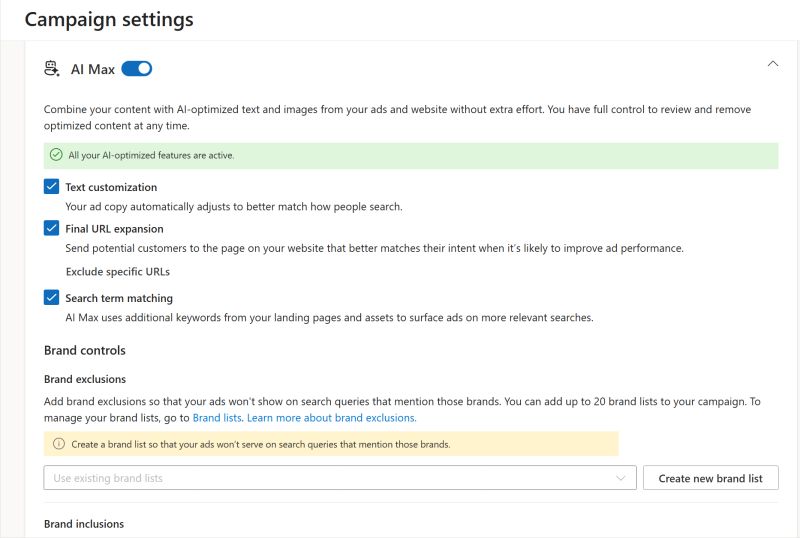
Microsoft is positioning the features as complementary, encouraging advertisers to test all three together while using brand controls, URL rules and ad group-level settings to manage how the automation operates.
Search term matching. The feature expands campaign reach beyond an advertiser’s existing keyword list by using keywords, ads, landing pages, user intent and contextual signals to identify additional relevant searches.
Microsoft says this could be particularly useful for reaching more complex, conversational queries, including searches happening through AI-powered experiences on Bing and Copilot.
Text customization. Microsoft AI can use an advertiser’s existing creative assets and website content to generate additional messaging variations.
The system then selects what it considers the most appropriate creative combinations at auction time, with the aim of making ads more relevant to individual searches and AI-native experiences.
Final URL expansion. Instead of directing every user to a predetermined landing page, AI Max can select a page from the advertiser’s website that it determines is more closely aligned with the user’s intent.
Microsoft says this is designed to create greater consistency between the search query, ad creative and the page users ultimately visit.
Search term landing page report. Microsoft is also providing advertisers with a deeper visibility than the traditional Search terms or Search term insights reports, showing how queries connect to AI Max performance and landing page experiences.
Its default columns include search term, final URL, campaign, ad group, headline, delivered match type, final URL source, impressions, clicks, spend, conversions and conversion rate.
Because AI Max can dynamically select relevant URLs based on a user’s query, the Final URL and Final URL source may differ, giving advertisers insight into how AI Max matched each search to the landing page ultimately served.
Advertiser controls. Microsoft is emphasizing that automation doesn’t mean advertisers have to surrender all control. AI Max launches with brand controls, including term exclusions for text asset generation, as well as reporting, URL rules and ad group-level settings.
Advertisers can also use optimization experiments to test the entire AI Max suite or individual features before applying them more broadly.
Existing automation moves into AI Max. Advertisers already using autogenerated text assets for Search campaigns or Predictive matching will see those capabilities moved under the AI Max umbrella.
Those corresponding AI Max settings will be switched on in affected campaigns. However, Microsoft says it won’t automatically activate the other AI Max features, and AI Max will remain an opt-in setting for new and existing campaigns.
What about Google Ads imports? AI Max settings will also carry across when advertisers import eligible Search campaigns into Microsoft Advertising.
If an imported Search campaign already has AI Max features enabled, Microsoft will preserve those corresponding settings. There is one notable exception: AI Max Search campaigns that originated from upgraded Dynamic Search Ads will be converted back into DSA campaigns on Microsoft Advertising while the company develops additional functionality.
Why we care. Microsoft is bringing more of the automation increasingly shaping paid search into a single Search campaign framework, while notably keeping AI Max optional and providing controls from launch. For advertisers already managing AI Max campaigns in Google Ads, the ability to carry settings across through imports could also reduce duplicated setup work, although differences between the two platforms mean imported campaigns will still need monitoring.
Bottom line. AI Max marks Microsoft’s latest push to make Search campaigns work across both traditional search and emerging AI experiences, with broader query matching, generated creative and dynamic landing pages now rolling out globally.
Dig deeper. More about Search term landing page report
Explore more on
Editorial disclosure
Search Engine Land is owned by Semrush. We remain committed to providing high-quality coverage of marketing topics. Unless otherwise noted, this page’s content was written by either an employee or a paid contractor of Semrush Inc.
About the author