Why the traditional link building model no longer works for AI search

Traditional link building agencies had an incredible run. The pitch was easy to sell: “We build you links from high-DR sites with commercial anchor text, your rankings improve, and you get a spreadsheet every month that tallies up your backlink counts.”
SEO teams would report to their leadership: “We built X number of backlinks this month,” broken down by domain authority. The pricing model was simple: The higher the domain authority, the more expensive the backlink.
That supply chain link building model worked well for more than a decade. But the market has evolved beyond the service model.
Do backlinks still matter for SEO?
Yes. Links still matter because, without a certain baseline level of authority, competitive SEO thresholds become hard to clear.
But the outdated package of 500-word guest articles, link inserts, and high-volume link exchanges is becoming less effective for AI search.
If you’re still buying links, you’re paying for fake authority instead of building it. And if you’re paying a GEO agency for “LLM visibility campaigns,” you’re still buying fake authority, just wrapped in new marketing jargon.
Here’s why traditional link building is fundamentally broken, how AI search exposed it, and how to acquire real authority today.
What a $500 backlink really buys you
Most traditional link building vendors sell a unit. That unit is a link insert or a guest article, and the pricing is almost always tied to domain authority.
Over the years, I’ve personally tested dozens of link building services and audited countless vendor proposals. If you look at a typical pricing sheet today, you’ll find flat rates of $400 to $500 per backlink, or rigid monthly retainers starting at $5,000.
But let’s look at the reality of what that $500 per link actually buys you.
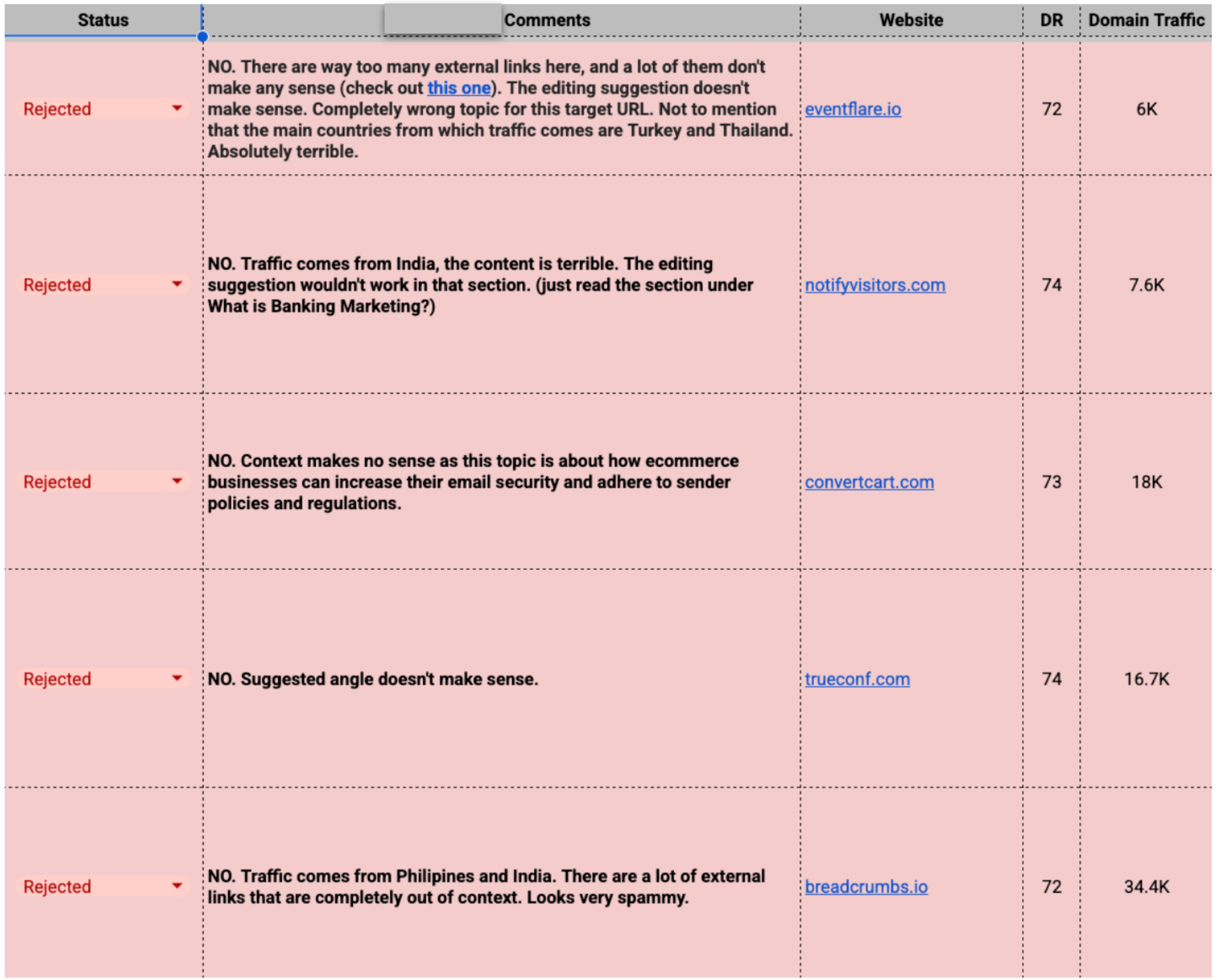
A vendor might promise a placement with a Domain Rating of 70+ and 15,000 monthly organic visitors. On paper, it passes the test. But when you actually inspect the link placements, the cracks show immediately.
*Example below: I rejected 40+ link insertion pitches because they were completely irrelevant.*
Here’s what you typically find when you dig into those “high-quality” $500 links:
- The link is shoved into completely irrelevant content that makes zero contextual sense.
- The page traffic is generated entirely from countries outside the client’s target market.
- The editing suggestion completely ignores the core topic of the client’s target URL.
- The page is already stuffed with spammy, out-of-context external links.
Link building vendors hide behind Domain Authority
This exposes the core problem with traditional link building: It focuses on the wrong incentive. The agency is paid to produce a spreadsheet row, not to build real authority. The client receives proof of activity, not impact.
Link building vendors use Domain Authority as a crutch because it gives buyers an easy filter and sellers an easy pricing model.
But a high Domain Authority number is often just an illusion of authority. It doesn’t guarantee that the website is legitimate or that the referring page drives organic traffic.
And it certainly doesn’t guarantee that the content is editorially credible or that AI systems will consider that backlink as a source when deciding to recommend your brand.
AI search is harder to manipulate with one-off backlinks
Wil Reynolds said it best:
- “In the old days you could just muscle your way to the top of Google with zero receipts that you are “top 3” at XYZ thing. If you had enough domain authority you could rank. AI is 100x more likely to force you to have receipts to back up your claims.”
For years, the goal was to push a target URL higher up in the traditional rankings list. SEO teams achieved this through “ground and pound” link building to a specific target URL.
AI search forces a completely different and more complex question: Did we create enough credible context for an AI system to understand, trust, and recommend the brand?
That’s nearly impossible to fake with random, forced links.
AI models are looking for consensus, not random backlinks
AI answer engines analyze patterns of corroboration across the entire web. They don’t just crawl your backlinks. They synthesize the consensus around your entity.
If your brand is mentioned across credible, topically relevant sources, the model encodes it as factual.
A random link doesn’t add to your brand consensus. It gets filtered out as noise.
Context is the new authority signal
In traditional SEO, a link was a form of digital vouching.
In the AI world, the co-occurrence of your brand name next to relevant industry terms, competitors, and specific use cases is the signal. AI systems map your brand’s entity footprint. They identify what you do, who you serve, and who you compete with.
A link stuffed into an irrelevant guest article provides zero entity context. It’s essentially invisible to the AI’s understanding of your brand.
AI mention building is just link building 2.0
As the industry shifts toward AI search, link builders are scrambling to adapt. Instead of evolving their underlying model, many are simply rebranding it. Enter the GEO grift.
Agencies that previously sold backlinks are now pitching “AI mention building” and “LLM visibility campaigns.” The sales pitch promises to engineer your brand into ChatGPT, Perplexity, and AI Overviews. Look under the hood, and it’s the exact same playbook wearing a new mask.
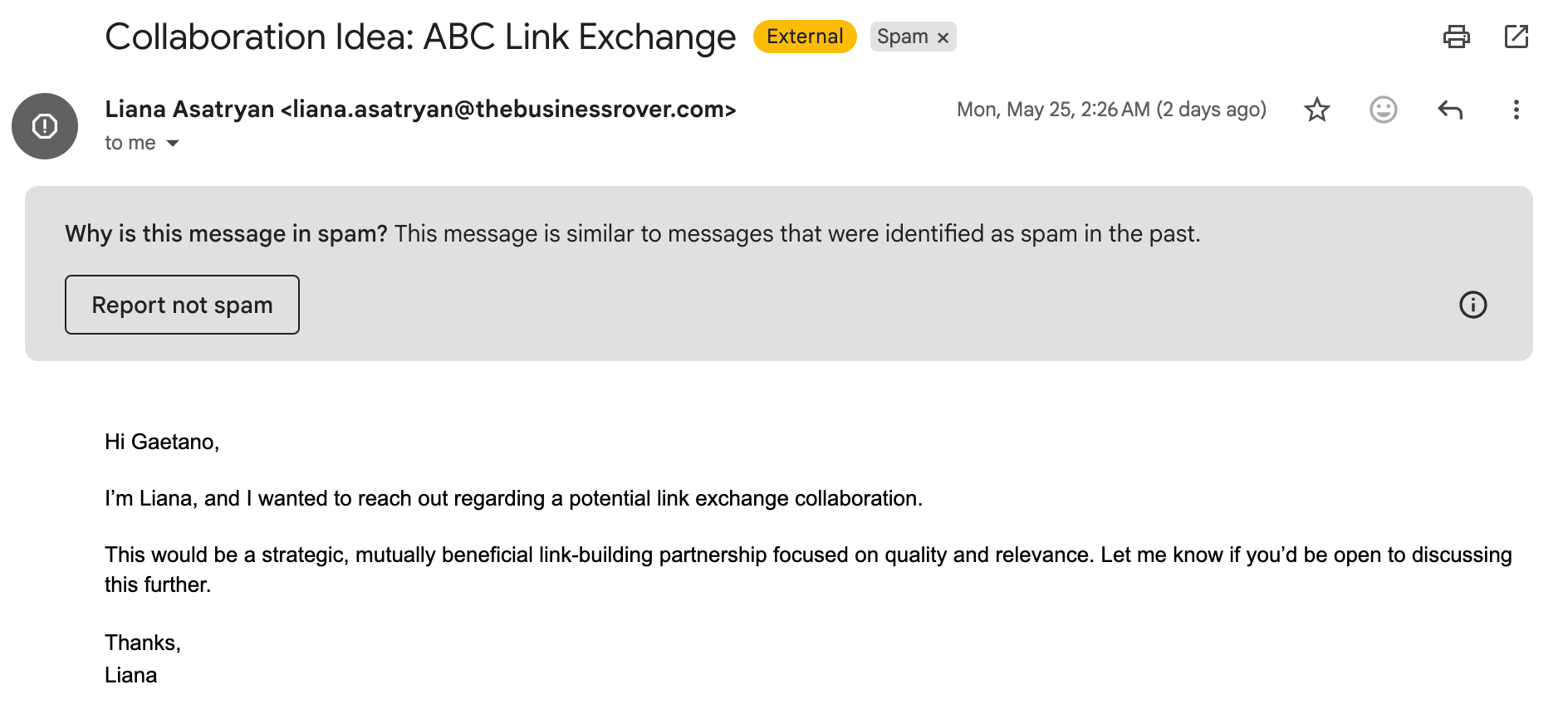
Take a look at the pitch below. The sender explicitly states, “We’re not asking for a backlink, just a mention,” but immediately follows it up with an offer to link back to you from a “partner site” in return.
It’s the exact same ABC link exchange scheme, just rebranded with AEO/GEO buzzwords.

Instead of building real authority, these vendors repackage the tired outreach model:
- Selling brand mentions on the exact same low-quality websites.
- Paying for sponsored listicles on external sites just to rank their clients at the top.
- Pitching a Reddit strategy that’s actually just blatant astroturfing.
Buying fake brand mentions isn’t a modern AEO/GEO strategy. Third-party validation only matters when it comes from credible, topically relevant sources.
If a brand mention doesn’t come from a domain that buyers and AI engines already trust, it won’t influence a recommendation.
The industry’s trusted source for essential news and analysis.
Sign up for our newsletter to receive exclusive insights and updates directly to your inbox.
- Daily breaking news
- Expert analysis from industry veterans
- Join over 200k subscribers
- Covering SEO, PPC and AIO
What to do instead
GEO is a relevance engineering problem, not a tactical link building problem.
AI systems are trying to determine exactly what you do, who you serve, and where you sit in the competitive landscape. If you don’t intentionally shape that narrative, AI excludes your brand from the vendor selection process.
When buyers ask AI search platforms for a shortlist of vendor solutions, your brand needs to become an unavoidable, logical answer.
Here are some ways to achieve this.
Drive customer reviews to influential third-party sources
In this example for “best insider risk management solutions,” it’s clear that your brand must be represented on Gartner.
If your brand profile isn’t aligned to the correct Gartner category, and you aren’t driving credible and authentic customer reviews for this product line, your brand will likely be excluded from the vendor selection process.

Publish owned BOFU listicles for narrative control
This has become a hot topic in SEO, but there’s a way to do it right.
John-Henry Scherck says that if your brand belongs in a category, it makes sense to build your own bottom-of-funnel comparison content.
But the goal isn’t to artificially rank your brand as “number one” in hopes of manipulating AI search. Instead, do it for brand narrative control.
By publishing objective comparisons on your own site (e.g., Your Brand vs. Competitor, Competitor Alternatives), you increase your chances of entering the citation pool.
This helps the AI accurately understand your product features, use cases, and market position relative to your competitors, ultimately enabling it to better understand when it should recommend you.
Build proprietary content assets
Cyrus Shepard found in a recent study that 92% of sites that experience significant organic growth produce their own proprietary assets.
Vince Nero also pointed out that owning a unique data asset on your own site allows you to run legitimate digital PR campaigns that earn real coverage, rather than paying vendors for forced insertions.
Focus your content budget on:
- Original data studies and industry benchmarks.
- Free interactive tools and calculators.
- Multimodal assets like infographics and comparison charts that AI models can easily parse.
The bottom line is that you should strive to create assets that no competitor can copy.
Rely on founder-led PR and real relationships
Spamming out generic cold email templates for link exchanges doesn’t build trust. Most of it never even reaches a human being.
Irina Maltseva recommends shifting entirely to relationship-based marketing. You build true entity association by getting your founders and subject matter experts out into the market. This looks like:
- Securing appearances on industry podcasts.
- Co-marketing with non-competing SaaS companies that share your audience.
- Earning mentions in private communities, newsletters, and dark social channels.
Links are ultimately the result of a smart marketing strategy
Traditional link building agencies are struggling because the market no longer rewards raw link volume as a measure of success.
SEO teams need to abandon the tired publisher database model that forces links into irrelevant guest articles to hit a monthly quota.
If your brand is absent from the conversations that shape your category, no number of forced backlinks or brand mentions will fix the problem.
The best links don’t come from rows of a spreadsheet that need to be manually reviewed and approved. They’re the natural result of a good marketing strategy.
Explore more on
Editorial disclosure
Contributing authors are chosen for their expertise and work under the oversight of the editorial staff. Search Engine Land is owned by Semrush. The contributor was not asked to mention Semrush; the opinions expressed are their own.
About the author