At One Month, Bing Says Unique Users Up; Compete Says Barely Any Gain In Searches
A second major ratings service, Compete, has now released search engine share figures for June 2009 showing Microsoft’s new Bing service making a tiny gain. That, following Hitwise’s mixed stats from last week, keeps Bing in “it’s too early to say” territory. Meanwhile, Bing itself says at one month old, unique users up 8%. Here […]
A second major ratings service, Compete, has now released search engine share figures for June 2009 showing Microsoft’s new Bing service making a tiny gain. That, following Hitwise’s mixed stats from last week, keeps Bing in “it’s too early to say” territory. Meanwhile, Bing itself says at one month old, unique users up 8%.
Here are the figures showing share of searches each search engine handled in the United States, for June 2009 from Compete:
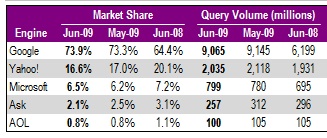
Normally, I’m loathe to do month-to-month comparisons, because they can be so easily skewed by many factors and not be indicative of a trend. But given Bing’s massive launch, it makes sense to look closely at the May to June 2009 change.
Bing was up — barely — from 6.2% to 6.5%, a tiny 0.3% gain. Did that hurt Google? Nope. Google rose from 73.3% to 73.9%, a 0.6% gain. Down were Yahoo and Ask, both losing 0.4% in share. AOL was unchanged (and barely registers at 0.8%).
So Bing hurt Yahoo and Ask? Hard to say. There’s often a seasonal downturn in summer, when students are out of school, so searching declines.
In terms of search volume — the actual number of searches performed — EVERYONE but Bing was down. That suggests the new marketing helped drive additional queries rather than necessarily pulled from the other players.
Google dropped from 9.145 billion searches in May to 9.065 billion searches in June, an 80 million searches drop. Yahoo lost about the same, 83 million searches. Ask lost 55 million and AOL lost 5 million. That’s 223 million searches lost. Did Bing get them all? No. Bing was up only 1 million searches.
What happened is the overall search “pie” of searches got smaller. Bing’s marketing helped it keep a larger slice of pie than likely would have happened, but the decline of the others isn’t because it “stole” from them.
And how’s Google up on a percentage basis when it’s also lost 80 million searches? That’s because on a percentage basis, Google actually got a bigger slice of the smaller pie compared to May 2009.
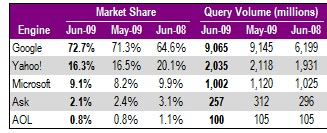
If searches from Bing’s “Club Bing” gaming service are included, the service does much better, gaining nearly 1% in share (0.9%). But Google also gains even more share, 1.4%. That’s because in May 2009, when Club Bing (then Club Live) figures were counted, that gave it less of a slice compared to June:
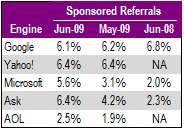
In terms of ads, Bing has more to trumpet. The percentage of “sponsored referrals,” that is the percentage of people clicking on ads compared to free results, nearly doubled from 3.1% in May to 5.6% in June, a 2.5% gain:
That comes along with news from Efficient Frontier’s research that Bing has gained click share along with advertiser spend share (see Report: Search Ad Spending Stabilizes While Bing Gains On Google, Yahoo).
Of course, both Ask and AOL saw similar gains. Ask gained 2.2% month-to-month in sponsored clicks and AOL got a 1.9% gain. Neither had major redesigns or marketing pushes.
Where’s this leave us? Hitwise: Bing Both Grows & Drops In June; Google Still Tops covers how stats last week from Hitwise were hardly conclusive. On a monthly basis, Bing lost share. On a week-by-week basis, it gained over 2% from the beginning of the month to the end.
So, it remains watch-and-see. NetRatings and comScore will be out later this month with their own figures for June. Still, we really want to see what happens around October and November, when people are back from school and the marketing barrage has ended or ramped down. How has the service done then? Bing: comScore sees Gains; Compete Sees Same Old, Same Old has more perspective about that.
Meanwhile, over at the Bing blog, Microsoft has posted some stats of its own in Bing At Month One:
- Bing said it saw an 8 percent growth in unique users (note this is users, not actual searches, if you’re trying to compare to Compete or other figures)
- Bing said its estimate of “people likely to recommend” visitors to Bing doubled
- Shopping’s said to have had a 3 times increase in visits and 5.42% increase in Cashback transactions
- Travel’s said to have had a 90% increase in traffic
Contributing authors are invited to create content for Search Engine Land and are chosen for their expertise and contribution to the search community. Our contributors work under the oversight of the editorial staff and contributions are checked for quality and relevance to our readers. The opinions they express are their own.

Related stories
New on Search Engine Land
About the author
