Long-tail keywords: Target lower-competition phrases and attract qualified visitors
As a search engine user yourself, when you want to know how to do something or explore your options around a decision, chances are you’ll use a long-tail keyword.
Maybe you’ll search Google for [warm places to visit in December] when you’re planning your next getaway or [how to make strawberry shortcake] on a wet Sunday afternoon.
Congratulations! You’re using long-tail keywords to search.
Because of their specificity, long-tail keywords may have less search volume – and less competition.
It’s often easier to rank for these longer phrases. It can also be easier for someone searching to find what they want.
Does that sound like a win-win?
Good. Because it is.
Read on to learn how long-tail keywords can help with SEO and ways to identify and incorporate long-tail keywords into your content.
What are long tail keywords?
Long tail keywords are longer, more specific search phrases that people use when they’re closer to making a decision or looking for something very specific. Compared to head terms, long tail keywords usually have lower search volume but higher intent—and less competition—making them easier to rank for.
These keywords are great for attracting highly targeted traffic and are especially useful for smaller or newer websites. For example, instead of targeting the broad keyword “shoes”, a long tail version might be “best running shoes for flat feet women.”
The use of “head” “tail” and “long tail” when applied to search keywords originates from an analogy to a comet. At the head is the large bright mass, and trailing towards infinity is the long tail.
The SEO toolkit you know, plus the AI visibility data you need.

Infinity may seem exaggerated, but consider this:
- In 2007, 25% of Google queries on a daily basis had never been seen before.
- Today, despite significant changes in access to devices and faster connections, that figure is still 15%.
Why does this matter?
Knowing there’s a potentially never-ending long tail means there’s a huge opportunity to develop an effective keyword and content strategy.
Although individual long-tail keywords may generate little relative traffic, together, they make up a whopping 91.8% of Google searches.
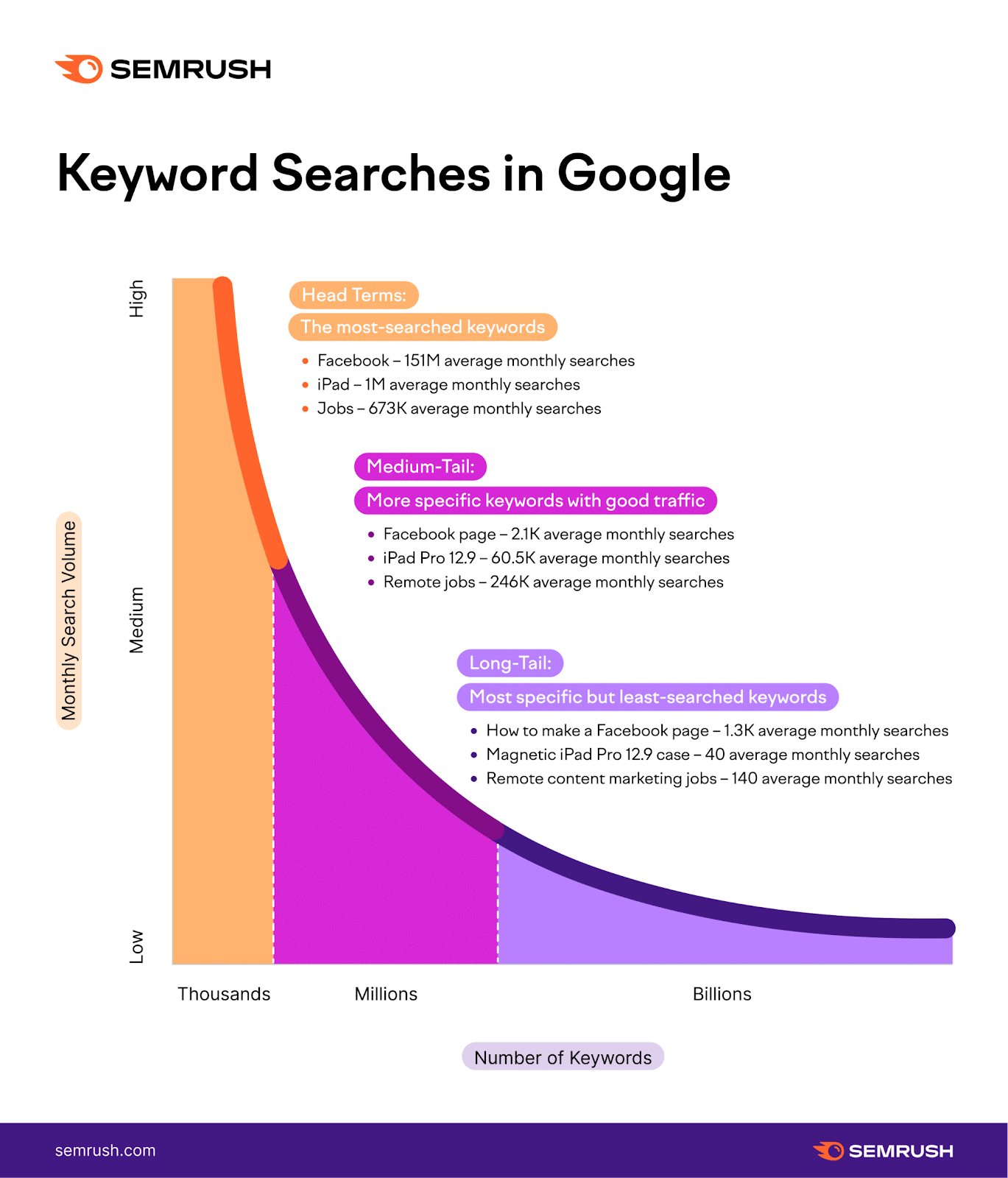
By comparison, the most-searched keywords like “iPad” or “jobs” are at the top of the volume and frequency graph (or “head” of the comet). Some have millions of monthly searches. They’re also highly competitive, and unless they include a brand term like “Facebook,” they tend to lack context.
Medium-tail keywords are somewhere in the middle for length, popularity, and search volume. These keywords often contain a qualifier that reveals more about the search user intent.
Head and medium-tail keywords, more often than long-tail, can generate a SERP that incorporates AI results or another kind of SERP feature. For example, [weather today].

While extensive SERP snippets or AI results (AI Overviews in Google, for example) are less likely with long-tail keywords, SERP analysis is an important consideration with any keyword strategy.
Identifying great long-tail keywords with search user intent that’s relevant to your content gives you more opportunity for more SERP share of voice. Just one of the many reasons long-tail keywords are an important part of your strategy.
Why long-tail keywords matter for SEO
Long-tail keywords show us what our potential visitors or customers want. Identifying and evaluating these keywords can reveal:
- What matters in decisions (think of keywords that include “best” or “cheapest”; e.g., “best women’s hoodie”).
- Which product features might be more popular than others (think of qualifiers like color or style; e.g., “red hoodie front pocket”).
- Questions they may have before considering a solution (“Hoodie Warehouse returns policy”).
Long-tail queries are more specific than broad keywords, like “smartphone” or “coffee brands.” This means that they:
- May be less competitive.
- Allow you to reach a niche market.
- Are more likely to align with search intent and drive conversions.
- Are ideal for creating targeted content.
- Trend toward lower cost per click (CPC) for paid search campaigns.
Let’s say you sell coffee online and use your blog to drive traffic. By focusing on long-tail keywords, you have higher odds of ranking in organic search.
Short, generic keywords (e.g., “coffee”) are highly competitive and can take months or years to rank for.

“Organic coffee beans,” “best coffee for espresso,” and other long-tail keywords have fewer searches because of their specificity. Plus, consumers who use them are often closer to making a purchase because they’re more aware of what they want.
These shoppers don’t just want to know more about coffee. Instead, they’re looking for a specific type of coffee or want to find local stores offering that product (e.g., “organic coffee shops NYC”).
Optimizing your website or blog for long-tail keywords related to your product or service can boost conversions. You can more easily create content that addresses the specific needs driving your target audience to search. The more creative you get with your long-tail keywords, the wider you cast your net.
For example, you could branch out while exploring topics related to “organic coffee beans” and focus on their benefits, like “organic coffee beans benefits,” “organic mushroom coffee benefits,” “organic coffee benefits for skin,” etc. Your resulting blog content can provide people with the information they need and also lead them to engage with other related content, products, or services on your site.
As your click-through rates rise and bounce rates fall, Google will recognize how your content matches these keywords and boost your SERP rankings.
5 ways to find long-tail keywords
Long-tail keywords are one of the secret tools in a seasoned marketer’s toolkit. If you get good at finding new long-tail keywords, you enjoy an endless source of new audience segments and cool content ideas to connect with your audience across all channels, not just organic search.
1. Use Google Autocomplete
What better way to find search queries than by using Google itself?
Start by entering a generic keyword into Google. For example, “coffee machines.”

As you type, Google’s Autocomplete feature will display keyword variations, including long-tail queries. These variations are informed by several factors including trending interests relating to what you typed in. You get to tap into real-world intel on related long-tail queries of interest!
Pick the most relevant keyword variations and then analyze them with a tool like Semrush’s Keyword Overview to get more detailed insights.
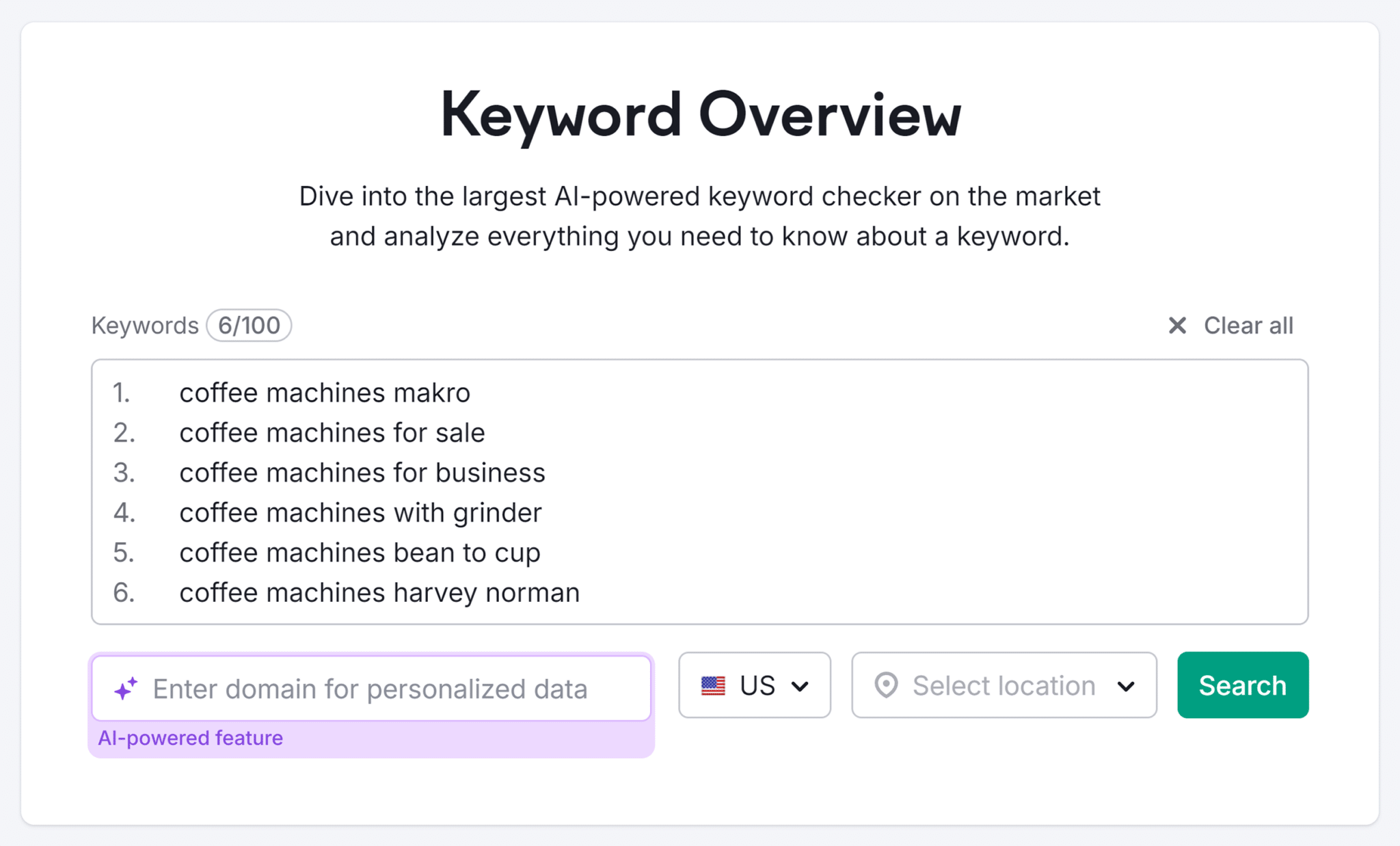
The tool will generate a report where you can see their average monthly search volume. Other relevant data includes:
- Keyword difficulty (KD%): How hard it is to rank in Google’s top 10 results for a given keyword. The lower this percentage, the better.
- Search intent: The reason behind an online search (e.g., informational or transactional intent).
- Trend: User interest in a search term over the last 12 months.
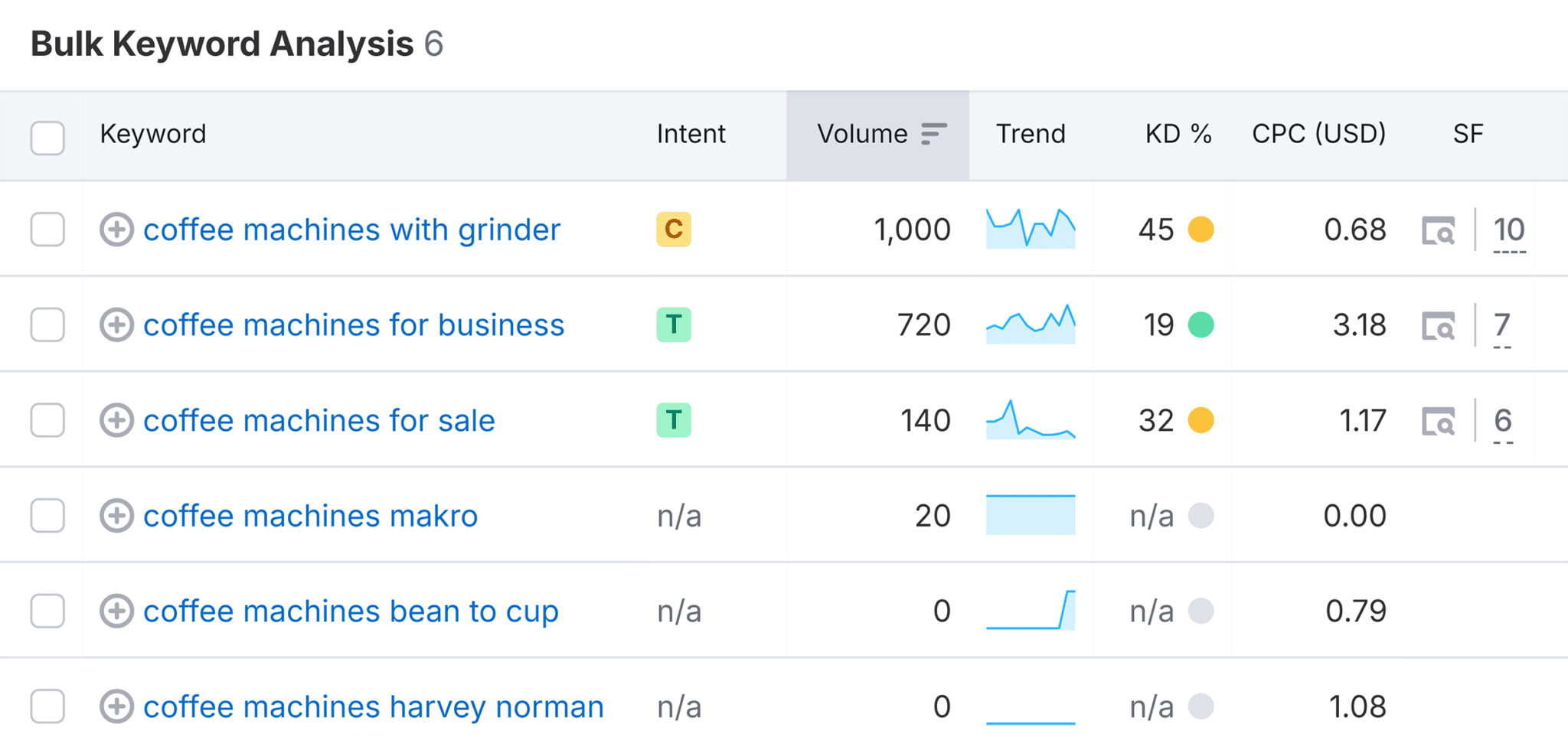
For instance, “coffee machines Makro” fits the definition of “long tail.” Not only is it highly specific, it also has a low search volume and low keyword difficulty.
2. Discover long-tail keywords with Semrush
Use Semrush’s keyword research tools to identify and analyze long-tail queries. Consider these options:
- Keyword Overview: Check up to 100 keywords at a time to discover their search volume, intent, competition level, and popularity.
- Keyword Magic Tool: Research your target search terms and get relevant keyword ideas. Filter or sort the results to narrow down your choices.
- Keyword Gap: See how your keyword strategy compares to that of your competitors. Use this data to uncover hidden opportunities, such as keywords they may have missed.
For example, Semrush’s Keyword Magic Tool gives you access to a database of over 25.5 billion search terms. Simply enter a “seed” keyword, or the search term you’ll base your research on, in the designated field.

Based on what you input, the Keyword Magic Tool will generate a list of related terms. You can filter the results by monthly search volume, keyword difficulty, word count, and other criteria.
Say you’re looking for keywords that are easy to rank for and have at least 100 searches per month.
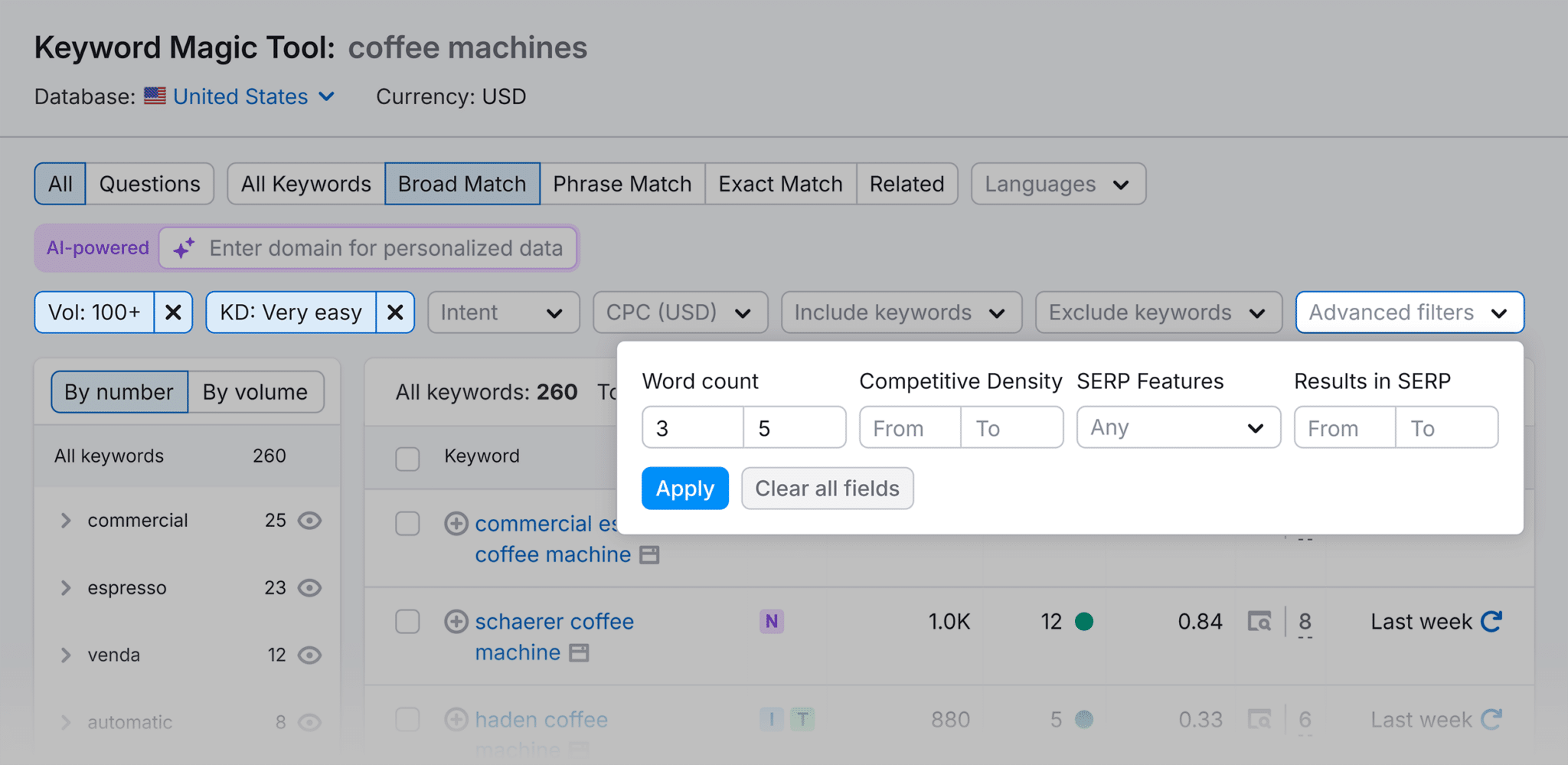
Apply these filters and then analyze the results. For example, you can click the “Questions” tab to get a list of search queries in question form. Long-tail keywords in question form can be really useful to inform your content strategy. For example, consider “how to clean a coffee machine with baking soda?”
- If you’re an expert barista who’s now an independent coffee store owner, you could answer the question with tips from your relevant experience
- If you’re a high-end coffee machine manufacturer, you may want to add the company’s stance on if customers should use baking soda to clean their machines, and if they do, what are the warranty implications?
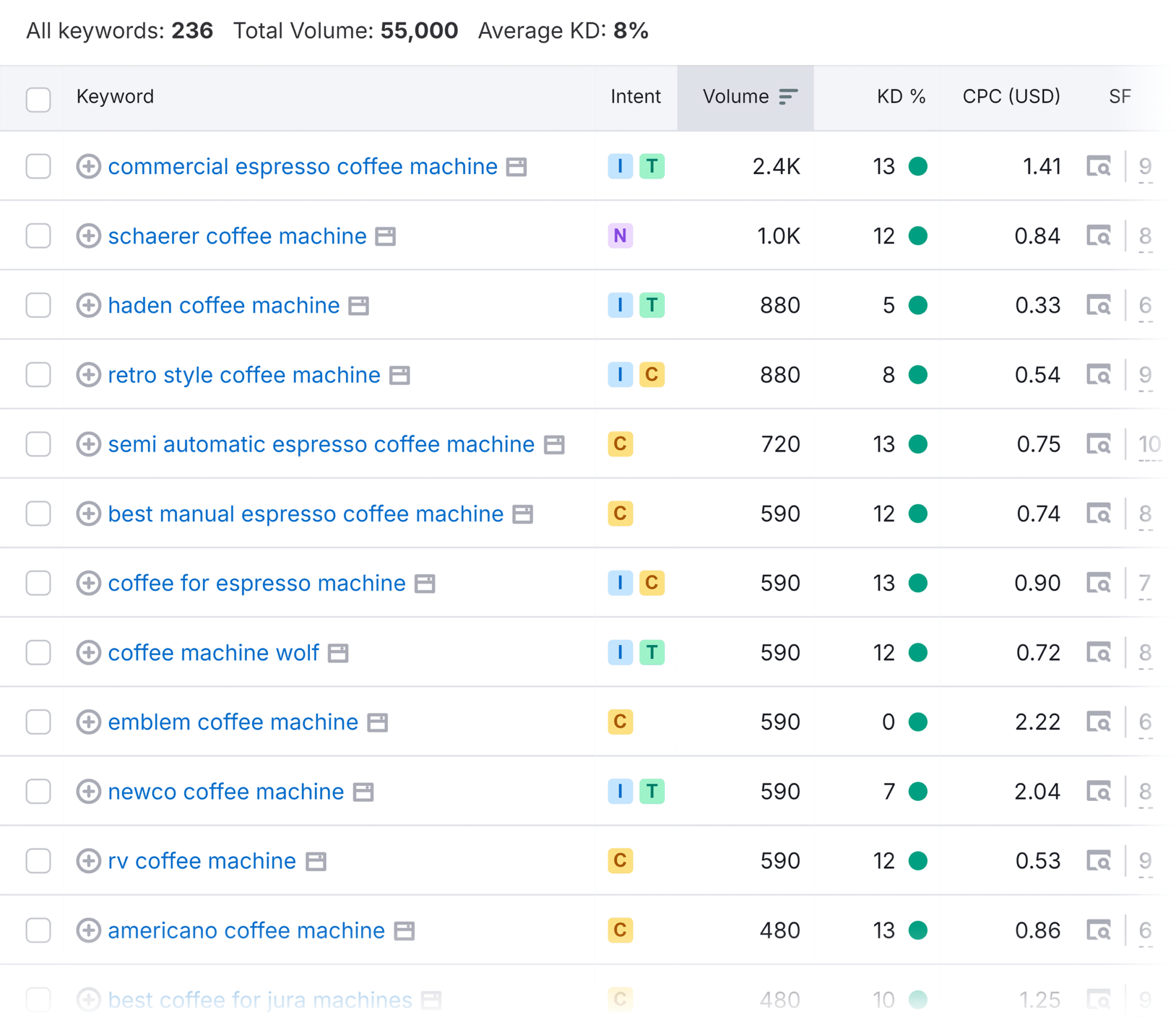
Remember, long-tail keywords can reflect all stages of a person’s experience with a topic, from consideration stage to post-purchase.
3. Analyze your competitors
Are your competitors hoarding long-tail keywords? They could keep valuable audience segments and traffic away from you.
Find out what keywords your competitors are targeting – and discover new opportunities to outperform them – by using Semrush’s Keyword Gap.
Keyword Gap lets you compare your website against up to four of your competitors. Use this tool to:
- See keywords your competitors are ranking for but you aren’t.
- Discover search terms both you and your competitors are targeting.
- Find gaps in their keyword strategy.
4. Explore niche forums and Q&A websites
Niche forums and Q&A sites are great resources for keyword research. You can leverage the questions asked as writing topics, or note key discussion points and common phrasing used in the comments.
Remember, wording matters when it comes to search. You should always use the language your target audience is using.
As you scour forums and discussions online, you can identify gaps in your content strategy and find untapped keyword opportunities to expand your reach.
Start by looking to see where your audience hangs out. Some good starting points include:
- Quora.
- Reddit.
- GitHub Community.
- Facebook or LinkedIn groups in your niche.
To save time, type “site:forum + topic” into Google’s search bar.

Google will display the discussion threads related to the topic you entered. Scan them to start identifying long-tail keywords used in conversations and user questions. Run them through Semrush’s Keyword Overview tool.
Alternatively, use SEO tools like Semrush’s Organic Research to mine online forums for relevant keywords.

5. Leverage Google Search Console
With Google Search Console (GSC), you can see the keywords visitors use to find your website and how you rank for each query.
To get this data, check the Performance report on your GSC dashboard.
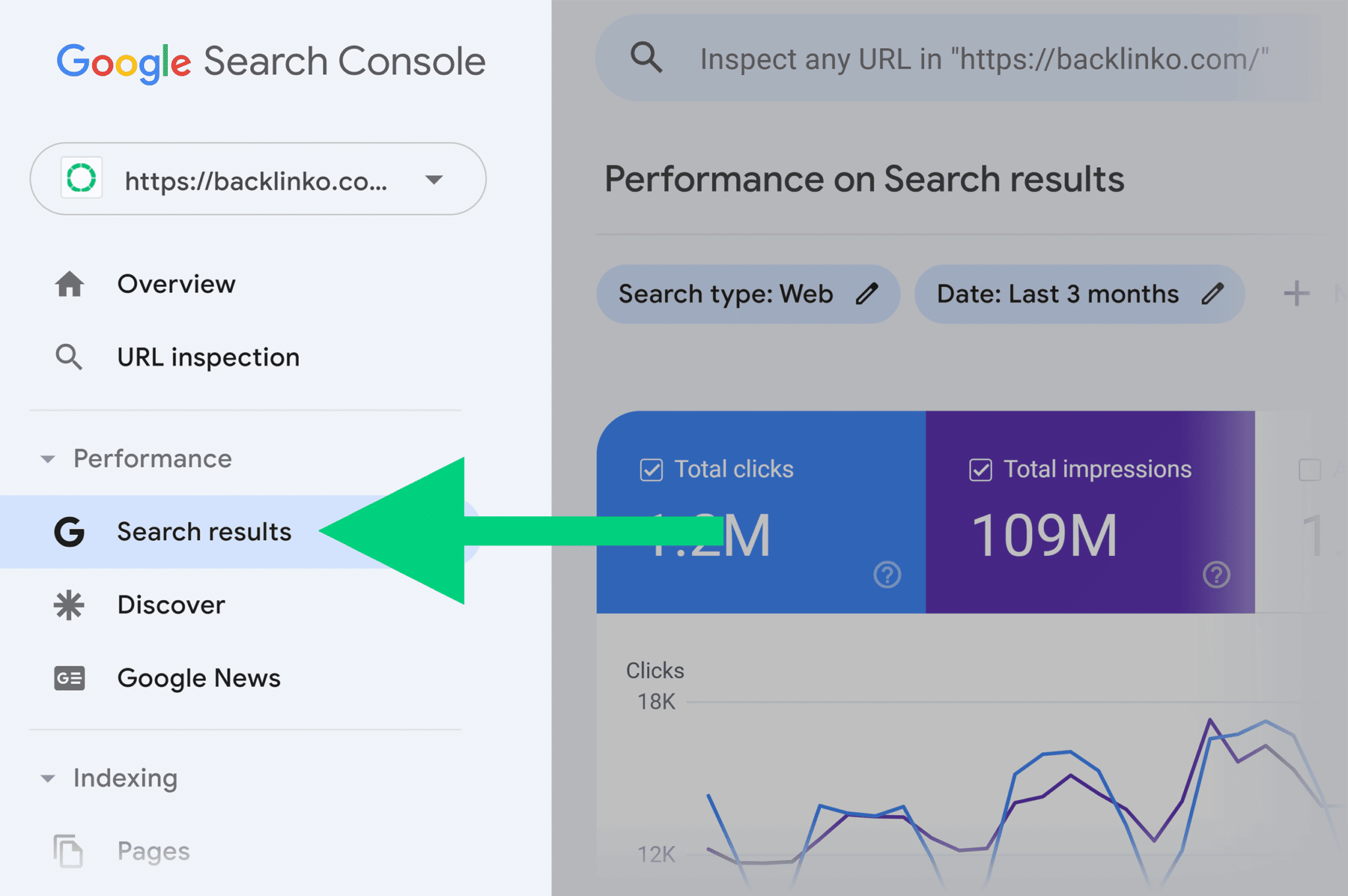
Then, click Queries and sort the results in descending order by position.

Scroll down until you find positions 11 to 30. These are the keywords you rank for on Google’s second or third page. They already drive traffic to your site and might be worth targeting.
Analyze them with Semrush’s Keyword Overview to gauge their competitiveness, ranking difficulty, and traffic potential. Pick out the long-tail keywords and start creating content!
How to use long-tail keywords in your content
Use long-tail keywords to optimize existing content so it goes deeper into topics. For example, add new related content to expand existing pages. Only do so where it is a natural continuation of the topic or customer journey.
Another way to leverage long-tail keywords for SEO is to craft content around them, such as in the earlier example of “how to clean a coffee machine with baking soda?”
Who you are and how you approach answering a question may dictate what content format you create. If it’s a webpage, use the search term naturally in the page title and other strategic locations, including:
- Page URL
- Subheadings
- First and last paragraphs
- Title tag
- Meta description
- Throughout the content
Use multiple secondary keywords where appropriate. These search terms are related to the primary keyword and the topic.
Also, remember to include your primary keyword in the title tag and meta description. Google may use these HTML elements to understand what your page is about, and they often appear as the SERP snippet.
Avoid these common long-tail keyword mistakes
Long-tail keywords can be a powerful tool when wielded effectively. Avoid the following pitfalls as you work through your keyword research and content development.
Ignoring or misaligning user intent
Although the specificity of long-tail keywords helps align your content with search intent, it’s always a good idea to confirm this is the case by reviewing the SERP directly.
Otherwise, your content might not appeal to the target audience.
The result? Low engagement, which leads to poor conversions and higher bounce rates.
Overstuffing keywords
Keyword stuffing, or the practice of overusing specific keywords on a web page to try to manipulate Google, can hurt your rankings. In the worst-case scenario, it could get your website deindexed from Google.
This tactic affects content quality and user experience (UX), resulting in low engagement. It can also reflect poorly on your brand and turn away potential customers.
Incorporate keywords naturally throughout your content. If there’s tangible monthly search volume for a long-tail keyword, make sure your content matches the intent so that you offer value, not repetition. Use long-tail variations where appropriate instead of repeating the same keyword.
For example, if you were trying to rank for “paper coffee filter,” here’s an example of what keyword stuffing vs. writing more naturally could look like:
| Example of keyword stuffing (Bad) | Not keyword stuffed (Good) |
| Paper coffee filters are essential for brewing the perfect cup of coffee, and choosing the right paper coffee filters can make all the difference. High-quality paper coffee filters trap oils and sediment, ensuring a clean, smooth flavor in every cup. Many coffee lovers prefer unbleached paper coffee filters for a more natural brewing experience, while others appreciate the convenience of pre-folded paper coffee filters that fit neatly into any coffee maker. If you’re looking to upgrade your coffee routine, investing in durable, eco-friendly paper coffee filters can improve the taste and quality of each brew. Whether you’re choosing to buy a paper coffee filter for use in a drip coffee maker or a pour-over method, finding the best paper coffee filters tailored to your needs can elevate your coffee experience to a new level. | Choosing the right paper coffee filter can make all the difference in brewing the perfect cup of coffee. Higher-quality filters trap oils and sediment, ensuring a clean, smooth flavor in every cup. Many coffee lovers prefer unbleached paper coffee filters for a more natural brewing experience. Other drinkers appreciate the convenience of pre-folded filters that fit snugly into their machine. If you’re looking to upgrade your coffee routine, investing in durable, eco-friendly paper coffee filters can improve the taste and quality of each brew. |
Focusing only on volume instead of relevance
Just because a long-tail keyword has high search volume doesn’t mean it’s a great one for your audience.
For example, say you work for a nonprofit and want to write a content series about community outreach. You look up “outreach” in the Keyword Overview tool to try and get ideas from the types of questions commonly asked.
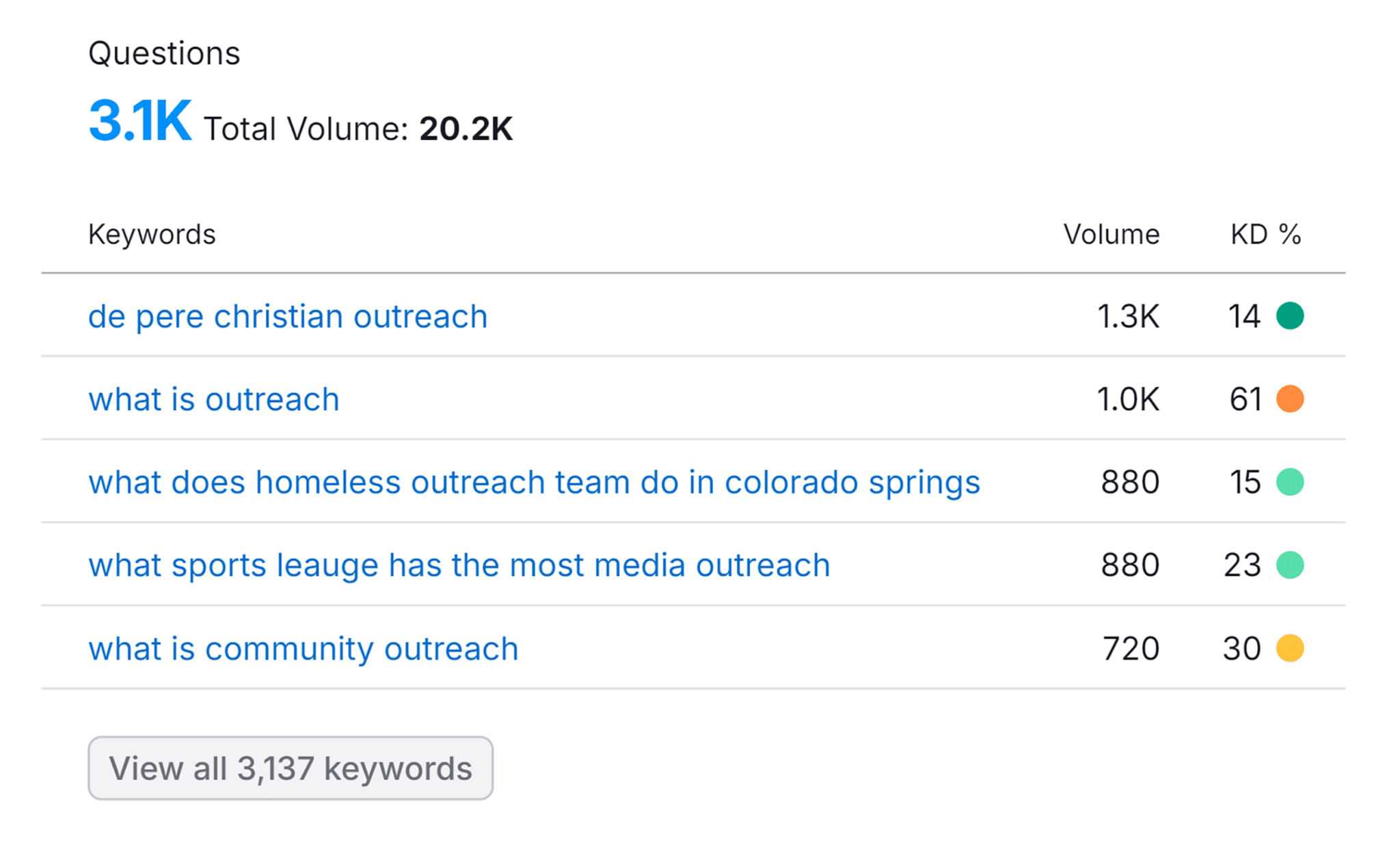
The highest volume long-tail keyword here is “how to double text a cold outreach on linkedin,” which makes sense for an audience in business sales but isn’t relevant to your audience.
Although it has about half the search volume, a better long-tail keyword on this list is “how to make community outreach video.” The latter is relevant to your audience and therefore more likely to drive meaningful engagement.
Track, optimize, and win in Google and AI search from one platform.
Long-tail keywords are just one aspect of keyword research
Long-tail keywords are just one tool in your SEO toolkit. A robust keyword strategy balances keywords across varying levels of keyword difficulty, analyzes competitors to find new opportunities, and even leverages lessons from paid search.
Next up, learn how to quickly uplevel your keyword strategy for maximum reach.
Opinions expressed in this article are those of the sponsor. Search Engine Land neither confirms nor disputes any of the conclusions presented above.
Explore more on
Editorial disclosure
Search Engine Land is owned by Semrush. We remain committed to providing high-quality coverage of marketing topics. Unless otherwise noted, this page’s content was written by either an employee or a paid contractor of Semrush Inc.
About the author