Cloudflare will upend the AI visibility space

At Cloudflare Connect 2026 last week, the message was clear: the agentic internet has arrived, and Cloudflare sits at its center. I believe what Cloudflare is building for AI visibility will fundamentally change how SEOs and marketers report on AI and agentic traffic.
CEO Matthew Prince drove home that agentic traffic is the future, predicting it will reach 1,000x human traffic. He didn’t give a timeline, but said Cloudflare has pulled its predictions forward considerably because of how fast AI adoption is moving. He wasn’t kidding.

Day 1: The bots look human now
Over breakfast on Day 1, a couple of engineers told me that since Meta Muse launched, they’ve seen 20,000+ unique residential IPs hitting their site with behavior nearly indistinguishable from human traffic.
That’s a different problem from the familiar one: a few actors deploying many bots with a similar footprint, which the web already has established ways to handle. These new bots interact with page elements and solve CAPTCHAs. The engineers were weighing whether to keep guest checkout open or block bots to relieve the strain on their systems. I’m not sure where they landed.
Another conversation turned to when and how to disclose that you used AI to write something. The two ends of the spectrum: train your AI on your past writing so it sounds like you, or append “this was made by AI” to everything. My takeaway: these tools help, but people are already weary of reading AI text.
I left Day 1 less pessimistic about agents. It’s still unclear how well they handle basic tasks that make life easier, but people are clearly using them. Even so, the senior engineers presenting didn’t trust their agents to act on their behalf.
Day 2: Tools for search marketers
Day 2 brought more tangible features for search marketers, presented by Michael Tremante, VP and Field CTO at Cloudflare:
- AI Search Index: Lets webmasters opt in to Cloudflare’s index. This intrigued me because it could open a path to enforcing monetization. Setup took a minute, and our site is now indexed. We’ll see if it goes anywhere.

- AI Crawl Control: Serves bots a static, agent-ready version of your site before they ever reach it. It launched a year ago, but new features show which bots are crawling and which crawls turn into traffic. That will change AI reporting as we know it. Having hard data right now is a breath of fresh air.

The star of the show: The AEO report
If you’re like me, you’ve been smashing the “Register Your Interest” button on the Agent Readiness dashboard to no avail. I finally got a preview from Ashish Vinodkumar and Will Rowe, who led the research and envisioned the dashboard.
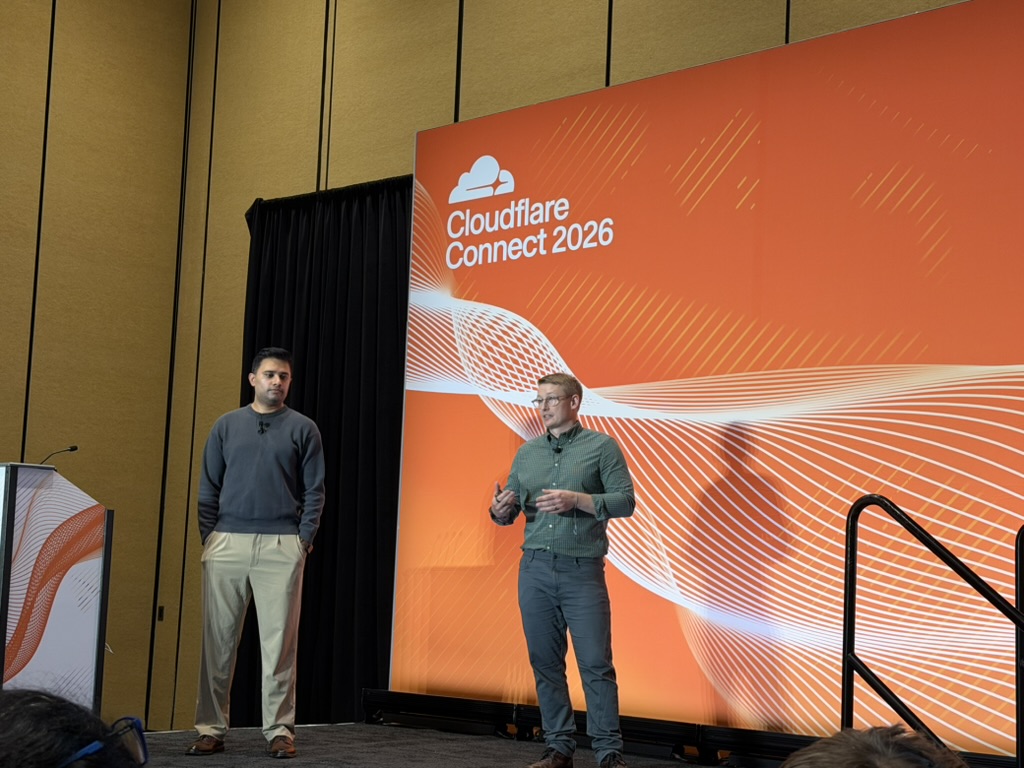
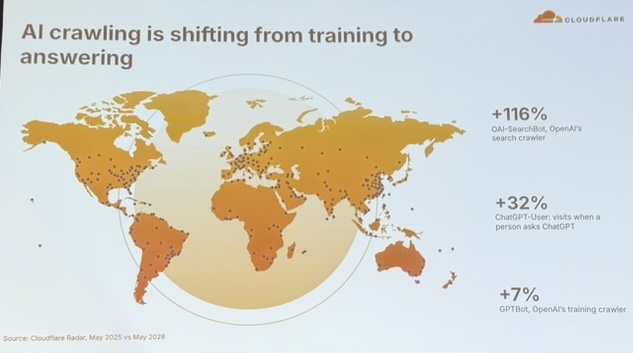
Their most interesting finding: OpenAI’s crawling is shifting from training to answering. Search crawler activity is up 116% YoY, while training bot activity is up just 7%. It looks like a race to build the AI search index.
They also compared mentions vs. citations by vendor (50 prompts x 8 samples). OpenAI sends 4x more traffic than Anthropic, which likely explains why it drives the most AI referral traffic in our analysis.
That raised the obvious question for me: what index is OpenAI pulling its answers from? Both presenters smiled and said a blog post is likely coming soon. That will be an interesting read.

Then came the “so what”: the AEO Performance dashboard. It’s sweet. It shows whether AI bots can access your site and are properly configured, as well as your citation and mention rates by LLM.

It shows whether AI bots can access your site and if they’re configured properly, along with your citation and mention rates by LLM.
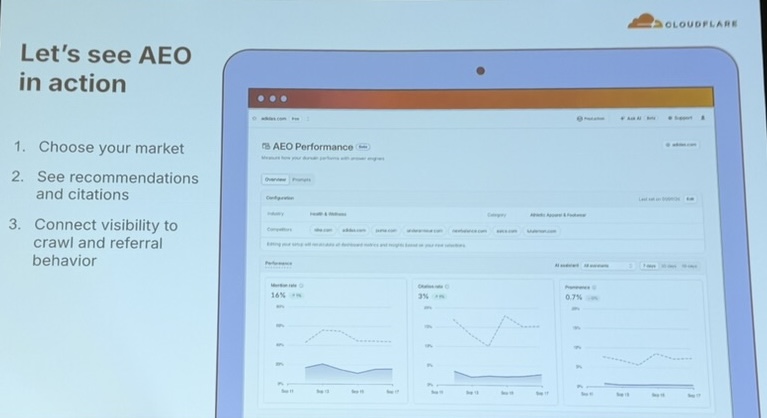
After the talk, the presenters told me they have moonshot ideas for 2027 to make these insights actionable. No one else has this data or visualization, especially not for $20 a month. Once it’s broadly available, it’ll be a huge win for digital marketers who need hard data to make decisions.
Next year’s Cloudflare Connect needs a lot more SEOs in the audience (or whatever people call themselves these days). I’ll be there.
Explore more on
Editorial disclosure
Contributing authors are chosen for their expertise and work under the oversight of the editorial staff. Search Engine Land is owned by Semrush. The contributor was not asked to mention Semrush; the opinions expressed are their own.
About the author