


The truth about byline dates in SEO (and how they really affect visibility)
Learn how Google interprets byline dates, published vs. updated dates, schema signals, and how freshness impacts rankings, trust, and click-through rates.
Byline dates that show when a piece of content was published or last updated play a critical role in SEO strategy.
These dates signal content freshness to search engines—a ranking factor that can directly impact your visibility in search.
But in recent years, some SEO teams have created a tangled mess of date implementation, showing conflicting dates between their schema markup and visible content. Or, in some cases, manipulating dates to fake freshness signals.
These inconsistent approaches confuse both users and Google’s algorithms, often backfiring entirely.
What’s the harm, exactly?
Trust drives buying decisions. In fact, 60% of consumers believe trust and transparency are the most important brand traits, according to CMS Wire. Yet most websites still make mistakes with content attribution and dating, undermining the transparency that helps build that trust.
The stakes here are higher than most people realize. Google’s algorithm prioritizes experience, expertise, authority, and trust (E-E-A-T) signals and content that demonstrates clear authorship and expertise.
When your date implementation is inconsistent, you’re risking user trust and potentially triggering negative quality signals that can suppress your content’s visibility in search results and AI-powered features like AI Overviews.
So, smart SEO teams are working to get dates right. This creates a foundation for better rankings, improved click-through rates in SERPs, and stronger performance in freshness-dependent queries.
In this guide, you’ll learn how Google interprets dates on your pages, when to update them (and when not to), and how to audit your site for date-related issues that could be undermining your credibility. You’ll also discover the proven best practices that align your visible dates, schema markup, and editorial workflows to build the trust signals that both users and search engines reward.
What byline dates are (and what they aren’t)
Byline dates are the timestamp elements that appear on your content pages to communicate when a piece was published, last updated, or modified. They help search engines confirm content freshness, improve trust, and support ranking for time-sensitive queries. Google uses byline dates to evaluate recency signals, especially on news, reviews, and YMYL pages.
However, they’re not just a single date type, and the confusion around them creates real SEO problems.
How?
Most publishers use “byline date” as a catch-all term without realizing they’re actually dealing with five different date types that Google treats differently. Let’s break down what each one actually does.

- Published dates tell readers when you first hit “publish.” This is your content’s birthday—it never changes, and it shouldn’t. You’ll typically see this as “Published March 15, 2024” or just a plain date near the headline.
- Updated dates show when you made meaningful changes to the content. Think new sections, updated statistics, or substantial revisions.
- Schema dates live in your structured data markup and speak directly to search engines. You can have both “datePublished” and “dateModified” in your Article schema, and these don’t always have to match what users see on the page.
- On-page dates are what visitors actually see—the visible timestamps in your content. These should align with the last time your content was actually published or updated considerably.
- Lastmod dates appear in your XML sitemap and help tell Google when to re-crawl pages.
The confusion happens when these five types get mixed up.
For example, the schema might say “published yesterday” while the visible date shows “updated last month” and the sitemap lastmod date fires every time someone fixes a typo. That inconsistency creates trust issues with both users and search engines.
If users don’t trust you, they don’t visit or buy. If search engines don’t trust you, that’s a problem for your SEO.
The SEO toolkit you know, plus the AI visibility data you need.

Why byline dates matter for SEO
Byline dates are crucial elements that communicate content freshness, credibility, and relevance to both search engines and users. These timestamps directly influence how Google evaluates content quality, impacts user click behavior in search results, and affects your content’s visibility in AI-powered features like Google’s AI Overviews.
Especially if you’re in an industry where freshness really matters, the strategic use of byline dates can make or break your search visibility.
Let’s take a deeper look at the reasons why byline dates matter so much for your SEO strategy.
Freshness
Google treats freshness as a query-dependent ranking factor, meaning some searches absolutely demand recent content while others don’t care about recency at all. Think about it—someone searching “iPhone 15 review” expects current information, while “how to tie a tie” works just fine with older content.

The Query Deserves Freshness (QDF) part of Google’s algorithm kicks in when it detects that users need timely information. News events, trending topics, seasonal queries, and product launches all trigger QDF. When your content includes clear, visible byline dates, you’re giving Google explicit freshness signals that can boost your rankings for these time-sensitive queries.
Beyond publish dates, Google also considers update dates, but be careful how you implement this. You don’t want to have two dates on each article.
Credibility
Users make snap judgments about content trustworthiness, and visible dates probably play a role in that process.
For example, when someone lands on your page about “best email marketing tools” and sees it was published three years ago, they’re likely to bounce and look for more current information. That bounce sends negative signals to Google about your content quality.
That’s why you should use byline dates strategically. Update evergreen content regularly and refresh the modification date to maintain credibility. The key is authenticity—fake freshness backfires when users realize the content hasn’t actually been updated in meaningful ways.
SERP behavior
Dates in search results can influence clicks, but mostly for queries where freshness actually matters. When someone’s searching for fast-moving topics like breaking news, tech updates, or financial changes, a recent date can help signal that your page is up to date.
Google may show a date next to your result, but if there are multiple to choose from, you can’t fully control which one appears. Even with proper markup, Google pulls from multiple signals and sometimes chooses a different date than the one you expect. That means simply adding or updating timestamps isn’t a reliable way to boost click-through rate (CTR).
A better approach is to make meaningful updates that satisfy search intent and improve the snippet users actually see. Dates can support that story, but they’re not the main character—quality and relevance matter far more in the click decision.
SERP features
AI Overviews and other SERP features have added new layers to how Google understands and surfaces content. A recent analysis of AI Overview citations shows that pages with strong metadata, clear structure, and accurate timestamps are more likely to be pulled into answers and citations.
Freshness is part of that bundle, working alongside technical quality and other trust signals.
When your content appears in an AI Overview, the content Google chooses to display skews more toward well-structured, authoritative pages than simply newer ones. Older evergreen resources still show up when they remain the best match.
In general, dates help Google interpret context, not determine worth.
So, instead of chasing freshness, focus more on maintaining technically sound, clearly dated content to signal accuracy. Dates can support your eligibility for AI-driven features, but they’re only one piece of what gets surfaced, not the deciding factor.
How Google interprets dates on pages
Google uses multiple signals to identify and interpret timestamp information from web content, including structured data markup such as the “datePublished” and “dateModified” properties, visible on-page dates, and sitemap lastmod values. The search engine examines these various sources to estimate when content was published or last updated.
Let’s dive into how Google interprets dates more closely.
Schema, on-page dates, and lastmod
Google doesn’t rely on a single signal to determine when your content was published or updated.
Why?
Because every date source can have issues. Schema markup can be implemented incorrectly. Visible dates might be ambiguous. Sitemap lastmod values don’t always reflect real editorial changes.
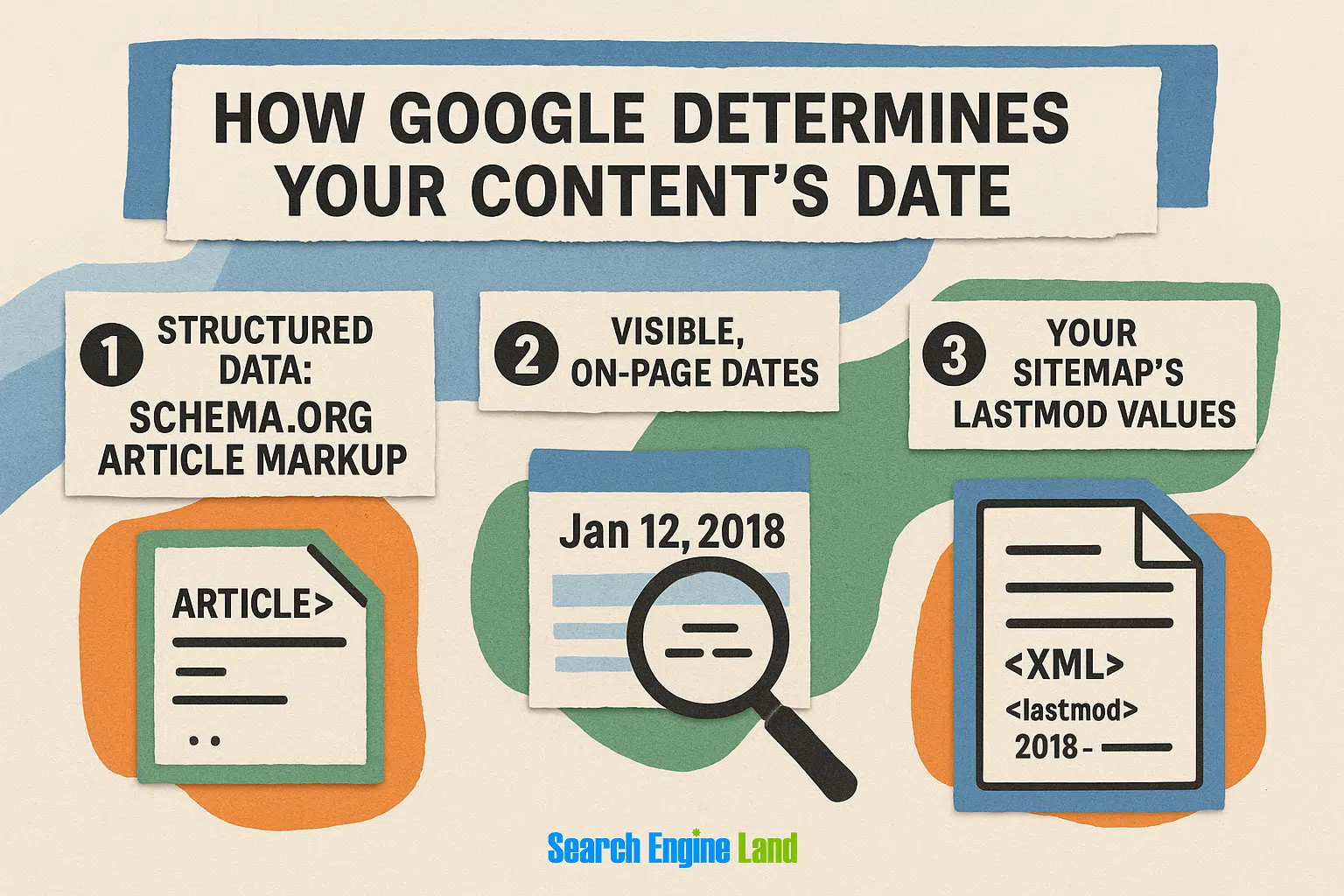
So Google’s systems look at multiple factors to estimate your page’s publication or last update date. The goal is to find the most reliable signal and display it in search results when it’s useful to searchers.
Here’s what Google looks at:
Structured data provides a clear signal. When you implement schema.org markup using Article, NewsArticle, or BlogPosting types with datePublished and dateModified properties, you’re giving Google a clear signal about your content’s timeline.
These dates should be formatted in ISO 8601 (for example: 2024-03-15T14:30:00+00:00).
Google recommends including both the time and timezone in your structured data for added precision, even though only the date is required.
Visible on-page dates help Google understand your content timeline. Google advises making your dates prominent and clearly labeled with text like “Published” or “Last updated.” Examples of accepted date displays include:
- Posted March 4, 2025
- Published March 4, 2025
- Last updated: March 14, 2025
- Updated March 14, 2025 8pm ET
Your XML sitemap’s lastmod values serve as a supporting signal. Google considers these timestamps when determining update frequency, but they won’t guarantee immediate crawling or indexing. Treat lastmod like a helpful hint, not a ranking lever.
Google recommends consistency between visible and structured dates. The date should match between what users see on the page and what’s in your structured data.
Minimize the presence of other dates on your page. If you’ve followed best practices (more on these later) and find incorrect dates are being selected, consider removing some or all other dates that appear on the page.
One other critical rule: never use future dates or dates that describe events mentioned in your content. Your dates should only reflect when the page itself was published or meaningfully updated.
When Google displays (or doesn’t display) dates
Google doesn’t guarantee that dates will appear in search results, even when properly implemented.
According to Google’s documentation, “Google shows the date of a page when its automated systems determine that it would be relevant to do so, such as for pages that can be time-sensitive, including news content.”
This means dates are more likely to appear for:
- News articles
- Time-sensitive how-to guides
- Product reviews
- Content where recency affects usefulness
For evergreen content where freshness isn’t a meaningful factor, Google may choose not to display a date at all.
Google’s guidance on updating dates
Google Search Advocate John Mueller has been clear about when to update dates on your pages.
In a 2021 SEO office hours discussion, Mueller explained: “If you’re doing this manually, kind of like tweaking the date every time you make a small change like shuffling images, then I would recommend just skipping that and only update the date when you actually make significant changes on a page.”
Small adjustments like fixing typos, swapping images, or updating year references don’t warrant a date change. Substantial updates that add new information, revise outdated sections, or meaningfully improve the content’s value justify a fresh timestamp.
What Google actually tracks
Google doesn’t just accept the dates you provide at face value. The search engine maintains its own crawling records and compares publisher-provided dates against when it discovered and indexed content.
This is why Google explicitly states it uses multiple date signals rather than relying on any single source. The search engine needs to reconcile what publishers claim (via visible dates and structured data) with what Google’s own systems have observed through crawling.
When Google encounters conflicting date information across different sources on your page, or when dates don’t align with Google’s crawling history, the search engine may opt not to display a date at all. Google’s documentation notes that dates appear in search results “when its automated systems determine that it would be relevant to do so.”
The risks of manipulating byline dates
Date manipulation is tempting when you see competitors ranking with fresher timestamps. But changing article dates without making meaningful updates creates more problems than it solves.
Date manipulation happens when publishers change timestamps to newer dates without substantively updating content. An article from 2018 suddenly shows “Published: January 2025” with maybe a paragraph tweak or an updated screenshot.
Why fake freshness backfires
When users click a link in search results expecting current information and land on outdated advice with a new date, they leave. The content’s tone, reference points, and examples all signal this is old material with cosmetic changes.
This creates a cascade of negative signals. Users who feel misled bounce quickly, looking elsewhere for genuinely current information. High bounce rates signal poor user experience to search engines. When this pattern repeats across multiple pages, it damages the trust signals that feed into your site’s overall quality assessment.
Google addressed this practice directly back in 2017. When publishers complained about competitors manipulating dates, John Mueller called it “an old trick,” explaining that Google maintains its own records of when URLs were discovered and when content actually changed.
What constitutes meaningful updates
John Mueller expanded on this in his 2019 blog post: “If an article has been substantially changed, it can make sense to give it a fresh date and time. However, don’t artificially freshen a story without adding significant information or some other compelling reason for the freshening.”
The key distinction? Significant versus minor changes. Small adjustments like fixing typos, swapping images, or updating year references don’t warrant a date change. Substantial updates that add new information, revise outdated sections, or meaningfully improve the content’s value justify a fresh timestamp.
As Mueller reinforced in 2022: “When you write something new, or significantly change something existing, then change the date. Changing the date without doing anything else is just noise & useless.”
He also clarified that simply changing dates won’t affect rankings: “I don’t think it would change anything with regards to search, and we definitely wouldn’t rank those pages differently in search just because you’re changing the date and time on a page.”
The ranking benefit comes from the improved content itself, not the updated timestamp. Google’s systems examine multiple date-related factors—schema markup, visible dates, sitemap lastmod values, and its own crawling history.
When these signals conflict or when dates claim freshness the content doesn’t deliver, Google detects the inconsistency.
Think about it from Google’s perspective—they want to serve genuinely helpful, current information. When publishers game date signals without improving content quality, it degrades the search experience. The algorithm has evolved to prioritize content freshness that comes with genuine value updates, not cosmetic date changes.
Best practices for using byline dates
Now that you understand how Google interprets dates and the risks of manipulation, let’s get practical. Most publishers fail at byline dates not because they don’t understand the theory, but because they lack clear implementation standards.
Here’s how to build a date strategy that actually works.

1. Set up your content management system (CMS) to prevent automatic date updates
Your biggest enemy is a CMS that automatically updates modification dates every time someone saves a page. This creates false freshness signals that undermine your credibility with Google.
Most platforms—WordPress, Drupal, custom CMSes—default to updating “modified” timestamps whenever you save changes. A typo fix shouldn’t trigger a date change, but your CMS doesn’t know that.
Configure your system to separate “last saved” from “last substantially updated.” Create a custom field for “last meaningful update” that editors manually trigger only when making substantial changes. This gives you control over when dates actually change in your visible content, schema markup, and sitemap.
If your CMS doesn’t support custom date fields, consider using a plugin or custom code to add this functionality. The investment pays off in maintaining date accuracy.
2. Create editorial date standards
Document exactly what triggers a date update at your organization. Your content team needs clear criteria based on the scope and impact of changes.
Establish thresholds that work for your content type. A news site might update dates for any factual correction, while an evergreen resource library might only update for major revisions. The key is consistency across your editorial team.
Consider creating a simple decision tree: “Did this change affect how readers would use this content? Did it update outdated information? Did it add new value?” If the answer is yes to any of these, document the change and update the date.
Make these standards accessible in your editorial documentation. When in doubt, editors should be able to reference concrete examples of what qualifies as “substantial.”
3. Align your sitemap lastmod with real updates
Your XML sitemap’s lastmod tag should reflect the same date standards you use for visible dates.
According to Google’s sitemap guidelines: “The <lastmod> value should reflect the date and time of the last significant update to the page. For example, an update to the main content, the structured data, or links on the page is generally considered significant, however an update to the copyright date is not.”
Configure your sitemap generator to pull from your “last meaningful update” field—the same one your editors manually trigger. Don’t let it pull from automatic “last modified” timestamps.
Use W3C Datetime format (YYYY-MM-DD or full timestamp with timezone). Keep it consistent with your visible dates and schema markup.
Google uses lastmod “if it’s consistently and verifiably accurate.” If you update lastmod without real content changes, Google will eventually stop trusting this signal from your site.
4. Document why dates were changed
Create a simple change log system where editors note why they updated a date. This could be as simple as a comment field in your CMS or a shared spreadsheet.
Example entries:
- “Updated statistics from 2023 to 2024 study results”
- “Added new section on iOS 17 features”
- “Revised pricing information following vendor changes”
This documentation serves three purposes:
First, it forces editors to consciously decide if a change warrants a date update. The act of documenting creates accountability.
Second, it helps during audits when you’re reviewing why certain pages show recent dates. You can verify that changes were substantial.
Third, it trains your team on what constitutes meaningful updates by creating a library of real examples.
5. Position dates strategically for maximum visibility
Google’s guidelines specify that on-page dates should appear “between the headline and article text.” Don’t bury them in your footer or sidebar.
Make them visually prominent using:
- Clear labels (“Published” or “Last updated”)
- Readable font sizes
- Strategic placement above the fold
- Formatting that distinguishes them from body text
This transparency helps users assess content recency at a glance and provides Google with clear signals about your content timeline.
The consistency you build through these practices creates the trust signals that benefit both users and search engines. When your visible dates, structured data, and sitemap lastmod all align and reflect genuine editorial changes, you’ve built a foundation for better search visibility.
When NOT to show dates
Showing publication dates isn’t always the right call. For certain content types, dates can actually hurt performance by creating unnecessary doubt about relevance.
The decision comes down to one question: Does knowing when this content was published help users make better decisions?
The debate around dates on evergreen content has been ongoing in the SEO community for years, and there’s no universal consensus.
John Mueller weighed in on this in 2020 when an SEO asked whether evergreen content needed date updates. His response was straightforward: “If it’s evergreen, then by definition you don’t need to change it. No need to do anything special. Keep your dates, make it great.”
But that doesn’t tell the full story. While Google doesn’t require you to hide dates on evergreen content, there’s evidence that visible dates can affect user behavior even when content remains perfectly relevant.
A 2024 case study by Aubrey Yung found that adding publish dates to evergreen content actually decreased organic traffic by 13.37% within one week. When they rolled back the change, clicks recovered by 10.10%. The rankings themselves barely moved—72% of keywords remained stable. The issue wasn’t how Google ranked the content. It was how users perceived it.
This illustrates the psychological component. When readers see a two-year-old publication date on content about “marketing strategy fundamentals,” for example, some will bounce without reading, assuming the information is outdated—even when it’s not.
Content types that work better without dates
- Product and service pages rarely need dates. Your core offering descriptions, feature lists, and pricing pages communicate their own freshness through regular updates to the content itself. Adding “Published: 2022” to a product page doesn’t add value and might raise questions about whether the product is still available.
- Foundational educational content often performs better without visible dates. Beginner guides, 101 tutorials, and explainers about timeless concepts don’t lose value over time. If you’re teaching basic principles that haven’t changed—grammar rules, fundamental business concepts, core technical processes—dates can become a distraction.
- Company pages and brand storytelling don’t require timestamps. Your About Us page, mission statement, and company values are meant to feel permanent and foundational, not time-bound.
- Reference resources and tools that users bookmark for ongoing consultation work well without dates. Glossaries, checklist templates, and comprehensive resource guides are designed to be consulted repeatedly. The moment you add a date, you’re suggesting the content might become outdated.
The UX consideration
Dates create what some user experience researchers call “cognitive load”—extra mental processing that distracts from your actual content value. Users spend time evaluating whether content is “fresh enough” rather than immediately engaging with the information.
For some content types, this evaluation makes sense. News articles, software tutorials that track with frequent updates, and trend analyses benefit from clear timestamps that help users assess relevance.
For truly evergreen content, that timestamp could become a barrier rather than a helpful signal.
When Google shows dates anyway
Here’s what makes this tricky: You can remove dates from your visible content, but Google may still show a date in search results if it finds one in your HTML, structured data, or through other signals.
Google tends to show dates on searches where freshness matters and omit them on older content where recency is less relevant.
This means your control over date display is partial, not absolute.
Making the strategic decision
If you’re considering removing dates from evergreen content, think through the implications:
Do your users need temporal context to evaluate your content’s value? If yes, keep dates visible. If your content references current events, recent research, or time-specific information, dates provide necessary context even if the core advice remains solid.
Is your content truly timeless, or are you just rationalizing? Be honest. If you’re citing statistics, mentioning specific tools or platforms, or referencing industry conditions, your content probably isn’t as evergreen as you think.
Can you commit to keeping it genuinely current? If you hide dates to avoid the “old content” stigma but don’t actually maintain the content, you’re trading transparency for a false sense of freshness. That erodes trust.
How to audit a site for date accuracy
Most sites have more date problems than their teams realize. You’ll find articles showing “Updated yesterday” while the schema still lists 2019. Sitemap lastmod values that update whenever someone fixes a typo. URLs with one date, visible pages with another.
These conflicts mess with user trust and send confusing signals to Google.
1. Check what users actually see first
Start by spot-checking a third or so of your pages across different content types—blog posts, landing pages, product pages. Screenshot the dates and note exactly what they say.
You’re looking for patterns. Does your site show “Published March 2023, Updated January 2025” or just “January 2025”? Do you display dates in URLs but different ones on the page? Are you using relative dates like “3 months ago” that stop making sense over time?
Pay attention to inconsistencies between content types, too. Maybe your blog posts show both published and updated dates, but your resource pages only show one date, and your case studies show none at all.
2. Verify your schema markup
Next, check what your structured data tells search engines. Use Google’s Rich Results Test to see what Google rich results can be generated for your pages and the Schema Markup Validator for generic schema validation.
For your date audit specifically, you’re comparing schema datePublished and dateModified values against what users see on the page. If your visible date says “Updated December 2024,” your dateModified should match—not show some random timestamp from a CMS auto-save.
The fastest way to check a single page: right-click anywhere on the page, select View Page Source, and search for “datePublished” or “dateModified.” You’ll see your JSON-LD structured data and can compare those dates to what’s visible on the page.
For checking multiple pages at scale, you’ll need a platform like Semrush Site Audit that can extract and compare schema dates across your entire site, or a crawler like Screaming Frog.
3. Cross-reference with your XML sitemap
Pull your XML sitemap (usually at yoursite.com/sitemap.xml) and examine those lastmod values. The question: are these meaningful editorial updates, or do they fire for trivial changes?
Remember, Google doesn’t want to see dates updated every time any little edit is made—those dates should reflect when content actually changed in ways that matter to searchers.
If you’re using WordPress, you can check your post revision history to see what actually changed and when. For other platforms, look for change logs or version control that shows content modifications versus technical updates.
4. Map dates to your editorial workflow
This is where audits get revealing. You’ll probably find pages where lastmod updates weekly but nobody’s touched the content in years.
The fix depends on your CMS. Some platforms let you control which types of edits trigger date updates. Others require plugins or custom development to implement smarter date logic. For your most important pages—the ones driving traffic and conversions—consider manually curating timestamps to reflect real editorial changes only.
Create a spreadsheet documenting when you actually update important content, then compare that to your sitemap dates. If they don’t align, you’ve got work to do.
5. Document your findings
Build a simple audit report showing:
- Date display inconsistencies: Pages showing conflicting dates between URL, visible content, and schema
- Schema mismatches: Pages where dateModified doesn’t match visible updated dates
- Sitemap accuracy issues: lastmod values that don’t reflect actual content changes
- Missing dates: Important content with no date information at all
This documentation becomes your roadmap for fixes and helps you explain the problems to stakeholders who might not understand why date accuracy matters.
Common myths about byline dates
Here are the biggest misconceptions SEO teams make about byline dates—and why they’re wasting time on tactics that don’t work.
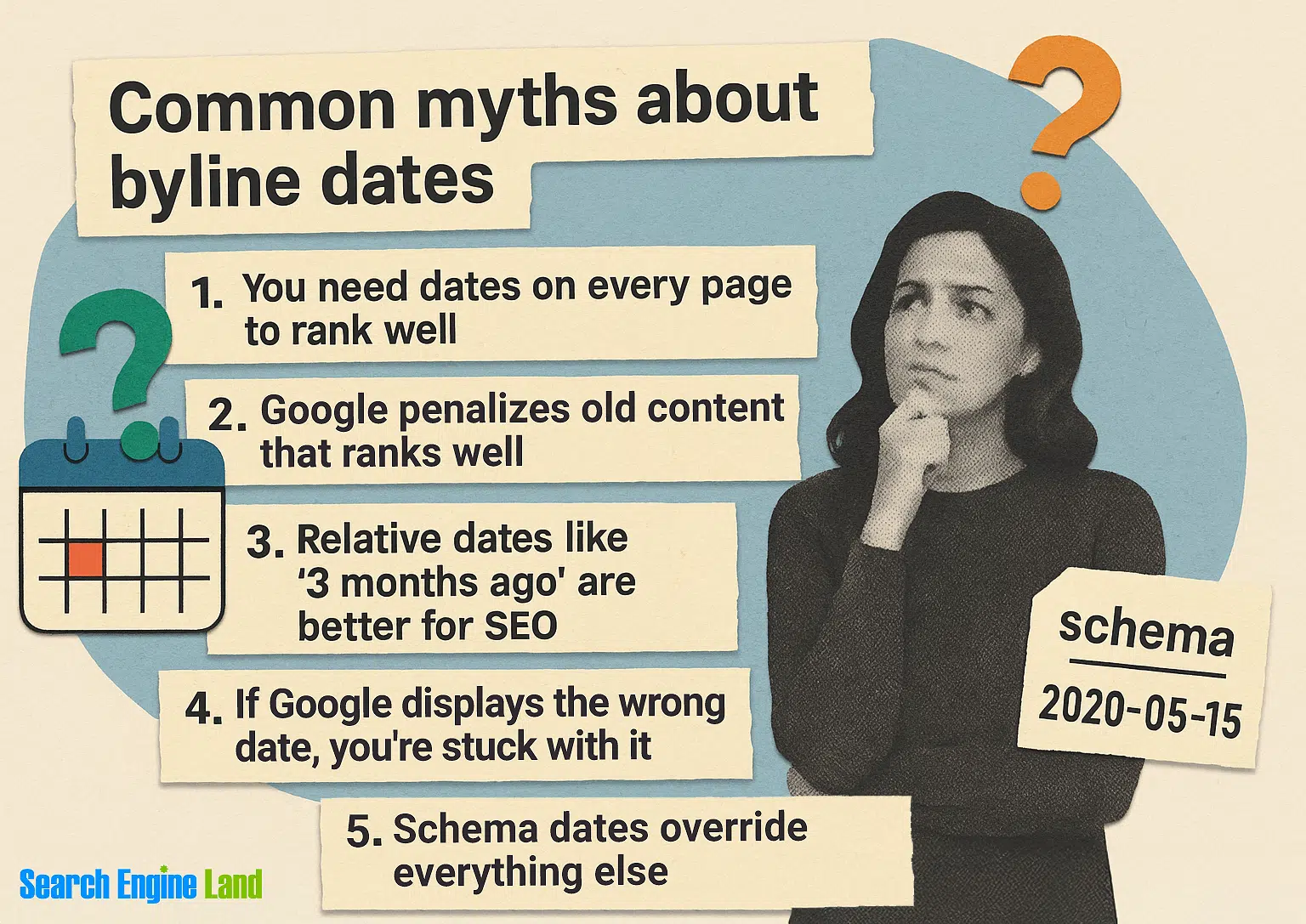
Myth #1: You need dates on every page to rank well
Not true. Google doesn’t require dates on all content, and for some pages, they actively hurt performance.
Product pages, service descriptions, and company information don’t need timestamps. Neither do foundational tutorials, glossaries, or reference resources that users bookmark for repeated use.
As covered earlier in this article, visible dates create cognitive load. Users spend mental energy evaluating whether content is “fresh enough” instead of actually reading it. For evergreen content, that evaluation works against you.
The real rule: Use dates when temporal context helps users make better decisions about your content’s relevance. Skip them when they don’t.
Myth #2: Google penalizes old content that ranks well
This concern comes up constantly—teams worried that their 2020 article ranking #1 will get penalized just because it’s old.
That’s not how Google works. Age alone doesn’t hurt rankings. What hurts is when old content provides outdated, inaccurate, or less comprehensive information than newer competitors.
Think about comprehensive guides, foundational research, or authoritative resources. These pages often rank for years because they remain the best answer to the query. Google’s algorithm evaluates quality and relevance, not just recency.
The freshness signals covered throughout this article apply to queries where users expect current information—news, reviews, trending topics. For everything else, content quality trumps publication date.
Track, optimize, and win in Google and AI search from one platform.
Myth #3: Relative dates like “3 months ago” are better for SEO
Some teams use relative dates thinking they’ll always appear fresh. This backfires in multiple ways.
First, relative dates stop making sense over time. “3 months ago” from when? If someone lands on your page six months after you published it, that timestamp is now “9 months ago” but your code might still say “3 months ago.”
Second, relative dates make it harder for Google to establish a clear timeline for your content. You’re introducing ambiguity when you should be providing clarity.
Third, users find them less trustworthy than actual dates. “Updated 3 days ago” raises questions: Updated with what? Why won’t you show me the actual date?
Use clear, specific dates formatted consistently across your site. Make it easy for both users and search engines to understand when your content was published and updated.
Myth #4: If Google displays the wrong date, you’re stuck with it
When Google shows an unexpected date in search results, most people assume they can’t fix it. But incorrect dates usually stem from fixable problems on your site.
As covered in the audit section, Google pulls from multiple date signals—schema markup, visible dates, sitemap lastmod, and other timestamps scattered across your page. When these conflict, Google makes its best guess about which date is most accurate.
The fix: create consistency across all your date signals. Make sure your schema datePublished and dateModified match what users see on the page. Clean up any stray dates in your content that might confuse Google’s systems. Update your sitemap lastmod to reflect real editorial changes only.
Once you align these signals, Google will typically start displaying the correct date within the next crawl cycle.
Myth #5: Schema dates override everything else
Teams sometimes think they can control date display in search results purely through schema markup. They’ll set dateModified to yesterday even though nothing changed, assuming Google will just use that timestamp.
Google doesn’t work that way. The search engine considers schema as one signal among many, not the definitive source of truth. When your schema dates conflict with visible on-page dates, Google might ignore your schema entirely or choose a different date signal it considers more reliable.
This is why the best practices section emphasizes alignment across all date implementations. Your schema should match your visible dates, which should match your sitemap lastmod when applicable. Consistency builds trust with Google’s systems.
The pattern across all these myths: SEO teams want shortcuts and simple rules. But date strategy requires judgment about when timestamps add value and consistency in how you implement them. Focus on those two principles instead of chasing hacks.
Build credibility through accurate date implementation
Mastering byline dates is about building the trust signals that separate authoritative content from the noise.
When readers see accurate publication dates that align with actual updates, clear “last updated” labels when content has been refreshed, and consistent date formatting across your site, they’re processing trust signals that your competitors aren’t providing. When Google sees aligned date signals across your schema, visible content, and sitemap, you’re eliminating confusion that could suppress your visibility.
The publications winning visibility in AI Overviews and featured snippets have eliminated these basic credibility gaps. They’ve implemented the date standards, schema alignment, and editorial workflows covered in this guide.
Your next step: conduct a date accuracy audit on your highest-traffic pages. Verify that your schema dates match what users see, your sitemap lastmod reflects real editorial changes, and your visible dates follow consistent formatting. Use the audit list from earlier in this article to document inconsistencies, then fix them systematically.
Ready to learn more about the technical things you can do to improve your website and gain visibility in AI platforms and search engines? Check out What is technical SEO? The definitive guide.
About the Author


