Google AI Mode: What it is & how it impacts search
Google AI Mode is reshaping how results are generated. Learn what it means for SEO, how it works, and how to adapt your strategy for AI-driven search.
Google AI Mode is available in over 200 countries. This is big news for search.
Unlike traditional search, Google’s AI mode handles complex, nuanced searches in natural language as well as image-led search. For example, searchers could upload an image of a damaged plant leaf and ask: “What’s wrong with my plant? The leaves changed two weeks ago. I want to fix the problem without chemical pesticides.” AI-powered answer algorithms would take context from the image, the query and answer the user’s questions with information across the web.
AI search is growing and it’s looking highly probable that AI search is the future of SEO. According to the latest study, AI search visitors will surpass traditional search visitors in 2028.
Forward-thinking SEO specialists and brands are not waiting for mass adoption of AI search; they’re experimenting with it now so when the switch happens, they’re ready.
Read on to find out what Google’s AI mode is, how it works, what its strengths are, and its limitations. You’ll also find specific examples of content types that perform well in AI Mode, helping you to future-proof your strategy while still reaching today’s search audience.
What is Google AI Mode?
Google AI Mode is the newest format for AI search and is part of Google’s Search Generative Experiences (SGE). SGE refers to search experiences that use AI, such as:
- Natural language processing (NLP): This technology enables Google to understand the meaning, context, and intent behind conversational language.
- Generative AI: Generative AI creates new text and responds to user queries using natural language.
- Real-time web content: This up-to-date information is pulled directly from available website content.
Note: We go into greater detail about how AI Mode actually works in the section, How does AI Mode work?
AI Mode understands queries, interprets intent, and delivers summarized answers that fulfill user search queries directly on Google.
SGE was initially tested in Search Labs, an experimental program where users access early-stage Google features, provide feedback, and influence their development.
Your audiences can now access AI search within SGE, such as AI Overviews—and now—AI Mode.
AI Overviews and AI Mode are not the same, but they work similarly.
The difference?
AI Overviews appear at the top of search engine results pages (SERPs) as one of the search features, while AI Mode replaces the traditional search experience for users who have access to it.
When it’s available, you can access AI Mode by clicking on the “AI Mode” tab on Google, which takes you to a new search interface.
Here is where you can find AI mode on desktop:

Here’s what AI mode looks like after you click through to the tab on desktop:

AI Mode features, like image search, are also found within Gemini, Google’s AI assistant.
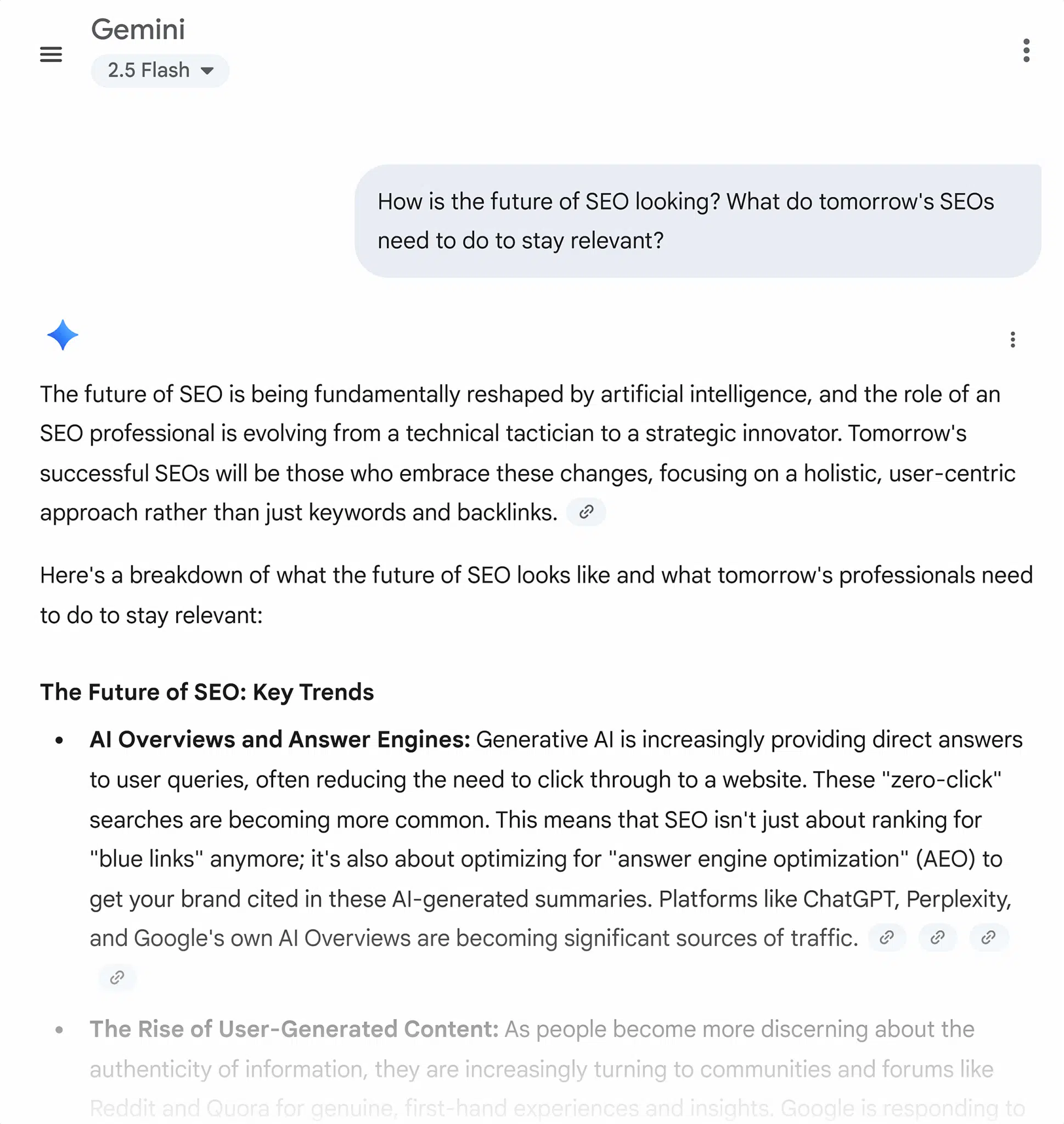
AI Mode brings a new layer to the search landscape.
Instead of delivering a list of results that users have to sift through manually, as you do on traditional search, AI synthesizes and summarizes information from across the web in real time, using generative AI. This removes friction for searchers by giving users direct answers to their queries. Moreover, instead of starting a new search, like you would on a traditional search engine, you can iterate on your original query with a new question or request for more information using natural language.
The SEO toolkit you know, plus the AI visibility data you need.

How does AI Mode work?
For now, there seem to be some inconsistencies with what triggers the AI Mode to appear. Some report that the AI Mode tab is available for every search, while others see it inconsistently.
It’s a new feature, and Google may be experimenting and refining when to trigger AI responses.
Google describes AI Mode as using “Gemini 2.5 model’s advanced reasoning, thinking, and multimodal capabilities to help with even your toughest questions.”
If we dig a bit deeper, this means using a range of methods to compile answers. Let’s take a look at those.
Retrieving results using real-time web index and LLMs.
In AI Mode, after a search, the tool shows you how many sources it’s viewing. Here’s what it looks like when you complete a search:
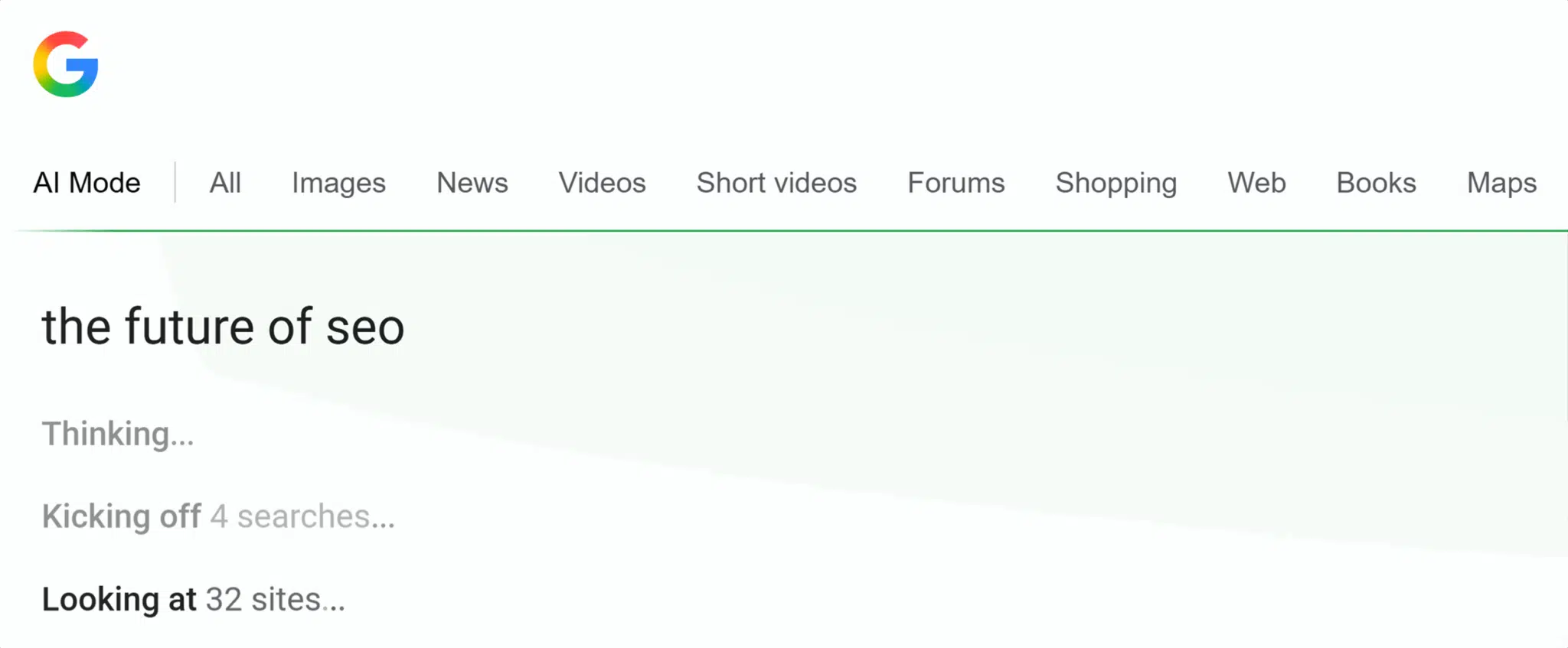
This information tells us something: AI Mode isn’t just looking at the top ten results on Google. For the search above, AI mode is looking at 32 websites; that’s a lot more than can rank on the top of Google.
What does this mean?
When it comes to citations in Google’s AI Mode, SEO isn’t everything.
Instead, AI Mode cites “click-worthy,” relevant sources.
Source diversification
AI Mode pulls data from a diverse set of sites, including:
- Forums such as Reddit
- Niche sources such as specialized blogs or industry newsletters
- Authoritative publishers such as the New York Times, the BBC or CNN
In the search pictured below, a search for a specific pickleball paddle (the Franklin C45) shows a range of sources synthesized and cited for one answer within AI Mode:

Sources cited in AI include results from Amazon and longer-form content from niche sources like “Matt’s Pickleball.” This website, while not as prestigious as the New York Times or CNN, is authoritative in its space.
For comparison, a traditional Google search for the query: “C45 paddle review” showed some of the same citations, but not all. Reddit, which often shows up in AI Mode, appears here.

Content quality and structure
Visibility in AI mode isn’t as simple as securing a page one rank in traditional SEO.
Instead, it’s about prioritizing content that includes information gain, entity-rich content, and a strong semantic structure. What do we mean by that?
Information gain refers to adding new, valuable insights that aren’t already widely available online.
This means:
- Talking to your subject matter experts
- Interviewing your team
- Finding out what’s going on in your industry
- Researching competitor content and going above and beyond their efforts
You want your content to be more valuable to your readers than anything else on the web.
And if you want to catch those long-tail, nuanced searches, such as “[solution] for…” or [product] for [use case],” you need to get specific. Don’t just write about your product; cover its particular use cases. Ask, who are we trying to reach? What problems are they having? How can we solve them? Then do just that.
All of this information helps you create content that wins in Google and LLMs.
Entity-rich content includes clearly defined people, places, products, and concepts that AI can easily recognize and connect.
This means:
- Including author bylines, their credentials, and links to author pages, which include links to their social media profiles and other pieces by the same author.
- Linking to relevant pieces of content, like your products or service pages.
- If you mention a location, include an embed of your business on Google’s maps—link to company business profiles.
Entity-rich content may also help protect your brand’s narrative in AI search because you’re making it very clear who you are and what content across the web belongs to you and your brand. If you’ve done the work to bring entities together, AI search is less likely to mistake your brand for another. This can happen when brands have similar names. More on this in the risks and limitations section.
Semantic structure means organizing content logically so that it’s easy for AI to read. More importantly, well-organized content is easier for your audience to skim and process.
Well-structured content means:
- Using clear, descriptive headings (H1, H2, H3) that reflect the content beneath them
- Breaking up information into short paragraphs and bullet points for scanability
- Using consistent formatting for key terms, definitions, and lists
- Structuring content in a logical flow
The easier it is for AI to read your information, the easier it will be for that information to show up in AI Mode.
Retrieval-augmented generation (RAG) for synthesis
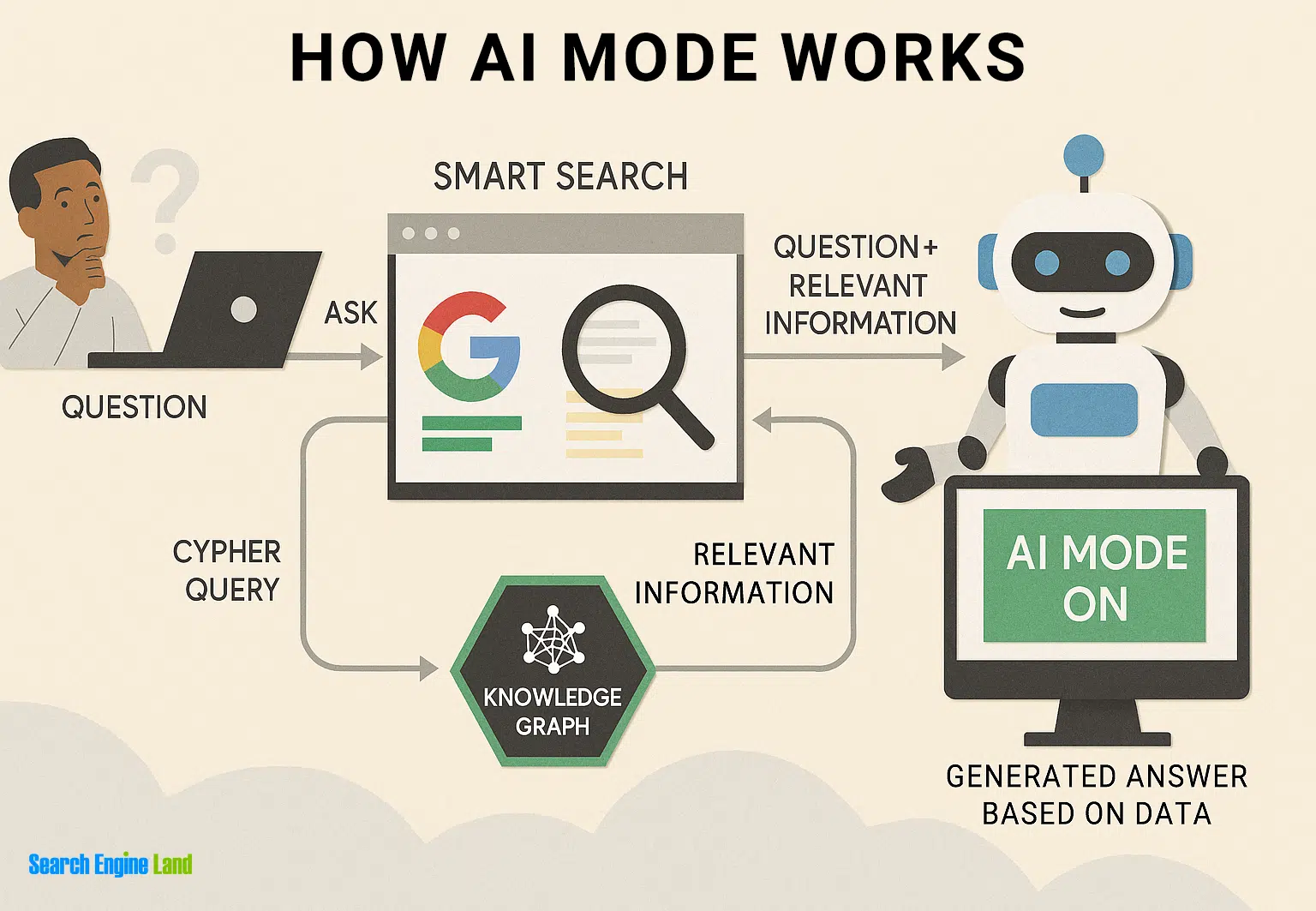
RAG is a process where Google’s AI (or other AI systems) retrieve information from sources. As an example, Google’s AI Mode takes information from the real-time web index or Knowledge Graph, then blends them with generative AI to create a coherent, well-structured answer that directly addresses the query.
This diagram shows the process. A user asks the tool a question, such as “using combs vs. brushes on wet hair” AI gathers information from a range of sources, and then the generative AI structures the answer.
Content types that perform well in Google AI Mode
It’s looking highly likely that Google’s AI Mode will soon be available for every type of search, but in this fast-changing era of AI, anything could change.
Future-thinking SEO specialists need to think both about content and how people search for it. It’s worth considering:
- Your audience
- The type of search
- How your audience is using AI versus traditional search
AI adoption survey data from HigherVisibility shows:
- All age groups (Gen-Z, Millennials, Gen X, and Baby Boomers) are using AI occasionally. While it’s in use, AI isn’t dominating search habits (yet).
- Americans prefer the traditional Google search over AI.
- Product comparisons are most useful on AI search tools like ChatGPT, Claude, and Bard: It’s fair to assume AI Mode will join this list.
Here are some content types likely to perform well in AI Mode and why that is:
Product comparisons
The data shows that people like to search for product comparisons in AI search. It makes sense because of the synthesis and paraphrasing that comes from AI search.
Users can also get specific about their needs and use natural language to refine products.
Here’s an example:
The first prompt was: “What’s the best SEO tool for keyword research”?
AI Mode delivered a range of options from free tools to more extensive tools. As expected, there were direct links to specific tools, but also longer-form articles like round-ups of the best tools. Including round-ups makes sense as it enables searchers with information about a few tools so they can make the right decision for them.
The generative AI also summarizes two best choices: Semrush or Ahrefs, and rationalizes why one of these might be best.

A useful result, but a serious potential buyer will have more questions and will likely continue research within the AI. Searchers tend to make several searches before making a purchase. Perhaps a natural next question would be about specific use cases.
The second prompt was: “Great. I need a tool that can help me with SEO keyword research, but also grow with my business as we explore visibility in AI tools. What would you recommend?”
The AI refined the recommendation and provided a specific example that would work for the use case (keyword research):

Pro tip: Review the sources on the right in both screenshots. They’re not the tools themselves, but third-party opinion pieces. You can create product comparisons on your own website, and it may influence the AI summaries, but content on other websites is key.
How-to guides
AI can synthesize your how-to guides and deliver the steps by taking common next steps from existing articles across the web. It does this by scanning content across the web and looking for suitable content. You can increase your chances of appearing in step-by-step or how-to guides by using definition-based languages and styling, like:
- Lists in bullet point or numbered formats
- Headings including step-by-step sequences
Google Mode takes this information, often from multiple sources, then turns it into a natural language answer that feels conversational.
The generative AI serves users within AI Mode or AI Overviews.
Because AI can serve such content on the search engine, you might find fewer people clicking onto your website, resulting in a reduced or even no click-through rate (CTR), also called a zero-click search.
How-to guides are generally a must-have in your content repertoire, regardless of your SEO needs, so don’t let zero-click search stop you from creating them. You’ll still get visibility in AI tools and you can use the content elsewhere. For example, if you know your audience needs it, you can send it in emails or share it on social media.
FAQs and decision frameworks
As demonstrated in the product comparisons example above, people ask AI search questions and use these questions to refine results, which helps them to make better decisions about their individual needs.
To show up for these queries, you need to have your brand associated with the problem the user is trying to solve through FAQs and as part of their decision framework.
For example, in the searches above, for prompts like: “What’s the best SEO tool for keyword research?” Semrush was the result given. This type of use case is covered extensively by Semrush (as a feature here) and they have third-party credibility from authoritative sources (like Zapier here).
If the content doesn’t exist on the web, it’s not going to show up in AI Mode.
What can you do?
Add FAQs targeting specific questions or use cases.
FAQ blocks in accordion-style (collapsible) modules can work well for this. They keep a site tidy and manage content overwhelm, but keep the content available for the crawlers.
For example, Google’s “People Also Ask” uses an accordion style for FAQs:

Create specific use cases
You need to create content about how your product works in specific use cases in order for AI to find and summarize it. Include stats and data about how and why it was successful.
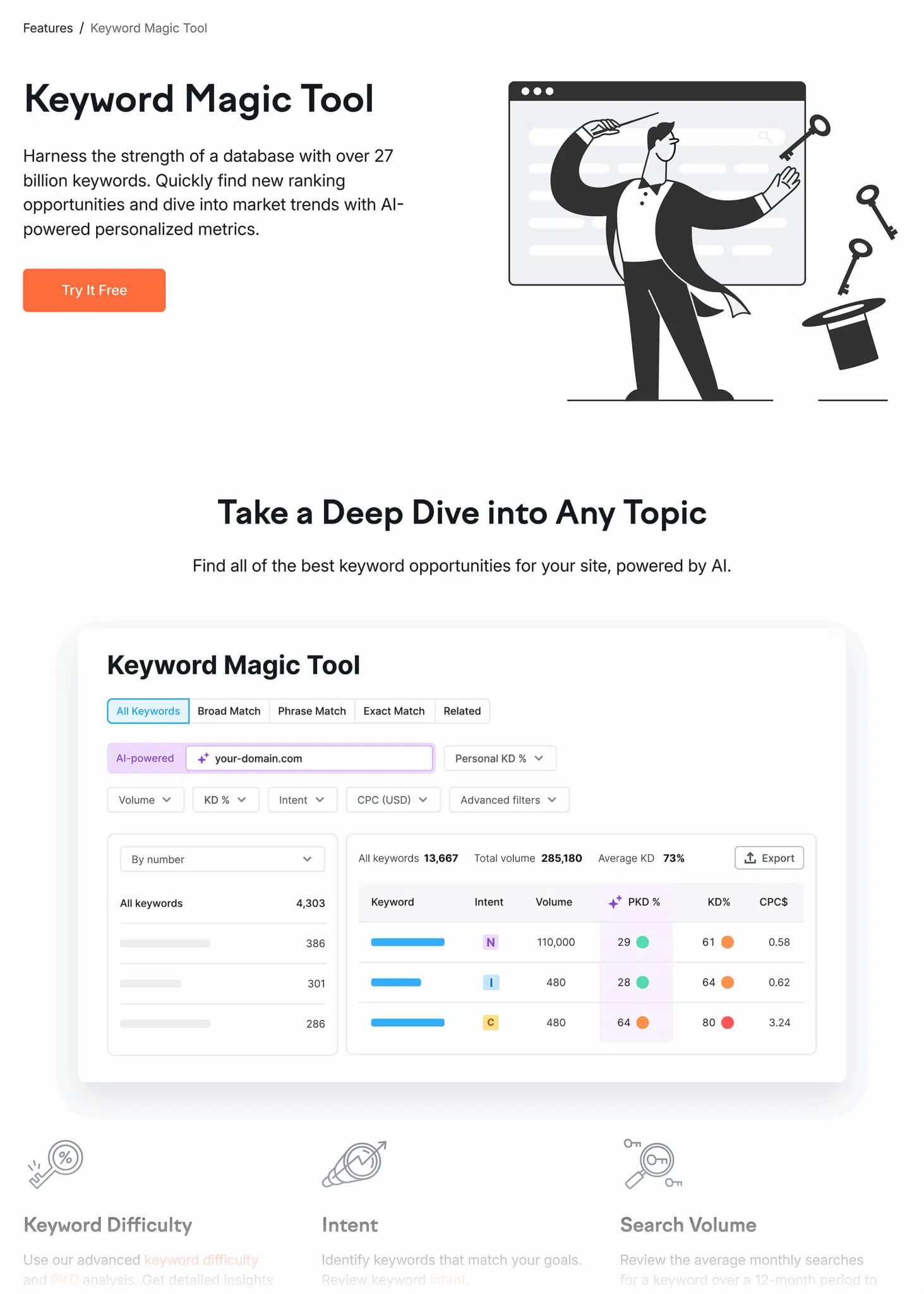
Here’s a landing page from Semrush which shows the keyword magic tool, and what it’s useful for (keyword difficulty, intent, and search volume).
Third-party credibility is always good.
If you can get customers or users to write about your product and how it has helped them, their content could be pulled into their AI summaries.
The Zapier example listing its four best tools is a good one:

Niche expert content
Niche is your opportunity to get visibility in AI Mode (and AI search generally).
Why?
Because AI Mode synthesizes and fulfills user intent in a way that directly fulfills search intent.
It’s not just providing a list of links that a user then needs to search through in hope of finding what they need.
Instead, it’s providing specific answers to specific queries.
For example, in traditional search, if you asked “best red light therapy devices for knee pain,” you’d get a list of URLs with short snippets, leaving you to click through and piece things together yourself.
In AI Mode, the response might be: “For knee pain, look for portable devices in the 600–850nm range. Brands like X and Y offer models with adjustable straps, making them easier to use during recovery.”
AI Mode gives the answer upfront and cites the sources that informed it.
If your brand owns a specific area, like a product that can solve a particular problem for a certain audience, you need to make it known.
What you can do:
- Cover specialized topics in depth. When you write about a topic, don’t do the bare minimum and cover only what competitors have. Aim to add more information and include insights from subject-matter experts.
- Have experts author the content. If your subject matter expert is happy to author and byline the article or content, even better. Content written by experts helps you demonstrate experience, expertise, authority, and trust (E-E-A-T)
- Use terminology that your audiences search for and meet their pain points. Think beyond keywords and topics, and think about audience needs and how they might search using AI. What are they trying to solve? What do they need to know to help make decisions? Remember people can search with longer-tail keywords and more nuance.
- Include unique data and insights so that you increase your chances of earning citations. If you’re citing data and referencing the same surveys or research as everyone else, then the original source might be cited by the AI. If not the source, then it’s up to the AI to choose who is cited, and you have no more right to the citation than a competitor article. When it’s your unique data, you at least deserve the citation. Though AI doesn’t always correctly cite sources. More on inconsistent citations later.
Long-form, semantically organized articles
These include roundups, listicles, and detailed guides that structure information clearly for both users and AI.
For example, we added a long-tail, nuanced search into AI Mode.
The prompt was: “My business is a small boutique marketing agency, and we need a cost-effective way to manage leads. Currently, we use Asana, but it’s not the right solution. We need a simple CRM where we can add details and track the leads through to sales. Emails, notifications, or tasks to ensure we follow up would be helpful. Ideally, the solution would be free or cheap.”

The content that was returned was highly specific.
All of the linked articles listed:
- The best CRM or lead management system
- The top two cited focused on “small business”
- All of them were semantically organized with lists
From our example, let’s take a look at how Startups structured their content to earn that citation:
- Heading one includes “best CRMs” and “for small business”
- The inclusion of the year may also help with relevancy
- Three top CRMs are pulled out into a “learn more” CTA
- “Best for” call-outs help readers make decisions about how the tool might help them
- Listicle-style article with details

Risks and limitations of Google AI Mode
AI search has a long way to go before it’s operating with complete accuracy, which is why most tools include clear disclaimers.
In Gemini, every search carries this note: “Gemini can make mistakes, including about people, so double-check it.”
AI Overviews include a similar warning: “AI responses may include mistakes.”
Other AI search tools like ChatGPT or Perplexity have similar disclaimers.
Mistakes in AI search answers are a problem for users, since not everyone is aware that AI search can be wrong.
Research by Ars Technica found that AI is confidently wrong in as many as 94% of queries.
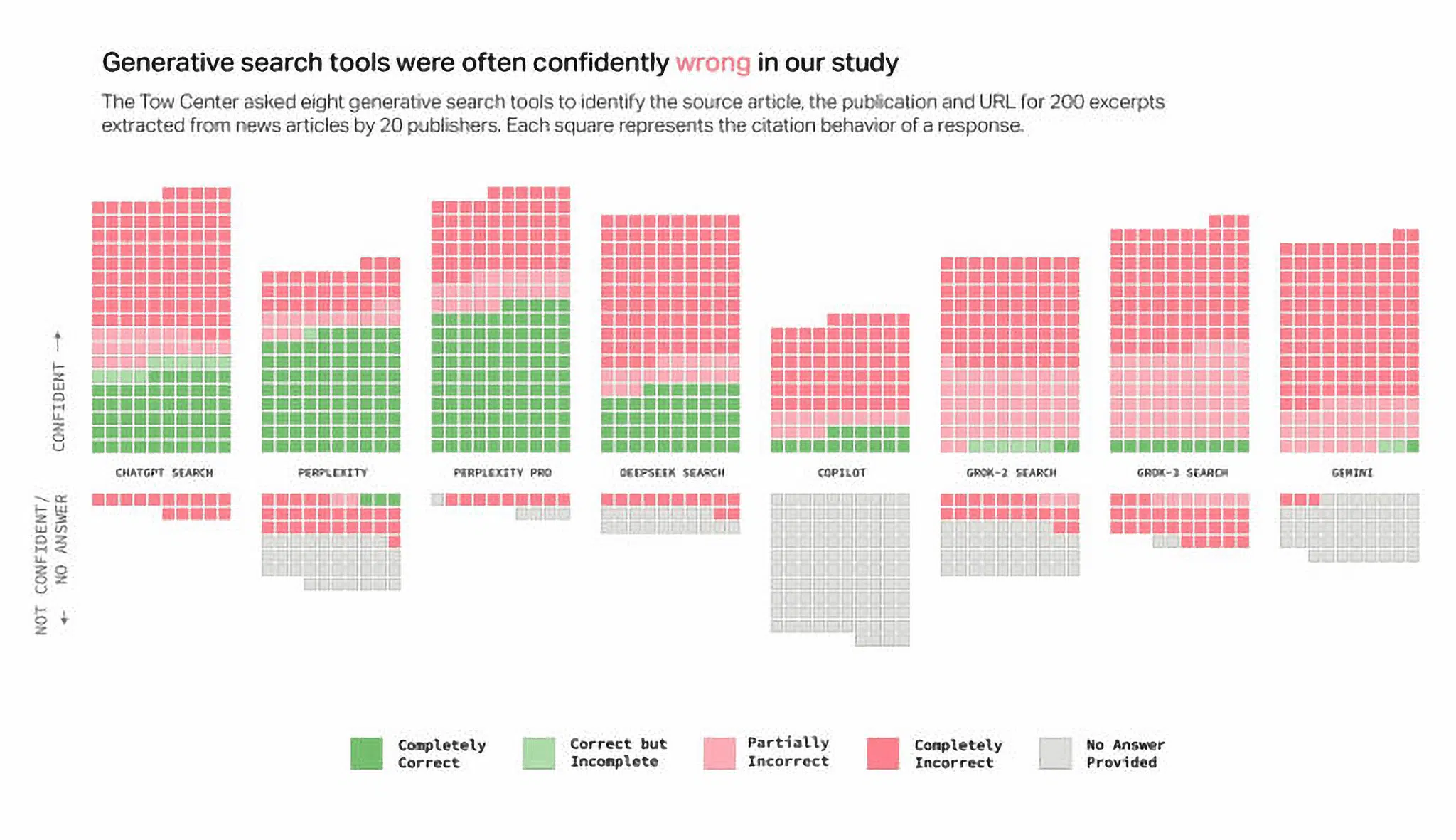
For brands, the consequences can be significant.
While not an example from AI Mode, generative AI cost Air Canada in both reputation and money when its AI chatbot incorrectly advised a customer about bereavement policies. The customer took Air Canada to the tribunal.
Air Canada claimed it shouldn’t be held accountable for what its chatbot told customers, but the tribunal rejected that defense. The ruling found the airline had not exercised “reasonable care to ensure its chatbot was accurate” and ordered it to compensate the customer with CA$812.02, including CA$650.88 in damages.
Brand accuracy may suffer (summarization errors)
AI summaries don’t always get it right, and summarization errors can be significant.
Suppose there are two companies with the same name (or very similar names). The AI could combine information across the web, about two companies, and present it as if it’s about a single company.
Therefore, a search like “is [brand] trusted?” might pull information about someone else’s brand. If these reviews are negative, these summarization errors can reflect poorly on your brand sentiment and the way potential buyers perceive you.
It’s a tough one to solve.
Since AI is rolling out with disclaimers about known summarization errors, the responsibility for brand narrative falls onto the shoulders of SEO specialists and digital teams who need to monitor AI-generated content about a brand and ensure that brand sentiment aligns with the brand’s identity and values.
How do you do this?
You can search for your own brand manually. Ask about your brand on AI tools and see how the AI summarizes and presents information about the brand.
This is suitable, but it is also time-consuming and subjective since you have to deliver the prompts.
Further reading: ChatGPT for SEO: Boost rankings & automate workflows
For a more accurate read, you need AI tools that can do sentiment analysis for you and alert you to any potential trouble.
Here’s what that looks like in Semrush’s AI:
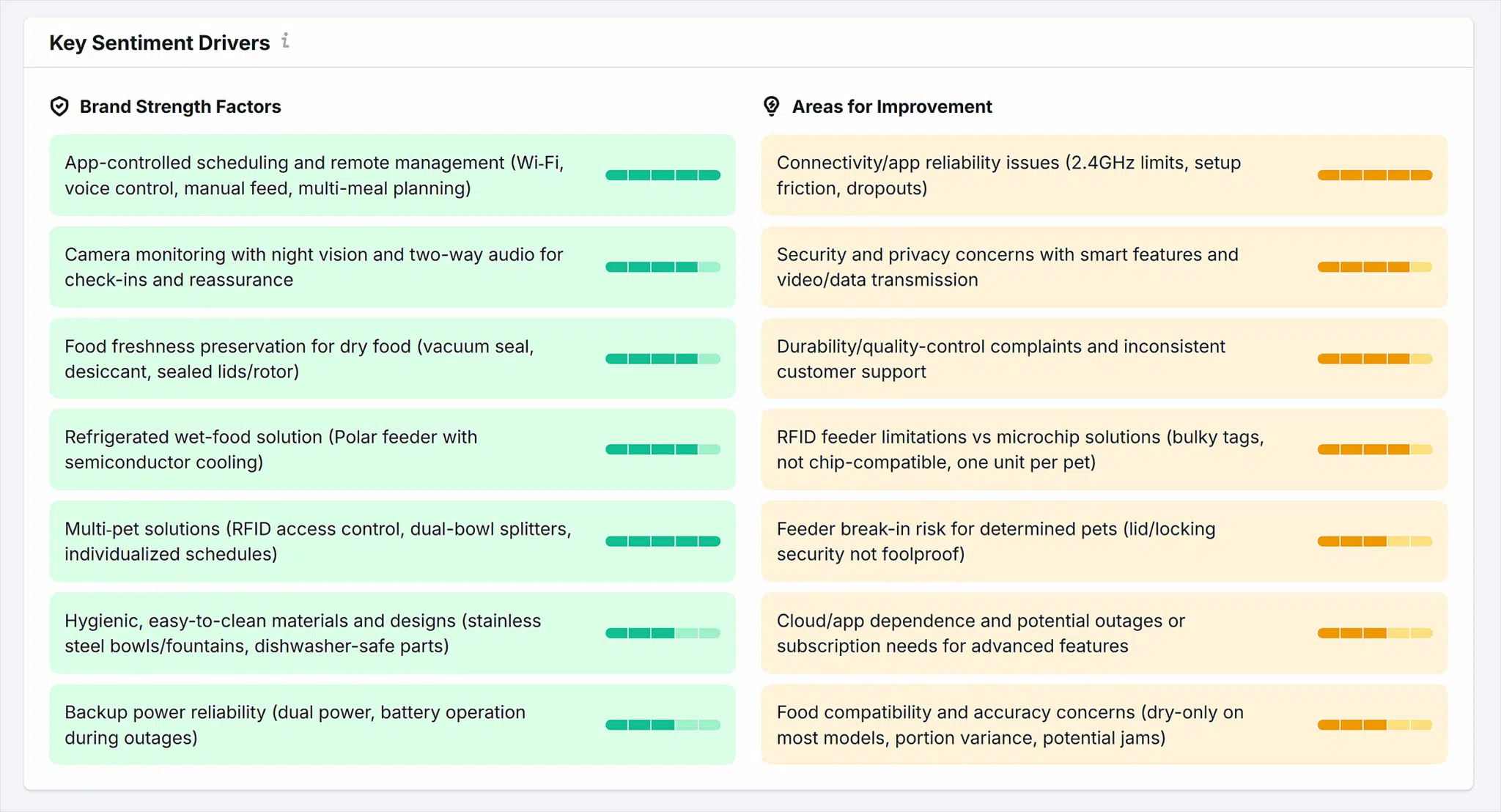
The “Areas for Improvement” section includes neutral, and, when present, negative statements.
You can assess them to see if they’re reasonable, based on what’s out there, or downright incorrect; an indicator that the AI is picking up information that doesn’t belong to your brand.
SEO specialists need to pivot their strategies to include AI SEO so that AI search tools can access content and summarize it in a way that suits the brand.
How?
Strategies might include:
- Capturing plenty of positive reviews within tools like Google Business Profile and third-party websites like Clutch or TrustPilot
- Using testimonials on your websites
- Earning positive PR pieces on relevant and authoritative websites
- Entity-rich content to help AI synthesize the right answer from the right locations
Ultimately, for AI to display the content, it needs to exist somewhere on the web.
Further reading: What is AI SEO? How artificial intelligence is changing search optimization
Citations may be inconsistent
AI Mode (and AI overviews) don’t always add citations, though they are getting more consistent.
When citations are added, they appear next to paraphrased or summarized content opposed to direct quotes.
Outside of AI, it’s unusual to add a citation next to synthesized content. Usually, citations are made against actual quotes verbatim.
It’s a bit misleading.
Your website and brand could be cited alongside content that doesn’t precisely reflect what you wrote. Although it would be against the general consensus, the nuances can matter a lot.
For example, if you have a device, and make a claim like: “Our device is proven to help improve [problem]. However, research is still emerging and results vary.”
But the AI cites you next to a sentence reading: “Our device is proven to help improve [problem],” an important detail is missing.
Further reading: Try reading this article on SERP Features, as it outlines what you need to do to get visibility in AI Overviews. Likely, the same practices apply for AI Mode.
AI summaries may reduce CTR, even when you’re cited
When people search via SGE, they see paraphrased summaries from a range of sources. They get exactly what they want instead of having to click through links and sift through content to get their questions answered or search intent fulfilled.
As a result, you might find that your impressions rise in Google Search Console, but clicks are dropping, plateauing, or nonexistent.
A graph might look like this:

As seen in this graph, the impressions (the purple line) are increasing, meaning people are seeing the website in Google search engine results pages, but the clicks (the blue line) have remained neutral, even dropping a bit.
The site is getting plenty of visibility, but people aren’t clicking through because AI is serving the users within the SERP, negating the need for them to click through and read more from the original content at the source.
It’s frustrating because you’re not getting people onto your site when you would’ve done pre-Google’s AI Mode.
Track, optimize, and win in Google and AI search from one platform.
To some degree, there’s nothing you can do about this.
If you want to serve your audiences, you will need to create content that doesn’t get clicked (the how-to guides, for example). It’s still helpful to your business: you can share it with audiences via email, on socials, or use content as a sales tool.
The key thing is that you consider the content and its purpose.
Here are some key things for consideration:
- Not everything has to be valuable for clicks and SEO. As long as your business is using content to serve audiences and is finding results with it, the content has a role. Step-by-step guides might not get clicks, but are still useful for your content architecture.
- Some content won’t bring the clicks, but is still critical for SEO success. You can’t expect to be perceived as a trusted source if you don’t prove that you know a lot about it through content. If you want a money-generating page like a product page to rank, you still need content that proves you can be trusted. Reviews, for example, can be synthesized for AI search, which stops people from clicking to your site, but if the reviews appear in AI, they might still encourage a sale.
- Visibility within AI search is still visibility, and that counts for something. Change the way you think about content and its KPIs. Some content is suitable for email marketing, and that’s where it’s most effective at driving business goals. Other pieces of content rank well, get clicked, and make money. Content isn’t just about clicks; AI visibility is also a good measure of content success. And revenue from other channels (eg, a sale after an article was shared in email) is a valuable metric.
- Focus extra-hard on content that ranks and earns clicks. Likely, this will be the money-generating pages, such as services and products. Put most of your effort into visibility and clicks to these pages as they’re more likely to attract a click to a website. While AI Mode can serve information, you can’t buy from it (yet!)
Further reading: Content marketing strategy: A practical guide
Legal and ethical gray areas: Misattribution, hallucination, or bias
AI creates legal and ethical challenges, and brands can find themselves in the firing line through poor AI implementation and bias, or simply bad luck when misattribution and hallucinations occur.
Let’s first define these AI gray areas, then look at what you can control.
- Misattribution is when AI tools incorrectly credit the wrong source for providing information or quotes. It goes both ways. Your brand could be credited for something a competitor said, or a competitor could get credit from something you said.
- Hallucination is when an AI invents details that aren’t true and presents them as facts.
- Bias is when AI favors particular perspectives, regions, or publishers over others. Since AI summarizes what exists on the internet and, since humans are biased, AI becomes biased.
What can you do?
- Make sure the information you’re providing is easily accessible on your website. An AI tool will always answer a question. It doesn’t say “I don’t know” or “I can’t find this information,” so when it can’t find information, it might hallucinate it. A good content strategy ensures the content you want users (and AI) to see is available and clearly structured so AI search tools can use it and synthesize it.
- Correct inaccuracies in your own content so that the AI can find the correct information on your website. Your own content editing is something you can control. If you don’t already, you might want to include editorial processes within your content production workflows. Edit your content for spelling and grammar and then have that content reviewed by a brand gatekeeper to ensure the messaging is correct.
- Have an internal strategy for handling AI. Ideally, brands will have policies and procedures in place that instruct internal teams on how to use AI. These policies ensure compliance, help brands maintain a high standard of content production, manage brand integrity within AI tools, and keep sites ranking and work accelerated in an AI era.
Further reading: AI governance in SEO: Balancing automation & oversight
Content theft concerns from direct synthesis
As mentioned above, AI Mode works by retrieving results using a real-time web index and LLMs. Once sources are retrieved, the AI pulls information from hundreds of sources, paraphrases it, and presents a unified answer.
This immediacy is great for users as they get quick, comprehensive results that directly answer their questions.
For brands, paraphrasing without attribution can leave them feeling like their content has been taken without credit.
Frustration and disappointment compound when the brand’s well-researched, well-written content is paraphrased and shared within AI Mode.
All that hard work and the brand doesn’t even earn a click.
SEO specialists must focus on what they can do, rather than what they can’t:
- Publish original data: Use data that includes thought leadership, statistics, and surveys. Unique insights may increase the chances of your brand getting the citation it deserves.
- Byline articles and use schema: Byline articles from subject matter experts, with detailed biographies to prove your experience and expertise. Feed more data to crawlers by using schema markup (code that helps search engines understand your content). With schema markup, you can share author details, such as credentials and experience.

Further reading: Schema markup: Deciphering the language of search engines
Prepare your strategy for Google’s AI Mode
While AI has been growing (and fast), this Google AI mode update takes AI to the masses via a platform (traditional Google search) they’re already familiar with. The leap from conventional search to AI search is the smallest it’s ever been, and the most accessible.
Expect to see more AI searches than ever before.
This means thinking beyond traditional SEO metrics and strategies, and considering brand perception in AI search.
Ready to take your SEO and AI search to the next level? Try:
- Using an AI tool to manage brand sentiment and AI visibility.
- Creating a robust content strategy that dominates traditional search and aids content visibility in AI.
- Getting your AI Governance in place so you can manage how your teams are using and presenting your brand to AI.
About the Author