The future of SEO is now: Growth & visibility

The future of SEO often feels shaky. After all, we’ve all seen the posts shouting that “SEO is dead.”
But is it?
Search has been evolving for some time now—and continues to do so. Semrush released a groundbreaking 2025 internal study to address industry rumors head-on and understand the impact AI—aka everyone’s favorite buzzword—has actually had on search traffic. As we’ll review, those findings and current industry trends require we take a step back and reevaluate what it takes to get your website in front of people looking for answers.
AI might feel like the biggest disruption yet, but AI is just the latest in a series of shifts in the search industry. Before this, many predicted that TikTok would replace Google. And in another shakeup, Reddit now dominates search engine results pages (SERPs) after Google reportedly struck a $60 million deal with the platform.
All these recent industry curveballs have forced SEO professionals to learn new skills beyond what we typically think of as “search engine optimization.” In addition to learning new platforms, new initiatives like Core Web Vitals and Page Experience have forced SEOs to encroach on developer territory by learning how to optimize website code and page speed.
The truth is, the old way of doing SEO just isn’t enough anymore. But this isn’t a crisis. It’s an opportunity for SEO professionals to think beyond clicks and keywords and focus on brand visibility and growth across multiple platforms.
In this article, we explore how SEO is changing, the role of alternative search discovery channels, and how SEO professionals must become growth and visibility experts. The leap into this new era of SEO isn’t as big or as scary as you might think.
Search is no longer the sole discovery engine
User behavior has dramatically shifted away from traditional search engines and toward platforms that offer faster, more curated discovery experiences.
Instead of typing keywords into Google, users increasingly turn to social media like TikTok and Instagram for visual inspiration, Reddit for authentic community opinions, and YouTube for in-depth walkthroughs. AI tools like ChatGPT or Perplexity are being used to summarize or explore topics conversationally, reducing the need to sift through links. Meanwhile, marketplaces like Amazon or Etsy serve as direct search destinations for product discovery.
This change reflects a preference for personalized, trustworthy, and context-specific information over generic search results–and traffic numbers are starting to show this new reality.
When compared to other search engines, Google’s search engine market share has dropped below 90% for the first time since 2015. While this has triggered questions, concerns, and even fear throughout the SEO community, we’re starting to get answers about what to expect going forward.
Semrush’s 2025 internal study uncovered several big findings, including that AI search is on track to surpass traditional search by 2028.

AI Overviews prominently feature in search engine results pages (SERPs), with a growing number of queries triggering AI Overviews. With AI answering user queries directly on the SERP, SEO professionals and businesses must now contend with zero-click searches, which most commonly cite Quora and Reddit. Searchers can get answers to their queries from Google and don’t need to click through to a website anymore, reducing website traffic across all industries and verticals. Google’s recently launched AI mode might contribute to even more zero-click searches.
The SEO toolkit you know, plus the AI visibility data you need.

Think that getting to the top of the SERP just means landing an AI Overview? Think again. That same Semrush study found that AI & LLMs like ChatGPT often tend to cite lower-ranking search results. Almost 90% of the time, ChatGPT cites pages in position 20+. Similar trends carry over to Perplexity and Google LLMs. Other LLMs do show some preference for positions 1 to 5, but it seems likely caused by how optimizing for SERP rankings often lends itself to LLM visibility.
In fact, here’s what organic traffic numbers look like for AI platforms over the past year:

Important note: These numbers represent organic traffic and don’t account for direct traffic or searches made within alternative search platforms. The growth and search share is more significant than we can account for, and it’s growing at extraordinary rates.
On top of this, social media platforms like TikTok and Reddit have been taking searches from Google for some time.
Back in January 2022, Reddit received an estimated 209,382,110 organic visitors. In January 2025, that number had increased by over 500%. Reddit received 1,285,011,759 organic visitors, and that number continues to grow.

Why this matters:
Social media has been around for years, but like generative AI search platforms, social media platforms are also experiencing extraordinary growth rates. More people are spending time on them and using them for search and discovery.

HubSpot’s research identified that while 88% of those surveyed use search engines to answer questions online, 31% use social media (e.g., Facebook, Instagram, TikTok), and 12% use AI (e.g., ChatGPT, Gemini, Perplexity). This represents a growing trend where people are increasingly turning to alternatives to traditional search engines when they need to run an online search.

These alternative search platforms are not to be dismissed. All channels lead to your website receiving visits and conversion opportunities, and different channels have different roles in the buyer journey. As search evolves, it’s not enough to focus only on Google, keywords, and click-through rates.
So, where does SEO go from here?
The future of SEO is a multi-channel approach that encompasses optimizing for multiple search discovery platforms, including social media and AI.
Does this mean that SEO specialists now have to master all search platforms?
Absolutely not.
But it does mean that SEO specialists need to level up their marketing skills, shifting from blue-link thinking to strategic thinking, focusing on visibility and business growth.
Growth and visibility is the new north star
Being a growth & visibility expert is the natural next step for yesterday’s SEO because the role now demands more than just ranking on Google: It’s about driving meaningful presence and performance across a fragmented discovery landscape.
Traditional SEO is part of a broader visibility mix. To truly grow, brands must appear in SERPs, AI summaries, social feeds, influencer mentions, and marketplaces. Visibility now means discoverability everywhere.
Growth experts don’t just analyze rankings; they test messaging, landing pages, distribution tactics, buyer journeys, and creative across platforms to accelerate visibility and conversions. Yesterday’s SEO focused on keyword optimization and technical fixes. Today’s growth & visibility expert collaborates across content, UX, PR, product, and paid search—bridging silos to unlock sustainable discovery and revenue.
In short, the job isn’t just to optimize for search—it’s to engineer discoverability in a multi-surface world, blending natural language with automation to meet user needs.
Platform fluency: visibility requires more than Google
Growth and visibility require marketers to approach search strategically and across multiple channels, depending on what platforms their target audiences actually use—and how they engage.
For small businesses with limited time and resources, the key is finding the best channels that drive the highest impact (e.g., where are your customers spending their time online?).
For larger brands, platform fluency is about marketing coordination. Optimizing every channel requires more work and expertise than one person can handle. Marketing teams coordinating expertise between platform specialists are more likely to succeed.
Insights from one platform should be shared with another when a keyword or topic shows promising engagement potential, especially for sales.
TikTok
TikTok is a social media platform with search functionality. Its short-form video format gets straight to the point. Unsurprisingly, TikTok’s user base grew by 70% between 2022 and 2024.
The social media platform is on a mission to connect users in real time. The platform lends itself well to trending content, as well as evergreen searches.
The nature of content on TikTok means it provides valuable search insights and content creation inspiration in the form of trending topics.
Here’s an example from TikTok’s Creative Center:
In the US, “comfortable” clothing is trending in men’s clothing. If a TikTok search specialist found that videos about this topic were performing well and driving sales, it would make sense for them to share this search insight with other search marketers on their team.

Unlike TikTok, traditional SEO’s keyword research tools share search volume predictions based on historical data.
Combining insights from the two platforms is more conclusive than relying on just one dataset.
Here’s what Semrush’s Keyword Magic Tool shows for the related keyword “comfortable men’s clothing.” The keywords are longer-tail and more nuanced. These keywords can form part of the strategy for Google and traditional search optimization, while inspiring additional keywords and content ideas for TikTok.

You can repeat this type of research for as many platforms as you’re using, then create a strategy to gain visibility on all of them.
At its most basic, SEO for Google and other search engines involves using keywords and entities in the right places on pages. For example, you should place relevant keywords in:
- Title tags
- URLs
- Headings
- Body text
SEO on TikTok involves using keywords within:
- The video script
- The caption
- Annotations for the video
YouTube
YouTube is the second most visited website in the world. While TikTok has received a lot of attention in recent years, the number of searches for YouTube’s brand name has consistently exceeded that of popular short-form video platforms, including TikTok, Facebook, and Instagram.

The takeaway?
For as long as YouTube remains the most searched for video discovery engine, optimizing for its algorithm is essential for growth and visibility.
Plus, compared to other video platforms, YouTube results have a high chance of appearing in Google SERPs, increasing the reach of videos created and published on the platform.
However, growth and visibility-conscious SEO professionals are not just posting videos to one social media platform. Instead, they’re:
- Adding them to YouTube
- Embedding them within pages on their site (and adding video schema to earn video SERP features)
- Using keywords in video titles and descriptions
- Adding chapters to improve video usability and the overall video experience
- Conducting keyword research for YouTube and Google separately
There are two ways to think about keywords for YouTube:
- You can think of YouTube as a search discovery platform. There is a search bar, and people can enter search queries directly on the platform.
- A portion of YouTube views come from Google search. Videos can be optimized to capture traffic from the search engine.
In February 2024, Google announced its partnership with Reddit, and this partnership seemed to alter Reddit’s position in Google SERPs.
Reddit started appearing high in the search results for opinion-based searches and recommendations. See the example below for the query “best long distance running shoes”:

By July 2024, Reddit’s traffic and ranking keywords increased significantly, and Reddit started appearing in SERP features for the first time.

What does this mean for future SEO strategies?
Brand visibility, brand mentions, and even brand involvement on relevant Reddit subreddits become part of your marketing strategy.
You can track how much Reddit is helping your business by monitoring referral traffic from Reddit using the Traffic Acquisition report in Google Analytics (GA4).
LinkedIn is a powerful social media platform for brands, especially B2B, for a number of reasons.
Articles published on LinkedIn will rank on Google.
If you repurpose content into LinkedIn articles, you may secure two rankings on Google. Like any website, LinkedIn can rank for keywords. Take a look at the example below:

LinkedIn connects your human team directly with your audiences through personal profiles.
On LinkedIn, you can create company profiles and personal profiles. Most companies should be using both. You’ve probably heard the saying “people buy from people.”
Using LinkedIn, passionate team members can share case studies and insights that showcase your business as the best in the industry. This builds a brand’s trust signals with audiences and builds E-E-A-T (there’s a whole section on this here)

LinkedIn is a trusted, verifiable source of human identity and expertise.
AI-generated content is everywhere, and users value signals that a real person stands behind the content.
LinkedIn helps do that.
When you can connect a piece of content to a writer (and their LinkedIn profile), you can demonstrate that the writer really knows the subject.
A LinkedIn profile includes:
- Traceable history of experience
- Previous roles and experience
- Endorsed skills
- Recent posts
Pro tip: Use the sameAs schema to connect social media entities, such as your company profile, with your organization. Or, you might connect a personal LinkedIn profile with an authorship page.
Instagram is another social media platform that has long been used for search discovery. People use Instagram to find (and buy) products, vet brands for legitimacy, or find inspiration from influencers.
Ranking in Instagram’s search tool has some crossover with traditional SEO. For example, you will include:
- Keywords in captions
- Keywords in bios
- Location tags for local search
Some of Instagram’s keyword-placement opportunities are more hidden. You can write alt text in Instagram, which may help with visibility and rankings. Plus, it’s best practice to create content with accessibility in mind.
Here’s how to do it for an uploaded Instagram post.
Go to your Instagram grid > Click the post you want to edit > Click the three dots in the top corner > “Edit” > “Accessibility” > Click the arrow > Type your alt text.

Alt text should be descriptive and written with its primary purpose in mind (to help people using screen readers navigate and contextualize the internet). It is also a great place to include a keyword provided it makes sense with the image and the alt text still reads naturally.
Within the edit settings, be sure to add a location if applicable.
Generative AI and AI overviews
Generative AI and AI overviews are a hot topic in the SEO industry, and for good reason. Semrush’s 2025 internal study of AI’s impact on search traffic looked at conversion rates and found that the average AI search visitor is 4.4 times as valuable as the average organic search visitor.
Modern SEO professionals cannot ignore generative AI, but they must be cautious about focusing on AI to the exclusion of other opportunities. Generative engine optimization (GEO) is best done in parallel to other efforts.
When it comes to optimizing for AI on Google, the recommendations provided by Google follow modern-day SEO best practices, such as:
- Focus on unique, valuable content for people
- Provide a great page experience
- Ensure Google can access your content
- Manage visibility with preview controls
- Make sure structured data matches the visible content
- Go beyond text for multimodal success
- Understand the full value of your visits
- Evolve with your users
Further reading: Google shares 8 ways to be successful with AI Search experiences, and How to track visibility across AI platforms
Platform fluency is essential, but it’s better to do a few platforms really well than try to tackle all of them badly.
What’s next?
Understanding your users, how they like to search, and how they engage with your brand. If you know these data points, you can use them to select the platforms you focus on.
Audience-first thinking: behavioral segmentation and attention mapping
Audience-first thinking is essential in modern SEO and will continue to be in the future. Instead of thinking about monthly organic traffic and keyword rankings, modern-day search professionals get to know their audiences.
Does it seem risky and wild to think less about keywords? Consider Semrush’s findings that almost 90% of the time, ChatGPT cites pages in positions 21+ for related queries, with similar findings in Perplexity and Google’s LLMs.

Free yourself from keyword obsession and focus on what really counts: understanding and meeting the needs of your target audiences. This enables you to offer the right solutions to increase visibility and grow your conversion rate.
Understanding your audience
Today’s digital marketing strategies demand a more dynamic, real-time understanding of audiences than static buyer personas can offer. While traditional personas attempted to generalize customer segments through demographic and psychographic traits, they often failed to capture the nuances of intent, context, and behavior across channels. In a world where users toggle between Reddit threads, TikTok videos, search engines, and AI tools—all within minutes—marketers must grasp not just who their audience is, but also what they’re doing, feeling, and seeking in that exact moment.
Modern visibility strategies require an intent-driven, situational approach to messaging and placement. For example, a millennial searching for skincare advice on YouTube isn’t the same “persona” as that same individual scrolling Instagram or engaging in a Reddit AMA—each behavior reveals different motivations and levels of consideration. Platforms shape expectations, and audiences fluidly shift roles from explorer to evaluator to buyer in a single session. Marketers who cling to outdated persona models risk missing these micro-moments entirely.
Instead of fixed profiles, successful marketers now lean into behavioral signals, first-party data, content-interaction patterns, and AI-generated audience clusters to guide strategy. This means creating messaging that flexes with context, investing in real-time feedback loops, and designing for discoverability across fragmented attention paths.
It’s no longer about fitting people into buckets—it’s about mapping content and offers to dynamic, evolving journeys.

Further reading: Content marketing strategy: A practical guide, How to restructure your website using personas: A guide for better results, and How to do audience research for SEO
Behavioral segmentation and personalization
What’s driving the rise in behavioral segmentation (understanding audiences in terms of the specific actions different subgroups take)?
A few very significant shifts.
For one, we’ve got real-time data and AI doing the heavy lifting—helping us spot patterns and predict intent faster than ever. At the same time, the customer journey has become way more fragmented, so we have to meet people where they are, with relevant content and messaging that actually fits the moment. And with privacy changes limiting third-party tracking, it’s essential to make smarter use of our own first-party behavioral data to stay relevant.
Integrating behavioral segmentation and personalization into your reporting
Reporting is more insightful with segmentation since you can create groups of visitors based on a particular behavior. For example, you might want to build an audience of people who visited a particular page on your site.
If the page’s content addresses a specific pain point, you can set up marketing campaigns that bring users back to a landing page that:
- Encourages conversion
- Elaborates on how your solution solves their problem
Behavioral segmentation allows you to consider where a person is in their buying journey and precisely what they’re after. You can grow your audience by better serving needs or by discovering new groups. You can also unlock new tools for CRO.
Enter, personalization.
With behavioral segmentation, you:
- Split audiences
- Personalize landing page content
- Include specialized offers

Segmentation leads to smaller audiences, but this shouldn’t put you off. Smaller audiences are more targeted, so you can get more targeted with your messaging and focus your conversions.
Attention mapping
Attention mapping helps you understand at what point in your content your audience is most engaged. Using tools, you can analyze where user attention is spent on your content.
For example, if a video on YouTube has a long watch time, it means the video captures the audience’s attention. Something in the video resonates, indicating that it’s the right messaging or that the video itself is highly engaging. With this information, you can try repurposing the video messaging or the video itself.
On your website, you can also use tools like Microsoft Clarity to level up your on-page analytics with heat maps. You can see where people are clicking and scrolling to on a page. You might find that most engaged visitors take a specific action on your website, like downloading a whitepaper or signing up for your e-newsletter.
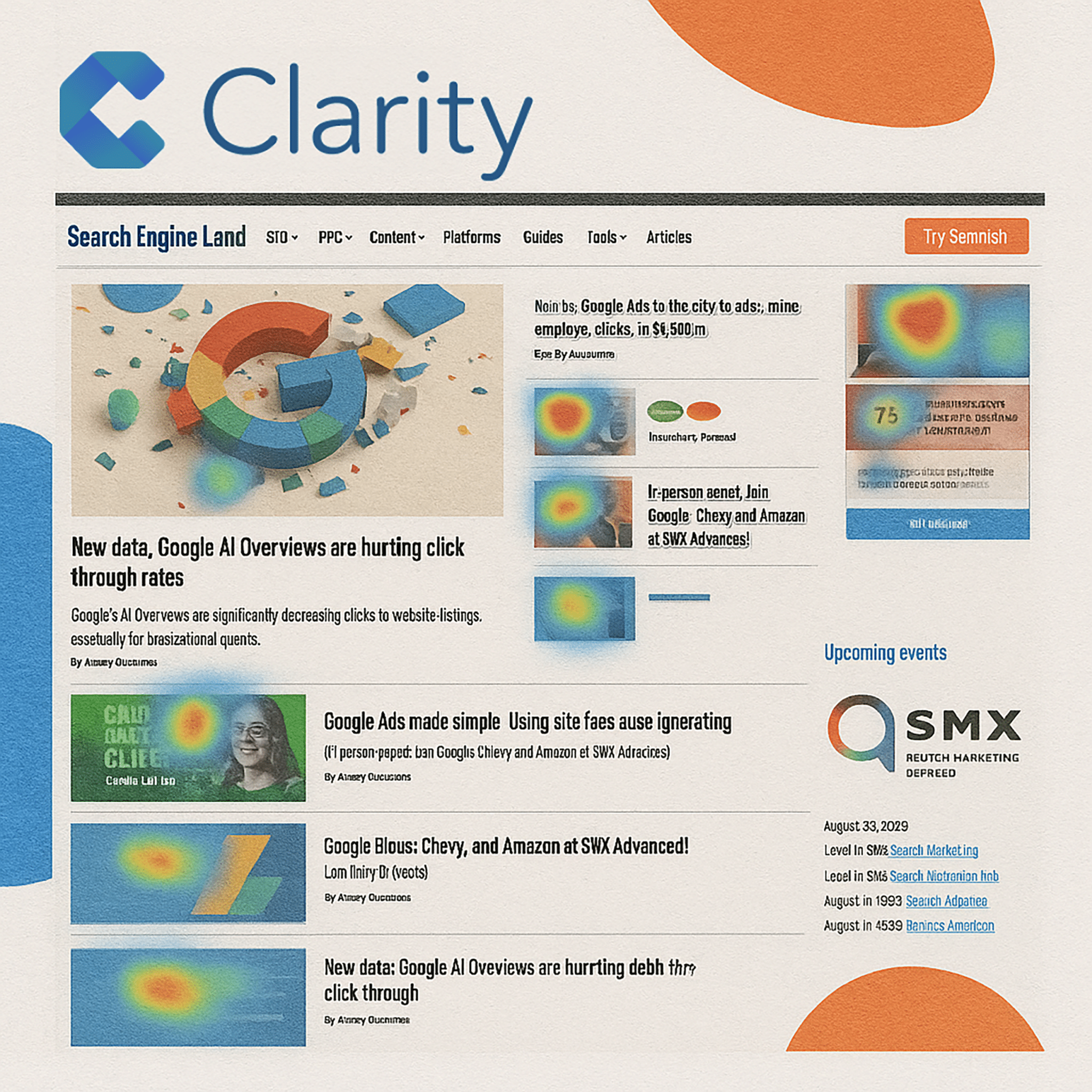
You might uncover engagement patterns with particular topics or types of content.
There may be transferable data here that can be shared with search teams, such as if a whitepaper for a particular audience proves popular. Perhaps there’s an opportunity to get it in front of audiences by ranking it across multiple channels that the particular audience frequents for suitable keywords.
Brand as a visibility multiplier
When E-A-T first hit the scene, SEOs focused on things like adding author bios, linking to credentials, and building backlinks from high-authority domains. It was tactical, almost like a checklist. But with E-E-A-T (adding Experience to the mix), we’ve moved beyond surface-level optimizations. Now, it’s about proving real-world expertise, showing up across multiple touchpoints, and earning trust at scale. That means E-E-A-T isn’t just an SEO concept anymore—it’s becoming a full-blown brand strategy.
We’re also finding new ways to quantify how a brand shows up in the world. Branded search volume growth, unlinked brand mentions, share of voice in AI summaries and social search—these are fast becoming indicators of visibility strength. Google’s increasingly looking for signals that say, “People know who you are and trust you,” and those signals often come from outside traditional ranking factors. That means brand presence—consistency, tone, authority, even visual identity—plays a measurable role in discoverability.
What used to be the intangible magic of brand awareness is becoming more measurable by the day. For years, we all knew brand mattered, but the mechanics of how it influenced visibility or trust were hazy at best. Now, with the explosion of consumer-facing touchpoints—from influencer content and product reviews to social comments and AI citation patterns—we have enough data to start modeling how often, where, and in what context a brand shows up. This has helped not only marketers, but also Google and LLMs, better understand the relative significance, expertise, and trustworthiness of different sources across the digital ecosystem.
Marketers can now set clear KPIs around brand growth while also managing online reputation with the latest generation of tools. Semrush Enterprise AIO has cracked the code on measuring brand visibility, share of voice, and sentiment, which takes all the guesswork around digital impact.
Today, authority is less about the domain and more about how memorable you are across channels. If someone sees your brand in a TikTok, then spots you in a newsletter, and later finds you ranking in Google—it reinforces your credibility. That’s when SEO starts compounding. Branded search spikes, high click-through rates on name-based queries, and repeat engagement all signal to search engines that you’re the go-to. In that sense, strong brand engagement and recognition aren’t just byproducts of SEO—they’re important factors of the ranking engine.
AI-native content strategy and SERP-less discovery
As AI search evolves, SEO specialists must focus on creating content that’s in-line with traditional SEO and organic search while simultaneously securing visibility in AI tools and AI overviews.
Within the SERPs of traditional search engines, AI tools often generate summaries or answer questions directly at the top of the results. This means that it might be unnecessary for users to click through to a website to get the information they need, which is known as a “zero-click search.”
SEOs must think about:
- Data ingestion: AIs collect data from various sources and provide it to users. Content needs to be written to make understanding and snipping information easy. Structured pages with headings and succinct answers are one way to do this, and structured data and schema can help Google understand content, too.
- Citation loops: If your content is used or paraphrased by a search engine’s AI or within tools like ChatGPT, you may earn a small citation, which can bring users to your website.
- Language model exposure: With AI becoming a discovery tool for content, you must write content that will appear in places like ChatGPT or Gemini. Good SEO is a significant help here, and Google has provided guidelines on what helps with visibility in AI overviews.
- Prompt injection: If you can inject prompts into your content, you may be able to align content with an AI model’s understanding of a topic. For example, if you wanted to appear within AI results for “What is SEO?” you might include this question in a heading and then answer the question succinctly and completely.
- Source architecture: Your content must be well-structured and organized for AI tools to navigate it and pull relevant information for AI-generated answers.
- Attribution strategy: Start developing a clear attribution strategy now. Backlinks and citations are crucial for ensuring AI tools and search engines recognize and credit your content. Add authors to your articles, and ask people mentioning your brand to link to you.
Further reading: Semrush analyzed the impact of AI Search on SEO Traffic
Performance loops and growth metrics
SEO and search experts cannot work in a silo. Marketing coordination across search marketing channels and other channels is key to success.
Metrics SEO teams must consider
Modern SEO has evolved from a keyword-ranking discipline into a driver of performance loops—feedback systems where visibility, engagement, and conversion reinforce each other across multiple surfaces. It’s not enough to track position in SERPs; SEOs now monitor traffic velocity (how quickly content gains momentum), assisted conversions (especially through organic content that supports broader journeys), and engagement loops (such as content that earns repeat visits or gets shared, saved, or cited elsewhere). These loops create compounding returns, and they’re essential for understanding content’s true ROI across organic, social, and AI-powered surfaces.
To reflect this shift, SEOs are developing new KPIs to capture multi-surface impact. For instance, how often is content referenced in AI answers or cited on Reddit? What’s the click-through rate on branded queries driven by social buzz or video engagement? How much downstream value does an early-stage blog post create by warming up a user before they convert on a retargeted ad or demo request? These are the kinds of insights that help prove SEO’s influence beyond last-click attribution—and they’re critical for visibility in a fragmented discovery ecosystem.
Track, optimize, and win in Google and AI search from one platform.
What SEOs now report to CMOs and growth leads has changed drastically. It’s no longer just “we moved from position eight to three”—it’s about organic contribution to revenue, share of search, content-assisted pipeline, and how SEO plays into cross-channel growth strategies. Leadership wants to see how organic surfaces (search, AI, social, marketplaces) are feeding the broader funnel—and how fast. This means SEOs are expected to tie their work directly to business outcomes, integrating with paid, brand, and product teams to report not just on rankings, but also on growth acceleration and visibility momentum.
Enhancing user experience (UX) as an SEO strategy
Page experience used to be a designer’s challenge, but SEO professionals (now growth & visibility experts) need to be more involved in page experience. Page experience undeniably became part of SEO’s remit with Google’s Page Experience Update.
Page experience contributes significantly to conversions.
Using old-school SEO methods and thinking, all SEO had to do was drive clicks and visibility to a website.
But if a website’s page experience was so poor that the page didn’t convert, then the SEO wasn’t effective for growth. Arguably, driving traffic to a poor page experience could do more harm than good.
A landing page offering an excellent UX is:
- Visually appealing
- Fast loading
- Easy to use
- Set up to help the person landing on it
- Aligned with user intent
Important note: a website’s UX must be optimized for both desktop and mobile because people use both devices to access web content. It may be that more people are using desktops, especially in B2B, but mobile experiences should never be neglected.
Page experience is key to multi-channel search marketing because all platforms should funnel traffic to the website and eventually to conversion.
It doesn’t matter how successful your multi-channel marketing is if it fails at the point of a potential buyer reaching your website.
SEO skills are table stakes—visibility thinking is the differentiator
To become a true growth & visibility expert, today’s SEO must go beyond keyword rankings and take ownership of how, where, and why people discover a brand across search, social, AI, and emerging platforms.
This means mastering new discovery surfaces, leveraging behavioral data and first-party insights, and aligning efforts with growth metrics like traffic velocity, branded search volume, and content-assisted conversions.
The role is no longer about optimizing pages—it’s about engineering a discoverability ecosystem that builds authority, drives engagement, stays user-centric, and directly contributes to business growth.
Keep reading to chart your brand’s course through AI SEO.
Explore more on
Editorial disclosure
Search Engine Land is owned by Semrush. We remain committed to providing high-quality coverage of marketing topics. Unless otherwise noted, this page’s content was written by either an employee or a paid contractor of Semrush Inc.
About the author