Google Analytics Now Considers Bing A Search Engine

As promised, Google Analytics is now logging traffic from Microsoft’s new Bing search engine into the “search engine” traffic source category, rather than in the “referring sites” category. As a result, Google Analytics users can now see for themselves whether all of Microsoft’s Bing marketing is producing more traffic for Bing, which in turn is generating traffic for their web sites.
Looking at our Search Engine Land stats, Bing’s a big winner. For the past three days, it has sent more traffic to us than Yahoo. Here’s Bing:

June 12 is only a partial day, so it’s really June 8 through 11 to look at. It shows Bing sending us between 350 to 400 people per day. In contrast, Yahoo beat Bing on June 8 then fell behind:

From June 9-11, Yahoo’s been sending us less traffic than Bing, about 300 to 350 per day.
I’ve never seen Microsoft in the second place spot for search engine traffic referrers. Going back two weeks ago, it was comfortably ahead of Bing, sending us nearly three times the traffic.
This is only one site, of course. Looking at my personal blog Daggle, yesterday’s traffic breakdown was like this:
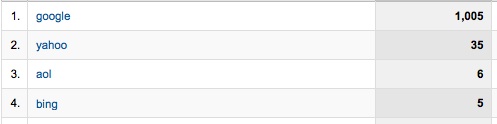
There, you can see that Bing is well behind Yahoo, sending Daggle only 5 visits to Yahoo’s 35. So by no means is what’s happening on Search Engine Land indicative across the web.
Google, of course, far outdistances them all — sending just over 1,000 visits. The same is true with Search Engine Land:

While Bing and Yahoo were sending less than 500 people each to Search Engine Land, Google was sending well over 5,000 per day.
This gap between search market share reported by companies such as comScore, Compete, Hitwise and NetRatings is well known. While they typically give Google a 70 percent share of the market, this comes largely from measuring searches that happen at each of the search engines and not what happens after a search is done.
Referrer stats show the percentage of share each search engine has based on the traffic they send to web sites. Those stats often have site owners finding that Google might have a 90 percent share (see Google By Far The Leader, If You Look At Site Owner Traffic Stats for more about this). No one’s really offered a good explanation for the gap — it’s not much studied, and it has been more pronounced with Yahoo. My own guess is that Yahoo recycles more searches at its site back into Yahoo’s own properties or to external sites that participate in its paid inclusion program (anecdotally, when you ask who gets traffic from Yahoo, those doing paid inclusion put their hands up).
More early stats have been coming in about how Bing is doing, and I plan to churn through those next week. Unfortunately, it’s not going to be until early to mid-July that we have full month June figures to get a real solid measure on how Bing’s done. But for a particular site, Google Analytics gives you a way to assess the situation now.
Explore more on
Editorial disclosure
Contributing authors are chosen for their expertise and work under the oversight of the editorial staff. Search Engine Land is owned by Semrush. The contributor was not asked to mention Semrush; the opinions expressed are their own.
About the author