Google: Bing Is Cheating, Copying Our Search Results

Google has run a sting operation that it says proves Bing has been watching what people search for on Google, the sites they select from Google’s results, then uses that information to improve Bing’s own search listings. Bing doesn’t deny this.

As a result of the apparent monitoring, Bing’s relevancy is potentially improving (or getting worse) on the back of Google’s own work. Google likens it to the digital equivalent of Bing leaning over during an exam and copying off of Google’s test.

“I’ve spent my career in pursuit of a good search engine,” says Amit Singhal, a Google Fellow who oversees the search engine’s ranking algorithm. “I’ve got no problem with a competitor developing an innovative algorithm. But copying is not innovation, in my book.”

Bing doesn’t deny Google’s claim. Indeed, the statement that Stefan Weitz, director of Microsoft’s Bing search engine, emailed me yesterday as I worked on this article seems to confirm the allegation:

As you might imagine, we use multiple signals and approaches when we think about ranking, but like the rest of the players in this industry, we’re not going to go deep and detailed in how we do it. Clearly, the overarching goal is to do a better job determining the intent of the search, so we can guess at the best and most relevant answer to a given query.
Opt-in programs like the [Bing] toolbar help us with clickstream data, one of many input signals we and other search engines use to help rank sites. This “Google experiment” seems like a hack to confuse and manipulate some of these signals.

Later today, I’ll likely have a more detailed response from Bing. Microsoft wanted to talk further after a search event it is hosting today. More about that event, and how I came to be reporting on Google’s findings just before it began, comes at the end of this story. But first, here’s how Google’s investigation unfolded.

Postscript: Bing: Why Google’s Wrong In Its Accusations is the follow-up story from talking with Bing. Please be sure to read it after this. You’ll also find another link to it at the end of this article.

Hey, Does This Seem Odd To You?

Around late May of last year, Google told me it began noticing that Bing seemed to be doing exceptionally well at returning the same sites that Google would list, when someone would enter unusual misspellings.

For example, consider a search for torsoraphy, which causes Google to return this:

In the example above, Google’s searched for the correct spelling — tarsorrhaphy — even though torsoraphy was entered. Notice the top listing for the corrected spelling is a page about the medical procedure at Wikipedia.

Over at Bing, the misspelling is NOT corrected — but somehow, Bing manages to list the same Wikipedia page at the top of its results as Google does for its corrected spelling results:

Got it? Despite the word being misspelled — and the misspelling not being corrected — Bing still manages to get the right page from Wikipedia at the top of its results, one of four total pages it finds from across the web. How did it do that?

It’s a point of pride to Google that it believes it has the best spelling correction system of any search engine. Google even claims that it can even correct misspellings that have never been searched on before. Engineers on the spelling correction team closely watch to see if they’re besting competitors on unusual terms.

So when misspellings on Bing for unusual words — such as above — started generating the same results as with Google, red flags went up among the engineers.

Google: Is Bing Copying Us?

More red flags went up in October 2010, when Google told me it noticed a marked rise in two key competitive metrics. Across a wide range of searches, Bing was showing a much greater overlap with Google’s top 10 results than in preceding months. In addition, there was an increase in the percentage of times both Google and Bing listed exactly the same page in the number one spot.

By no means did Bing have exactly the same search results as Google. There were plenty of queries where the listings had major differences. However, the increases were indicative that Bing had made some change to its search algorithm which was causing its results to be more Google-like.

Now Google began to strongly suspect that Bing might be somehow copying its results, in particular by watching what people were searching for at Google. There didn’t seem to be any other way it could be coming up with such similar matches to Google, especially in cases where spelling corrections were happening.

Google thought Microsoft’s Internet Explorer browser was part of the equation. Somehow, IE users might have been sending back data of what they were doing on Google to Bing. In particular, Google told me it suspected either the Suggested Sites feature in IE or the Bing toolbar might be doing this.

To Sting A Bing

To verify its suspicions, Google set up a sting operation. For the first time in its history, Google crafted one-time code that would allow it to manually rank a page for a certain term (code that will soon be removed, as described further below). It then created about 100 of what it calls “synthetic” searches, queries that few people, if anyone, would ever enter into Google.

These searches returned no matches on Google or Bing — or a tiny number of poor quality matches, in a few cases — before the experiment went live. With the code enabled, Google placed a honeypot page to show up at the top of each synthetic search.

The only reason these pages appeared on Google was because Google forced them to be there. There was nothing that made them naturally relevant for these searches. If they started to appeared at Bing after Google, that would mean that Bing took Google’s bait and copied its results.

This all happened in December. When the experiment was ready, about 20 Google engineers were told to run the test queries from laptops at home, using Internet Explorer, with Suggested Sites and the Bing Toolbar both enabled. They were also told to click on the top results. They started on December 17. By December 31, some of the results started appearing on Bing.

Here’s an example, which is still working as I write this, hiybbprqag at Google:

and the same exact match at Bing:

Here’s another, for mbzrxpgjys at Google:

and the same match at Bing:

Here’s one more, this time for indoswiftjobinproduction, at Google:
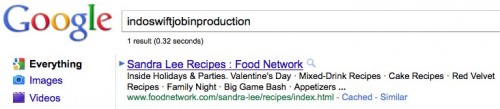
And at Bing:

To be clear, before the test began, these queries found either nothing or a few poor quality results on Google or Bing. Then Google made a manual change, so that a specific page would appear at the top of these searches, even though the site had nothing to do with the search. Two weeks after that, some of these pages began to appear on Bing for these searches.

It strongly suggests that Bing was copying Google’s results, by watching what some people do at Google via Internet Explorer.

The Google Ranking Signal

Only a small number of the test searches produced this result, about 7 to 9 (depending on when exactly Google checked) out of the 100. Google says it doesn’t know why they didn’t all work, but even having a few appear was enough to convince the company that Bing was copying its results.

As I wrote earlier, Bing is far from identical to Google for many queries. This suggests that even if Bing is using search activity at Google to improve its results, that’s only one of many signals being considered.

Search engines all have ranking algorithms that use various signals to determine which pages should come first. What words are used on the page? How many links point at that page? How important are those links estimated to be? What words appear in the links pointing at the page? How important is the web site estimated to be? These are just some of the signals that both Bing and Google use.

Google’s test suggests that when Bing has many of the traditional signals, as is likely for popular search topics, it relies mostly on those. But in cases where Bing has fewer trustworthy signals, such as “long tail” searches that bring up fewer matches, then Bing might lean more on how Google ranks pages for those searches.

In cases where there are no signals other than how Google ranks things, such as with the synthetic queries that Google tested, then the Google “signal” may come through much more.

Do Users Know (Or Care)?

Do Internet Explorer users know that they might be helping Bing in the way Google alleges? Technically, yes — as best I can tell. Explicitly, absolutely not.

Internet Explorer makes clear (to those who bother to read its privacy policy) that by default, it’s going to capture some of your browsing data, unless you switch certain features off. It may also gather more data if you enable some features.

Suggested Sites

Suggested Sites is one of likely ways that Bing may have been gathering information about what’s happening on Google. This is a feature (shown to the right) that suggests other sites to visit, based on the site you’re viewing.

Microsoft does disclose that Suggested Sites collects information about sites you visit. From the privacy policy:

When Suggested Sites is turned on, the addresses of websites you visit are sent to Microsoft, together with standard computer information.
To help protect your privacy, the information is encrypted when sent to Microsoft. Information associated with the web address, such as search terms or data you entered in forms might be included.
For example, if you visited the Microsoft.com search website at http://search.microsoft.com and entered “Seattle” as the search term, the full address http://search.microsoft.com/results.aspx?q=Seattle&qsc0=0&FORM=QBMH1&mkt=en-US will be sent.

I’ve bolded the key parts. What you’re searching on gets sent to Microsoft. Even though the example provided involves a search on Microsoft.com, the policy doesn’t prevent any search — including those at Google — from being sent back.

It makes sense that the Suggested Sites feature needs to report the URL you’re viewing back to Microsoft. Otherwise, it doesn’t know what page to show you suggestions for. The Google Toolbar does the same thing, tells Google what page you’re viewing, if you have the PageRank feature enabled.

But to monitor what you’re clicking on in search results? There’s no reason I can see for Suggested Sites to do that — if it indeed does. But even if it does log clicks, Microsoft may feel that this is “standard computer information” that the policy allows to be collected.

The Bing Bar

There’s also the Bing Bar — a Bing toolbar — that Microsoft encourages people to install separately from Internet Explorer (IE may come with it pre-installed through some partner deals. When you install the toolbar, by default it is set to collect information to “improve” your experience, as you can see:

The install page highlights some of what will be collected and how it will be used:

“improve your online experience with personalized content by allowing us to collect additional information about your system configuration, the searches you do, websites you visit, and how you use our software. We will also use this information to help improve our products and services.”

Again, I’ve bolded the key parts. The Learn More page about the data the Bing Bar collects ironically says less than what’s directly on the install page.

It’s hard to argue that gathering information about what people search for at Google isn’t covered. Technically, there’s nothing misleading — even if Bing, for obvious reasons, isn’t making it explicit that to improve its search results, it might look at what Bing Bar users search for at Google and click on there.

What About The Google Toolbar & Chrome?

Google has its own Google Toolbar, as well as its Chrome browser. So I asked Google. Does it do the same type of monitoring that it believes Bing does, to improve Google’s search results?

“Absolutely not. The PageRank feature sends back URLs, but we’ve never used those URLs or data to put any results on Google’s results page. We do not do that, and we will not do that,” said Singhal.

Actually, Google has previously said that the toolbar does play a role in ranking. Google uses toolbar data in part to measure site speed — and site speed was a ranking signal that Google began using last year.

Instead, Singhal seems to be saying that the URLs that the toolbar sees are not used for finding pages to index (something Google’s long denied) or to somehow find new results to add to the search results.

As for Chrome, Google says the same thing — there’s no information flowing back that’s used to improve search rankings. In fact, Google stressed that the only information that flows back at all from Chrome is what people are searching for from within the browser, if they are using Google as their search engine.

Postscript: See Google On Toolbar: We Don’t Use Bing’s Searches

Is It Illegal?

Suffice to say, Google’s pretty unhappy with the whole situation, which does raise a number of issues. For one, is what Bing seems to be doing illegal? Singhal was “hesitant” to say that since Google technically hasn’t lost anything. It still has its own results, even if it feels Bing is mimicking them.

Is it Cheating?

If it’s not illegal, is what Bing may be doing unfair, somehow cheating at the search game?

On the one hand, you could say it’s incredibly clever. Why not mine what people are selecting as the top results on Google as a signal? It’s kind of smart. Indeed, I’m pretty sure we’ve had various small services in the past that have offered for people to bookmark their top choices from various search engines.

Google doesn’t see it as clever.

“It’s cheating to me because we work incredibly hard and have done so for years but they just get there based on our hard work,” said Singhal. “I don’t know how else to call it but plain and simple cheating. Another analogy is that it’s like running a marathon and carrying someone else on your back, who jumps off just before the finish line.”

In particular, Google seems most concerned that the impact of mining user data on its site potentially pays off the most for Bing on long-tail searches, unique searches where Google feels it works especially hard to distinguish itself.

Ending The Experiment

Now that Google’s test is done, it will be removing the one-time code it added to allow for the honeypot pages to be planted. Google has proudly claimed over the years that it had no such ability, as proof of letting its ranking algorithm make decisions. It has no plans to keep this new ability and wants to kill it, so things are back to “normal.”

Google also stressed to me that the code only worked for this limited set of synthetic queries — and that it had an additional failsafe. Should any of the test queries suddenly become even mildly popular for some reason, the honeypot page for that query would no longer show.

This means if you test the queries above, you may no longer see the same results at Google. However, I did see all these results myself before writing this, along with some additional ones that I’ve not done screenshots for. So did several of my other editors yesterday.

Why Open Up Now?

What prompted Google to step forward now and talk with me about its experiment? A grand plan to spoil Bing’s big search event today? A clever way to distract from current discussions about its search quality? Just a coincidence of timing? In the end, whatever you believe about why Google is talking now doesn’t really matter. The bigger issue is whether you believe what Bing is doing is fair play or not. But here’s the strange backstory.

Recall that Google got its experiment confirmed on December 31. The next day — New Year’s Day — TechCrunch ran an article called Why We Desperately Need a New (and Better) Google from guest author Vivek Wadhwa, praising Blekko for having better date search than Google and painting a generally dismal picture of Google’s relevancy overall.

I doubt Google had any idea that Wadhwa’s article was coming, and I’m virtually certain Wadhwa had no idea about Google’s testing of Bing. But his article kicked off a wave of “Google’s results suck” posts.

Trouble In the House of Google from Jeff Atwood of Coding Horror appeared on January 3; Google’s decreasingly useful, spam-filled web search from Marco Arment of Instapaper came out on January 5. Multiple people mistakenly reported Paul Kedrosky’s December 2009 article about struggling to research a dishwasher as also being part of the current wave. It wasn’t, but on January 11, Kedrosky weighed in with fresh thoughts in Curation is the New Search is the New Curation.

The wave kept going. It’s still going. Along the way, Search Engine Land itself had several pieces, with Conrad Saam’s column on January 12, Google vs. Bing: The Fallacy Of The Superior Search Engine, gaining a lot of attention. In it, he did a short survey of 20 searches and concluded that Google and Bing weren’t that different.

Time To Talk? Come To Our Event?

The day after that column appeared, I got a call from Google. Would I have time to come talk in person about something they wanted to show me, relating to relevancy? Sure. Checking my calendar, I said January 27 — a Thursday — would be a good time for me to fly up from where I work in Southern California to Google’s Mountain View campus.

The day after that, Bing contacted me. They were hosting an event on February 1 to talk about the state of search and wanted to make sure I had the date saved, in case I wanted to come up for it. I said I’d make it. I later learned that the event was being organized by Wadhwa, author of that TechCrunch article.

A change on Google’s end shifted my meeting to January 28, last Friday. As is typical when I visit Google, I had a number of different meetings to talk about various products and issues. My last meeting of the day was with Singhal and Cutts — where they shared everything I’ve described above, explaining this is one reason why Google and Bing might be looking so similar, as our columnist found.

Yes, they wanted the news to be out before the Bing event happened — an event that Google is participating in. They felt it was important for the overall discussion about search quality. But the timing of the news is being so close to the event is down to when I could make the trip to Google. If I’d have been able to go in earlier, then I might have been writing this a week ago.

Meanwhile, you have this odd timing of Wadhwa’s TechCrunch article and the Bing event he’s organizing. I have no idea if Wadhwa was booked to do the Bing event before his article went out or if he was contracted to do this after, perhaps because Bing saw the debate over Google’s quality kick off and decided it was good to ride it. I’ll try to find out.

In the end, for whatever reasons, the findings of Google’s experiment and Bing’s event are colliding, right in the middle of a renewed focus of attention on search quality. Was this all planned to happen? Gamesmanship by both Google and Bing? Just odd coincidences? I go with the coincidences, myself.

[Postscript: Wadhwa tweeted the event timing was a coincidence. And let me add, my assumption really was that this is all coincidence. I'm pointing it out mainly because there are just so many crazy things all happening at the same time, which some people will inevitably try to connect. Make no mistake. Both Google and Bing play the PR game. But I think what's happening right now is that there's a perfect storm of various developments all coming together at the same time. And if that storm gets people focused on demanding better search quality, I'm happy].

The Search Voice

In the end, I’ve got some sympathy for Google’s view that Bing is doing something it shouldn’t.

I’ve long written that every search engine has its own “search voice,” a unique set of search results it provides, based on its collection of documents and its own particular method of ranking those.

I like that search engines have each had their own voices. One of the worst things about Yahoo changing over to Bing’s results last year was that in the US (and in many countries around the world), we were suddenly down to only two search voices: Google’s and Bing’s.

For 15 years, I’ve covered search. In all that time, we’ve never had so few search voices as we do now. At one point, we had more than 10. That’s one thing I love about the launch of Blekko. It gave us a fresh, new search voice.

When Bing launched in 2009, the joke was that Bing stood for either “Because It’s Not Google” or “But It’s Not Google.” Mining Google’s searches makes me wonder if the joke should change to “Bing Is Now Google.”

I think Bing should develop its own search voice without using Google’s as a tuning fork. That just doesn’t ring true to me. But I look forward to talking with Bing more about the issue and hopefully getting more clarity from them about what they may be doing and their views on it.

Opening image from Real Genius. They were taking a test. There’s no suggestion that Google is cool Chris Knight or that Bing is dorky Kent (or vice versa). It’s a great movie. You can even watch it for free here on Crackle.

Related Stories:

Postscript: Bing: Why Google’s Wrong In Its Accusations is the follow-up story from talking with Bing. Please be sure to read it in addition to this story.

Related Topics: Copygate | Google: Web Search | Microsoft: Bing | Stats: Relevancy | Top News


About The Author: is editor-in-chief of Search Engine Land. He’s a widely cited authority on search engines and search marketing issues who has covered the space since 1996. Danny also oversees Search Engine Land’s SMX: Search Marketing Expo conference series. He maintains a personal blog called Daggle (and maintains his disclosures page there). He can be found on Facebook, Google + and microblogs on Twitter as @dannysullivan.

Connect with the author via: Email | Twitter | Google+ | LinkedIn


SMX - Search Marketing Expo

SearchCap: Get all the top search stories emailed each day!

Name: Company: Email:

Like This Story? Please Share!

Other ways to share:

Like Our Site? Follow Us!

Search Engine Land on Google+

LinkedIn over 34,000 members
Subscribe to Our Feed! 81,186 subscribers take our RSS feed
 

Comments

126 Comments on Google: Bing Is Cheating, Copying Our Search Results

Adrian Bold,

Oh no, if Bing is just copying Google and Yahoo is just publishing Bing, where can a searcher go if they want to get some search results that don’t just lazily put Wikipedia top?


devisenhandeln,

I ve just googled and binged for ertgsdf and got different results. What more concerns me is the fact that SELand now already headlines “Are They Copying Us?”: Since when are “we” (or in this case “us”) Google Inc.? Are you getting paid by big G for this article?


Googlebot In Leet,

Now now, I enjoyed this article. No need to flame the author. If I discovered this I’d also be quick to write an article about it.

Brilliant job and thank you!

At the end of the day Google always stands on the no 1 podium even after someone jumped on their back for the ride to the finish line!


leadfigures,

Shows how quickly google is responding to updates to your keywords though, as now searchengineland.com is appearing in the results for the apparently gobledigook search terms. Should drive a good bit of traffic your way ;-)


Badams,

The phrasings used in this article, as well as the number of times sources from Google are quoted vs sources from Bing, and the amount of input Google has been allowed to have on the contents on this tale, leads me to conclude it’s not exactly am example of balanced reporting. Please do try and get some more input from Bing on this and let them explain their side instead of just serving as Google’s free PR spin machine. (Or isn’t it free? Hmm.)


Chris Smith
Chris Silver Smith,

From the info presented, I’d argue that Bing’s supposed method is actually pretty clever and likely wasn’t invented just to rip off Google. I mean, think about it – there’s still a lot of the internet that’s invisible to search engines and this exposes more of it.

For instance, if a government site with bad SEO (not unheard of) has a search form, then Bing could discover pages not previously found. This functionality likely got results from a number of search engines and on-site search forms.

I think the fact that this appears aimed primarily at long-tail queries Bing didn’t already have good results for indicates it was not intended to merely rip off Google, but merely as yet another means of agnostic discovery.


Danny Sullivan
Danny Sullivan,

Devise, it’s a sub-headline that’s meant to summarize the main theme of the section, which was Google asking “Are They Copying Us.” Sorry that you took that the wrong way. I’ll change it to make it clearer. And no, neither Google nor Bing nor anyone pays us for our articles.

Badams, it’s difficult not to source Google when the entire story is what Google said it did. They ran the sting operation. They’re the ones talking about it.

Bing was allowed to have as much input as they wanted. I contacted them early on Monday morning, when I started working on this. I received a reply around 3pm Pacific, which I included in this article. That’s all they wanted to provide.

I called Stefan by phone after getting that email and specifically asked, “Is that all you really want to say?” I felt like the statement wasn’t saying much, so I went out of my way to follow up even though I’d already been given a statement.

We had an off the record conversation that I can’t report, since it was off the record. But as I said in the story, Stefan said it was likely they’d have more to say when I see them after the event today.

I would have loved to have had much more input from them. I do indeed hope that they’ll provide some more comment on this.

In lieu of them commenting, I’ve tried to provide as much balance as I can. I’ve made it clear that not all of Google’s results are being mimicked — indeed, I’ve said most aren’t. I’ve been at pains to try and illustrate that the Google Ranking Signal, as I’ve called it, only appears to be most visible on long tail results. That gives Google concerns, but it’s still not the same thing as Bing copying everything.

I’ve also been at pains to explain exactly how the story came out. Clearly Google wanted it out; they responded to one of our columns and decided to tell me what they were doing. I thought it was important for people to understand this, and how it came about, which is why I have that long section at the end.

At the same time, it is a good, interesting story. My goal is to tell it, try to give all the sides and be fair to them, as best I can — because no, we’re not Google’s PR machine (and I’ve got plenty of articles that slam Google on various things), nor are we Bing’s PR machine — nor do we want to be anyone’s PR machine.

In the end, I tend to feel like it’s something Bing shouldn’t do. But I’m very curious what the general reaction is from a wide range of people. As I wrote — you could view this as a very small, very clever move. Perhaps that will be the consensus. Perhaps I’ll even be convinced that it is fine.

Frankly, it’s still pretty hard to digest. I’ve never — in 15 years now of covering the space — ever seen something like this. Kind of hard to get your head around.


nexcerpt,

Dear Google:

While reviewing your results, we discovered that you were creating Googlewhacks in a manner that is not compliant with our policies. For instance, we found violations of Googlewhack policy in the creation of “hiybbprqag.” Please note that this token
is an example and that the same violations may exist with other tokens in your results.

As stated in our policies, people are not permitted to create “Googlewhack Brand Whacks.” This includes any attempt to create a false association with Googlewhack.

We strongly suggest that you take the time to review our Googlewhack experience: ( http://blog.nexcerpt.com/2011/01/28/adsense_nonsense/ )

Oh… wait… Matt Cutts says it’s cool. Never mind. ( http://blog.nexcerpt.com/2011/01/29/adsense_sentience/ )

Please accept our sincere apologies for the erroneous notification.

Sincerely,
The Googlewhack Team


painperdu,

Wait. What? MS is copying technology from someone else? When did this start?


Chris Smith
Chris Silver Smith,

It’s difficult for me to feel a sense of injustice or outrage with any of the big search engines, because their products have so clearly immitated each other for so long. Google isn’t at all pure in this area, though I can admire their ability to tweak other’s ideas into more successful iterations, and they do innovate some stuff.

I think Danny’s attention to how/why/when the story came to him show his desire to be balanced. (Not to mention his extensive and often critical reporting on Google and search engines.)

I think Bing is falling down some on the PR game on this- Google clearly feels threatened by them some, else there wouldn’t be this attention. Further, as I suggested, there’s an argument to be made that this wasn’t intended just to rip off Google, and the discovery method could more broadly improve their ability to expose more of the dark web for search.


Steven Cole,

I don’t think its right what microsoft/bing are doing but microsoft has always been that way, taking the easy way out.

I’m more disappointed in google and their willingness to use code like they did here to edit results. even if they did do it just to catch bing there is no telling weather or not they might do it again maybe for the highest bidder like their recent decision to censor torrent and torrent related words from their auto complete feature. Google has lost my respect and will not get it back until they are back to the way they started, a honest company that cares more about its users and its users needs then about other companies.


Badams,

@Danny, thanks for taking the time to respond to my concerns. I take your meaning and don;t doubt your intentions to cover the SE industry as thoroughly as you can – and SEL is a credit to that driving spirit – but I do feel that this article has a heavy pro-Google anti-Bing slant.

This may not even be intentional. We all bring our own biases and prejudices, subconscious as they may be, with us when we write. Yours seems to be distinctly pro-Google. Even your criticism of Google seems aimed at ‘lesser’ offences, while on the big issues SEL seems to side with Google a bit too often (the EU antitrust case and search neutrality issues come to mind).

Yes you did cover all those points you mentioned. It’s just that the counter-arguments in favour of Bing seem to be much further down in the article, the headline is tone-setting against Bing, and the way things are phrased leaves little doubt on where you as the journalist stand on the issue.

But maybe that’s just my own anti-Google bias showing itself. :)


Dave_Lawlor,

Perhaps Google should do what it tells Yelp/Travel Advisor to do to combat this and that is block users from seeing their results so then Bing cant copy it…. oh wait that would cut of their business use? Oh then I guess maybe they aren’t really in a position to call foul over how sites use data that they didnt produce


Dan Hickey,

Interesting issue. Let’s say I own and run Pizza Hut. I know McDonalds spends a lot of time and money researching locations that successfully drive the growth of its business. Instead of spending money duplicating their research, I simply wait until they announce store openings (public info) and then I build next to them, which drives my success. I’ve piggybacked on their efforts using publicly available info. Cheating? Hardly. Smart? Arguably.


Håvard Krüger,

Did they look at other search engines or just Bing?

Altavista gets the same website, but they might be using Bing/Google as the engine?


Danny Sullivan
Danny Sullivan,

Badams, Google takes far more criticism than any other search engine. I do tend to jump into some of those frays when I don’t think there’s a lot of balance. It’s not to defend Google. It’s honestly because I’ll read something that’s really one-sided, to me, and feel like there just ought to be a more balanced view out there.

Of course, others reading what I write might disagree. That’s especially so if they read it in isolation from what I’m responding to.

Where I stand on the issue is pretty plain — it’s right down there at the end. It doesn’t feel right, to me. But I might change my mind, as this all gets discussed. i’m honestly curious to see how everyone’s reacting to this and some of the debate that will come up.

As for the headline — the world’s biggest and most popular search engine accuses its chief rival of cheating. That’s a big deal. That is the headline that should be there, I’d say. But that’s my view.


Dave_Lawlor,

And one more question I have is why would Matt Cutts be in this meeting about a subject that has NOTHING to do with Spam? Perhaps using the personal relationship he has over years with Danny to sell the story? It certainyl looks like this was an exclusive for SEL and one wonders how that spin works out.

And while Danny is true they do carry negative stories on SEL, I would be hard pressed to see negative stories the has carried his byline and weight.


James Lowery,

Without wishing to add fuel to the fire, or come across as a Microsoft fanboy here, and someone else might like to prove me wrong, but within the labyrinthine privacy policy / terms and conditions of Google Chrome (6,500 words), and the various Google privacy policies / terms of use documents, there are multiple references to Google storing information and browsing data such as this one:

“Google will receive and store the URL sent by the web sites you visit, including any personal information inserted into those URLs by the web site operator.”

Don’t get me wrong, the whole thing stinks and Microsoft probably deserve a kicking about this, but I’m willing to bet that Google aren’t entirely blameless when it comes to being a little bit too creepy about the amount of data they aggregate about users.


Asim Ali,

In the end, technological innovation is being killed in this blame game. Google’s got innovative on the blame game now.. ;)

If Google feels its results are being mimicked, innovate somethin that cannot be.

This reminds me of how Google copied the Bing Visual search and the background image thingy.

No doubt Google delivers better results than Bing. Period. Do not degrade your stance by doing this PR stunt before a Bing event.


Bruno Michels,

We shouldn’t reinvent the wheel. Why should we start from the rock wheel if there is already much more advanced technologies?

No one will reinvent the wheel, we will know how to look forward.


Jesse Barker,

Awww, this is the first time I have seen a search engine cry :D


Designbysoap Team,

Doesn’t this just prove that Google are perfectly capable of manipulating their SERP’s – something they’ve always claimed they were never able to do?

As you pointed out, they’ve assured us they’ll be removing this ability, but haven’t they always said they didn’t have that ability in the first place? That it was all algorithmic? Just a thought!

Excellent article as always though.


Danny Sullivan
Danny Sullivan,

Dave, I hardly need Matt to “sell” me on a story where Google’s going to come out and publicly accuse Bing of cheating. That’s like a self-evident story you’d want to cover.

As to why he was there, you’d have to ask him. I think you’re pretty familiar with the fact that Matt works as an unofficial defender of Google. So he does have interest in things beyond spam.

He was also there for another really easy reason. It’s his office. He shares the space with Amit and some of the other search quality engineers. Which, I imagine, is how he got involved — people in Google offices, like any offices, talk to each other.

Now about those negative Google stories that I never write. Coming right up.


Kevin,

Here is another take on the use of Google’s listings:
Google is considered by most of the general searching public as the leader amongst the search engines. Many consider it to be the authority when it comes to searches (yes we in the industry are finding a lot of things wrong with the results but the general public still views the Big G as #1). Taking this into account with the amount of searches running through Google why wouldn’t use Google’s ranking for keywords as 1 of its 200 (2000?) ranking factors. The reason it is so evident, as Danny mentions in the article, is that there is no other ranking factors to diminish this ranking factor’s importance. I think this makes sense as a ranking factor for Bing. Google has surpassed just being a search engine to being, the authority and Bing is taking that knowledge and using it to better deliver authoritative results.
That is my take.


Danny Sullivan
Danny Sullivan,

OK, negative articles about Google that I’ve written, in descending date order:

http://searchengineland.com/a-to-do-list-for-googles-new-ceo-larry-page-61957

http://searchengineland.com/why-youre-still-waiting-for-hulu-plus-on-google-tv-60770

http://searchengineland.com/when-ocr-goes-bad-googles-ngram-viewer-the-f-word-59181

http://searchengineland.com/first-day-review-the-google-chrome-os-cr-48-notebook-58322

http://searchengineland.com/google-bing-searching-for-wikileaks-web-site-57742

http://searchengineland.com/googles-gold-standard-results-take-hit-new-york-times-57081

http://searchengineland.com/android-fragmentation-google-search-android-56582

http://searchengineland.com/google-facebook-if-youre-so-smart-work-it-out-56272

http://searchengineland.com/meet-the-new-borg-google-facebook-apple-54969

http://searchengineland.com/why-google-cant-count-results-properly-53559

http://searchengineland.com/life-with-google-tv-my-first-day-impressions-53471

http://searchengineland.com/at-google-images-g-is-for-girls-bathrooms-53237

That gets me back to October 2010.


Jared R. Fabac, IMCP,

@Danny Great write up. I’m anxious to find out how Google responds to this. Obviously, from a Search Engine perspective, we can all certainly understand the frustration and immediate concern that Google has. Who in their right mind would sit back and gently take “fueling their largest competitor’s existence”. And was it really algorithmic, or is Bing just passing a script to retain Google results when there is no result found. I don’t really think Google’s algorithmic intelligence should be in question, here. Although clever, and somewhat humorous, I hope it doesn’t start a chain reaction of worry!

Its almost scary to sit back and just urge Google to innovate themselves more thoroughly so that they cannot be mimicked. I mean, aside from complete lack of ethics from bing, you have to assume that Google’s usability has left open some vulnerabilities which made this possible, right? So if we urge Google to innovate further to avoid unethical actions by bing, do we risk losing some of the usability that makes Google great?


modelportfolio2003,

@Asim
I’m totally with Danny on this one. Bing should get kicked from here to there and there being out a here! This is plain cheating on a mass scale and is degrading for Microsoft and shows there lack of creative ideas when it comes to search. If all they can do is copy Google, why bother, esp when they are losing more money every quarter. Just stupid pride.
But why put a pin in the Bing balloon before their event? Because it feels good to have the shoe on the other foot when each and every day Microsoft spends money and time in Washington DC and Brussels and with the ITA anti-Google group figuring out how they can prevent Google from bringing greater and greater innovation to its users. Really pathetic behavior and a sign of a monopolist who has nothing better to do with its monopolistic profits.


Rich Miles,

Ha! Google’s value is based on weighting content produced by OTHERS. Bing using Google is EXACTLY the same thing.

There is no way that Google would use something like the Yahoo directory to help rank sites, right?

This is a joke. This only proves two things: 1.) Google can and does manipulate its search results and 2.) Google is afraid of Bing.

Weak sauce Google. Really weak sauce.


Jeff Darcy,

I see nothing wrong with using expressed user preference/behavior at a competitor’s site to test/tune one’s own ranking algorithms, which is what this at first appeared to be. As I read about getting the exact same #1 site for *nonsense terms*, though, it became harder and harder to believe that Bing’s algorithms were involved in any way. Copying results isn’t an algorithm. Shame on them.


Dave_Lawlor,

@Danny – I stand corrected, and not afraid to say I missed the fact your author page only had the recent articles to scan through. I know having Matt there wouldn’t sell you on writing the story it is a no brainer, but having someone there that you are friendly with can change the questions you ask and take things at face value because you trust him. You did do some back checking on things like the Google Toolbar data usage, but it just seems onsided, espcially when you even say that you are more likely to have more from Microsoft on this after the upcoming event. I totally believe this was an exclusive to you, I dont see the rush before you could go back and ask why thier use is different and fill in these other questions.

@modelportfolio2003 – lol yeah poor Google… they have never brought up anti trust or jumped on the lobbyist bandwagon


Jared R. Fabac, IMCP,

@Rich, I think you went a little off the beaten path with that one.

Google uses many different variables to rank sites, including the quality of inbound links from quality places such as, Yahoo! directory. But still, regardless of what’s being used as variables, its still Google’s process for determining search results.

What’s frustrating is that we DON’T NEED ANOTHER GOOGLE. I don’t need a repopulated list of equal results branded with a different logo. I need bing and their engineers to improve upon current processes to make my experience, as a user, better. Not reproduce results I just got from Google.

And I know people are quick to say “I just searched for xyz bla bla bla on google and on bing and got different results, this article of full of…” Of course the entire search engines are not going to be synced together, but it is an alarming note that the search engines may be close to generating results that are so close to user requests that, outside of Google, they’re running out of room to improve it.


Brent Buford,

In a sense, this is simply reverse-engineering. I guess one risk of a private, proprietary algorithm is that the results of that algorithm, though vast, can still be collected and studied and even copied. With this and the whole Chrome/h.264 dustup, Google seems to be saying open/free is good as long as they can monetize it; otherwise, they’re protective and a little…snippy? I understand Google’s pride of ownership; they’ve built the best search engine out there. But for a company whose revenue is largely built on the back of other people’s content, there is a whiff of delicious irony here.


Danny Sullivan
Danny Sullivan,

Dave, absolutely — if you hear only one side, it’s easy to be convinced of only one side.

In terms of asking why their use is different. I did ask. They said they don’t use the data as Microsoft does. Asked and answered.

Later in the evening yesterday, I did some further research and came across the previous comment about site speed. So I cited that, which I thought probably cost Google some credibility — they should have mentioned that from the start, right?

But realistically, I think they were focused on the do they use it to add aspect. I will follow up on it, but that was a minor point that wasn’t worth holding the entire article, in my view.


Yael K. Miller,

In my personal experience, I don’t believe Bing copies Google for every search. As a PC Windows (7) user, I always use Bing to search when I encounter issues with my computer. And Bing gives better results than when I use Google for such searches. Conversely, whenever I have questions about Google products, I use Google to search.


Scott Duffy,

I don’t see any injustice here.

Microsoft’s technique of catching “referrer” information and using that to adjust it’s search results is brilliant. I am willing to bet this mainly affects nonsensical and misspelled words and has very little impact on real searches.

It’s not like Microsoft is hacking into the Google search database and copying its results. It’s referrer data – available to anyone. And as you said, clearly spelled out that they’re doing that!

Can’t fault Microsoft on this one. Sorry Google, time to innovate some more instead of whining to the press.


Wouter Kiel,

Found an interesting thing when trying to find the original serps for those synthetic queries.

Looks like the date filter isn’t flawless on Google. When searching for those phrases with only results for 2010 there’s a couple that shouldn’t be there: http://bit.ly/ewLYSo. How come Google thinks they’re from 2010 when they feature an artical that’s clearly from 2011? Are they looking at actual dates on a page? Why not use crawl or cache date?


Ashley Sellers,

@Danny I agree and think this will cost Google some credibility and am curious how Google will respond to this situation as well! Great article and thank you for sharing!


Mateus Pinheiro,

One very simple solution? STOP USING INTERNET EXPLORER. WHAT KIND OF PEOPLE ENJOY USING IT WHEN WE HAVE SO MUCH OPTIONS AS CHROME AND FIREFOX?

Keep it simple.


Ian Lurie
Ian Lurie,

I’m kinda stunned at the whole thing. Both at Bing’s chutzpah and at their stupidity at getting caught.

If you ARE going to steal results from arguably the smartest folks on the planet, wouldn’t you at least randomize or somehow mix stuff in?

Google does lots of hinky stuff, but Bing once again proves that if there’s a race to the bottom in search land, they’re going to win it.


teeman,

This reflects more poorly on Google than Bing. It shows that Bing is catching up to Google and Google is making excuses by promoting this false controversy.

Bing indexes websites. Google is a website that indexes other websites. It only makes sense to index the indexer to get the most complete picture of the internet. It’s public, it’s out there, why wouldn’t you index it? It shows real innovation – combining the speed of a single search engine with the broadness of meta-search engines that reach more websites. Frankly I am surprised Google hasn’t done it themselves!

I hope Bing also scours other search engines as well! Only then would they really have the most complete index of search results


yamamma,

google ‘copied’ dmoz all the time.. maybe not now… but they used too….


Michael Martinez,

So people are okay with Google capturing data from their Websites and serving it to Google users as “instant answers”, but they’re not okay with Bing monitoring Google’s query traffic?

That is a completely bizarre and uncritical point of view.

Google needs to stop monetizing other people’s content before it gets up on this soap box.


Jeremy Post,

Wow. Kudos to Google for the brilliant PR stunt. They won’t call it illegal, but they’ll use the media to label their only U.S. competitor a “cheater” in the court of public opinion.

And for what? Microsoft is leveraging data about their users’ online behavior to adjust the information they serve in search results. Google does the same thing, probably more so. If the user interaction starts in a Microsoft browser search bar and ends on a content or commerce site, why shouldn’t MS be able to capture that data and use it to inform Bing SERPs?

These allegations just seem like a lot of sizzle, no steak.


teeman,

On a not so related side note: this reminds me about how the folks at Lotus were caught by Excel’s rapidly improving feature set while they failed to quickly transition Lotus 123 to Windows. Their first response was also “they cheated!”. They made all sorts of excuses: they must’ve gotten windows code in advance, they made excel run better, etc.

They couldn’t believe how fast Microsoft caught up and was in denial. Microsoft may not be the most innovative company out there, but they are persistent and eventually gets there, and if you rest on your laurels, they will eventually catch up.


contextfree,

Buried halfway through the article:

“These searches returned no matches on Google or Bing — or a tiny number of poor quality matches, in a few cases — before the experiment went live. [...] Only a small number of the test searches produced this result, about 7 to 9 (depending on when exactly Google checked) out of the 100. Google says it doesn’t know why they didn’t all work, [...]”

The writer apparently thinks these results justify concluding the article with this takeaway:

“When Bing launched in 2009, the joke was that Bing stood for either “Because It’s Not Google” or “But It’s Not Google.” Mining Google’s searches makes me wonder if the joke should change to “Bing Is Now Google.”
okayyyy.


Sam Street,

Well it’s just as well that NOONE (except Microsoft employees) uses Bing then.


Jamie Grove,

“It’s cheating to me because we work incredibly hard and have done so for years but they just get there based on our hard work,”

And… Just when did Google decide to start paying royalties on all the links they use to help determine Page Rank? Oh, that’s right, they’re not.

I love Google, but it seems like they’ve forgotten that their own search results are based on looking over the shoulders of everyone to see what is relevant.


tubby_bartles,

It’s obvious what’s happening. Bing isn’t \scraping\ Google’s search results. They are monitoring all search terms across all search engines (including their own) and watching what site the user visits immediately afterwards. This feeds into their own algorithms. For common search terms like \Britney Spears\ this would simply find any sites they may have missed in their own crawl plus remove spam that users skip over when they click on search result #3.

For *uncommon* results like mis-spellings and \fake words\, this would have the unpleasant side effect of basically mimicking Google’ search results, since they are the largest engine.

So I suspect their original \non-denial\ is correct – it wasn’t an intent to copy Google’s search results with a \results scraper\, but that is a side effect for rare search terms.


ChrisCD,

Hasn’t Google admitted to using other signals such as Twitter. Of course they would love to have Facebook signals, but last I heard Facebook and Google aren’t playing very nice together.

And others pointed out, Google has relied on the Yahoo!directory and DMOZ for quality signals.

So come on, now. Who is “cheating”?

And talking about using others’ info, how much content has Google created?

cd :O)


BitFarmer,

I don’t feel Microsoft is doing wrong by cleverly using the info they get from their’s users use of the web.

If, as I understand it, the problem is that google is embeding info in the links they return of a search, including the searched text, so, receing this info back (searched text, link they chosed to follow after) into the google’s servers each time a user click on a search result.

As far as I can see it, now google claim this info is being mined by bing to improve their own results, and google feels it should be better if bing stop doing so, but bing doesn’t feel that way.

OK, if this is the case, the solution is rigth in the google servers: This searche text google embeed in theirs results, is for internal consum, so why to just encrypt the text before embeding it into the search result, and decrypt it back to plain text once the user send it back to you by clicking on the result link.

Bing will receive this encripted search text, but won’t be able to decrypt it, so bing won’t be able to connect the search text with the link its users are clicking on, so end of the dispute, bar is closed.

To avoid bing from beeing able to brute force attack google encryption, google could just change from encrypting algorithm and password each minute, and then decryt it back using the last five minutes algorithms and passwords until one of the succed in recovering the right search text.

Just keeping in mind that the same servers that encrypt will be the ones to have to decrypt it back some seconds after, the ways google could do it are just enndless, so they only have to choose one that doesn`t make theirs servers to melt.

One possible solution to google servers CPU usage raising too high due to encrytion overhead is to use the same hardware they actually use for the hppts secure connexions, sure they have some cryptograsphic hardware attached that could do the work without investing too much on it.

Just my thougths, may be it is a total sillyness from me!


FMJohnson,

“Around late May of last year, Google told me…”

“More red flags went up in October 2010, when Google told me…”

“In particular, Google told me…”

I didn’t realize there was someone at the company by that name. I guess he or she is the founder?


James Pollard,

I don’t think anyone has mentioned this, but it wasn’t so long ago that Microsoft complained to the DoJ about how the “Google monopoly” was helping Google outperform their competitors on obscure search terms because they have more users entering obscure search terms that they can track the behavior of. So now they’re just stealing that behavior data.

I think you’re also overestimating the complexity of Microsoft’s data gathering too. Since they are receiving a list of visited links for anyone using their Bing toolbar, all they have to do is group visits like http://www.google.com/search?q=torsoraphy with whatever links were visited after that and they’ve correlated searches to results.


The Electron Plumber,

Interesting. Based on this, if I pay a bunch of people to install the Bing toolbar, search for some keywords I want to rank higher for, then click on my results, there is a chance I’ll move up the Bing rankings?

Cheating or thinking outside the box?


Rajesh S R,

@Danny I think link to ” Curation is the New Search is the New Curation.” seems incorrect. I think it should be: http://paul.kedrosky.com/archives/2011/01/curation_is_the.html


Pat OConnell,

The behavior of both Google and Bing reminds me of Artificial Intelligence software, which can change its behavior based on how a user reacts to the software.

I don’t know if that’s accidental behavior or deliberate.

Discuss?


Clint13,

The most interesting point of this whole article is not the accusation that Bing copied Google results but that Google altered their algorithm to manually rank pages.

Let me say that again – GOOGLE ALTERED THEIR ALGORITHM TO MANUALLY RANK pages.

Now admittedly Google did say this was a one-time deal but this proves IT IS POSSIBLE.

Is this the first time the Google algorithm has been altered to the benefit of a single entity of individual?

Pandora’s Box indeed.


sescout,

At SEscout – http://bit.ly/i5nTOO – we track over 2 million search phrases on a daily basis for both Google and Bing rankings. Not only do they very rarely match up for long-tail terms, they’re typically wildly opposite.

This article just screams “sensationalism”. It’s totally one-sided and to be completely frank, probably not true.

I think, “Opt-in programs like the [Bing] toolbar help us with clickstream data, one of many input signals we and other search engines use to help rank sites.”, pretty much sums it up. Bing isn’t admitting to anything, in fact, you didn’t even get their side of the story from this, but of course it’s okay if you simply reply with “well that’s what Google said”. Calling this a “sting operation” is absurd.


Jordan Vance,

Actually, if Microsoft/Google do track the URL of every page you go to, they’ll know what you searched for when you click on a link in google. Not that it’s incredibly obvious, but it’s in the URL (Microsoft do not appear to do the same thing).

For instance, if I search for Boston Bruins in google, the URL for bostonbruins.com goes through a re-direct: http://www.google.com/url?sa=t&source=web&cd=1&ved=0CDMQFjAA&url=http%3A%2F%2Fbruins.nhl.com%2F&rct=j&q=boston%20bruins&ei=7mZITYOqFoHegQf1m-mmBg&usg=AFQjCNE0LBI-3qxUVcrcG5l60SNIasyyvA&sig2=Wl7bWo9ikB-4emqdbKDeyA&cad=rja. There you cans see both the url and query parameter (q=).


Patrick Correia,

In your discussion of the terms of use for IE’s Suggested Sites feature, I believe you missed the simplest explanation of why the terms state that “Information associated with the web address, such as search terms or data you entered in forms might be included”. You discussed the possibility that they don’t actually collect search data, but I think that Microsoft’s example illustrates what they probably mean.

Assume, for the moment, that Suggested Sites only submits the URL of the page you’re on. If that page was generated in response to the submission of a web form that used the GET method (instead of POST), then all the data you submitted in the form would be contained in the URL. In that scenario, Suggested Sites would receive all the form data you entered, without Microsoft really having any control over it. This is exactly what the Microsoft.com example is illustrating. In this scenario, the Suggested Sites TOS are actually very responsible, since they ensure that non-technical users are aware of the fact that the data they enter may end up as part of the URL that is submitted to the service.

Now, it’s possible that Microsoft is actually collecting form data intentionally – there’s nothing in the TOS that limits them to only collecting form data in this “innocent” scenario. But I wanted to point out that there’s a simple explanation.


Christian Lercher,

I was thinking, that there _might_ also be a completely different reason, why the results finally showed up in Bing. (And by the way, this would even explain, why it didn’t work with all sites.) In other words: It doesn’t necessarily have to be a client tool like the Bing toolbar.

It’s just a wild guess, but it could be, that the target sites (teamoneticket, rim, foodnetwork) are using an analytics tool to analyze the referer header, and post the “what links here” results, and the search terms that were used, somewhere on their site, or maybe on a different site. Using so-called “Refbacks” is not too uncommon after all.

This is not to defend Microsoft here at all – it’s just that I can’t make the conclusion “Results show up” => “Bing toolbar (or similar) must have sent data to MS”.


John Beagle,

According to this article from Danny Sullivan, http://searchengineland.com/what-social-signals-do-google-bing-really-count-55389 , both Google and Bing are using Social Signals as part of their search results logic.

So isn’t Google part of the social experience on the web? Bing using Google in their secret formula is easily a good ingredient.

Besides, I wouldn’t be a bit surprised to find out that Google also is using Bing data as part of their overall formula. No one knows for sure what’s in there (Google’s search algorithm).

Companies who live in glass houses shouldn’t be throwing black kettles at each other. Or something like that. lol


diego,

“Information associated with the web address, such as search terms or data you entered in forms might be included.”

I think that the thing that actually sounds alarming is that, given that nobody knows what IE logs, all your passwords (twitter, facebook, bank, …) could be logged too.
What happens if their DB is ever breached or the encryption that MS uses is found to be exploitable?
tic-toc tic-toc…


galeal,

Danny – I always assumed Google used this data – shocked to see they don’t – seems like excellent feedback loop data. Any insight into why they don’t use it (or say they don’t use it)?


CharlesGibbs2010,

I applaud Google for going public with this!!!

They could have done the easy thing and very easily have gamed this. Loading the bing toolbar on a fraction of their trillion servers and repeatedly click on a porn site for the misspelled search term Steve Baalmer.

Ultimately, it reinforces my prejudices about microsoft that it attracts more of the desperate to win types (spawns of tiger moms).


Aussiewebmaster,

Danny the article definitely was written with journalistic skill and while I think at times you may be too close to Google, since they are the big player, I understand they will get more coverage.

Now as far as cheating – Google’s words not yours – I think that is not the appropriate choice of descriptive. As has been mentioned by quite a few of the people above, you keep an eye on the competition. Copying some of their ‘innovations’ or new information sources is not surprising – Google does it all the time as well – ‘Google Offers’ is a good example, as is the Android App Store.

Bing’s actions are more like what is done in the fashion industry. One designer uses a technique that becomes popular and others rush to copy – how do they know what to copy? They watch everything their competitors are doing.

The example of made up words is perfect to use to understand what is being done. Bing wants to have search results for everything just like any engine should, so how do you do that? Watch if new words are being seen by other engines – I would wager a guess they are looking at all the other engines as well, not just Google for that.

Google needs to get over itself. The timing of this release was done for maximum impact – Matt had a big grin while he made the claims at BigThink and if he were honest, I think part of it was motivated as a way to downplay Bing – hey why are people going over to Bing when they are just copying us may help get the market share back to them or even have a big swing and really hurt Bing’s share.

Was this announcement done more to impact Bing’s credibility with their partners?

Google has a monopolistic view. They want to be the only search engine, the only analytics program and I am sure the only smartphone operating system.

The biggest thing this great article lacked was an opinion on why Google made the information public.


George F. Rice,

As of 5 pm EST on 1 February, “The Wiltern seating chart” was still the 5th most popular result on Bing for “hiybbprqag” (after 4 “Microsoft is cheating” articles). Absolutely hilarious. Microsoft doesn’t appear willing or able to hide the smoking gun even when the room is crawling with reporters…


Ash Nallawalla,

More power to Bing. Search engines learn by crawling the web and crawling Google’s results is fair game. Imitation is the sincerest form of flattery.


SterlingT,

This sheds a whole new light on Googling with Bing. http://www.collegehumor.com/video:1915736

:)


Steve Stoffers,

Bing works, Google doesn’t if you are outside the US. Yesterday I switched to Bing after using Google for more than 10 years. I live in SE asia and got way too tired of resetiing and saving English as my preference 50 times a day, everyday.


consumerjustice,

I wonder what Bing used as it’s starter database for it’s search results.

I have been waiting for years for some things that used my real name to drop off of Google. They were almost gone, and then Bing started up: the “digital dirt” was again a number one search result.

IMHO, the biggest problem with the Internet is anything that is published about you is saved forever. There is no way to ban the use of your name, since other people might have the same name. If your name appears in mainstream media simply because it appears in public court record or the police are seeking to interview you as a “person of interest”, then you become a public person whether you want to or not. Historians and librarians are now wringing their hands about “saving” lost web sites, without regard to whose privacy might have been invaded and who might want them to go away. There are “investigation” sites that are dedicated to aggregating any information they can about people, no matter how old. And they often mix the information of several different people!

Google has ruined a lot of people’s lives already. Bing resurrecting Google results just revives and perpetuates this tremendous injustice.

I would like to see a law that would enable people to black out any mentions of their name more than six months old. If some employer or nosy person wants to investigate you, let them do it the time-consuming old-fashioned way: go to a public records office and squint at microfiche all day. This would serve as a good anti-bullying measure, too. Perhaps there can be a “do not mention” list along the lines of a “do not call list”. Let people, including mainstream media, who keep stuff on the Internet without redacting names become legally liable.

Anyway, I really hate Bing for dredging stuff up. I hope Google succeeds in their complaint.


Adam Wehn,

This is just another reason for me to be glad I don’t use Internet Explorer as my primary web browser. It also makes me despise Micro$haft even more for their underhandedness.


Alireza Sefati,

I think Google would have done the same thing if it was in Bing’s position. We all learn from our competitors. As an SEO, I often tend to look at what my competitor is doing in order to rank better than my site and replicate their work, and also add my own innovation too.


JobsFor10,

Bing should focus on their quality services. Period.


leofishman,

I still remember 1999, when searching with google “more evil than satan” and clicking I’m feeling lucky, redirected the page to microsoft.com site

I wonder what else does microsfot with the data they collect


Sean Reilly,

I have little sympathy for Google complaining about “copying”. One more analogy along the lines of the “running a marathon” complaint: It’s like spending years designing and building a touch-screen phone with no physical keyboard only to have a competitor come along and clone it.


CharlesGibbs2010,

Bing is a search engine. A search engine crawls the web, indexes and spits out the results. By showing the same irrelevant results for the google made up words as google, although the words didn’t appear anywhere within the webpages, bing proved that it is doing nothing but copy google’s index. It is sad that google is unwilling to act on this.

I am very sad to see so many readers justifying this dishonest behavior. I suppose it is not surprising, given how many crooks lurk around here.


Danny Sullivan
Danny Sullivan,

Catching up on some comments, now that I’m back from the Bing event.

Yael, Bing absolutely does NOT copy every Google search. I never said that. I actually said the opposite, that most of Bing’s results do not appear identical to Google’s. But in some unusual case, it seems more likely that what does well on Google might be used as a signal for the same things to also do well on Bing

Michael, Jamie, I’ve seen several other people echo your comments.

Contextfree, it was kind of a joke. And if you’re mining some of Google’s searches, it seemed funny. You might not agree.

Tubby, you and Google would agree on what’s happening. Where you’d disagree is that Google would indeed consider this copying.

Chris, Google says it has some Facebook signals, too.

FM, I was speaking about the company in general as the source. I think you understand that. I also think most people understand it, as well.

James, interesting point.

Clint13, yes, it is possible, for the specific test terms on the list, as long as they don’t exceed a certain threshold, as long as the code stays up. And yes. Which is why Google is disassembling that box.

SEscout, yes, it’s Google’s story. That makes it pretty one-sided. As I’ve explained above, I’ve tried to add balance where I could. At this point, there’s no doubt I’d say that Bing is seeing searches on Google, and that those searches can influence the results. Which results, how many and to what degree is where there’s current debate.

Galeal, I was surprised, too. I’m working on a follow-up to get more details.

Aussie, I thought I made that clear. They wanted the information out before the event, because they thought it was important to discuss. Bing, obviously, would disagree. I went ahead with it, because they were going to speak about it regardless.

George, if they pull it down, some might then point at that to be a “smoking gun” showing it as “proof” they’ve done something wrong. Bing is saying they’ve done nothing wrong.


Ahmad Wali,

After this news what would be the response from Bing? I think they should accept and put a sign Bing Powered by Google or they should put a disclaimer that we display results from Google to enhance our searching technology. It is unethical to copy the results and denying that we do not copy.

Moreover, if Google going to sue Bing or a lawsuit? Bing market share will come down after this news. I am REALLY SURPRISED on this News.


J G N,

Look at this: http://goo.gl/O7BnQ.
The literal translation would be unable Bing. I pointed out some time ago. That the results are either very different. Or the other way very similar (for English).


bonnieyu,

I’m on the side that utilizing IE toolbar data makes sense as a signal, but it needs to be tweaked so that it can’t be gamed. for cases of extremely low count queries such as really odd misspellings where it’s hard to get other signals except from users, it seems reasonable. G has a huge advantage because of their search share so they get a lot more of those long tail queries. It’d be difficult for Bing to get that kind of data.

Anyway I like this because it will challenge Bing and other engines to come up with other ways to get solve this problem.


timacheson,

This is utter nonsense.

And yet, the same headline and story have suddenly appeared on seemingly every tech blog. This is pure corporate wartime propaganda from Google. Bing is unique, and superior, with less Spam and junk — but thanks for confirming that I might as well be using Bing as Google can’t tell the difference. Google and Bing give different results, so the algorithm is clearly not the same — please stop lying.

This is also blatant hypocrisy. How dare Google speak of innovation? Google employees have propagated the myth of their innovation for so long, they’ve begun to believe it. Google’s innovation doesn’t extend far beyond search, and that was a decade ago!

- Google’s Android OS is blatantly an attempt to copy Apple’s iPhone and iOS. And it’s actually just Java, which they are using without permission.

- Google’s Docs is openly just their attempt to emulate MS Office. And Google acquired it, they did NOT innovate it.

- Google’s GMail is blatantly copying Hotmail and Yahoo mail.

- YouTube was purchased by Google, not innovated by them, presumably because they couldn’t just copy it as normal.

Need I go on?

If Google wants to play dirty let’s put more facts on the table. Sadly people who know the truth don’t have Google’s vast exposure.


Lastwebpage,

Google made a similiar test with e.g. Opera or Firefox and Bing as search provider?
If not, the test scenario was wrong and bing stole nothing.


patsmith,

It seems to me this could be happening even with no intent on Bing’s part to copy results from Google or any other search engine. That may be implicit in some of the earlier comments, but it’s worth stating it explicitly.

It might seem reasonable for Bing to use information from Suggested Sites (SS) thus: (1) Just because SS says a user visited a site doesn’t make it okay to include that site in search results – the site might be private, and the URL might include confidential information such as passwords. (2) But if the site’s URL is known to be public, then use the SS information about the site to help decide when to include it in search results.

One of the things the SS info might include is “which website referred you”, according to http://www.microsoft.com/windows/internet-explorer/privacy.aspx. So if a user gets to en.wikipedia.org/wiki/Blue by following a link from private.x.y.z/periwinkle, this would make it a bit more likely that a search for “periwinkle” on Bing would return the Wikipedia page for blue.

If Bing follows such a strategy, then it’s going to pick up Google search results without even trying. “So the user got to http://www.bing.com from http://www.google.com/search?q=bing. OK, let’s raise the probablility that searching for ‘www’ or ‘google’ or ‘search’ or ‘bing’ will return http://www.bing.com just a smidgen.”

For Bing to avoid using Google search results, it would actually have to go out of its way to check the referring URL, see that it is a Google results page, and decide not to use this bit of information to weight search results.

From the outside, we can’t know if this is what Bing is actually doing. But it does raise an interesting question.

Even supposing we all agreed that one search engine should not deliberately copy results from another (and that’s not obvious), if an engine’s normal operation would automatically pick up results from another engine, is the first engine obliged to put in extra effort to prevent this from happening?

(Disclosure: I used to work for Google, but have never worked on search, at Google or anywhere else.)


B. Dougherty,

I think The Google is crying Wolf on this one.

Their “sting” doesn’t show that Bing copies Google search results. It shows that Bing takes advantage of user behavior data.

In the “hiybbprqag” example, the Bing algorithm apparently learned that users click on the link to the Seating Chart article after doing a search for “hiybbprqag”. That search might have been on Google or Yahoo, or even Bing itself, if those other engines had planted honey pots of their own. It doesn’t matter which search engine the user was on when they found the link.

Now, if the Google testers had NOT clicked on the links for the high-ranked bogus search results, and found that Bing ranked the same sites highly, this might provide evidence of copying. In that case, MS wouldn’t have learned from user behavior, because there wouldn’t have been any. But the Google testers didn’t try that. Too bad.

I’m really surprised that Google is being so alarmist about this. I’ll bet they didn’t even consult with a statistician.


seoelk,

well maybe that’s just a bloody coincidence :)


Anthony Callegaro,

This confirms a trend we have been seeing in some of our customers ads see : http://opticout.com/en/about_bing_copying_google_search_results


PawelW,

I am not surprised that Google alarms. If Bing copies results from Google, then Google can be seen as authority. Coming closer to Google results means – we do not trust our own algorithms. Why? see this: http://t.co/tm6Ej0P


cherrytron,

Hi Danny, great article. When I read this I wondered if their signals could be coming from “all” click-stream data. Sure, Google would have more data volume than anyone else on the planet so it could be very easy to confuse the volume of data with the strength of such a signal in an algorithm. But, maybe someone should do some more tests with other sites anyway?

If I was writing an algorithm that used click-stream data and considered a random walk on any website, say I came to SEland and searched for a weird term but then clicked on whatever result you returned, if I could see the user path in that data (like MS/IE can) then I would use it.

I really wonder if Google is alone here, can we put together a test and see if Bing is using this type of data from all websites?

Microsoft have similar research that suggests to this kind of technique in lots of places, here is just one for example: http://research.microsoft.com/apps/pubs/default.aspx?id=142649 (If I can’t put links in, cause I am new here, search Google for “Result Enrichment in Commerce Search using Browse Trails” it was the 3rd result for me).

Besides, who uses Bing anyway?


Rycke,

I have a Bing story for Google and Goodsearch. Their browser suddenly appeared as my new homepage, and I can’t get rid of it.

I had Goodsearch set as my homepage, but one day another search engine replaced it, and when I went to Goodsearch, I could no longer find the button to make it my homepage. Same result for Mail.com.

That page was not Bing; I can’t remember the name, because within a couple of weeks, it was replaced by Bing. I used their contact button on their page to ask them to take it off my computer, a couple of times, and have been totally ignored.

I want it off my computer. I have to look at it every time I get on the web, and I can’t get rid of it. I want to set my own homepage. Please help!


parseljc,

Haven’t the geniuses at Google ever heard of a “control” in an experiment?

Google Engineers should register a new domain. How about Sdsgfrdsfg.com? Set up a search engine there. A fake search engine. One that includes “search” and your search terms in the URL when you search for stuff. Then put the same fake unrelated results in for specific searches like “asefas asrggevcce aaiesojrf”. Then go run the exact same tests from your IE browsers again with Suggested Sites and the Bing bar on. And check to see if you notice any amazing changes on the Bing results page for “asefas asrggevcce aaiesojrf.” Of course you will, if you run the scenario exactly the same way.

Then of course SELand will be OBLIGATED by journalistic integrity to run an article claiming that Bing is COPYING their search results from Sdsgfrdsfg.com! Think about it.

The bottom line is that in the Google “experiment,” if the Google “engineers” had NOT actually clicked on the top fake search result, that would have told you something more. Because that would mean that MS was just running searches on Google and looking at the results. THAT would have been a story!


B. Dougherty,

Precisely, @parseljc:. I kinda made a similar point in my comment, timestamped at 7:35.

Not that I’m accusing you of scraping my idea, LOL! We both simply mined our own stores of common sense.

Like you, I am stunned that Google has the nerve to (1) publicize this “experiment” (2) make the ridiculous claim that Bing is copying their results, and (3) expect no one to question their pretzel logic. Well, I guess I’m not so surprised at #3. Most people (including, sad to say, search engine bloggers), don’t quite understand the tech. Plus, these claims do come from Google, after all. Who have just lost a modicum of my respect.


Allen Graves,

I’m a content marketer. For years I’ve been watching people steal my content and publish it elsewhere – eventually some of it ended up outranking my site and pushing it into the dreaded Google supplemental index.

Countless contact attempts have been made about it over several years and I have never heard back from Big G, nor did any of my pages ever come back. I have been completely ignored.

How does it feel Google?!

I’m sure I am one of thousands who has had this happen to them. Could this be a touch of Karma? True, I’m talking a single page of content out of billions, but if Google is going to balk at what Bing is allegedly doing, then perhaps they should give a little of that attention to those who have been complaining about this very thing to them for years!

Cheers…


kcseo,

Maybe @Google they should do a super bowl commercial about it. right after the @BING commercial runs ;)


Syed Aamir Aarfi,

No matter who gets rich, the Google is the best and MS are jealous and cheat without getting their hands dirty. But Google caught them red handed.
In fact Bing’s claim as a search engine fails and bing’s results are more like a book mark results, delicious. Which is definitely not AI but real intelligence which we call cheating, and yeah Robots get confused but Bing hits the bulls eye, without suggestions, through its old cranky Internet explorer which are only used in third world countries where IE is synonym for Internet.
Anyway, thanks to MS for teaching how to use computers and internet to an average human being. But wait Google also collects data from Chrome but does suggests lot of options which is possible only via AI and data collection over the years. Yahoo! for that matter is much better than Bing and in fact I still respect them and believe they ‘ll be back competing with Google and break the monopoly.


Aussiewebmaster,

Danny the thing is the panel was about addressing spam – I suppose Matt could have said well Bing grabs all sorts of spam – even the stuff we set up as a trap for made up words


richyokevin,

Let’s see.

1. Search for “hiybbprqag”, google’s honeypot word. Right now, Google returns 2 pages of results. Bing returns 7 pages with all relevant results. Who’s better?

2. Don’t forget the Google toolbar. They track data and dial mommy as much as IE dials Microsoft with your click data. They both track where you’re clicking – be it Bing search results or Google search results or independent clicks. Google toolbar uses you and your data as much as IE toolbar does.

3. Don’t forget Google’s famous words: they could give a crap about your privacy. That’s what their “adult” CEO Eric said. They have your data, they sell your data, they’ll sell more data as much as they want. They don’t care about your security or privacy.

4. Google has used and stolen from us, big time. Remember the free 411 calls? They used the data for training their speech engines – did they tell you? Did they thank you? They just dumped us all as soon as they had enough training done. We were a one-night stand.

5. What has Google copied and failed at? From Microsoft, Apple, the rest of the world? Umm – plenty.


morkedi,

@richyokevin

Are you kidding?

Google search results for “hiybbprqag” is 52.600, and in Bing is only 3,420! They can’t copy all of them from Google! :D

Bing (Microsoft) busted!
Epic Fail for MS!


purplepeopleeater,

For all of Google’s innovations and contributions to tech & culture, its bread-and-butter, search, has always caused me some ambivalence: their search engine has been superior since it emerged on the scene, and it has never stopped evolving. But while the technology behind it is all their own, the simple fact remains: their business is based on *capturing* public data and building its own content through the display of that data. In some cases Google partners with companies to integrate “proprietary” data, for example Twitter users’ realitime tweet stream, but this still requires that *users*, en masse, produce information voluntarily that Google then selectively displays — and then profits from doing so.

Again, this is a great service that Google provides for free, and they are an ethical and quality company that demonstrates respect for the community. But at the end of the day, Google’s business is to create content (search result pages, image result pages, news feeds, product result pages, movie showtimes, flight information, weather, snippets and secondary site links, page caches, etc.) out of *other people’s data.*

There’s another layer here: Google has a vast source of its own proprietary, private data in the form of user keyword searches. Make no mistake: this is a type of user-generated content that is massively valuable, especially when it is gathered and analyzed over time. Google has tools to make much of this data publicly query-able, but no one has the insight that Google has into the cultural zeitgeist, and this is unprecedented. Google’s entire business is fortified, and its search results improved by orders of magnitude, by incorporating the “content” of user search queries (queries as trends, as patterns, as location-based descriptions of a population, as yearly cycles, as flu pandemics, as reports of a concern or interest…). I call this “content” because these keywords have to be said to go beyond an “index query” in any simple sense.

So: is Bing being unethical by incorporating Google’s results? Yes, without a doubt. But Google should have handled this differently, perhaps by letting the quality of search results speak for themselves (since copying search results will not, ultimately, make for the better search engine). But at the end of the day, Google’s content — a search result page — is public information. It has relied on publicly accessible content for its entire business model, and that content is really the content that we, everyone, publishes to the web. It is nobody’s, it is everybody’s; and the company with the largest “cache” of this other-peoples-content has a major competitive leg-up. Bing is catching up to Google, no doubt, and has a long way to go: but this shortcut, as technically unimpressive as it is, should hardly be called an offense by Google, lest we should critically consider how they themselves built a business by “crawling” other people’s content.


Piers Johnson,

I’d like Google to have done a proper double blind test, and even have some engineers only using Suggested Sites and others only using Bing Toolbar – that would have been a better indicator.
Still, it’s nothing we didn’t already suspect, is it? I’d noticed Bing getting more G-like over the year.


NVRAM,

I’m not that surprised that Microsoft is “cheating” by stealing (info) from Google. But while it’s despicable, it’s not all that surprising.

If you search at Google, and click any links in the results page, they capture which links were worthwhile for you for those search terms (at times I’ve done a copy-n-paste and avoided feedback on the page, but rarely).

But here’s what HAUNTS me — in this scenario, Microsoft is also watching your searches and watching your clicks AT GOOGLE, and almost certainly not with your INFORMED CONSENT. Like a nefarious thief lurking in the shadows, they’re invading your privacy.

I see only two options – either they explicitly capture what you do when you search Google — and are thereby obviously guilty of industrial “cheating.” Or perhaps they do this for EVERY search query, regardless of the site — in which case it’s an even bigger invasion of end-user privacy.

Badly done, Microsoft. Badly done, indeed.


jalaj,

Obviously there is Google’s yet another intention behind revealing this sting-operation. Flooding Bing with Black-hat SEOs. Carried a full blog post at http://jalaj.net/2011/02/03/hiybbprqag–the-search-engine-game/


Bharath Radhekrishna,

There’s nothing new Googlr Read newtons 3rd law so that you can understand how the world will be. You copied Apple iPhone and iPad concepts and design and make them in your own way. Now Microsoft copied you. So google engineers shout now. This is law of karma…:-)


GoogleLuva,

I mentioned exactly this idea to google engineers years ago. I asked them what was to stop MS, or Yahoo or any of the other competitors at the time using google rankings to inform their own ranking algorithms. They claimed it couldn’t be done, wouldn’t work, yadda yadda (it is obvious that it would work).

Now the google crybabies are bitching about it. Boo hoo.

Google’s entire codebase runs on linux, to which they have contributed next-to-nothing. When they start coming close to giving back to the public domain an amount equal to their benefit, maybe I’ll have time for their whiny engineers.


EntrepreneurSecrets,

The game is getting interesting. Lets see who wins


EntrepreneurSecrets,

The game is getting interesting. Lets see who wins the competition


Hannah,

Bing- Because It’s Not Google


J Nimetz,

“And if that storm gets people focused on demanding better search quality, I’m happy” I agree. Personally I have found results in Google to be getting progressively worse over the past three years. Search and more importantly relevancy in search is difficult, no question. Google probably does it better than most. Everyone has a different semantic map which makes it difficult to consistently provide relevant results. In addition relevancy is in the eye of the beholder. I for one do demand better search quality. Blekko is a breath of fresh air. Thanks for the post Danny.


BarryF,

“Google has proudly claimed over the years that it cannot manipulate search results” …except for the “one-time” code that can be added and removed at will???

What a hopelessly one-sided article.

Barry
P.S. IE9 is faster than Chrome


jimkarter,

Here is a totally different view: http://www.seoindian.co.in/blog/is-bing-really-copying-content-from-google


Ben Edelman,

Here’s a twist others haven’t yet flagged: Google itself previously praised and endorsed this same technique.

In http://www.webmasterworld.com/forum80/21-1-30.htm , Google’s Matt Cutts (then posting under pseudonym GoogleGuy) wrote as follows:

“It’s my personal, unofficial belief that using toolbar data in the future to augment our crawl is not only a good idea, but specifically allowed by the original policies we posted.”

“A good idea” indeed — a good idea then, Matt said, when contemplating Google using this method. But now that Microsoft uses this very method, suddenly Google argues it’s improper.


mdo1979,

Google should take a look inwards before they propose that others should stop copying their innovations. What have they even innovated? Adwords? Nope, they stole that from Overture (and had to pay Yahoo for it later). Android? A pretty direct ripoff of IOS with tech overtly stolen from Sun and changed just enough to not have to pay them. Instant? Yahoo did that years earlier. Buzz? Nope, even the name was ripped off. How about Google’s new look? Strange, that looks an awful lot like Bing. Where would Google be now if they weren’t able to copy a lot of brilliant ideas?


John Repa,

NVRAM, you’re silly. Go sit in the corner with the other conspiracist, you’ll spot them by their tinfoil hats.

As for the subject at hand, I’m more dishearted by Google’s actions than I am Microsoft’s. Grow up.


Philly wiz,

It seems clear that MS is not using Google rankings directly, but is incorporating what sites users actually click on. I believe the long term impact of this will be detrimental to users. Here’s why:

Suppose hypothetically, Bing and Google both incorporated website choices made by users of any search engine. Eventually, search results from Bing and Google would converge to the same results – the rankings determined by user choices. Doesn’t matter whether one engine is better than the other, the results will be eventually virtually identical. Therefore, there will be no motivation for a search engine to improve its algorithms – there would be no long term impact on the results. That discouragement of improving algorithms sounds like a negative to me.

The exception to this would be for brand-new search terms or new websites; the engine that incorporated new information the quickest would have a short term advantage


Joan Stewart,

Thanks Danny,

Interesting article, I personally feel the more on-board the greater the possibility of accurate data. Sometimes the copycat will smooth out wrinkles that the originator missed or overlooked.


ThatsNachoCheese,

wonder if hiybbprqag is an acronym taking a shot at Bing.

any guesses?


Publishing…,

Ohhhhhhhhhh….so THAT is why Bing is called a decision engine…because it looks at everyone else’s search results and then \decides\ on which one to display in it’s \queries\…LOL!!!!!


FMJohnson,

FM, I was speaking about the company in general as the source. I think you understand that. I also think most people understand it, as well.\n
I did understand that and I’m sure everyone else understands it as well. But companies in general can’t be a source.

I don’t think an attribution like that would pass muster if a blogger at the Washington Post or the Wall Street Journal used it. (The White House told me… Procter & Gamble told me…)

Something like (for example) a source at Google told me… or a friend at Google told me… would sound a little more buttoned up.


Darren Forster,

Microsoft have copied quite a lot in the past anyway, so why stop? Windows was copied from the WIMP (Windows Icon Mouse Pointer) system from Apple, which even Apple copied from the Xerox WIMP system on photocopiers. Microsoft happily took Java and incorporated it into IE without Sun’s permission until Sun forced them to stop, and then created their own version of Java, which worked very similar to Sun’s, and yet the ironic thing is Microsoft get really annoyed when people don’t have genuine Windows on their computer.

Maybe Google should put something into their search engine that detects where the user came from previously, and if it was Bing then send them somewhere else (like maybe Google?), that would stop Bing piggy backing onto Google’s hard work.

This is plagurism, it is like me reading a book, liking bits of the book and taking bits for my own work and not giving credit to the author of the book.

One thing that is quite funny is now if you use them test search terms that Google came up with, they now both come up with links to these news articles on both Bing and Google, so even though Google have now removed the honeypot pages, they still exist.


Peter Young,

Am I the only one that thinks this is a case of the pot calling the kettle black?

Surely much of Google’s success is based on copying the successes of other search engines. Further to that I can’t help thinking that Google need to make sure they have their facts 100% spot on in this, otherwise they are in danger of causing some real issues for themselves.


meb0,

“Is It Illegal?

Suffice to say, Google’s pretty unhappy with the whole situation, which does raise a number of issues. For one, is what Bing seems to be doing illegal? Singhal was “hesitant” to say that since Google technically hasn’t lost anything. It still has its own results, even if it feels Bing is mimicking them.”

Isn’t that the same claim for and against all internet piracy? ‘The copyright holder hasn’t lost anything by pirating. nothing was stolen, just copied’


Darren Forster,

@meb0 – Probably is illegal – it’s similar to me going to a library and photocopying a book, walking away with the photocopy and telling the author of the book that I didn’t steal the book, just photocopied it.

The author would be pretty annoyed at me and probably sue me for breaking copying laws.

Even though it appears nothing is stolen, Google are losing advertising revenue, as the adverts that show up on Bing will be Bing’s adverts which they’ll get paid for, and yet the results will be Google’s which they won’t be able to show they’re sponsored links, although with the amount of Google sponsored links around it’s probably not going to make much difference over all.


Fiji Web Design,

I found this post quite misleading. The results are what they are because the experiment was designed to produce those results. I’ve wrote a more detailed explanation here: http://www.bucabay.com/search/bing-copies-google-results-experiment-fixed/


Clinton Cimring,

I think we all know that Bing has been copying Google. I’m glad Danny finally called them out on it.


Klaus Johannes Rusch,

What started as a technical and ethical issue has somewhat turned into a legal debate, not the least because of Harry Shum’s comments that Google doesn’t the clickstream data and therefore doesn’t have a say in how this gets used. Even if you assumed for a moment that this technically clever use of Google referral data is “legal” it is quite obvious that Google considers the use of clickstream data that contains Google Search URLs plagiarism and doesn’t want another search engine to use this data.

One possible solution, putting the Website owner in control, is the application of the Robots Exclusion Protocol to clickstream data. Hopefully this heated debate will eventually lead to search engine and toolbar developers putting their heads together and implementing a solution for fair use of clickstream data.


White Rabbit Express,

they’re climbing in your Windows(TM), stealing your search results…


Garth,

Actually, Bing had the auto correct feature BEFORE Google, google copied Bing in that aspect, the side bar search sort aspect, and the background image, along with the ‘unlimited’ scroll feature, it’s a bit dumb to think that if your web crawler picked something up, another search engine’s shouldn’t.


Get Our News, Everywhere!

 
  • Advertise With Us
 

Click to watch SMX conference video

Join us at an upcoming SMX event:

Search Engine Land produces SMX, the Search Marketing Expo conference series. SMX events deliver the most comprehensive educational and networking experiences - whether you're just starting in search marketing or you're a seasoned expert.

SMX Site » | SMX Difference » | SMX News »


Learn more about search marketing with our free online webcasts and webinars from our sister site, Search Marketing Now. Upcoming online events include:


Search Engine Land Periodic Table of SEO Ranking Factors

Get Your Copy
Read The Full SEO Guide