Russian Roulette: McAfee Details Web’s Riskiest Search Terms

Somewhere online right now there’s a music fan who’s big on free downloads, likes Coldplay’s “Viva La Vida” but doesn’t know the lyrics, is looking for free ringtones, uses MySpace, likes to play solitaire and wants the latest game cheats. Like many of us, s/he uses a search engine to find all of these things.
This person may as well be playing Russian roulette.
In a recent report (PDF), online security company McAfee says those are some of the most dangerous search terms on the web.
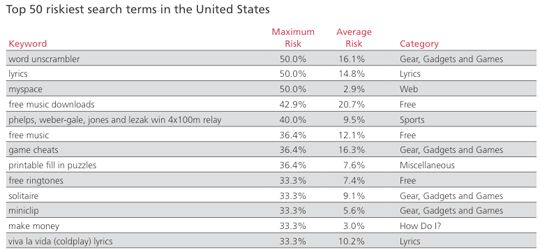
That’s just a sample of the report’s list of the 50 riskiest search terms in the U.S. “Maximum Risk” describes the percentage of pages on a single search results page that were dangerous; i.e., on a search for “lyrics,” there was one search results page on which 50% of the ranked pages were risky. “Average Risk” is the overall risk from all five pages of search results for each term.
McAfee analyzed the first five search results pages of 2,600 popular keywords across five search engines: Google, Yahoo, Live, AOL, and Ask. They analyzed both organic and paid listings and counted the number of links that led to pages that McAfee’s SiteAdvisor tool flagged as dangerous. The study ultimately reviewed more than 413,000 unique URLs.
McAfee’s study also found that certain categories of keywords were more riskier than others. Searches related to “lyrics” and “free” had both the highest average risk and highest maximum risk.


It should be no surprise that McAfee also found scammers like to look at popular trends when choosing what keywords to target. Here’s a chart showing some of the riskiest terms related to the economic crisis:

The report also has charts detailing the most dangerous search terms in other U.S categories, as well as several other countries including Canada, France, Italy, Spain, Germany, and others. Here’s the PDF download link (2.2mb) if you’re interested in more details.
To some degree, the McAfee report calls into question how well the search engines themselves do at notifying users of risky sites. Yahoo uses McAfee’s SearchScan, Ask uses Symantec, while Live Search Bing and Google have their own malware detection tools. But, on a purely anecdotal level, if you search for the terms listed in the McAfee report, Google, Yahoo, and Bing show very few warnings in the first five pages of results.
(found via Lifehacker)
Explore more on
Editorial disclosure
Contributing authors are chosen for their expertise and work under the oversight of the editorial staff. Search Engine Land is owned by Semrush. The contributor was not asked to mention Semrush; the opinions expressed are their own.
About the author