Community signals are AI’s largest third-party source

Across a sample of 35,000 ChatGPT citations, user-generated content (UGC) platforms hold more of the cited-domain share for SaaS-related prompts than review sites and publishers combined. They hold it at the top of the journey, at the bottom, and at every point between. There is no stage where they’re skipped.
So how do you build authority in a source you don’t control?
Let’s talk brand authority multiplication. Part 1 covered third-party citation signals. Parts 2 and 3 covered proprietary data and what makes it citable. Both of those are levers you can pull on your own.
This one — UGC — is not.
The uncomfortable part: The UGC pattern is bigger than expected. Problem is, this is the authority layer you can seed, prompt, and participate in, but never truly own. While some platforms, like Reddit, are really, really challenging to influence.
Method and limitations
The data comes from an analysis I ran for G2 in February 2026.
- Source: ~35,000 citation URLs captured in Profound.
- Coverage: US only, ChatGPT only, month of December 2025.
- Each SaaS vendor-related prompt was classified into one journey step: discovery (376 prompts), exploration (1,179), evaluation (1,367), or focused evaluation (255).
- Each citation URL was reduced to a root domain and classified as review_platform, ugc_platform, publisher, or vendor_or_other.
- Records were de-duplicated to one per run, intent, and domain, so a single answer citing 6 Reddit threads counts once.
The evaluation stage was the largest journey step covered in this prompt set.

And for reference, more than half of the SaaS-related prompts in this study use commercial language. But only 1.5% actually name a vendor brand.

What this analysis doesn’t do:
- The UGC set is wide. It groups Reddit, Wikipedia, Quora, YouTube, and LinkedIn. These UGC platforms have different uses and audiences. We report on the UGC set in aggregate for the stage analysis and break out composition later (in section 3).
- The analysis measures share of unique cited domains, not share of citation volume. Part 1 measured citation rows and put Video and Social at ~6.5%. Different denominator, different bucket, different dataset.
- One engine, one market, one month. There are limitations with this data set. Given the consensus gap, where 91% of citations appear in only 1 engine, don’t read ChatGPT results as overall AI search results.
- The prompts for this analysis were software vendor-seeking by design, which is why vendor domains hold 66.7% to 71.8% of citations at every stage.
1. UGC is the largest third-party source class in SaaS-related AI answers
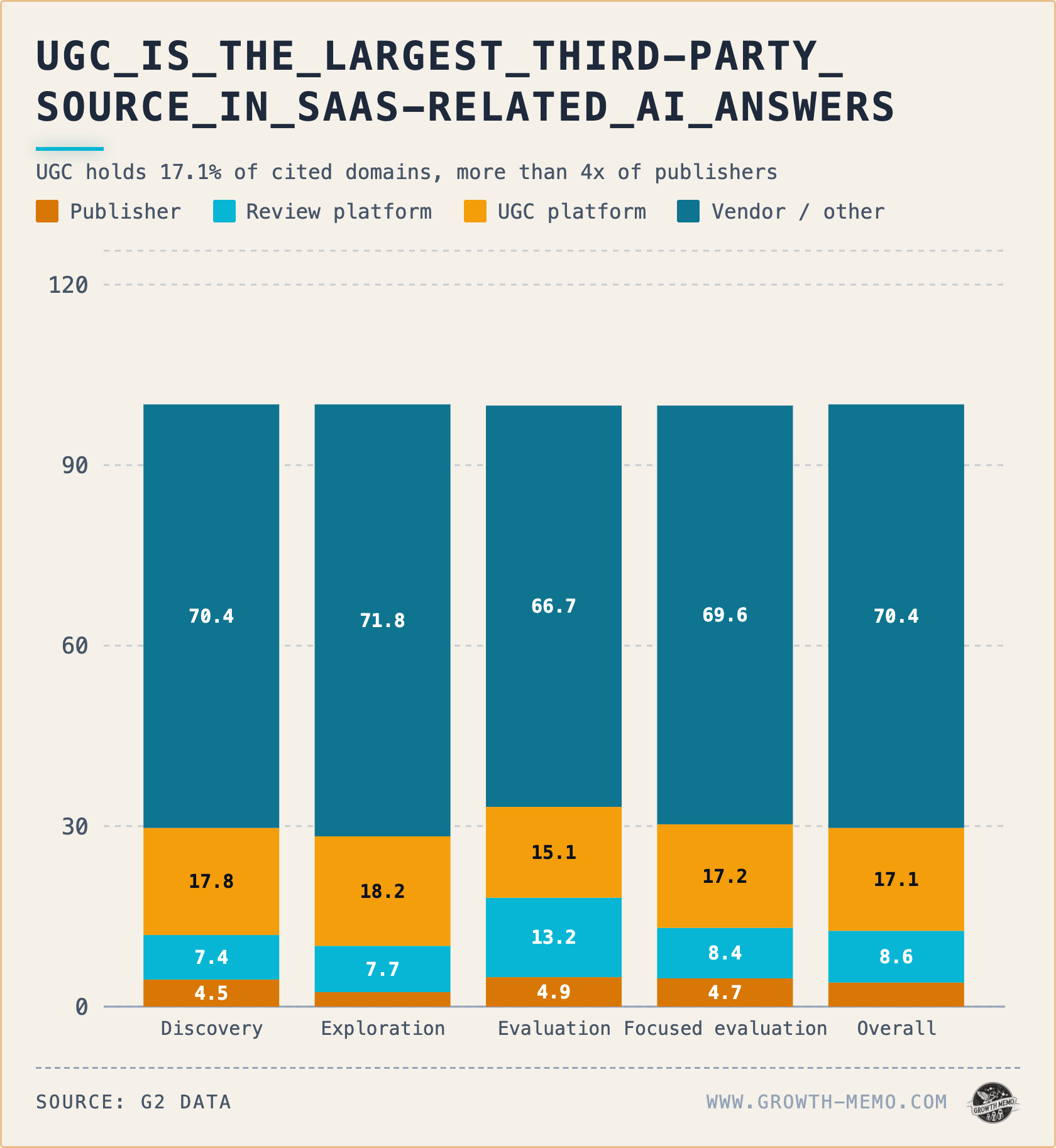
Strip out the vendor domains included in this analysis, and look at what is left: UGC platforms hold 17.1% of cited domains overall, more than 4x publishers at 4.0%.
Sit with the ratio for a second, because most authority-building budgets are aimed at the 2 smaller buckets: Digital PR targets publishers. Review campaigns target review platforms.
But the largest outside-source class in the sample, for this particular set of prompts, receives the least deliberate investment. Mostly because most marketing pros aren’t sure what a plan for it even looks like.
Even more importantly, excluding the vendor, UGC is the most common third-party source to show up in the AI Answer (not just the citation set) in this SaaS prompt data.

2. Review sites move with purchase intent. UGC doesn’t.
Read the table by column instead of by row and a second pattern shows up.
UGC dips slightly in the Evaluation journey step, passing its share over to publishers and review platforms. (Confirming that, yes, investment in Digital PR and review campaigns does matter.)
But review platforms swing. They sit at 7.4% in discovery and climb to 13.2% at evaluation, roughly 1.8x, then fall back to 8.4% in focused evaluation. A 5.8-point range.
UGC barely moves. 17.8%, 18.2%, 15.1%, 17.2%. A 3.1-point range across the stages.

Review platforms are a reliable bottom-of-funnel lever, while UGC is a floor.
That distinction can help decide where the money goes and when. A review campaign can be scheduled against a quarter because its payoff concentrates at a known stage. In other analyses, I found that (software) reviews increase a vendor’s AI visibility and shape AI answers.
But community presence has no such stage, unfortunately. Much like classic organic search visibility, it involves doing work to gain visibility in the answer when someone is learning what their needs are, and it still requires work to earn visibility when they are choosing between 2 finalists.
The review platform shares peaks at evaluation and falls to 8.4% in focused evaluation. Review platforms do their work while a buyer is building a shortlist, less once they are comparing 2 finalists. UGC holds at 17.2% through that same step.
Even at the narrowest gap between UGC and the review platforms (at the evaluation step), the point where peer proof is supposedly most concentrated on review sites, UGC still leads in citation amount.
3. Platform concentration isn’t platform stability
A floor that holds at 17% doesn’t mean the platforms underneath it hold.
Break the UGC bucket into its parts: Wikipedia, Reddit, and LinkedIn account for 99% of UGC citations in this sample. Everything else splits the remaining 1%.
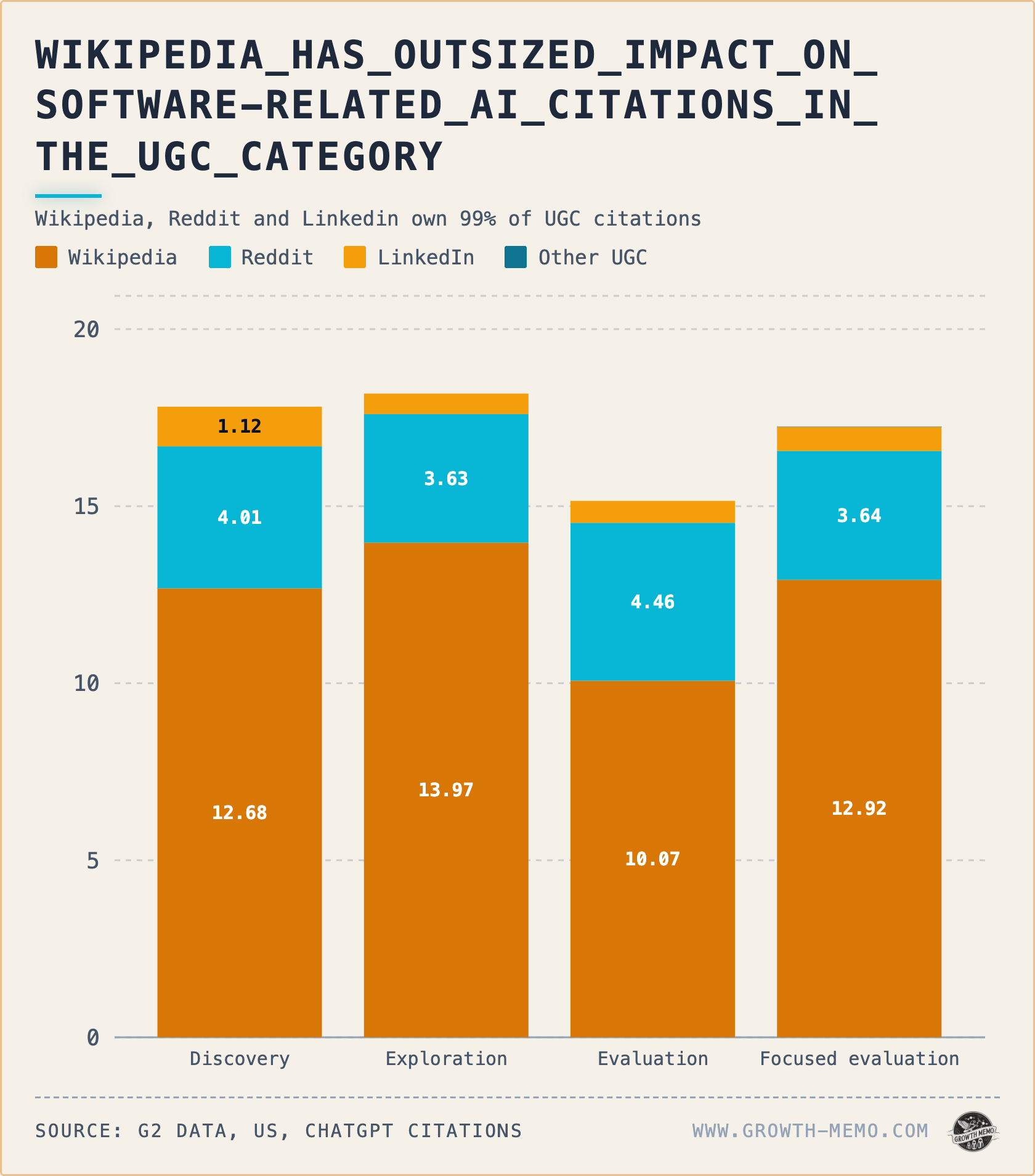
Wikipedia alone runs 10.1 to 14.0 points of that 17-point floor depending on the stage. It’s the single largest third-party source in the dataset… larger than the entire review platform class at every journey step except evaluation. That means the biggest slice of the biggest third-party source class is the one where deliberate action is least available to you.
Despite their hold across the AI citations and answers in this set, these platforms are volatile in their visibility.
In GIB #20, Reddit declined on both dimensions for the first time since I started tracking AI mentions in February: visibility down 11.7% and AI mentions down 10.9% in the 28 days to June 8, 2026.
Three weeks later the bucket moved the other way. In the 28 days to June 29 (GIB #21):
- LinkedIn +43.3% SEO visibility (289.4 to 414.7)
- X +38.6%
- Instagram +21.4%
- Facebook +20.1%
- Reddit +18.1% (2,297.6 to 2,765.7)
- YouTube at the bottom of the range: 11%
All UGC. The 2 windows overlap by a week, so treat these as adjacent reads on a moving bucket rather than a before and after.
Every one of those platforms lost AI Overview citations in the same 28 days it gained organic visibility. Google rewarded them in search and cited them less in AI answers, on the same properties, in the same window. A platform can concentrate share in one surface while losing it in the other.
So treat UGC as a portfolio and give each platform a job.
The aggregate is the number to defend. The composition is what you rebalance. And the platforms doing the work here aren’t interchangeable:
- Wikipedia is the largest and least actionable. You don’t campaign here. You make sure the sources Wikipedia editors are required to rely on (things like trade press, original research, primary documentation) exist and are accurate.
- Reddit is the most volatile, but presence here is worth it.
- LinkedIn is where a named person outperforms a brand account.
- YouTube offers durability as a Google-owned property where you have some control, and it’s your hedge.
Focus on the platforms where your audience actually lives. An audience research tool like Sparktoro will tell you where. What you don’t do is bet the whole community effort on one platform and then check the box that you’re “doing UGC.”
4. How to produce community signals on purpose
None of this is an argument for buying reviews or astroturfing threads. That’s a short-term tactic that can hurt your brand in the long-term. But there is an argument here for showing up where the answers are already being assembled.
Find which UGC platforms your category feeds
Run your highest-intent prompts and record which UGC domains appear, mostly across citations. In some categories, it will be Reddit and YouTube. In others, it’s a Discord, a Stack Exchange, or a single trade forum. The bucket is 17% on average and the composition is local to your topic. Part 1’s finding applies here: The source set AI trusts is rebuilt per topic.
Highlight people in the places that matter to your audience, not just the brand account
In Topics matter for third-party signals, we reported that a named author with a byline appears to outperform the same content under a brand, and LinkedIn’s own testing pointed the same way. A community treats a person as a participant… and a logo as an advertiser. This can be something as simple as your best sales rep making a YouTube shorts series about tips and tricks with your product.
Answer the questions your support queue already sees on repeat
Ticket logs, sales call transcripts, and in-app search queries hold the exact phrasing buyers use. Why proprietary data is your most defensible asset made this case for owned content. It applies even harder in community, where a question is sitting there already asked.
Make your customers’ words retrievable on your own pages
Pull real third-party review quotes, with links to the source, into the top of your highest-cited pages. The science of how AI pays attention found 44.2% of citations come from the first 30% of a page.
Whether the presence of positive third-party proof in that top third band changes how AI describes your brand is untested (outside of first-hand experience), so run it as a test with a stated hypothesis and a control set rather than as a tactic.
Measure the aggregate, rebalance the mix
Track UGC-sourced citations as 1 number, and platform composition as a second. The first tells you whether the floor is holding, and the second tells you where to move next quarter.
Mine communities for questions and terminology
Extract questions your audience asks on Reddit & Co. and track what words they use to describe your category, features, and brands. Then, use this information to inform your prompts and copy.
Correct the record that’s already sitting there
A 2023 thread claiming you lack a feature you shipped last year stays retrievable and keeps feeding answers. Reply in-thread with a dated correction and a link to the change. Removal requests rarely land, and deleting a thread deletes the context AI is reading from.
Set alerts on brand plus category terms (F5Bot for Reddit and HN, Syften if you need Discord and Slack coverage), so you catch it in weeks instead of quarters.
The strongest community signal isn’t written by you
Give customers and power users something worth posting on their own: early access to your data, a free tool, a number they can quote in an argument. That is as close to ownership as this bucket gets.
If a finding from this week changes a decision for your brand, the Growth Memo Premium Resource Library has 45+ (and growing) checklists, light tools, AI workflows, and stakeholder slide decks to put it to work.
5. Google started measuring social, and left out the platforms that matter most here
On July 7, Google introduced platform properties in Search Console, a property type that reports clicks, impressions, CTR, average position, and queries for Instagram, TikTok, X, and YouTube. You must link owned accounts to view, so this isn’t the same as brand mention monitoring across the web.
But Reddit isn’t on the list. Neither is LinkedIn, the two platforms doing the most work in the UGC bucket above are the two you still can’t measure natively.
Plus, this new feature reports visibility in Google Search and Discover, not AI answers. A team that connects these properties and calls the output AI visibility measurement will be measuring the wrong surface with real numbers, which is worse than measuring nothing.
Use it for what it is:
- The first native read on how your off-site content performs in classic Google. (The community signals feeding AI answers stay unmeasured for now.)
- An important signal of how crucial multichannel brand visibility is for AI search.
Out of the factors in the brand multiplication series (we examined topics, proprietary data, and original first-party research), community proof is the only one that keeps working while you sleep.
Third-party authority takes a quarter to move. Proprietary data takes a research cycle. Community presence takes a year, and once it takes off organically, then holds a floor that doesn’t care which stage of the journey your buyer is in.
Fund it as a standing line rather than a single campaign, because there is no stage where turning it off is safe when you want to maintain or grow organic AI search visibility.
This post first appeared on the author’s website and is republished here with permission.
Explore more on
Editorial disclosure
Contributing authors are chosen for their expertise and work under the oversight of the editorial staff. Search Engine Land is owned by Semrush. The contributor was not asked to mention Semrush; the opinions expressed are their own.
About the author