Why the For You Page deserves SEO attention


Think about the last time you discovered a brand you’d never heard of, a product you didn’t know existed, or an activity you’d never considered. Did you search for it, or did it appear on your For You Page (FYP)?
Google Search is extraordinarily good at capturing demand. But you need some intent before the search bar can help. Personalized social feeds can generate that interest before someone ever types a query.
When someone eventually searches for your brand on Google, they may be confirming a preference formed on their FYP. SEO reporting captures that search but often overlooks the discovery that led to it.
The FYP deserves SEO attention because it can generate demand and function as a search engine in its own right — ranking content, interpreting interest signals, and helping people discover what they’re looking for without a typed query.
Why the FYP functions as a search engine

The For You Page is a personalized feed of content, typically short-form videos, on platforms such as TikTok, Instagram, and Facebook.
Traditionally, social platforms prioritized content from people users knew or had already shown an interest in. TikTok changed that model by prioritizing content based on users’ interests, regardless of who created it.
Its recommendation algorithm interprets signals from user behavior to identify what people might want to see next. Those signals can reflect their needs, interests, and desires, even when they haven’t explicitly searched for anything.
Other social platforms have increasingly adopted this approach, serving content from unfamiliar creators based on users’ consumption habits and search behavior.
But can a personalized feed really be considered a search engine if nobody has typed a query?
Since starting my search agency, I’ve constantly heard from other SEOs, “A For You Page has no query, so it can’t possibly be a SERP.”
So let’s get to what a search engine actually is, in its simplest form:
- Query: An expressed need. It doesn’t have to be typed to exist.
- Ranking system: Something decides the order in which information is given to users.
- Evaluation and exploration: The user judges one option against another, in whatever time or format the surface gives them.
- Action: The thing the surface was built to make you do — such as clicking a blue link.
Nothing in that list requires a search box.
| Surface | Query | Ranking system | Evaluation | Action |
| Branded Google search | Typed | Ranking algorithm | Compare results | Click |
| YouTube comments | Inferred | Top comments / sort | Read consensus | Upvote, reply, leave |
| The social save | Inferred | Feed ranking | Worth keeping? | Save |
| Reddit thread | Typed or inferred | Upvotes + Google / AI | Compare options | Click, comment |
| The FYP | Typed or inferred | Recommendation engine | Watch or scroll | Watch, follow, save |
Three of the four properties fit our understanding of a search engine. Only the query column is contested.
Dig deeper: TikTok SEO: How to optimize for search and the For You Page
The query is becoming inferred instead of typed
Watch time. Rewatches. Follows. Saves. Shares. What you paused on. What you scrolled past. Time of day.
The pain, the need, the want, the desire — none of it stopped being important to how we understand users and their intent. It just stopped requiring a text entry field.
And it’s this that Google can’t easily replicate. A search session has always had an end. And it wasn’t always the ending we SEOs wanted.
You type, you evaluate, you act or you don’t, and it closes. If you don’t come back, the intent is gone. The search bar is a pull mechanism. It waits for the user.
The FYP doesn’t wait. You search for something once, the algorithm registers it, and then it keeps serving adjacent content for days and weeks, with no further input necessarily needed from you.
This means that audiences no longer return to the search. The search returns to them.
How the FYP generates and captures demand
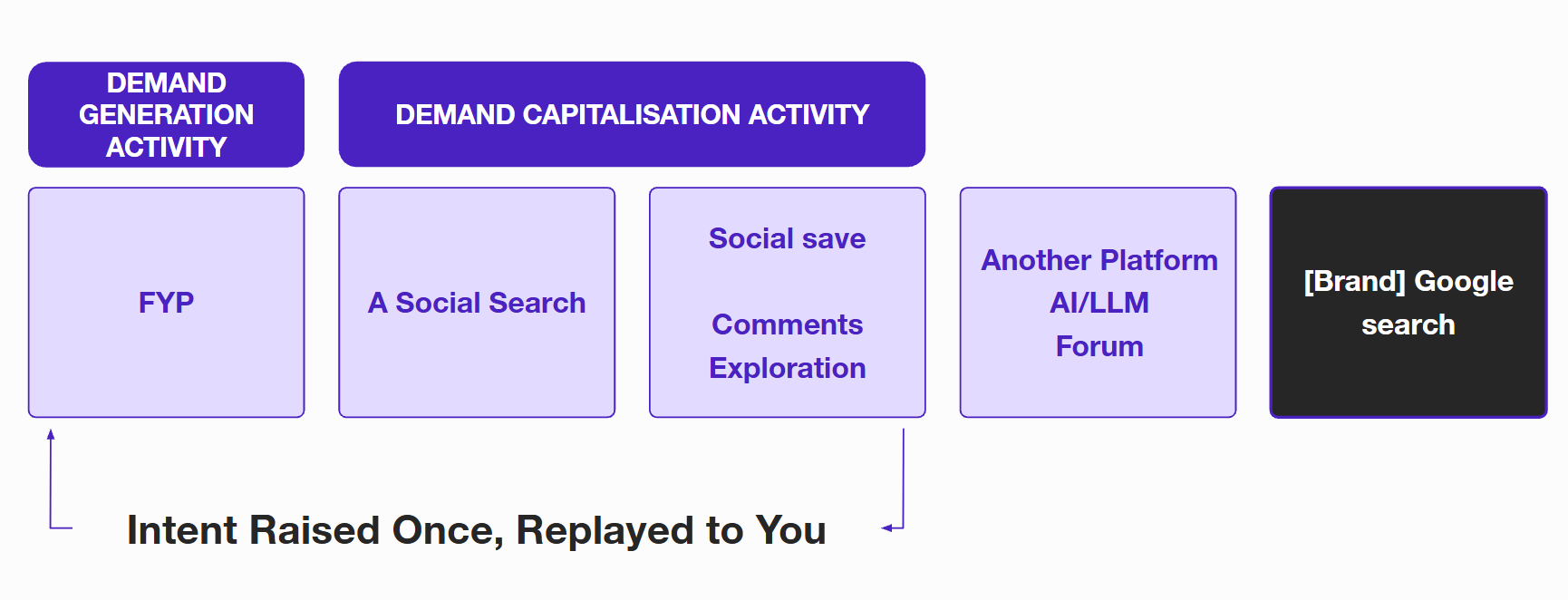
Historically, a billboard would be a typical surface that could generate demand. But seeing a billboard still leaves you with the task of finding that product or service somewhere else.
Google captured this demand when someone came to search after seeing the billboard — demand it had no hand in creating.
The FYP can generate demand and capture it without the user leaving the app.
It serves content unprompted whenever someone opens the app. The viewer can then search on the same platform and, within seconds, get a result. They save it, read the comments, and maybe check a forum or a large language model (LLM).
These feeds learn what the user searched for and how they engaged, then serve future content based on those signals.
The user either continues engaging with the content and conducting further searches, or they don’t. Either way, they’re providing signals about their intent.
This loop can lead to a branded Google search and a key action, such as a purchase. Alternatively, the interest wanes, and the algorithm moves on because the user hasn’t engaged or conducted further searches.
It’s intent that’s raised once but then replayed to you.
Dig deeper: Why TikTok deserves a place in your SEO strategy
How Hyrox turns social discovery into search demand
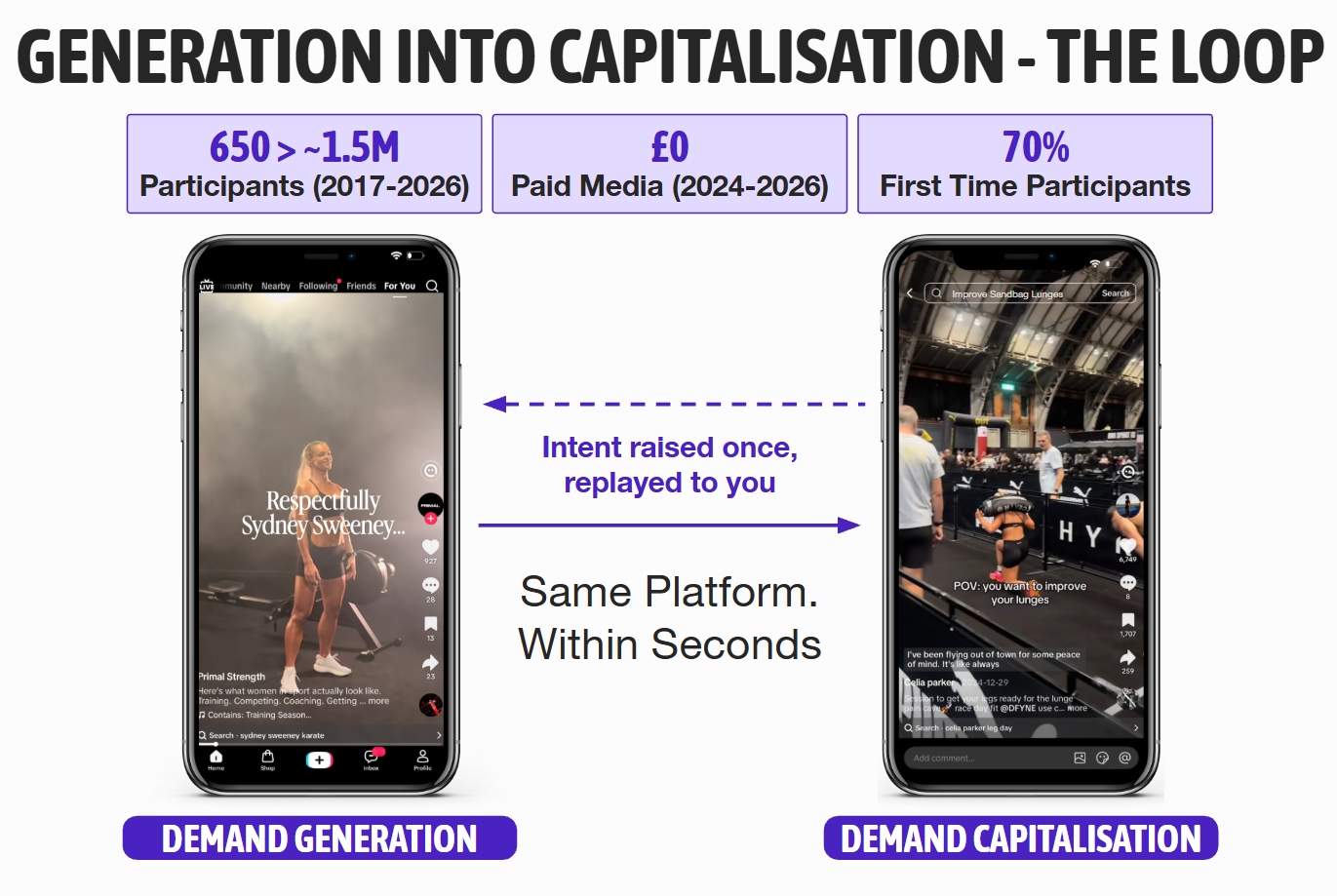
In 2017, Hyrox, which combines racing with workout stations, had 650 participants, mostly concentrated around Berlin. By 2026, that number had exploded to around 1.5 million participants worldwide. In addition, at its events, a whopping 70% of racers are participating for the first time, showing incredible ongoing growth. And all of this was done without spending a single dollar on paid media.
Here, demand generation is achieved via finish-line videos, sled pushes, bib photos, preparation livestreams, and other content. It’s achieved via shareable footage posted by the athletes themselves.
Demand capitalization then follows. Since 70% of racers have never done it before, it’s likely that every single one of them starts out by searching:
- How do I improve my sandbag lunges?
- What shoes are best for a Hyrox?
- What is a wall ball?
The 30% who’ve done a Hyrox previously are searching for 1% gains and optimizations to improve their time at their next event.
This is search marketing and a prime example of the FYP acting as a SERP: queried, answer-seeking behavior served on the same platforms that generated the interest.
The industry’s trusted source for essential news and analysis.
Sign up for our newsletter to receive exclusive insights and updates directly to your inbox.
- Daily breaking news
- Expert analysis from industry veterans
- Join over 200k subscribers
- Covering SEO, PPC and AIO
What branded search data doesn’t tell you
Consider a familiar SEO reporting scenario.
Six months of Google Search Console data for fashion brand ThruDark shows the following performance for branded queries:
- 372,000 clicks.
- 769,000 impressions.
- 48.3% average click-through rate (CTR).
- Average position: 2.

These figures would typically be combined with Google Analytics data for a quarterly business review (QBR). The SEO team would report organic search’s contribution to revenue, changes in purchases, and average order value (AOV).
But there’s something these numbers can’t tell us: Where did those people first discover the brand?
Some people may have discovered ThruDark through social content, developed an interest in the brand, and later searched for it on Google.
In that scenario, SEO reporting captures the branded search but misses the earlier discovery that helped generate demand.
How to build demand through social search and digital PR
Think of search marketing as a flywheel, then add another lever: digital PR.
The goal is to create content that encourages people to search and ensure your brand is discoverable when they do. As you build visibility, digital PR can support both demand generation and demand capitalization.
Build brand mentions, backlinks, and awareness through digital PR efforts that complement your social search content. Together, these activities can create a connected marketing experience that helps your brand become the preferred choice in relevant conversations.
You can also engineer social moments and use digital PR to amplify them, encouraging searches on social platforms and Google alike. Think of the walking pad trend in 2025 or the SharkNinja CryoGlow LED face mask campaign.
How you put this flywheel into practice depends on your brand, budget, and resources. Consider three approaches:
- Led by the market: What’s moving in the category, culture, and search right now.
- Led by the calendar: Demand arriving on a specific date, whether you’re prepared or not.
- Led by business goals: Working back from an established target and deciding how best to hit it.
Depending on your budget and resources, you may be able to pursue multiple approaches.
Dig deeper: Your next customer may discover your brand on TikTok before Google
Social search belongs in SEO’s scope
Social search presents ranking challenges that SEOs already know how to address. Ranking signals for organic media include:
- Query-matched titles.
- Content freshness.
- Comments and comment depth.
- Engagement.
- Semantic relevance.
- Sort order.
- Captions.
- Video metadata.
- Related content.
- Hook optimization.
Though these ranking signals apply to organic media rather than websites, you already speak this language. Ranking inside someone else’s system is our skill. Our discipline.
The factors may change, but our ability to test and learn, establish frameworks, and develop suitable processes can help SEOs take ownership of optimizing social search content.
Why organic media deserves a place in SEO reporting
Beyond the website, organic content typically sits in the brand budget. It gets brand KPIs — reach, engagement, sentiment, and share of voice. It’s valued for awareness. But it also contributes to discovery.
Branded search can be an output metric for social search. When reporting credits the branded search without accounting for the discovery behind it, brands can undervalue social search.
For example, last-click data may show branded search and direct traffic driving most of the pipeline. That can make PR, social search, AI, and SEO content appear inefficient. Those activities then get cut, or investment in them is reduced.
Cutting that investment can cause branded search volumes to decline. But the impact may not become apparent for around three months. By then, the pipeline has dropped, and nobody can explain why.
The result is that social search gets underreported, and you’ve defunded the demand generation engine.
Look beyond traditional keyword performance
Social saves, shares, video views, and changes in branded search volume can provide insights that help explain a brand’s growth — something our field has historically struggled to do.
Organic search may still contribute a meaningful percentage of revenue. But that doesn’t mean it generated all the demand behind those visits.
Google Search Console can also support this work, with one caveat worth remembering: GSC only starts tracking from the day you add the properties to your account. Add them now, not when you need the data.
SEO expertise extends beyond Google
SEOs know how to optimize content for ranking systems their brands don’t control. That expertise can extend beyond Google to social search and personalized feeds, creating more opportunities to help people discover their brands.
Why? Because the FYP is a SERP. And you already know how to work with a SERP.
Explore more on
Editorial disclosure
Contributing authors are chosen for their expertise and work under the oversight of the editorial staff. Search Engine Land is owned by Semrush. The contributor was not asked to mention Semrush; the opinions expressed are their own.
About the author