Sponsorships
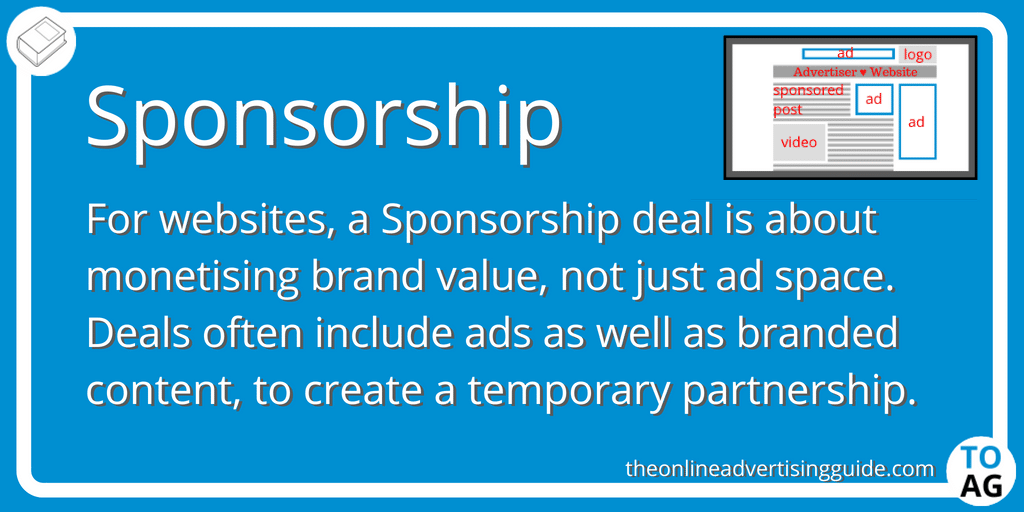
In online advertising, sponsorships involve an advertiser paying for both ads and site content. This content can include logos, articles, videos, and more.
These are typically employed when specific sections of websites anticipate increased traffic during events, like the Tennis section on a sports site during Wimbledon. They are frequently used for Homepage Takeovers as well.
A reskin is also often included to distinguish a sponsorship from a simple roadblock. (A roadblock occurs when one advertiser uses all the ads on one page.)

Sponsorships Definition
In offline marketing, a sponsorship is when an advertiser pays to have its name placed on all materials related to an event or institution. It is primarily a branding exercise and can be very favourably viewed. For example, when an advertiser pays for a charity event, everyone knows that the advertiser has reduced the charity’s cost burden and is making life better for both the charity and the event’s attendees.
This sort of marketing often requires very little from the advertiser. They just want their logo placed noticeably (and a thank you is always nice). The benefit to the advertiser is often a tangible boost to their reputation.
Sponsorship is often less subtle in online advertising. Many sites consider selling all the ads on one page as sponsorship. However, this is not really a co-branding exercise, and it, therefore, lacks the advantages of a sponsorship deal. Display ads are often viewed negatively by many, so having them all sold to a single advertiser is unlikely to create a positive impression among users.
This is why a reskin and/or company logo is often included in a sponsorship deal. Sometimes, it is actually used instead of simply selling all the ads on one page to a single advertiser. Reskinning a website’s logo itself is also a common way of differentiating this type of advertising.
Sponsored Posts
As part of a sponsorship deal, many websites will include sponsored posts. Many advertisers also try to buy these on their own in order to gain links to their site. For either, the goal should not be SEO. Websites are supposed to mark links from sponsored posts as such, and this will severely reduce any SEO value these links have.
Many sites do not mark links or posts they have sold as being sponsored, however you should be wary of the value of these. Search engines are on the lookout for this type of behaviour and will penalise sites that try to circumvent the rules. If this happens to a site you have paid, then you will lose all of the value you gained from that link or post.
More than this, the type of site that freely sells links and posts without marking them is likely not concerned with its reputation. Therefore, it is more likely that your links or posts will have less impact than those on honest sites. This is because:
- For links:
- The number of links on a page you have paid for may increase as they sell more and more. This reduces the link equity you receive from your links, and the likelihood your links will be clicked.
- The types of links on that site will be of lower quality, so users are less likely to trust them (including yours)
- For posts:
- The quality of posts will be reduced if editorial standards are lowered for money. This means your post won’t be viewed as positively as it could be.
- The cost of a post will increase with the site’s reputation, as this is what they are really selling. If you are getting a good deal financially, you are often not getting a good deal in terms of what you get from the article.
For these reasons, we would not recommend purchasing links or posts on sites that do not disclose they are sponsored (or asking that they are not disclosed). At best, you’ll get results from them for a short period before all the value is destroyed when they are caught.
It makes much more sense to pay for posts that are marked as being sponsored with links inside them. Many publications will sell these with a promise to promote them built in so that they guarantee a minimum number of clicks. You’ll still get the branding effect this way, as well as some web traffic.
What it looks like
Here is an example of what a sponsorship can look like.

In this example, EGX has sponsored Eurogamer’s homepage.
Technical Information
A sponsorship is usually sold on a page or section of a website for a set period of time. This means it is commonly billed on a CPD basis.
If it is billed on a CPM basis, this can cause problems, as all ad units will not necessarily appear at the same time for a variety of technical reasons.
Sponsorship Advice for Site Owners
For small sites, selling off all the ads across your site is a convenient way to maximise your profits from advertising while minimising your effort. This can and should include a reskin and an advertiser’s logo if possible. By selling your whole site (or a section of it) in bulk, you can reduce worries about inconsistent advertising revenue.
If you are a medium or large site, selling sponsorships of parts of your site (or newsletter) is a great idea. However, to increase their value, you should distinguish these from roadblocks or homepage takeovers.
Selling advertising space in bulk is a good idea and can increase the value of your ad inventory. Selling a sponsorship should be more than just advertising space; it should focus more on branding.
To this end, you should sell it with the promise of positive mentions of your sponsors on the site. These needn’t be more than thank-yous, but calling out to your audience that an advertiser is making a significant financial difference can cut through banner blindness.
Increasing the positive experience of this sort of sponsorship for your advertisers will help gain repeat business too!
Sponsorship Advice for Ad Buyers
If you plan to sponsor a website or a specific section of it, ensure you receive value for your expenditure. If the arrangement involves advertising, paying a higher rate for sponsorship is justifiable only if it results in a greater return on investment.
You should derive brand value from every sponsorship deal. A reskin should definitely be included, and whenever possible, your logo should be seamlessly integrated into the area of the site you are sponsoring.
Also, don’t underestimate the value of being mentioned (even as just a thank you) on the site. Once the advertising has been taken down, the text in articles on a site will remain, giving you a useful inbound link (which is nice for SEO).
A sponsorship should always be a way of improving how your brand is perceived. Therefore, make sure you only sponsor websites whose ethos aligns with your company and that your audience will look upon favourably.
Not to be confused with
Roadblocks, Homepage Takeovers
Summary
Back: Ad Size Guide
Explore more on
Editorial disclosure
Search Engine Land is owned by Semrush. We remain committed to providing high-quality coverage of marketing topics. Unless otherwise noted, this page’s content was written by either an employee or a paid contractor of Semrush Inc.
About the author