YouTube CPM Calculator

Use this YouTube CPM Calculator to work out how much advertisers are paying (or need to pay) to place ads on YouTube videos.
CPM is the price per 1,000 ad impressions. An ad impression is a single time an ad is shown on YouTube (whether within the video or on the page with it). Each video can have multiple ads shown within it, and therefore:
1 video view = many ad impressions
This is why it is useful to work out a CPM for YouTube as opposed to a Cost Per View (CPV) as it takes into account:
- That not all videos are monetised
- That videos of different lengths will show different numbers of ads
YouTube CPM Calculator
Feel free to experiment with different scenarios in order to help you understand this ad pricing model better.
CPM Formula
The equation for CPM is:
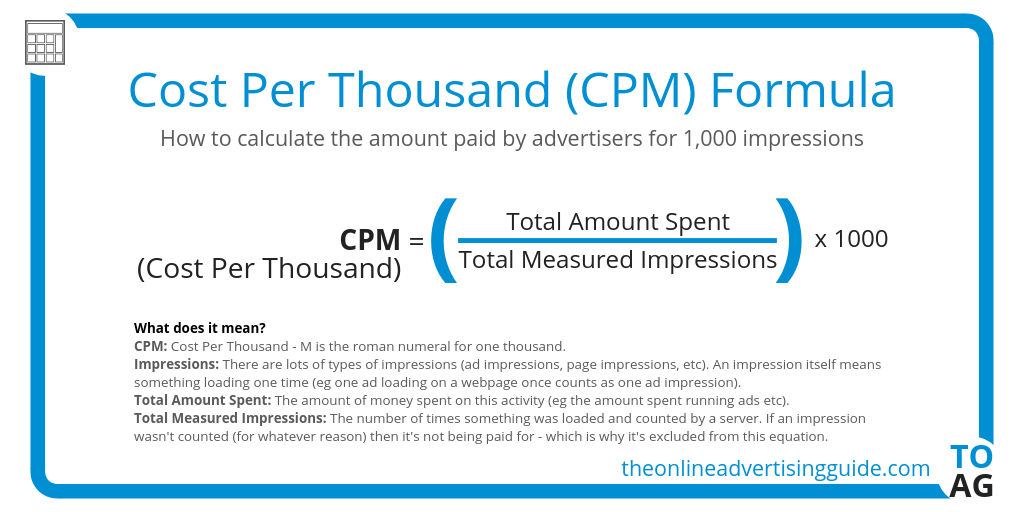
CPM = (Ad Spend ÷ Ad Impressions) × 1000
What is a CPM?
CPM stands for Cost Per Thousand Impressions (with M standing for mille – which is French for 1,000 ). It is one of the most common ad pricing models.
It is different to RPM – which is Revenue Per Thousand. A CPM is what the advertiser pays, and the RPM is what a creator receives.
The difference between the two is due to:
- The revenue split with YouTube. Advertisers aren’t just paying you, they are paying YouTube as well. This is means they keep between 45%-60% of the amount advertisers pay (you can find out your Rev Share if you go to Settings > Agreements > View Agreement).
- Taxes. Depending on where you are located, your YouTube revenue might be subject to tax.
- Differences in counting. CPM counts the cost of 1,000 ad impressions. RPM counts the revenue from 1,000 video views.
Why is CPM Important?
It can help to think of CPM as a measure of how popular you are with advertisers. Not your viewers – advertisers.
This is because a higher CPM means that ads on your videos perform well and therefore there is high demand for them.
If you are trying to maximise your ad revenue from your videos, then CPM can be helpful to understand if you are creating content that is monetisable.
However, if you want to look at how successful your videos are, you should look at RPM instead. That will tell you how much you are earning from the main sign of your popularity – video views.
CPM Advice
To optimise your CPM there are a few simple things you can do:
Be palatable to advertisers.
Sensitive content will be rejected by most. Read YouTube’s guidelines for more info.
Monitor your CPM to find patterns.
Maybe advertisers pay more on the weekend for your channel, or during the winter. By understanding these patterns you can optimise your posting times to have your best videos come out at times when they will make the most money.
Don’t put too many ads on your video pages.
More ads don’t always equal more money!
Scarcity drives up prices, so test all available options to see what works best for you. This means both within videos, and with the types of ads that you can add to the page.
The best answer is almost always to not cram them in.
Note: It’s not always up to you. If you don’t own all the content in a video (such as the music) the copyright holder might decide on the ads for that video.
Not to be confused with
YouTube confusingly has a second type of CPM called ‘Playback based CPM’. This is CPM but for video views instead of ad impressions.
This means that if one video has multiple ads in it, the ‘Playback based CPM’ would add up the cost of all the ads on the video and then divide it by video views.
This metric is only useful to directly compare your RPM with as RPM is calculated in the same way (except with revenue instead of cost). It is not a useful measure of advertisers (as they will likely not run all the ads in one video) or as a measure of popularity with advertisers.
Find out more
Back: Ad Calculators
Explore more on
Editorial disclosure
Search Engine Land is owned by Semrush. We remain committed to providing high-quality coverage of marketing topics. Unless otherwise noted, this page’s content was written by either an employee or a paid contractor of Semrush Inc.
About the author