Content strategy in 2026: What actually changed (and what didn’t)
Your organic traffic dropped 28% in the last six months. Before you cut your content strategy, understand where it went: LLM visibility, changing search behavior, AI Overviews answer queries without clicks. You can’t diagnose the problem with only Google Search Console.
The instinct when traffic drops is to cut underperforming content or rebuild everything for AI search. Both reactions assume you know where the traffic went. You probably don’t.
The real shift we’re seeing in content strategy: You’re auditing two search surfaces now, not one. And those surfaces evaluate authority differently. Google rewards backlinks and technical signals. ChatGPT and Perplexity evaluate topical depth and credibility directly, with no link graph to lean on.
That changes where content strategy starts. Entity authority has moved from an advanced SEO consideration to the first question you answer before you create anything.
The brands getting this right aren’t abandoning fundamentals. They’re adding the second measurement layer and making decisions with both surfaces in view.
What actually changed
Three shifts define content strategy in 2026. They’re not theoretical — they’re affecting content decisions right now, and ignoring any of them means making calls with incomplete information.
The SEO toolkit you know, plus the AI visibility data you need.

The first shift is measurement. The second is where content strategy starts. The third is how you know whether content is working. Together, they change what a complete content audit looks like and what questions you need to answer before you create or cut anything.
Measurement got more complicated
Traffic is down. Impressions are flat. Your author is being cited in AI Overviews and Perplexity responses. Is that a win or a loss?
It depends on what job that content was supposed to do.
Content strategy in 2026 is harder because traffic and visibility have decoupled. A piece can lose Google clicks and gain LLM citations in the same quarter. A page that never ranked in Google might be cited regularly by ChatGPT.
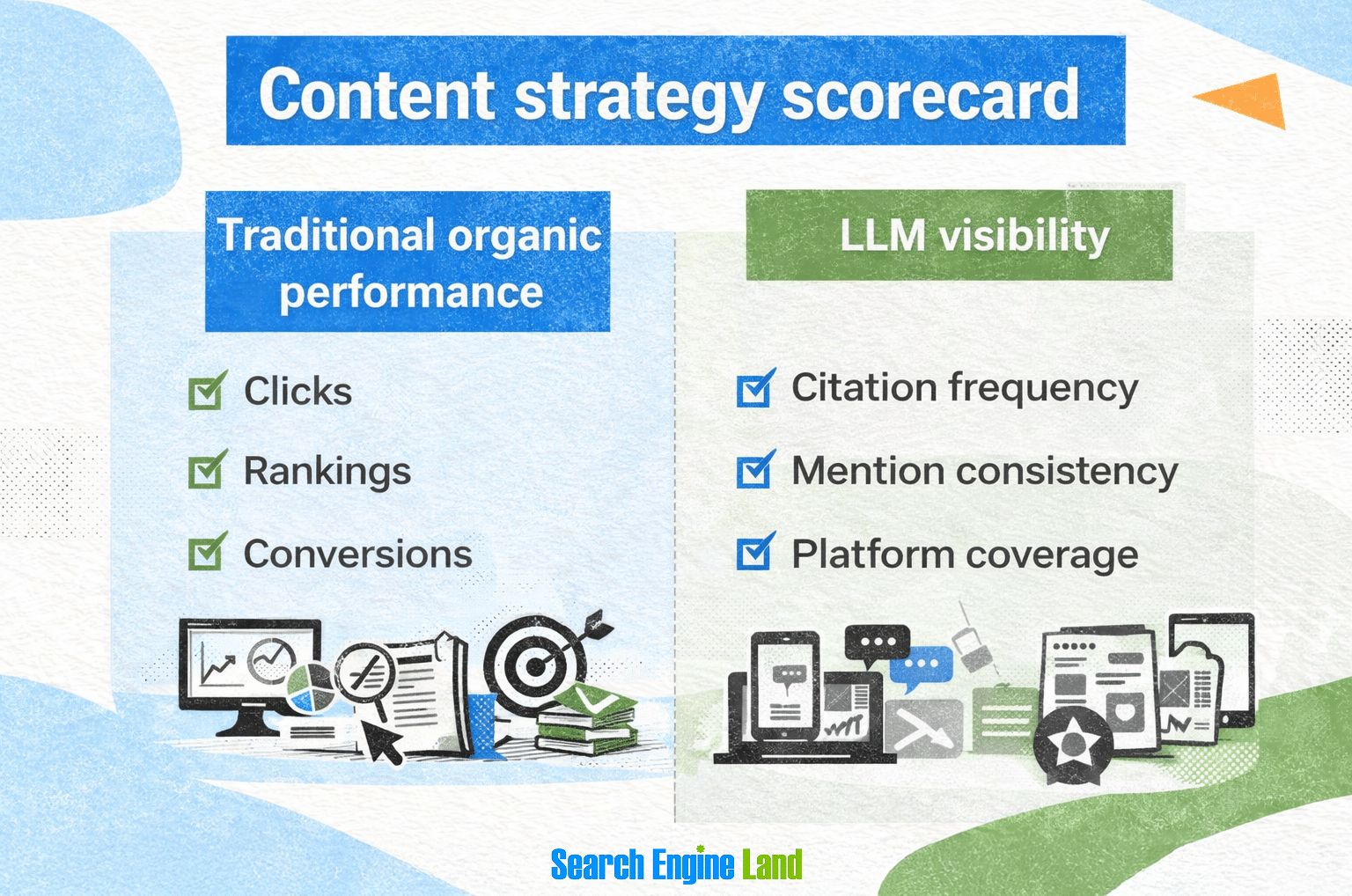
Your content scorecard needs two tracks: traditional organic performance (clicks, rankings, conversions) and LLM visibility (citation frequency, mention consistency, platform coverage). They don’t always correlate. You need both to make informed content decisions.
There’s a specific failure mode worth naming: Ghost Rankings. It’s what happens when ChatGPT or Perplexity cite your content and recommend your brand, but then suggest a competitor for the actual purchase or hire. You’re visible, you’re being cited, and you’re still losing the conversion.
That’s not a traffic problem. It’s a measurement problem. You can’t fix what you can’t see.
The brands getting this wrong in 2026 aren’t ignoring AI search. They’re measuring only one surface and making content cuts (or investments) based on an incomplete picture.
Entity authority now shapes what you create, not just how you rank
The old content strategy workflow started with a keyword list. Find volume, assess competition, map to pages, create content. Keywords were the input that drove everything downstream.
That workflow isn’t broken. But it’s no longer where you start.
The better question now is: What is this brand genuinely authoritative on? Where do they have real proof, real depth, real credibility? That’s your content surface area. Keywords map to that reality, they don’t define it.
Why this matters for LLM visibility: ChatGPT and Perplexity don’t run a link graph. They evaluate topical depth, author credibility, and query resolution. Strong backlinks don’t guarantee citations. Genuine expertise and clear answers can earn citations without traditional SEO signals.
Entity authority isn’t a new concept, but it’s moved from an advanced SEO consideration to a first-principle content strategy question.
You’re now auditing two surfaces, not one
Six months ago, if a client’s glossary section lost all its Google rankings, the call was easy: Cut it. Thin traffic, possible crawl drag, no upside.
Not anymore.
Then, if Google largely ignored or de-indexed a glossary with over 600 terms, it would be an easy decision to kill the content. Now you’d need to pull LLM visibility data across ChatGPT, Perplexity, and Claude via API (using Claude Code) to understand whether those same pages are being cited in AI-generated responses.
Because some of them are. And that changes the decision entirely.
Google organic still drives most traffic and revenue. But ChatGPT, Perplexity, and Google’s AI Overviews are real secondary surfaces. Content decisions made without accounting for both are incomplete.
The glossary audit will probably show 50–80 of those 600 terms earn meaningful LLM visibility. Those get enhanced. The rest get cut or consolidated.
That’s the new surgical standard. Audit both surfaces, then decide piece by piece.
What didn’t change
Before you throw out your content strategy and rebuild for AI search, understand what’s still working. The fundamentals that drove organic growth in 2023 still drive it in 2026. Keywords still matter. Quality still wins. The ground shifted, but the foundation held.

The mistake isn’t ignoring the new surface. It’s abandoning proven strategy that compounds over time.
Keyword research still works
Keywords didn’t die in 2026. They just lost their position at the front of the workflow.
Commercial intent content still converts. Rankings still drive revenue. Between briefs, strategy, and editorial calendar development, keyword research still accounts for close to 20% of a solid SEO team’s week. The brands quietly compounding organic traffic right now are still doing it.
Keyword research is an input. It’s just not the first input anymore.
Strong content fundamentals still win (with one caveat)
Clear answers, genuine depth, credible sourcing, named authors with real expertise. These aren’t AI optimization tips, they’re just good content. The brands and products getting cited consistently in ChatGPT and Perplexity are largely the same ones earning authority in Google. That’s not a coincidence.
Not every piece needs to perform on both surfaces. Forcing it produces content that’s mediocre on both.
Some content is built specifically for Google organic: commercial category pages, high-intent comparison content, transactional PDPs.
Some content is built specifically for LLM citation: definitional content, entity relationship pages, brand authority signals that help ChatGPT understand who you are and what you’re known for.
For example, auditing the site at Digital Commerce Partners site revealed ChatGPT and Perplexity weren’t connecting DCP and Copyblogger — two entities with a documented relationship that wasn’t clearly stated anywhere LLMs could find it.
The fix: entity relationship content on the About page and a Facts page built to resolve that ambiguity.
That content will never drive meaningful Google traffic. It wasn’t built to.
Know what job each piece is doing before you write it.
Some things working in LLMs right now are tactics, not strategy
Build a content strategy for LLM visibility. That’s the point of this piece.
Inside that strategy, short-term tactics are working right now. Use them before they stop working.
The most obvious example: brands publishing their own listicles and positioning themselves at the top. “Best ecommerce SEO agencies.” “Most comfortable yoga pants brands.” Self-referential, self-serving, not ranking anywhere in Google. Some of them are getting picked up and cited by ChatGPT anyway.
Will it work in six months? Probably not. These platforms are smart, and they’re catching up fast. But it’s working now, and sitting on your hands while competitors capitalize on it isn’t a strategy — it’s just falling behind.
Use what’s working today. Document it. Move fast. Just don’t restructure your editorial calendar around it, because the ground is shifting and what earns a citation in Q1 2026 may actively hurt your credibility by Q4.
What surgical auditing looks like
Strategy without execution is theory. The two-surface audit is how you turn this shift into actual content decisions.
Most brands have 300+ pages that need individual evaluation. Some should be enhanced. Some should be cut. Some should be left alone. The audit framework below shows you how to make each call with both surfaces in view.
The two-surface audit framework
Before you create anything new, audit what you have. Not just in Search Console — across both surfaces.
For every content type (glossary entries, category pages, hub content, guides), the audit runs the same decision matrix:
- Performing on both surfaces → maintain and protect
- Google down, LLM visibility up → enhance
- Underperforming on both → cut or consolidate
The enhance/cut distinction is where most content teams get this wrong. The instinct when Google traffic drops is to either rewrite everything or kill it. The surgical move is to understand why it lost Google visibility and whether it’s earning value somewhere else before making the call.
The glossary GEO audit mentioned above proves this. Six hundred-plus terms. Google has largely de-indexed the section — organic clicks are negligible. A year ago, that’s an easy cut. Today, it’s important to pull citation data across ChatGPT, Perplexity, and Claude before deciding, because some terms appear in AI-generated responses consistently enough to matter.
The audit will probably surface 50–80 terms worth keeping or enhancing. The rest get cut or consolidated. Without running both surfaces, you’d be reacting to incomplete information.
What “enhance” actually means
Enhance doesn’t mean rewrite. It means adding what’s missing for the surface where the content needs to perform better.
For Google: Is the page resolving the query or gesturing at it? Does it have a clear structure, internal links, and enough depth to hold a ranking?
For LLM citation: E-E-A-T matters here. ChatGPT and Perplexity evaluate credibility signals that Google has always rewarded in theory, but now matter in practice:
- Named authors with verifiable expertise: Not “the editorial team”
- Primary data and original research: Cited claims, not restated ones
- Recency: LLMs weight content from roughly the last 13 weeks more heavily for fast-moving topics
- Topical depth: Does this page demonstrate that the brand actually knows this subject, or does it cover the basics and stop?
An enhanced page isn’t longer for the sake of it. It’s more credible, more specific, and more clearly authored. That’s the work.
The decision to cut
Cutting content is still the right call, just not by default.
If a page underperforms in Google, is invisible in ChatGPT and Perplexity, and serves no clear strategic purpose, cut it. Thin content ignored by LLMs still dilutes crawl budget and topical authority on Google.
The two-surface audit doesn’t save bad content. It prevents cutting content that’s quietly doing a job you weren’t measuring.
Building a content strategy that works across both surfaces
You’ve audited what you have. Now you need to know what to create next, and how to structure the decision-making process so every new piece is built with both surfaces in mind.
This isn’t about optimizing for two audiences. It’s about asking the right questions in the right order before you make a brief for anything.
Start with authority mapping, not a keyword list
That traffic drop from the intro? The fix doesn’t start with a keyword list. It starts with a harder question: What is this brand genuinely authoritative on, and where’s the proof?
That’s your content surface area. It’s finite. You can’t build topical authority on 40 unrelated subjects. You can build it on the eight to 10 things your brand actually knows. Keywords then map naturally to that authority rather than driving you toward content your brand has no business creating.
Entity authority mapping doesn’t require a new tool or a new process. It requires an honest answer to a hard question: If ChatGPT were asked to describe this brand’s area of expertise, what would it say? Is that accurate? Is it what you want? If the answer is no — or worse, if ChatGPT doesn’t have a clear answer at all — that’s where your content strategy starts.
Your editorial calendar now has two inputs
Once you have your authority map, content planning runs on two parallel inputs:
- Google opportunity: Search volume, keyword competition, commercial intent, category gaps. This drives the majority of revenue-generating content decisions and isn’t going anywhere.
- LLM citation potential: Topical depth, credibility signals, recency, query match. This drives brand visibility in ChatGPT, Perplexity, and AI Overviews. It doesn’t always correlate with Google opportunities, and it doesn’t need to.
Not every piece serves both inputs equally. A high-intent category page built to convert Google traffic doesn’t need Perplexity optimization. A brand authority page built to help ChatGPT understand who you are doesn’t need to rank for anything.
Know which input each piece is answering before you brief it.
Track, optimize, and win in Google and AI search from one platform.
The measurement setup
Two surfaces require two measurement tracks, reviewed on the same cadence.
- Traditional organic: Clicks, conversions, keyword rankings, category page performance. Still the primary revenue signal for most brands. Review monthly, act on trends over 60–90 days.
- LLM visibility: Citation frequency across ChatGPT, Perplexity, and Google AI Overviews, mention consistency across different prompt variations, sentiment of how your brand is being described. Running a consistent set of prompts monthly and tracking what changes is enough to spot meaningful shifts.
The goal isn’t a perfect correlation between the two tracks. It’s making content decisions with the full picture in front of you, not just half.
The only mistake that matters
There are two ways to get this wrong.
The first: Treat 2026 as a complete reset. Throw out your content strategy, rebuild everything for AI search, and chase citation tactics at the expense of fundamentals that compound over time.
The second: Ignore the second surface entirely. Keep measuring only Google traffic, keep starting with keyword lists, and wonder in 18 months why visibility eroded somewhere you weren’t watching.
Neither extreme works. The actual move is quieter: Keep your content strategy fundamentals intact, add the second measurement layer, and audit what you have before creating anything new.
Most brands have more content than they need and less authority than they think. The two-surface audit tells you the truth about both.
The content strategy question today isn’t “how do we optimize for AI?” It’s the same question it’s always been: What does this brand actually know, and how do we make sure the right people, and the right platforms, understand it?
The question hasn’t changed. Where it gets answered has. Find out how well your content is performing in AI Overviews.
Explore more on
Editorial disclosure
Search Engine Land is owned by Semrush. We remain committed to providing high-quality coverage of marketing topics. Unless otherwise noted, this page’s content was written by either an employee or a paid contractor of Semrush Inc.
About the author