Ask For A Frequency Cap
Last updated June 2024

Index
Click on the links below to jump to the associated section
What is a Frequency Cap?
A frequency cap is a set limit on the number of times each user sees an ad, generally expressed as a per-day allotment. For example, “3/24” means each person will see an ad three times in a 24-hour period.
The number of times someone sees an ad can change whether or not they interact with it. It is traditionally thought that people need at least five opportunities to see an ad campaign (across all formats) before they notice it.
For online advertising, 3/24 is generally the best frequency cap. This means that, on average, more users will click on an online ad if they see it three times per day at most.
Keep in mind that this is an overall average. Depending on your goal and the type of advertising you are running, different frequency caps will likely improve the outcome of your campaign.
Top Tip: To optimise your frequency cap, look at the average number of times people see your ads before converting, and set it slightly above that
Frequency Cap Advice for Ad Buyers
Experimenting to find which frequency cap works best for each activity will yield the best results for all types of campaigns.
However, below are some best practices you can follow when running a new campaign.
CPA Campaigns
Display ads are more suited to brand advertising than performance advertising. If you want to drive conversions, you should choose a different frequency cap depending on how your brand value plays into your plans.
High-intensity campaigns
For a brand-new product or CPA campaign, you may want to start with a high frequency cap of 5/24 or even 10/24. This will cause your ad to be seen by people at high intensity and give you data to show what a good frequency cap is for the campaign. This tactic is intended to boost brand awareness and performance simultaneously.
It is risky, though, unless you are a large advertiser, as it can mean spending a lot of money quickly. You should only try this if you have deep pockets and a strong marketing plan to minimise initial wastage.
A strong marketing plan, in this case, means targeting an audience that is likely to convert.
Always on campaigns
For advertisers not looking to make a big splash with a campaign, a reasonable frequency cap for most CPA campaigns is 1/1. This means that users will see your ad once per hour.
For products with good brand awareness, this should keep your product front of mind without overwhelming people (or your budget).
For advertisers with small budgets who are not relying on a brand, this can be a way to ensure a large number of people see your ads – and keep seeing them frequently. The cost per conversion will be high compared to established brands. However, a 1/24 frequency cap should increase the efficiency of your limited ad spend.
Top Tip: You may want to use a lower frequency cap if you are running ads across lots of ad platforms, as people could see your ads in many different places
CPC Campaigns
Keep in mind that when you pay for clicks, you will only get clicks. There will likely be no attempt to ensure that the people who click on your ads are actually interested in what you have to offer. It is up to you to do what you can to improve the quality of those clicks.
Looking for your core audience
If you are running a CPC campaign to draw in people who are very interested in what you have to say, a suitable frequency cap is likely 1/24. This means people will see your ads once every 24 hours at most. The point is to increase the likelihood that only the people who are very interested in what you have to say notice your ad and click on it.
Using a 1/24 tactic will also ensure that your ad budget is spread across more users, as your ad won’t be shown repeatedly to the same person. This is important as many people will click on basically anything but have little intent behind the click. This means they may click your ad when they see it – and then may click it again when they see it again.
Ad networks/algorithms can generally identify these click-happy people and send them ads that pay for clicks. Then, the ad network gets money, and the click-happy person gets to click—everyone wins (except you).
So, by limiting the daily exposure per user, you can improve the performance of your ads in two ways:
- Creating more opportunities for high-intent clicks
- Limiting the opportunity for low-intent repeat clicks
Example
Compare these two example personas:
- John is a massive fan of kiwi fruit. When an ad for a kiwi fruit site comes up, he clicks on it immediately and loves what he finds.
- Jane is a massive fan of fruit, but kiwis aren’t her favourite. When a kiwi fruit ad comes up, she ignores it.
- If Jane saw the ad ten more times, she might eventually give in and click. But it would be begrudging, and Jane is less likely to be interested in the kiwi fruit site.
In this example, people like John are your core audience. People like Jane are a more appropriate target for prospecting campaigns (see below).
Prospecting campaigns
A higher frequency cap is a good idea if you are looking for people who may be interested in your site (but don’t know it yet). You may need to wear people down into clicking, which means going to a frequency cap of anywhere between 3/24 and 10/24.
The more times someone who is slightly interested in your site sees your ads, the more likely they are to click. Keep in mind that they have to be somewhat interested in the first place, so you can’t just run an ad constantly and hope to get a click from anyone.
You will have to balance this with your budget (depending on how you pay for your campaign). But on average, the higher the frequency cap, the less interested the people clicking will be – so it really depends on how wide you want to cast your net.
This also means that the landing page you create is extra important. A good ad will get more clicks, but what happens after those clicks depends on the landing page. And if you are prospecting for a new audience, then you really have to give them what they want when they arrive on your site.
Especially if you’ve paid for the click that brought them there.
Brand awareness campaigns
If you are running a CPC campaign to raise brand awareness, you should also go with a 1/24 frequency cap.
This is because clicks alone aren’t worth that much.
If you are trying to drive people to your site but don’t have any further specific plans for them, it’s more important than ever to find people who are interested in it.
As with core audience campaigns, a 1/24 frequency cap will help you focus your clicks on those who are most interested. As with a prospecting campaign, your landing page must make its point.
Top Tip: A frequency cap can often be applied to an individual ad or an ad campaign as a whole. When capping individual ads, use a lower frequency cap to achieve the same campaign efficiency.
CPM Campaigns
When you advertise on a CPM basis, you should ask for a frequency cap, preferably of 3/24. A 3/24 frequency cap means your ad will be seen by each person three times per day.
A CPM campaign is free money for an ad network, as there is no promise of performance at all. As an advertiser, you should only run CPM campaigns if you are trying to improve your branding.
A 3/24 frequency cap will ensure that your ad gets seen by people frequently enough for them to remember it. It will also limit your ad spend per person, meaning your ad will likely be seen by enough people to make a difference.
If you run display ads as a brand campaign, you should consider a homepage takeover or roadblock ad. This means running all the ads on a page at the same time. They are typically run on a CPD basis (meaning you pay per day they run). However, some larger sites run them on a CPM basis, and when this is the case, a 3/24 frequency cap is still considered best practice.
Frequency Cap Advice for Site Owners
You may not be able to add a frequency cap to campaigns because the ad tech you use may not give you the option. However, when it is an option, frequency capping campaigns is vital for sites funded by advertising.
Running ads yourself
If you run display ads on your site, adding a frequency cap to campaigns will improve performance and increase revenue.
This is because if you keep showing the same ads to the same user repeatedly, they will probably only interact with it once at most. This limits the amount you can make from those ads if you are being paid for an interaction with those ads.
You will also make advertisers feel like they have wasted their money on your site (due to poor performance). This, in turn, means less repeat business.
Try to show the ads booked on your ads to many users and keep showing them daily to everyone to maximise exposure. By rotating ads, you will keep users more engaged and likely make more money.
Best practice for frequency capping (unless an advertiser specifies otherwise) is:
- CPA campaigns – as 1/1 (but set as high priority) – This means everyone will see them, but you are not gambling too much on conversions happening.
- CPC campaigns – at 1/24 – this increases the likelihood of clicks
- CPM campaigns – at 3/24 – this improves the value of the audience you are selling
- Also, cap invasive ads (like video ads and overlays) at 1/24 so you don’t annoy your users (as much).
Top Tip: To maximise your earnings, calculate the eCPM of each campaign and prioritise them based on that.
Using an Ad Network
Most ad networks add appropriate frequency caps to campaigns as a matter of course. They want to be as efficient as possible when serving campaigns to make both you and them the most money.
The frequency caps they use are based on the likelihood of an ad campaign making money.
- CPM or CPD campaign earns money just by being shown. This means they might as well show those ads all the time.
- CPC ads only make money when someone clicks on them. Since clicks are easy to obtain, these can be run fairly frequently.
- CPA ads only make money when someone converts. Because they are harder to profit from, they will be run only when conversions are most likely to occur.
Technical Information
Frequency capping has some technical limitations:
- When people block tracking cookies, an ad server cannot keep track of ads being served, making traditional frequency capping impossible.
- A single user can visit a website on multiple devices simultaneously. Depending on how it is implemented, it may confuse frequency capping.
If a user is logged in to a site or service, it can be possible to base a frequency cap on server-side information. This could negate both of the above, but it depends on the individual technical implementation. Ad networks will not natively provide this service in most cases.
Campaigns can also run multiple ad sizes at once. Many ad servers can set a frequency cap at the ad set or campaign level, but setting up a frequency cap across creatives can be challenging when that is not possible.
Frequency Formula
To work out the frequency your ads have been shown at, you can use the frequency formula:
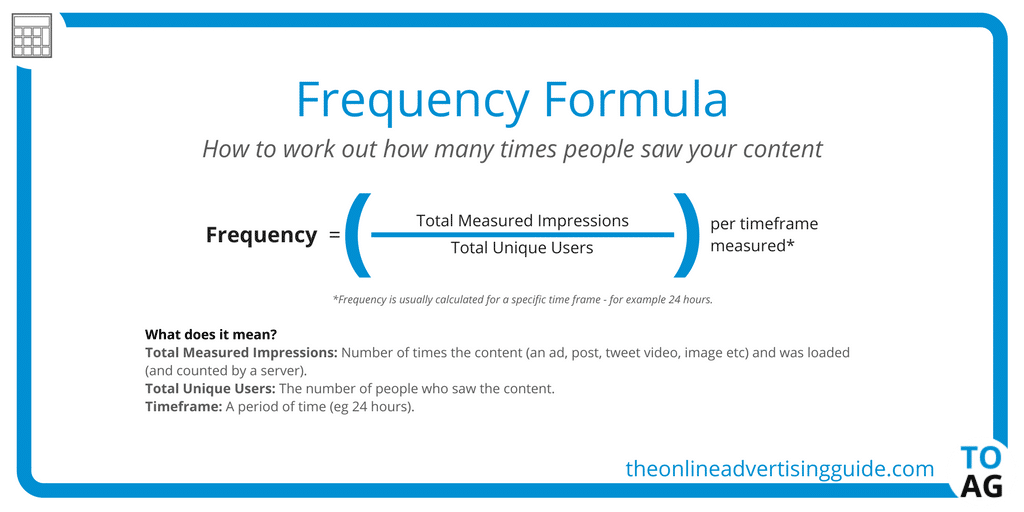 Click to enlarge
Frequency = Impressions ÷ Users (per timeframe measured)
Example
Thirty impressions were shown to three people in a 24-hour period. Using the above formula, this would be expressed as 10/24 (as each user saw ten impressions on average).
In reality, it could be that
- Person 1: Saw 25 impressions in a day
- Person 2: Saw 4 impressions in a day
- Person 3: Saw 1 impression in a day
In this case, the average of ten impressions per person per day would be obfuscating the truth. This is why you should always ask for a frequency cap.
Other names for Frequency Cap (synonyms)
Ad Frequency Cap, Opportunities to See (kinda)
Not to be confused with
Recency
Find out more
Explore more on
Editorial disclosure
Search Engine Land is owned by Semrush. We remain committed to providing high-quality coverage of marketing topics. Unless otherwise noted, this page’s content was written by either an employee or a paid contractor of Semrush Inc.
About the author