Query fan-out optimization guide: How to rank in AI searches

Query fan-out optimization has a simple goal: making your content useful across multiple related queries at once, not just a single keyword.
AI-powered search systems and LLMs increasingly answer questions by expanding the original query into related sub-queries, retrieving information across multiple angles, and synthesizing a response. When your content consistently addresses those angles in one place, it becomes easier for AI systems to extract, reference, and cite it.
The SEO toolkit you know, plus the AI visibility data you need.

This guide isn’t about chasing new keywords. Instead, it focuses on structuring content so it holds up as queries expand. Learn how query fan-out works in practice, how it differs from traditional SEO content models, and why broader topic coverage has become a prerequisite for visibility in AI search.
Which AI search platforms use query fan-out to process and expand search queries?
Query fan-out isn’t limited to a single platform. It’s a shared retrieval pattern used across modern AI-assisted search experiences, particularly those designed to generate synthesized answers rather than return a list of links.

Fan-out behavior appears across several major AI search systems. Google explicitly describes query fan-out in its documentation for AI Overviews and AI Mode, where multiple related searches across subtopics and sources are issued before a synthesized response.
Other systems support multi-query or multi-step retrieval patterns. For example, Perplexity’s documentation explains how multiple related queries can be issued together to improve coverage of a topic.
Large AI assistants and search-integrated models also exhibit this behavior in practice. Platforms such as Gemini, ChatGPT, Microsoft Copilot, and Grok decompose complex prompts into related sub-questions or follow-up searches when grounding answers in external sources, even if their public documentation doesn’t always use the specific term “query fan-out.”
While each platform implements fan-out differently, the underlying behavior is consistent: The original query is treated as a starting point, not a final instruction. These systems don’t assume the user’s query is complete or perfectly specified.
Instead, they infer what else a user might need to know to receive a useful answer. That inference triggers follow-up searches that explore definitions, related concepts, constraints, examples, and implications of the original question.
The responses users see are the result of this internal expansion. Multiple queries are issued and multiple sources are evaluated. The final output is synthesized from those results.
This is why query fan-out matters for content creation.
When AI search platforms retrieve information this way, they favor sources that can support multiple related questions within the same topic area. Content that only answers one narrow angle may still be retrieved, but it’s easier to replace as fan-out expands.
Query fan-out optimization exists to align content with this retrieval model. It focuses on making a single page resilient to query expansion, so it remains useful as AI systems ask follow-up questions on the user’s behalf.
What’s the difference between query fan-out optimization and content optimization for traditional SEO?
The core difference between query fan-out optimization and content optimization for traditional SEO lies in how content is expected to answer related questions.
Traditional SEO content strategies are built around separation and linking.
A common approach is the hub-and-spoke model:
- One primary page targets the main keyword
- Supporting pages target individual subtopics
- Internal links connect those pages into a thematic cluster
Overall, the hub-and-spoke model of content optimization creates separate pages for a hub topic and each subquery and links them all together, but they’re still all thought of as distinct pieces of content.
This structure works well in classic search environments, where pages are ranked individually and users choose which result to click based on a specific query.
Query fan-out optimization is designed for a different retrieval model.
Instead of treating each subtopic as a separate destination, the main topic becomes the container. Related sub-queries are addressed directly within the same piece of content, typically as clearly labeled sections or question-based headings.

The reason is simple: AI systems don’t evaluate pages in isolation.
When a query expands, AI search systems assess whether a single source can support multiple aspects of the question at once. They aren’t looking for the best page per subtopic. They’re looking for sources that remain useful as the query fans out.
This changes how content competes.
When subtopics are fragmented across multiple URLs, AI systems may retrieve and combine information from several sources. Once those subtopics are consolidated into a single, well-structured page, that page can satisfy a larger portion of the expanded query set and appear more consistently across AI-generated responses.
This doesn’t mean hub-and-spoke models no longer work. They still play an important role in site architecture, internal linking, and classic search visibility.
What changes is the expectation placed on each individual page. In a query fan-out environment, every article within a hub needs to be sufficiently self-contained. Each page should be able to explain its topic clearly on its own, while still contributing to the broader thematic coverage of the hub.
Instead of optimizing primarily around URL granularity, query fan-out optimization prioritizes semantic completeness, ensuring a single page can explain a topic clearly, consistently, and from multiple relevant angles.
Why is broader topic coverage important for query fan-out?
Query fan-out works by expanding a single query into multiple related sub-queries before a response is generated.
For example, let’s take the query “how does AI affect SEO?”
An AI search system is unlikely to treat this as a single lookup. Instead, it may expand it into multiple related questions such as:
- What is AI search and how does it work?
- How are search rankings changing with AI-generated results?
- What types of content perform well in AI-assisted search?
- How should SEO strategy adapt to AI retrieval models?
- What risks or limitations exist for AI-based ranking systems?
The system then retrieves information across these related angles and synthesizes a response based on the combined results.
Because the system is answering several implied questions at once, it favors sources that cover the topic broadly rather than narrowly. A page that only addresses one aspect (for example, ranking factors) may be retrieved for part of the fan-out, but it’s less likely to remain useful as the system expands into definitions, implications, and strategy.
This is why broader topic coverage matters. Content that supports multiple related sub-questions can survive query expansion and remain relevant as AI systems explore adjacent concepts on the user’s behalf.
Google describes this behavior directly:
“Both AI Overviews and AI Mode may use a ‘query fan-out’ technique — issuing multiple related searches across subtopics and data sources — to develop a response.”
In practical terms, this means AI search systems aren’t evaluating a page against one narrowly defined query. They’re evaluating whether a source can support a set of related questions that emerge as the original query expands.
This is where broader topic coverage becomes important.
When content explains the main topic alongside its logical extensions, it’s more likely to remain useful as the query evolves. Content that only answers one narrow question may still be retrieved, but it’s easier for AI systems to replace as additional sub-queries are introduced.
Broader coverage increases the likelihood that a page is:
- Retrieved across multiple fan-out variants
- Referenced more than once within an AI-generated response
- Treated as a stable supporting source rather than a single-use citation
If your piece of content covers the main topic and all of the subtopics in one article, you may be cited more consistently, whereas other sources may be cited less (or not at all) if they only cover one of the subtopics.
Query fan-out optimization aligns closely with collapsed funnels. In AI search results, informational, evaluative, and contextual questions often appear together. A page that looks at a topic from each funnel stage and addresses them in one place instead of across multiple pieces of content is better aligned with how AI systems retrieve and synthesize information to assemble answers.
Ranking factors for fan-out queries
AI search systems don’t publish a formal set of ranking factors for fan-out queries. However, consistent patterns are emerging across platforms based on how AI systems retrieve, evaluate, and reuse content during query expansion.
Content that performs well in fan-out scenarios tends to share a small set of structural and editorial characteristics:
Comprehensive topical coverage
Pages that naturally address multiple related questions are more useful as queries expand. Content that only covers a single angle may still be accurate, but it’s less resilient when additional sub-queries are introduced.
Clear structure and hierarchy
These systems rely on visible structure to understand what a page covers and where specific answers are located. Clear headings, logical sectioning, and content chunks make it easier to associate sub-queries with the right parts of a page.
Factual accuracy and internal consistency
Fan-out retrieval often involves comparing explanations across multiple sources. Content that contains contradictions, vague claims, or unverifiable statements is less dependable in that comparison process.
Deep semantic relevance over keyword repetition
Fan-out retrieval favors coverage of related concepts, entities, relationships, and sub-topics tied to the main topic. Expanding semantic coverage is more effective than repeating a single phrase.
Demonstrated subject matter understanding
Pages that explain concepts clearly and show how ideas connect are easier for AI systems to treat as reference material when synthesizing answers across multiple angles.
Source authority and credibility
When multiple pages can answer the same sub-queries, AI systems must choose which sources to rely on. Established publishers, recognized subject-matter experts, and consistently reliable domains are more likely to be reused across fan-out expansions, especially for definitions, explanations, and interpretive content. Authority helps determine which sources persist as fan-out widens and comparisons increase.
In short, query fan-out favors content that explains a topic clearly and coherently, rather than content narrowly optimized around a single query.
How to optimize for query fan-out
Optimizing for query fan-out means designing content so it can support multiple related queries within a single page, rather than answering one narrow question in isolation. Successful optimization increases the opportunity to be cited more often in AI search results.
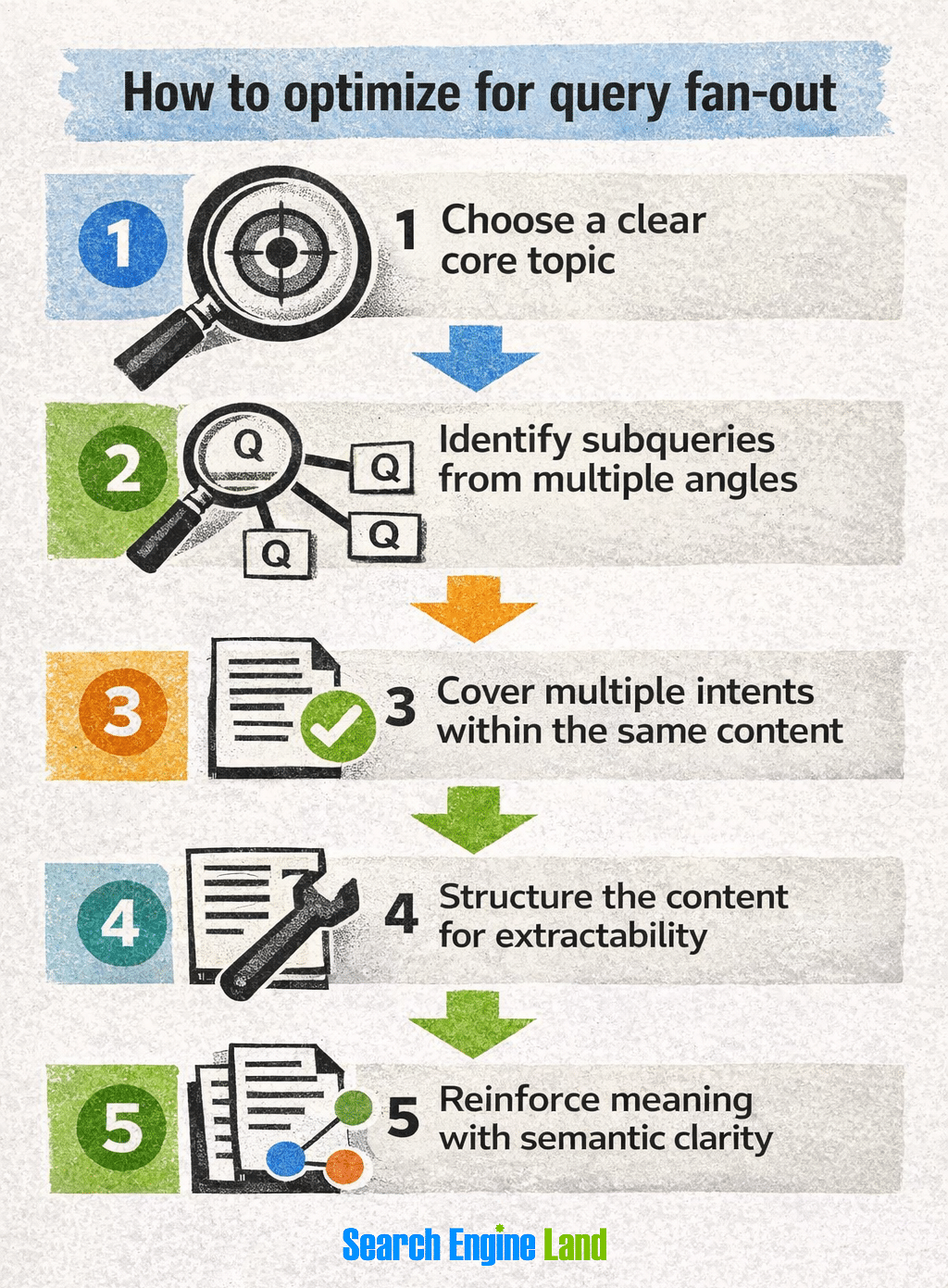
At a high level, effective query fan-out optimization is shaped by a small set of guiding principles:
- Choose a clear core topic. Query fan-out optimization starts with a well-defined subject that can act as a stable anchor as queries expand. Topics that are too broad lack focus, while topics that are too narrow limit how many related questions the content can support.
- Identify subqueries from multiple angles. Fan-out behavior emerges when a topic is expanded, rephrased, specified, or implied. Content that performs well anticipates these variations and accounts for how different questions might logically branch from the same core idea.
- Cover multiple intents within the same content. AI search often surfaces informational, evaluative, and contextual questions together. Content that performs well in fan-out scenarios tends to address these intents in a coordinated way, rather than isolating them into separate pages or formats.
- Structure the content for extractability. Clear headings, lists, tables, and content chunks help map sub-queries to specific sections of a page. This structure makes it easier for AI systems to retrieve and reuse relevant content as queries expand.
- Reinforce meaning with semantic clarity. Fan-out optimization relies on making entities, relationships, and key concepts explicit. When meaning is clear, AI systems can interpret how ideas connect and apply the content more consistently across related queries.
The sections below explore each of these principles in more detail.
1. Choose your topic
Every query fan-out strategy starts with a single, well-defined topic.
This topic acts as the semantic center of the page. All subqueries, examples, and explanations should relate back to it, even as the query expands in different directions.
For this guide, the topic is query fan-out optimization.
This topic works well because:
- It has clear informational intent
- It naturally expands into related questions
- It can be explored across strategy, structure, and content design without becoming tool-specific
Once the topic is defined, the next step is to examine it from every relevant angle.
2. View the topic from all angles to create a list of subqueries
Once you’ve chosen a topic (or seed keyword), the next step is identifying the subqueries that AI systems are likely to generate as that query expands.
These subqueries aren’t arbitrary. Research into query expansion shows that fan-out behavior tends to follow a small number of repeatable patterns. These patterns reflect how people naturally explore a topic: by rephrasing questions, asking follow-ups, broadening scope, narrowing focus, or clarifying intent.
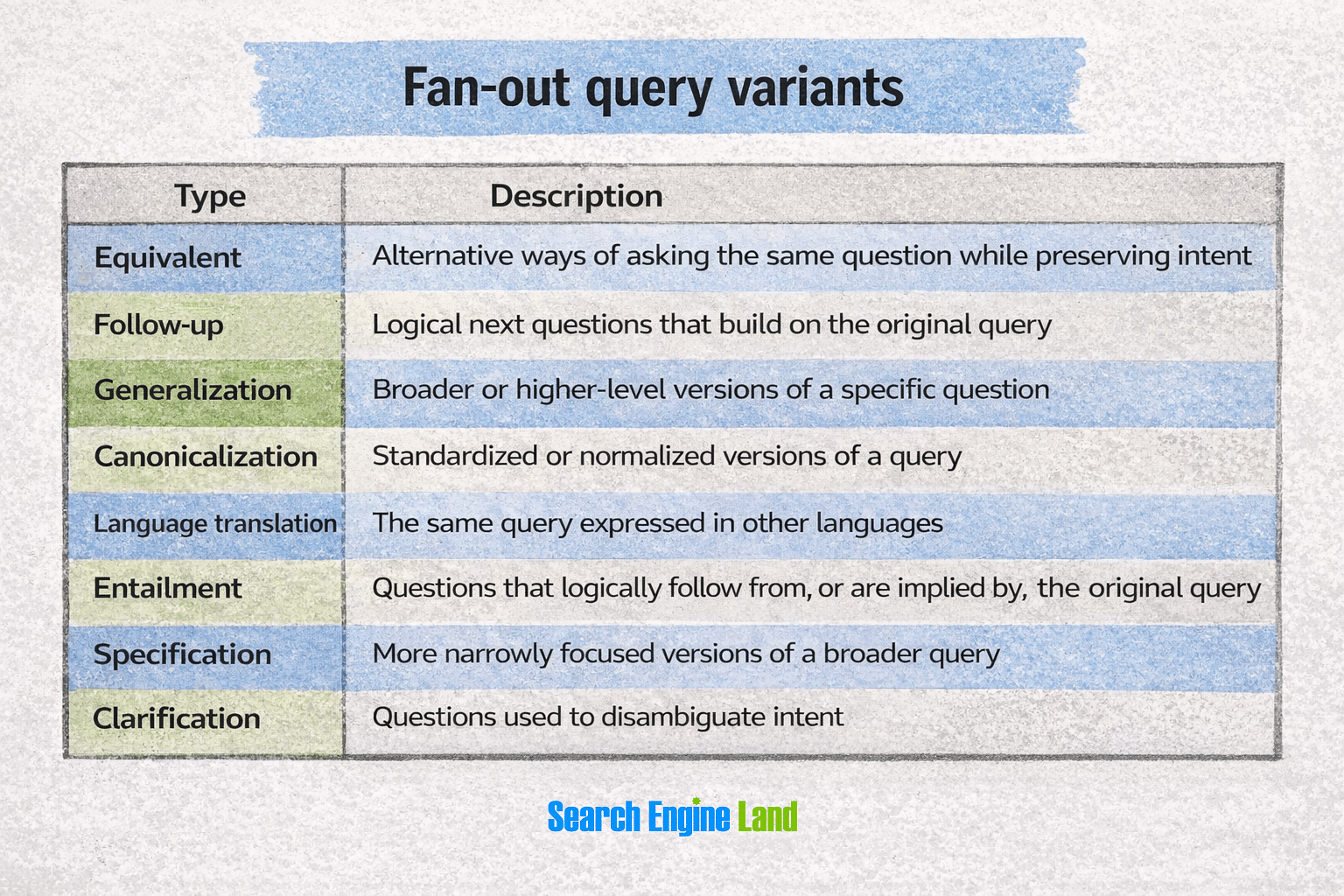
To account for this, it’s useful to examine a topic through eight common fan-out angles.
The eight fan-out angles to consider:
- Equivalent: Alternative ways of asking the same question while preserving intent. These are paraphrases that don’t change what the user is trying to learn, only how they phrase it.
- Follow-up: Logical next questions that build on the original query. These often appear when the first answer introduces new information that prompts further inquiry.
- Generalization: Broader or higher-level versions of a specific question. These queries widen the scope to place the original topic into a larger context.
- Canonicalization: Standardized or normalized versions of a query. This includes removing colloquial phrasing or informal language to arrive at a clean, searchable form.
- Language translation: The same query expressed in other languages. AI systems often retrieve multilingual content to broaden coverage or validate understanding.
- Entailment: Questions that logically follow from, or are implied by, the original query. These explore consequences, requirements, or related concepts that naturally stem from the topic.
- Specification: More narrowly focused versions of a broader query. These add constraints such as format, audience, or context to refine intent.
- Clarification: Questions used to disambiguate intent. These appear when a query could reasonably be interpreted in more than one way.
Together, these angles describe how a single query can expand into a network of related questions during fan-out.
Let’s apply these angles to the topic used throughout this guide: query fan-out optimization.
The table below shows how this single topic can expand across different fan-out variants. These examples illustrate the types of subqueries AI systems may generate internally as they explore the topic from multiple directions.
| Variant type | Subquery example 1 | Subquery example 2 |
| Equivalent | How to optimize content for query fan-out | Best ways to optimize for AI query fan-out |
| Follow-up | How do AI systems generate query fan-out variants? | How can you measure the impact of query fan-out on visibility? |
| Generalization | How do AI search engines retrieve information from multiple queries? | How does multi-query retrieval work in AI search? |
| Canonicalization | Query fan-out optimization guide | Query fan-out optimization strategy |
| Language translation | Optimización de la expansión de consultas en IA | Optimisation de l’extension de requêtes IA |
| Entailment | Why does query fan-out require broader content coverage? | How does query fan-out influence AI-generated answers? |
| Specification | Query fan-out optimization for long-form content | Query fan-out optimization for informational search queries |
| Clarification | Are you asking about content optimization or retrieval optimization for query fan-out? | Do you mean optimizing for AI summaries or for query expansion behavior? |
Each of these variants represents a question AI systems may ask internally as the original query is expanded.
The objective isn’t to create separate pages for each variation. Instead, it’s to structure content so these questions are answered coherently and contextually within the same article.
That’s what allows a single page to remain relevant and reusable as queries fan out.
Note: The goal isn’t to target each subquery individually. It’s to ensure the content naturally addresses these angles within the same page.
3. Content coverage and copywriting for query fan-out
Once you’ve defined the main topic and mapped the likely subqueries, the next step is shaping the content itself.
Query fan-out optimization is less about which keywords appear on a page and more about how clearly and completely the topic is explained. As queries expand, AI systems favor content that can stand on its own without relying on additional pages to fill in critical gaps.
That places more emphasis on content coverage, clarity, and structure.
Cover multiple intents in a single piece of content
Query fan-out often collapses traditional funnel stages.
A single query can trigger informational, evaluative, and contextual subqueries at the same time. AI systems don’t retrieve these sequentially. They retrieve them in parallel and synthesize the results into a single response.
Content that only addresses one intent may still be accurate, but it becomes easier to replace as fan-out expands.
Effective fan-out content accounts for this by covering the topic across funnel stages within the same page, including:
- Foundational understanding, such as what the topic is and how it works
- Strategic implications, including why the topic matters and when it becomes relevant
- Practical considerations, focused on how teams should think about applying the concept in real scenarios
This doesn’t mean writing sales copy or step-by-step tutorials. It means recognizing that AI systems retrieve answers across intent layers simultaneously, not one stage at a time.
Prioritize factual accuracy and demonstrate E-E-A-T
Fan-out retrieval increases scrutiny. As AI systems compare answers across multiple sources, inaccuracies, vague claims, and internal inconsistencies become more visible. Content that includes unverified statements or oversimplifies complex topics is easier to discard during synthesis.
Strong query fan-out content:
- Makes claims that can be verified
- Avoids absolute rules where none exist
- Explains why something works, not just that it works
This is especially important for complex or emerging topics, where clarity and precision directly affect trust.
Clear signals of experience, expertise, authoritativeness, and trustworthiness, or E-E-A-T, reinforce this foundation.
Use concise, authoritative language
AI systems extract meaning more easily from clear, direct statements.
That typically means:
- Short paragraphs
- One idea per sentence
- Explicit definitions and conclusions
Instead of implying relationships, state them. Rather than building gradually toward an answer, lead with the answer and then explain.
This style aligns closely with how AI systems identify passages that directly satisfy fan-out subqueries.
Anticipate fan-out with Q&A-style sections
Many fan-out variants take the form of implied questions.
Structuring content so those questions are answered directly increases the likelihood that individual sections are reused or cited when AI systems generate responses.
This doesn’t require a standalone FAQ block. It can be achieved through:
- Question-based subheadings that mirror likely sub-intents
- Clear answers in the opening sentence of each section
- Supporting context immediately afterward
The goal is precision and clarity, not repetition.
Dig deeper: How to create answer-first content that AI models actually cite
Make entities and relationships explicit
Semantic clarity is a core requirement for query fan-out optimization.
AI systems don’t just process words. They identify entities and evaluate how those entities relate to one another.
For example:
- Query fan-out → is a retrieval technique
- AI search platforms → use query fan-out
- Content structure → affects how fan-out queries retrieve information
Writing in a way that makes these relationships explicit helps AI systems interpret and reuse content more reliably. This is often described as using subject–predicate–object structures, but in practice it simply means being clear, specific, and unambiguous in how concepts connect.
4. Content structure, layout, and technical considerations
Once the content is written, structure becomes the deciding factor in how effectively it can be retrieved and reused in AI search.
AI search platforms tend to favor pages that are organized, scannable, and semantically rich, rather than pages that rely on dense paragraphs or keyword-heavy text. Even strong content becomes harder to extract when hierarchy and layout are unclear.
Use clear headings and content chunking
Headings act as retrieval anchors. Each main idea and subtopic should be clearly labeled so AI systems (and users) can understand the hierarchy of the page and map fan-out subqueries to the correct section. When headings are vague or overloaded, that mapping becomes less reliable.
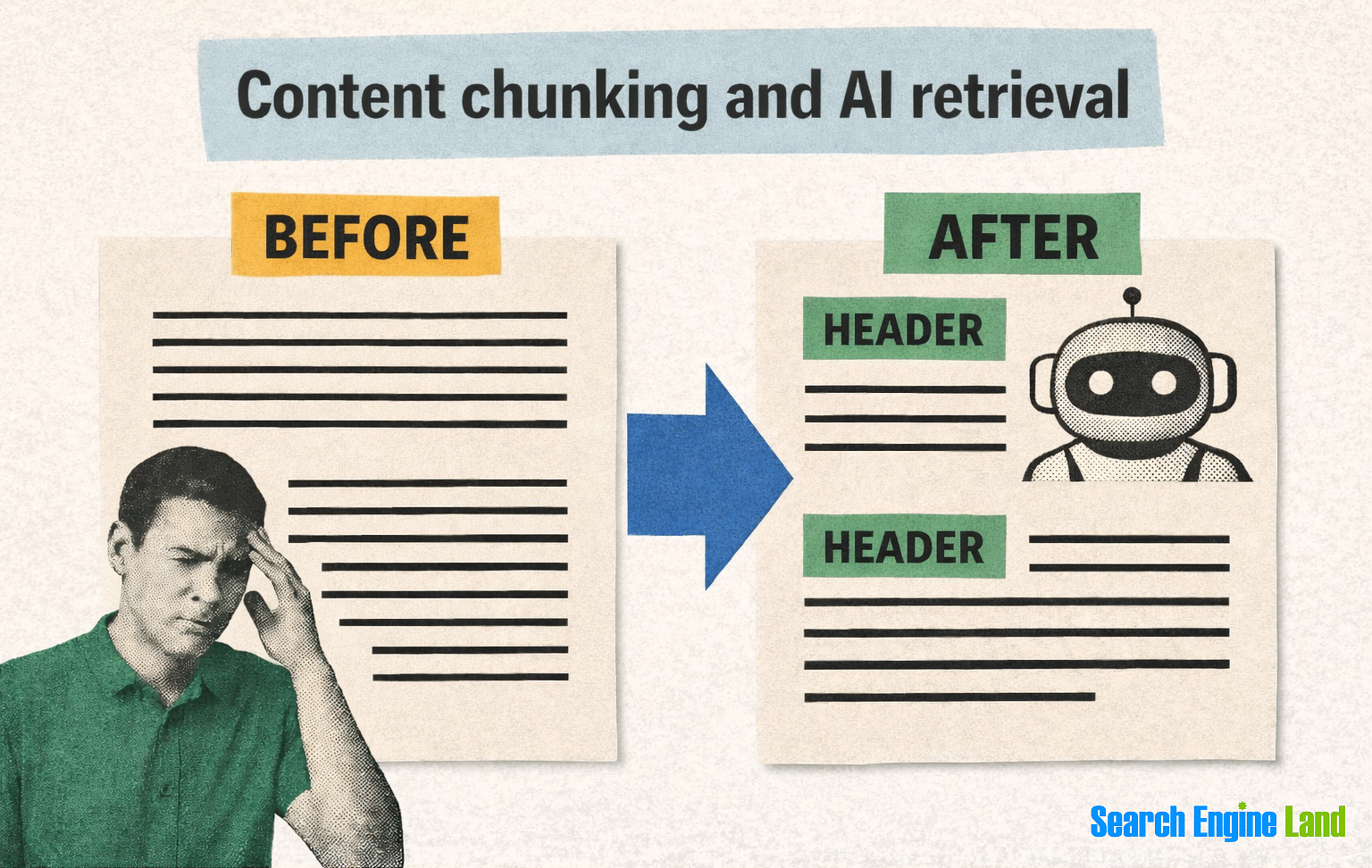
This is where content chunking becomes important. Breaking content into logically complete sections improves readability for users and makes it easier for AI systems to parse, segment, and reuse information.
Favor lists, tables, and structured formats
Structured formats help make relationships explicit.
Lists, tables, and bullet points are particularly effective for:
- Comparing related concepts
- Grouping ideas that belong together
- Presenting steps or sequences at a conceptual level
These formats reduce ambiguity, which becomes especially important during query expansion, when AI systems are deciding which source best supports a specific sub-query.
Reinforce meaning with structured data and schema
Structured data doesn’t guarantee visibility in AI search, but it’s considered a best practice for reinforcing meaning.
When used thoughtfully, schema markup can help clarify:
- Which entities are being discussed
- How those entities relate to one another
- Which parts of the content represent definitions, explanations, or relationships
This works particularly well when paired with clear semantic writing. If your content already makes subject–predicate–object relationships explicit, structured data can reinforce those relationships in a machine-readable way.
Be realistic about the role of internal linking
Internal links still matter for users and traditional search engines, but their role in AI search is less consistent.
Many AI systems rely heavily on pretrained models and use crawling selectively, often retrieving web content only when additional grounding is required. In these cases, internal links may function more as contextual signals than as primary discovery mechanisms.
The practical takeaway is straightforward:
- Use internal links to support understanding and navigation
- Don’t rely on them as the primary driver of AI search visibility
As AI systems evolve, crawling behavior may change. For now, internal linking should be treated as a supporting element, not a core optimization lever for fan-out queries.
Measuring results from query fan-out optimization
Optimizing for query fan-out only matters if it changes how your content appears in AI-generated results.
One challenge is that traditional SEO metrics don’t fully capture this behavior. Rankings and clicks still matter, but visibility in fan-out scenarios often appears before traffic patterns shift.
To assess whether your content is benefiting from query fan-out, it’s more useful to track signals tied to presence and consistency, rather than position alone.
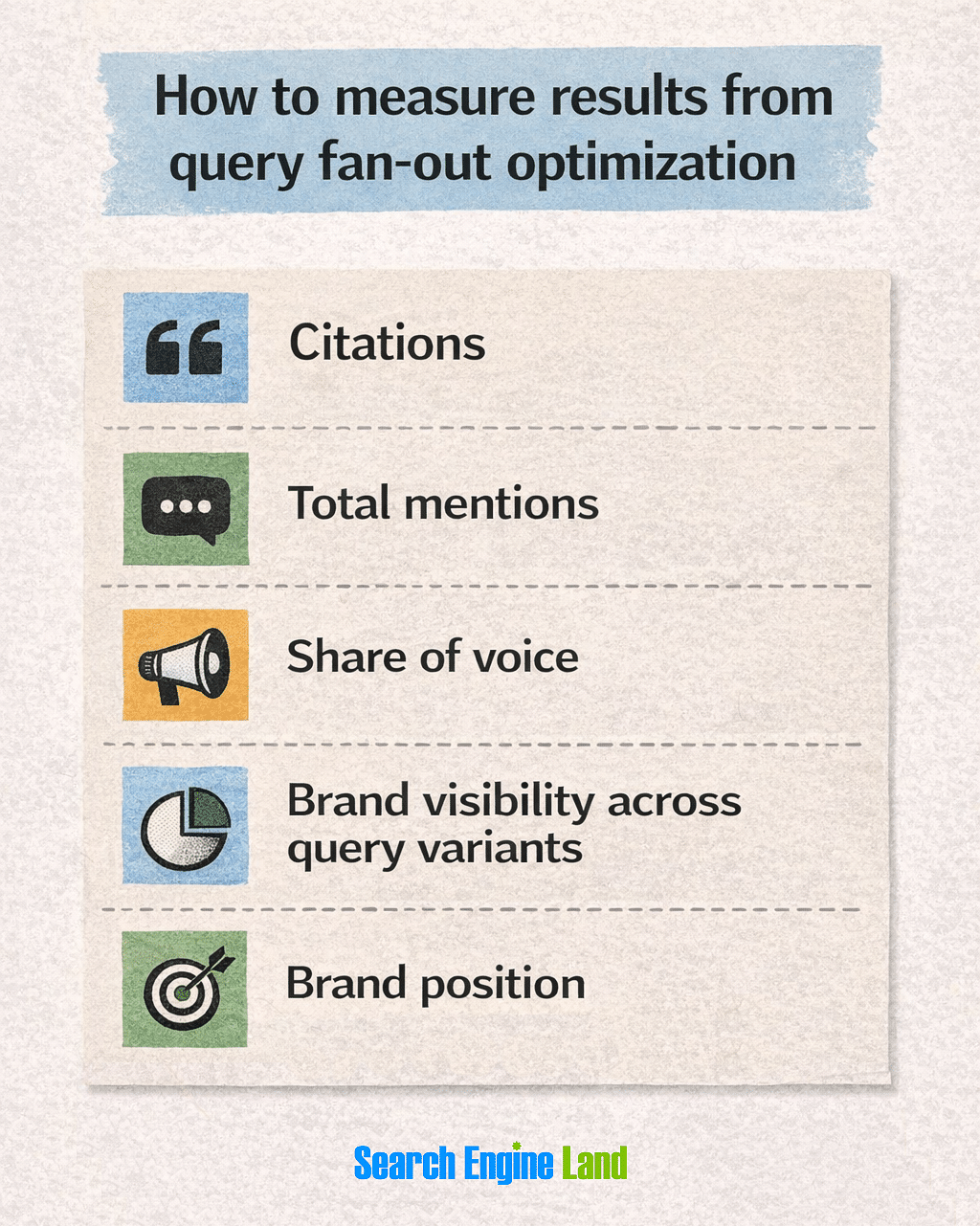
Key metrics to monitor include:
- Citations: How often your content is referenced or linked within AI-generated answers (such as AI Overviews)
- Total mentions: How frequently your brand or domain appears across AI search outputs for related queries, not just the primary topic
- Share of voice: How often your content appears relative to competitors when AI systems respond to fan-out variants of the same query
- Brand visibility across query variants: Whether your content remains present as the query is rephrased, expanded, or generalized
- Brand position: The order in which your brand or content is mentioned when multiple sources appear in an AI-generated response
Together, these signals help indicate whether your content is becoming a consistent reference during query expansion, rather than appearing only sporadically.
Dig deeper: How to measure brand visibility in AI search (before you disappear)
Is your content being featured in AI search results?
When optimizing for query fan-out, visibility doesn’t always look like a traditional ranking improvement.
Instead, it often appears as repeated inclusion within AI-generated answers, such as AI Overviews, even when the wording or intent of the query changes. This kind of visibility often appears before measurable changes in traffic or rankings.
Track, optimize, and win in Google and AI search from one platform.
One practical way to assess this exposure is by using tools that report on AI-driven search visibility. For example, Semrush One includes reporting on AI Overview visibility, which can help identify whether content is being surfaced across AI-generated results.
More broadly, evaluating fan-out performance requires looking beyond a single query or result. Consistent presence across related prompts, formats, and answer types is a stronger signal that content is aligning with how AI search systems retrieve and synthesize information.
To find the right solutions for your workflow, explore our recommended query fan-out tools and software. And if you’re looking to go deeper into how AI search works beyond query fan-out, our AI SEO guide covers the broader principles in detail.
Explore more on
Editorial disclosure
Search Engine Land is owned by Semrush. We remain committed to providing high-quality coverage of marketing topics. Unless otherwise noted, this page’s content was written by either an employee or a paid contractor of Semrush Inc.
About the author