Query fan-out tools and software to optimize content and track results

In AI search, query fan-out refers to the expansion of a single query into multiple related sub-queries before a response is generated.
Query fan-out optimization becomes practical only when you can operationalize it. That means using tools that surface fan-out subqueries, evaluate how well your content covers them, and measure whether those efforts translate into visibility across AI-generated search results.
This guide will focus on query fan-out tools and software for advanced practitioners. We’ll explain what each tool does, when to use it, and how it fits into your real-world AI search optimization workflow.
Query fan-out tools for AI search optimization
Query fan-out tools are designed to expand a single query into multiple related questions and variations in order to better understand intent and retrieve more complete information.
The SEO toolkit you know, plus the AI visibility data you need.

Rather than matching a single keyword to a page, these tools model how AI-assisted search systems break up an initial query into parallel or sequential sub-queries, then synthesize information across those variants into a single response.
From an optimization standpoint, query fan-out tools are primarily used to surface the questions a piece of content should be able to support, so that it will remain useful as queries expand. Query fan-out optimization, in turn, means structuring content so that those related questions are clearly addressed and easy for AI systems to retrieve and reuse.
Most query fan-out tools rely on a shared set of query variant categories. These include query rewrites, paraphrases, follow-up questions, and subtopic expansions, and originate from retrieval techniques described in Google patents and research, including the use of multiple related searches across subtopics and sources.
Let’s take a look at some of the tools used to generate and simulate fan-out queries before the corresponding content is created.
Query fan-out generators & simulators
Query fan-out generators and simulators are primarily used during content planning and creation. Their purpose is not to evaluate existing pages, we will cover these tools later on, but, instead, to help teams understand how a topic may expand once it enters an AI-assisted search system.

In practice, generators are used to systematically produce a structured set of query variants, while simulators are used to approximate how AI systems may expand and reframe a query in real time.
For example, let’s take the topic “AI SEO.” A query fan-out generator might return a list such as:
- What is AI SEO
- How AI search changes ranking
- AI SEO vs. traditional SEO
- How to optimize for AI-generated answers
- Risks of AI SEO strategies
A simulator, by contrast, would attempt to mimic how an AI search system expands that topic when generating an answer. Instead of producing a flat list, it might surface a sequence of related angles such as:
- What “AI SEO” means in practice
- How AI retrieval differs from link-based ranking
- What types of content perform well in AI-assisted search
- How query fan-out affects visibility
- How to measure performance in AI-generated results
The generator produces query variants for planning and coverage. The simulator models how those variants may be combined and prioritized during answer generation.
These tools surface related questions, paraphrases, follow-ups, and refinements that are likely to appear during query expansion. Content teams can then design a single page to support those variants more comprehensively, rather than addressing them piecemeal across multiple URLs.
For example, if a generator surfaces variants such as “What is AI SEO,” “How AI search changes ranking,” “AI SEO vs. traditional SEO,” and “How to optimize for AI-generated answers,” a content team might design one page that:
- Defines AI SEO clearly
- Explains how AI-assisted search retrieves and synthesizes content
- Compares AI SEO with traditional SEO approaches
- Outlines practical optimization considerations for AI-generated results
Instead of creating separate pages for each phrasing, the page is structured to answer the full set of related questions that an AI system is likely to explore during fan-out.
Examples of tools used for this purpose include:
Keywords everywhere (Chrome extension)
Keywords everywhere is a Chrome extension that displays related searches right in your browser as you research topics.

One useful feature is that it lets you view the fan-out queries on ChatGPT. You can use this information to plan out what to cover in your content if your goal is ranking in AI searches.
Query Fan-Out by DEJAN
Query Fan-Out by DEJAN is a purpose-built tool designed to expand a seed query into a structured set of fan-out variants.
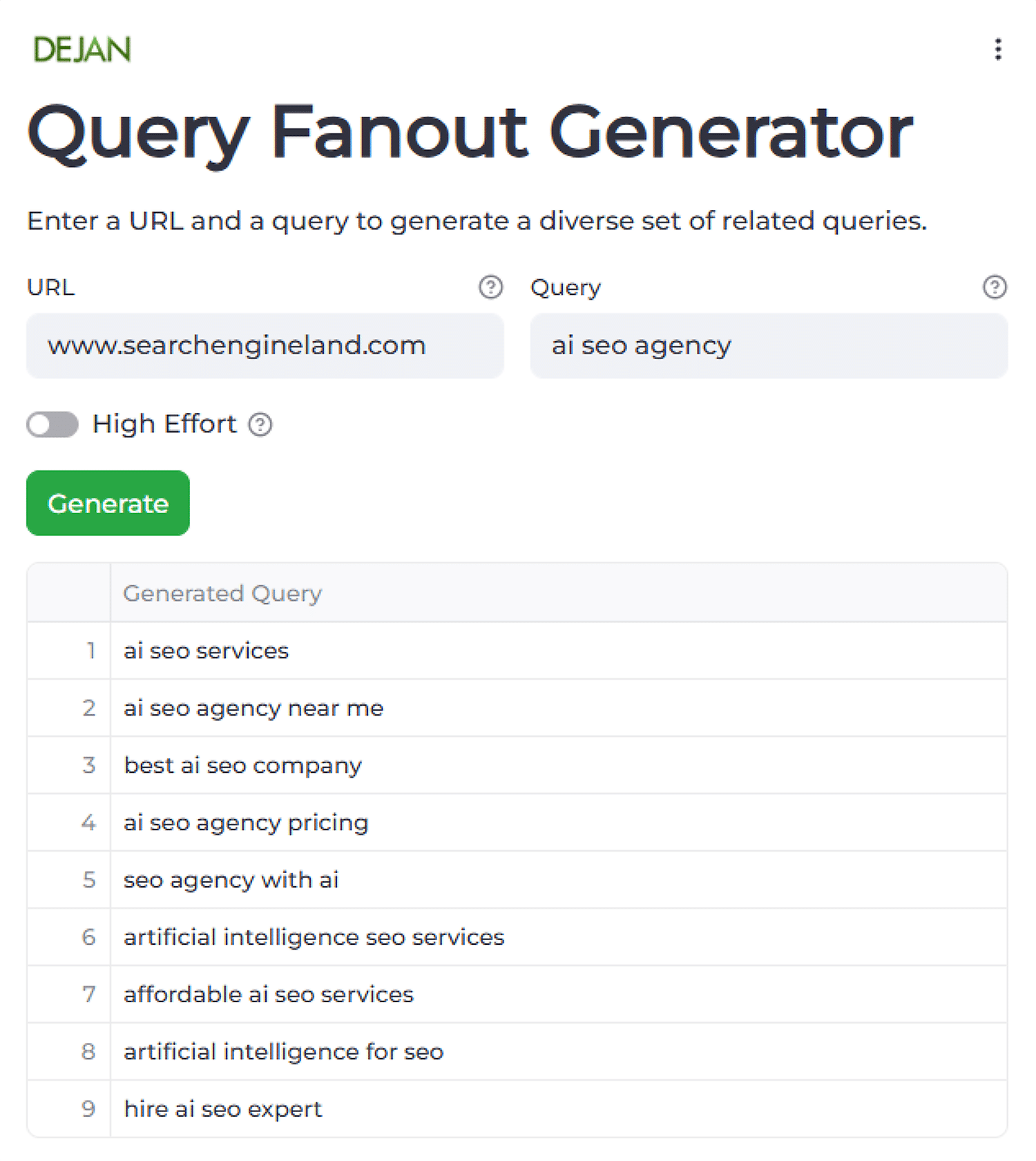
It uses a simple interface where the user enters a website and a target term, and the tool returns a diverse set of related queries that reflect how that topic can be expanded and explored.
Query Fan-Out by DEJAN can be used to identify the range of questions and angles a single page should cover, helping teams to design content that aligns with how AI and search systems broaden queries during retrieval.
Qforia by iPullRank
Qforia by iPullRank is a research platform designed to model how a topic expands into related questions and user intents.

It uses an LLM (via a Gemini API key) to generate and organize these expansions, helping teams understand the different angles and follow-up questions a topic naturally produces.
The tool supports multiple input modes and allows users to choose which platform or search environment to explore, making it useful for analyzing how a topic may unfold across different query contexts and surfaces.
ChatGPT Search Query Extractor
ChatGPT Search Query Extractor is a lightweight tool used to simulate fan-out behavior by extracting the related search queries an LLM generates when performing web searches.

It works as a browser bookmarklet; when you open a ChatGPT conversation that includes web search results, clicking the bookmarklet reveals all the underlying queries used during retrieval. These can then be copied and reused for fan-out analysis, content planning, or coverage testing in spreadsheets or other tools.
Query Fan Out Analysis (Otterly AI)
Query Fan Out Analysis (Otterly AI) generates fan-out query variants to model how a topic expands into related questions.
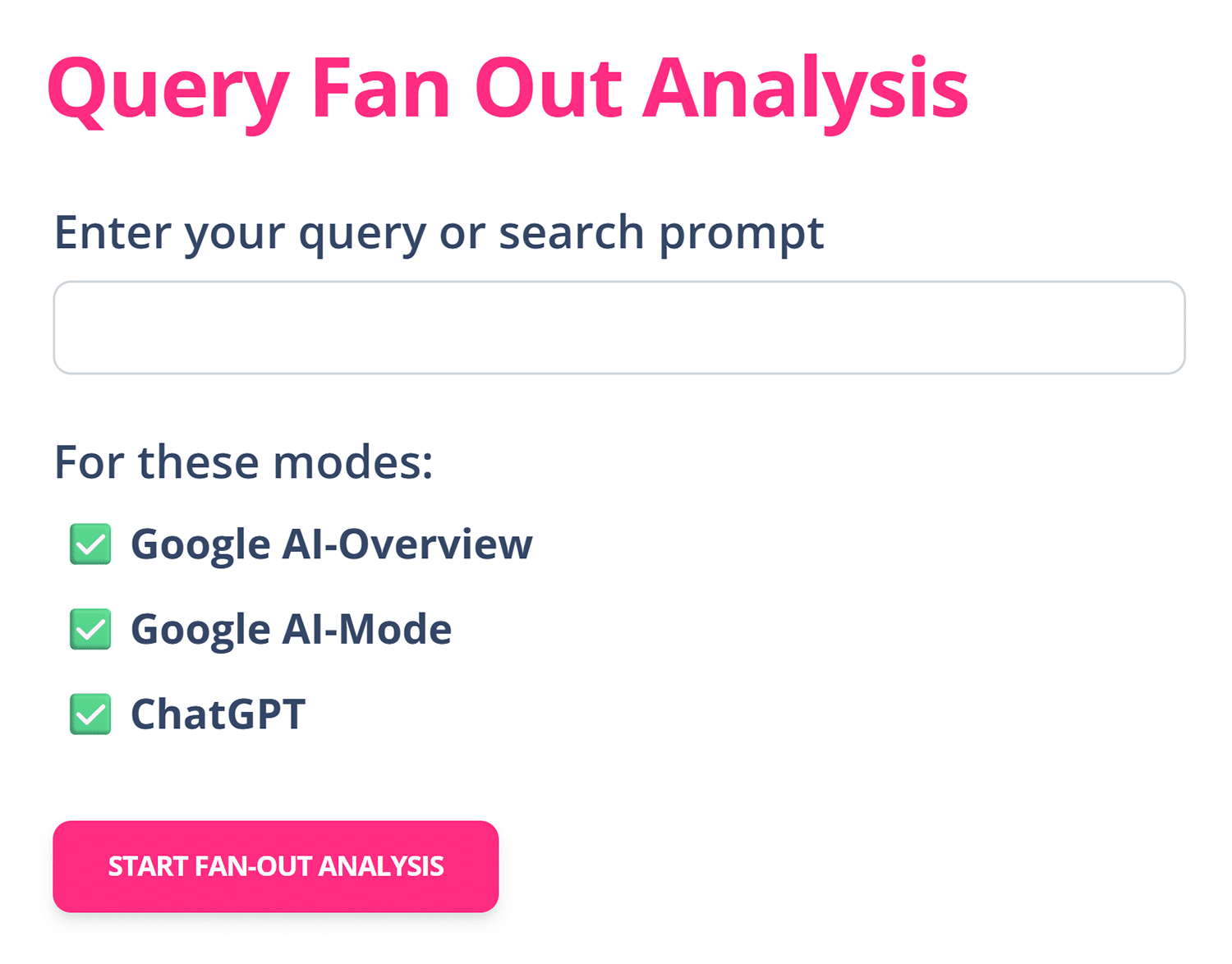
The tool requires registration to access results and is typically used to explore how a single query can branch into multiple angles, making it easier to understand and plan for the types of follow-up questions AI-powered search systems are likely to generate.
Query Fan-Out Generator (Wellows)
Query Fan-Out Generator (Wellows) is a lightweight tool for expanding a seed query into multiple related variants.
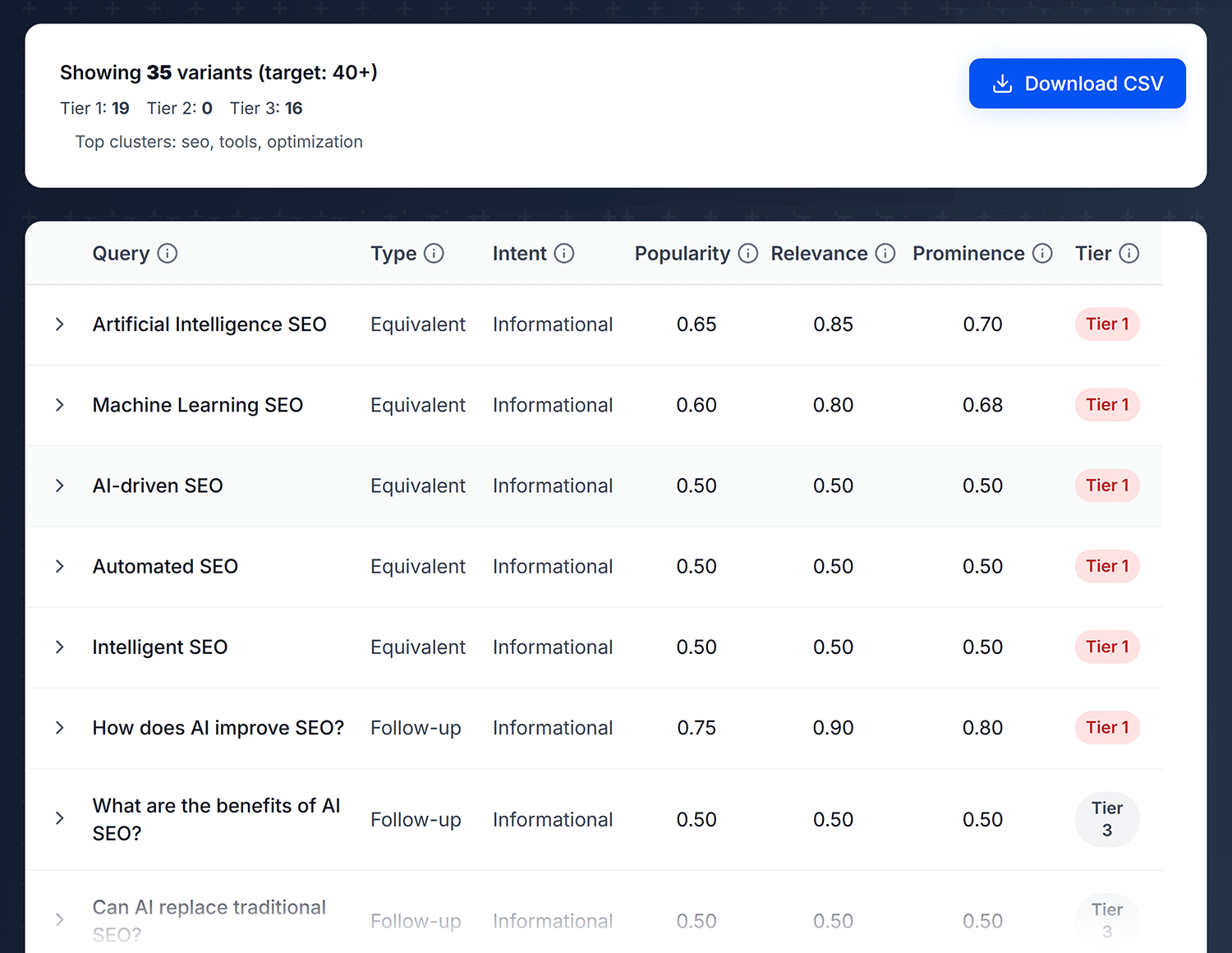
The user enters a primary keyword and the tool then generates semantic query variations that can be filtered and prioritized by type or search intent. Results can be exported to CSV and are typically used for keyword research and content planning, helping teams identify which related queries to target for awareness, conversion, or broader topical coverage.
While these tools vary in interface and sophistication, they share the same underlying goal: expanding a single topic into a structured set of query variants that define meaningful coverage.
Using AI prompts for fan-out generation
In addition to dedicated tools, it is possible to generate fan-out queries directly using large language models (LLMs). In this setup, prompts act as a flexible fan-out generator, allowing you to control how query variants are produced and grouped.
When queries are generated using LLMs, the fan-out process typically combines:
- A task prompt, which defines what the AI model should generate
- A query variant framework, which constrains how fan-out should be structured
That means, the prompt defines the objective (for example, generating fan-out queries for content creation), while the framework defines the rules: which query variant types exist, how they differ, and which ones should be included or excluded.
For example, the task prompt might be:
“Generate fan-out queries for the topic ‘AI SEO’ to support content creation.”
The query variant framework then shapes how that output is produced by specifying that the model should return:
- Definition queries (for example, “what is AI SEO”),
- Comparison queries (for example, “AI SEO vs. traditional SEO”),
- Process queries (for example, “how AI search retrieves content”), and
- Application queries (for example, “how to optimize for AI-generated results”).
In this setup, the prompt sets the goal, while the framework controls the structure and scope of the fan-out.
This is why prompt-based fan-out workflows often include controls such as:
- Variant weighting (for example, 0–1)
- Inclusion or exclusion of specific variant types (such as Language Translation)
The framework is a control mechanism that ensures fan-out generation is consistent, repeatable, and aligned with how AI search systems expand queries.
When using AI prompts for fan-out analysis, the schema is typically included directly in the same prompt sent to the LLM, clearly labeled as the reference framework for evaluation.
To make this concrete, the following example shows how a task prompt and a query variant schema can be combined in a single prompt to guide fan-out generation.
Use case: Creating new content that is designed to perform well in AI search results.
Task definition and query variant schema combined:
You are a content marketing SEO who wants to create content that ranks well in AI search results. You want to come up with a list of fan-out queries based on the main topic.

I'm going to give you a main topic, and I need you to come up with some examples of subqueries (query variants) for that main topic. You will need to use these eight types of query variants to come up with {{number}} examples for each for a total of {{number}} examples.

Output requirements:

- Return the results only as a table
- Use one row per query variant
- Do not include explanations outside the table

Table columns (required and in this order):

- Variant Type
- Original Query
- Fan-Out Query Variant
- Intent Description (short phrase)

Let me know when you are ready.

{
  "VariantTypes": [
    {
      "type": "Equivalent",
      "weight": 0.9,
      "explanation": "Alternative ways to ask the same question (paraphrases that preserve intent)",
      "examples": [
        {
          "original": "did roger moore drive an aston martin in the persuaders",
          "variant": "what car did roger moore drive in the persuaders"
        },
        {
          "original": "best AI tools",
          "variant": "top artificial intelligence tools"
        }
      ]
    },
    {
      "type": "Follow-up",
      "weight": 0.9,
      "explanation": "Logical next questions that build on the original query",
      "examples": [
        {
          "original": "did leonardo da vinci paint mona lisa",
          "variant": "who commissioned leonardo da vinci to paint the mona lisa"
        },
        {
          "original": "how to bake sourdough bread",
          "variant": "what ingredients are needed for sourdough starter"
        }
      ]
    },
    {
      "type": "Generalization",
      "weight": 0.9,
      "explanation": "Broader or higher-level versions of the specific question",
      "examples": [
        {
          "original": "best Italian restaurants in Manhattan",
          "variant": "best restaurants in New York City"
        },
        {
          "original": "iPhone 15 camera review",
          "variant": "best smartphone cameras"
        }
      ]
    },
    {
      "type": "Canonicalization",
      "weight": 0.9,
      "explanation": "Standardized or normalized versions of the query (clean, searchable forms)",
      "examples": [
        {
          "original": "what’s the fastest way to lose weight?",
          "variant": "fastest methods for weight loss"
        },
        {
          "original": "AI tools for seo",
          "variant": "AI software for search engine optimization"
        }
      ]
    },
    {
      "type": "Language Translation",
      "weight": 0.0,
      "explanation": "The same query translated into different languages to find multilingual content",
      "examples": [
        {
          "original": "what are the best ai tools",
          "variant": "mejores herramientas de IA"
        },
        {
          "original": "how to learn Python programming",
          "variant": "cómo aprender programación en Python"
        }
      ]
    },
    {
      "type": "Entailment",
      "weight": 0.9,
      "explanation": "Queries that logically follow from or are implied by the original",
      "examples": [
        {
          "original": "how to choose the best AI tools?",
          "variant": "what factors should be considered when selecting AI software?"
        },
        {
          "original": "causes of climate change",
          "variant": "how do greenhouse gases contribute to climate change?"
        }
      ]
    },
    {
      "type": "Specification",
      "weight": 0.9,
      "explanation": "More detailed or narrowly focused versions of broad queries (adds constraints or audience)",
      "examples": [
        {
          "original": "climate change",
          "variant": "climate change effects on coastal cities"
        },
        {
          "original": "best laptops",
          "variant": "best laptops for graphic design under $1500"
        }
      ]
    },
    {
      "type": "Clarification",
      "weight": 0.9,
      "explanation": "Questions asked back to the user to confirm intent or disambiguate",
      "examples": [
        {
          "original": "Did you mean the movie or the book?",
          "variant": "Are you asking about the novel or its film adaptation?"
        },
        {
          "original": "Which Apple product?",
          "variant": "Do you mean iPhone, iPad, or MacBook?"
        }
      ]
    }
  ]
}
This example shows what a structured fan-out table might look like when applying a query variant schema to a topic such as “AI SEO.”
| Variant type | Original query | Fan-out query variant | Intent description |
| Equivalent | AI SEO | artificial intelligence SEO | Same intent, paraphrased |
| Equivalent | AI SEO | SEO for AI-powered search | Same intent, different phrasing |
| Follow-up | AI SEO | how does AI change search ranking | Next logical question |
| Follow-up | AI SEO | what content works best in AI search | Builds on original topic |
| Generalization | AI SEO | SEO strategy for AI search systems | Broader framing |
| Generalization | AI SEO | search optimization for AI-driven engines | Higher-level version |
| Canonicalization | AI SEO | AI for search engine optimization | Normalized phrasing |
| Canonicalization | AI SEO | artificial intelligence for SEO | Standardized form |
| Specification | AI SEO | AI SEO for ecommerce websites | Narrowed by audience/context |
| Specification | AI SEO | AI SEO for generative search results | Narrowed by result type |
| Entailment | AI SEO | how do AI systems retrieve content | Implied concept |
| Entailment | AI SEO | what factors influence AI-generated answers | Logical implication |
| Clarification | AI SEO | do you mean optimizing for AI search or using AI for SEO | Disambiguation |
| Clarification | AI SEO | are you asking about tools or strategy | Intent clarification |
Alternative ways to mimic query fan-out tools
You can also approximate fan-out behavior using traditional SEO research methods.
Keyword clustering tools like Semrush can be used to group related queries around a core topic, aka topic clusters. Each cluster can then be mapped to a section within a single page, mimicking how AI systems expand queries across subtopics.
Additional fan-out ideas can also be surfaced by manually reviewing SERP features such as:
- People Also Ask (PAA)
- People Also Search For (PASF)
- Autocomplete suggestions
These features reflect how search systems already associate related questions with a topic.
For example, if you search for “AI crawlers,” People Also Ask and related searches may surface queries such as:
- How AI crawlers index content
- How AI crawlers differ from Googlebot
- How to block AI crawlers
- What content AI crawlers can access
A content team can use these signals to identify adjacent angles that an AI system may explore during query expansion and ensure that a single page addresses them directly.
However, manual SERP review has limits. It reflects only what is visible for one query, in one location, at one moment in time. It does not expose deeper reformulations, hidden entailments, or less common variants that appear during fan-out. Human review is also selective by nature; It favors obvious questions and can miss structural gaps that automated tools or schemas are designed to detect.
Dig deeper: People Also Ask: The obvious opportunity most SEOs are missing
Query fan-out coverage analysis tools for AI search optimization
As we’ve covered, query fan-out generators and simulators are used during content planning to generate new topics or pages. To optimize existing content use query fan-out coverage analysis tools.
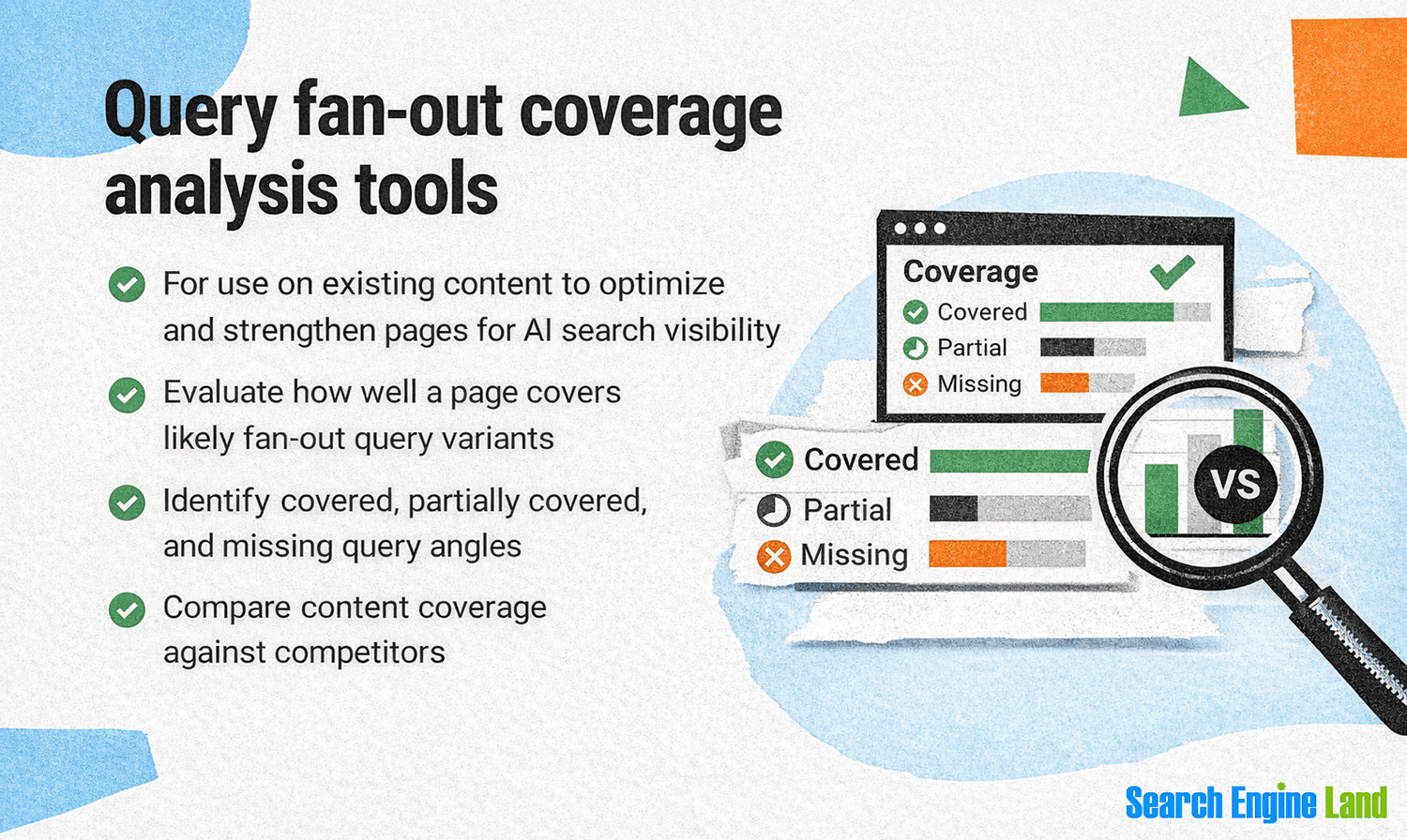
Instead of answering the question of “What should I write,” these tools help answer a different question: Which fan-out query variants does my current content already support, and which are missing?
This type of analysis is especially important in AI-assisted search environments where visibility depends on whether a single page can support multiple related sub-queries as intent expands.
The tools below all operate on the same underlying principle: They evaluate content against a standardized set of query variant types and assess coverage consistency across those variants.
Query fan-out AI coverage tools
Query fan-out coverage tools analyze a page by comparing its content against a predefined fan-out taxonomy. Rather than evaluating rankings or keywords, they assess whether the page meaningfully addresses the types of questions AI systems are likely to generate as a query expands.
For example, consider a page targeting “AI SEO.” A coverage tool might evaluate that page against fan-out variants such as:
- Equivalent queries (for example, “artificial intelligence SEO”)
- Follow-up questions (for example, “how does AI change search ranking”)
- Comparisons (for example, “AI SEO vs. traditional SEO”)
- Specifications (for example, “AI SEO for generative search results”)
The tool would then assess whether the page:
- Defines what AI SEO is
- Explains how AI-assisted search retrieves and synthesizes content
- Distinguishes AI SEO from traditional SEO approaches
- Addresses practical implications for optimizing content for AI-generated answers
Instead of reporting that the page ranks for “AI SEO,” the tool reports which fan-out angles are covered, which are partially addressed, and which are missing entirely.
Some of the most used query fan-out coverage tools include:
Query Fan-Out AI Coverage Tool
Query Fan-Out AI Coverage Tool analyzes how well a page covers fan-out query variants and how thoroughly those variants are supported within the content.
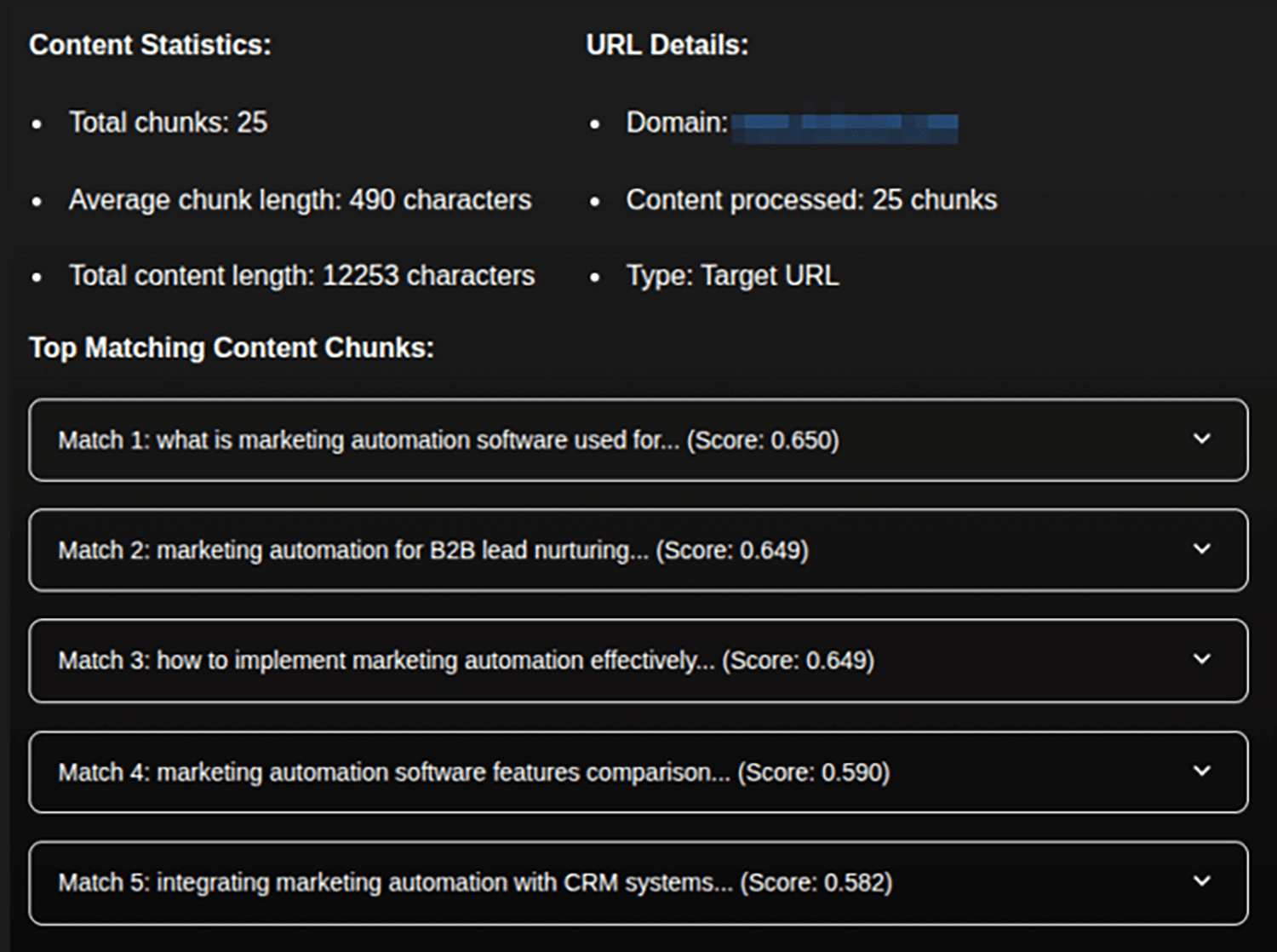
It is typically used to compare one page against competing pages to identify structural or topical gaps, showing which related questions are fully addressed, partially covered, or missing altogether.
Google AI Mode insights
In practice, Google AI Mode can be used as a qualitative coverage diagnostic by observing which subtopics and explanations appear in its generated response for a given query.

For example, a response to “AI SEO” might cover definitions, differences from traditional SEO, and optimization considerations. If a page omits one of those angles, that omission signals a coverage gap. By comparing AI-generated responses for a topic against your existing page, you can identify which aspects of the query expansion are being synthesized from other sources rather than your own content.
A practical workflow looks like this:
- Enter a core query related to your page into Google AI Mode.
- Review how the response expands the query into related explanations, constraints, examples, or follow-up questions.
- Compare those expansions against your content structure and sections.
- Any concept or angle surfaced in the AI response that is not clearly addressed on your page represents a potential fan-out coverage gap.
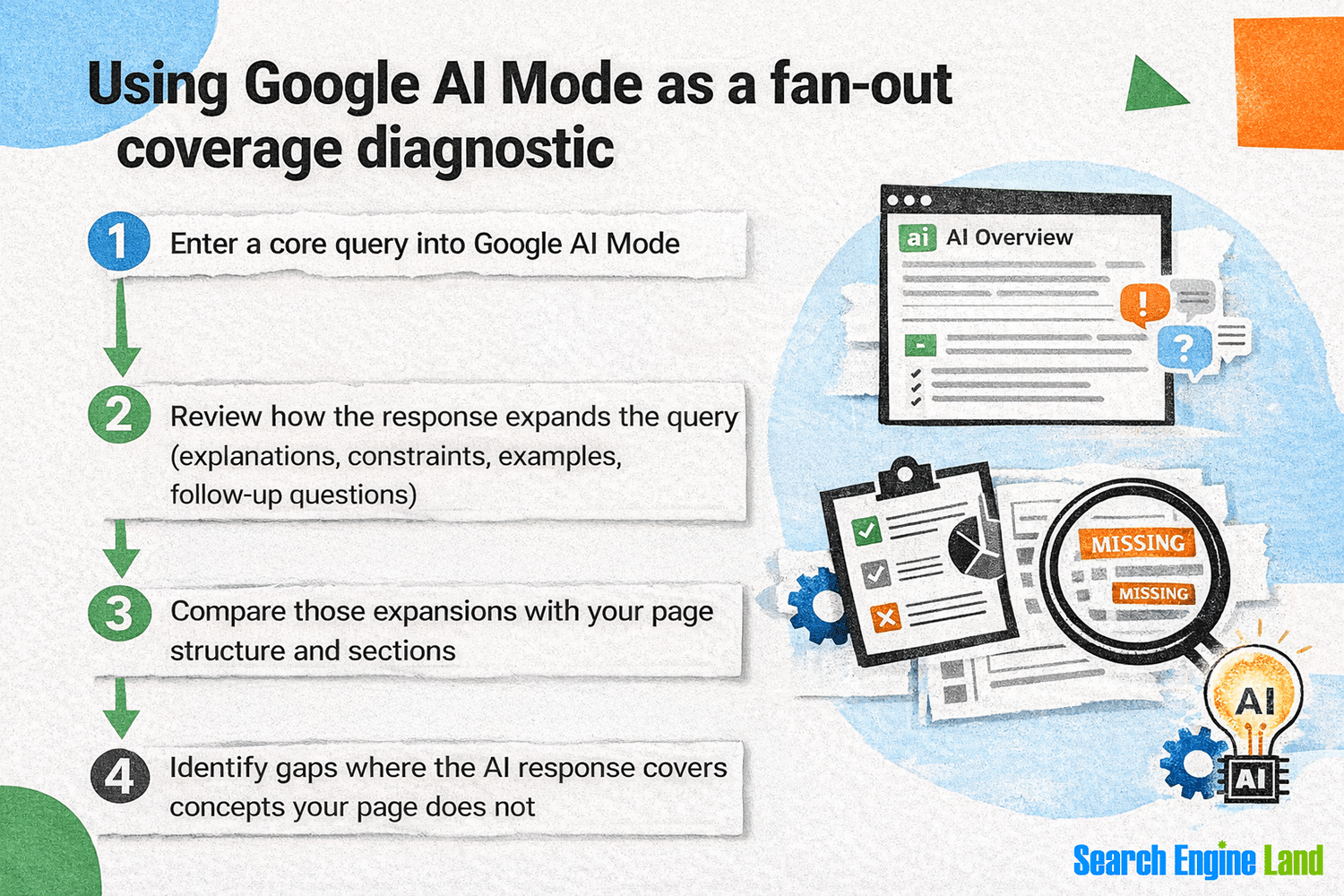
This approach does not replace structured coverage analysis tools, but it provides fast directional insight into how Google is reframing the query and which subtopics your content may be under-supporting.
Screaming Frog + Gemini or Screaming Frog + custom LLM scripts
In these workflows, Screaming Frog is used to extract page content at scale, while an LLM evaluates that content against a fixed set of query variant types. This allows teams to assess whether each page meaningfully addresses the types of questions AI systems are likely to generate as a query expands.

Instead of checking rankings or keywords, the output shows which fan-out angles are covered, which are partially addressed, and which are missing.
Go Fish shares how they use Screaming Frog to extract AI Overview query fan-outs. And Semrush shows how to use Screaming Frog and a custom script to research fan-out queries.
Using AI prompts to perform query fan-out coverage analysis
In addition to dedicated software and crawling-based workflows, query fan-out coverage analysis can also be performed directly using LLMs through structured AI prompts.
In this setup, the LLM is not acting as a content generator. Instead, it functions as an analysis engine, evaluating existing content against a predefined fan-out framework to determine coverage gaps.
This approach is commonly used when:
- Dedicated fan-out coverage tools are not available
- Teams want to prototype or validate coverage logic quickly
- Fan-out analysis needs to be applied to individual pages or small content sets
When using an LLM for coverage analysis, you need to account for two elements:
- A task prompt, which defines the analysis objective
- A structured query variant schema, which defines how fan-out variants are classified
The task prompt tells the LLM what to do. The schema tells it how to evaluate coverage consistently.
For example, a task prompt might look like:
- “Analyze whether this page adequately covers the topic ‘AI SEO’ based on likely fan-out query variants.”
- “Compare this page’s content against common fan-out expansions for ‘AI SEO’ and identify missing angles.”
These prompts set what the model is being asked to evaluate (coverage and gaps), before any schema or taxonomy is applied to control how that evaluation is performed.
A schema might specify categories such as:
- Equivalent queries (for example, “AI SEO” → “artificial intelligence SEO”)
- Follow-up queries (for example, “AI SEO” → “how does AI change search ranking”)
- Specification queries (for example, “AI SEO” → “AI SEO for generative search results”)
In this setup, the schema controls how fan-out variants are labeled and grouped, while the task prompt controls what the model is being asked to evaluate.
This separation is important; without a fixed schema, coverage analysis becomes subjective and cannot be reliably compared across pages, competitors, or time.
In practice, the schema is passed to the LLM as a control framework, not as content to interpret. It constrains evaluation so every analysis uses the same variant definitions, categories, and weighting logic.
Let’s go back to our example. If the task is to analyze a page about “AI SEO,” the model is not asked to reason about the schema itself. Instead, it is instructed to use the schema to label and evaluate fan-out variants. A follow-up like “How does AI change search ranking” would be classified as a Follow-up variant, while “AI SEO for generative search results” would be classified as a Specification variant, based on the schema rules rather than the model’s own interpretation.
This keeps coverage analysis consistent across pages by ensuring that the same types of variants are recognized and scored the same way each time.
In practice, the schema is included directly within the same prompt sent to the LLM, clearly labeled as a reference framework the model must use when evaluating coverage.
Below is an example of how fan-out coverage analysis is typically configured when using LLMs directly. The prompt establishes the task, while the schema ensures standardized evaluation.
Use case: Optimizing an existing page for AI search visibility
Task definition and query variant schema combined:
You are a content marketing SEO who wants to optimize already existing content so that it ranks well in AI search results.

I'm going to give you 1) a main topic, 2) the URL of the page or the page contents (uploaded or pasted into this chat).

Your task is to analyze the content and identify which query fan-out variants are covered, partially covered, or missing, using the exact query variant types defined in the JSON below.

You will need to use these eight types of query variants to come analyze the content.

Output requirements:

- Return the results only as a table
- Use one row per query variant
- Do not include explanations outside the table

Table columns (required and in this order):

- Variant Type
- Original Query
- Fan-Out Query Variant
- Intent Description (short phrase)
- Coverage
- Content Idea / Suggestion

Let me know when you are ready.

{
  "VariantTypes": [
    {
      "type": "Equivalent",
      "weight": 0.9,
      "explanation": "Alternative ways to ask the same question (paraphrases that preserve intent)",
      "examples": [
        {
          "original": "did roger moore drive an aston martin in the persuaders",
          "variant": "what car did roger moore drive in the persuaders"
        },
        {
          "original": "best AI tools",
          "variant": "top artificial intelligence tools"
        }
      ]
    },
    {
      "type": "Follow-up",
      "weight": 0.9,
      "explanation": "Logical next questions that build on the original query",
      "examples": [
        {
          "original": "did leonardo da vinci paint mona lisa",
          "variant": "who commissioned leonardo da vinci to paint the mona lisa"
        },
        {
          "original": "how to bake sourdough bread",
          "variant": "what ingredients are needed for sourdough starter"
        }
      ]
    },
    {
      "type": "Generalization",
      "weight": 0.9,
      "explanation": "Broader or higher-level versions of the specific question",
      "examples": [
        {
          "original": "best Italian restaurants in Manhattan",
          "variant": "best restaurants in New York City"
        },
        {
          "original": "iPhone 15 camera review",
          "variant": "best smartphone cameras"
        }
      ]
    },
    {
      "type": "Canonicalization",
      "weight": 0.9,
      "explanation": "Standardized or normalized versions of the query (clean, searchable forms)",
      "examples": [
        {
          "original": "what’s the fastest way to lose weight?",
          "variant": "fastest methods for weight loss"
        },
        {
          "original": "AI tools for seo",
          "variant": "AI software for search engine optimization"
        }
      ]
    },
    {
      "type": "Language Translation",
      "weight": 0.0,
      "explanation": "The same query translated into different languages to find multilingual content",
      "examples": [
        {
          "original": "what are the best ai tools",
          "variant": "mejores herramientas de IA"
        },
        {
          "original": "how to learn Python programming",
          "variant": "cómo aprender programación en Python"
        }
      ]
    },
    {
      "type": "Entailment",
      "weight": 0.9,
      "explanation": "Queries that logically follow from or are implied by the original",
      "examples": [
        {
          "original": "how to choose the best AI tools?",
          "variant": "what factors should be considered when selecting AI software?"
        },
        {
          "original": "causes of climate change",
          "variant": "how do greenhouse gases contribute to climate change?"
        }
      ]
    },
    {
      "type": "Specification",
      "weight": 0.9,
      "explanation": "More detailed or narrowly focused versions of broad queries (adds constraints or audience)",
      "examples": [
        {
          "original": "climate change",
          "variant": "climate change effects on coastal cities"
        },
        {
          "original": "best laptops",
          "variant": "best laptops for graphic design under $1500"
        }
      ]
    },
    {
      "type": "Clarification",
      "weight": 0.9,
      "explanation": "Questions asked back to the user to confirm intent or disambiguate",
      "examples": [
        {
          "original": "Did you mean the movie or the book?",
          "variant": "Are you asking about the novel or its film adaptation?"
        },
        {
          "original": "Which Apple product?",
          "variant": "Do you mean iPhone, iPad, or MacBook?"
        }
      ]
    }
  ]
}
The table below shows what a fan-out coverage analysis might return for a page targeting “AI SEO.”
| Variant type | Original query | Fan-out query variant | Intent description | Coverage | Content idea / suggestion |
| Equivalent | AI SEO | artificial intelligence SEO | Same intent, paraphrase | Covered | No change needed |
| Follow-up | AI SEO | how does AI change search ranking | Builds on topic | Partially covered | Add section explaining retrieval and synthesis in AI search |
| Generalization | AI SEO | SEO strategy for AI search systems | Broader framing | Missing | Add high-level strategy overview for AI-driven search |
| Canonicalization | AI SEO | AI for search engine optimization | Normalized phrasing | Covered | No change needed |
| Specification | AI SEO | AI SEO for generative search results | Narrowed to result type | Missing | Add subsection focused on optimization for AI-generated answers |
| Entailment | AI SEO | how do AI systems retrieve content | Logical implication | Missing | Add explanation of query fan-out and multi-query retrieval |
| Clarification | AI SEO | do you mean optimizing for AI search or using AI for SEO | Disambiguation | Partially covered | Add clarification early in the page defining scope |
The framework below defines the query variant taxonomy used in fan-out coverage analysis. In simpler terms, this framework is just a shared set of labels for different kinds of related questions, so every tool evaluates content using the same rules. Dedicated tools and LLM-based workflows alike rely on these same variant types to assess coverage in a consistent, comparable way.
Regardless of whether you use a dedicated tool or an LLM, anchoring coverage analysis to a fixed fan-out schema makes it possible to:
- Compare pages consistently
- Identify structural gaps, not just missing keywords
- Optimize content for how AI systems actually expand and retrieve queries
This is what turns query fan-out from a theoretical concept into a measurable optimization practice.
How long does it take to see results from query fan-out optimization?
Query fan-out optimization does not usually produce immediate, page-level ranking changes. Instead, early signals tend to appear as increased inclusion in AI-generated answers, often before traditional SEO metrics shift.
Some AI search optimization case studies have reported visible changes within relatively short timeframes:
- GrowthMarshal reported that one of their clients, Lake, increased its inclusion and citations in LLM-generated answers within three weeks, raising its share of U.S. AI answers from 0.9% to 13.5%.
- Relixir reported a similar pattern over a longer window, with brand mentions and citations in AI-generated responses increasing after about 28 days following broader topical expansion and clearer scope definition.
- Semrush reported that “Our four articles went from being cited two times to five times—a 150% increase.” one month after implementing query fan-out optimization.
It’s important to interpret these timelines carefully. These studies were focused on AI search optimization in general, not exclusively on query fan-out optimization. In practice, fan-out improvements often surface gradually as content is reused across multiple related prompts.
What this looks like in practice is increased reuse of the same page across different, but related, AI-generated answers. In our example, a page about “AI SEO” might first appear only when users ask “what is AI SEO.” Over time, as the page expands to cover related angles (such as how AI search retrieves content or how AI SEO differs from traditional SEO), it may also be cited or summarized for prompts like “How does AI change search ranking” or “How to optimize for AI-generated answers.”
This progress can be noticed by:
- Tracking which pages are referenced or summarized across different AI prompts.
- Comparing the range of questions that surface a given page over time, and
observing whether AI responses rely on the same page for multiple related explanations rather than just one narrow query.
Instead of a sudden ranking jump, the signal is broader reuse; The page shows up in more contexts as fan-out expands.
For competitive topics or established domains, it may take several weeks or months to see consistent changes, especially when improvements involve expanding coverage, resolving content gaps, or consolidating fragmented explanations.
How can you measure the impact of query fan-out on visibility?
Because query fan-out affects how content is retrieved and reused across multiple prompts, its impact is not fully captured by traditional rankings alone. Measurement needs to focus on presence, consistency, and comparative visibility across AI-generated results.
This means checking whether a given page appears at all when related AI prompts are issued (presence), whether the same page is reused across multiple related prompts over time (consistency), and how often it appears relative to competing sources (comparative visibility).
For our page about “AI SEO,” presence would mean seeing that page referenced or summarized when users ask “What is AI SEO.” Consistency would mean the same page also appearing when users ask related questions such as “How does AI change search ranking” or “How to optimize for AI-generated answers.” Comparative visibility would mean observing whether that page is used more frequently than competing pages when those related prompts are tested side by side.
This reframes success from a single ranking position to how broadly and reliably a page is reused as fan-out expands.
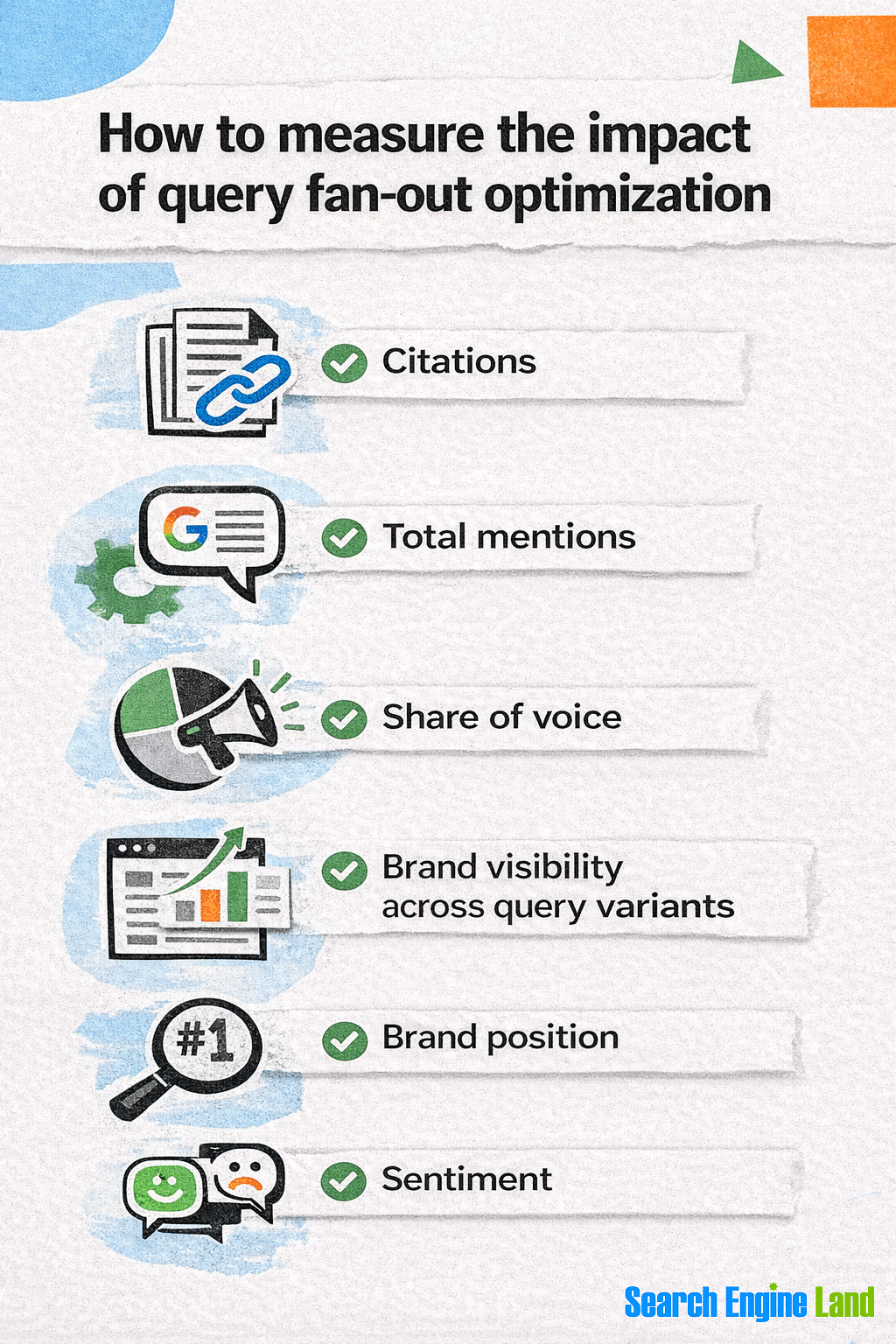
Key metrics to track include:
- Citations: How often your content is referenced or linked within AI-generated answers, such as AI Overviews or conversational responses.
- Total mentions: The frequency with which your brand, domain, or content appears across AI-generated outputs for related queries, not just the primary topic.
- Share of voice: Your relative presence compared to competitors when AI systems respond to fan-out variants of the same topic.
- Brand position: Where your brand or content appears within AI-generated answers (for example, primary source, supporting source, or peripheral mention), reflecting its prominence in the response.
- Brand visibility across query variants: Whether your content continues to appear as queries are rephrased, expanded, generalized, or specified.
- Sentiment: The tone and framing associated with your brand when it appears in AI-generated responses, particularly in evaluative or comparative contexts.
Together, these metrics provide a clearer picture of whether content is becoming a reliable reference during query expansion, rather than appearing sporadically for isolated prompts.
AI visibility tracking tools to measure query fan-out optimization results
Several tools have been developed specifically to track visibility within AI-generated search results. While they differ in implementation, they all aim to surface patterns that traditional SEO tools do not capture.
Semrush One
Semrush One consolidates multiple AI visibility capabilities into a single platform, including:
- Visibility overview: This tracks mentions across AI-generated results
- Prompt tracking: This allows you to monitor how content appears for specific prompts and variations
- Brand performance: This is where share of voice, sentiment, and comparative presence can be monitored
The following steps show how to use these features to review your current AI search visibility.
Step 1. Select the “AI Analysis” tool and click “Visibility Overview.”

Step 2. Enter your website URL to see a baseline view of your AI search visibility and click “Check AI Visibility.”
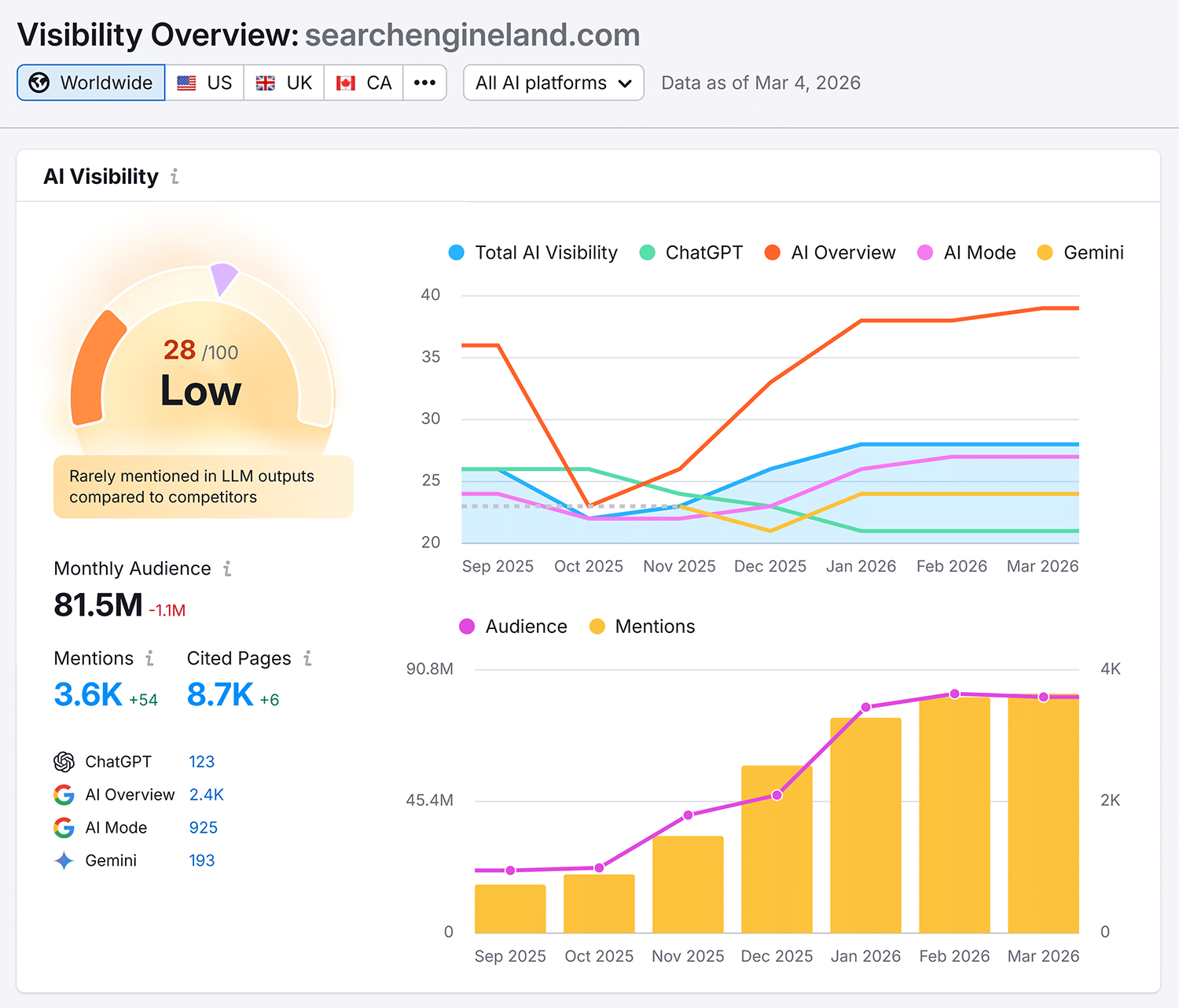
Step 3. Review the report to identify which topics and prompts are currently driving inclusion in AI-generated answers.

Step 4. In the menu go to “Brand Performance,” input your website and discover how AI perceives and talks about it.

Peec AI
Peec AI tracks, analyzes, and helps improve brand performance across AI search platforms using key metrics such as visibility, position, and sentiment.
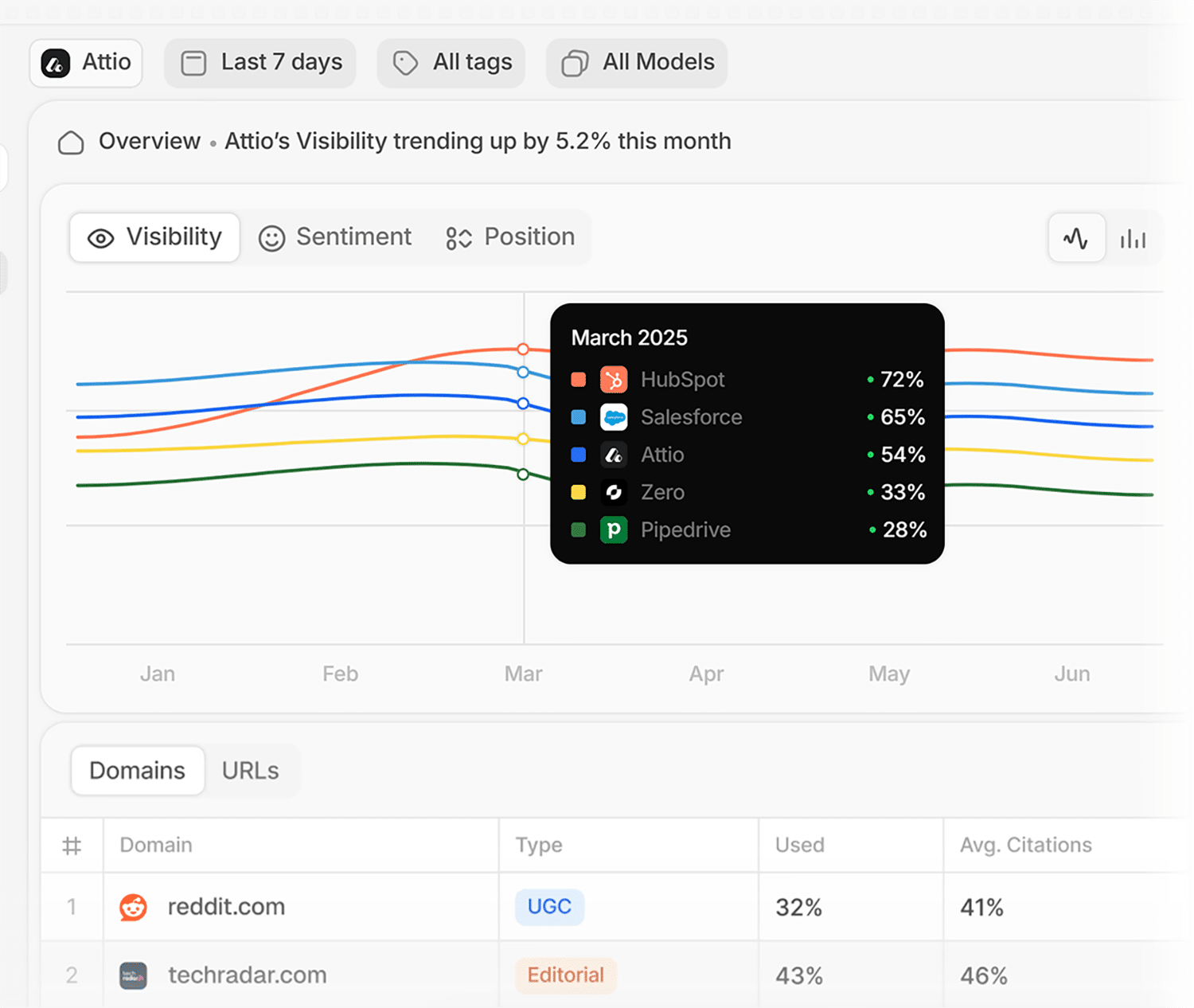
It focuses on monitoring brand and content mentions within AI-generated answers, showing where and how often a brand appears in responses.
AI Search Watcher
AI Search Watcher is designed to track how brands and pages appear across conversational and AI-assisted search environments over time, including ChatGPT, Gemini, Claude, Mistral, and Llama. It runs multiple prompts per check to provide repeatable visibility insights and allows teams to create or select custom prompts relevant to their brand.

Results are presented in comparative reports that show how a brand performs relative to competitors, where it is cited, and how LLMs describe and interpret it.
Airefs
Airefs provides a framework for tracking AI search visibility using GEO-focused metrics rather than traditional SEO indicators.
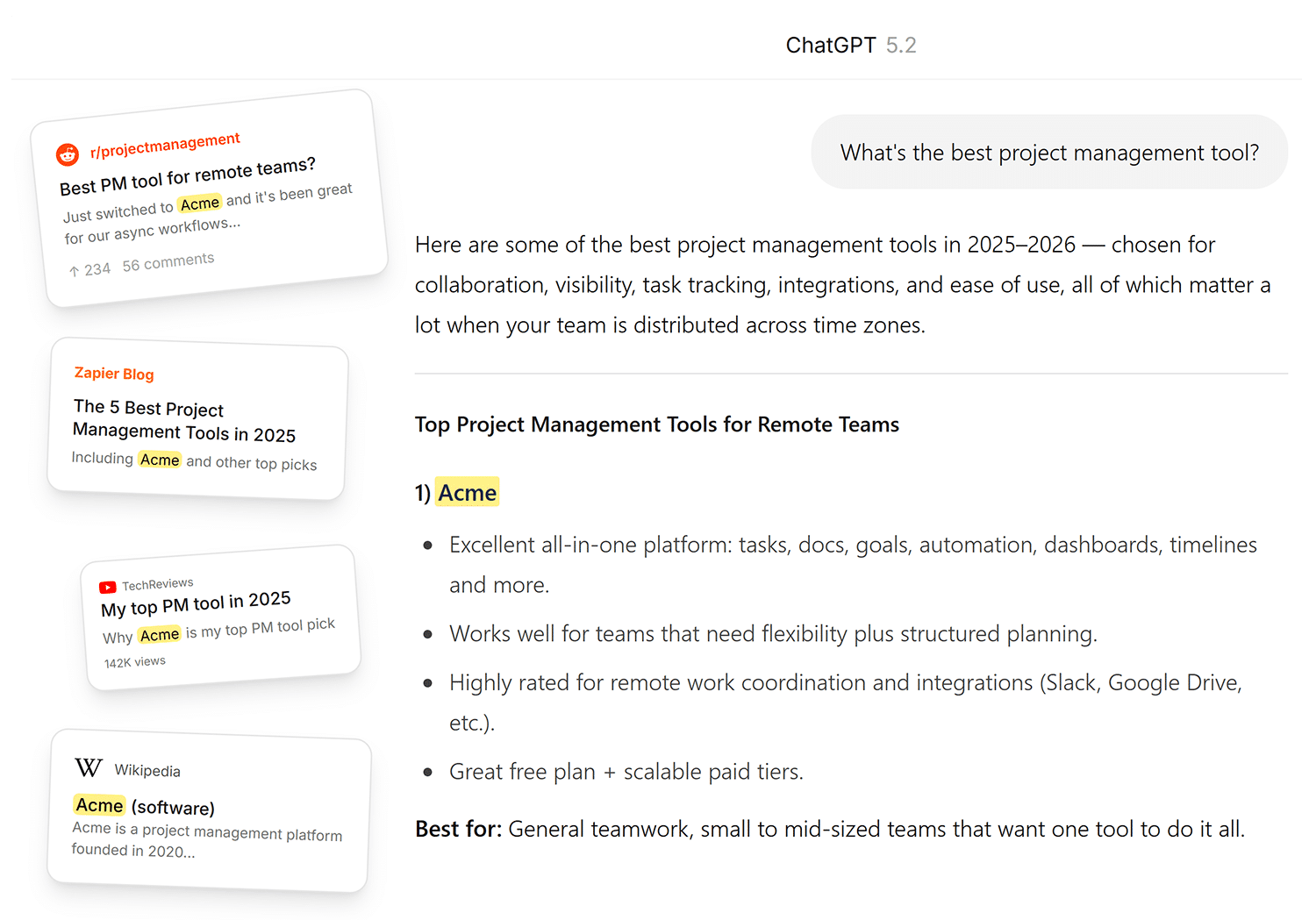
It monitors how often and where a brand appears across major LLMs as they generate answers to user queries. It can be used to track visibility over time for priority prompts, compare performance against competitors, and understand which brands are being recommended instead of yours and in what contexts.
These tools are most effective when used to identify patterns over time, rather than single wins or losses tied to individual prompts.
Is your content being featured in AI search results?
When optimizing for query fan-out, success rarely appears as a single ranking change. Instead, it shows up as repeated inclusion within AI-generated answers, even as the query is reworded or expanded into related questions.
The most reliable way to assess this today is to examine how often and how consistently your content appears across AI-generated responses for related prompts. Tracking patterns of reuse over time is more informative than evaluating isolated outputs or individual queries.
Track, optimize, and win in Google and AI search from one platform.
Ultimately, query fan-out optimization is about becoming a dependable reference as AI systems expand, reinterpret, and synthesize user intent. Content that fulfills that role tends to persist across prompts, formats, and answer types, even as the surface of search continues to change.
For example, a page that clearly explains AI SEO may first surface when a user asks “What is AI SEO.” Over time, that same page may also be reused when users ask “How does AI change search ranking,” “AI SEO vs. traditional SEO,” or “How to optimize for AI-generated answers.” Rather than being tied to one phrasing or one result type, the page becomes a stable reference that AI systems draw from as they generate explanations, comparisons, and recommendations.
This shift is part of a broader move toward generative engine optimization (GEO), where visibility depends on retrieval and synthesis behavior rather than rankings alone. For a clear overview of how GEO works, see our guide on generative engine optimization (GEO).
Explore more on
Editorial disclosure
Search Engine Land is owned by Semrush. We remain committed to providing high-quality coverage of marketing topics. Unless otherwise noted, this page’s content was written by either an employee or a paid contractor of Semrush Inc.
About the author