How long does SEO take to work? Understanding ranking timelines and the truth behind “quick results”

SEO typically takes three to six months to produce measurable results, and in competitive industries it can take six to 12 months to see significant ranking and revenue impact. The timeline depends on the age and authority of the website, how quickly SEO changes are implemented, and how long search engines take to crawl and reassess updated pages. That said, momentum should be visible before results arrive, with clear indicators of progress along the way. For example, technical fixes or on-page optimizations can generate early gains within weeks, but sustainable growth in organic traffic is a cumulative process that builds over time.
The SEO toolkit you know, plus the AI visibility data you need.

This guide is a means of support for both SEO agencies and consultants, as well as for stakeholders or clients who want reassurance that they’re working with an SEO pro. We’ve comprehensively covered the SEO timeline, the factors that influence ranking, and also some SEO myths, so you can confidently know how to spot an SEO red flag early on.
Factors that impact SEO results: What determines how long SEO takes to work?
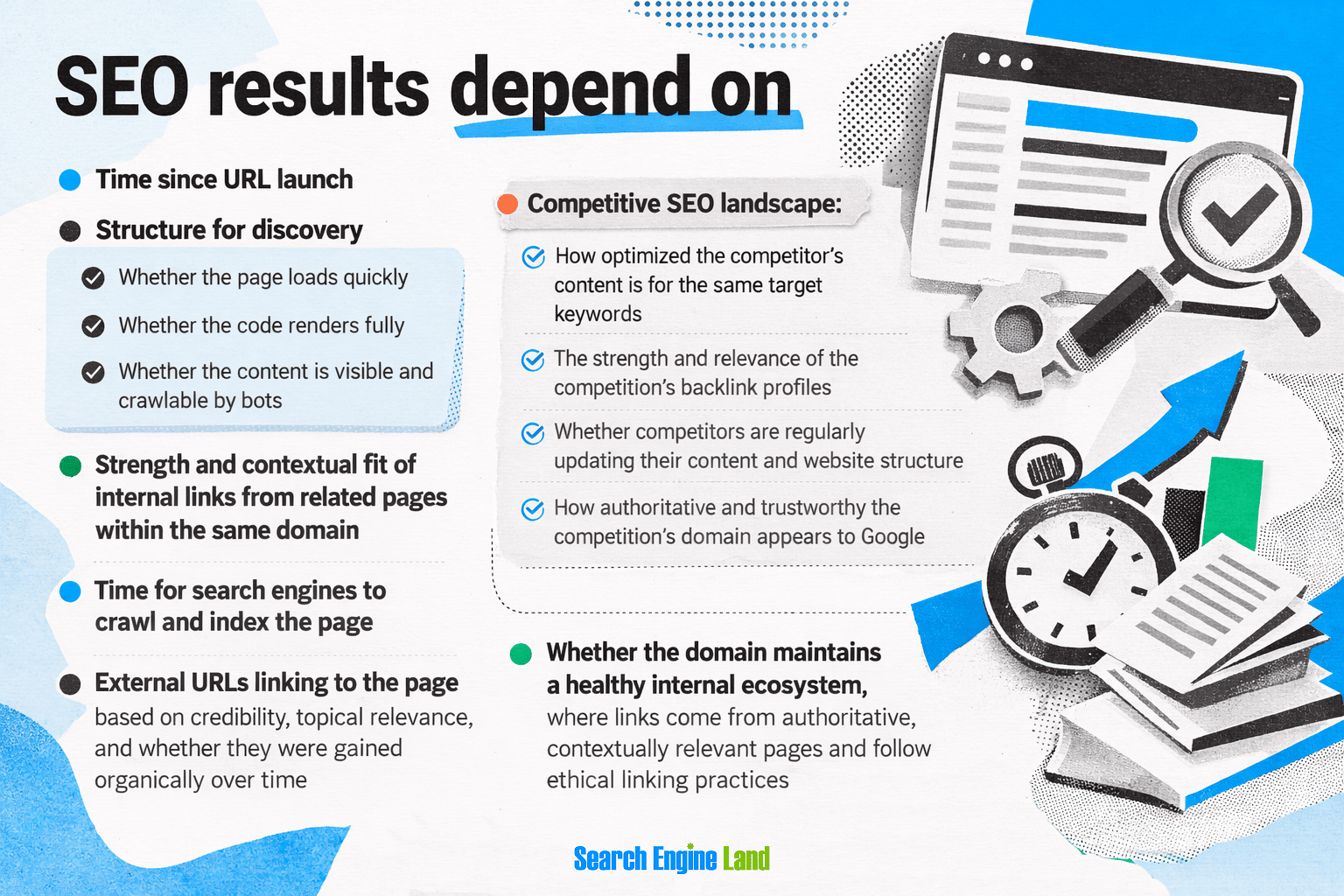
1. How old is the brand or website?
The biggest challenge with the SEO timeline is that results are custom and depend heavily on where your website is starting from. For example, a brand-new domain will almost always show SEO improvement more slowly than a site that’s been live for years and that has a strong, foundational content structure.
2. How long does it take to implement the SEO changes?
SEO results also depend on how quickly teams, such as developers, can implement changes requested by the SEO team. Updates that take weeks or months to complete will naturally slow results. This is often a significant factor when SEO is competing for finite resources within large companies.
3. How long does it take Google to assess or re-asses a page or an entire website?
Finally, Google needs time to crawl, process, and reassess changes, and that timeline varies based on site size, authority, and architecture. For example, large sites with millions of pages take longer to crawl, and JavaScript-heavy sites relying on things like client-side rendering, dynamic content loading, and interactive elements can take nine times longer.
The key for SEO specialists and website owners is to understand where their site stands relative to various types of SEO factors.
There are hundreds of known ranking factors, more than we can cover in this article, but for an idea of how long SEO takes to work, you don’t need to know everything to the tiniest detail. Below, we’ve outlined some key factors that you need to understand to gauge how long SEO will take to work on your site.
Google’s algorithms and backend processes
Not all elements of SEO success are controllable; Google’s algorithms and internal processes play a major role. While some of Google’s processes are understood and somewhat manageable (such as crawling, rendering, and indexing), others (such as algorithm updates) are sprung on SEO teams with no warning.
Here’s a table showing different processes, what they are, and whether SEO teams can control them.
| Factor | What it is | Can SEO control it? |
| Core algorithm updates | Broad updates to Google’s ranking systems that can significantly shift search visibility across industries. | No |
| Re-ranking cycles | Periodic reassessments where Google recalculates rankings based on updated signals and data. | No |
| Crawl scheduling & crawl budget | How often and how deeply Googlebot crawls a site based on its authority, health, and size. | Partially |
| Indexing prioritization | The order and speed at which Google processes and indexes newly discovered or updated pages. | Partially |
| Spam detection systems | Automated systems that detect manipulative tactics and adjust rankings accordingly. | Yes |
| Machine learning intent matching | AI systems that refine how Google interprets search intent and matches pages to queries. | No |
| SERP layout experimentation | Google testing different search result formats (e.g., AI answers, snippets, local packs) that affect visibility. | No |
While SEO teams can’t control most of these systems, they can control how well a site adheres to SEO best practices.
To name a few, SEO can control:
- Strong technical health so that websites can be efficiently crawled, processed, and evaluated without unnecessary delays caused by errors or performance issues.
- Ensure crawlability and indexability so that important pages are discoverable, properly indexed, and eligible to rank in search results.
- Publish relevant, well-structured content from a well-thought out content strategy so that Google can clearly understand it and accurately match those pages to user intent.
- Build high-quality backlinks so that search engines recognize your site as authoritative and trustworthy within its niche.
- Optimize site structure so that authority flows logically through internal links and Google can easily identify the most important pages.
By aligning with Google’s goal of surfacing reliable, helpful, people-first content, sites put themselves in the best position to perform consistently through algorithm updates and ranking fluctuations, whether expected or not.
Google’s SEO Sandbox
Google’s SEO Sandbox (not to be confused with Google’s privacy sandbox) is not an official Google feature, but it is a long-standing industry term used by many experienced SEO specialists to describe a period when brand-new websites, or sometimes new pages, struggle to rank competitively, despite being well-optimized and high-quality.
SEO specialists have observed that new domains take time to gain traction in search results. It’s thought that this happens because Google hasn’t built up any authority signals for them.
With a new domain, there will be:
- Limited backlink data
- Little branded search demand
- No historical performance data
- Minimal engagement signals
Some assume that the Sandbox concept is simply a natural evaluation period. And that makes sense because it is reasonable to expect that Google would assess a new site carefully before allowing it to compete in search results.
Some SEO professionals believe this “sandbox” effect can last several months, or even years, particularly in competitive industries.
Regardless of what we call it and whether the Sandbox exists, the outcome is the same; brand-new websites typically move more slowly in search compared to established domains.
Rank transition
Rank transition is a concept described in a Google patent where ranking changes are intentionally phased over time rather than applied immediately. That means, after making optimizations to a site, delayed uplift, or even a page dropping in rankings, isn’t always a sign that SEO isn’t working; it may reflect how the algorithm manages risk before rewarding a page more fully.
You might’ve seen the impact of rank transition if you’re working on an established website where you’re making changes to the site or content. You can make best-in-class SEO changes to a site, yet, instead of your new and improved page soaring to the top of SERPs, you see inconsistent movements, or, even, a (temporary) drop. The rank transition patent suggests that Google may have already recalculated your page’s new ranking, but it’s deliberately withholding it or adjusting it gradually.
The idea is that withholding rank position reduces manipulation and ranking volatility.
It makes sense: If the algorithm were highly reactive to change, it would be easy for SEO teams to manipulate it because of the instant feedback on what “good SEO” and “bad SEO” look like.
Here’s what the patent says:
“After a period of time, the document’s rank might rise to its new steady state (target) value. Like FIG. 6, the time line shown in FIG. 7 may be represented in days in one implementation consistent with the principles of the invention. In other words, the document’s rank may decrease for a period of approximately 20 days before settling in on its new steady state (target) value (e.g., 1.0 in FIG. 7) in approximately 70 days after a positive change in its link-based information.”
Here’s that FIG. 7 mentioned in the quote above:

The image demonstrates how a page’s rank dropped, increased, and steadied into its final position.
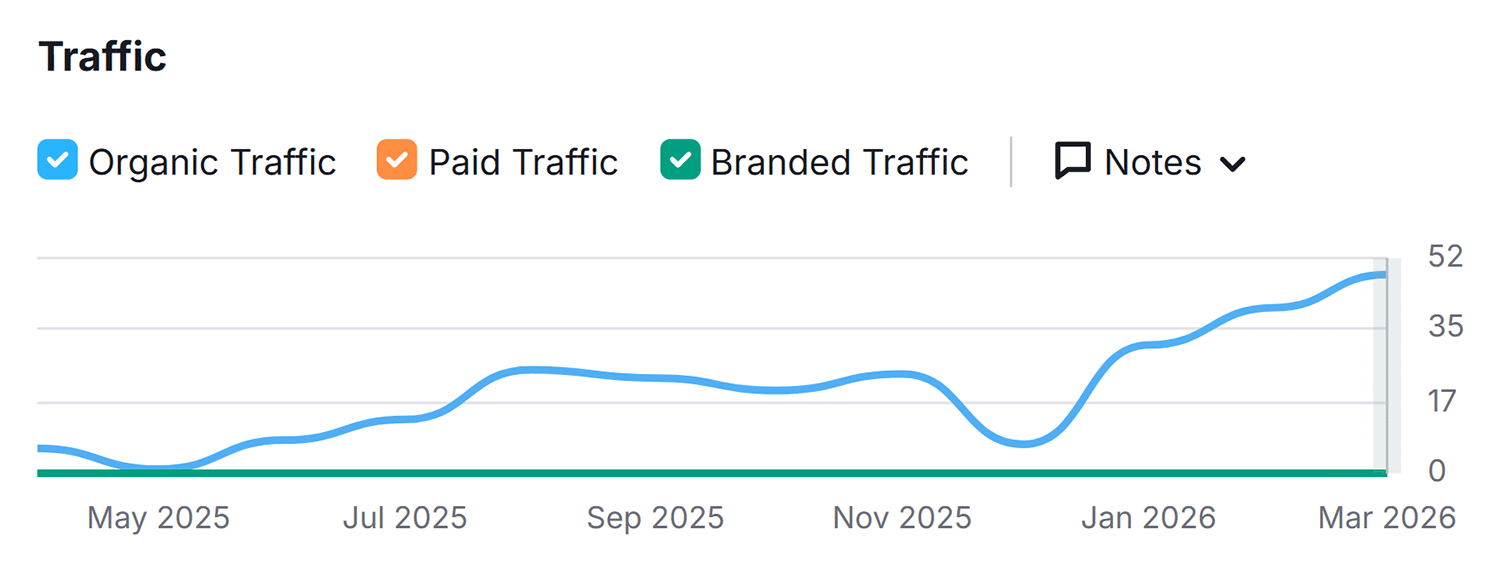
Let’s look at a potential example of rank transition taking place in the wild on content we’ve edited at Search Engine Land.
In June, we republished an article titled Content marketing strategy: A practical guide.
As you can see in the graph below, traffic was rising already through June. It stabilized in July. In November, approximately five months after publication, traffic dropped, then sharply increased in December and January.
The traffic numbers likely change in line with the average position on the SERPs. The higher up the SERPs, the more traffic. The latter part of Search Engine’s graph below looks a lot like FIG. 7 from the patent.
Although SEO results are often subjective, depending on where a website is in its implementation, it’s not entirely guesswork. In fact, Google has released official statements on how long SEO takes. Let’s see what they say.
Google’s official statement on how long SEO takes
In the video below, Google’s Maile Ohye answers the question, “How long does SEO take?”
She says: “In most cases, the SEO will need four months to a year to help your business first implement improvements and then see the potential benefit.”
This tangible timeframe may reassure business owners and agencies because it comes from a credible, Google-backed expert who has no financial stake in your investment. The advice is objective and impartial.
However, this video doesn’t suggest that people investing in SEO should just twiddle their thumbs for four months and hope for the best. Ohye also recommends steps that customers hiring SEO specialists can take to vet a good supplier.
She recommends asking for:
- The SEO’s description of the issue(s) that needs to be improved to help with ranking
- The approach they prescribe for accomplishing the task
What’s important is that, as early as month one, there’s work that represents an SEO specialist’s commitment to the client. Clients shouldn’t be expected to pay a monthly retainer while simply waiting four months on hope alone, instead there should be visible, strategic work that lays out a plan. A credible SEO team delivers a defined roadmap, implements best-practice improvements, and tracks leading indicators of progress to build accountability in from the start.
Indicators of early progress might include:
- Site errors reducing after tech fixes: Fewer crawl errors, broken links, and technical issues show that foundational barriers to ranking are being actively resolved.
- Impressions increasing: Rising impressions indicate Google is surfacing the site for more relevant queries, often one of the earliest signs that SEO changes are gaining traction.
- New, optimized pages going live: Consistently launching content in line with the strategy demonstrates execution against a defined roadmap.
- Existing pages being improved and restructured: On-page refinements, stronger internal linking, and clearer topic alignment show authority is being built methodically.
The key takeaway is that SEO isn’t just about rankings, it’s about user experience and building a brand that people want to buy from. Conversions will only come when you build a website and brand that genuinely serves its audience.
When working with an SEO specialist, you want to look out for meaningful work that makes sense for your business and brand, as well as the SEO.
Brand authority
Brand authority refers to the level of trust, credibility, and recognition a brand, and, by association, a website has earned. It’s not an official Google concept or ranking factor, but we know that there are benefits to building a brand and SEO. In the video above, which Google published nine years ago, Ohye emphasized “building a great brand” as a key component of SEO success. The relationship between brand and SEO is nothing new; It’s marketing 101. You won’t get far without it.
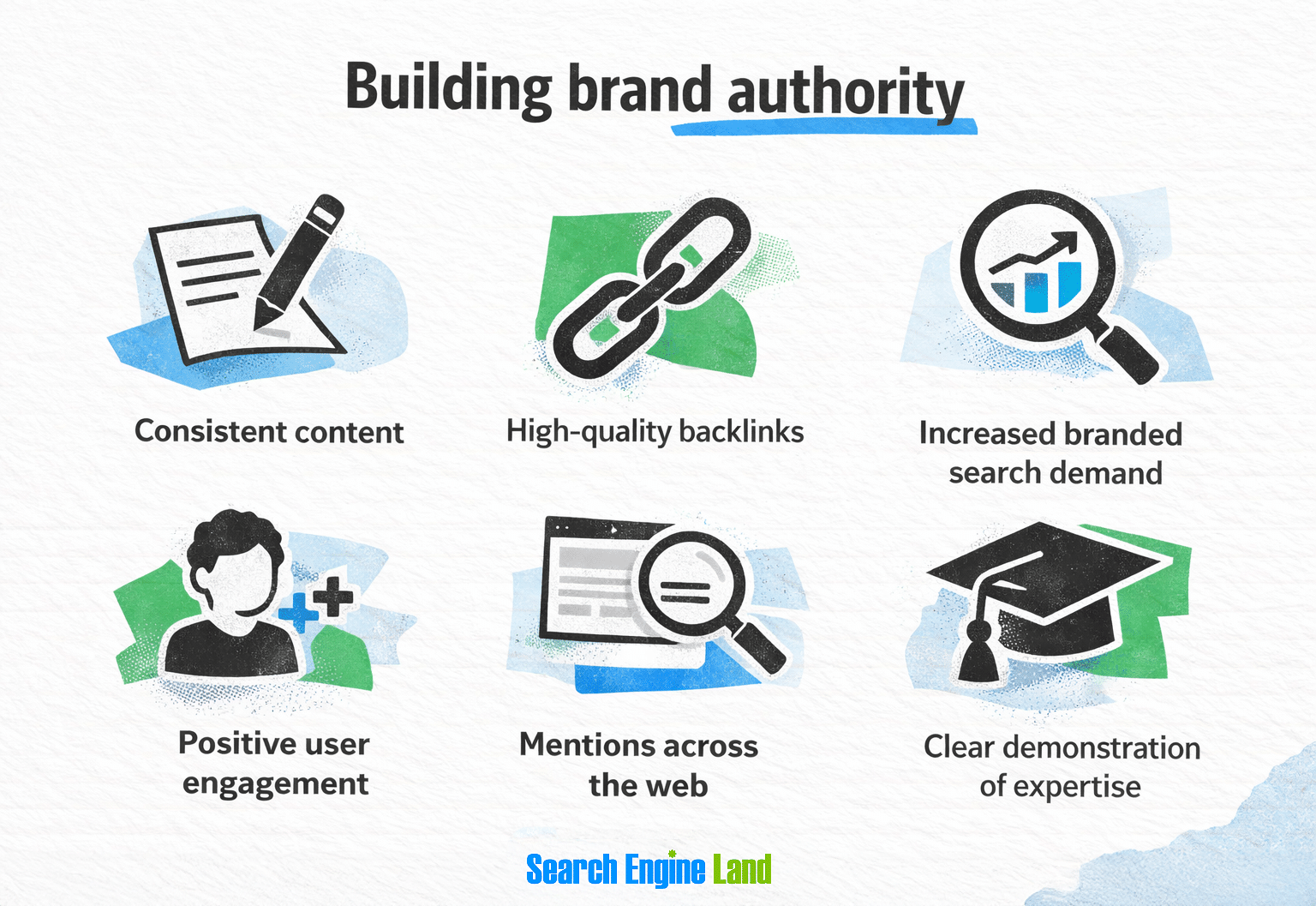
But there’s a major challenge: brand authority doesn’t come quickly.
You build it over time through:
- Consistent content
- High-quality backlinks
- Increased branded search demand
- Positive user engagement
- Mentions across the web
- Clear demonstration of expertise
Brand authority is the reason some websites (think the New York Times or Wikipedia) can publish a page today and rank tomorrow, while others publish for months and see little traction.
In modern-day SEO, particularly with the rise of AI-driven search results, brand is more prominent than ever. Google and AI systems rely on trust signals. They cite information from sources that demonstrate authority, consistency, and reliability.
Brand authority is a major component of ranking, and it’s made up of hundreds (if not thousands) of individual ranking factors.
A brand-new website, by contrast, has no foundations. There’s no branded search demand, limited link history, and no established trust signals that that website is sitting on. Even if the content is strong, Google has less context to evaluate it confidently. As a result, rankings typically move more slowly.
Technical SEO and site health
Technical SEO is the practice of optimizing a website’s infrastructure so search engines can efficiently crawl, index, and understand its content. It influences rankings and directly impacts how quickly rankings change. Strong content and quality backlinks can’t perform at their full potential if technical issues slow crawling, indexing, or signal interpretation.

Here’s how technical SEO affects the timeline:
- Crawlability determines how fast search engines discover changes. If Googlebot can’t efficiently crawl your site due to blocked resources, slow server response times, excessive JavaScript, or a disorganized structure, new or updated content won’t be discovered quickly. Poor crawlability can delay visibility by weeks or even months regardless of the quality of the content.
- Indexing affects when pages can rank. Pages blocked by robots.txt, excluded from XML sitemaps, marked “noindex,” or caught in duplicate clusters won’t enter Google’s index. Until indexing issues are resolved, your SEO improvements are effectively paused.
- Page speed and Core Web Vitals (CWV) influence evaluation and crawl frequency. Slow-loading pages may be crawled less frequently and can underperform in rankings. Improving performance of key elements like speed and mobile-friendliness ensures pages are processed efficiently and reduces the lag between optimization and measurable results.
- Site structure influences how authority flows. Logical architecture and clear internal linking will help Google understand which of your pages matter most. Without this structure, link equity becomes diluted, and new or optimized pages may take longer to gain traction.
- Technical errors slow momentum. Broken links, redirect chains, improper canonicalization, and duplicate content introduce friction into Google’s evaluation process. Cleaning up these issues accelerates processing and allows ranking signals to consolidate more quickly.
For enterprise business, if you don’t have access to developer resources, these issues can be problematic for months, even years. Many technical SEO tasks are boring, invisible development work that gets sidelined in favor of more exciting projects. That’s problematic and SEO teams must ensure these tasks are both fully understood and executed instead of being put off for later.
Why? Well, here’s a real-life example, provided by Jenn Mathews, an SEO consultant who worked with Groupon, that shows the real-world impact of technical SEO.
Groupon executives were frustrated that new merchant deals weren’t showing up in Google search results. The problem was painful — by the time a deal started gaining visibility, it had already expired.
In an attempt to surface new deals faster, the team added a dynamic list of the latest deals on the homepage. It looked great to users and worked flawlessly in the browser, but search engines weren’t indexing it.
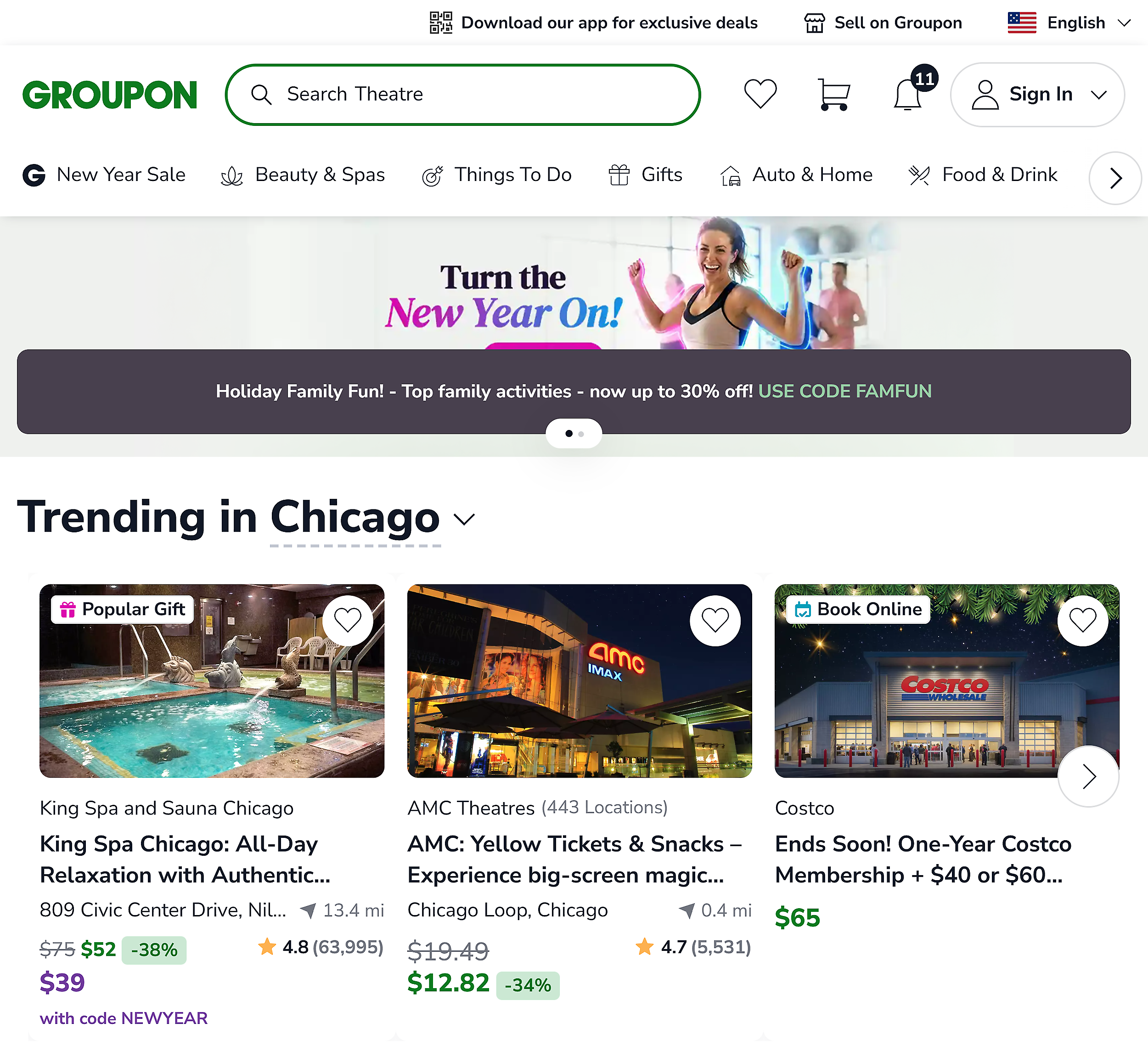
After digging into the code, the team discovered that the JavaScript used to load those deals wasn’t being rendered by Google’s crawler, making the content effectively invisible to search bots. A bug was filed with engineering. Once the rendering issue was resolved, Google began indexing the deals almost immediately.
That fix alone led to a 120% increase in SEO-driven revenue in the following quarter. Behold the power of technical SEO.
Remember, good SEO work often looks invisible when it’s working well, but that doesn’t mean it’s simple.
On-page SEO (content quality and quantity)
On-page SEO, that is, content quality and quantity, plays a major role in how Google understands, evaluates, and ranks your content. In the majority of cases, you need published content around a topic before you’ve got any chance of ranking.
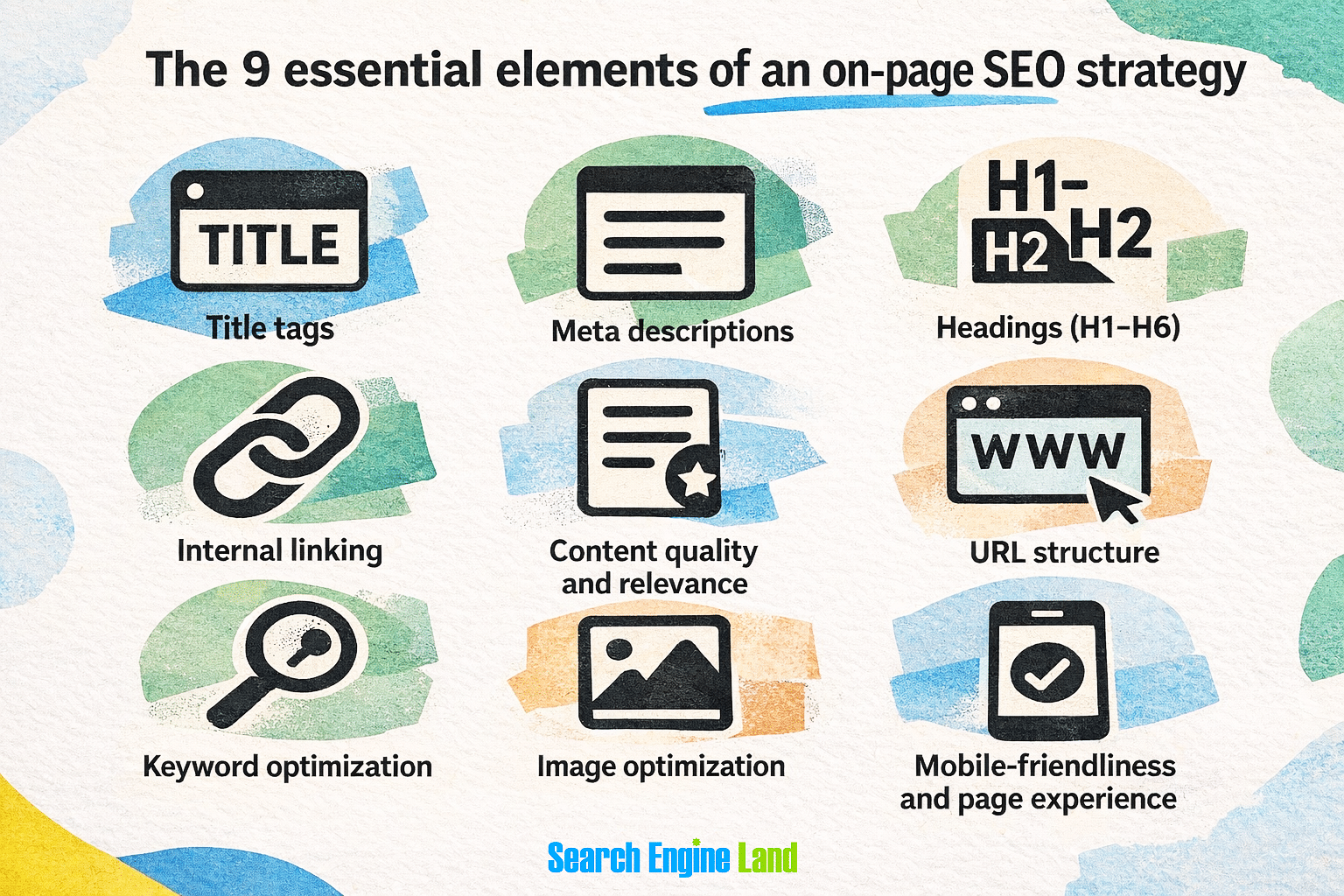
But you can’t just create a service or product page on your website and expect it to rank. If only it were that easy.
Generally, you need well-developed service or product pages, supported by relevant content such as articles, knowledge bases, and case studies that reinforce expertise and answer buyer questions. Together, this content ecosystem builds topical authority, strengthens internal linking, captures buyers at different stages of intent, and gives search engines clearer context about what you do, what you know, and why you’re credible.
Here’s how on-page SEO impacts ranking:
- Content relevance and keyword optimization contextualize a page. If your pages clearly target specific keywords and search intent, Google can quickly understand them and rank them for the right searches. Pages with poorly optimized content or missing keyword signals may take longer to rank because search engines aren’t sure what the page is about.
- Meta tags and headings are SEO basics that also help crawlers match pages to search intent. Well-crafted title tags, meta descriptions, and header structures make your content easier for search engines to understand and improve click-through rates. Without these, even strong content might take longer to gain visibility, because Google may undervalue or misinterpret the page.
- Internal linking distributes authority and guides crawlers to important pages. Pages that are isolated or have weak internal linking may take longer to gain traction, while well-linked pages can rank faster.
- Content structure and readability are easier for crawlers to parse. Readable, well-structured content with proper headings, bullet points, and visuals helps search engines parse your page efficiently. Complex or disorganized content slows down Google’s assessment, delaying potential ranking improvements.
- User engagement signals can indirectly affect SEO ranking speed. On-page elements that improve engagement, such as multimedia, clear calls to action, and fast-loading content, help keep visitors engaged and may be rewarded with higher rankings more quickly.
- Rich snippets and structured data enhance your appearance in SERPs. This doesn’t guarantee faster ranking, but it can make your page appear in rich results sooner, and with a more interesting listing, such as review stars next to your traditional blue link. Features like this increase the click-through rate (CTR).
- Demonstrating high levels of experience, expertise, authoritativeness, and trustworthiness (E-E-A-T) helps Google assess the credibility of your content. Pages authored by recognized experts, with clear credentials, citations, or reviews, are more likely to rank faster and sustain their rankings.
Jenn Mathews has another case study, this time looking at how on-page SEO and merging old pages helped Groupon.
On Groupon, the “Local Services” section and “Browse by Category” section cannibalized each other (meaning the two pages competed for the same search queries) in the search results. By consolidating them and rewriting the content to focus on user intent instead of internal naming conventions, the team improved rankings and made the user journey smoother.
Cannibalization is really common in enterprise SEO; Content structures tend to fragment over time. Different teams launch new pages, new sections, and new campaigns often without a centralized content strategy. The end result is multiple pages targeting the same intent, competing against each other, and diluting performance.
Sometimes the best content work is structural. This is what we mean when we say content optimization isn’t about tricks. It’s about understanding both the business and the audience, and using that understanding to craft a strategy that moves both forward.
To learn more about creating an SEO-driven content strategy that works, check out the Search Engine Land guide to setting goals and planning content.
Dig deeper: Content pruning: Boost SEO by removing underperformers
Off-page SEO (link building, mentions, and citations)
Off-page SEO, or those actions you perform off of your site to improve both your visibility and rankings, significantly influences how quickly your rankings move because it shapes how much trust and authority Google assigns to your site.

Here’s how off-page SEO impacts the timeline:
- Backlink quality and quantity from authoritative and relevant websites signal to Google that your site is trustworthy and valuable. Pages with strong backlink profiles can rank faster, while pages with few or low-quality backlinks may take longer to gain visibility, if they ever do at all.
- Link diversity and growth rate from backlinks build a natural backlink profile. A natural, gradual growth of backlinks from diverse sources helps build credibility. Sudden spikes from low-quality sources can trigger algorithmic scrutiny, slowing down SEO results. It looks like spam. Consistent, relevant link-building accelerates ranking improvements.
- Brand mentions (including unlinked mentions) and your brand’s online reputation on reputable sites, news outlets, or industry blogs contribute to authority. Strong brand visibility helps search engines trust your content more quickly, which can speed up your ranking.
- Social signals and engagement encourage backlinks. While social media links themselves don’t directly affect rankings, widely shared content can attract backlinks and traffic. This indirect effect can help search engines notice your content sooner.
- Positive reviews and user-generated content on platforms such as Google Business Profile, Yelp, and industry-specific directories contribute to trust and authority. High ratings and active engagement may accelerate visibility, particularly for local SEO.
Competition and niche difficulty
In SEO, you’re never judged by algorithms based on your site alone. Your competitors can also have a major impact on how long your SEO takes. That’s because you’re competing against every other site that’s targeting the same queries. The stronger and more established those competitors are, the longer it typically takes to break through.
Additionally, even if you have a top-ranking page, if you let it stagnate while a competitor improves their own site and builds their brand authority and SEO, you might drop.
Keyword competition is also a factor. Highly competitive keywords, such as those targeted by many authoritative websites, take longer to rank for because Google favors established pages. Low-competition keywords can show results more quickly, even with modest SEO efforts.
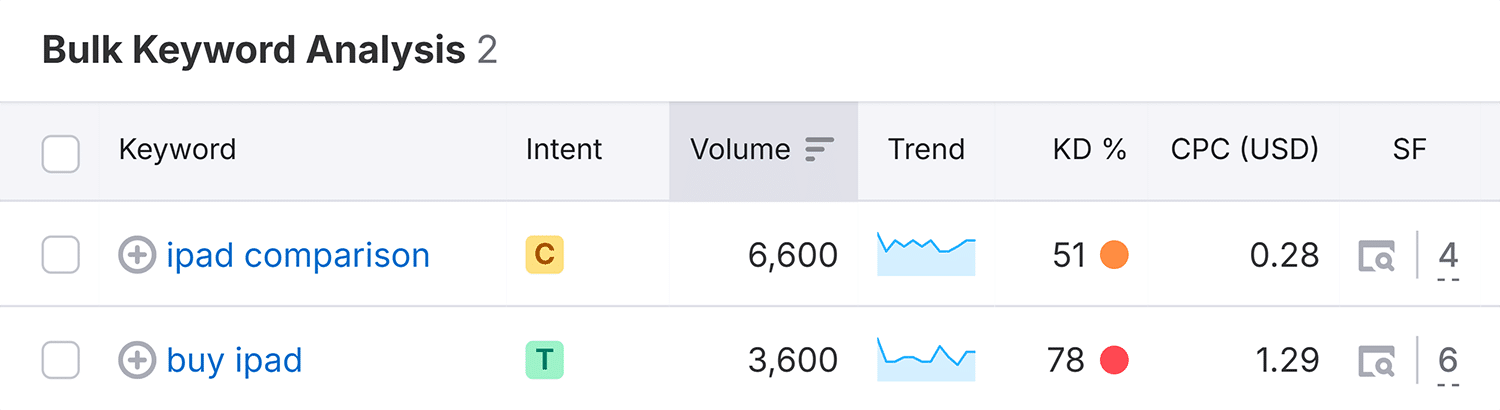
For example, “buy iPad” is more competitive than “iPad comparison” because the “buy iPad” keyword signals purchase intent. That is, people searching for it are likely close to actually buying an iPad. iPad sellers want to rank for it because that’s the page and the final click that is most likely to generate revenue.
Here’s a screenshot from Semrush’s Keyword Overview tool that shows keywords, volume, and keyword difficulty (KD). You can see that “buy iPad” is more competitive than “iPad comparison”, with a 78% keyword difficulty rating compared to 51%.
Important note: Just because a keyword is highly competitive, doesn’t mean you shouldn’t create pages with the intention of ranking for it. The page is useful for marketing purposes, even if it doesn’t rank. For example, you can share it on social media or in emails, or use it in paid advertising campaigns. Plus, if the page is live and you properly set up internal links, your site will eventually rank.
Outside of competitors and keyword competition, there’s also niche difficulty that directly impacts how long SEO takes to generate meaningful results.
Some industries are inherently harder to grow in because of how Google evaluates risk. These sites often fall into Your Money or Your Life (YMYL) categories. YMYL refers to industries that impact health, finance, safety, or major life decisions. Often, YMYL sites include medical advice, supplements, legal services, insurance, investing, and similar. Because inaccurate information in these spaces can cause real harm, Google applies stricter standards around trust, expertise, and credibility. This causes them to move more slowly in the algorithm.
In practical terms, that means YMYL sites typically require:
- Demonstrable subject-matter expertise (qualified authors, medical or professional review, transparent credentials)
- Highly authoritative, relevant backlinks, not just by volume, but, more importantly, written by trusted industry sources
- Clear brand signals, including reviews, citations, and third-party validation
- Robust “About,” editorial policy, and trust documentation
As a result, SEO timelines in these industries are often longer and less forgiving compared to lower-risk niches.
Where you’re starting from
SEO specialists can only estimate the timeline for SEO success when they first take into consideration what a website’s current position is.
It’s a website’s starting point that will determine the strategy, the pace, and the type of progress you’re likely to see. Your starting point refers to the starting point for each factor that affects SEO results that we’ve mentioned above. It’s important to remember that no two sites start at the same baseline. Your baseline is solely yours.
But there’s also your starting point in SERPs to consider as well. The closer you get to the top of the SERPs, the more competitive and incremental each gain becomes. It’s much easier to move from position 99 to 30 than it is to move from position two to one.
Early gains often come faster when a site has never had structured SEO work but already has decent backlinks or underlying authority. In those cases, foundational on-page improvements and technical clean-up can trigger noticeable ranking shifts relatively quickly.
By contrast, an established site that already ranks well may require significantly more effort to achieve incremental gains. Moving from the bottom of page one to the top typically requires stronger authority signals, more precise intent matching, and competitive differentiation. Those improvements take time to build, which often extends SEO timelines by months rather than weeks.
Budget and resources available
SEO timelines are heavily influenced by budget, team structure, and access to resources. Even the most robust marketing plan will assuredly stall if there aren’t enough developers to implement fixes, writers to produce content, designers to improve UX, or analysts to measure performance.
In enterprise environments, SEO often competes for shared resources. For example, content updates may require approval from multiple departments and budget allocation may require multiple stakeholder sign-offs.
On the other end of the spectrum, small businesses may not have dedicated SEO support. The founder might be the marketer, content creator, and decision-maker rolled into one. There’s more agility, but less manpower. Tasks simply take longer because there are fewer hours available to execute them.
A good way to think about getting results from SEO is that it is a lot like remodeling a house.
Imagine your house. You paint the walls, refinish the floors, and move the furniture around. You have your eye on the future and how great your house is going to look, but if someone walked in mid-project, things might look worse before they get better.
There are home renovation projects where you are able to hire the full crew, the right tools, and have a clear plan for success drawn up by a contractor. And then there are the ones that are more fly-by-the-seat-of-your-pants DIY affairs where you’re doing it all alone, borrowing what you can, and working nights and weekends.
When working at Groupon, Mathews said the company employed a very large team of SEO experts, data analysts, and engineers, while GitHub — at one time, at least — relied on a single individual contributor (the only SEO for the entire company). That SEO often had to push hard to get the resources SEO needs to be successful.
These were resources like:
- Writers to create and optimize the right content
- Designers to make content visually engaging and usable
- Engineers to implement technical fixes
- Product managers to help prioritize work
If you’re a big company and you have the right team, things can move quickly and you’re likely to see SEO results much faster. Doing it solo, on the other hand, takes patience and pacing, but you can still make progress one step at a time. Your results might come a bit more slowly, but they’ll come. Learning to prioritize SEO is key.
SEO timeline at a glance
As noted above, the SEO timeline for every site will vary, but below, we’ve provided a general example to give you a sense of what a timeline might look like. This timeline is a good starting point, but it should be refined during the auditing phase, when the SEO team builds a clearer picture of where your site is now, what it’s likely to achieve, and the steps to take to accomplish it.
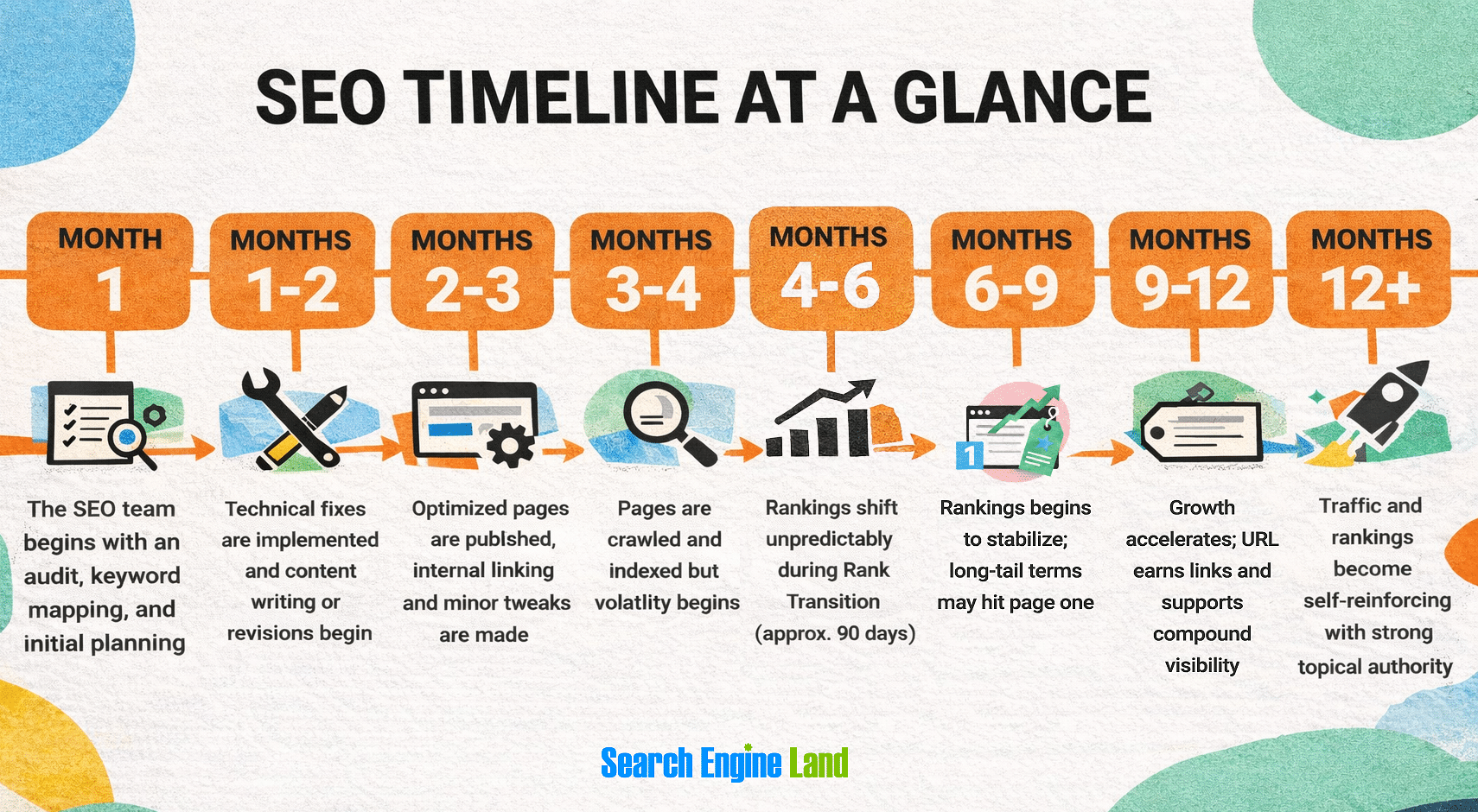
The first month or two of SEO is like prepping a garden: You clear the weeds, till the soil, and plant each seed with care, but even though it might still look like bare ground, the important foundational work has been completed. Your garden will eventually blossom, but in order to make certain it thrives, you’ll have to keep tending, watering, and adjusting as the conditions change.
Month-by-month SEO timeline example
This sample timeline is based on our years of SEO experience, both with clients at the agency level and as an in-house SEO.
But it’s important to keep in mind that YMMV. Your experience and site requirements will be based on the age of your URL, your competition, your technical SEO baseline and needs, and your site’s existing authority, content quality, and size.
This breakdown, however, is useful as a starting point for building your own SEO timeline.
Month one: Auditing and planning
Month one of an SEO engagement is typically about assessment and direction, not rankings. A comprehensive audit is the first priority because without understanding technical barriers, content gaps, and authority weaknesses, any optimization effort risks being misdirected
During this phase, SEO teams usually focus on understanding the current state of the website and defining priorities.
This phase may include:
- Reviewing technical health and site structure
- Analyzing existing content and keyword coverage
- Assessing the site’s backlink profile and authority
- Benchmarking where your site is compared to competitors
- Establishing baseline performance metrics
Early in an SEO campaign, websites typically go through a phase where technical issues are identified and addressed. This is an important step because unresolved technical barriers can limit critical tasks like crawling, indexing, and performance — undermining every other SEO effort that follows. The time required can vary widely depending on the site’s size and complexity.
Once site audits are completed, the SEO specialist will understand the site’s starting point, and can then begin planning.
This usually involves:
- Keyword mapping
- Content planning
- Task prioritization
At this early stage, little to no ranking movement is expected. The goal is to build a plan.
For SMBs and local businesses: Websites with a few dozen to a few hundred pages can often be fully audited within a few weeks. Fewer stakeholders and simpler site structures mean insights and prioritization happen faster.
For enterprise sites: Websites with thousands or millions of pages require deeper crawling, larger datasets, and cross-team coordination. Engineering validation, stakeholder approvals, and complex architecture often mean that this discovery phase alone can span the entire first month or longer.
Pro tip: If you’re working on a large site, you don’t have to audit the entire site in the first month; you can audit sections instead. For example, you might choose to work on one service and all associated content or perhaps shift your concentration toward a particular page template. This focused approach allows teams to work strategically and build authority in one particular topic. Once rankings meet expectations, you can move on to the next topic.
Month one sets the pace for everything that follows. The stronger and clearer the foundation, the faster implementation can begin in the months ahead.
Months one to two: Set up SEO strategy
Within the first month or two, the strategy will move from the planning phase into structured execution. The early stages of implementation often include solving quick wins, which are often associated with technical issues and the writing or editing of content on key pages.
Going back to the analogy of renovating a home, technical SEO is the foundation, which is why it often comes first. You can design the most beautiful rooms, hang the perfect curtains, paint it the prettiest color, and invite all your friends over, but if the foundation is cracked or unstable, the whole house is at risk of collapse.
During this stage, websites often go through a period where:
- Technical findings are validated and scoped
- Fixes are prioritized based on impact and feasibility
- Content updates are scheduled or drafted
- Page templates may be reviewed for structural improvements
- Internal linking adjustments are planned
- Reporting frameworks are finalized
For SMBs and local businesses: A technical audit and initial fixes, can often be completed within one-two weeks. With fewer templates and simpler site architecture, improvements may begin influencing crawl efficiency and early ranking movement relatively quickly.
For enterprise websites: This phase can take considerably longer. Large sites often have layered navigation, legacy systems, complex internal linking, and multiple stakeholders involved in approvals. Crawling, diagnosing, validating, and prioritizing issues can span several weeks or even months. In these environments, technical improvements tend to roll out in stages, meaning SEO impact appears gradually as different sections are addressed and reprocessed by Google.
Months two to three: Implementation begins
Months two to three are typically when the strategy begins turning into visible changes on the site. Technical fixes may still be rolling out, but this is often when optimized pages start going live and structural refinements take shape.
During this phase, websites commonly experience:
- Publication of newly optimized or rewritten pages
- Updates to title tags, headings, and on-page elements
- Internal linking improvements
- Template-level enhancements (where applicable)
- Early technical fixes are deployed
- XML sitemap updates and crawl reprocessing
In other words: work that actually impacts rankings.
At this stage, Google begins recrawling and indexing updated content. Some ranking movement may occur, particularly for lower-competition or long-tail queries (more specific, lower-volume, multi-word search phrases that typically indicate clearer user intent), but volatility (thanks to Google’s Rank Transition) is common. Positions may rise, drop, or fluctuate as Google reassesses signals.
Pro tip: In months two to three, SEO specialists should be able to confirm that SEO work is indeed underway and show you the work they’ve completed in reports. With a bit of luck, you may be able to see improvements for low-competition, longer-tail keywords.
For SMBs and local businesses: Optimized content can often be published quickly, and changes may be crawled within days or weeks. Depending on your site’s existing authority, early signs of progress sometimes appear toward the end of this window.
For enterprise sites: Implementation can move more slowly due to development queues, sprint cycles, QA processes, and cross-team approvals. Further, optimized templates or page groups may be deployed in batches rather than all at once. As a result, ranking changes may appear gradually and unevenly as different sections are reprocessed.
Months three to four: Crawling and indexing
By months three to four, Google has typically had time to crawl and process a meaningful portion of the implemented changes. Because of this, updated pages are indexed, internal linking adjustments are recognized, and early authority signals begin to recalibrate.
During this phase, websites often experience:
- Increased crawl activity on updated sections
- Newly optimized pages entering the index
- Ranking fluctuations across updated keywords
- Early long-tail keyword improvements
- Traffic beginning to shift slightly, albeit often still modestly
Rankings may fluctuate as Google reassesses content relevance, internal link signals, and backlink impact. It’s common to see positions temporarily drop before once again stabilizing due to rank transition, especially for pages that have undergone significant changes.
For SMBs and local businesses: Google may re-evaluate updated pages relatively quickly. Early page-one appearances for long-tail terms can start to emerge during this window. Unless strong brand signals are there, it’s possible that competitive keywords won’t move much, or may be on lower pages in SERPs.
For enterprise sites: Because changes are often rolled out in batches, different sections of the site may be reprocessed at different times. Ranking volatility can appear uneven across categories or templates. Larger sites may not yet see cohesive upward trends as Google continues recalibrating signals across thousands of pages.
Months four to six: Early gains
Between months four and six, providing that budgets and resources are available, a meaningful number of changes are implemented and crawled. By now, Google has recalculated signals based on updated content, internal linking, and possibly even new backlinks.
During this phase, websites often experience:
- Noticeable ranking fluctuations (up and down)
- Some keywords climbing significantly
- Early page-one visibility for long-tail or lower-competition terms
- Gradual increases in impressions before large traffic gains
- Increases in keyword ranking on pages
For SMBs and local businesses: Some sites may begin seeing tangible traffic growth and lead generation during this period, particularly in less competitive or niche markets.
For enterprise sites: Different sections of the site may stabilize at different times, depending on what you have focussed on and where authority was already present.
Months four to six are often when stakeholders first see meaningful momentum — but it’s rarely linear. This is typically a period of signal adjustment rather than final results.
Months six to nine: Significant progress
By months six to nine, Google has had time to crawl, process, and reassess implemented changes, and ranking positions often start to reflect a more stable “new normal.”
During this phase, websites commonly experience:
- Rankings stabilizing after earlier fluctuations
- Long-tail keywords consistently landing on page one
- Broader keyword groups beginning to climb
- Noticeable increases in impressions and clicks
- Early compounding effects from internal linking and authority flow
- Conversions and revenue from SEO efforts
SEO begins to feel more predictable. Instead of sharp swings, movement becomes steadier and trend-based, and everyone has a feel for how the site responds to changes.
For SMBs and local businesses: Sites in less competitive niches may see clear growth in traffic and conversions during this period. Page-one visibility for commercial terms can begin driving measurable ROI.
For enterprise sites: Stabilization may occur at different speeds across categories depending on where you started and how competitive the category is. Some sections may show strong gains, while others continue climbing more gradually.
Months nine to 12: Growth
SEO efforts should begin to compound between months nine and 12. Earlier optimizations have been crawled, evaluated, and stabilized, and the site may now benefit from accumulated authority signals, improved structure, and consistent content momentum.
All else being well, at this stage website owners can start to see the compounding benefits of SEO. For sites in low- to medium-difficulty niches (i.e., not YMYL), work completed months earlier may continue to grow, gaining visibility in SERPs, attracting clicks, generating conversions, and driving revenue.
In more competitive or higher-risk niches (such as YMYL), the compounding effect can take significantly longer to materialize.
If results are taking longer than expected, have honest conversations with your SEO team about what’s improving, what’s not moving, and why. Together, you can review progress indicators and evaluate whether the strategy works with the reality of your niche.
During this phase, websites often experience:
- Broader keyword groups climbing into competitive positions
- Stronger performance for mid- and high-intent terms
- More consistent month-over-month traffic growth
- Backlinks and brand mentions reinforcing visibility
- Faster crawling and indexing
SEO in this time period shifts from tactics to meaningful business impact.
For SMBs and local businesses: In less competitive markets, this period can produce significant traffic, lead growth, and sales. Sites may begin ranking competitively for primary service keywords, not just long-tail variations.
For enterprise sites: Certain categories or templates may show strong upward trends. Eventually, multiple sections gain authority, and growth can compound more dramatically as internal linking and brand signals strengthen across the domain.
12 months and beyond: Scalable results
By the 12-month mark, most websites have established their foundational content and resolved major technical issues.
At this stage, the focus shifts from fixing and building to scaling.
Core content assets created the year before can often be leveraged year after year, allowing each new campaign to become more refined and strategically focused. That means, instead of starting from scratch, teams can update and improve their existing content, which is typically faster than creating new pages, while also developing more targeted, deeper content that builds on established authority.
During this phase, websites often experience:
- Compounding traffic growth from multiple ranking pages
- Faster ranking for newly published content
- Stronger performance in competitive keyword spaces
- Greater resilience through algorithm updates
- More predictable ROI from continued investment
- Enhanced performance of the same campaigns that ran the previous year
- More conversions and more revenue
For SMBs and local businesses: Growth may become more stable and sustainable. Established topical authority can make it easier to expand into adjacent services or neighboring geographic markets, and this will likely help visibility in AI tools.
For enterprise sites: Once multiple categories have gained traction, authority can flow across thousands of pages, accelerating growth in new sections. However, continued performance still depends on maintenance, technical health, and consistent strategic execution.
Why SEO is an ongoing effort
Continued SEO performance depends on maintenance, technical health, and consistent execution of strategy.
SEO isn’t a one-time project; It’s an iterative process.
Why?
There are two main reasons:
- Even the most carefully planned strategy won’t unfold exactly as expected because of factors that can’t be controlled or moved on quickly. Most websites will need to chip away at building brand authority, earning backlinks, and creating a robust content repository.
- As SEO starts to drive business goals, like revenue, why would you stop? When you find a process that works and gets your pages ranking, you should repeat it over and over for different services and audiences.
And, let’s not forget the exciting part: SEO is a marketing tactic that is always changing. Just when you feel like you’ve reached the summit with your page sitting confidently on page one, the landscape shifts, i.e., Google updates its algorithms or a competitor publishes a stronger resource or search behavior evolves as users phrase queries differently or rely more on AI-driven results.
What worked six months ago may not work the same way today. What works today may not work in six months.
How to measure SEO progress
Measuring SEO progress isn’t always about flashy wins or sudden spikes. It’s about paying attention to the quiet signals — like steady increases in impressions for target keywords, gradual ranking improvements from page three to page two, or previously unindexed pages beginning to appear in search results — to determine that efforts are taking root.
Whether you’re reporting to stakeholders or just trying to understand what the best next step is, it’s looking at the right metrics that’ll give you the clearest view of what’s working and what needs a second look.
Here’s how to break down reporting by platform:
Google Search Console
Google Search Console provides first-party data directly from Google itself and it’s free to use. It shows you how your site actually appears and performs in search results. This makes it the most reliable source for understanding visibility, indexing status, and ranking trends. And did we mention that it’s free?
| Metric | Report to look at | What you’re looking for during analysis |
| Impressions | Performance → Search results | Upward trend over time, especially for priority pages and keywords. |
| Clicks | Performance → Search results | Growth aligned with impression increases and improved CTR for your most important pages. You may not receive clicks for articles due to zero-click searches. |
| CTR | Performance → Search results | Improvements after ranking well. Look for pages with high impressions, but low clicks, and see if you can increase CTR by writing more enticing title tags. |
| Average position | Performance → Search results | Gradual upward movement for target queries. Focus on trends, not daily fluctuations, and look at specific pages and queries (not just site-wide). |
| Indexed URLs | Pages → Indexing report | Increase in valid indexed pages. Resolve issues that are preventing pages from being indexed. |
| Crawl errors | Pages → Indexing report / Crawl stats | Crawl errors that prevent search engines from properly accessing your site. Resolve issues such as 404s, server errors, and blocked resources. |
| Manual actions/penalties | Security & Manual Actions | Review “Security & Manual Actions” in GSC and address active penalties impacting performance. |
Google Analytics (or GA4)
Google Analytics 4 shows what happens after users arrive on your site. While Search Console shows how you perform in search results, GA4 connects that visibility to real business outcomes such as conversions and revenue. It’s essential for measuring true SEO ROI.
| Metric | Report to look at | What you’re looking for during analysis |
| Organic sessions | Reports → Acquisition → Traffic acquisition (Session default channel group = Organic Search) | Upward trends in traffic from organic search over time. |
| Organic users | Reports → Acquisition → User acquisition (First user default channel group = Organic Search) | Growth in new users discovering your site via search. |
| Conversions / key events | Reports → Engagement → Conversions (or Key events) | Increase in leads, purchases, or primary business actions from organic traffic. |
| Revenue (if applicable) | Reports → Monetization | Growth in revenue attributed to organic traffic. |
| Engagement rate | Reports → Engagement → Pages and screens | Healthy engagement signals that organic visitors are finding relevant content. |
Conversions and revenue should be the primary key performance indicators (KPI) you’re looking at.
Rank tracking tools
Rank tracking tools like Semrush provide competitive context and daily visibility into keyword movement. While Google Search Console shows aggregated performance data, rank trackers will help you monitor specific priority terms, SERP features, and competitive positioning more granularly. With a rank tracker you can set up reports and come back to them at the click of a button, or even automate emails to alert you to changes.
Look for tools that provide the following metrics:
| Metric | Report to look at | What you’re looking for during analysis |
| Keyword positions | Keyword ranking report | Upward trends for priority terms over time (focus on trends, not daily noise). |
| Ranking distribution | Position distribution report (Top 3, Top 10, Top 20, etc.) | Growth in keywords moving into higher visibility brackets. |
| SERP feature visibility | SERP features report | Appearances in featured snippets, Local Packs, People Also Ask, etc. |
| Share of voice/visibility score | Visibility or SOV report | Overall increase in competitive presence across a tracked keyword set. |
| Competitor comparisons | Competitor ranking report | Whether you’re closing gaps or gaining ground against key competitors. |
| AI visibility (if available) | AI search tracking / generative search monitoring | Whether your brand or pages are appearing in AI-generated answers. |
Technical audit tools
Technical audit tools surface the issues that can slow down SEO progress. Even strong content and backlinks can underperform if crawl, indexing, or performance barriers exist.
| Metric | Report to look at | What you’re looking for |
| Crawl errors | Site audit → Crawl issues report | Reduction in broken links, 404s, server errors, and blocked resources. |
| Status codes | HTTP status code report | Clean 200 status for key pages; minimal redirect chains or 5xx errors. |
| Site speed | Performance / Core Web Vitals report | Improved load times and stable Core Web Vitals (CWV) metrics. |
| Structured data errors | Structured data/schema report | Few to no validation errors within the code because this impacts your chances of getting a rich result (like rating stars in SERPs). |
| Duplicate content | Duplicate content/canonicalization report | Clear canonicalized URLs and reduction of duplicate pages. |
| Internal linking depth | Site structure/crawl depth report | Important pages within a few clicks of the homepage. |
Pro tip: If your budget allows, comprehensive SEO tools like Semrush will do everything detailed in “rank tracking tools” and “technical audit tools.” Having a single tool that does everything can be more efficient for workflows and more cost-effective than buying multiple tools.
Setting realistic quarterly KPIs means choosing metrics that reflect your SEO goals and tracking progress in digestible, actionable increments.
Instead of focusing on vanity metrics or long-term projections, break your benchmarks into quarters to create achievable goals tied to actual improvement. For example, start with increasing impressions, improving rankings for priority keywords, or reducing technical errors. This keeps you nimble, aligned with business priorities, and ready to adapt as algorithms, markets, and user behaviors shift.
Dig deeper: SEO reporting: How to track, prove & improve performance
Recommended tools
Choosing the right SEO tools is essential for tracking progress and uncovering opportunities. We’ve evaluated dozens of platforms over the years, but only a few consistently deliver what SEO teams need:
- Google Search Console: This free tool provides real-time indexing data, impressions, clicks, and crawl errors. Trust us; You want to understand how Google sees your site.
- Google Analytics 4 or Adobe Analytics: Both track user engagement, conversions, and traffic trends. They’re best for tying SEO to business outcomes.
- Semrush: It’s great for both content optimization and keyword tracking. Tools include search intent insights, keyword difficulty, and domain-specific recommendations. Plus, there are new features for tracking AI visibility.
- Clearscope: It offers content optimization and grading based on related keywords and readability. Clearscope is great for multi-language support, but limited in technical SEO.
- BrightEdge: It features strong competitor analysis and historical data, and also includes Adobe Analytics integration. Enjoy enterprise-grade reporting with AI-backed recommendations.
- seoClarity: It’s excellent for collaboration, content ideation, and customizable reporting. This tool also offers historical SEO data and real-time optimization checks.
- Screaming Frog: This option is best for small- to mid-sized sites since it crawls from the user’s computer. It offers deep technical SEO audits, duplicate checks, and crawl diagnostics.
- Botify: It’s a comprehensive enterprise SEO SaaS tool that’s ideal for technical audits, JavaScript rendering, custom reporting, and integration with analytics platforms. Botify offers the strongest crawl control and report customization.
Whatever tool you choose should match your current goals and capacity. If you’re a small business with no budget, free tools like Google Search Console and GA4 can still help you make real progress.
If you’re part of a larger company with complex systems and big goals, tools like Botify, BrightEdge, or seoClarity can provide the scale and support you need.
Remember, the best SEO stack is the one that fits your workflow today and still works when you grow.
For a deeper dive into tool strengths and how they stack up, check out this in-depth comparison of enterprise SEO tools.
Common myths about SEO timelines debunked
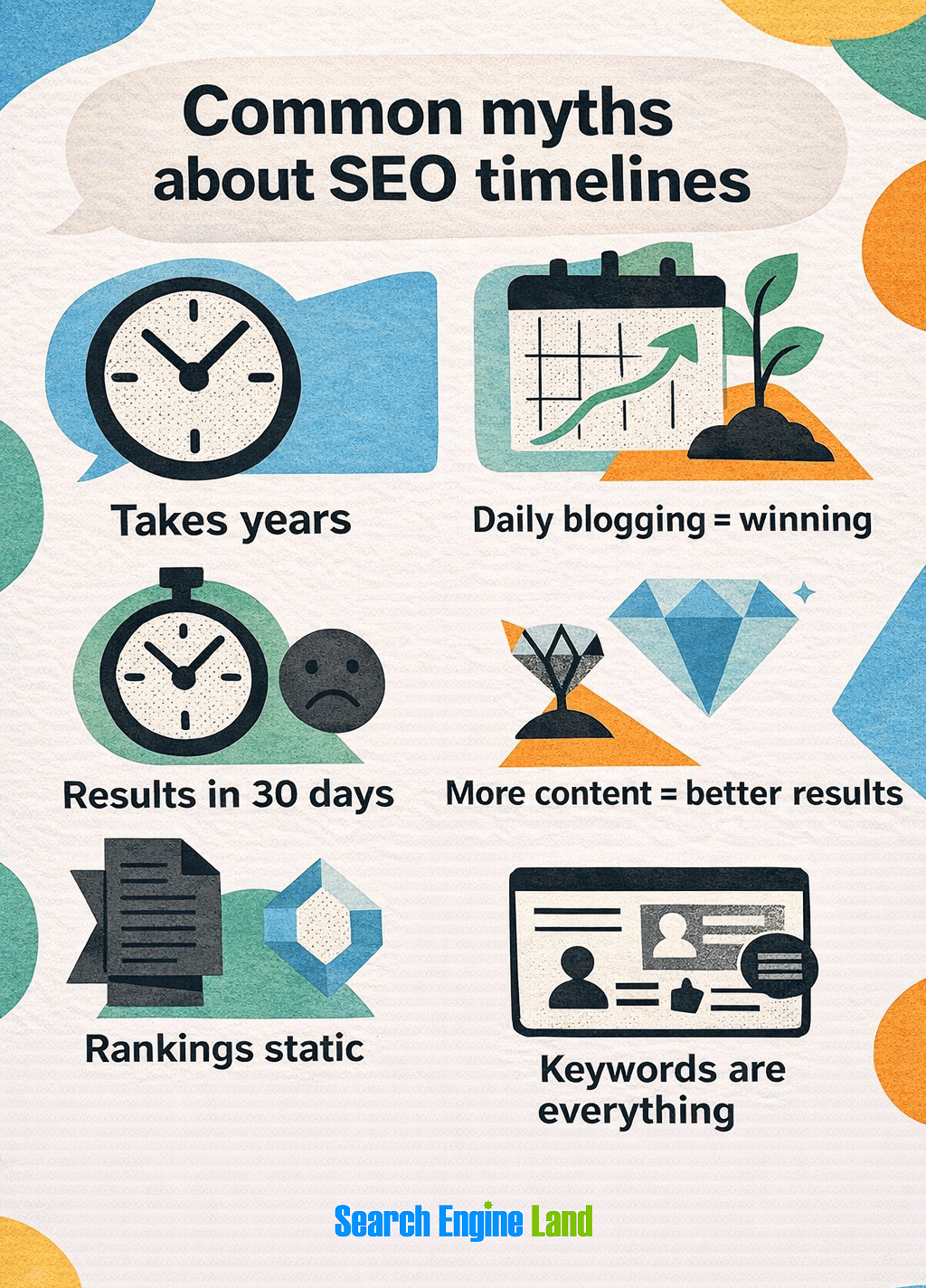
SEO timelines are often extremes: guaranteed results in 30-day or six-month plans that never deliver growth. The truth sits somewhere in the middle, results take somewhere between three and six months. Let’s break down the most common misconceptions and what really happens when rankings start to move.
“Pinging Google gets faster SEO results”
It’s true that you can ping Google to crawl and potentially index your pages faster. There are times when pinging Google is useful. For example, if you’re in a hurry for it to be crawled because you’ve made a mistake in a meta tag and you need the new one to show in the SERP as soon as possible.
Or if you have a time-sensitive message, like a limited promotion or regulatory update, that you want to get across.
Realistically, this won’t speed up indexing unless Google can’t find the page on its own. Google will crawl your page as part of its regular site crawl, provided the page is well-linked to from internal (or external) pages or if it’s part of your XML sitemap. Any competent SEO adds links from older pages to new ones and has a dynamic sitemap that updates as new pages are added.
That said, you can still ask Google to crawl the page by pinging it in GSC if you want to. It doesn’t hurt to do it, but either way, Google will “decide” whether and when to index it.
Here’s how you do it:
Visit Search Console > Find the “Inspect Any URL” box at the top > Fill in the URL you’re interested in > Hit the return key > Click the “Request Indexing” button on the right.
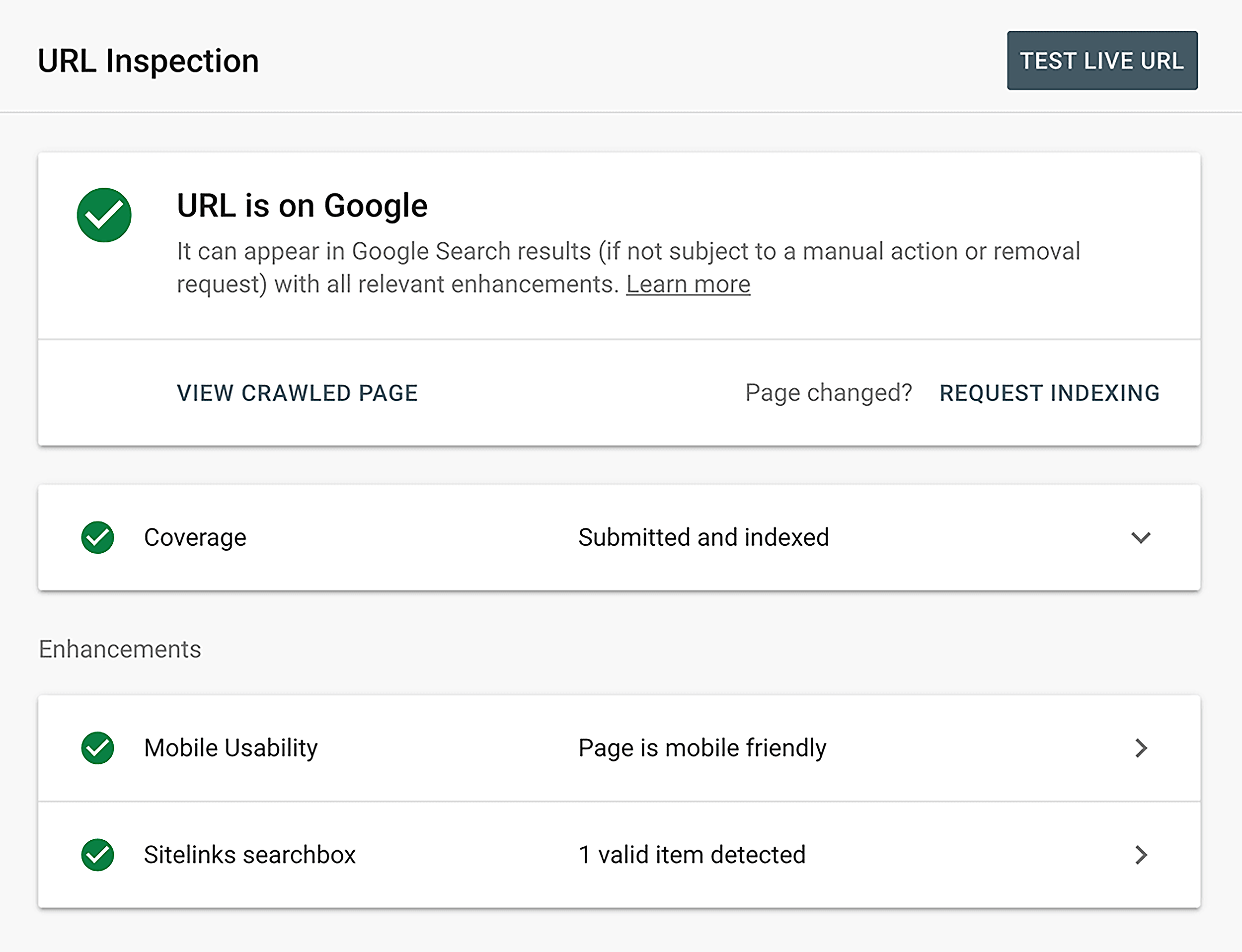
Note: Your sitemap and internal links are usually enough for Google to find and crawl your most important pages within a reasonable time. Requesting indexing is most useful when you’ve made a critical update and want to prompt a faster recrawl, rather than waiting for Google’s normal crawl cycle.
“SEO takes years”
It can take years to build enough authority to dominate a competitive space and it will take even longer if budgets are limited. Investing less than $2,000 per month is unlikely to drive exceptional performance in mid- to high-competition niches where on-page, off-page, and technical SEO is required.
Take a look at this Semrush position graph. It shows the performance for one of the keywords ranking on an accountancy firm’s website:

When rank tracking was set up in July, the accounting firm wasn’t even in the top 100 positions for that term. But not long after some initial work was done, it shot up to position 51, then to position 6. A week later, it was in position three. But it wasn’t until the start of September that it reached position one.
The site moved from position 100+ to position one in about two months — quicker than average, although this keyword wasn’t particularly competitive which was a factor; it’s often easier to move a less competitive keyword up in search results.
“You’ll see results in 30 days”
Stable, meaningful keyword positions rarely materialize in 30 days. Of course, there are sometimes exceptions, for example, if you’re operating in a very low-competition niche or publishing content on a site that already has strong authority.
Established domains with strong backlink profiles and consistent performance history can sometimes rank new content quickly. In those cases, it’s because Google already trusts the site, so new pages benefit from that existing authority. But even then, early movement might not be possible.
For most businesses, 30 days is barely enough time to lay the groundwork. A proper technical audit, analytics validation, keyword mapping, content planning, and prioritization can easily take a month. That’s before significant optimizations are implemented and reprocessed.
If your site is new, rebuilding authority, or targeting competitive, high-volume keywords, the timeline will almost certainly extend beyond 30 days. This is because new or rebuilding sites lack established authority and trust signals, and competitive, high-volume keywords require displacing well-established competitors — both of which take time to build and validate in search.
A good example of realistic progress comes from a Crowdo case study, where a combination of on-page, off-page, and technical SEO improvements led to a 525% increase in organic traffic over six months. The growth wasn’t instant; it was cumulative.
The site, which belongs in the YMYL category, offers medical prescription discount cards. As the SEO states, the site wasn’t starting from zero, but it was weighed down by years of technical debt. The sitemap was incomplete, canonical tags were missing, duplicate content was widespread, a test domain was indexable, and structured data hadn’t been implemented. On top of that, thin content, duplicate meta tags, and a weak backlink profile limited the site’s authority.
The first phase focused on repairing the foundation: updating the XML sitemap, implementing canonical tags, adding structured data, cleaning up duplicate pages, and preventing the test domain from being indexed. The SEO team also tackled content. They rewrote meta tags, expanded thin pages with high-quality content, and launched a strategic link-building campaign to strengthen authority.
Traffic didn’t spike overnight. Instead, early gains appeared in the form of increased organic keywords, improved crawling and indexing, and steady backlink growth. As those improvements compounded, rankings strengthened and organic traffic rose from 1,922 visits to 10,104 in six months, a 525% increase. The growth was cumulative, not instantaneous — the result of coordinated technical, on-page, and off-page execution working together over time.
“More content = faster results”
More is not always better.
Beware of strategies that post content for the sake of “having more.” Any content you publish should feel right — and be right — for your business. Before publishing, ask yourself: “Could I send this to my customers in a newsletter or share it on social media?” If the answer is yes, the content is likely good.
Publishing content strategically, with clear intent alignment, depth, and purpose, always outperforms mass-producing thin or loosely related articles, especially if you play the long-SEO game. The content must solve real problems for a clearly defined audience — not just target keywords — if it’s going to build authority, trust, and lasting visibility.
Churning out content is synonymous with severe click drops later. Let’s look at an extreme case of this happening.
A case study now known as “the great SEO heist” demonstrates what happens when a lot of thin content is published.
To cut a long story short, a lot of content was published using AI, it peaked, and nosedived:
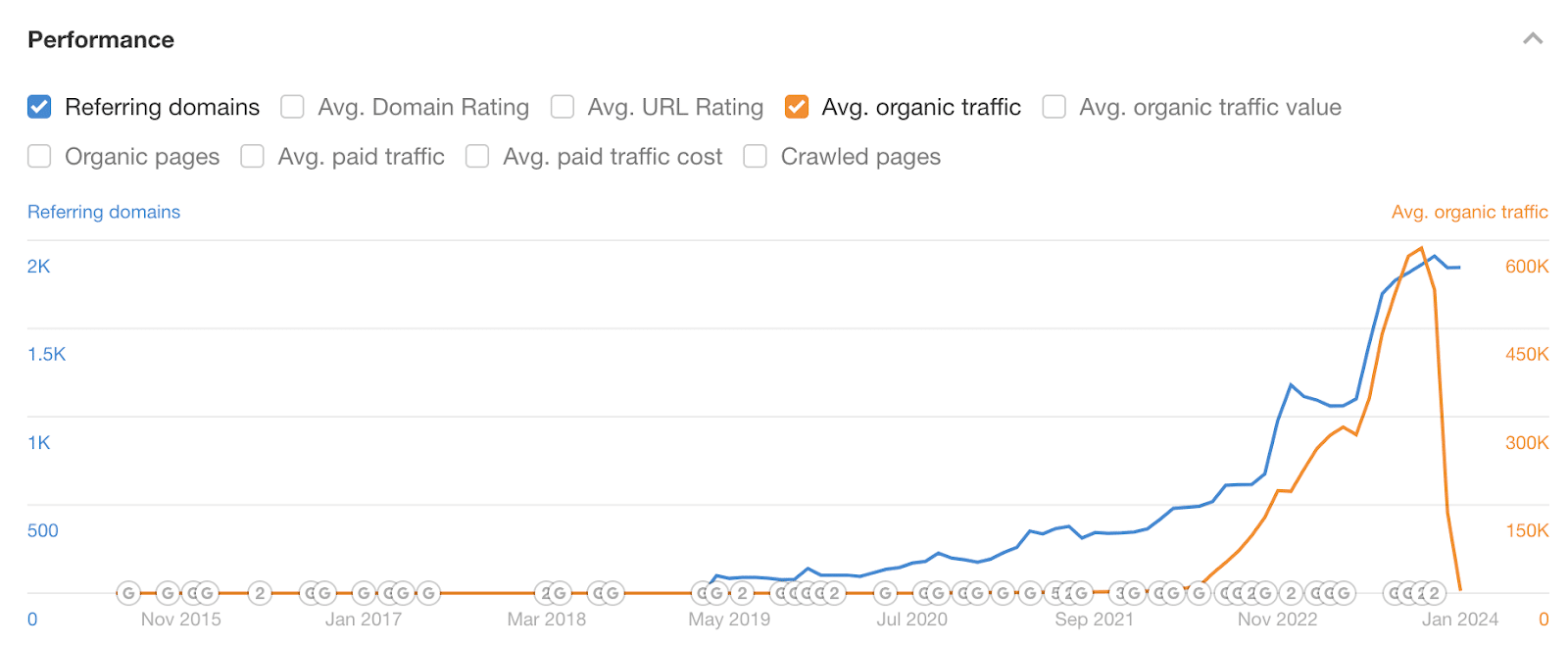
Aggressively churning out low-value content can slow progress or even reverse it. You’re essentially spamming your potential audience and Google knows it. Google has repeatedly reinforced that it prioritizes helpful, people-first content over scaled content designed primarily to rank.
Dig deeper: Find out more about AI content and the problem with focusing on “more.”
Another strong example of thin content suffering in algorithm updates comes from a Kevin Indig case study of the website throughtheclutter.com. This was a site that scaled rapidly by publishing large volumes of thin content covering movies and actor bios. At one point, it reportedly reached around one million monthly users. But when Google rolled out its Helpful Content Update, much of that traffic disappeared.
Important note: This doesn’t mean you shouldn’t publish consistently, or at scale, if you’ve got the resources to handle it. It simply means that publishing should have a strategic focus and be helpful to your audiences, not published as a way to manipulate algorithms.
“Once you rank, you stay there”
Ranking is not permanent, and SEO is not a one-and-done project.
Search results shift constantly for a host of reasons. For example, perhaps your competitors publish better content, earn stronger links, or refine their pages. Or Google updates its algorithms. Or user behavior evolves.The landscape around you changes, and your rankings move even when you’re not actively making SEO edits.
These days, you can also lose visibility without technically “dropping” in rankings.
For example, when AI Overviews (AIO), (the AI summary that’s added to the top of SERPs) are present, clicks drop. Searchers serve themselves without scrolling or clicking onto ranking websites.
Or, you may have dominated SERP features like the Local Pack, held a prominent position with a featured snippet, or a People Also Ask result, only for Google to remove or replace that SERP feature for the query.
A Semrush study on how long it takes to rank found that although 41% of the domains studied reached the top 10 within six months, only 27% remained there through the end of the 13-month study. Sustaining top positions requires lasting authority, strong engagement, and ongoing optimization, meaning SEO success is as much about defense and maintenance as it is about the ascent to top ranking positions in Google.
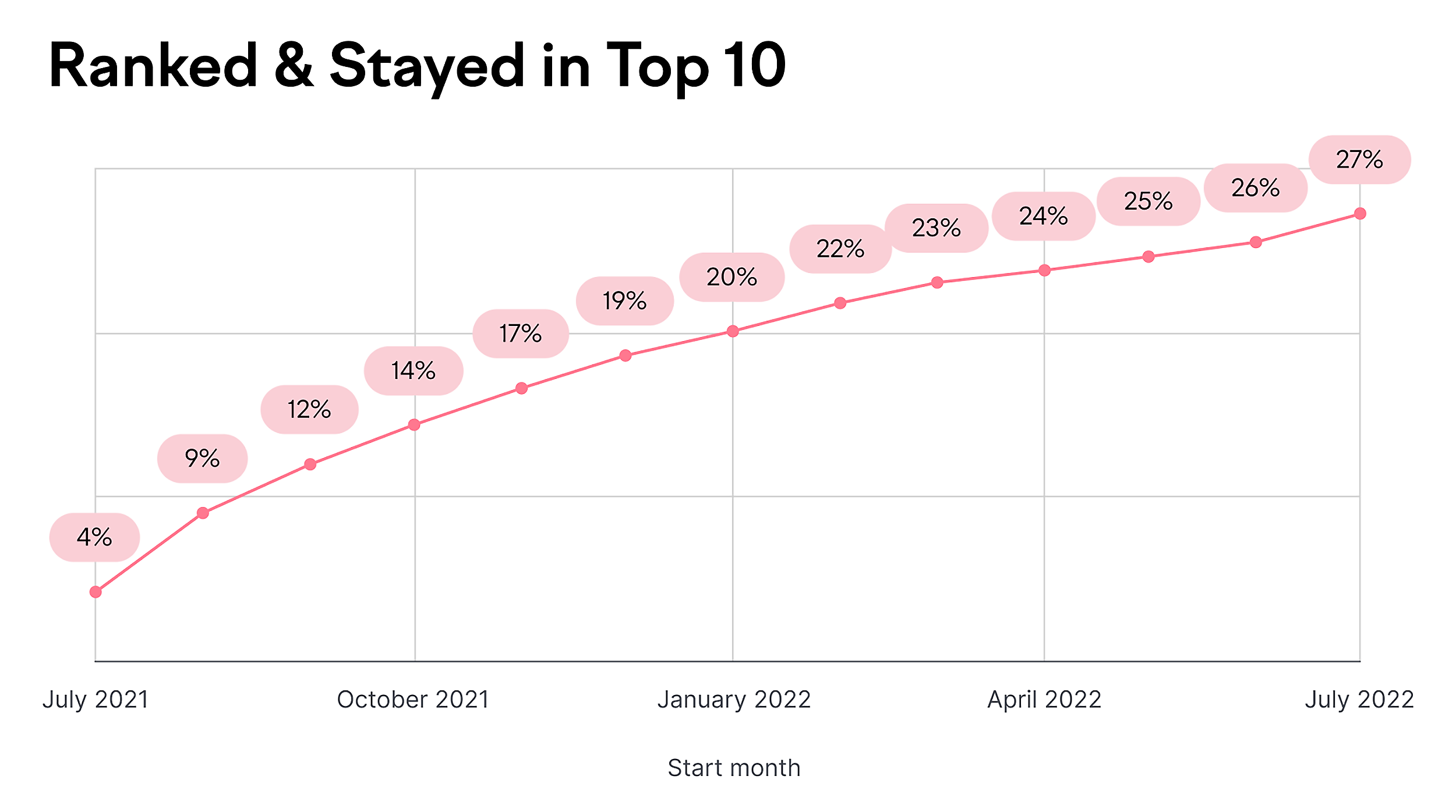
Consistent effort over time is key.
“You have to blog every day to win”
Not true. Quality always trumps quantity, but so does consistency. Publishing every day for a week, then disappearing for a month, then dumping two more posts and going silent again sends mixed signals to both users and search engines.
Blog content typically targets informational intent. While that’s an important part of SEO, it’s only one layer. To drive real business results, you also need content that supports navigational, commercial, and transactional intent, such as optimized service pages, product pages, category pages, and comparison guides.
Publishing daily blog posts won’t compensate for weak commercial pages. Plus, goals like daily blogging encourage thin, non-strategic content, which only interferes with crawl budget and weighs a site down.
The perfect blogging frequency for your website depends on your industry and goals. For example, one study suggests that 13 posts a month is the sweet spot for CBD websites. That’s roughly three a week.
Looking at successful competitors can provide a benchmark. And remember: Updating and strengthening existing content is often more impactful and faster than constantly producing new articles.
“SEO is all about keywords”
Keywords are important, but SEO today is also about topics, intent, and experience. Google’s systems are smarter these days and care more about how well your content serves the user than how often you say the keyword.
Track, optimize, and win in Google and AI search from one platform.
Today, strong performance comes from:
- Covering topics comprehensively
- Aligning content with search intent
- Structuring pages clearly
- Demonstrating credibility and expertise
This case study about a health and wellness site provides a strong example. After shifting from a traditional keyword-based model to a strategy centered on topical authority and intent-driven content, the site reportedly saw a 60% increase in organic traffic within six months. Their growth didn’t come from adding more keywords; it came from building authority around themes and better serving users.
Keep calm and start with a technical audit
One of the best places to start with SEO is a technical audit. For small sites, this can be done within a month, including implementing the fixes; For bigger sites, it could take months, but what’s true for every site is that technical elements of SEO are absolutely foundational.
Assess your foundation:
- Check crawlability. Make sure search engines can access your site efficiently. Issues here can delay discovery and extend your timeline. Learn more about crawlability.
- Verify indexability. If key pages aren’t indexed, they can’t rank, no matter how optimized they are. Confirm important URLs are eligible to appear in search results. Learn more about indexability.
- Set up reporting from day one. Track rankings, traffic, conversions, and technical health so you can measure progress and adjust quickly. Strong reporting shortens feedback loops. Learn more about SEO reporting best practices.
SEO takes time, but remember that that’s true for everyone. Your SEO journey will be successful as long as you’re creating a strategy and remaining focused on work that moves the needle for the business. Feel like you want to dive a bit deeper into what SEO is exactly? Check out our What is SEO guide for an in-depth tutorial.
Explore more on
Editorial disclosure
Search Engine Land is owned by Semrush. We remain committed to providing high-quality coverage of marketing topics. Unless otherwise noted, this page’s content was written by either an employee or a paid contractor of Semrush Inc.
About the author