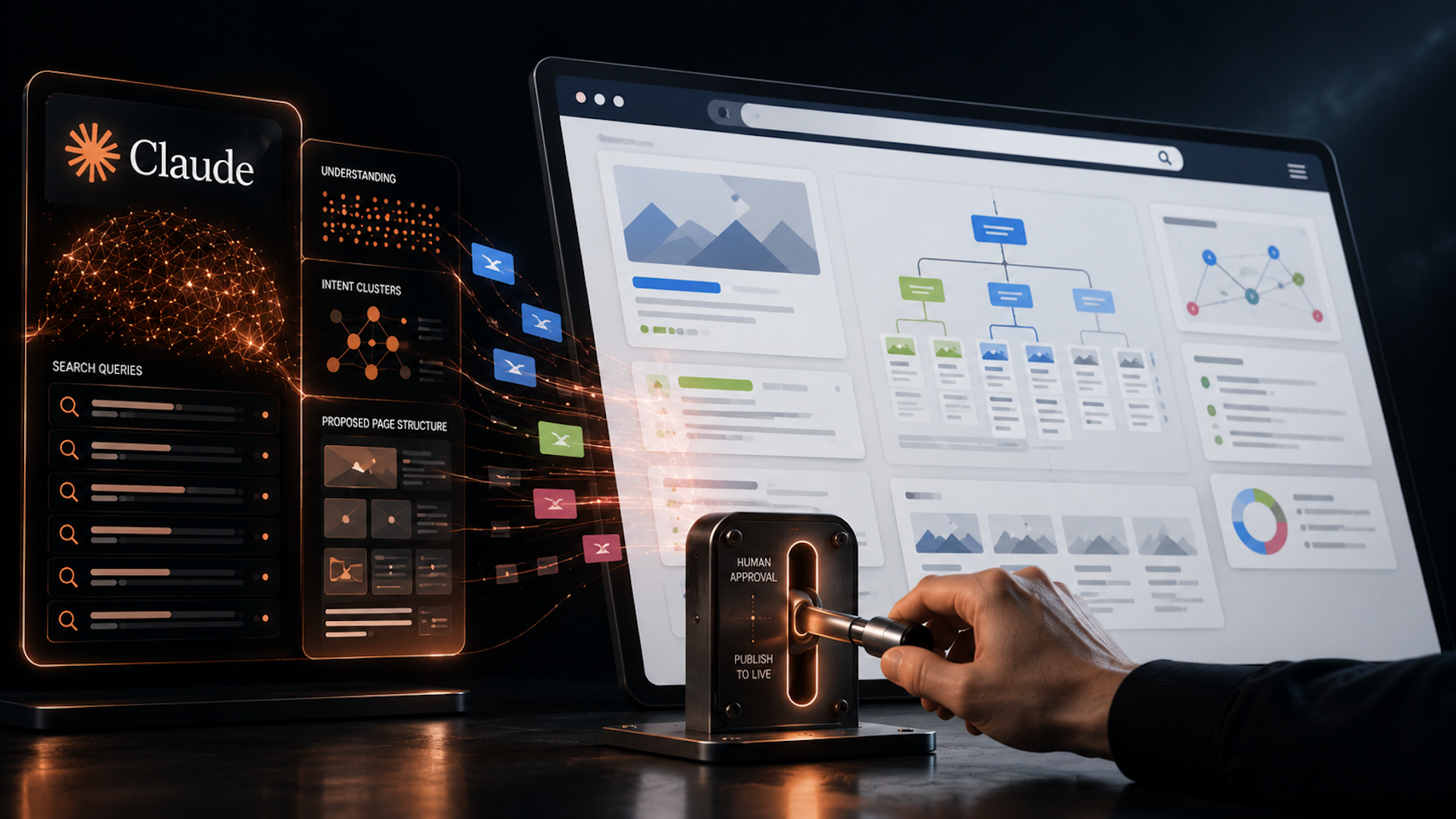
How to use MCP Servers to speed up SEO research
Learn what it is, how to install and configure MCP servers from SEO tools. Discover multiple use cases to fast-track manual SEO work at scale.
Model Context Protocol, or MCP, is an open standard for connecting AI assistants to external data sources and tools. It was created by Anthropic (the company behind Claude) in November 2024.
MCP defines a common way for applications to expose tools and data to AI Models. In the SEO context, it means you can connect your favorite SEO tool directly to LLMs such as Claude or ChatGPT and ask questions that use your selected tools as a source for the answer.
Put another way, if you know what an API is, imagine you’re calling an API from your LLM. MCP acts as a middleman between the LLM and your tool of choice. This connection is handy because you’re getting trusted data fed through an LLM.
Remember a while back when some marketers started doing keyword research on ChatGPT and it would hallucinate search volume? Now you can do your keyword research using the same tools, but instead get the same numbers you see on Semrush or other SEO tools.
See where your brand appears in AI search, where competitors are winning, and what it takes to become the answer AI recommends.
Why use an LLM locally in your machine instead of regular UI
This guide walks through steps to install MCP servers on ChatGPT, but will mostly focus on Claude, which comes in two versions:
- Claude: Use the regular UI that you download or use on the web. Best for conversation, writing, and one-off questions.
- Claude Code: Install on your terminal (Mac or Windows). Best for agentic workflows, write code, and multi-step tasks. (Most examples in this guide are better done in Claude Code, but technically possible in Claude as well if done on a smaller scale.)
For MCP server use cases, it’s strongly recommended to use Claude Code. Here’s why:
| Action | Claude (chat / claude.ai) | Claude Code |
| File handling | Upload files for analysis; can’t directly edit your local files | Reads and writes files directly on your device. You can create an automation that’s saved on your desktop daily. |
| MCP/integrations | Runs on the Cloud | MCP servers run locally. Some domains block bot visits, but if you can crawl a website locally (e.g., using Screaming Frog), you won’t have this issue. |
| Git/dev tools | No direct git or terminal access | Native git, runs commands, manages branches/commits. Writes code for you and saves it on your computer, even if you know nothing about code. |
| Task complexity | Great for single tasks; long workflows can lose the thread | Stays on multi-step tasks and works through them. Multiple requests are done at the same time. |
| Automation | Manual, turn-by-turn | Scriptable; can run unattended/overnight (CLI version). If your computer is on, the task will get done automatically. If not, it’ll run as soon as you turn it on. |
How to install Claude Code
Installing Claude Code is very easy and only takes about 30 seconds.
On Mac, open your Terminal (CMD + Space Bar) and paste: curl -fsSL https://claude.ai/install.sh | bash
On Windows, click on the Windows menu and search for “Windows PowerShell.” Then type irm https://claude.ai/install.ps1 | iex.
There are more ways to install it, which you can follow directly on Claude’s Quickstart Guide.

How to connect Claude or Claude Code to your MCP Server
Connecting your Claude or Claude Code account to an MCP is simple. If you’re using the Desktop interface, apps appear under Settings > Customize > Connectors. Multiple major SEO tools have extensions like this one.
The process is also simple for Claude Code. You could try something simple like “add [SEO Tool] MCP server on my Claude” and let the LLM do the job for you, or be more specific by following each tool’s instructions.
Major SEO tools have their MCP servers available on multiple LLMs, such as ChatGPT, Gemini, Cursor, VS Code, and Perplexity. Not all tools are available in every platform, so make sure to verify if they offer an official extension.
Example: How to connect Semrush and Claude Code
To add the Semrush MCP endpoint to your Claude Code settings, add a remote HTTP server by running the following command in the terminal:
claude mcp add semrush https://mcp.semrush.com/v1/mcp -t http
Next:
Open Claude Code and run the /mcp command
- Select “Semrush MCP” from the list of MCP integrations
- Select “Authenticate”
The OAuth 2.1 authentication process will automatically redirect you to the Semrush login page. For more details, refer to the official Claude MCP documentation.
Use case 1: Organize query by group beyond keyword patterns
Right when LLMs started rising in popularity, there were discussions in the SEO community about doing keyword research using LLMs. At that time, search volume numbers were hallucinated and you couldn’t trust them at all.
Now, however, the game has changed with the use of MCPs. Many of the most popular keyword research tools loved by SEOs have their own MCP servers, which means you can expect to see, for example, the same numbers whether you’re on Semrush’s interface or using their MCP server.
The magic happens when you slice the data in more meaningful ways. For instance, keyword research not long ago using a combination of keywords like “high paying [family] jobs in [location]” involved opening Semrush and selecting every relevant keyword manually, but it was a time-consuming process.
Now, using an MCP, it’s possible to feed some examples and find exactly what you need:
| Action | Example |
| Combine keyword variations | “top paying jobs,” “highest paying jobs,” “well paid jobs” |
| Combine keywords in groups | Keywords variations, such as “nurse,” “nursing,” “travel nurse,” or “nursing field” |
| Filter only keywords mentioning a city | For this specific project, I needed keywords that mention a city to have a general idea of demand per area |
Sure, this type of keyword research is technically possible to do manually, but AI is your friend here. What could easily be a whole day of research a few years back has now turned into a 30-minute task.
The end result is that you don’t have a large keyword list, but one list with a job family (marketing, sales, retail) and a total combined search volume.

How to write your prompt
Writing a keyword research prompt is easy. You just need to give examples of the type of output you’d like to see (keywords, format) and mention which MCP you’d like to use (in case you have multiple MCPs installed).
Below is an example for reference, but similar results can be achieved if you describe a prompt in your own words.
Check Semrush in the USA and look for keywords such as: high paying, top paying, highest paying, always followed by a specific profession or area
Here are some examples:
high-paying nursing jobs
high-paying pharmacy jobs
high-paying sales jobs
top-paying retail jobs
well-paid warehouse jobs
Find every keyword variation that has at least 10 in search volume and return them by group (all “nursing,” “retail,” “security,” etc. in one group). Return a table with Group and Total Search Volume. No need to list every single keyword.
Use case 2: Combine MCPs with Claude Skills to automatically create reports
Skills are folders of instructions, scripts, and resources that teach Claude how to do a specific task. These skills are saved on a SKILL.md file describing when to use it and how to proceed, often bundled with helper scripts (Python, etc.) and reference files. Once you ask for a specific skill, it knows exactly what to do.
There are great guides on how to build an AI skill, so we won’t cover the process step by step in this guide. Instead, we’ll give you an example.
We created a brand SEO audit that checks:
- Number of branded vs. non-branded keywords
- Total search volume of branded terms
- Live check of brand-related SERP features
- The Google Knowledge Graph confidence score
In this case, we combined multiple tools, including Google Knowledge Graph API. The API is free, but you should ask Claude Code the steps to store your API safely in your local machine.
After your skill is ready, you’ll be able to call it by invoking the skill and listing the domains you’d like to track. All the tools and instructions are stored.
Depending on the size of the domains, it’ll take a few minutes to call the skill. For reference, the prompt below took around 10 minutes to return an answer and generate the local page.
Use GP SEO Audit and check the following domains and brand names in the UK: screwfix.com (Screwfix), toolstation.com (Toolstation), and wickes.co.uk (Wickes).

Use case 3: Use historical data to create unique data visualization
You can also utilize data to create reports that you couldn’t before.
For instance, how many clicks are AI Overviews taking away from your company or client? We can’t exactly measure this number, but we can see how often they appear in your keywords or in your total search volume.

Of course, you need to take all data with a pinch of salt. This result is as accurate as your SEO tool, and it’s not considering users who replaced Google Search in favor of other AI services.
The above report could be done by a specific set of keywords, pages, or even competitors — or everything combined. With time, your prompts will get better.
Initially, we got some of the data we expected, but a lot of extra information as well — we didn’t ask for “top 3 keywords by traffic share” or “total organic keywords,” but still spent API units on it.

How to write your prompt
We split this request into two prompts. You may be able to do it all at once, but we wanted to test the results in each one first.
First prompt:
Check how many keywords searchengineland.com ranks for in the US within the top 3 keywords. I’d like a data visualization showing how many keywords have only traditional SERP results vs. AI Overview or AI Mode. Give me the historical data for the last 3 months.
Then, to replace the keyword count with the sum of search volume:
Now, add a final graph. Instead of the number of keywords, I’d like a new graph that sums up the total search volume these keywords have. Same rules, but replace the count of keywords by the total search volume these same keywords have.
Use case 4: SERP scraping
Another great use case for MCPs is SERP scraping.
Do you need to find which pages are ranking on page one or which ones are sources for an AI Overview? You can always do this manually by changing your location setting on Chrome or by using Semrush’s Free SERP Checker, but this process isn’t scalable if you need to do it for multiple locations.
Speed up the process using MCPs. Connect to a tool such as DataForSEO, which has a low cost and will do fresh scrapes for any location.
To combine the power of multiple MCPs, you could start a keyword research project using Semrush, then use DataForSEO to get live data only for the keywords that matter most.

You also have an option to compare SERP features for different countries. Doing this manually for two countries is more reasonable (only two locations) when compared to cities (dozens of locations). However, to stay on the safer side and do a more clean comparison, you may still use the same methodology.
For example, comparing the US and UK versions of a SERP module such as “popular products” is very simple — it’ll give you a comparison of prices, reviews, vendors, and condition.

How to write your prompt
Since this use case involves a prompt chain, you’ll take multiple steps to find your ideal output. It may start like this one:
Use Semrush MCP to find all keywords mentioning “supermarket” and “near me” in the US. Classify them per ethnicity, brand name, mentioned location, and any other adjectives.
Once the keywords are in place, you can continue your scraping by writing something like:
Now, use DataForSEO to check which domains appear the most on AI Overview, AI Mode, or Local Pack. Do this check on the top 10 cities in the US with the highest population.
For the “popular products” prompt, here’s an example that’s a simple description of your request. Mention which MCP you want to use, the query, the location, and what you need to scrape.
I’d like to analyze Google SERPs for iPhone 16 in the UK. Use data for SEO to scrape Google results in the UK vs. the US. Return only the results from “popular products” feature. Show me only organic results and include price, vendor, model, and energy rating.
MCPs are powerful, but not always necessary
There’s a lot you can do with MCP Servers and skills; they’re a game changer to do SEO tasks at scale. However, you should get used to API and token costs and evaluate when MCPs are necessary to avoid taking a Ferrari to a marathon.
Each company charges the API costs for their MCPs differently. Some offer them as part of existing subscriptions, while others charge credits separately as an add-on. In a few cases, like the Google Knowledge Graph, they offer a lot of API usage for free.
Understand that costs can add up, and LLMs sometimes overthink tasks that could be done with a script on Google Colab or a local Python environment. To avoid unnecessary spending, try using AI to describe your problem and ask if MCPs are the most effective way to achieve your goals.
Track your visibility across AI search, uncover missed opportunities, and grow your presence where customers are asking questions.
Overall, MCPs open a new universe of possibilities. There are plenty of unique use cases to explore for core SEO activities and adjacent use cases, so MCPs are well worth exploring in cross-functional efforts for marketing, UX, SEO, and development teams.
Investigate which ones are already available in your company and use your curiosity to improve your workflows.
About the Author