SEO attribution is still broken. Stop trying to make it perfect.
You don’t need to reconstruct every touchpoint. You need enough evidence to understand what’s contributing to the outcome.

You don’t need to reconstruct every touchpoint. You need enough evidence to understand what’s contributing to the outcome.

Search intent still shapes content strategy, but AI Overviews now shape how users behave on the SERP itself.

New clickstream data shows AI Overviews reshape user behavior, from reverse scrolling to longer SERP evaluation across search intents.

AI may be changing search, but much of the visibility is already going to platforms that dominate results and user attention.

New data shows people use ChatGPT to find local healthcare and aesthetics providers through short prompts, keywords, and limited follow-up.

Liz Reid says AI isn’t driving the change in Google Search — users are. Younger audiences are shifting to video, forums, and creator content.

AI is changing how people search – again. Learn what decades of search history can teach us about adapting to the next big shift.

AI tools are reshaping search habits, but Google’s dominance endures as the default gateway for online information, new research shows.
Explore user motivations, intent categories, and tactics to create SEO content that resonates and converts.

Becoming the go-to source across Google, AI tools and social platforms is key to standing out in an AI-driven organic search landscape.

Microsoft Clarity's new Google Ads integration gives marketers visibility into post-click behavior, allowing them to track user interactions.

Learn why keywords aren't everything and how user behavior, machine learning, intent and more shape modern SEO.
Here's how individuals and brands can adjust online reputation management (ORM) strategies to adapt to a post-continuous scroll world.

Explore the growth of voice search, its impact on user behavior and search, and what it means for the future.

Here’s why brands must focus on user experience, not semantics, and be present on platforms where their audience is searching.

Discover the impact of generative AI on search marketing and how you can prepare for the evolving landscape and unlock growth opportunities.

Reporting remains the same in Search Console, but eliminating the line between pages may result in new user behaviors, which can create winners and losers.
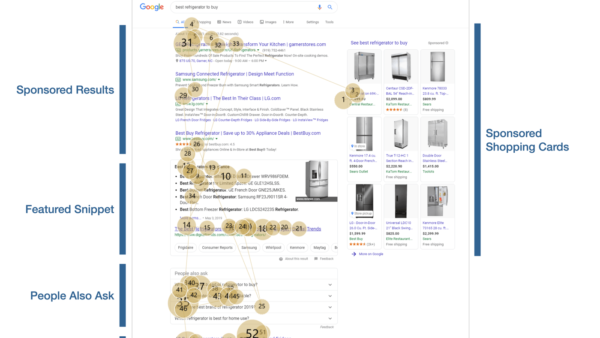
Search behaviors are changing as users "ping pong" their attention across search results pages.

Emoji search hasn’t quite caught on, but emojis still pose some interesting opportunities for your organic visibility.

A new Google eye tracking study published by Mediative shows how the evolution of the Google search results from 2005 to today has resulted in searchers looking outside of the golden triangle. The golden triangle was coined back in 2005 based on a study on how searchers looked at the Google search results page back […]

Yelp may once again feel Google is robbing it of its fair share of search traffic, with a study that’s been leaked to TechCrunch to prove it. A close read of that study actually shows that it proves the opposite — or at least, that it’s certainly not as damning as it sounds. Leaked Documents […]

Engadget spotted and has archived a promotional video that suggests the Google Search App for iOS may be gaining Google Now support. That support might help boost usage of the Google Search App, which barely makes the iTunes Top 100. Google Now No Longer Android-Only? Google Now is Google’s predictive search assistant, which tries to […]

Today, Facebook has shared information that “hundreds of thousands” of people are using its Facebook Graph Search service, highlighting that people still use it like “old’ Facebook search — to find friends. Facebook then suggests some ways to go beyond that, for those who have the new search feature. New Ways To Find Friends From […]
I first met Jacquelyn Krones, a Senior Product Manager from Microsoft, at a search show. A mutual friend on the Bing team, Product Manager Stefan Weitz, introduced her to me and said, “You have to meet Jacquelyn. You speak the same language.” Stefan was right. Jacquelyn started talking about the research project she was then […]
Google Instant’s Impact On SEO & User Behavior Presentations from SMX East, October 2010 Google Instant is a radically new approach to search, delivering actual search results and ads as you type, updating with each new keystroke. Some pundits have declared that this means the death of SEO, but Google maintains nothing’s changed with result […]
On May 11, 2010, Google was granted a new patent that basically states that all links on a page do not have to carry (or pass) the same weight. The concept is that the value a link should pass to a target page will be largely based on the probability that a user would click […]
In this column, I’ll follow up on my conversation with Dr. Jim Jansen from Penn State and his recent investigation into behavior patterns that lie within a large data set of visitor and search advertising campaign data from a high traffic ecommerce site. In part one, Jim and I explored whether a search funnel actually […]
Re-finding search behavior is common in web search, image search, and video search. What is it, and how can you make it easy for searchers to re-find your content?
SEO is actually optimizing a website for people who use search engines, both web search engines and site search engines. The key ingredient has always been searchers -- their characteristics and behaviors.
A new research paper from Microsoft looks at how surfing behavior — as logged by a search toolbar — can be used to improve search results.
Since the advent of “blended” or “universal search” last year across the major engines, there’s been ongoing discussion and speculation about its impact on user behavior and search marketing. Gord Hotchkiss last year wrote extensively about how blended search (on Google) has in fact shifted the user focus from the so-called “golden triangle” at the […]
A few columns ago I talked about user behavior on the results page and compared it to a shopping mall. In recent eye tracking studies, we’ve seen that several factors can create barriers or “walls” in this mall that can keep traffic from ever finding your listing.
The big search engines released end-of-the-year lists that intrigue and entertain. They can also remind us of the fundamentals of search user behavior. Each year when we look back at top searches, we get to see what searchers are up to and measure the strides in human development over the last twelve months. Our curiosity. […]
Gary Price at ResourceShelf points us to an intriguing article appearing in the IEEE Computer Society’s Computer Magazine about mobile search at Google. In the piece, two researchers at Google dissect and mine mobile query logs from WAP-based searches coming through a single (unnamed) U.S. carrier. One million “page view requests” from one month earlier […]
University students don’t question Google from PC World reports on a recent study named In Google We Trust: Users’ Decisions on Rank, Position, and Relevance. The study surveyed 22 Cornell University students on the Google search results. The conclusion of the study showed that these students trusted Google’s ranking of the search results at a […]