Beyond blue links: Why traditional SEO is not enough in a zero-click world

Controversy about the state of search will have you in a panic about SEO and its future. It feels like half of the experts insist nothing has changed, while the other half promote AI SEO as if we’re watching a complete overhaul of organic search.
Amidst the noise, it’s hard to decipher what’s real and what’s overblown.
The truth? Search is changing. But perhaps not as much as you feared.
Yes, almost 60% of searches resulted in no clicks in 2025. Yet Google search volume remains stable. According to the Datos State of Search Q3 2025 report, Google accounted for roughly 95% of all desktop queries in Q3 2025.
Searchers are still turning to Google as much as ever, but AI Overviews are fulfilling search intent and taking clicks from your site. Plus, search engine results page (SERP) features like featured snippets and knowledge panels often dominate the highest placements in the search results.
So, what are SEO specialists doing to maintain relevance in search? They aren’t abandoning traditional search tactics to focus exclusively on AI SEO. Instead, they’re maintaining traditional search optimization efforts while focusing on visibility-first SEO—treating two facets of search as complementary forces.
Here’s the crux: Traditional SEO focuses on rankings and clicks, but modern visibility requires optimizing for AI answers.
This article explores why ranking and visibility aren’t an either-or strategy. We dig into the rise of zero-click search, the risks associated with AI fads, and the value AI SEO brings to search. Plus, we cover the benefits and risks of a traditional SEO strategy in today’s modern search experience.
The rise of zero-click search
From a zero-click search, users find the answer or information they need in the search results without needing to click through to a website.
In recent years, zero-click searches have quickly become commonplace. It may seem like this search behavior came out of nowhere. But in hindsight, it’s the natural evolution of how search has changed over time.
The SEO toolkit you know, plus the AI visibility data you need.

Let’s look at the rise of zero-click search and the formats that contributed to its evolution.
AI Overviews
AI Overviews synthesize information from various sources in a single conversational response that cites some (but not all) sources. They’re a major factor in the rise of searches ending without a click.
Why?
AI Overviews provide comprehensive answers to queries within SERPs. These answers are often complete enough that searchers don’t need to click sources to read more.
Here’s an example of an AI Overview within search:
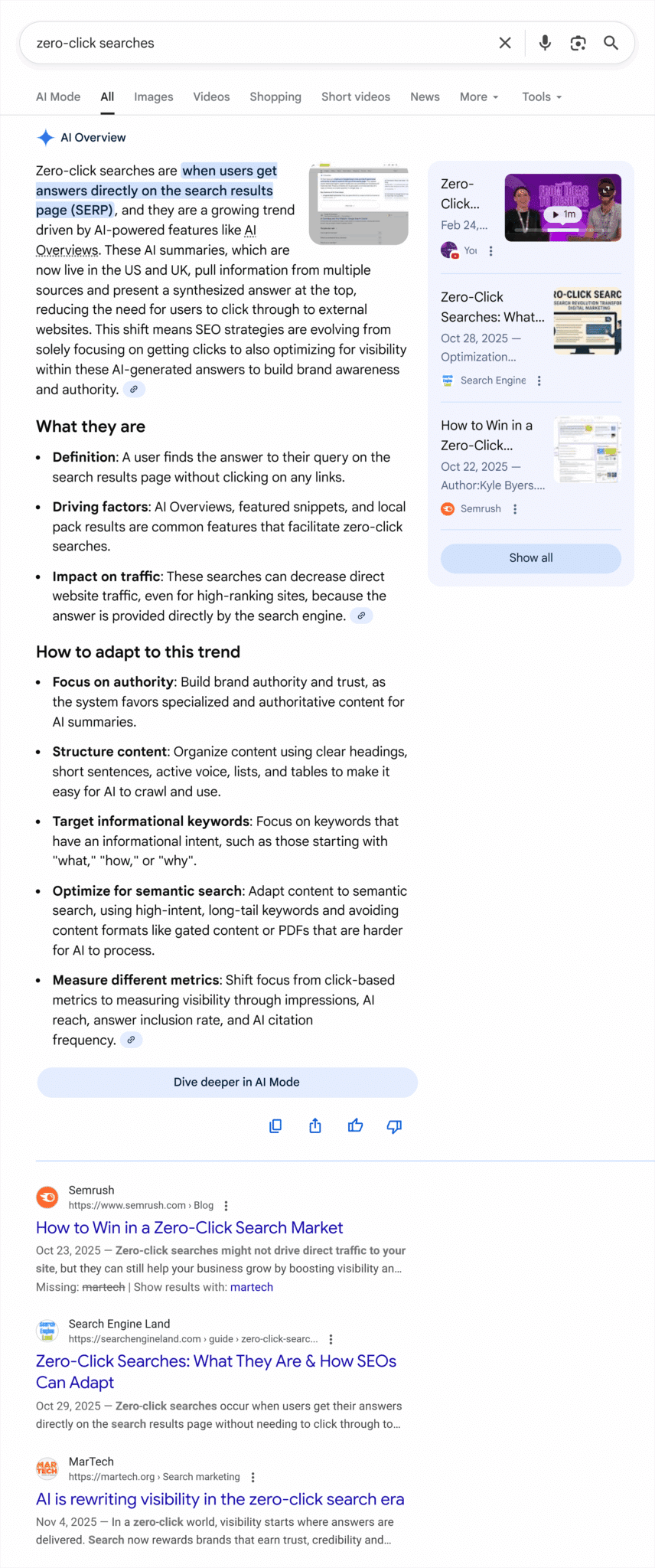
In the example above, you can see:
- A brief AI-generated response to the query “zero-click searches”
- More information directly related to the query like detailed explanations and examples
- A list of cited sources with links
- A button to dig deeper in AI Mode
Below the AI Overview are organic listings that searchers can click if they don’t already have what they need.
Zero-click searches feel prominent now due to the impact AI Overviews have had. But other formats, such as knowledge panels, have been pinching clicks from sites for years.
Knowledge panels
Knowledge panels appear on the SERP as structured summaries of people, brands, products, or other entities. They pull factual information from trusted databases and public sources, displaying key details without requiring the user to visit a website.
Here’s an example of a knowledge panel in search:

In the example above, you can see:
- An overview of the entity (e.g., a business, person, place, or product)
- Key facts like the entity’s founding date, social profiles, and headquarters
- The entity’s logo, which is likely pulled from structured data or public sources
- Links to social channels or owned platforms
People Also Ask
People Also Ask (PAA) boxes expand to provide and follow-up questions and answers. Generally, PAA features under a couple of organic listings, often after AI Overviews. But PAA can also appear at the top of the Google SERP.

In the screenshot above, you can see:
- PAA format that answers questions related to the original search
- Entity panel with Wikipedia’s definition of the search term
Below the PAA box, you can see organic listings that have traditional SEO blue links.
Featured snippets
Featured snippets extract short answers verbatim from webpages and present them within search results. They’re no longer common in the 200+ countries and territories that have access to AI Overviews—which are replacing featured snippets.
However, some searches still show a featured snippet, like the example below:

As you can see, the content is pulled verbatim from the source. Here’s the exact content from the article:

Although featured snippets are declining in frequency, they have a crucial role in the rise of zero-click search.
Why?
Featured snippets have trained a generation to expect and desire instant answers presented in the SERPs.
Like AI Overviews, featured snippets reveal answers directly within the SERP. But there’s one significant difference between user behavior around these two elements.
When Google pulls an answer verbatim into a featured snippet, the cited source usually experiences a significant increase in clicks. Because of their prime position at the very top of all organic listings and their ability to answer search queries (sometimes with images and videos), featured snippets have long been irresistible to searchers—who often click through to read more.
AI Overviews have the complete opposite impact.
Now, searchers get what they want from AI Overviews. Unlike featured snippets, AI Overviews often provide a comprehensive answer to queries, so searchers don’t need to click through to websites to read more.
Sites often experience a significant drop in clicks for searches that return AI Overviews. Google has designed an answer-first experience that keeps users on-platform rather than clicking away.
What does this mean for SEO teams?
To maintain a top position on Google, consider a visibility-first SEO approach.
Visibility-first SEO is the way forward
Visibility-first SEO refers to the strategic shift from focusing solely on traffic to optimizing for brand presence and visibility.

In a zero-click world, success isn’t measured solely by who gets the click. It also considers who shows up with answers. It’s about appearing as a source in AI Overviews, not just getting listed below with a traditional blue link.
Tip: For optimal results, measure the benefits of visibility-first SEO at every opportunity. Understand SEO reporting, including core metrics and key performance indicators (KPIs) that you must include in modern-day SEO reports, providing an accurate picture of SEO’s impact to stakeholders.
For the past two decades, SEO marketers have built success stories using metrics such as:
- Number of ranking keywords and their position
- Impressions that show how many searchers saw a listing
- Clicks to cited pages
When most searches ended with a click, this made sense. However, these metrics never directly translated to tangible business outcomes like revenue.
Visibility-first SEO reframes organic search as a two-layer strategy:
- Brand visibility at the answer layer, where users see brand mentions and citations in AI Overviews
- Traffic and conversions from traditional rankings, where users who want to learn, compare, or buy continue their journey by clicking through to a website
Visibility-first SEO isn’t a replacement for traditional SEO. It’s a complement to and an expansion of it.
If you only optimize for blue links, you lose visibility to AI-led surfaces that appear above them. And if you optimize only for AI, you lose the revenue layer that actually drives the final click, leading to business outcomes.
The risk with visibility-first SEO? Positioning in search engines becomes increasingly about mentions in AI overviews, which can overlook the conversion component.
Shiny object syndrome: Why visibility in AI search isn’t just a fad
Not every SEO believes that optimizing for AI-driven visibility is worth the effort. For some, it feels like yet another shiny object in an industry already overflowing with hype cycles and temporary tactics.
We get it.
But AI Overviews aren’t just another fad.
AI search visits remain consistent
In fact, over the last year, AI search has found its place in the search ecosystem. In 2025, AI tools earned a consistent 1.31% to 1.34% of visits in the US, according to Datos.

This is notable because it reflects a shift: Traffic to AI tools has leveled out.
Rather than surging month after month, visits have stabilized. This suggests that AI search is transitioning from rapid growth into a more steady, established pattern of use.
While traditional search remains the most visited tool, AI-powered search is an important part of the experience. Remember: AI Overviews contribute to 60% of searches ending without a click.
You help prevent negative effects
If SEO specialists fail to achieve visibility in AI search, the impact could be detrimental to the brand.
Why?
AI search features allow people to learn about your brand, compare your product, and trust your expertise—without ever reaching your website.
Failure to get your narrative into the AI Overview answer engine leaves your brand wide open to:
- Third-party opinions and reviews that don’t represent your brand
- Incorrect information that can have a detrimental impact
- Competitors placing at the top of SERPs when your brand could’ve been there
Unfortunately, this is already a reality for many businesses.
Google Search Help has threads of complaints from business owners who claim that their businesses are not accurately represented in SERPs.
Complaints include:
- AI Overviews damaging brand reputation, despite the brand spending hundreds on ad spend each month
- Negative competitor reviews surfacing for their brand due to AI-generated overviews that mix the companies’ reviews
- Incorrect summaries that aren’t corrected after business owners report the issue using Google’s dedicated system
- Pictures appearing within the results that don’t depict people related to the business are causing confusion and misrepresentation
The complaints go on. The image below shows just one.

Regardless of accuracy, AI Overviews are taking over prime real estate in SERPs. Google, Bing, and other engines are pushing AI-generated answers to the top of the page.
In many queries, the AI Overview appears above every organic result.
A business that doesn’t appear in AI Overviews can hold the top, traditional, organic position and still be invisible to users who fulfilled their search with an AI answer.
You control your brand narrative
If AI tools can’t find the correct answer in a way that’s easy to produce, they’ll still answer the query. These tools don’t reply, “I don’t know.”
Large language models (LLMs) like ChatGPT, Gemini, and Claude predict the most likely next word in a response. Their default behavior is to generate an answer. Even when confidence is low, the model still produces a summary to fulfill the searcher’s intent.
The best thing you can do?
Ensure that the correct responses to important questions about your brand are publicly available and presented in a way that increases the chances of earning brand visibility, even if related searches don’t lead to a click.
Visibility-first opportunities may reward early movers
Because there’s no playbook (yet), there’s also less competition.
Brands that become niche, specific, and authoritative can earn placement simply because others haven’t tried yet.
Here’s an example:

Featured in the AI Overview are multiple niche tools that have earned enough authority to feature in a prime position above market leaders.
Important note: AI Overviews often include information with third-party source citations. Positive earned media coverage helped the niche tools clinch this placement. If the reverse had been true, and other brands had made negative statements about these tools, then negative sentiments could’ve made the AI Overview.
Brands must maintain positive sentiment online through effective PR and earned media. But it’s better for your brand to publish it to an owned website than miss a chance to manage its narrative.
Visibility has always been part of marketing
With the rise of zero-click search comes a narrative about how visibility doesn’t pay the bills.
In a world where brand marketing and visibility have always been a crucial part of the marketing landscape, this narrative doesn’t always make sense.
Not every brand activity leads to immediate revenue generation, and it never has.
Think:
- Expensive billboard ads that reach thousands of people while they’re in a car and unable to take action
- Sponsorships and partnerships with credible brands that create association, authority, and trust by borrowing the credibility and attention of the brands they sponsor
- Luxury storefronts at airports that aim to target high-income earners and high-traffic areas
- Printed brochures that, for many years, generated virtually untrackable results
- Trade shows that serve as the first point of contact between a brand and a prospect
All of these activities primarily exist to build awareness or make that initial contact with a prospect. AI Overviews are no different. They build familiarity, credibility, and trust at the moment a user asks a question.
Despite all the above, it’s easy to see why skeptics hesitate:
- Visibility doesn’t pay the bills like clicks to a conversion-driven landing page do. If AI Overviews don’t drive traffic, leads, or revenue, then it’s easy to question the goal. From a purely ROI-driven perspective, stakeholders could perceive every hour spent optimizing for AI as a poor trade-off compared to strategies that directly bring in customers.
- AI-driven results are still in their early stages and can be inconsistent. Google continues to test, adjust, and scale features. Some SEO specialists argue that it’s too soon to invest resources into something that’s still being built under our feet.
- There’s no proven playbook. With traditional SEO, established frameworks are in place. With AI Overviews, there’s no guaranteed step-by-step method for placement. We’re all learning. For businesses that want predictability, investing in AI is uncomfortable.
- Citations aren’t always accurate. AI Overviews don’t consistently credit the correct sources. Even if the AI uses your unique perspectives, users might never realize it’s your insight powering the answer.
It’s time for a mindset switch. Modern SEO needs visibility and clicks.
AI-led visibility and traditional SEO aren’t opposing forces. They solve different parts of the customer journey.

Important: If SEO teams chase only what converts today, they’ll miss the visibility layer that earns trust tomorrow. If they chase only visibility, they’ll miss the revenue layer that keeps the business alive today.
The keyword obsession problem
Traditional SEO has long focused on keyword targeting and rank tracking. For years, this made sense: Users typed keyword-driven searches, websites ranked for keywords, and Google returned a list of relevant pages in the form of blue links. The goal was to grab the click.
But modern searchers don’t behave like that anymore.
Intent-driven search behaviour demands more than keyword optimization
AI engines don’t rely on keywords alone. They provide an opportunity for searchers to get specific—and then the tools offer an answer based on the context.
McKinsey provides examples of AI-driven search queries at various stages of the decision journey:
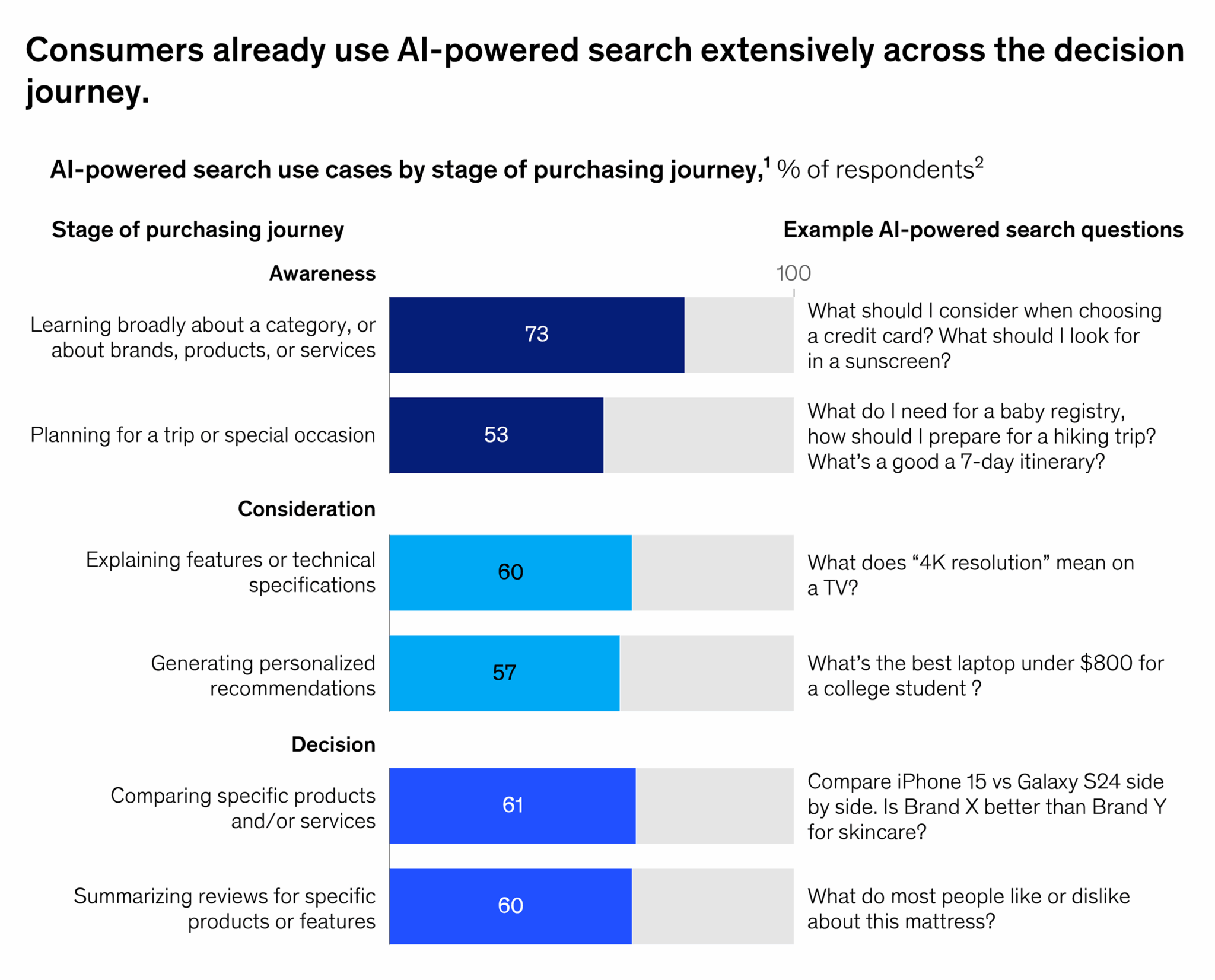
Queries include:
- “What should I consider when choosing a credit card?”
- “What do I need for a baby registry?”
- “Is brand X better than brand Y for skincare?”
All these questions reveal a bit more about the searcher’s intent than search terms like “best credit card,” “baby registry list,” or “brand X reviews.”
And by intent, we don’t mean traditional search intent, neatly categorized into four buckets: informational, navigational, commercial, and transactional.
Users ask complex, multi-layered questions. AI interprets the intent behind the query using natural language processing (NLP), which allows AI systems to understand human language, context, and meaning. Then, the AI recognizes semantic relationships between concepts, not just matching the exact words on a page.
Keyword volumes were never accurate anyway
If you want to know what your audience is searching in LLMs, the answer is “everything.” Users are probably searching for every use case and example you can think of. The potential variations are infinite.
There’s no finite keyword list anymore. And truth be told—there never was.
You may have relied on keyword research tools when using SEO playbooks. But they’ve never provided the full story. Keyword research tools simply don’t have a database of every search ever made—or they list keywords with inaccurate search volumes.
Or you may have used Google Search Console (GSC) as a method of finding keywords. But GSC can only show you the keywords for which your site actually has some visibility.
Note: Keyword research tools and GSC all have their place. Keywords aren’t entirely obsolete, but they’re not conclusive enough to shape a content strategy that addresses AI SEO.
SEO specialists have to get smarter if they want visibility in AI search. You need to answer the questions your target audiences are actually asking.
Keywords don’t matter in AI, and AI is the preferred search format for many
A McKinsey survey found that AI-powered search is already most people’s preferred source of information. The only demographic that prefers traditional search to AI-powered is baby boomers—but even 36% of boomers prefer AI.

We’ve moved beyond the era where Google once rewarded pages that ticked SEO boxes like keywords, PageRank, page speed, or backlinks.
In AI responses, you can often see niche sites outranking major brands, simply because their content directly, clearly, and concisely answers the question.
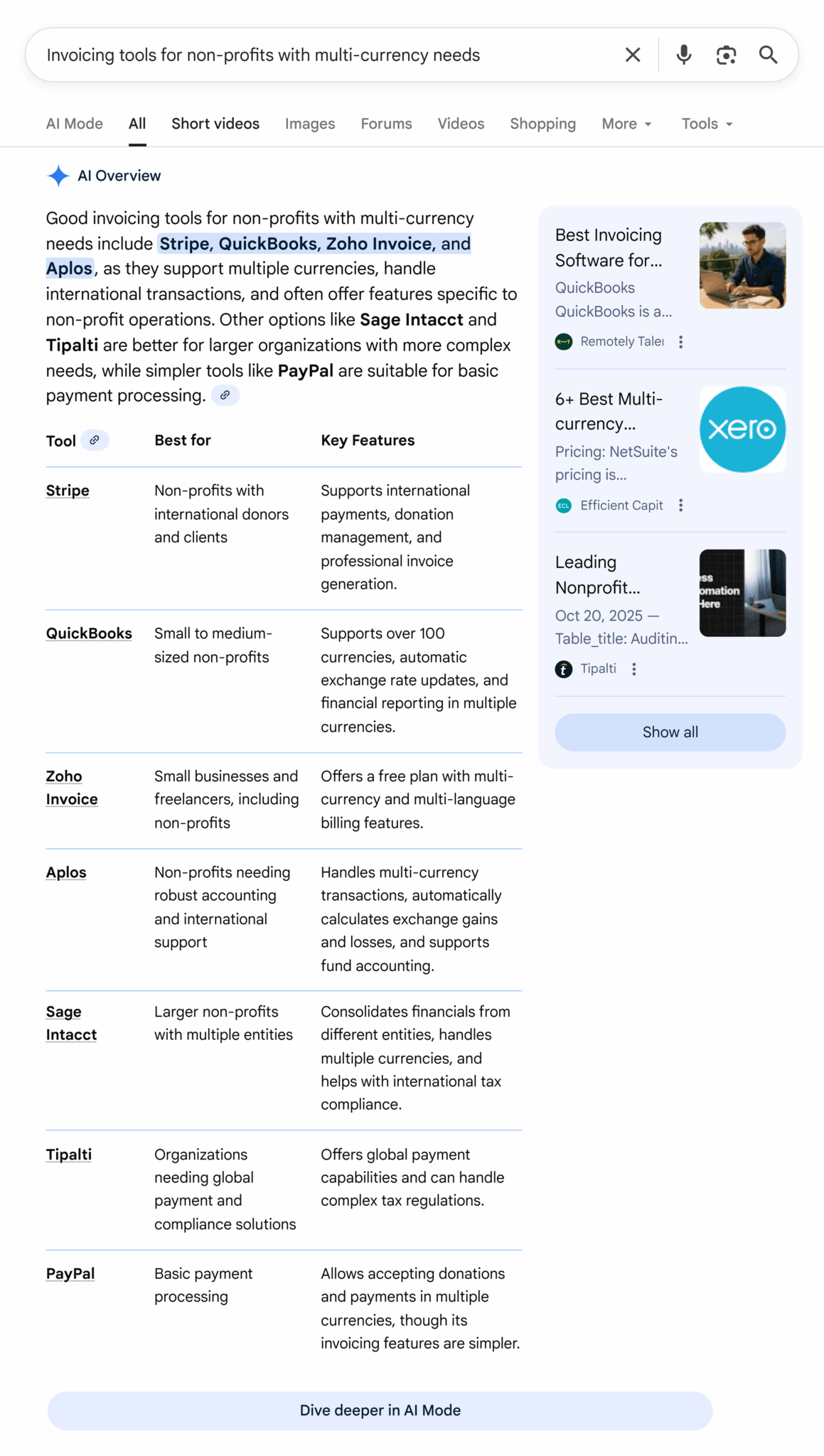
Here’s an example that shows one key difference from the SERP we discussed above. In this example, two of the brands mentioned in AI Overviews don’t rank well in traditional search.
There’s an argument that AI tools take all their information from the top of Google search results. Therefore, traditional SEO is all you need to get into AI summaries.
This isn’t entirely true.
Research from Semrush shows that the majority of answers in LLM search results are in position 21 or higher in traditional search results. That’s likely a page three ranking.

It’s undeniable that many searches share similar results between those well-ranked in traditional SEO and those well-cited in AI. But ranking at the top of Google is not a prerequisite for featuring in AI.
These findings are significant because in a zero-click world, traditional SEO rankings—even those on page one—don’t get the clicks they used to.
In the example above, one of the results mentioned in the AI Overview isn’t on the first five pages of Google search results.
Another is ranked on page one, but it appears in position seven after:
- AI Overview
- Discussions and forums SERP feature
- People Also Ask
- Sponsored results
Position seven in traditional search has an average click-through rate of 3.9%, according to Backlinko.

If not for the citation in AI overviews, these brands are as good as invisible in Google.
Still not convinced?
As the AI Mode search below suggests, the tool initiates multiple searches and examines multiple sites before compiling a single answer. It doesn’t just consider the top 10 blue links.

Here’s the crux of the issue: Keyword-based content often fails to satisfy what AI engines need.
They require:
- Concise definitions: Short, direct explanations that answer the question immediately instead of long, story-driven intros and keyword padding bury the answer
- Factual clarity: Verified, unambiguous statements supported by data, citations, or expert sources
- Structured information: Lists, tables, steps, FAQs, and clear subheadings that provide structured formats that enable AI to identify key points and assemble them into a summary
- High authority signals: Expert authorship, reputable sources, strong E-E-A-T indicators, references, and topical depth that provide subject matter experts for AI to quote
- Extractable formatting: Clean HTML, clear sentence structure, bullet points, definitions, Q&A formatting—the content must be easy for AI to lift and reuse without confusion
Keyword research is still valuable, but its role has evolved. It’s no longer the whole AI SEO strategy—it’s just the starting point with prompt research.
Keywords and prompt reviews help uncover themes, questions, and language patterns that can inform future content.
But after that, the discussion has to widen:
- What is the reader actually trying to achieve?
- What problem are they trying to solve?
- What problems can the business solve better than anyone else?
- Who is asking for what, and in what context?
- How can we provide an answer structured well enough to be quoted by an AI?
The solution isn’t more keywords.
It’s strategic content design, including holistic elements like:
- Building content around buyer personas
- Solving niche problems
- Creating specific pages for specific audiences
- Writing in formats that LLMs can extract, structure, and cite
- Ensuring other websites, such as industry-leading publications, support your narrative
Tip: Read this article on content marketing strategy for a comprehensive guide on creating content for your buyer personas.
The SEO sweet spot: Optimizing for traditional and zero-click search
Modern SEO isn’t about choosing between traditional and AI tactics. Every SEO professional should now be doing two things at once: helping Google and AI engines extract accurate, trustworthy answers while also creating deeper content that earns clicks, conversions, and revenue.
Gaetano DiNardi agrees with the notion that SEO teams need to do two things at once:
“AI is the great equalizer. Top-of-funnel clicks are being eaten alive due to AI’s ability to easily summarize consensus information based on its own training data, driving even more zero-click searches. Top-of-funnel informational pages have become irrelevant, middle-of-funnel content remains valuable, and bottom-of-funnel intent is critical.”
You can still achieve the keyword rankings required for middle-of-funnel and bottom-of-funnel content while getting cited in AI.
A key step is getting specific on who you’re creating content for.
Get specific on who you’re creating content for
You’ll fail in visibility-first SEO if you think your audience is everyone who needs your solution.
In reality, the most significant content wins come from getting very specific about niche use cases, industry types, job roles, or pain points.
You can build landing pages dedicated to micro-audiences with specific use cases, problems, and needs. These pages are more likely to appear in the AI overviews due to their niche approach.
And if these searches don’t earn the clicks they once did, you don’t have to worry—because these pages become multi-purpose assets. Even if search traffic is slow to build or non-existent due to zero-click searches, you didn’t waste time creating these pages. Pages designed as multi-purpose assets can convert through other means of marketing.
Track, optimize, and win in Google and AI search from one platform.
In other words: other marketing channels benefit from SEO’s research and can send traffic to these pages and convert them.
For example:
- You can run ads to them
- You can link social traffic to them
- You can use them in email nurturing
- Sales teams can use them as proof points
Tip: Viewing these SEO pages as business assets may help you secure budget. Read Russell Welch’s article SEO Stakeholders: Align Teams and Prove ROI Like a Pro to find out how stakeholder buy-in can help secure budget for future SEO work.
Another benefit to knowing your audience?
You can find out how they search.
Above, we mentioned that baby boomers are the only subsection of people who prefer traditional search. If your audience is baby boomers, then you might place a greater emphasis on traditional SEO tactics.
However, if your audience has a household income of $200,000 or more, then focusing on citations in AI overviews will be really important.
Why?
41.2% of people with a household income of $200,000 or more always or usually click the sources provided in an AI Overview, according to Exploding Topics. For this audience, AI citations are earning clicks over 40% of the time.

Solve the content format misalignment
Many SEO teams are still producing content for a world where users scroll, skim, and eventually click. In other words, they’re still creating long-form articles stuffed with keywords and content architectures with pillars and subtopics, regardless of audience relevance.
And while that content can still rank well in traditional search, it performs poorly in zero-click environments.
AI Overviews, featured snippets, People Also Ask, and other answer-first surfaces don’t want a thousand words of context. They want information they can extract cleanly and confidently.
Citations in these formats are more likely to occur with:
- Concise definitions that answer a query in one or two sentences
- Tables, comparisons, and structured lists that present facts clearly
- Step-by-step logic that breaks actions into numbered instructions
- Direct question–answer formatting instead of narrative buildup
- Consistent narratives across authoritative websites
Zero-click is here—and sites that adapt now will own the future of search
Zero-click search is here, and it’s not going away. Searchers are getting answers before they ever reach a website. And Google is doubling down on AI-first experiences, keeping users on the search engine rather than clicking through to your website.
The businesses that adapt to visibility-first SEO now will have the best chance of ranking at the top of Google and within traditional SEO listings.
Traditional SEO laid down the foundations of search, but it wasn’t designed for a world where answers appear above every blue link.
Modern search demands more.
The future belongs to optimizing for discovery, credibility, and entity-driven answers across human and AI interfaces.
Stop chasing rankings. Start building visibility ecosystems.
Explore more on
Editorial disclosure
Search Engine Land is owned by Semrush. We remain committed to providing high-quality coverage of marketing topics. Unless otherwise noted, this page’s content was written by either an employee or a paid contractor of Semrush Inc.
About the author