Content scoring tools work, but only for the first gate in Google’s pipeline
Google’s first-stage retrieval still runs on word matching, not AI magic. Here’s how to use content scoring tools accordingly.

Google’s first-stage retrieval still runs on word matching, not AI magic. Here’s how to use content scoring tools accordingly.

ChatGPT pulls most from early sections, favoring direct definitions, balanced tone, and dense entities, new research finds.

Behind the AI interface, a staged system narrows tens of thousands of documents to a few, showing that visibility hinges on classic signals.

It's not about placement, it's about structure. Analysis of 2,300+ AI citations shows Google pulls answers from anywhere on a page.

Search patents reveal how AI search systems interpret intent, evaluate content passages, and build brand understanding in generative results.

AI systems don’t evaluate pages the way search engines do. Learn how extraction, embeddings, and structure determine reuse.

Use AI-SEO tactics that help you surface in AI answers – structure facts, earn citations, and protect your visibility.

Here's why treating ChatGPT like Google will guarantee your failure in the age of RAG, reranking, and probabilistic systems.

Google's new BlockRank model promises faster, smarter AI retrieval and hints at how Google’s future ranking systems may evolve.

AI search mythbusting: cutting through hype, half-truths, and grifts to show what really matters for visibility.
Search Engine Land still believes in SEO. But search is evolving. Here’s why we talk about GEO, what it means, and why we welcome the debate.

An analysis of 800+ websites across 11 sectors reveals which domains AI assistants cite most and what it means for authority in the AI era.

Add a fake 2025 date, increase your AI visibility. A new study shows ChatGPT and rivals reward recency over relevance.

AI models pull from search results to build answers. Here’s how to ensure your content is among what Gemini, ChatGPT, and others surface.

From training data to citation frequency, learn how generative AI systems assess credibility and decide which sources to surface first.

Despite AI’s promise of inclusion, search and LLMs still sideline minority languages. Here’s why it matters – and what must change.

Gen Z is driving a shift toward AI and social platforms for search, as trust in AI tools grows and search habits splinter by age and intent.

A deep dive into the unseen systems behind Google Search – uncovering live experiments, entity-based infrastructure, AI agents, and more.

Clicks are vanishing and SEO playbooks are being rewritten. And Google has been telling us for a long time where this is all headed.

SMX Advanced speaker Dawn Anderson shares insights on SEO's future and adapting to the era of generative information retrieval.

'For the next two or three years, both those modes are going to be growing and necessary. We plan to dominate both,' says Demis Hassabis.

Read this deep dive into six patents that reveal how Google's AI Overviews and AI Mode work – and what it all means for the future of SEO.

The page is dead. Long live the stack. Here's how vector databases, embeddings, and Reciprocal Rank Fusion have changed the search stack.
New DOJ exhibits reveal insights into how Google Search ranks content, Navboost, RankEmbed, and LLMs reshaping the future of search.

In AI-driven search, retrieval beats ranking. Clarity, structure, and language alignment now decide if your content gets seen.

An Apple document reveals how AI digital assistant responses are rated for harmfulness, truthfulness, satisfaction, and more.

Generative AI is changing search. Goodbye blue links, hello AI answers. Learn what this shift means for the future of SEO and traffic.

AI agents are redefining digital interactions. Find out how they enhance search, automate personalization, and drive business efficiency.

A detailed analysis of ChatGPT search and Google's performance across 62 queries, with scoring metrics and practical examples.
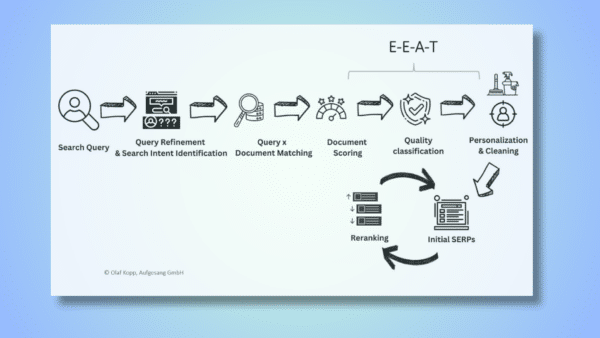
Unpack the complexity of Google's quality assessments with a deep dive into E-E-A-T's influence on content, domains, and entities.

Actionable insights for optimizing your digital presence across search engines, AI platforms and emerging technological ecosystems.

The before:YYYY-MM-DD and after:YYYY-MM-DD search operator commands yield results for before, after, and within the dates you specify.

Gain powerful insights to inform your marketing efforts. Use the following advanced Google search operators and commands to your advantage.

Understand the building blocks of knowledge graphs – entities, relationships and attributes – and how they relate to information retrieval.

Understanding the concept can help you optimize ecommerce content for better alignment with Google's AI-driven search, boosting visibility.
Here’s why you should focus on creating valuable, unique content that answers users' questions effectively, regardless of word count.

Learn how to do type-in, image and voice search, plus how to use Google Search for different content types and formats.

A deep dive into how AI is disrupting search engines and its impact on SEO, digital marketing and the future of information access.
Addressing common questions, critiques and concerns following the massive Google Search leak and how your approach to SEO should change.

This breakdown unveils potential Google Search ranking factors, including details on PageRank variations, site authority metrics and more.