AI search is here, but marketers still call it SEO


The SEO industry has been debating what to call AI search optimization. GEO. AEO. LLM optimization. AI search optimization. Every few weeks, a new acronym gains traction on LinkedIn, shows up in an agency deck, or gets debated during a conference happy hour.
To be clear, the debate isn’t meaningless. Language shapes how teams hire, budget, measure, and explain the work.
But there’s a difference between the language the industry uses to signal expertise and the language buyers use to solve a problem.
In previous research, we examined how new AI search terms were being adopted across social and hiring platforms and among industry influencers. This time, Fractl surveyed 343 U.S. marketing decision-makers to understand how they describe, fund, and evaluate AI search optimization. (Disclosure: I’m the co-founder of Fractl.)
Key takeaways:
- 81% of marketers still refer to their internal AI search visibility strategy as SEO.
- 70% of marketers would search for either “AI search optimization” (46%) or simply “SEO” (24%) when looking for help with AI search visibility online.
- C-suite marketers use “GEO” (28%) and “AEO” (17%) at roughly three times the rate of individual contributors (9% and 3%).
- 36% of marketers cited excessive buzzword usage without a clear explanation of what each term means as the No. 1 vendor red flag.
- 66% of marketers report having used AI-based tools to research marketing vendors.
- Marketers allocate 24% of their search or content budgets, on average, to AI search visibility.
The findings suggest that AI search is changing the mechanics of visibility faster than it is changing the vocabulary of the buyers funding it.
Most marketers still describe this work as SEO. Many are still looking up the new acronyms. And when they evaluate vendors, they’re far more interested in measurable case studies, clear methodologies, and credible expertise than terminology fluency.
Half the industry is still looking up the vocabulary
The AI search vocabulary may feel settled within industry circles, but most marketing teams are still catching up.
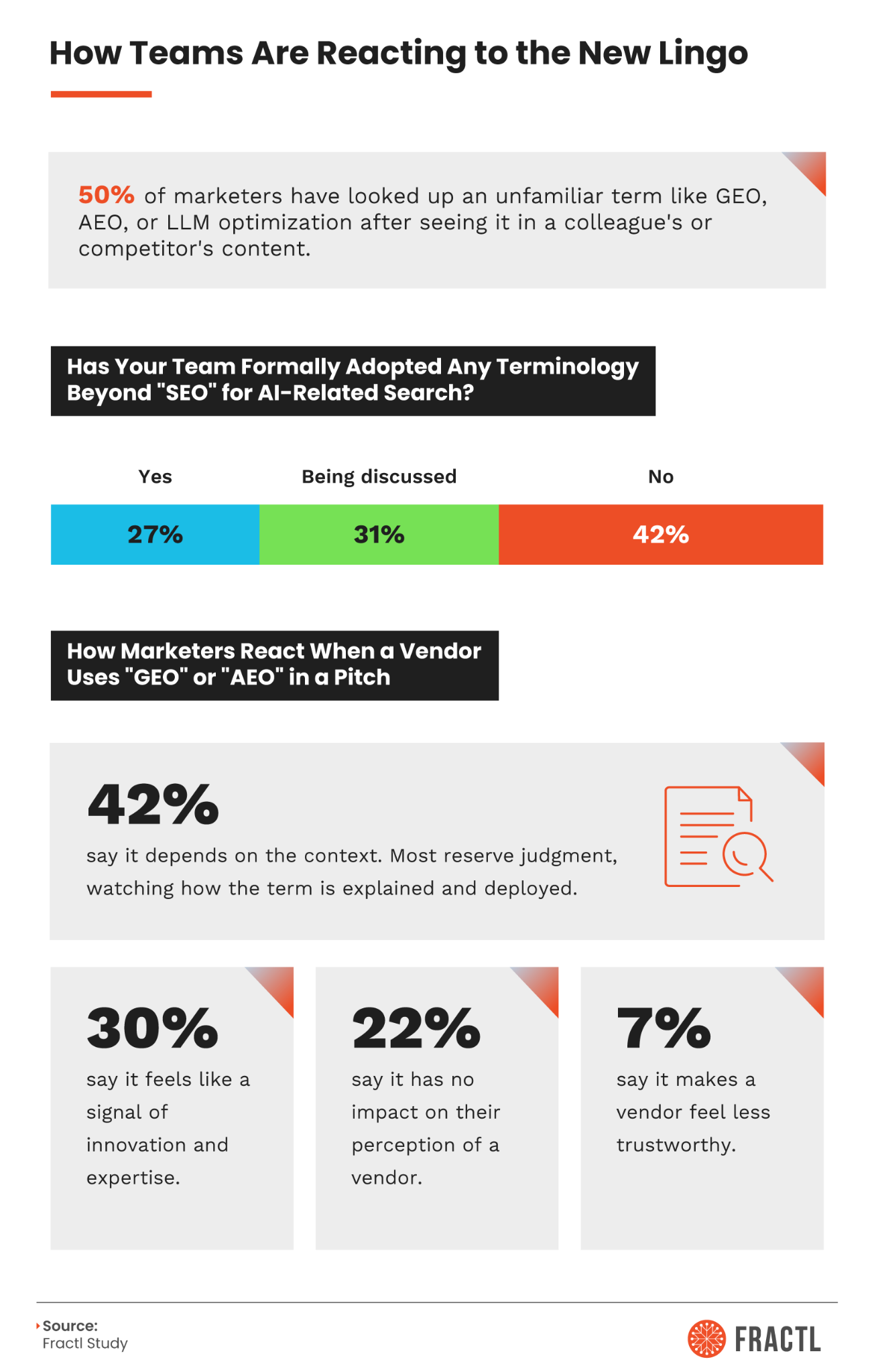
Half of marketers said they’ve researched a term they didn’t know after seeing it used by a peer or competitor. Only 27% of marketing teams have formally adopted a term beyond SEO to describe their AI search activities, while 42% have decided against it, and 31% are still undecided.
This isn’t resistance to AI search strategy. It’s a sign that buyers still need clearer language.
This is where vendors need to be careful. When marketers were asked how they respond to terms like GEO or AEO in a pitch, 42% said it depends on how much context is provided. Another 30% saw the language as innovative, but 22% said it had no impact, and 7% said it made the vendor seem less trustworthy.
The takeaway: Don’t let the acronym carry the pitch.
Use the term if it helps, but define it through the work. Explain how AI search changes discovery, brand citations, third-party authority, content structure, and measurement. Then connect it back to the language buyers already understand: SEO performance, visibility, authority, qualified traffic, and revenue influence.
The segmentation data shows why this matters. Senior leaders are more likely to adopt new terminology, with 36% of directors and C-suite executives saying their teams have moved beyond SEO. But C-suite leaders were also the most likely to report looking up unfamiliar terms, at 56%.
That suggests many executives are interested in the category before their organizations have a shared operating model for it. They may be asking about GEO because they saw it in a board deck, while the SEO, content, PR, and analytics teams are still figuring out what changes in execution.
For agencies and platforms, the opportunity is to make AI search easier to understand, budget for, and act on, rather than to win the naming debate.
AI search budgets are here, but strategy is still unsettled
AI search may still be an unsettled category, but marketers are already funding it.
On average, marketers are now allocating 24% of their total search or content budget to AI search visibility. Most teams aren’t sitting this out. Up to 82% have committed at least some of their budget, and 43% are allocating more than 20%.
That budget shift is the clearest sign that AI search has moved from experimentation to planning.
The teams investing the most are closest to performance measurement. SEO and performance marketing teams allocate a higher share of their budgets to AI search visibility than content and brand teams. That makes sense. These teams are most likely to notice changes in impressions, rankings, traffic quality, attribution paths, and assisted conversions first.
But the biggest challenge marketers cited wasn’t measurement. It was keeping pace with how quickly the landscape is changing.
Twenty-eight percent said the speed of change is their top challenge, ahead of measuring performance or visibility in AI-generated results (17%), identifying which AI search platforms to prioritize (15%), and the absence of industry standards or best practices (13%).
For vendors, agencies, and internal SEO leaders, the mandate is bigger than another dashboard. Teams need a strategy that can evolve as search surfaces continue to change.

Right now, platform focus is fragmented. ChatGPT leads, with 34% of marketers prioritizing it for AI search visibility, followed by Gemini at 16%, Claude at 6%, and Copilot or Bing AI at 5%. Only 1% named Perplexity, despite the attention it gets within SEO and AI circles. Another 14% said their team hasn’t picked a target platform yet.
A platform-by-platform strategy may be useful for advanced teams, but many companies are still one step earlier.
They need to know whether ChatGPT, Gemini, Claude, Perplexity, or AI Overviews are pulling from listicles, Reddit threads, analyst pages, trade media, YouTube transcripts, their own site, or competitor-owned content, and which of those sources they can realistically influence.
Marketers should avoid both extremes. Don’t dismiss AI search because your traffic hasn’t collapsed. But don’t overcorrect by chasing every new answer engine separately.
Start by identifying where AI search is already influencing your category. Audit the prompts your buyers are likely to use. Track how your brand, competitors, and publishers are represented across ChatGPT, Gemini, Google AI Overviews, Claude, and Perplexity. Then look for the recurring sources, citations, comparisons, and entity signals shaping those answers.
For vendors, the opportunity is to help teams prioritize. The winning pitch isn’t “we optimize for every AI platform.” It’s “we can show you where AI search is already changing discovery in your category, which platforms matter most right now, and what actions are most likely to improve visibility.”
The industry’s trusted source for essential news and analysis.
Sign up for our newsletter to receive exclusive insights and updates directly to your inbox.
- Daily breaking news
- Expert analysis from industry veterans
- Join over 200k subscribers
- Covering SEO, PPC and AIO
Case studies beat acronym fluency by 4:1
Agencies have spent the past year repositioning around AI search, GEO, and AEO. Pitch decks have new glossaries. Capability slides have new headers. Service pages have been rewritten around AI visibility.
But when decision-makers evaluate a vendor, the signals they trust are much more familiar.

Case studies with measurable, verifiable results were the top credibility signal, selected by 34% of marketers. Clear methodology followed at 22%, and team expertise or a demonstrated track record came in at 15%.
Combined, 71% of decision-makers ranked case studies, methodology, or team track record as their top credibility signal. Terminology fluency ranked at just 9%.
Agencies should take this as a reset. The strongest pitch isn’t about acronym fluency. It’s about showing that you understand what changed, what to do about it, and how to measure what happened next.
The red-flag data reinforces the same point. The biggest turnoff was heavy use of buzzwords without a clear explanation, cited by 36% of marketers. Another 21% pointed to a lack of case studies or trackable results, while 20% flagged vague or unsubstantiated performance claims. Repackaged SEO services with new AI branding also raised concerns for 16%.
Senior SEO teams don’t need to avoid AI search positioning. They need to make the methodology visible.
Show which prompts were tested. Show where the brand appeared, where competitors appeared, and which sources influenced the answer. Show whether the issue is technical accessibility, weak entity signals, outdated comparison content, missing third-party validation, thin category-level authority, or an absence from trusted industry sources. Then show what changed after the work was done.
The strongest AI search pitch isn’t “we do GEO.” It’s a clear proof chain: Here’s how AI search represents your category, here’s where your brand is missing or misrepresented, here’s what influences those answers, and here’s the work required to improve visibility.
AI search is becoming part of the vendor discovery loop
The marketers being sold AI visibility services are already using AI tools to evaluate the companies pitching them.
Two-thirds of marketers said they’ve personally used an AI search tool such as ChatGPT, Perplexity, or Gemini to research or evaluate a marketing vendor or agency.
Adoption is highest among the groups most likely to influence search investment: SEO specialists (89%), performance marketers (84%), and C-suite leaders (81%).
That changes what “visibility” means for agencies and platforms selling into this market.
Vendor discovery no longer starts and ends with Google, LinkedIn, trade media, review platforms, or referrals.
AI search tools and peer recommendations are now tied as marketers’ first stop when researching AI search solutions or partners, with each selected by 34% of respondents.
Traditional discovery channels, such as Google Search, LinkedIn, industry publications, and trade media, followed at 22%, while agency review platforms like G2 and Clutch came in at 8%.
This is the feedback loop senior SEO teams should be watching.

A prospect may search Google, ask peers in a Slack community, and prompt ChatGPT before ever filling out a form. Those surfaces aren’t separate anymore. They reinforce each other.
Agencies should audit the full discovery path: what AI tools say about them, which third-party sources those answers rely on, how peers describe them in communities, and whether their case studies are visible enough to support the claims being made.
Start with the prompts your buyers are already likely to run. Ask which agencies specialize in AI search visibility, which SEO firms have credible case studies, how your company compares with competitors, and which vendors are trusted for GEO, AEO, LLM optimization, and AI search optimization. Then look at the sources shaping those answers.
AI search success depends on visibility, not vocabulary
If your brand is absent, misrepresented, or supported by weak evidence, that’s not just an AI visibility problem. It’s a sales visibility problem.
Vocabulary isn’t strategy. Marketers are still using familiar terms, evaluating familiar proof points, and rewarding vendors that can explain the work clearly. What’s changing is where they discover and validate those vendors.
The winners of the next phase won’t be the agencies arguing hardest for a new acronym. They’ll be the ones that make themselves easy to find, easy to understand, and easy to evaluate and trust across Google, AI search tools, and the peer networks marketers already rely on.
Explore more on
Editorial disclosure
Contributing authors are chosen for their expertise and work under the oversight of the editorial staff. Search Engine Land is owned by Semrush. The contributor was not asked to mention Semrush; the opinions expressed are their own.
About the author