How to build topic clusters that AI will cite

AI search platforms reward content that covers a subject and its related questions thoroughly. This coverage is often accomplished with topic clusters, and using them to build authority around a subject isn’t a new concept, but building them for AI search visibility is.
This guide will walk you through how to create wide topic coverage with topic clusters: finding emerging topics before keyword tools surface them, clustering topics for AI SEO instead of traditional search, mapping out subheadings with query fan-out, and optimizing each page so AI can easily extract and cite it.
How creating content for SEO vs. AI search differs
Traditional SEO content targets one search intent per page, while AI search content consolidates several related intents onto a single, comprehensive page.

With traditional SEO, the typical strategy was to build a pillar page for the main topic and spin off each subtopic into its own narrowly focused spoke page. Each URL covered one keyword and one intent.
For AI search, you want to consolidate pillar content. Each page should cover a topic along with its subtopics, so one URL can satisfy several related queries at once.
AI engines do this by breaking one query into a series of related sub-questions — called query fan-out — and then pull passages from the best answers. A page that thoroughly covers several related questions will give an engine more to retrieve and be more likely to get cited.

Now that you can see how the two structures differ, it’s time to build one. It starts with finding the right topics to cluster around.
Find topics that keyword research tools don’t show yet
The fastest way to build topical authority is to publish on a topic before it gets popular and competitive. That means finding topics while they’re still emerging, before keyword research tools even have enough data to surface them.
You can do this with a trend tracking tool like Exploding Topics in Semrush.
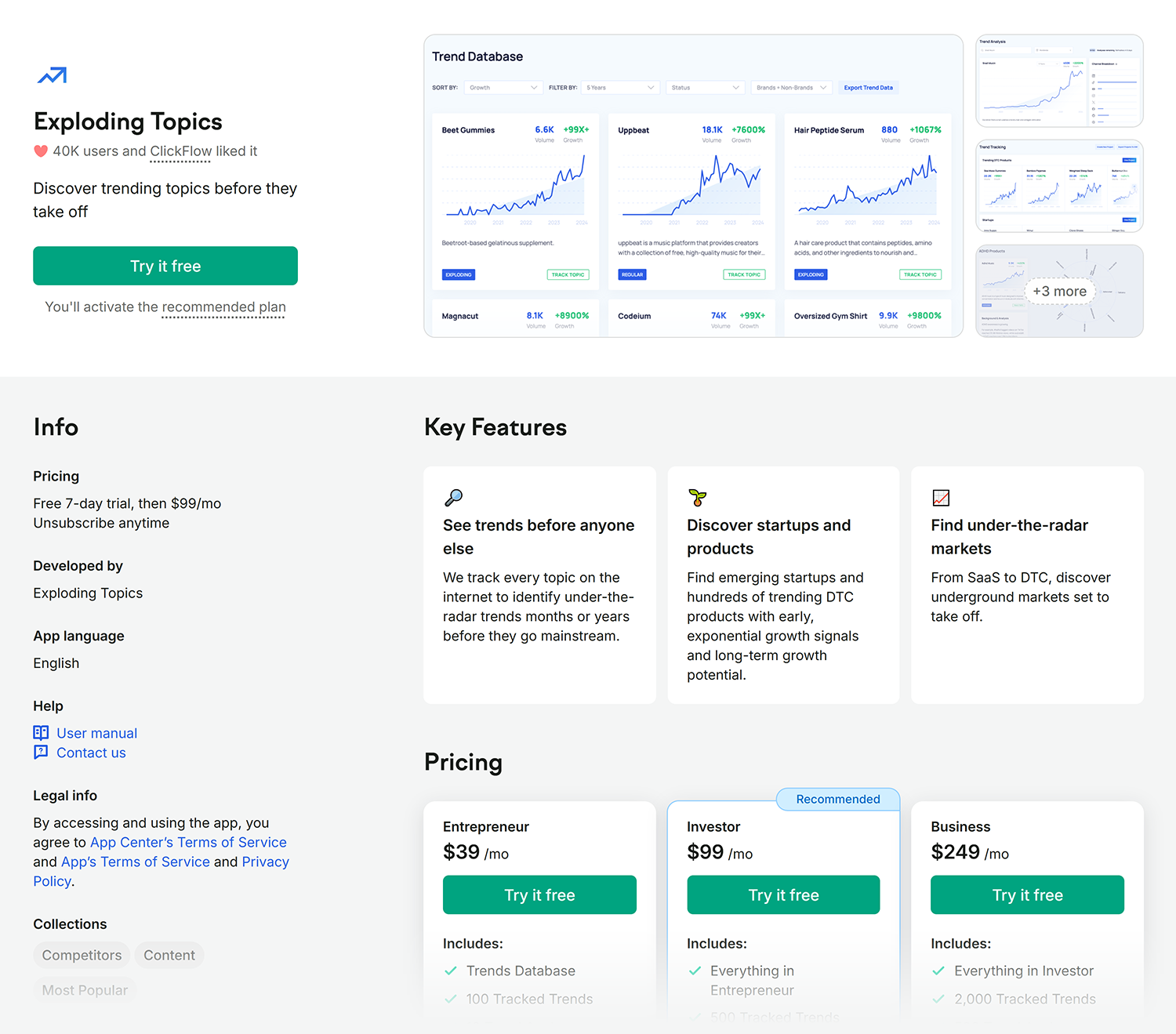
Exploding Topics spots trends early by tracking signals across search, YouTube, Reddit, TikTok, and other platforms, so you can build a cluster around a topic while competition is low.
Keyword research tools work off of historical and current search volume. A topic needs time to gain traction before it shows up with any real numbers, which means by the time it’s worth targeting, everyone else can see it, too.
Here are a couple ways to find emerging topics.
Search related trends
In Exploding Topics, open the ”Trend Analysis” tool and enter your seed phrase. For example, “smart bottle.”
The tool will show you:
- Whether the topic is trending
- Growth trajectory
- Where activity is concentrated across platforms

Now, scroll down to the “Related Trends” section, where you’ll find topics connected to your seed topic. Each one is a potential page in your cluster, and each comes with its own growth and volume data.

Sort this list by different growth classifications to surface fast-climbing topics or sort by volume classifications to separate by different volume levels.
To find the best potential topics, target ones that are climbing but haven’t plateaued. Also, run each subtopic one-by-one through the Trend Analysis tool to keep expanding your related topic list.
Check for related meta trends
Meta trends group a set of related trends under a single umbrella, so you can see the broader market your topic belongs to and the cluster of subtopics that come with it. With meta trends, you can get a whole cluster mapped to one market.
Head to the “Meta Trends” tab and look for a topic that fits the market you’re building around. For the term “creator marketing,” there’s currently a “Content Creator Essentials” meta trend:
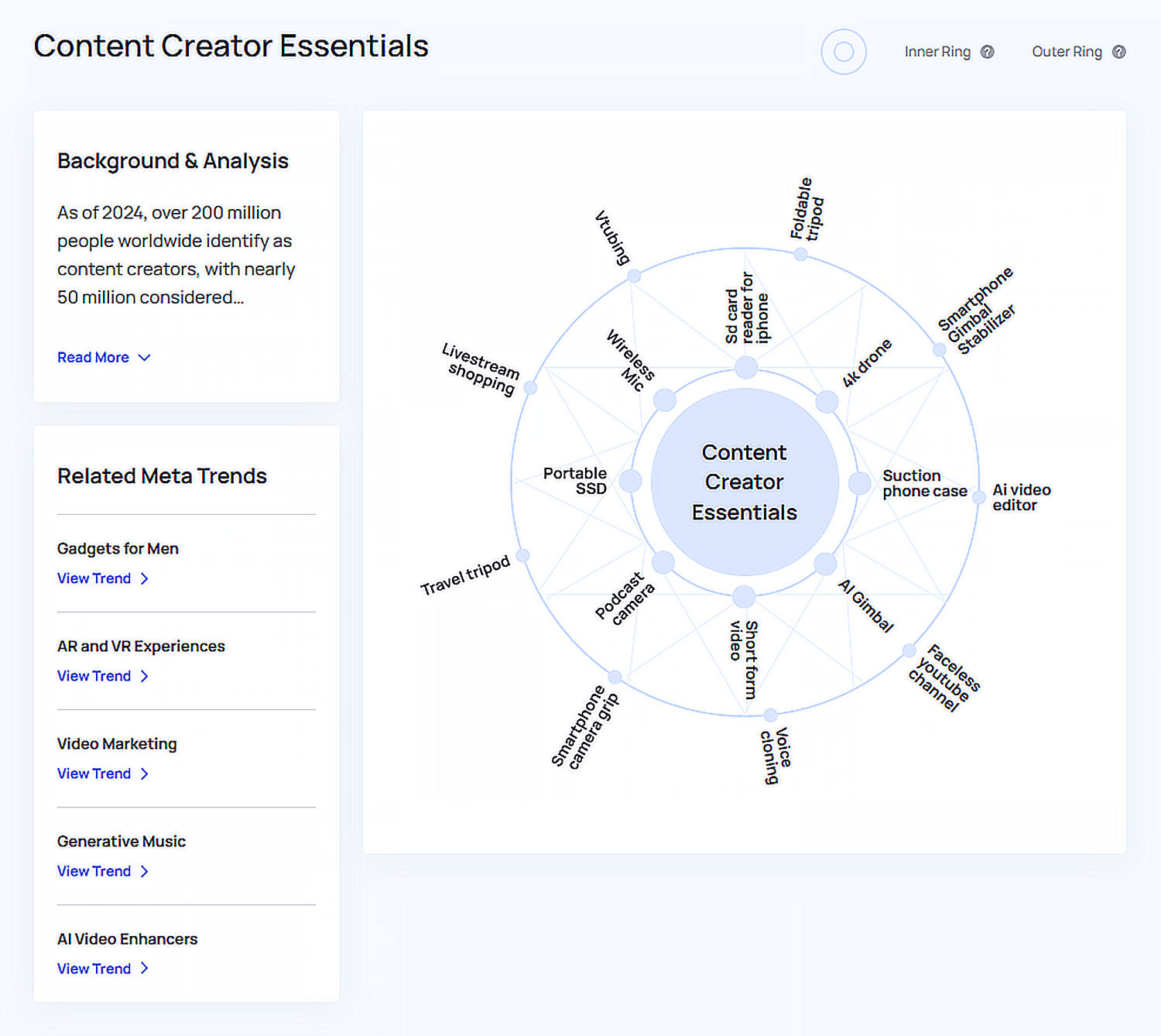
The meta trend is in the center, circled by individual trends that make it up. Each one is a distinct angle on the larger topic and a potential page in your cluster. For a “creator marketing” cluster, topic-worthy trends might include:
- Short-form video
- Livestream shopping
- Faceless YouTube channel
- Voice cloning
- AI video editor
- Vtubing
Also, check out the “Related Meta Trends” panel. It links out to adjacent umbrellas, like “Video Marketing,” which can be folded into your cluster.
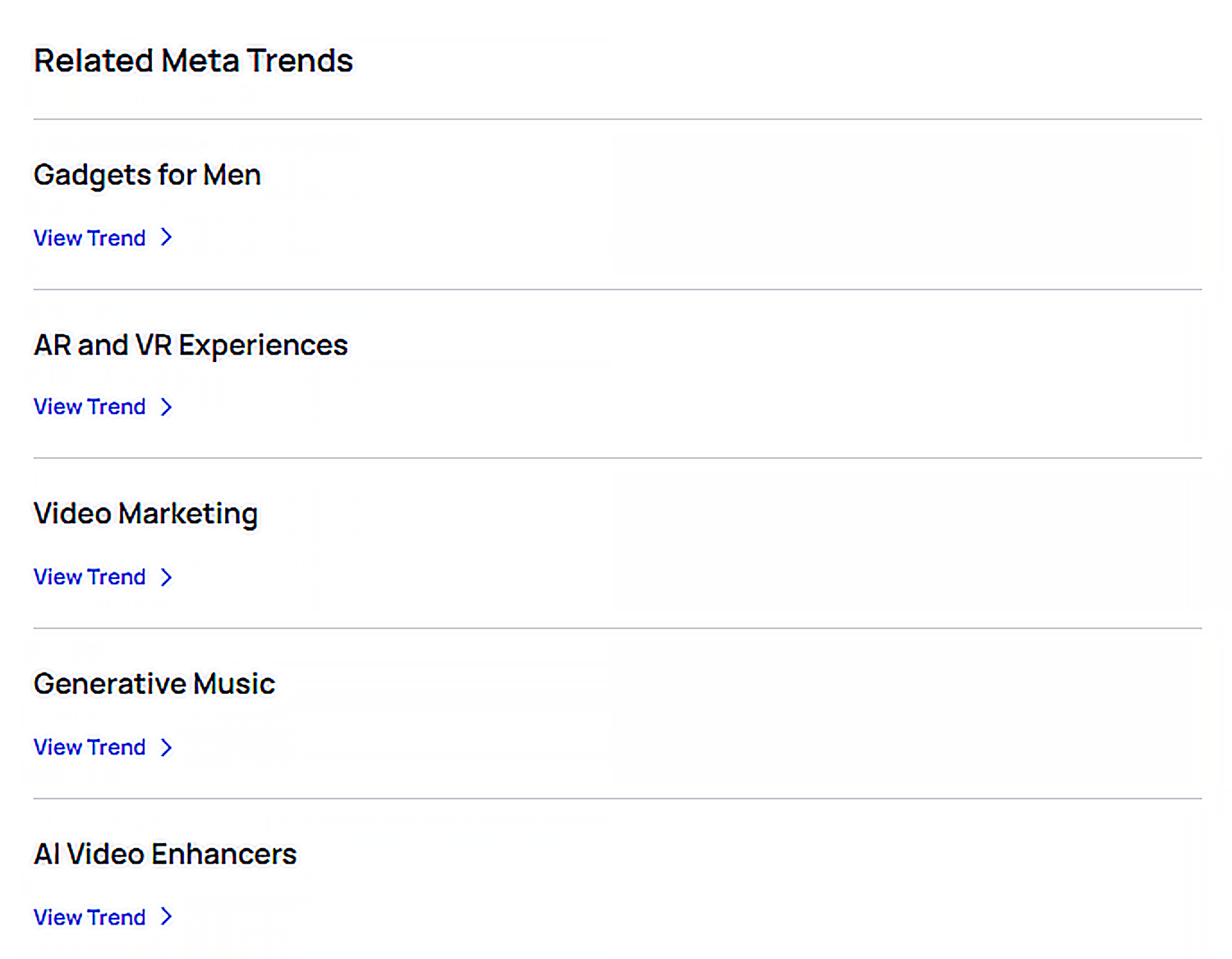
Pro tip: Meta trends can include topics at different stages of popularity — some may be climbing and some may be past their peak. Check the growth classification of each one, just like with related trends, and prioritize topics increasing in popularity.
Cluster topics for AI search
To get maximum AI visibility, figure out which topics belong together on one page and which ones deserve their own page. Group topics by how semantically related they are — semantic closeness helps AI engines decide what to pull into an answer.
Most keyword clustering tools group topics by search engine results page (SERP) overlap — if two keywords return similar Google results, they’ll land in the same cluster. (Semrush’s keyword cluster tool can help you identify SEO topic clusters for traditional search.)
But AI search plays by different rules.
AI search engines reward comprehensive pages that answer several related intents at once — query fan-out optimization — instead of pages with a single, focused intent. They do this using semantic similarity.
Use semantic and cosine similarity to cluster topics
Semantic clustering means grouping topics by how closely their meanings relate. This method of matching by meaning rather than phrases is a better fit for AI search.

AI engines turn language into long strings of numbers called embeddings. Every word, question, and passage gets converted into an embedding, and that string of numbers captures the meaning of the text.
Two pieces of text with similar meanings get similar strings of numbers, even if they don’t share the same words.
For example, “how do I find creators?” and “ways to source influencers” are semantically similar and would have similar embedding numbers despite not having any overlapping words.
Cosine similarity works similarly. Picture each embedding as an arrow pointing in a direction. Text with similar meanings point in a similar direction and have a similar angle of measurement.
Cosine similarity is a comparison of the angle between two terms: A small angle means the meanings are closely related, while a wide angle means they’re not.
When someone asks an AI search engine like ChatGPT a question, it breaks that question into smaller sub-questions, turns each one into an embedding, and looks for text with embeddings that point in a similar direction or have a similar angle. It then pulls those passages into its answer.
When you cluster topics by meaning, you’re running a rough version of this process. Topics that cluster tightly are ones an AI search engine is likely to retrieve together for a query, so they would belong on the same page.
Tools to cluster topics
There are a few different methods and tools to find the best clustering topics, depending on how technical you want to get:
- Embeddings-and-cosine-similarity method without having to write code: KeywordsPeopleUse
- Embeddings-and-cosine-similarity method with code: Semantic keyword clustering with Python
- Mapping keywords to topics: supervised and unsupervised machine learning approaches
We’ll walk through the first option, since it’s the fastest way to get to a usable cluster map.
Run topics through the semantic tool
Open KeywordsPeopleUse > “Semantic Keywords.” Make sure you’re on that tool — the platform also offers a keyword clustering tool that groups keywords by shared search results, which is the traditional SEO strategy we’re moving away from.
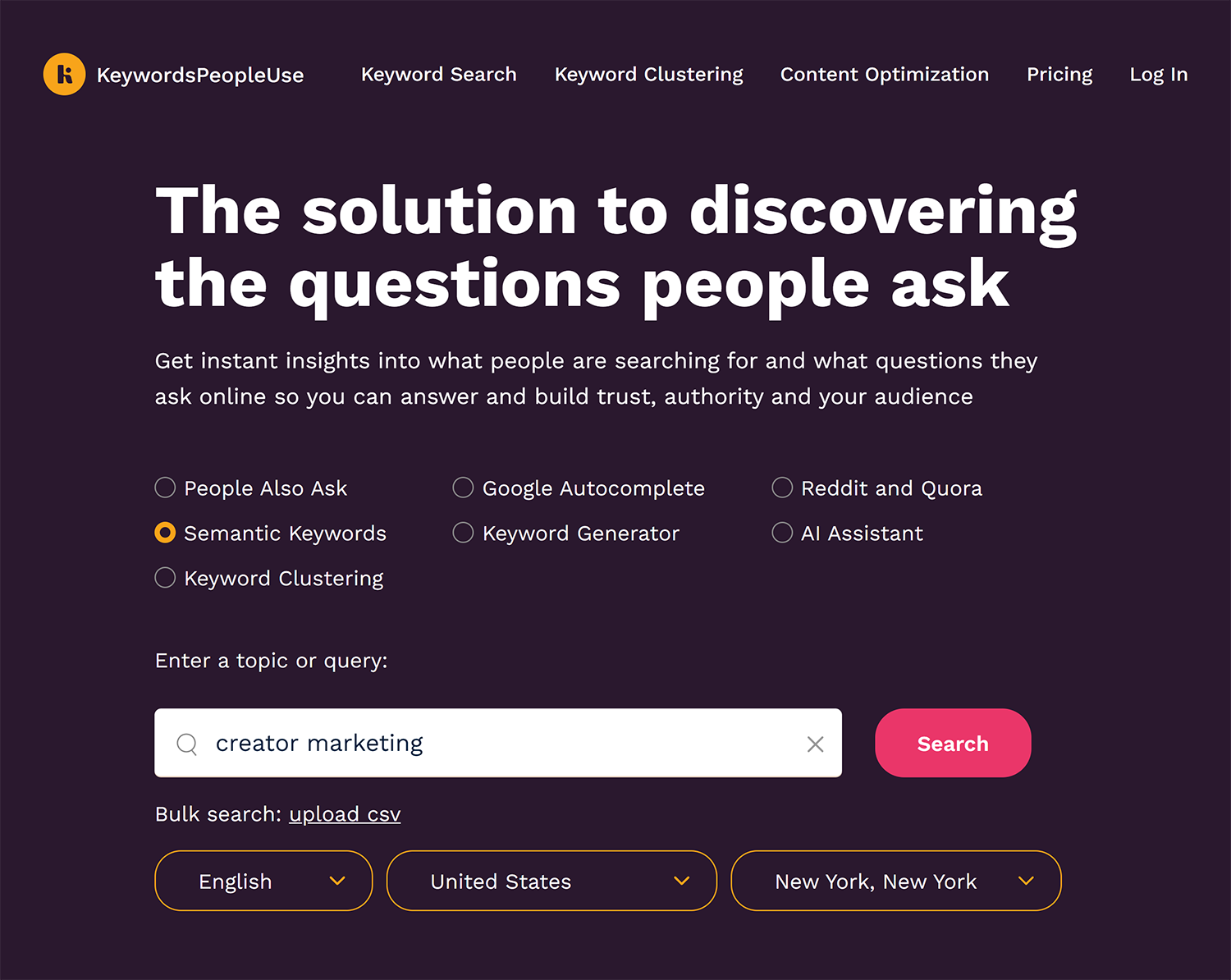
Enter your topic, for example, “creator marketing.”
Set your language and country, then click “Search.”
Read the semantic map
The tool will return queries, questions, entities, and concepts that Google treats as closely connected to your topic, organized by starting letter.
To group the phrases into clusters, click on the “Keyword Groups” tab:
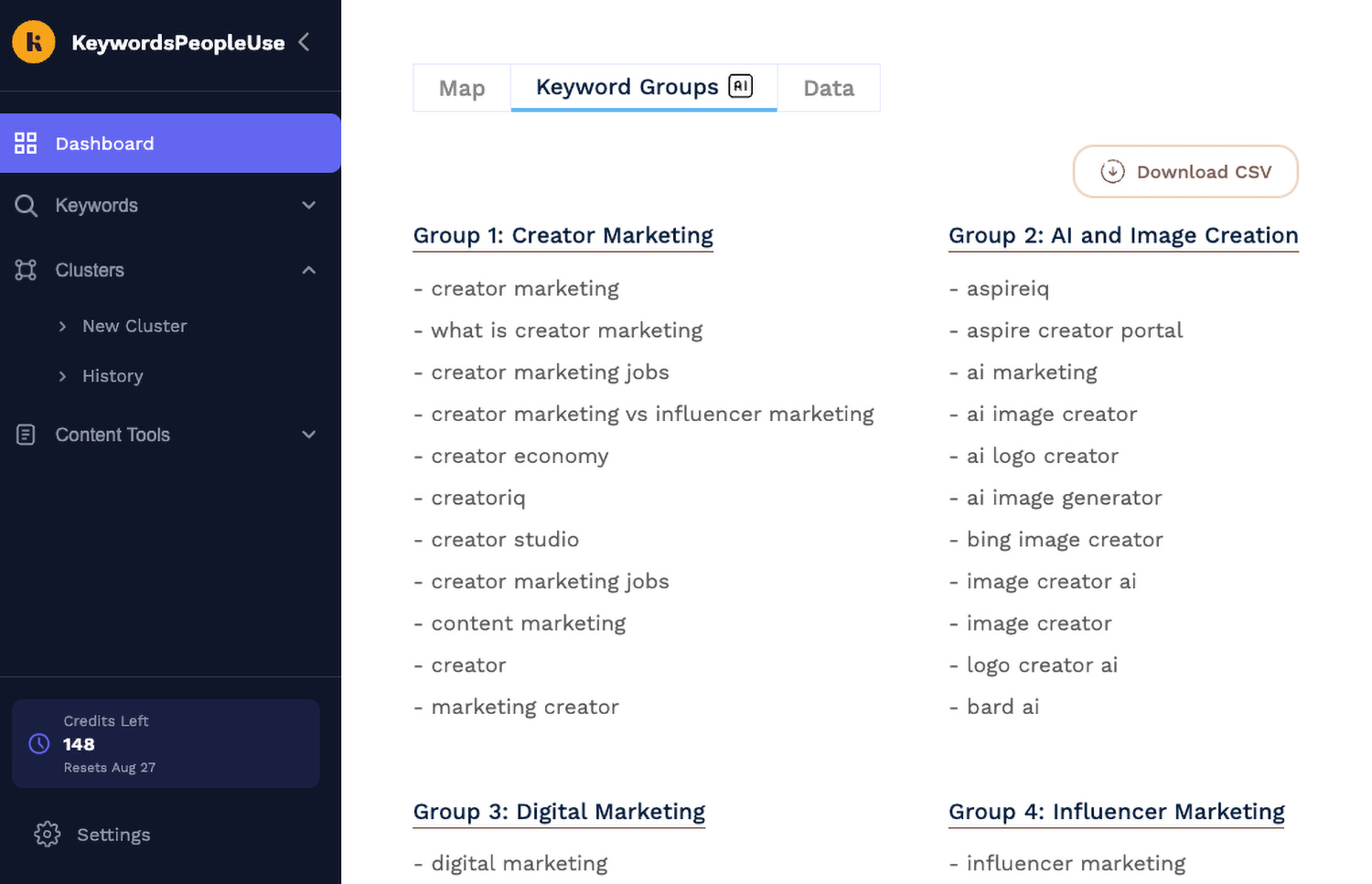
Here, the tool identifies different entities in your semantic keywords that fit together in general groups. In our creator marketing example, the tool groups semantically related topics together in buckets like “AI and image creation,” “digital marketing,” “influencer marketing,” and more.
Now look at the trending topics you found in the Exploding Topics method from above — where does “livestream shopping” land relative to “short-form video,” for example?
You may need to run more specific keywords through KeywordsPeopleUse to find the right fit for your trending topics (“creator marketing” is very broad). But if they group together in the same related bucket, that’s a signal they belong on the same page.
Turn clusters into pages
Create one comprehensive page per content cluster, covering every topic and question inside it.
In our example, “how to find creators,” “vetting creators,” and “outreach best practices” end up on a single page about finding and managing creators because they cluster together semantically. Measurement topics like KPIs and attribution form their own cluster and therefore their own page.
Export your clusters to a CSV file so you have a working list. Now, you have a content strategy.
Find fan-out queries for each topic to map out subheadings
When someone searches, an AI search engine doesn’t just answer that single query. It fans out that query into a batch of related sub-questions, retrieves the best passage from each, and synthesizes them into one response — this is called query fan-out.
If you map those sub-questions onto your page as subheadings, AI engines can retrieve them easier. A single page that directly answers all sub-questions gives the engine more to pull from, leading to more of a chance that your page will get cited.
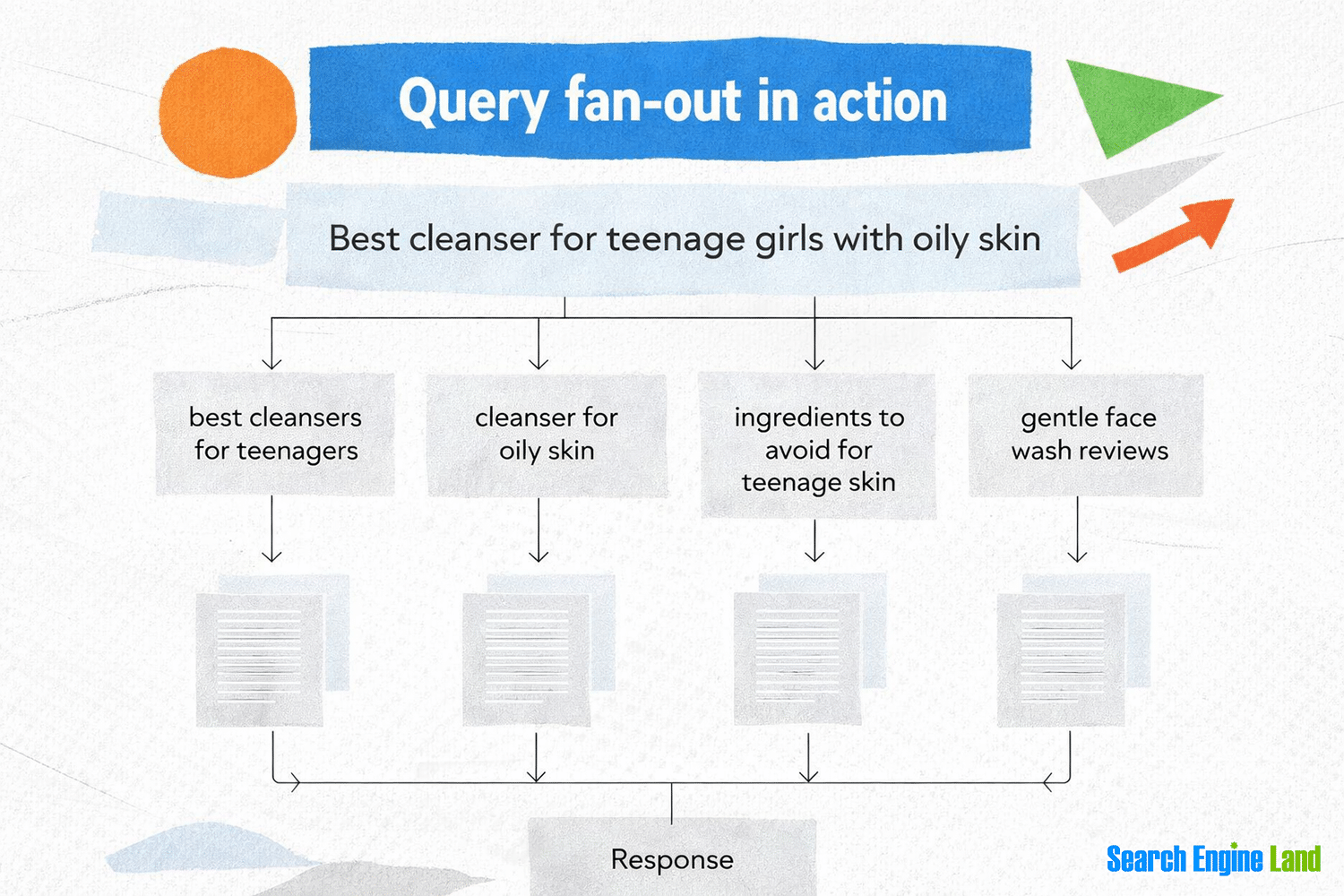
How to find fan-out queries
To optimize a page, predict the fan-out for each topic cluster and then structure the page around it. Here’s how.
Run each cluster topic through Wellows
There are multiple query fan-out tools. For this tutorial, we’ll use Wellows.
Open the Wellows Query Fan-Out Generator and enter the topic of one of your cluster pages. For our example, we’ll use “creator marketing tools.”
Fill out your seed keyword, domain, email, and location, then click “Generate Queries.”
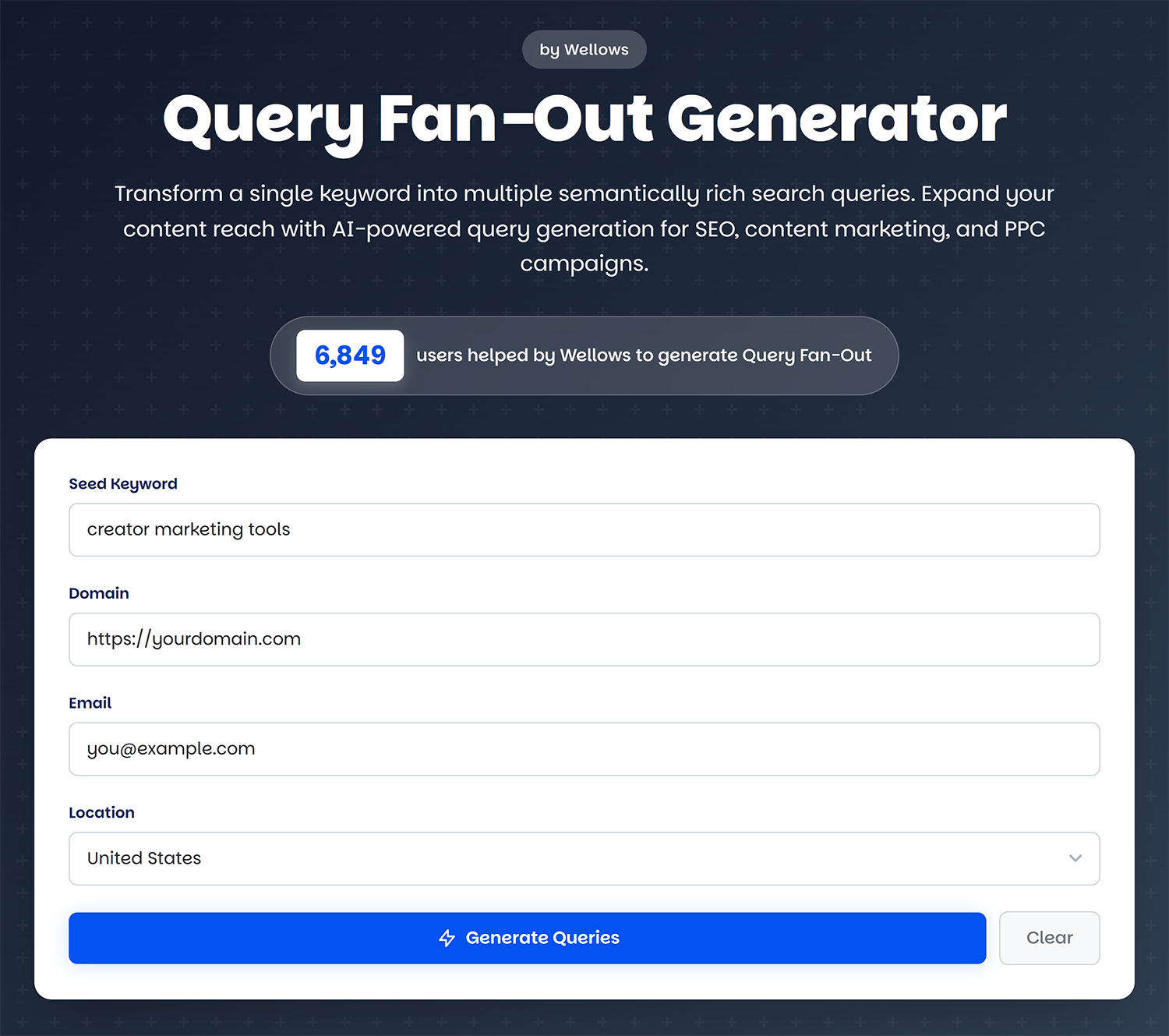
The tool will expand your topic into 40+ related queries, each classified by intent, popularity, relevance to your domain, and more.

Read results as a subheading blueprint
Wellows scores each query and sorts it into different tiers, which is helpful in creating an action plan:
- Tier 1 queries are central to your topic. These should be your primary subheadings, the questions the page has to answer first and foremost.
- Tier 2 queries are strong supporting angles. These could become subheadings too, if they fit well within the scope of your content.
- Tier 3 queries are related terms that you should take into account but keep on the backburner. Pull these in where they fit, or save them for later.
Each query is scored on popularity, relevance, and prominence, so within any tier you can see which topics carry the most weight.
Map queries to your pages
To help turn your list into an outline, export it as a CSV.
Focus on Tier 1 and 2 queries — group them by user intent and drop topics that don’t fit the page’s focus.
For example, after running “creator marketing tools” through Wellows, and thanks to additional data from KeywordsPeopleUse, the outline for our article on creator marketing tools would look something like this:
- H1: Creator Marketing Tools Guide: All the Best Tools Creators Need in 2026
- (Intro)
- H2: Best Influencer Marketing Tools (3-4 tools)
- H2: Best AI & Digital Creation Tools (3-4 tools)
- H2: Best Content Creator Tools (3-4 tools)
- H2: Best Tools for Creator Marketing Campaigns (3-4 tools)
- H2: FAQ (using questions surfaced by Wellows)
On-page optimization: Design for extractability
Extractability is a measure of how easily an AI search engine can take a passage of text from your page and use it in an answer.
AI engines don’t use whole pages of content. They pull individual chunks, so each section on your page needs to answer a question completely on its own without leaning on paragraphs around it.
A page can rank well and still get passed over if its answers are buried in long, meandering paragraphs that the engine can’t cleanly understand or take.
Designing content for easy extraction makes every section a candidate for AI citation.
Here’s how to do that.
Structure each chunk to stand alone
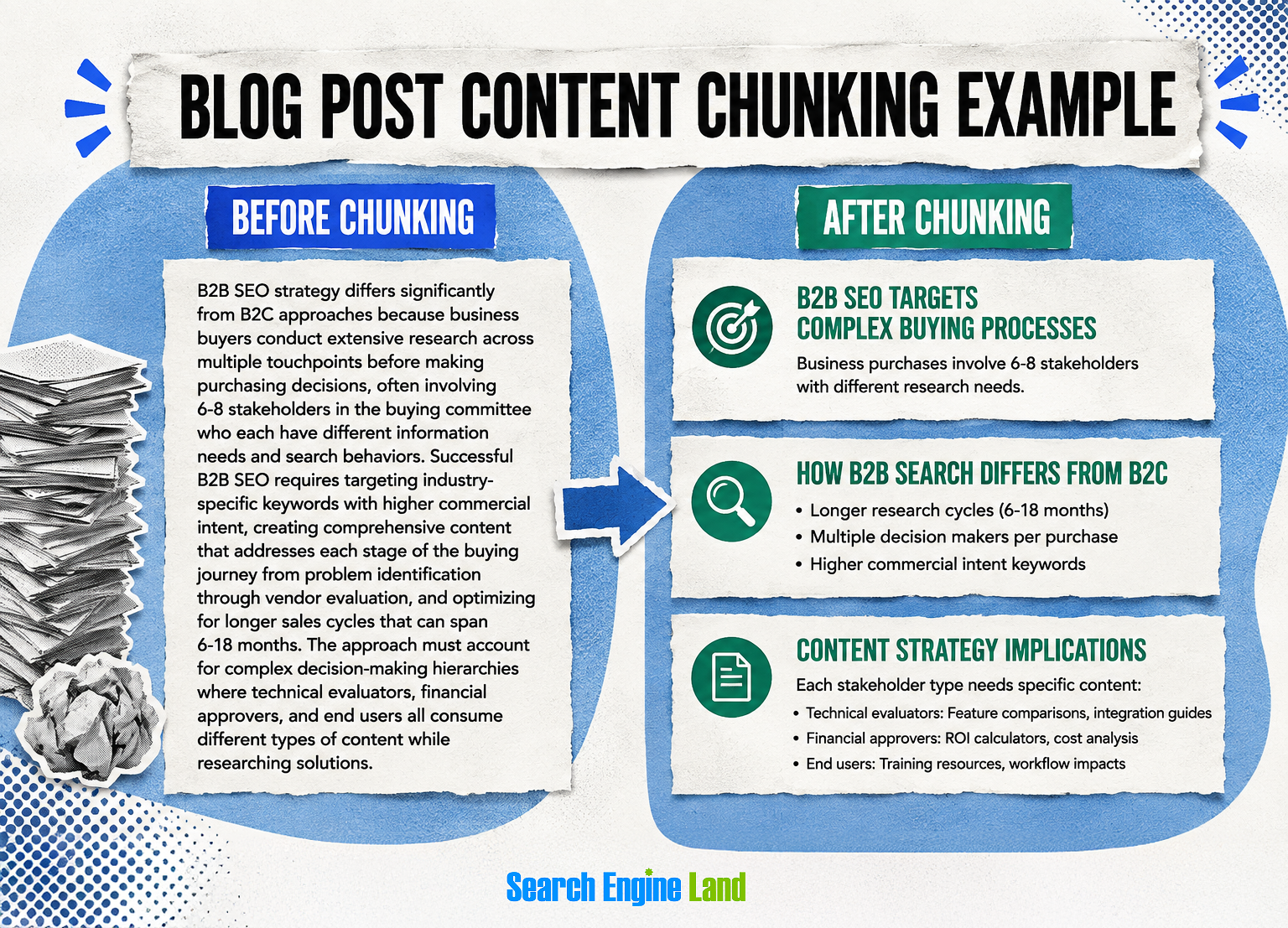
A chunk is a section of your page that makes sense on its own, without the rest of your article. To make chunks extractable:
- Start each chunk with a subheading phrased as a question or a clear statement that matches how people search.
- Lead with the answer, then add detail — front-loading lets the engine get to the point without delay.
- Keep each chunk focused on one subject, avoiding unrelated details that could muddy the passage.
- Name the topic explicitly in the opening lines instead of relying on “it” or “this,” so the chunk makes sense alone.
Ask yourself: If an AI engine pulled this passage out and showed it with no surrounding context, would the passage answer the question?
A good example is: “Creator marketing works well for brands that want to grow their authentic reach without the cost of popular influencers” because it names the subject and can stand alone.
“It works well for many brands” doesn’t work because it depends on the sentence before to define what “it” is.
Dig deeper: Use content chunking to structure information for better UX, rankings, and AI visibility
Format for extractability
Think of the best format for each answer. For instance: a table for a comparison, a numbered list for a process, or a set of common questions for an FAQ. Use clear headings throughout, and keep tables and lists tidy. These structured formats are easier for AIs to lift whole.
To get a better sense of which format to use, research current AI answers for the topic — how do competitors format their content?
Link related pages
Once your cluster pages are live, build an internal linking structure that connects them with bidirectional links to related pages in the cluster with descriptive anchor text, making sure they also link back.
This maps the relationships between your pages and topics for AI engines, helping them see the full scope of your coverage, not just one page on its own.
This is an important part of creating topic clusters, so don’t skip it!
Send strong E-E-A-T signals
AI engines favor content that demonstrates experience, expertise, authoritativeness, and trust. One of the best ways to create that is to use original data — proprietary research, first-hand testing, or stats no one else has. AI engines prefer original content that can’t be found anywhere else.
Dig deeper: An SEO guide to understanding E-E-A-T
SEO fundamentals: Page experience and freshness
Two baseline SEO factors still matter when optimizing for AI search: page experience and freshness.
An optimized website with fast load times, no intrusive pop-ups, and clean mobile rendering delivers the user experience that keeps your content accessible to both AI engines and readers.
Freshness counts, too. According to Seer Interactive, AI engines lean toward new content. Keep your cluster pages updated as topics evolve.
Build authority with topic clusters
Building topic clusters for AI search involves building fewer, deeper pages that answer a cluster of related questions rather than one query per page. Find emerging topics, cluster them by meaning, map subheadings using query fan-out, and format pages so answers are easy to extract.
To go deeper on using topic clusters for AI search, check out our guide on optimizing for AI Overviews, which covers how to earn placement in Google’s answers, and our query fan-out guide, which goes further into mapping and finding sub-questions for your pages. And once your topic clusters are live, optimize for AI crawlers to make sure engines can actually access and index what you’ve built.
Explore more on
Editorial disclosure
Search Engine Land is owned by Semrush. We remain committed to providing high-quality coverage of marketing topics. Unless otherwise noted, this page’s content was written by either an employee or a paid contractor of Semrush Inc.
About the author