Google Ads is removing language targeting from Search campaigns

Google is removing campaign-level language targeting from Search and AI Max for Search campaigns starting in late September, shifting responsibility for language matching to Google’s automated systems.
Instead of advertisers explicitly selecting which languages to target, Google will determine which ads to serve based largely on the language of the ad alongside signals about the languages a user understands.
What’s changing. For Search and AI Max for Search campaigns, the campaign-level language targeting setting will disappear. Google says Search ads will automatically match based on the language of the ads.
Performance Max gets a more nuanced change. For ads appearing on Google Search, campaign-level language settings will no longer apply and language matching will work the same way as standard Search campaigns.
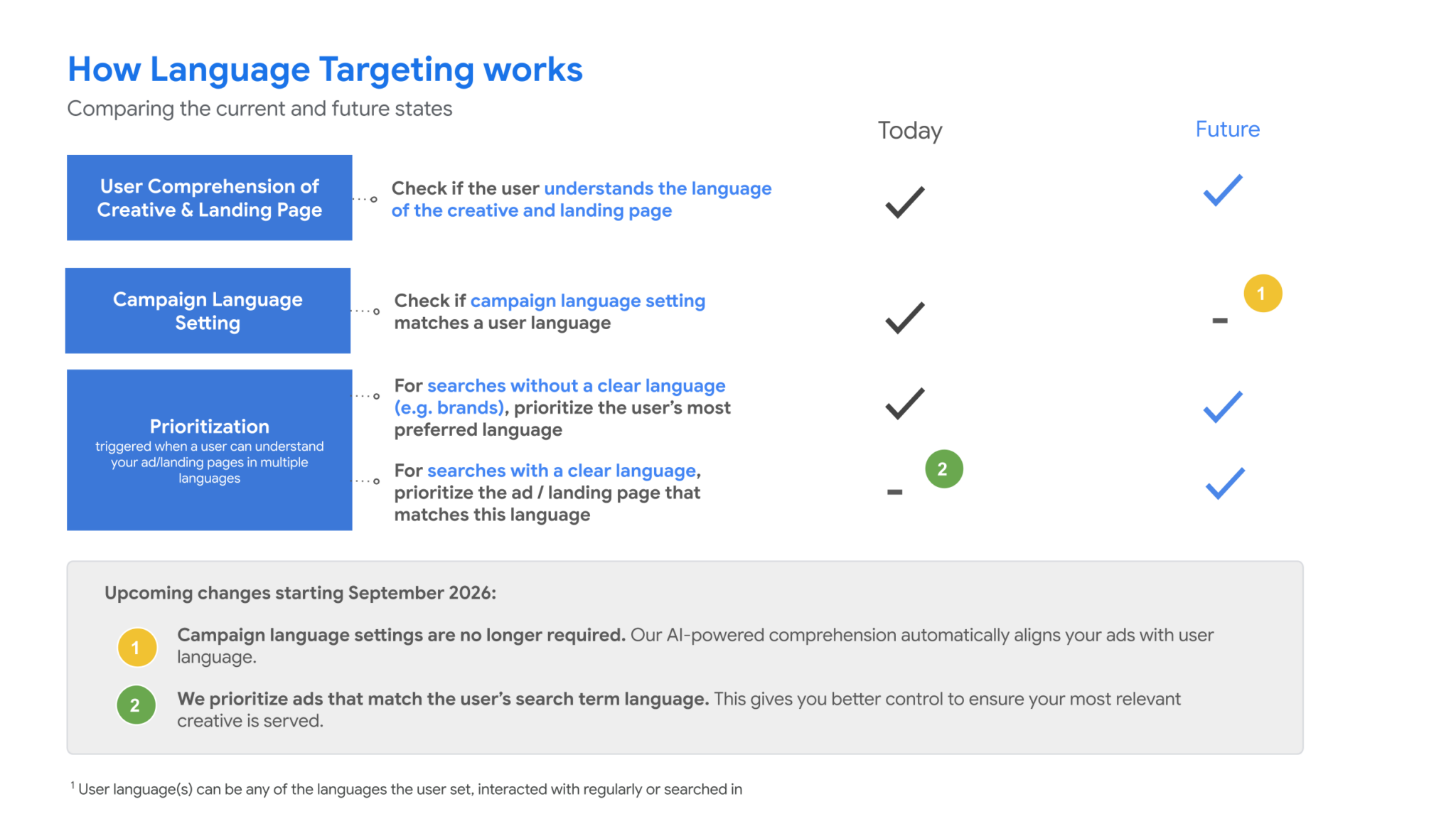
But language targeting isn’t disappearing entirely from Performance Max. Advertiser-selected language settings will continue to guide delivery across YouTube, Display, Discover and Gmail, while Shopping ads within Performance Max aren’t affected by language settings.
How Google will choose. Google already uses more than a user’s interface language to determine which languages they understand. On Search, signals can include the language of the search term, user language settings and other preferences.
That means someone whose browser is configured in Spanish but who regularly searches Google in English could potentially receive ads in either language.
When multiple eligible campaigns exist, Google says AI-based ad group prioritization will determine which ad candidates have the most relevant language for the user.
What advertisers need to do. Google says no action is required for existing campaigns, but the change puts greater importance on the languages used in ad creative and landing pages.
Advertisers running multilingual campaigns should make sure their ads and destination pages are clearly structured in their intended languages, since those signals will become increasingly important for Search language matching.
API changes. Developers will also need to adjust how they create and manage Search campaigns through the Google Ads API.
Google recommends stopping the use of language criteria when creating or updating Search campaigns. Existing language criteria can remain but will no longer affect targeting and can optionally be removed.
Attempts to add or update CampaignCriterion.language for Search campaigns will return a ContextError.OPERATION_NOT_PERMITTED_FOR_CONTEXT error. Performance Max won’t return the same error because language settings can still influence its non-Search channels.
Why we care. Google is removing a manual targeting control from Search, meaning you’ll no longer be able to explicitly choose which languages your campaigns target. Instead, Google will decide which language ad to serve using ad language and its own signals about what users understand, which could create less predictable delivery for multilingual campaigns.
Advertisers should review campaign structures, creatives and landing pages and closely monitor performance once the change rolls out.
Bottom line. Google isn’t eliminating language matching from Search; it’s automating it. Beginning in late September, Search advertisers will no longer choose campaign-level languages, while Google will use ad language and user signals to determine the most appropriate ads to serve.
Dig deeper. Google Ads Liaison, Ginny Marvin, also shared this help doc with more info about AI-driven ad group and asset prioritization that will be used to identify the most relevant ad based on the users’ specific context and language preference at auction time.
Explore more on
Editorial disclosure
Search Engine Land is owned by Semrush. We remain committed to providing high-quality coverage of marketing topics. Unless otherwise noted, this page’s content was written by either an employee or a paid contractor of Semrush Inc.
About the author