
How to audit your brand using search data
SEO data isn’t just for rankings. It’s a tool for brand intelligence. See how search trends exposed big shifts in the sports drink industry.
Big brands have a blind spot.
They talk about “brand health” while ignoring what users are actually asking about their products – on Google, in AI answers, and across search data.
Meanwhile, all the signals are right there in the SEO stack.
Questions like “Is Gatorade actually good for you?” aren’t just keyword opportunities.
They’re warning signs. And if you know how to read them, they expose major gaps in brand trust and positioning.
The brand audit hiding in your SEO tools
I sent a client a 100+ page audit evaluating their brand (to be fair, there were a lot of screenshots), and their first question was, “Where did you get this data?”
It was SEO data.
They had never seen this sort of data before – and didn’t even know it existed.
I use SEO data to audit brands all the time. It sounds nuts, but it’s not.
It’s actually really helpful data you’re probably already paying for, just being put to a new use.
And that’s the point: you don’t need to go out and buy another tool to do what I’m about to show you.
You already have what you need.
Below is a case I stumbled upon that’s pretty typical of what I see when I run a brand audit for a client.
And I’m going to use the data you have inside your SEO toolset to do it.
Tapping into market pressures
In January 2024, Gatorade – sports drink giant and go-to beverage for sick kids everywhere – saw its branded traffic fall off a cliff.

Now, there can be any one of a million reasons why this would happen.
And you might start by sifting through and seeing what keywords they lost or which are declining, etc.
That would take a lot of time. The best thing to do is probably figure out if this has to do with Google’s algorithm or the brand itself.
Thus, I pulled the search volume for “Gatorade” as of May 2025:

Then I pulled the same data for May 2024.
What do you know, search volume for Gatorade is down about 35,000 searches per month in the U.S.:
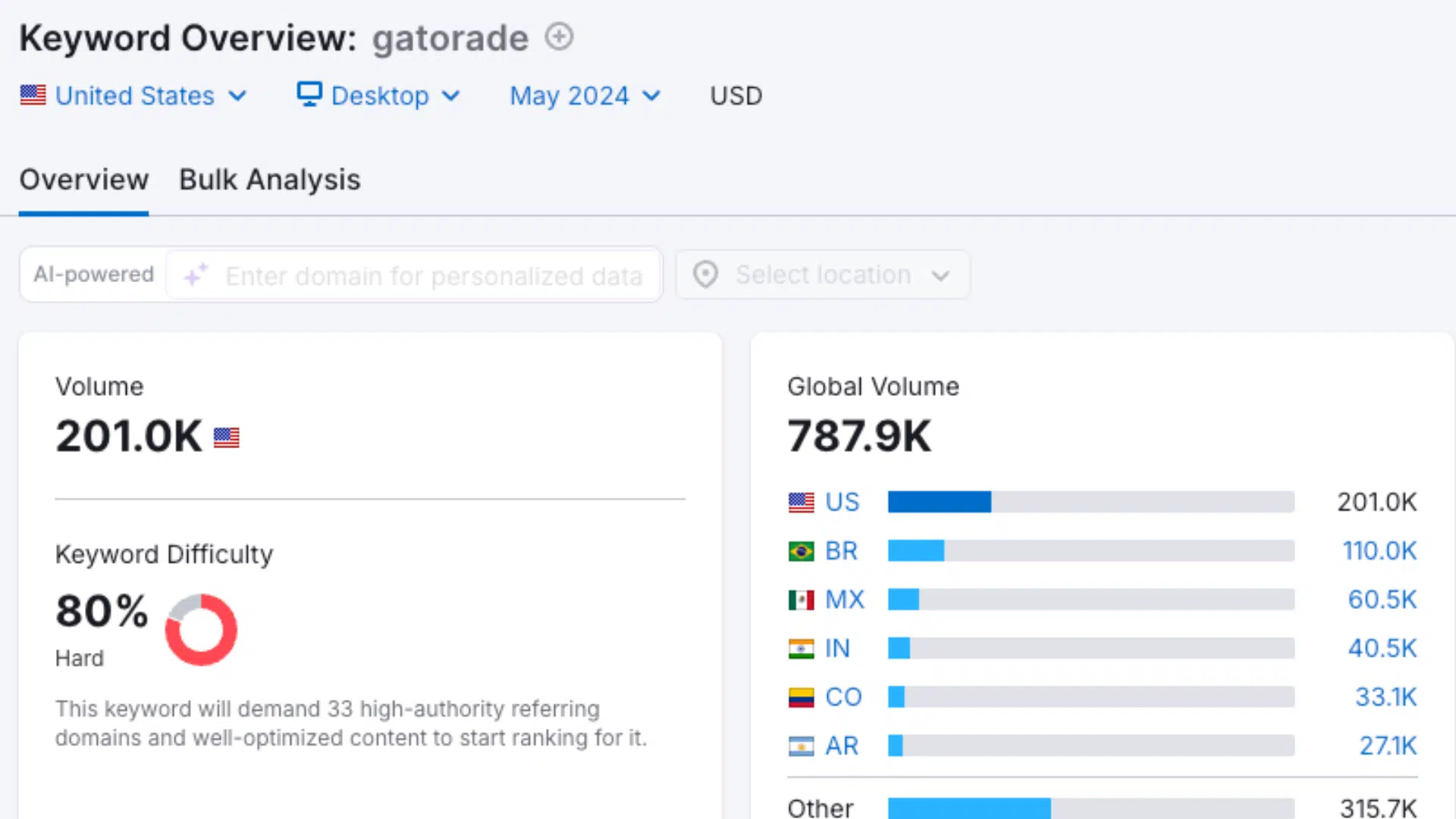
Going back to May 2023, while the U.S. search volume didn’t change, the global volume declined by roughly 50,000 searches a month:

Something happened in 2024.
We now have two different datasets pointing to the same thing.
The question is, did something happen to Gatorade or the sports drink industry?
Right now, we don’t know the answer to that. Drawing any conclusion about anything related to Gatorade’s brand would be a bit premature.
The easiest thing to do is to take their competitors and run the same analysis.
If we see the same pattern, then we can move ahead. If not, just give up (I’m kidding).
Thankfully, we do not need to give up, because Gatorade’s main competitor, Powerade, shows the same dip in brand traffic at the same time:

To further confirm this, the search volume for “Powerade” follows a similar pattern as we saw for Gatorade.
In May 2025, the search volume for the term “powerade” in the U.S. was 33,100 searches a month:

Now, unlike Gatorade, this is actually up from 2024, where the U.S. search volume was 27,100:

You might think this throws a wrench in the whole narrative.
Gatorade lost searches for its brand name between May 2024 and May 2025, whereas
Powerade only gained popularity.
Not so fast, all it shows is that the “events” that hit this industry most likely took months to play out, as the decline here just happened earlier.
In May 2023, the term “powerade” had a monthly search volume of ~33,000:
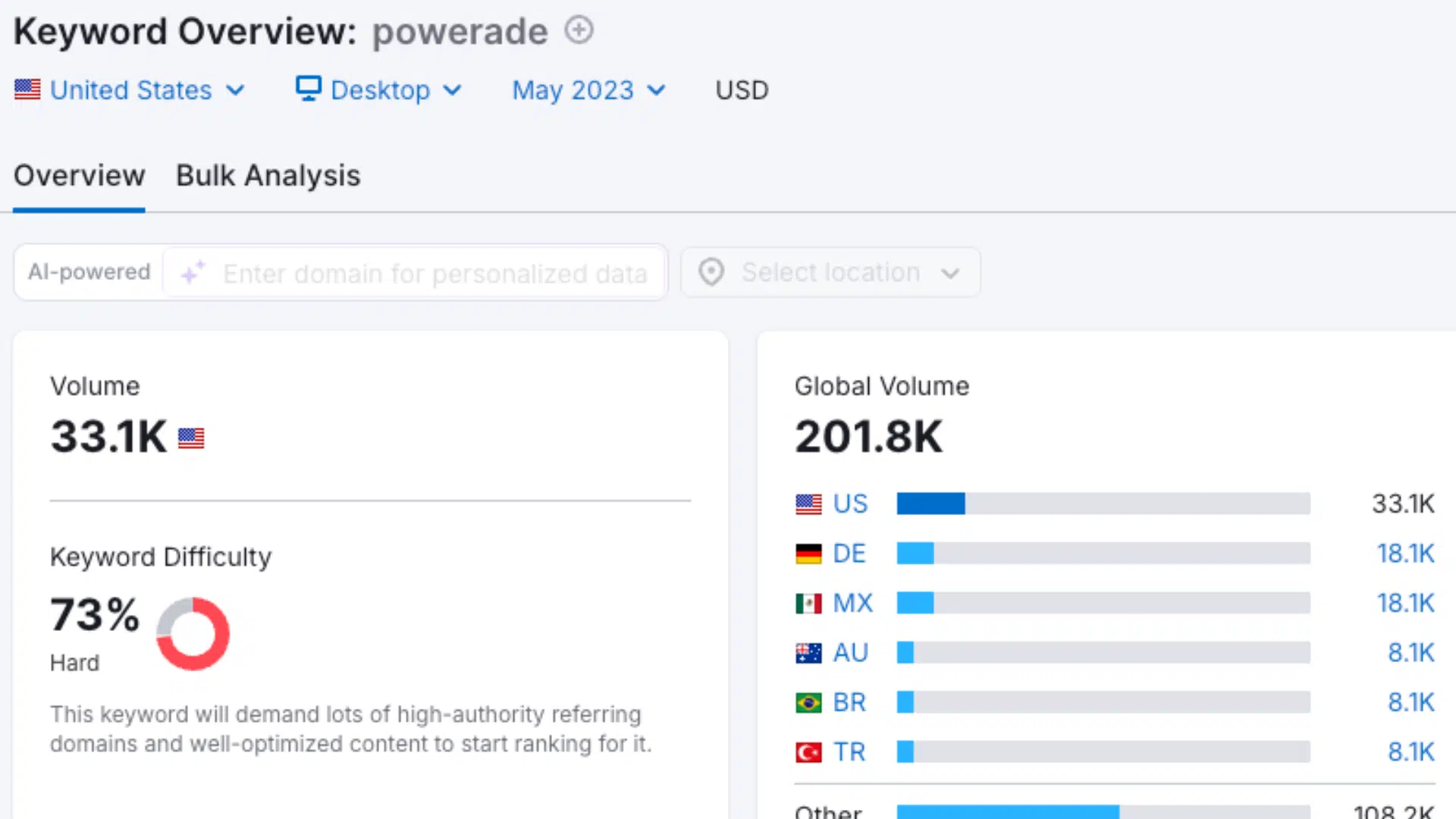
The term lost around 6,000 searches a month somewhere between May 2023 and May 2024, according to Semrush.
(Global search volume was actually up between 2023 and 2024, I would speculate as part of a pivot to focus on the global market more.)
Still, why did Powerade’s search volume rebound in 2025 while the time “gatorade” didn’t?
Great question. I’m not going to even answer it, because as you are going to see, we have much bigger fish to fry.
Next up is Bodyarmor, which, like Powerade, is owned by Coca-Cola. Here, too, there is a blip on the radar in January 2024:

Unlike the two legacy brands (Gatorade and Powerade), the search volume for Bodyarmor has only increased over time.
As of May 2025, the keyword “bodyarmor” pulls ~14,800 searches a month in the U.S.:

That’s up from 12,100 as of May 2023:

If I’m being honest, which in an article like this, I am not supposed to be (I am just supposed to present insights and data as if everything I say is the absolute truth with zero nuance), I could go either way with this site.
The slight dip in the data in January could be any number of things, and it’s not incredibly drastic either way.
The search volume increase does make sense since Coke only fully bought out the brand in 2021. It was still carving its space out for itself (as opposed ot the more established brands).
What tips the scale is what Coke’s Vitaminwater did – pull in more branded traffic in January 2024:

Suddenly, out of nowhere, Coca-Cola’s vitaminwater. (Yes, Powerade, Bodyarmor, and vitaminwater are all owned by Coke.)
Whether it was tied to a brand campaign or whatnot, there’s a strong correlation between sites like Gatorade and Powerade losing brand traffic and vitaminwater popping up on the SERP.
I would imagine there was some sort of campaign that drove greater interest in vitaminwater at this time, as the entire page was only created in 2024 per the Wayback Machine:

What most likely happened is that Coke added the vitaminwater page to its brands subfolder (/brands/subfolder) and ran a campaign around the same time.
As a result, interest in “sports drinks” was diverted from brands like Gatorade to vitaminwater.
The search volume data would support this narrative.
Search volume for the term “vitamin water” stood at 49,500 in the U.S. as of May 1, 2025:

This is the same level of brand interest from a search volume point of view that was seen in 2024:
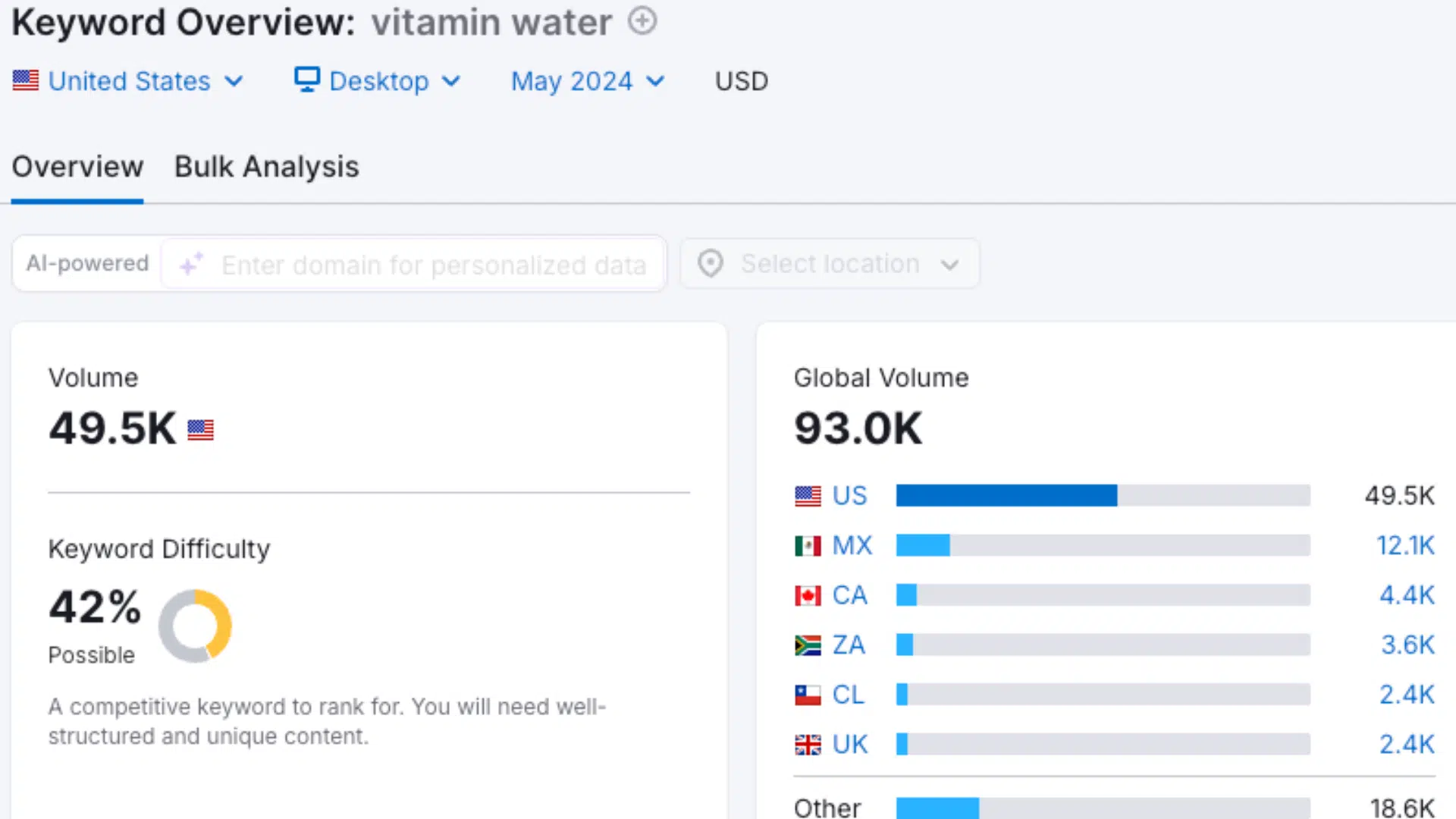
However, that is a 22% increase in search volume (which I am using as a proxy for brand interest) since 2023:

The search volume data directly supports the branded traffic data I showed earlier.
It wasn’t some sort of optimization or the mere appearance of the page on the web.
There was some form of greater interest in the brand that correlates with the launch of the vitaminwater subfolder on the Coke website.
Which is again, why the page was unquestionably supported by some sort of brand campaign (could be the entire reason the page was even created).
Here we are again with an event that took place within this space somewhere in 2024. (Which is why the Bodyarmor data is relevant to me.)
At this point, it felt like there was legitimately something going on in this industry. Once the red flags were I did a bit of digging, and there was (or is) something going on.
The sports drink industry had become markedly more competitive, as noted by CNBC in April 2024:

Now, it all makes sense.
When you see the branded search traffic decline, it makes sense.
When you see Vitaminwater come in and seemingly disrupt the market, it makes sense.
The data we used created a narrative that we can point to in reality.
The sports drink industry has gotten extremely competitive and disruptive.
The upshot is, at least from a brand audit point of view, you now have context.
I may have found the CNBC article at the start of this (which I didn’t), but even if I did, it has no context.
Seeing the state of the industry being covered by outlets like CNBC after having seen all the data gives the news report real context that you can use to make real marketing decisions with.
For the sentiment of it all
If the branded search traffic and search volume data helped us paint a picture of the sports drink industry, the sentiment data you have at your fingertips is a Picasso.
We’re about to put the data we just used to shame.
The top question Semrush shows for the search term “gatorade,” with a search volume of 12.1K searches a month, is “Is Gatorade good for you?”:

It’s the same for “powerade”:

It’s even the same for vitaminwater despite the brand having the word “vitamin” in its name:

This is a pretty strong signal that there is a substantial amount of user skepticism around the product vertical.
However, it’s not where I would end, but where I would begin.
Forget that this seems almost too uniform (which it’s not, as you’ll see), we still don’t have enough detail about the nature of the skepticism.
In plain English, we need to see more of what folks are skeptical about exactly.
Google’s People Also Ask is a fabulous proxy for this.
A simple search related to Coke’s Bodyarmor already tells us there’s some sort of controversy related to the brand (which is never a good thing):

One of the best ways to mine this data is using AlsoAsked, which allows you to dive into the subquestions Google shows within the People Also Ask feature.
For example, the term “gatorade” produces the question “Is Gatorade actually healthy for you?”
Pause. The world “actually” is huge.
And when you see something like that, it’s a red flag.
It assumes that the opposite is true. In this case, the question assumes that Gatorade is not healthy (and if they are saying it’s healthy, the brand is lying – which we’ll get to).
When you open this question, the subquestions within the People Also Ask feature are enlightening:

Two quick takeaways:
- “Is it OK if I drink Gatorade everyday?” This is huge, and it’s going to come into strong focus in a few moments. For now, just notice that people relate to the product like it might be a specialty drink.
- “Why don’t athletes drink Gatorade?” We’re not going to get into this here, but what indictment. People notice that the athletes don’t drink this stuff. I notice it. Watch a baseball game, everyone is drinking water.
The above questions are very similar to what the People Also Ask related to Powerade shows:

By the way, you can see the drop-off in brand power.
People are comparing Gatorade to Powerade, but Powerade gets compared to vitaminwater as well.
It’s the same thing, but worse, for vitaminwater:

People are not fooled. Just because they added the word “vitamin” does not mean people are dumb enough to think it’s healthy.
Again, we have the “actually” phrasology in the top-level question [Is vitamin water actually good for you?].
From there, it goes off the rails with:
- Is vitamin water good for the kidneys?
- Is vitamin water good for your liver?
- Is vitamin water zero ok for toddlers? (Seriously?)
There is a substantial amount of skepticism around the actual viability of these products from a health point of view.
And it again puts us right up on the doorstep of what the inner sports drink industry is talking about:

We just tapped into one of the major challenges of this entire industry by using keyword research and People Also Ask data from a sentiment perspective. To be blunt, I don’t understand why more people are not using the data this way.
Let’s go full circle and return to the CNBC report I referenced earlier.
Per the CNBC report, the issue was not only the various new players in the industry, but the consumer demand for a healthier sort of product. (Which, at this point, we know, is not surprising).
However, we have actual context. We don’t need the report (don’t get me wrong, it’s great confirmation, but you’re not going to have this in every niche for every product or service).
Using the data as we have, we have the reporting before anyone ever reported it.
It does help to see through the corporate nonsense. In the CNBC article, Gatorade’s President, Mike Del Pazzo, was quoted on their brand campaign to highlight the product’s health, saying,
- “This is one of the brands that has the best marketing campaigns, such great brand equity, consumer awareness, consumer love.”
Clearly, it hasn’t exactly gone over as Gatorade proclaims.
Our data shows huge amounts of brand equity drop-off that seems to be fueled partially by a substantial level of concern around the product’s health risks.
Don’t believe me? Just ask AI.
When I asked Google, “What should I know about Gatorade?” I got a mouthful about sugar content in the AI Overviews:

[Parenthetically, I find asking this sort of generalized question about a brand or niche incredibly insightful. It’s a good way to see what’s happening around a product or industry that can help you get your bearings quickly.]
Google’s AI Mode was pretty much more of the same, with a whole section about sugar content, and beyond:

ChatGPT spat back the same concerns:

I’ll tell you, whenever I see a brand or industry gap like we have here (in this case, we’ve seen both the industry and brand gaps), it always plays itself out in the LLMs.
Which makes total sense.
LLMs process the content out there on the web and act as a proxy of the web in a way.
When a theme is so pervasive, as it is here with health and the sports drink industry, it will make its way into the LLM outputs.
So, how did the brands handle this all? Not well
You would think that by now, the brands here would take more action regarding the perception (and perhaps reality) that they are not healthy.
The answer is they don’t.
We already saw that Gatorade either believes its own lies or is simply deluding itself.
Is it a surprise, then, that their homepage starts off by selling water bottles and does not mention (at the time of this writing) the word “health” a single time?

For the record, it doesn’t handle “health” on social or YouTube:

As you can see above, the brand’s YouTube content is all about promoting the brand with famous athletes.
Again, unlike the brand, we know that people are actually skeptical about this, as they know the athletes on TV are not actually drinking Gatorade as often as the brand might portray it.
The lack of digital content focused on health is incredible considering that the LLMs recommend the brand’s Coca-Cola-owned competitor.
When I asked chatGPT, “Which is healthier Gatorade or vitaminwater?” it basically told me the latter:

This goes back to the People Also Asked question I noted earlier, which referenced how often you should drink these beverages.
Turns out that factor plays a huge role in how the LLMs relate to the products (and we can see why, since we already know this issue has a basis in real user questions).
Essentially, the LLMs are saying Gatorade is fine after an intense workout and the like, but on a regular basis, vitaminwater is the better option.
Which makes Gatorade’s lack of substantial focus on this issue even harder to believe.
You would think, by the way, that vitaminwater would capitalize on this and brand itself as the healthy alternative to all these sports drinks.
It does not.
Its homepage starts by touting a new look with drinks of a variety of colors (none of which are found in nature):

It ends off by telling us to drink the product, because it is from New York:

I am from New York, does that make me healthy (don’t answer that)?
The first, and only time, “health” is discussed on the page is in the footer:

If you are wondering if perhaps the brand addresses the issue on social media, the answer here as well is no:

I think their social media is borderline cringe, but I am over 40.
Search data to seize the day
The maturity level of corporate social media accounts is a conversation for a different time.
Although it’s not too far off from what’s at the core of the conversation here.
Big brands are often the last to understand ecosystems and hunt down opportunities.
Sometimes, they just don’t have to. Sometimes they just don’t know how to.
In today’s ecosystem, big brands are the last people you should be looking at as a beacon of light.
A lot of this has to do with the internal communications structure and corporate mindset in conjunction with the demands of the new ecosystem we’re in.
It’s a whole (really interesting) conversation for a different time. However, you can see it play itself out in our case here.
It’s pretty clear that the brands we looked at, some of the biggest brands on the planet, are operating in the dark.
There are a variety of reasons why this might be. I don’t even know where to start, there are so many reasons. Let’s just take a few:
1. Brands don’t always understand digital
We take for granted how “natural” the digital landscape is from a marketing perspective.
Brands do not see “digital” in the same way.
A big brand will often focus on its presence on external platforms like social media and neglect its own website.
Coke’s Bodyarmor is a good example of this.
Their website’s homepage (like all the homepages we’ve referenced thus far) doesn’t reference the health topic in a real way. It’s stuck in the footer, again:

This is incredible considering this brand does try to focus on health concerns, as we’ll see in a minute.
2. Hubris
I’m just going to call a spade a spade.
Brands operating at this level often think too highly of themselves.
We saw this with Gatorade’s take on already being successful at addressing the “health” issue, as LLMs tell their users to go drink the competition’s beverage.
Even when the brands do address the health issue, it’s done from a place of a certain hubris.
Here’s Bodyarmor touting how healthy it is on social media, notice the comment:

For the record, this is not the only comment to this effect on this post.
To me, this outcome comes from brands not doing the work and not being entirely transparent. They often go for an all-or-nothing approach.
In this case, they operate from a framework that their product is either healthy or unhealthy. There is no nuance, and any middleground would be “showing weakness.”
This lack of “middleground” (a.k.a. reality) forces the brand to essentially treat their consumers without full respect to their intelligence.
In addition, there’s no substantiation—the brand simply positions the product as “we are healthy.”
This, too, doesn’t treat the consumer’s intelligence with the full respect it deserves.
No one is fooled, not even ChatGPT, which immediately calls out the health issues:

But brands will act as if they have provided a satisfactory “answer” to the question.
Embedded in that is a certain degree of hubris.
3. Lack of coordination
Both Bodyarmor and vitaminwater are owned by Coke.
The former clearly attempts to be seen as healthy, while the latter (despite its naming) doesn’t.
But aren’t these brands both under the same umbrella?
Wouldn’t it be so logical for a product named vitaminwater to push itself as a healthy choice?
Especially since the sister brand is already doing that?
Forget two brand under the same umbrella, a single brand has a hard enough time unsiloing itself. It’s easy to spot.
Go to a brand’s homepage and look at the messaging.
Then go and look at its creative copy (such as YouTube ads, etc.) and see how unaligned the two assets are from each other.
Whatever the cause in our case is, these brands are missing the opportunity. Someone should stand out and start handling the user skepticism head-on in a real way.
The problem is, these brands are not using the data we looked at, and if they are, not in this way.
Instead, what these brands often do is buy a subscription to some sort of social listening tool and get a top-level look at what people are “saying on social.”
Leaving aside that this ignores Google (which seems batty off the bat) and LLMs, it’s much more difficult to get a real sense of things than you might think.
Social media is a great way to track brand and industry sentiment. However, it’s also a black hole of endless “chatter.”
About 95% of that chatter is worthless.
Now you have to sift out what is real and what isn’t. What happens is, no one does that.
You end up tracking your brand’s sentiment in some trends graph because diving is too laborious, and the graph seems like “it’s enough.” It is not.
The data you have in your search marketing tools is way easier to use. For a simple reason, it’s aggregated in some form.
The keywords we used earlier to track sentiment are already organized according to search volumes (i.e., popularity).
The questions AlsoAsked mines from Google’s People Also Asked are the same. The output from the LLMs is “qualified” from what’s out there across the web.
Popping into social and starting from there, that’s a hard place to begin this journey.
In terms of process, after using the data we did earlier, I would only then dive into the various social feeds and the comments (as we did with Bodyarmor above).
It’s not simply a matter of “you’re paying for these tools anyway, you might as well use them for brand.”
It’s “you’re paying for these tools anyway, you should use them because they are better.”
But wait, there’s more
Doing a foolhardy thing like actually showing you how I use this data means I didn’t get to all of it. (Isn’t this post long enough?)
If I had done the SEO thing of “5 data SEO data points you can use for brand,” I would have talked about:
- Pulling out consumer sentiment via your branded search traffic
- Analyzing your branded search traffic to gauge product awareness
- Leveraging your branded search traffic to evaluate brand versus product impact
- Using traffic patterns to determine brand maturity
Perhaps another time.
For now, you have a goldmine of brand data that most brand marketers don’t even know exists. Don’t sit on it, use it.
Contributing authors are invited to create content for Search Engine Land and are chosen for their expertise and contribution to the search community. Our contributors work under the oversight of the editorial staff and contributions are checked for quality and relevance to our readers. Search Engine Land is owned by Semrush. Contributor was not asked to make any direct or indirect mentions of Semrush. The opinions they express are their own.
About the Author


