Google’s /goto change: The latest challenge for third-party SEO data


In August, Google confirmed it was rolling out the google.com/goto URL as a passthrough URL linking to webpages in its search results. Testing reportedly began in July.
The change is part of Google’s aggressive technical measures against third-party scrapers, like SerpAPI. But the bigger issue for SEOs is what these changes mean for the data those tools provide. As Google makes search results harder to access at scale, third-party SEO data is becoming thinner and increasingly disconnected from what’s actually happening to websites.
The /goto rollout isn’t a one-off. It’s the third technical change since January 2025 that degrades third-party access to Google results. And it almost certainly won’t be the last measure Google takes.
What steps has Google taken since January 2025?
January 2025: JavaScript-enabled change
In mid-January 2025, Google made a change that caused a data blackout for many SEO tools, including Similarweb, Rank Ranger, SE Ranking, ZipTie, and more. The change forced users to turn on JavaScript to use Google Search. Some tools, like Ahrefs and SISTRIX, were unaffected.
SEOs speculated that this change was made to make it harder for LLMs to access search data at scale. Google seemed to be trying to prevent LLMs from training on Google’s data.
September 2025: Google num=100 parameter change
In September 2025, Google confirmed it had dropped support for showing the top 100 results per page.
Overnight, website owners saw their impressions drop both immediately and drastically. As much as 77% of sites lost keyword visibility due to this change.
This move made it harder for third-party scrapers and SEO tools to collect the first 100 results of pages for keyword rankings. It broke many SERP volatility sensors and third-party rank-tracking tools.
August 2026: /goto passthrough links
Finally, there are the /goto passthrough links. Barry Schwartz reported that Google was testing this change in the months prior to July. However, it’s possible Google may have started making this change even earlier.
Around this time, I noticed some strange data across current and previous sites I manage in Semrush. My next step was to pull up Reddit and dig into the data.
What did the Reddit data show?
Reddit is a useful test case because it’s large enough that database noise washes out. From May to June, Semrush showed Reddit losing more than 13 million SERP features — a 21% decline — and more than 60 million total keywords — a 25% decline month over month.
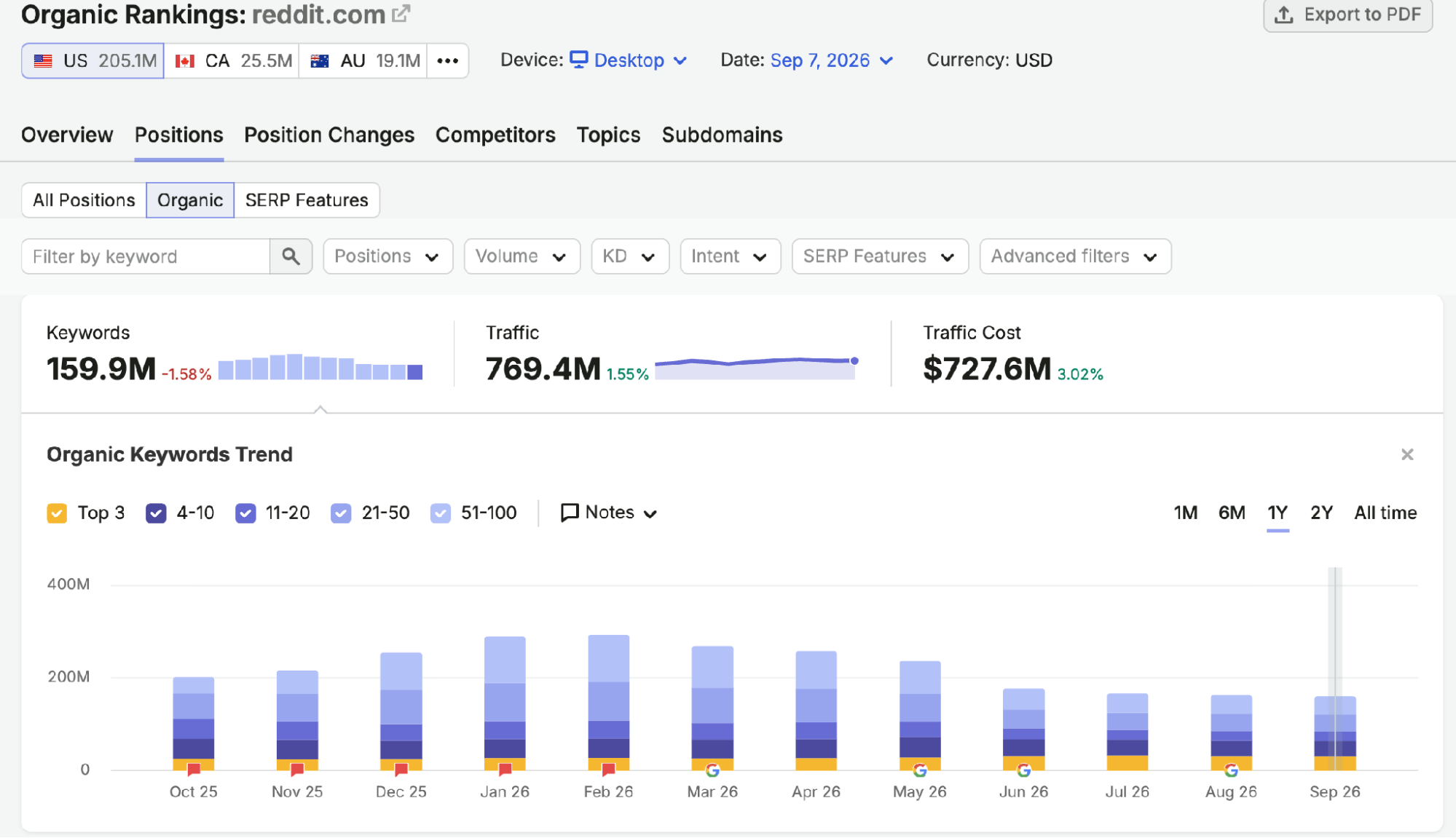
However, estimated traffic over the same period held steady.

That combination of steady organic traffic and lost SERP features and keywords is the tell. A genuine ranking collapse of that scale should dramatically decrease traffic. A visibility collapse with flat traffic means something changed in how the data was collected — not in how the site performed.
With that in mind, I broke the keywords into position bands:
| Position band | Change from May to June 2026 |
|---|---|
| Position 1 | +16% |
| Top 3 | +11% |
| Positions 4-10 | −8% |
| Positions 11-20 | −28% |
| Positions 21-50 | −34% |
| Positions 51+ | −35% |
The gradient is the whole story here. The deeper a keyword ranked in the search results, the more likely it was to have disappeared. Meanwhile, Position 1 and Top 3 counts actually increased.
A review of current and former client sites revealed the same trends and data: Organic clicks, impressions, and lead volume remained flat, while third-party keyword counts fell off a cliff.
The /goto passthrough redirect change helps explain the discrepancies. If every link in the search results must resolve through a Google-owned hop, scraping costs scale with the number of links on the page. Most keywords on Page 1 provide no visibility or traffic — which is why traffic metrics didn’t budge, but keyword “counts” did.
The legal backdrop
Google sued SerpApi on Dec. 19, 2025, alleging DMCA violations for circumventing its SearchGuard protections to scrape and resell copyrighted content from search results.
On July 20, Chief District Judge Yvonne Gonzalez Rogers granted SerpApi’s motion to dismiss. The claims involving search results that contain no copyrighted content were dismissed with prejudice on the reasoning that the DMCA doesn’t protect material that isn’t copyrighted.
Google was then given 21 days to amend its case on the narrower question of licensed content in Knowledge Panels. Google refiled on Aug. 10. SerpApi moved to dismiss again on Aug. 25. The case remains unresolved.
Now, examine that timeline next to the timeline of changes discussed earlier. Google’s legal position suffered a setback in July. The /goto links went from scattered sightings to near-total rollout over those same weeks. SerpApi has since stated it has already updated its service to correctly resolve /goto URLs.
Whatever the intent, the practical result is that the technical measures are doing the work the litigation couldn’t.
The industry’s trusted source for essential news and analysis.
Sign up for our newsletter to receive exclusive insights and updates directly to your inbox.
- Daily breaking news
- Expert analysis from industry veterans
- Join over 200k subscribers
- Covering SEO, PPC and AIO
Why do these changes matter for website owners?
The impact goes beyond rank tracking. These changes affect data reliability, reporting, costs, and how you interpret SEO performance.
Tool reliability degrades with depth
Rank tracking beyond position 10 or 20 is now materially less trustworthy than it was two years ago.
Scraping costs go up, and you pay them
Every measure that increases the number of requests per keyword increases data costs. Inevitably, that difference carries over into tool pricing.
The year-over-year comparisons are about to get strange
Google Search Console impressions dropped sharply in September 2025 when num=100 support was removed. September 2026 data will soon start reporting against the suppressed baseline of September 2025. Expect a wave of double-digit year-over-year impression growth that reflects nothing in truth.
Regarding the num=100 change, it’s important to realize that inflated impression counts from scrapers were never real.
But cleaner data is better data. Unfortunately, it breaks year-over-year comparisons for the past year. October 2026 will be the first apples-to-apples clean comparison month.
Dashboards cause panic that the business doesn’t warrant
A −34% keyword count in a monthly report will command a marketing team’s attention, regardless of whether a single customer noticed. The gap between what tools measure and what the business experiences is now wide enough to cause real damage internally.
Rethinking how you measure organic search
During an SEO job interview, I was once asked what I would do if rank tracking disappeared and how I would measure success without it. At the time, I couldn’t imagine that specific scenario. I can imagine it now.
Yes, results are personalized. Yes, third-party data is directional at best. It’s still the “best” snapshot of the SERP most of us have, even if it’s getting thinner.
Google’s own reporting isn’t filling the gap. The Search Generative AI performance reports launched in Search Console on June 3, and they show impressions only. No clicks, no CTR, no average position, and no queries.
So, the shift must happen on our side.
Measuring organic search performance based on clicks, traffic, and ranking counts alone is finished. Measuring how many keywords rank on page one is a vanity metric on a personalized, constantly shifting results page.
The questions now worth building models around are different:
- How often is organic the first touch?
- How does conversion rate change when the user initially arrives through organic visibility?
- What happens to every other channel’s performance when organic visibility changes?
These are all questions that most website owners aren’t yet ready to answer.
The measurement gap is getting wider
Imagine if email analytics removed open rates. Imagine if social media removed reach, or if paid search removed impressions and CPC. That’s roughly where organic sits, and unlike those channels, the data is getting worse rather than better.
We’re measuring a non-linear customer journey with linear tools and analysis methods. Organic is becoming as difficult to measure as elevator, bus, train, or billboard advertising.
Right now, I have more confidence in a seven- to 10-day weather forecast than I do in most organic reporting models.
All of which leaves us wondering what Google’s next change will be.
Explore more on
Editorial disclosure
Contributing authors are chosen for their expertise and work under the oversight of the editorial staff. Search Engine Land is owned by Semrush. The contributor was not asked to mention Semrush; the opinions expressed are their own.
About the author