Scalable local SEO practices

Where can you find wins that scale in local SEO? AI is making the digital marketing industry buzz with the promise of generative shortcuts, but scalable local SEO isn’t about spinning up thousands of cookie cutter location pages or finding ways to trick the Google Business Profile system.
Instead, it’s about building a repeatable, systems-driven operating model that transforms every location into a high-authority, high-trust, AI-recognizable entity.
Whether you’re in charge of local SEO for a multi-location enterprise brand or are doing agency work for multiple clients, you’ll find scalable strategies in this guide to building a dominant digital footprint.
The SEO toolkit you know, plus the AI visibility data you need.

6 scalable processes for local search marketing
Act on these tactics for repeatable wins across the board.
1. Operationalize a winning local mindset
The most powerful first step you can take to scale local SEO success is to get everyone on the same page about the impact of specific practices on total business outcomes.
Whether you’re running local SEO alongside your brand’s branch managers/franchisees or for a variety of your agency’s clients, every participant will come to the project at a different stage of local search education. Level up knowledge across the brand to ensure all team players know what they’re contributing to and why.
Start by customizing this template and sharing the following message in an email or internal document with all stakeholders:
Dear (Name),
As we begin the great work of promoting (brand or branch name) together, here’s the most important thing you can know:
No other factor will have a greater impact on our success than the quality of consumer experiences we provide our customers.
What happens in-store, on the phone, in texts, and in all of the public’s encounters with our digital assets is the foundation of becoming the top brand in our markets.
Consumer-centric practices underpin the reputation, rankings, referrals, and revenue we need to succeed. No amount of marketing can make up for poor customer service, and training in treating customers exceptionally well is the cornerstone of everything we’ll be doing together.
Next, if you’re working in-house, attach the customer service standards manual to this message with the request that all forward-facing staff be trained in it.
Or, if you’re serving clients, urge them to create a consumer-centric staff training manual that includes:
- All consumer guarantees
- Complete instructions on how to handle and escalate complaints
- Basic brand standards for how the company treats the public
Then, as appropriate, add links to the following resources in your template to help stakeholders understand the importance of different aspects of local search marketing:
- What is Local SEO? — This will quickly introduce all stakeholders to the definitions and components of local search engine optimization
- Local Search Ranking Factors 2026 — This will provide an advanced-level understanding of the factors that are believed to have the strongest impacts on local, organic, and AI results
- Beyond The Stars, 2025: How American Consumers Use Reviews to Choose Local Businesses — This will drive home the critical role of reputation management when it comes to rankings, conversions, sales, and referrals
- Mutli-location SEO: Boost local visibility for each location — If you’re working in-house for a multi-location enterprise or if your clients are multi-location enterprises, add this to your template to help convey the unique challenges of this scenario and how to achieve success.
By starting your relationship with this messaging and these resources, everyone will be given the opportunity to be educated about the importance of the work ahead. This is a scalable process you can repeat each time a new team member is hired or a new client is onboarded to improve project outcomes.
2. Centralized local data infrastructure
Once you’ve shared messaging and resources with all stakeholders, your next step is to establish a single, authoritative source of truth for the core details about each entity you’ll be marketing.
Developing a spreadsheet in which you document the essential information for each business entity will enable you to vet data like contact information, hours of operation, and other important fields with stakeholders like branch managers and franchisees.
This will ensure you’re working from accurate information and prevent your brand from publishing mistakes across the web that will inconvenience potential customers and cost the business sales.
Make a copy of the following Central Business Entity Sheet:
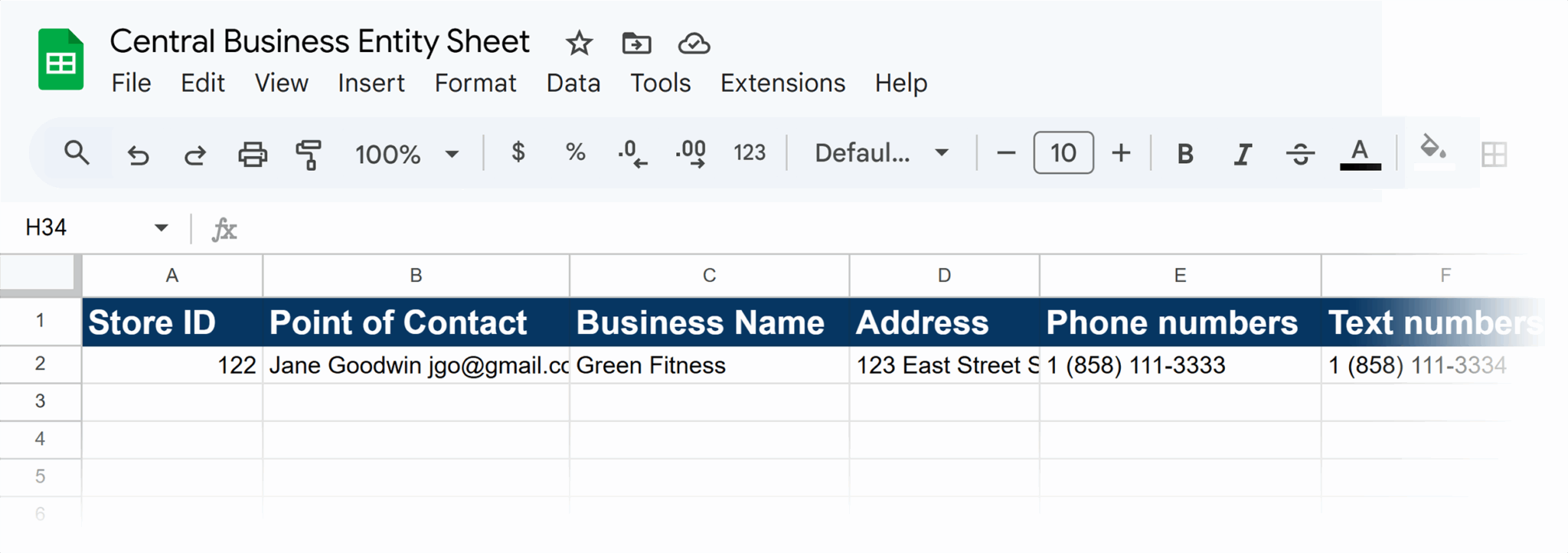
Ensure that your spreadsheet is accessible to all stakeholders. Have your point of contact at each enterprise branch fully vet all fields that apply to them.
If you’re managing multiple distinct clients, email each one their unique information and ask them to fact check it. This will save serious headaches — starting out with incorrect data can pollute a local search marketing campaign because the marketer is promoting the wrong information.
Be sure you’re working with accurate names, addresses, phone numbers, hours of operation, core products and services, website and landing page links, and other key details.
3. Programmatic local landing pages (built on an entity model)
For most local enterprises, location landing pages for brick-and-mortar models or service area pages for service area business models on the company site are each branch’s home base on the web.
Scalable pages become authority hubs that reinforce each location’s unique entity footprint, provided they don’t take shortcuts that result in the publication of unhelpful, thin content.
The strength of local pages impacts:
- Consumer experiences, conversions, and sales
- Local search rankings
- Organic search rankings
- AI visibility
Don’t make the mistake of treating local landing pages as an afterthought, spinning up hundreds or thousands of unhelpful, near-identical digital assets. Weak content doesn’t help the public. It can also give a brand a low-quality reputation in the eyes of Google, making it less likely for the search engine to rank the content as a relevant response to searcher queries.
Do scale the creation of local landing pages via a programmatic template system that supports dynamic local content. If your current CMS doesn’t support this type of publishing, it probably isn’t the right choice for a multi-location brand.
The types of content that can be included in location landing pages and service area pages are almost limitless. Need inspiration? Use our templated table to get you started.
Local landing page content components
Use the following checklist to create strong and helpful local landing pages across all branches:
1. Core business identity & contact information
- Accurate real-world business name
- Complete street address
- Phone numbers and text lines
- Email addresses and contact forms
- Linked social media widgets
- Complete hours of operation, including special and holiday hours
- Booking functionality
- Ask an expert/chatbot functionality
2. Visual trust signals & brand presence
- Exterior and interior premises photos and videos
- Photos and videos of company vehicles, staff at work, and completed projects
- Staff photos, bios, interviews, and third-party media appearances
- Proofs of community involvement, philanthropy, and/or cross-promotion with local brands
- Legal certifications and industry associations
3. Products, services, & commercial content
- Product and service menus with links for further action/information
- Real-time location inventory and next-nearest store availability
- Sales, deals, coupons, and promotional offers
- Event calendars
- Career and job opportunities
4. Reputation, reviews, & social proof
- Embedded third-party reviews and links to review profiles
- Embedded first-party reviews and testimonials
- Customer content (video testimonials, photos)
- Customer guarantees
5. SEO & technical optimization
- Optimized landing page URL, title tag, and header tags
- Strong calls to action (CTAs)
6. Expertise & authority-building content
- Unique sales proposition/value proposition
- FAQs
- Expert content showcasing authority on industry and local topics
- First- and third-party PR content
This starter list of 28 components will get any branch off on the right foot when it comes to creating local landing pages that assist the public, earn visibility, and secure transactions.
Some of the above fields (like name, address, phone number, email, hours of operation, and social media links) only need to be updated if a branch you’re marketing experiences a change in these details. Other fields (like photos, reviews, inventory, media links, sales, events, and job listings) can be updated regularly, ensuring that components of the page are being kept fresh, accurate, and helpful for the public and search engine bots.
Customize our template as a repeatable model that can be employed every time your brand opens a new location, enters a new service area, or onboards a new client.
4. Reputation management workflows that work across the board
Google’s own tips to improve your local rankings in their system emphasize the role of reviews as a signal of prominence:
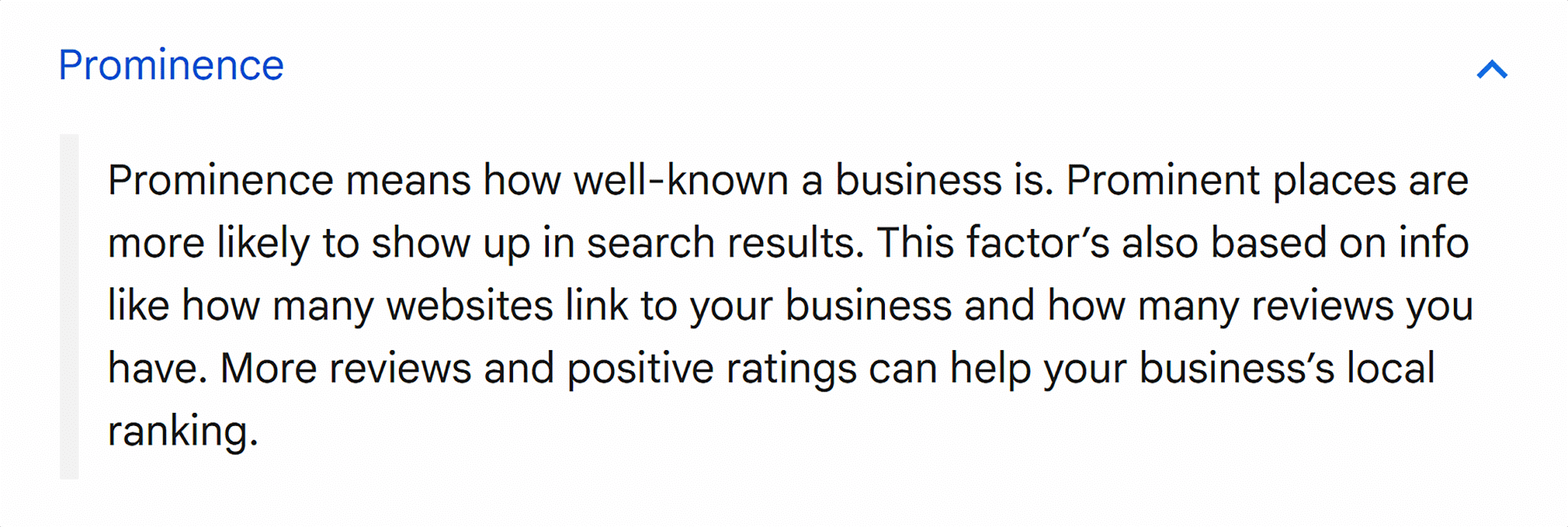
Beyond simply improving rankings, reviews are one of the most influential consumer behavior factors. Local business reviews are read by the majority of the consumer public, and directly impact whether or not branches are chosen for transactions.
The recency of reviews is the reputation component that consumers consider most important, as well as being one of the top 20 influences on local pack/Maps rankings. It’s vital to have a steady stream of fresh incoming review content across all locations of a brand.
Unfortunately, local brands of all sizes can get caught up in the hunt for “review tactics,” including shortcuts and spam, when they should be focusing on implementing review pipelines.
A review pipeline is a logical reputation management workflow that can be repeated across all of your locations.
Here are components you need in your workflow:
Ongoing training in customer service standards
As mentioned earlier, no amount of marketing can make up for bad consumer experiences. Sixty-seven percent of consumers write positive local business reviews as a reward for great experiences. Base your pipeline on delivering outstanding customer service by offering continuous training to all public-facing staff.
Active review acquisition
The survey linked to above also finds that the #1 reason local consumers don’t write more reviews is because they forget to.
Launch a brand-wide review acquisition campaign that empowers branch managers/franchisees to actively ask for reviews in person at the time of service plus via text/email shortly after service.
Templatize review requests that are working well and share them brand-wide to increase branch-level success. You’ll maximize the volume, velocity, and recency of reviews with the simple act of asking for them.
Centralized review monitoring
Reviews must be continuously monitored for incoming sentiment, be that positive or negative, to defend and improve brand reputation.
At a brand or agency level, invest in reputation management software that gives you a real-time overview of all incoming branch/client reviews across all platforms where the business has review profiles.
Your chosen software must also provide multi-seat access so individual branch managers, franchisees, or clients have access permissions to monitor their own reviews while being excluded from accessing the reviews of irrelevant entities.
Review response functionality
Sophisticated reputation management software offers auto-tagging features that apply custom tags to chosen words in your incoming reviews. This can quickly alert you to negative sentiment for prioritized owner responses.
All reviews should receive a fast response from each location, but negative reviews need to be tackled first to reduce reputation damage and consumer churn by winning back unhappy customers with the right response.
Templatized review responses
Build up a library of effective responses to negative reviews over time that succeeded in winning back unhappy customers.
Many reputation management products offer AI-generated response functionality. If you give branch managers/franchisees/clients access to this, be sure it’s being used under rigorous human oversight to avoid alienating consumers with generic replies to complaints.
Templatize responses to positive reviews as well so that every reviewer receives thanks, but again, avoid a generic approach. It’s not a good look if a large percentage of any location’s owner responses are near-identical.
Sentiment analysis and reporting
Identify positive and negative consumer experience trends across time by conducting ongoing review sentiment analysis.
A good reputation management product will enable you to slice and dice this vital data at a branch level or at a regional level across set time frames. When negative trends are uncovered, assess causes and rollout solutions designed to restore the good reputation of each location.
Review remarketing
Don’t just leave third-party reviews sitting on your local business listings. Instead, facilitate third-party review embedding on the location or service area landing pages of each entity/client.
You can follow these instructions for embedding Google Maps-based reviews, these ones for Yelp, or operationalize the process by investing in popular professional reputation management software like GatherUp.
For first-party reviews, templatize your requests so they result in customers writing unique reviews and testimonials for each branch.
Remarket all of this content as Google Business Profile images and posts, and as social media content for each branch.
Dig deeper: For more on this topic, read Google reviews & SEO: Advanced strategies that scale
5. Off-page local signal growth at scale
Further build Google’s sense of the prominence of each of your locations/entities via the development of unstructured citations (mentions of your business by third-party online publications).
A smart strategy is to experiment with unstructured citation development at a few branches of the business first, to discover which strategies are yielding best results. Then, roll out a playbook across your organization for repeatable wins.
Use the following template to spark outreach campaigns:

Each mention of a branch of your business increases its prominence signals in the eyes of Google. This influences the likelihood of Google seeing your locations as relevant results. Unstructured citations are also playing a role in conversational AI output in environments like Google AI Mode and ChatGPT.
Use your playbook to document and share outreach strategies that are working well at test branches. Encourage managers and franchisees to replicate these programs and to experiment with their own ideas.
Each local community is different. Sponsoring the town founder’s day picnic may be a win in one location, while donating sports equipment to a different city’s Little League is the right plan for another branch.
Multi-location enterprises have a unique advantage in being able to test structured citation outreach concepts within a control group before rolling them out brand-wide.
6. Operationalized Google Business Profile (GBP) management
Google Business Profiles have become a dominant part of local consumer journeys. Acting as an alternate “homepage” for each branch of a multi-location business, they contain information that drives conversions, like a map, basic contact details, hours of operation, images, ratings, reviews, and so much more:
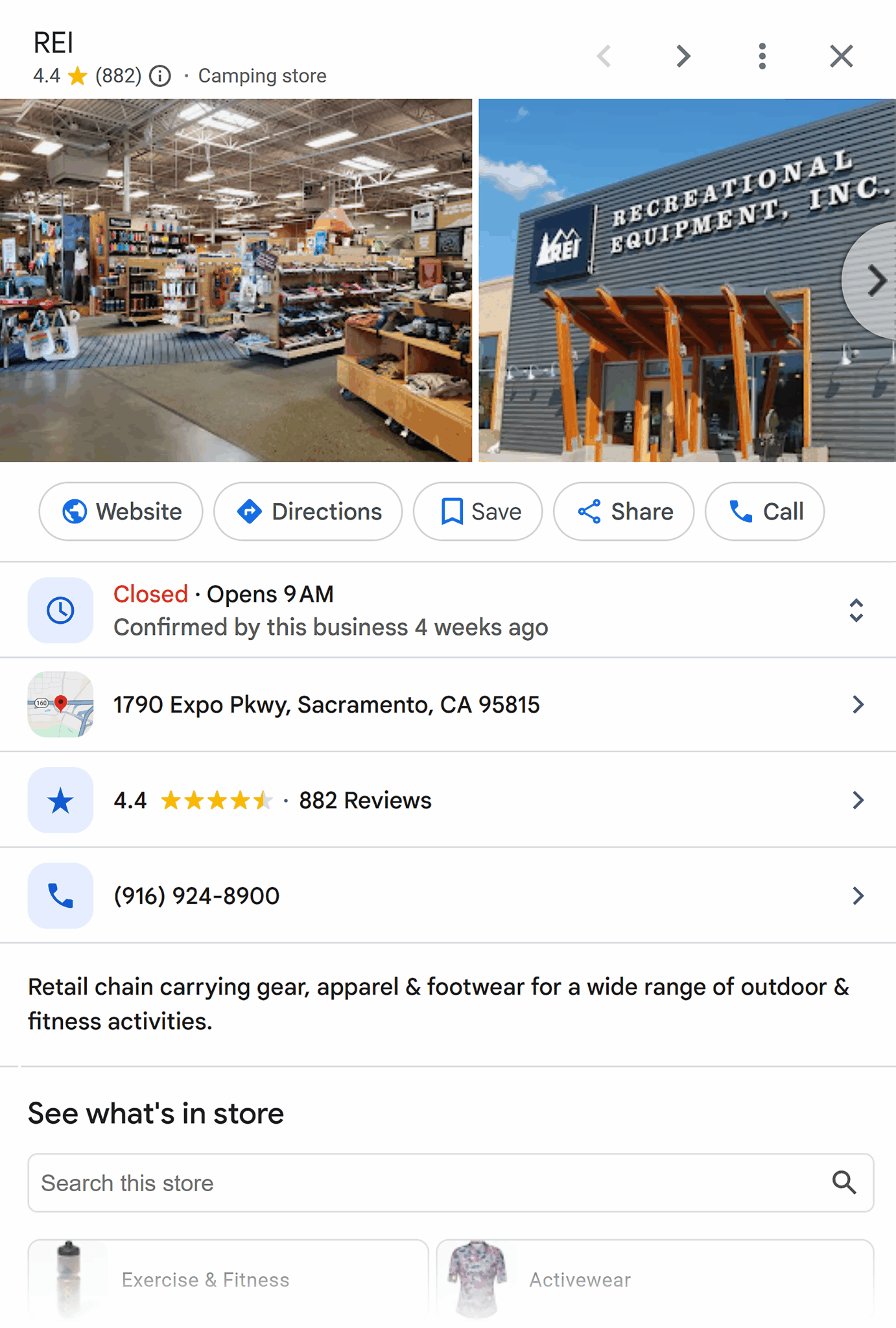
Small businesses are burdened with largely-manual GBP management. Larger enterprises have the advantage of being able to operationalize via the bulk creation, verification, and management of GBP if you have 10 or more locations.
(Note: This functionality is not available to hotel properties, which must use the Business Profile for lodgings API instead.)
Large brands and agencies can use the Google Business Profile APIs to manage listings at scale and receive real-time alerts to new reviews and updates to location data.
In addition to bulk and API benefits, multi-location brands can operationalize the following aspects of GBPs to improve branch-level listing optimization and performance:
- Q&A workflows: Develop a set of questions and answers based on brand-level FAQs to populate the Q&A section of all GBPs
- Category selection: Proper category selection is vital to ranking outcomes, and brand-level business intelligence on the best-performing categories should inform branch-level category choices
- Image asset libraries: Invest in brand-level photography of widely available, popular inventory to populate the image section of all GBPs
- Video asset libraries: Invest in professional video creation at the brand level, showcasing the history of the company to be added to the video section of all GBPs
- Review response templates: Provide customizable templates for responding to reviews, broken down into three categories: negative (1-2 stars), neutral (3 stars), and positive (4-5 stars)
- Google Merchant Center: Brands which operate via a point of sale (POS) system can incorporate all locations into Google Merchant Center, increasing the chances of being chosen by consumers for transactions involving featured products
Operational maturity surrounding GBP leads to a more stable consumer experience and more predictable ranking outcomes because listings are being carefully managed across the org instead of neglected.
Track, optimize, and win in Google and AI search from one platform.
Bonus: Measurement that doesn’t break at scale
Roll all locations into a unified analytics layer for monitoring search views, direction requests, calls, conversions, review sentiment, listing health, and entity consistency.
Why it matters: Scale means little without visibility. Enterprise success depends on spotting patterns before they become problems. By tracking performance locally and regionally across time, you’ll quickly identify emerging issues for troubleshooting and resolution.
For example, leadership at a fast food franchise may notice that there’s been an uptick in review complaints about outdoor dining comfort in its southern US branches in the summer, while no similar complaints exist in the north.
Defending the brand’s reputation, rankings, and revenue will require assessing the cause of these complaints and the implementation of operational solutions, like the construction of new awnings over outdoor seating areas to protect patrons from the sun. An eye for both the big picture and small details is key to scaling enterprise success.
The outcome: A scalable, entity-driven system where every location is consistently optimized, consistently trusted, and consistently visible across Google’s local pack, organic results, AI overviews, and every generative engine pulling local data.
Build a closer relationship between offline realities and online outcomes
Take your staff and clients’ education to the next level by connecting more dots between what happens in your stores and on the web.
Many local brands have made a massive leap from traditional marketing channels like print, radio, and television advertising to digital channels. But don’t relegate offline promotion to your rear-view mirror—dismissing or downplaying these opportunities may have a massive impact on profitability.
To learn more, read Offline SEO: How to build authority beyond the digital space.
Explore more on
Editorial disclosure
Search Engine Land is owned by Semrush. We remain committed to providing high-quality coverage of marketing topics. Unless otherwise noted, this page’s content was written by either an employee or a paid contractor of Semrush Inc.
About the author