SEO benchmarking: How to measure performance and outrank rivals


A huge part of an SEO’s role is tracking and monitoring performance of their site. For most, the go-to metrics are rankings and traffic. Those are important, of course, but what if we told you they’re not the only way to win in search?
That’s where SEO benchmarking comes in. Without it, you’re flying blind.
Benchmarking means comparing your site’s performance against your own history as well as against your competitors and industry standards. It’s the context that turns raw data into specific metrics driving real insight.
In this guide, you’ll learn what SEO benchmarking is, why it matters more than ever in an AI-driven search world, and how to set benchmarks that tie directly to business outcomes.
What is SEO benchmarking?
Similar to “SEO auditing” or “performance tracking,” think of benchmarking as your secret weapon—it turns data from numbers on a screen into something you can act on.

At its core, SEO benchmarking is simply tracking your SEO performance against three things:
- Competitor analysis: How are others in your space doing? Are they outranking you on key topics? Do they get more clicks, backlinks, or better SERP features?
- Industry averages: Where does your site stand compared to the broader market? Benchmarking turns small wins into clear signals—are you catching up, keeping pace, or pulling ahead?
- Historical baselines: How have you changed over time? Benchmarks let you see if new strategies are actually moving the needle, not just reacting to random fluctuations.
Auditing vs. performance tracking vs. benchmarking
Here’s a simple way to think about these three processes:
- Audit: A one-off health check. Picture it like a doctor giving you a full check-up. You’ll see what’s broken or underperforming right now.
- Performance tracking: Keeping an eye on your site over time. It’s like monitoring your daily steps or calories—you know if you’re trending up or down, and it’s all internal.
- Benchmarking: Measuring your progress in the wider market not just against yourself. This is the part that tells you whether your wins are actually meaningful. Are you ahead, behind, or right on par?
Why benchmarking matters today
Search has changed. With AI-driven features like Google’s Search Generative Experience (SGE) and richer SERP formats, the old “check rankings once a month” approach isn’t enough. Without benchmarking, it’s hard to know whether traffic drops, keyword ranking shifts, or engagement changes are normal fluctuations or signs that strategy adjustments are needed.
For example: If you notice a slight dip in traffic on your top product pages, benchmarking against competitors can show that they’ve maintained or grown traffic for the same keywords. That tells you the drop isn’t industry-wide, it’s something you need to investigate and address on your own site.
The SEO toolkit you know, plus the AI visibility data you need.

Another example: If your blog posts are ranking in traditional SERPs, but benchmarking shows that competitors are appearing in new AI-powered snippets while you’re not. That insight highlights an opportunity to optimize content for these emerging formats and to stay competitive.
The takeaway: SEO benchmarking provides perspective. It helps you understand where you stand, spot opportunities, and make informed decisions. When done right, it gives you confidence that your SEO efforts are meaningful and aligned with your business goals.
Why SEO benchmarking is critical
Even if you’re following SEO best practices—publishing fresh pieces, building backlinks, polishing meta descriptions—you may still feel like you’re running hard but not moving forward.
That’s where benchmarking comes in. It makes SEO more strategic, turning numbers on a dashboard into insights you can actually use.
Competitive insights
One of the biggest reasons to benchmark is to see yourself in the right context. SEO doesn’t happen in a vacuum—you’re competing for the same readers and keywords as other bloggers in your topic. Benchmarking lets you peek into their playbook.
Imagine your site is in the food/cooking space. Ask yourself:
- Are other sites consistently outranking me for “vegan breakfast bowls”?
- Have they cornered the market on “30-minute pasta recipes”?
- And more importantly, where are the recipe ideas they haven’t tapped yet?
Let’s say you’re ranking well for broad searches like “easy dinner recipes.” Sounds good—until your industry benchmarks show a competitor dominates “easy one-pot dinners,” which is gaining tons of traction.
That’s your lightbulb moment: You don’t need to copy them—you need to find your own twist in the gaps they’ve left open, like “one-pot gluten-free dinners” or “one-pot comfort meals under 20 minutes.”
Enterprise perspective
For bigger brands running multiple sites, benchmarking is even more valuable. With it, you see the bigger picture: Which sites are performing well, which ones are lagging, and where to double down.
Picture this: Your US recipe site consistently drives twice the engagement as your UK one. The difference? Your US site is packed with step-by-step video recipes, while your UK site relies only on text and images. Using engagement metrics, benchmarking can reveal that American readers stay on the site longer because of those videos, while UK readers bounce more quickly.
That insight is everything. Instead of blindly scaling, you can bring the video-first approach into the UK market and close the gap.
Tying benchmarks to ROI
Traffic doesn’t always translate into results. Benchmarking helps you connect visibility from traffic to real outcomes, like newsletter signups, purchases, or other actions that actually move your business forward.
Imagine you suddenly gain a surge of traffic for “air fryer desserts.” Exciting, right?
But when you benchmark conversion rates against others in the food blogging space, you see that your newsletter sign-up rate lags far behind.
That’s not a failure—instead, look at it as a clue. You’re getting the right crowd in, but they’re not taking the next step.
Now you know to tweak your CTAs, make your freebies more appealing, or add clearer prompts inside recipe pages—and realistically expect higher engagement rate.
Without benchmarks, you’d celebrate the spike in traffic, leave your existing content strategy in place, and miss the story beneath it.
Algorithm volatility and SERP changes
Here’s the messy truth: Search algorithms and results pages don’t sit still for long.
One week your chocolate chip cookie recipe article is at position three, the next, it’s slipped without warning. Sometimes it’s because a competitor improved their content. Other times, it’s because Google is testing new layouts or AI features.
This is where benchmarking can become your safety net. By tracking performance over time, you can tell if a dip is industry-wide or specific to you. Instead of panicking over a 5% traffic drop, you’ll know whether it’s a ripple everyone is seeing or an issue with only your site.
When Google introduced AI-powered recipe snippets, overnight results pages looked completely different. Some blogs gained new visibility, while others lost prime positions. Food bloggers with benchmarks in place would have immediately been able to tell if their site was underperforming or if a SERP shifted.
With that clarity, you could have adapted your recipe content for the new snippets instead of chasing phantom problems.
Types of SEO benchmarks
SEO benchmarking isn’t one-size-fits-all. Different aspects of your site and strategy can, and should, be measured in different ways.
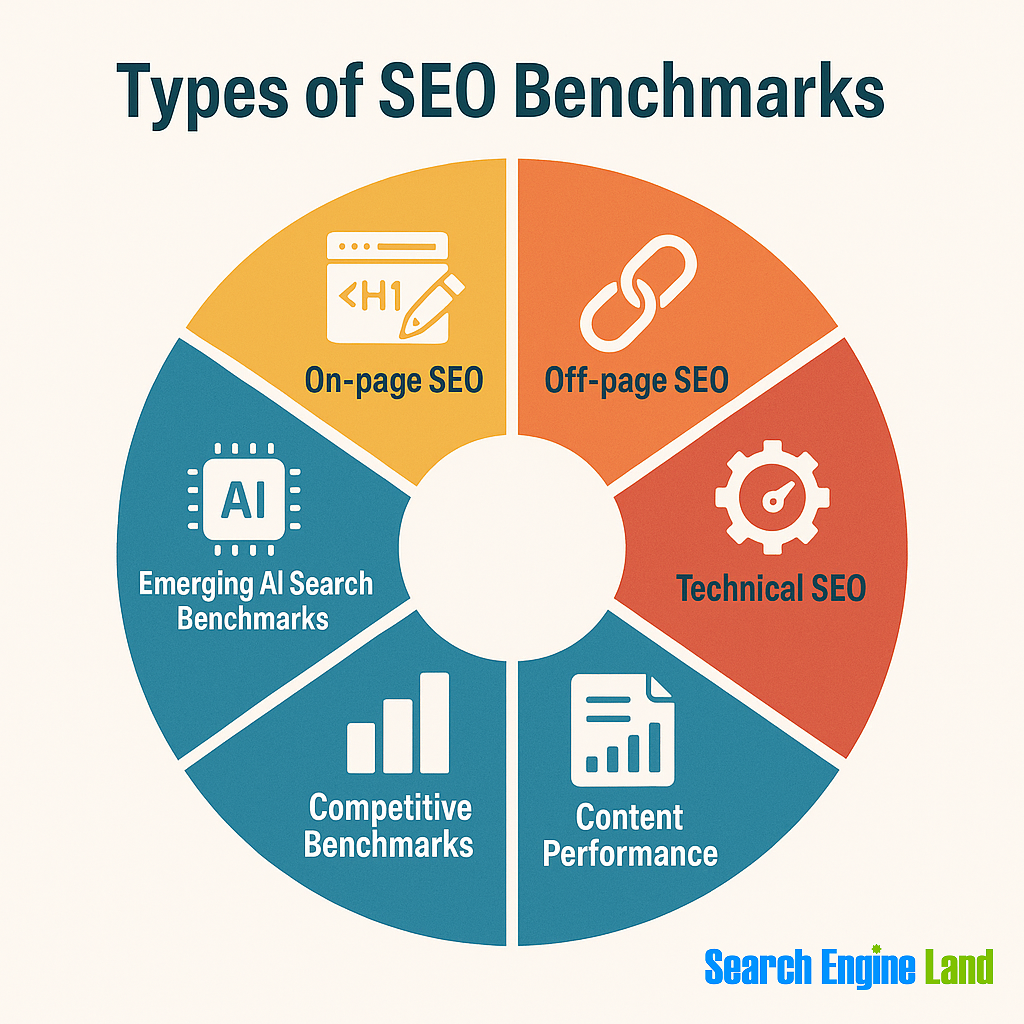
The trick is knowing which type of benchmark to use to tell what story. Each one shines a light on a different corner of your SEO performance, and together, they give you a complete, practical picture.
Each type of SEO benchmark is like a lens. They show you how your content reads, how the world perceives you, and whether your site loads fast enough to matter. And when you look through all of them together, you don’t just see numbers—you see a map for where to go next.
Let’s again imagine you’re a food blogger. How might each benchmark type actually be used for your work?
On-page SEO
On-page benchmarks measure the health and effectiveness of the content that lives on your site. This includes how well your blog posts cover a topic, whether you’ve naturally woven in the right keywords, and how easily your content links together.
Imagine your recipe for “15-Minute Chicken Stir Fry” ranks on page two of the SERPs. Your competitors, on the other hand, cover not just the recipe but also prep tips, substitution options, and nutrition notes.
Benchmarking against their coverage can show that your content is solid but not as deep or comprehensive. And that insight can prompt you to expand your post—maybe add a section on ingredient swaps or quick sauce hacks—so it’s as valuable, or more, than theirs.
Off-page SEO
Off-page benchmarks look beyond your own site and measure how the rest of the web views your brand. This is where backlinks, mentions, and overall authority come into play.
In other words: Do other trusted voices in your space consider your content worth referencing?
As a food blogger, you might discover that your competitor’s stir-fry recipe has been linked in two major “Top 10 Quick Dinner” roundups, while yours hasn’t been cited at all.
That gap isn’t about your content quality alone—it’s about visibility and the reputation of your site. It tells you it’s time to pitch editors, connect with other bloggers, or share your expertise in guest posts to expand your reach.
Technical SEO
Technical benchmarks are under-the-hood checks, including:
- Site speed
- Mobile usability
- Indexability
- Core web vitals
They may feel invisible, but they’re the backbone of user experience and rankings.
Say your “15-Minute Chicken Stir Fry” page takes four seconds to load on mobile because of large, uncompressed images. Benchmarking against the industry standard of about two and a half seconds can reveal the problem immediately: Readers who click, wait, and bounce will never even get to see your content.
Fix that by compressing images or lazy loading to ensure your recipes are accessible, fast, and pleasant to read, keeping both users and Google happy.
Content performance
Even after publishing, the story doesn’t end. Content performance benchmarks track how well your content engages readers once they land on your page. Metrics that matter here are:
- Click-through rate (CTR)
- Dwell time
- Conversions (e.g., newsletter sign-ups)
Maybe you notice two of your recipes get similar traffic, but one keeps readers on-page for five minutes while the other loses them in under a minute.
Benchmarking might reveal that the shorter dwell time correlates with a thinner recipe description and no photos. Suddenly, the fix isn’t mysterious: You need richer copy, visuals, and tips to hold people’s attention.
Competitive benchmarks
This is where you zoom out and compare your overall visibility against direct rivals.
Competitive benchmarks show you who’s winning, and where you need to catch up in:
- Keyword share
- Rankings
- SERP features
As a food blogger, you might find that your site ranks for 25% of target “quick dinner” keywords, while a competitor covers 50%. They’re appearing not only in standard results but also in recipe carousels and featured snippets.
That gap shouldn’t discourage you—it just tells you where to focus on your content, like optimizing recipes for structured data, so you also show up in featured snippets.
Emerging AI search benchmarks
With AI-powered search results rolling out, new benchmarks are taking shape. These track metrics like:
- Visibility in AI Overviews
- Search Generative Experience (SGE) panels
- Knowledge Panels
Picture searching “best healthy weeknight dinners” and seeing AI-generated summaries that cite a competitor’s blog but not yours.
Benchmarking can tell you to optimize your recipe content so it’s more likely to be pulled into AI snippets. This could mean adding clearer “expert tips,” structured FAQs, or emphasizing your credentials as a nutrition-conscious cook.
How to set effective SEO benchmarks
Benchmarks are like the compass points of SEO. They show you where you stand, where you’ve been, and where you could realistically head next.
A spike in traffic is always encouraging—it means people are finding you. But without benchmarks, it’s hard to know whether that spike is a one-off blip or the start of meaningful growth.
Benchmarks help you dig into the deeper story: Is that traffic aligned with your goals, bringing in the right audience, and creating long-term value?
With the right benchmarks in place, you can measure progress in a way that brings value while also being sustainable.
Use historical data for baselines
Start by benchmarking your own data. Look back over the past year or two to help separate normal fluctuations from genuine growth.
For a food blogger, that might mean recognizing that traffic always rises in November and December because readers are searching for holiday recipes.
Without that baseline, you might assume your new cookie post “went viral” when really, it’s seasonal behavior.
Digging deeper, you may notice your recipe posts pull in huge traffic but low newsletter sign-ups, while your in-depth how-to cooking guides attract fewer readers but convert at a much higher rate. This insight can help you double down where it matters.
Additionally, segmenting by desktop vs. mobile, or new vs. returning users in Google Analytics (GA4) can uncover patterns in audience behavior.
Select the right competitors
Competitors in SEO aren’t always who you expect. If you are a food blogger, for example, you’re not only up against other bloggers, you’re competing against platforms like AllRecipes, food magazines like Bon Appétit, and even YouTube creators.
Group competitors by type:
- Direct rivals: Other independent food bloggers with similar content
- Indirect publishers: Large media sites and recipe aggregators
- SERP competitors: Video creators or social media pages that dominate for certain food queries
Once you’ve mapped out who’s in the space, the next step is seeing where they’re winning. Compare keyword clusters—like “vegan baking” or “meal prep ideas”—instead of whole domains to make it easier to spot specific topics.
This way, you’re not overwhelmed by a competitor’s full site strength, and you can identify the specific areas where you can realistically compete, and where it’s smarter to carve out your own niche.
Industry vs. niche benchmarks
Broad industry averages don’t always tell the full story. For example, let’s say that food blogs in general might have a bounce rate of 80% because readers skim recipes quickly.
But if the top vegan food blogs you’re competing against hold bounce rates closer to 65%, then aiming for the industry standard won’t keep you competitive.
It helps to think in three tiers:
- Minimum thresholds: These are your “red flags.” If a metric dips below this level, it’s clearly underperforming. For example, if your recipe page load times exceed 5 seconds, you’ll bleed traffic. Minimum thresholds tell you what to fix first.
- Target benchmarks: This is the healthy, sustainable performance for your niche. It’s where you want most of your pages to land. For instance, a 70% bounce rate on vegan recipes might be realistic and maintainable, keeping you competitive without burning resources. Target benchmarks are practical goals grounded in your niche’s norms.
- Top-tier benchmarks: These are the stretch goals, based on what the best performers in your niche are achieving. If top vegan blogs are hitting a 70% bounce rate or higher on long-form recipes, that’s what top-tier looks like. They’re not easy, but they show you what’s possible if you push your strategy further.
Niche benchmarks are tailored to your specific audience and competitors. Instead of looking at the general food blog world, they focus on the slice of the market you actually compete in, so you’re measuring against peers who matter most.
For example, if you run a gluten-free dessert blog, your niche benchmark for average session duration or newsletter conversions should be against similar gluten-free sites, not all baking blogs. This ensures your goals are both aspirational and relevant.
Timeframes and seasonality
Benchmarking is only useful when it accounts for time. Your blog isn’t static—traffic and engagement ebb and flow with seasons, campaigns, and reader habits.
For example, summer barbecues spike in June, holiday baking dominates December, and January always brings a surge in “healthy recipes.” To make sense of these patterns, it helps to create benchmarks on different timeframes:
- Monthly benchmarks: These give you a close-up view. Are your latest posts building momentum? Are engagement and conversions holding steady from week to week? Monthly tracking helps catch small issues before they snowball.
- Quarterly benchmarks: These align with campaigns and larger initiatives. Maybe this quarter you’re testing video tutorials or a new newsletter format. Quarterly reviews show whether those efforts are hitting your midterm goals and let you adjust your strategy proactively.
- Yearly benchmarks: These provide the big-picture perspective. Comparing December’s Christmas cookie guide to last year’s helps you see whether your blog is steadily growing in authority and influence over time.
Key metrics and KPIs for SEO benchmarking
Benchmarking is all about perspective. Numbers on their own don’t say much—it’s the patterns, comparisons, and context that help you decide what to do next.

Think of key performance indicators (KPIs) as checkpoints. They show where you are, how you compare, and what deserves attention now.
If you run a food blog, this can mean spotting which recipes pull readers in, which ones spark sign-ups, and which posts get affiliate clicks.
Rankings and keyword movement across categories
You want to see how your rankings change over time. Are your “gluten-free desserts” steadily climbing, holding steady, or slipping because a rival refreshed their hub? Are there related terms or subtopics you haven’t explored yet?
Tracking this movement lets you spot patterns, prioritize updates, and focus on the categories that matter most.
With Semrush Position Tracking, you can monitor daily movement for your keywords and your competitors side-by-side.

Pair it with Google Search Console (GSC) for actual queries and impressions, and Ahrefs or Moz if you like a second view.
Example: You move from position 12 to 6 for “gluten-free brownies,” while a competitor jumps from 8 to 2. That’s your cue to review their content depth, internal links, and recent backlinks.
Organic traffic growth and quality: Bounce rates and conversions
Traffic is great, but are readers exploring more recipes, signing up for your newsletter, or actually converting into customers? And are they bouncing quickly from pages that should hold their attention? Benchmarks help you separate volume from value.
Use Semrush Organic Traffic Insights to bring GA4 and GSC together in one place, so you can see sessions, queries, and conversions in context. This gives you the full picture of which posts are truly engaging and driving meaningful actions and which need a rethink.

Example: “30-minute dinners” converts at 10% into subscribers, while “summer salads” looks busy yet leads to few actions. Now you know where to double down and where to tweak.
Crawl efficiency and indexation rates
If search engines can’t crawl or index your recipes, they’re invisible. Are important pages discoverable, and are they actually indexed?
Run Semrush Site Audit for crawl errors, blocked pages, thin content, and weak internal links.

Cross-check with GSC Pages/Indexing and the Crawl Stats report.

Example: You find 20% of dessert recipes aren’t indexed. Fix sitemaps, tidy robots.txt, and add internal links from strong category hubs, then re-check your benchmark next week.
Backlinks, referring domains, and authority: The health check trio
Think of backlinks as recommendations. You don’t need to have the biggest pile—it’s about who’s vouching for you, how diverse those voices are, and whether search engines trust them.
A healthy link profile balances three things:
- Steady backlink growth
- Wide spread of referring domains
- Solid authority score
With Backlink Analytics, you can see whether your growth keeps pace with competitors.

The Backlink Gap tool highlights opportunities where others are getting links but you aren’t.
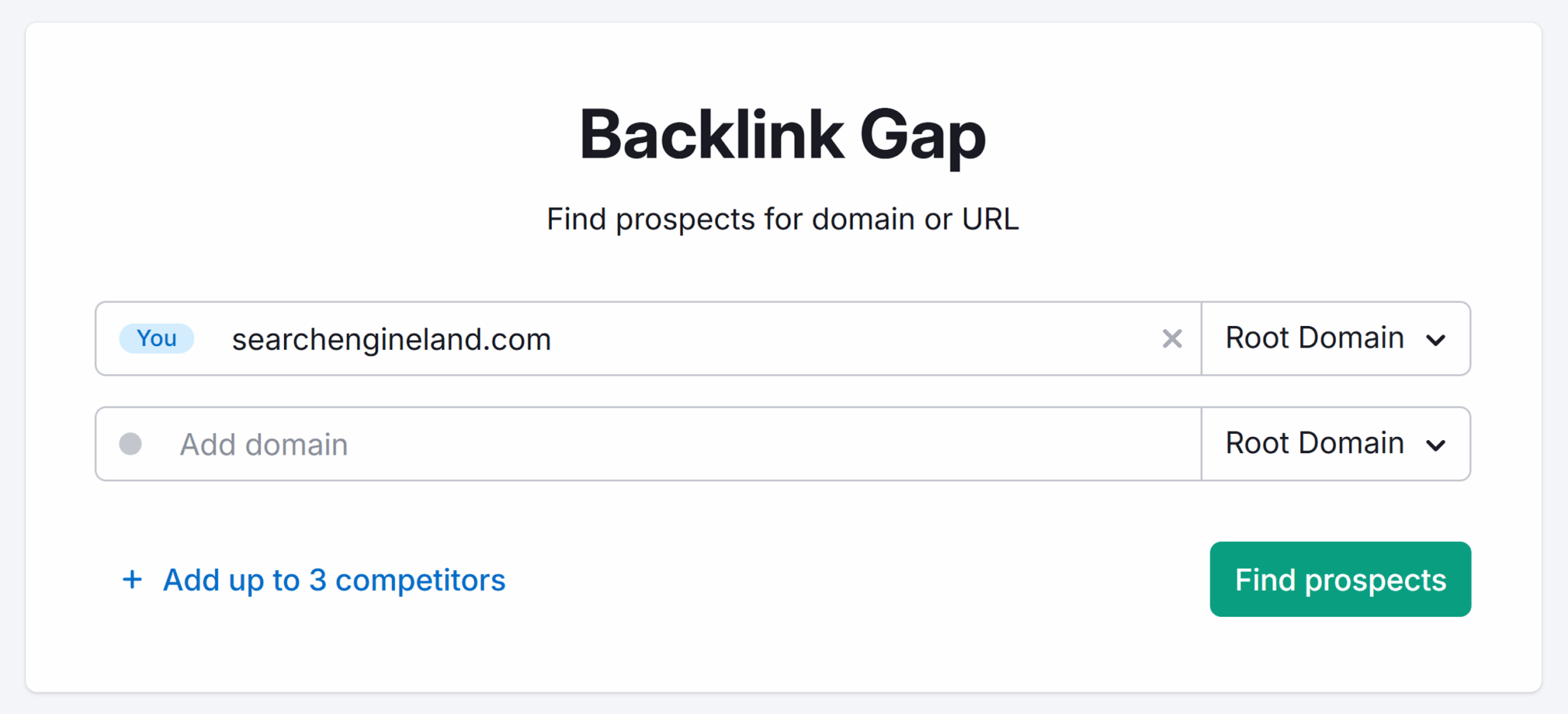
To spot potential issues like toxic links or gaps in your backlink profile, the Backlink Audit tool gives you a clear picture of where you might need to clean up or improve.

Imagine a peer blogger suddenly earns dozens of links to their holiday baking guide. That could tell you it’s time to refresh your own festive roundup, collaborate with creators, or promote a seasonal hub before the moment passes.
Your authority score ties it all together. Semrush’s Authority Score runs from 0 to 100, so if you’re sitting at 25 while your peers average 40, you’re starting from a lower base compared to competitors.
That gap is a clear signal: Create cornerstone content, secure a handful of trusted top-tier links, and tidy up weaker ones.
Over time, that authority boost makes ranking across a broader set of terms far easier.
Read more: Natural backlink profiles
Competitive visibility and share of voice
How much of the search conversation do you own today? Share of Voice (SOV) shows your slice compared to others across a keyword set.
Check Traffic & Market (.Trends) and the visibility metric in position tracking/organic research.

Example: You hold 25% visibility for “easy weeknight dinners,” while a rival sits at 50%. That gap points to a topic cluster to build out with long-form guides, video embeds, and tidy recipe schema.
AI search metrics and emerging SERP features: Entities, featured snippets, and knowledge panels
With Google and Bing both rolling out AI overviews and generative answers, the foundation of how your brand is recognized in search comes down to few things:
- Entities: These are the connective tissue of AI search. They’re the “things” in Google’s knowledge graph—brands, products, people, places, concepts—that search engines and LLMs use to make sense of content.
- Featured snippets: These top-of-SERP answers feed directly into AI systems. Winning a snippet doesn’t just boost click-through, it increases your odds of being quoted in AI-generated responses. For strategy, think beyond single keyword optimization by designing content hubs with concise, schema-backed answers, FAQs, and tables that anticipate snippet formats.
- Knowledge panels: These act as AI’s fact-checking layer. They pull structured data, official sources, and high-authority references into a single branded profile. A strong knowledge panel presence protects your brand narrative in both traditional search and generative summaries.
- AI Overviews and generative results: These are the new front door to your brand. Generative answers draw on entities, snippets, and knowledge panels to produce summaries. If you’re weak in any one of these, your visibility in AI search collapses—even if you technically “rank.”
Use tools like Organic Research reports to track your presence in SERP features, validate your structured data with Google’s Rich Results Test, and watch GSC for impressions from rich results.

Example: If a rival vegan blog wins the featured snippet for “easy vegan lasagna,” appears in a knowledge panel linked to “vegan recipe creators,” and is recognized as an entity in Google’s graph, they’ll likely be cited in AI overviews. And your content may be left out despite strong organic rankings.
Site speed and Core Web Vitals
Fast, stable pages keep readers on your recipe blog and help rankings. How do your vitals compare?
Use Semrush Site Audit for CWV scores at scale, PageSpeed Insights and Lighthouse for page-level diagnostics, and GSC Core Web Vitals for field data.
Example: Mobile LCP lags behind peers. Compress hero images, switch to next-gen formats, lazy load below-the-fold media, and test again.
Track, optimize, and win in Google and AI search from one platform.
Impressions and clicks
Are people seeing your results, and are they choosing you? Low CTR with healthy impressions usually points to titles, descriptions, or SERP competition.
Compare with Semrush Competitors Discovery (“Organic Research” > “Competitors”) to see who wins the clicks for shared terms and study GSC for page-level CTRs.
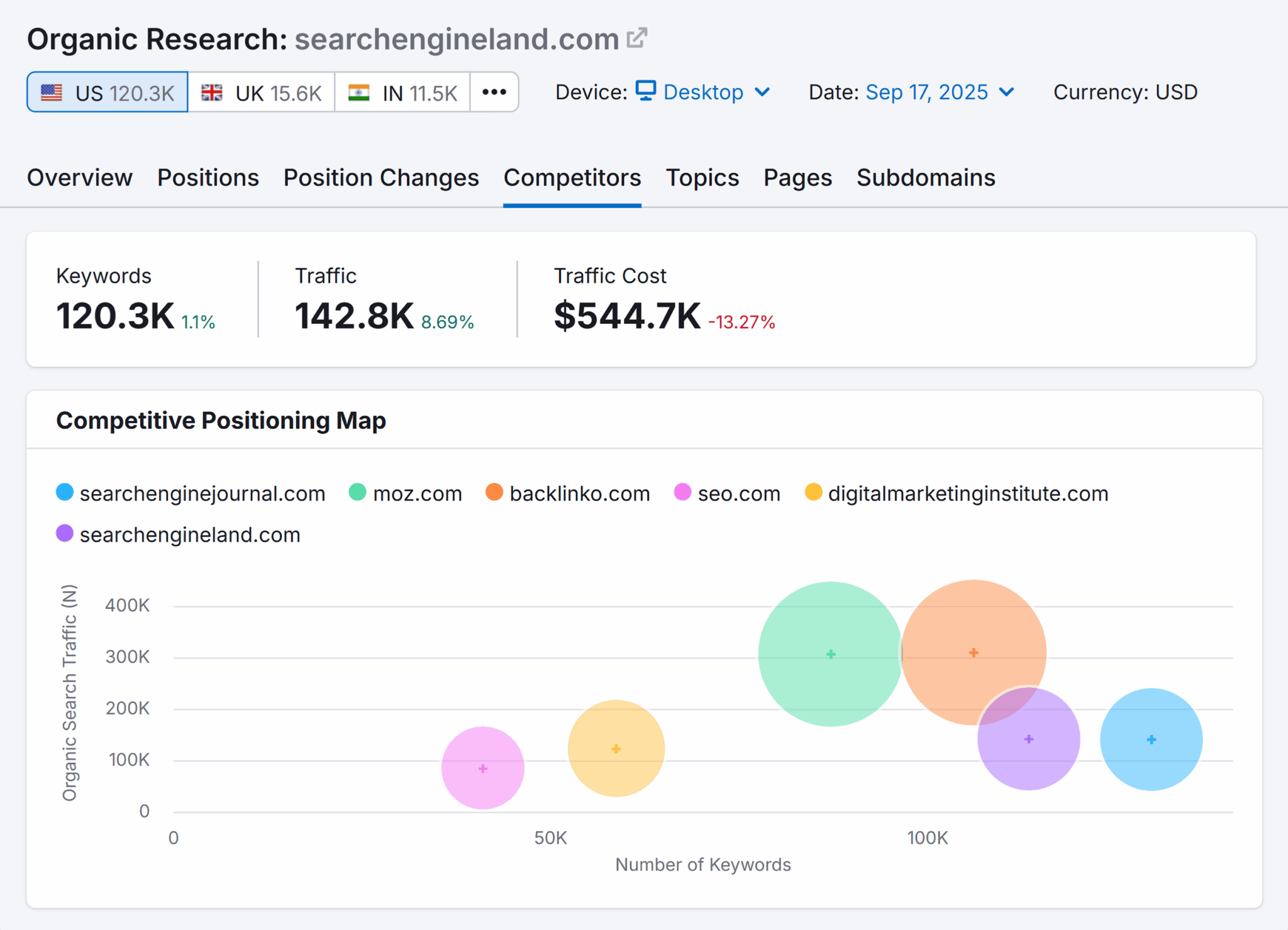
Example: “no-bake cheesecake” gets 10,000 monthly impressions with fewer clicks than rivals. Sharpen the title, add a prep time number, and include a tempting image where a SERP feature allows.
Building on your benchmarks
SEO benchmarking shouldn’t just be about collecting numbers—it should be about giving those numbers context so you can make smarter decisions. With the right KPIs, you’ll see where you stand, where competitors are gaining ground, and which levers are worth pulling next to achieve your organic search traffic goals.
The next step is turning those insights into a real plan. If you’d like to dive deeper into building a roadmap that connects visibility and growth, have a look at our guide on content marketing strategy. It’ll help you take what you’ve learned here and translate it into a framework for content that consistently ranks, engages, and converts.
Explore more on
Editorial disclosure
Search Engine Land is owned by Semrush. We remain committed to providing high-quality coverage of marketing topics. Unless otherwise noted, this page’s content was written by either an employee or a paid contractor of Semrush Inc.
About the author