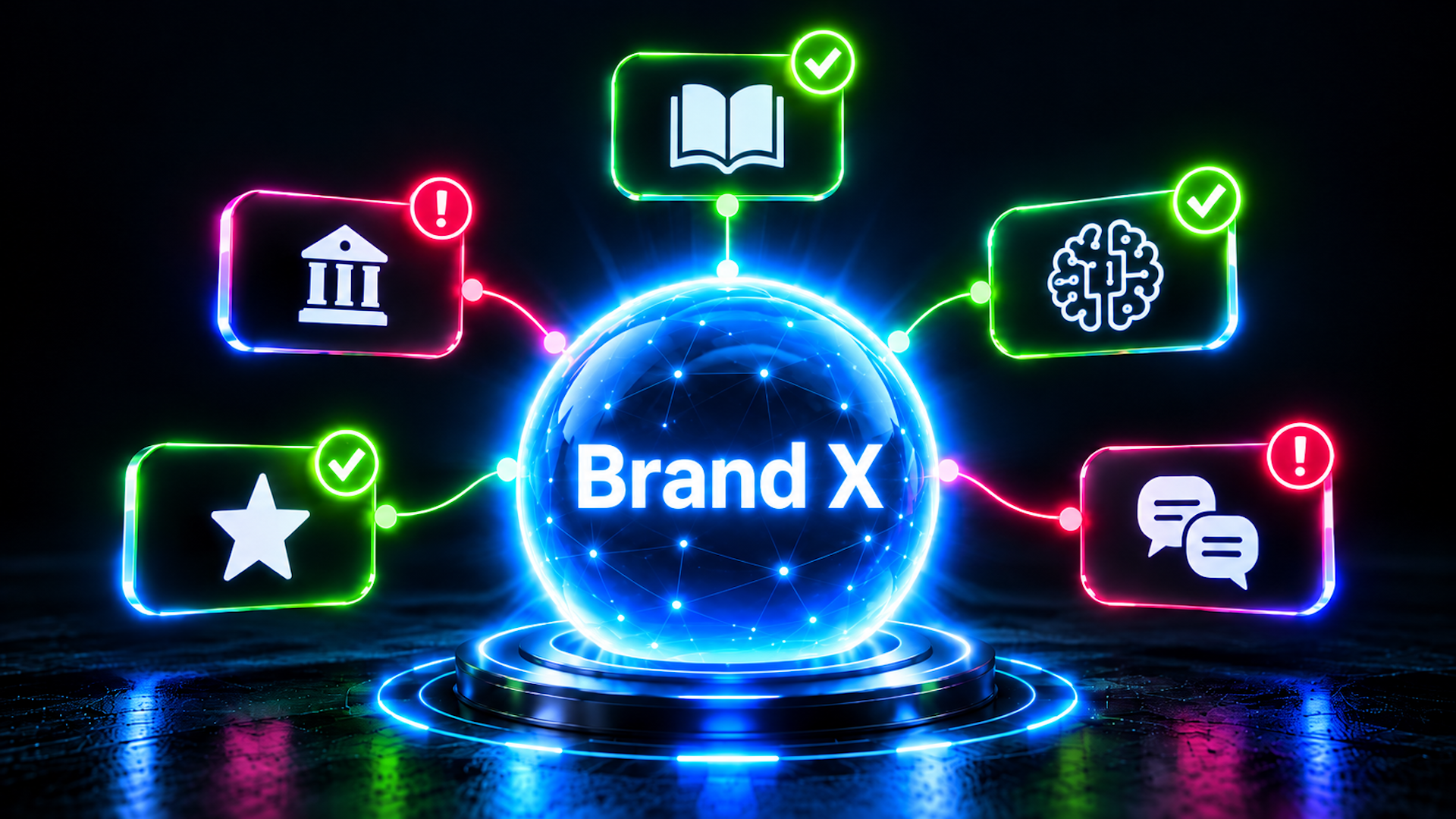
5 strategies for increasing AI visibility without messing up your SEO

For 20 years, SEO mostly meant Google. If buyers searched for your category and found you, you were visible. If they didn’t, you had work to do.
That world has changed. Buyers now ask ChatGPT, Gemini, Claude, Perplexity, and other AI systems for shortlists, comparisons, and recommendations. That has raised a new question: How do you optimize for AI visibility?
Most companies treat AI visibility as a content volume problem. Find the prompts where your brand is weak. Generate content for each one. Publish quickly. Cross your fingers and hope some of it works.
That’s a tempting approach. AI-powered content generation makes it easy. But it’s also a poor one. High-volume AI content can produce thin pages, repeat what others have already said, and weaken your site and the SEO authority you’ve spent years building.
A better approach? Improve AI visibility without breaking the principles behind strong SEO.
Over the past 20 years, our team at Bodhium Labs has collectively built multiple search engines and optimized search marketing strategies. Below, we share five foundational principles we’re seeing today at Bodhium Labs, an applied AI lab focused on marketing in the AI and agentic era.
We’ll also cover these strategies in more detail during our Aug. 5 webinar, 5 Strategies for Increasing AI Visibility…Without Messing Up Your SEO. You can register here.

Strategy #1: Understand how AI sees you
You can’t close a gap you haven’t measured. Before touching a single page, get an honest read on two things:
- How you want AI systems to describe you.
- How they describe you today.
Start with a few simple questions:
- Which categories should you appear in?
- Which prompts do your buyers actually use?
- Which strengths, use cases, and proof points should an AI answer surface?
Write them down, then build your visibility dashboard around them.
Ask the same buyer questions across ChatGPT, Gemini, Claude, and Perplexity, and log the results.
- Do you appear at all?
- Are you framed the way you want?
- Do the answers include stale promotional details, omit product features, or use a competitor’s language?
When a rival appears and you don’t, note which sources the model relied on to mention them.
“First, update your website – make sure it’s as up-to-date as possible and update conflicting information,” says Peter Rota, SEO consultant. “Companies often have in their mind a way they want to be seen, but they have conflicting information on their site or on the web that contradicts that. Then, use an AI visibility tool to see where your competitors are showing up that you aren’t and try to get listed there as well.”

This exercise turns a vague anxiety — “Are we even visible in AI?” — into a concrete scorecard.
You might find that your product page is strong but your Wikipedia entry is years out of date. Your visibility may be strong in one product area but weak in another. A competitor may own a comparison prompt simply because one review site ranks well for it.
The gap analysis shows where effort will pay off and where it won’t.
At Bodhium Labs, measuring this baseline is the first thing we do for a client. We don’t guess. We map the distance between the story you want AI to tell and the story it tells today, then trace each gap to the specific pages and sources driving it. That makes the fixes targeted, not scattershot.
Strategy #2: Broaden your SEO approach beyond traditional Google search
AI search hasn’t killed SEO. It has broadened it. Major LLMs use search tools to retrieve relevant pages and generate answers from their content.
In short, the higher you rank for questions users ask LLMs, the more likely your content is to shape their answers.

“Traditional SEO remains important and creates a strong foundation for AEO,” according to Avinash Kaushik, CSO at Human Made Machine. “With the ascendancy of answer engines and LLMs as primary sources of our seeking behavior, we need to focus on doing more, solving for new and different purposes, and be truly multi-model in our optimization.”
But Google is no longer the only gatekeeper. Gemini answers are still shaped by Google Search, while ChatGPT, Claude, Perplexity, and other AI systems use their own search tools and crawlers.
The question is no longer just, “Do we rank on Google?” It’s also, “Can the search engines AI systems use find and understand our best content?”
Start with the basics.
- Make key pages crawlable.
- Keep product and category pages clear.
- Use plain headings.
- Put important claims in text, not only in images or scripts.
- Check whether your robots.txt file blocks AI crawlers you care about.
Strong SEO is still the foundation. The foundation is simply wider now.
Strategy #3: Test content ideas before publishing them
Many companies now run prompt audits and find hundreds of queries where competitors appear and they don’t. The easy next step is to publish hundreds of AI-written blog posts. That’s where SEO efforts can go wrong.
Google doesn’t ban AI content, but it cares about low-value pages produced at scale. A site full of generic posts looks like what it is: a cheap attempt to capture traffic.
The damage compounds over time. Every thin page dilutes the topical authority of your strongest content, spreads internal links and crawl budget across URLs that will never rank, and teaches Google and LLMs to treat your domain as a content mill rather than a trusted source.
The payoff rarely materializes. Retrieval systems tend to skip low-value pages in favor of content backed by clear expertise and wider corroboration. You risk weaker SEO and a diluted brand for almost no gain in AI visibility.

This ties to one of the most damaging AEO mistakes digital marketing leaders and agencies make. Click here to learn about the #1 mistake hurting AI visibility for so many companies.
The takeaway isn’t to stop using AI to write. It’s to stop treating content volume as a strategy and start treating every page you publish as a claim your domain must support.
A smarter approach
A better approach is to use an LLM simulator to identify which of those hundreds of content ideas are most likely to shape AI answers. At Bodhium Labs, we encourage clients to “know before you execute.”
We use AI interpretability techniques to understand why you’re missing from AI answers and test which content changes are most likely to improve visibility. Sometimes the answer is “write a new blog post.” But it may be “update the main product page,” “correct outdated claims,” “fix your Wikipedia entry,” or “build a better comparison page.”
This shifts the focus from volume to judgment. Publish less. Make every page count.
Strategy #4: Build the sources AI systems cite
AI systems don’t rely only on your website. They pull from the wider web, including review sites, news articles, Reddit, LinkedIn, YouTube, analyst pages, podcasts, and comparison lists.
Your visibility therefore depends on what others say about you. Identify the sources that appear for your most important prompts.
“The mentions that carry the most weight look more like earned press: third-party validation instead of owned content,” according to Levi Neuland, SVP Digital Marketing, The Martin Group. “Your website can still benefit your business, but it shouldn’t be the focal point. It’s one tool for building awareness and citations, not the realistic objective when it comes to AI search. Find where your category already gets discussed, the trade press, forums, and industry conversations your buyers are already paying attention to, and put real effort into earning a presence there. That’s ground PR has always played on, so treat PR strategies as foundational as well.”
For example, Gemini often cites YouTube videos across many categories. Build a real YouTube strategy and publish useful owned videos. Work with credible creators through platforms like Agentio. ChatGPT and Perplexity often cite review sites, so strengthen your presence there.
This work can also improve SEO. Strong PR, earned media, useful reviews, and clear videos create signals across the web. They also help buyers who still rely on Google.
Strategy #5: Publish content with real expertise
The internet has enough bland, 800-word posts defining “AI visibility.” AI can produce them in seconds. So can your competitors.
Truly useful content is harder to copy. But what does it look like?
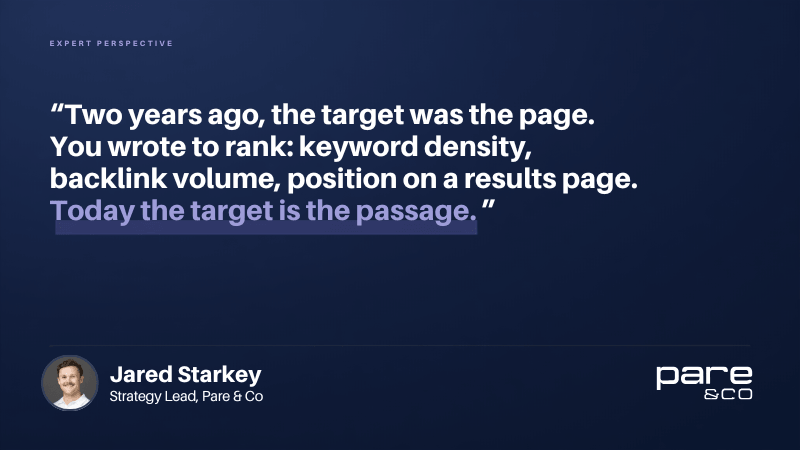
“Two years ago, the target was the page. You wrote to rank: keyword density, backlink volume, position on a results page,” according to Jared Starkey, Strategy Lead, Oomph. “Today the target is the passage. Retrieval systems pull out a chunk of content to answer a question directly, often without the user ever visiting the page, so the content has to work as a self-contained answer, not just a well-ranked one. The biggest trap is treating “ranking well on Google” and “getting cited by an LLM” as the same outcome. They’re not.”
Starkey is right. You need to spend more time understanding the questions customers ask at each stage of the buying journey and publish original research, customer stories, benchmarks, expert interviews, product comparisons, pricing guidance, and lessons from real work. Say what you know that others don’t.
Then make it easy to read. Lead with the answer. Use clear headings. Support claims with evidence. Name the tradeoffs. Admit the limits. A page that helps a buyer decide will usually help an AI system too.
AI visibility and SEO can work together, but it’s not easy.
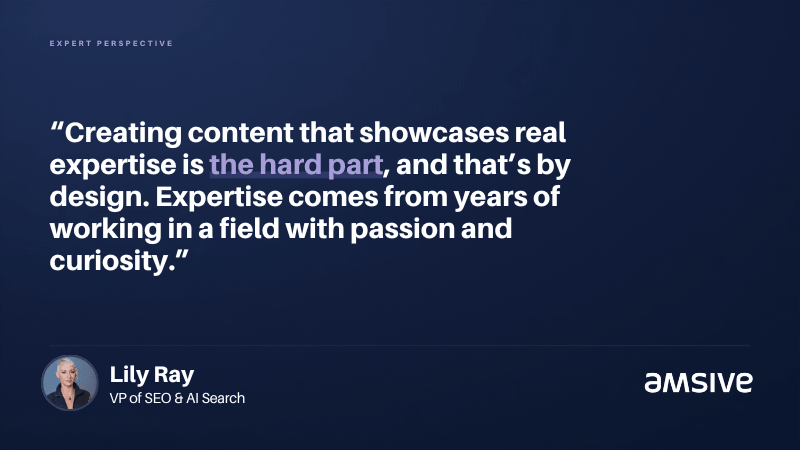
“Creating content that showcases real expertise is the hard part, and that’s by design,” according to Lily Ray, Founder of Algorythmic and VP of SEO & AI Search at Amsive. “Expertise comes from years of working in a field with passion and curiosity. The best way to demonstrate that expertise is building a personal brand and consistently publishing content that gets others thinking.”
Balancing AEO and SEO requires a different kind of discipline. Broaden your SEO foundation.
Don’t flood your site with AI-generated posts just because a prompt audit found gaps. Test ideas before publishing.
Build a presence in the sources AI systems cite. Create content that demonstrates real expertise.
AI has made average content cheap. That makes judgment more valuable.

To get the fully updated “AI Visibility Dos and Dont’s” – updated for Q3, 2026, based on what we’re seeing and recommending today – click here. To request a complimentary AEO/SEO audit of your brand and content strategy, contact Bodhium Labs by clicking here.
Thanks to Phalgun Kompalli and Philip Levinson for their contributions to this article.
Explore more on
Editorial disclosure
Opinions expressed in this article are those of the sponsor. Search Engine Land neither confirms nor disputes any of the conclusions presented above.
About the author