“Near me” SEO: Optimize for local searches that convert


What are “near me” searches and why do they matter?
“Near me” searches are high-intent, proximity-driven queries that include language like “near me” or “nearby” to land local search results. For example, instead of simply searching for “dentists” or “dentists san francisco,” many people will search for “dentists near me,” or “dentists nearby.”
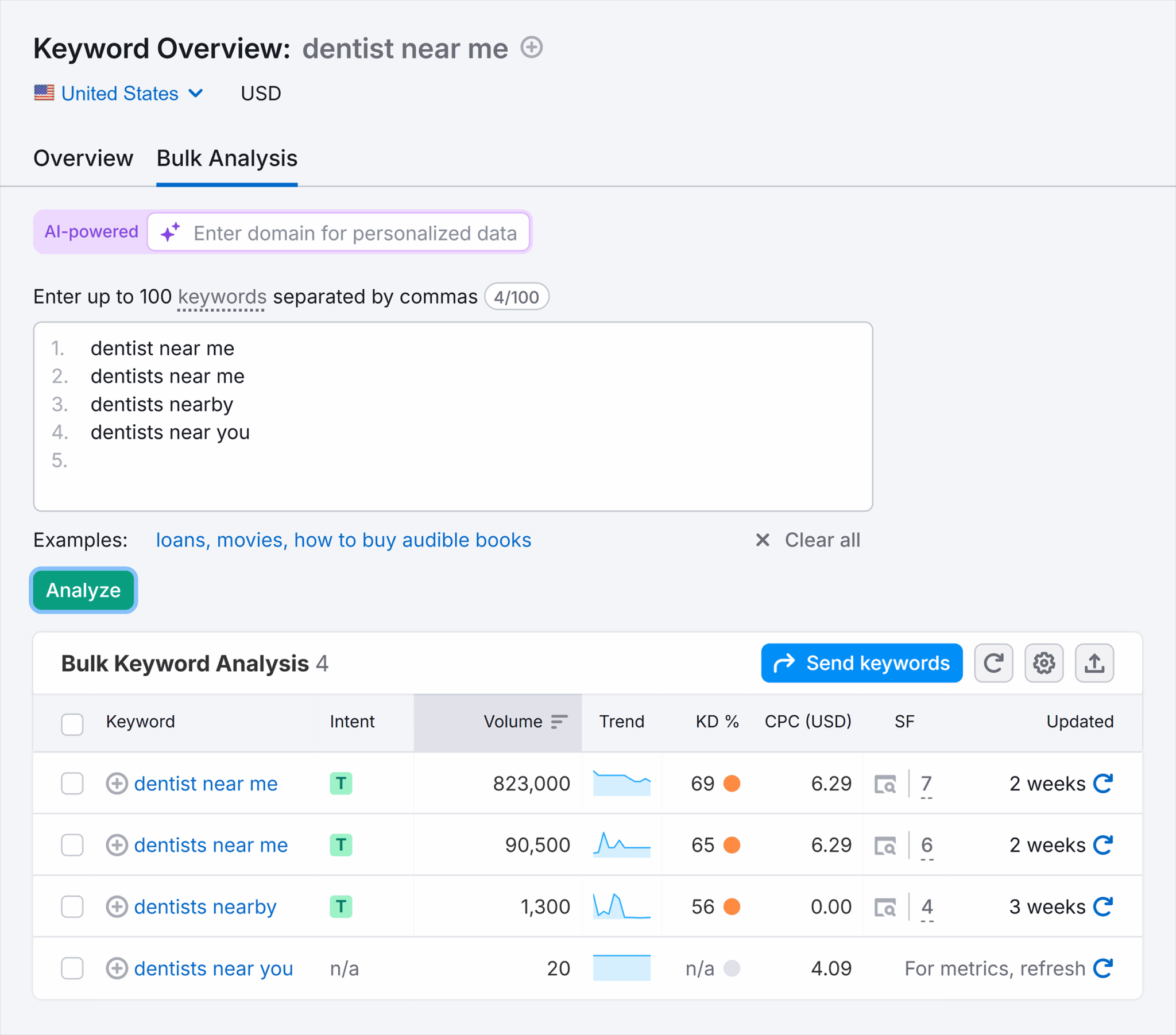
As the above screenshot from Semrush’s Keyword Overview tool proves, it’s quite common for searchers to add these “near” modifiers to their queries to signal to search engines like Google that they want to see results that are closest to their physical location, rather than seeing entities that could be situated more remotely.
Local businesses and their marketers need to understand this search behavior in order to weigh the risks/benefits of optimizing for it as they work through their local SEO strategy.
The main incentive in optimizing for “near me” keywords is that it can positively impact organic rankings. The main argument against it is that it can result in website content looking spammy and as if it were published for Google instead of for humans.
Understanding mobile/local “near me” intent via statistics
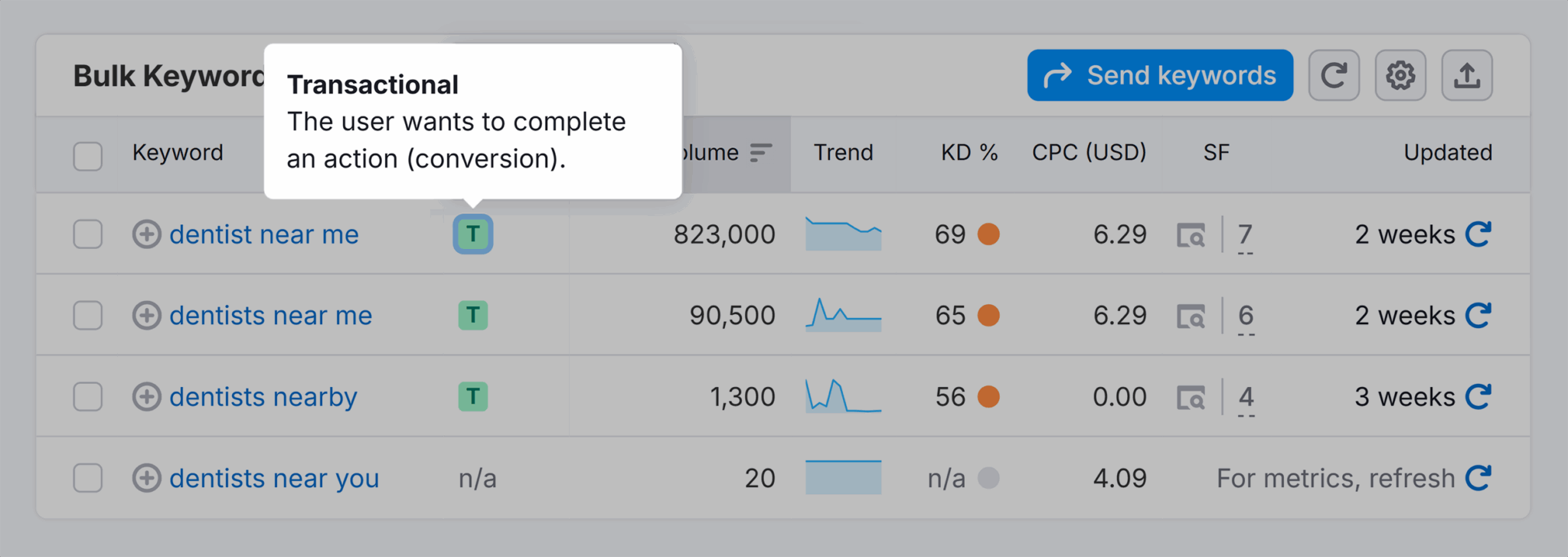
Harnessing the power of “near me” search language is a hot topic because these queries tend to have a strong transactional intent, meaning that customers are typically on the verge of completing an action like buying something, booking an appointment, or visiting a local store.
Over the past few years, Google and major marketing brands have published a variety of statistics about mobile and local searcher behavior that highlight how people are using phones and search language to navigate their nearby commercial landscape. For example:
- 76% of customers who use their phones to conduct a local search will visit a nearby business within 24 hours
- 60% of smartphone users have reached out to local businesses directly via Google’s search results
- 72% of consumers use Google search and 51% of consumers use Google Maps to look up local business information, making these dominant drivers of discovery and transactions
The consumer public has clearly adopted search and mapping apps to connect with businesses nearest them.
In 2025, new statistics are emerging about local searcher behavior in the context of AI. For example, one study finds that business websites make up 58% of the results being returned by ChatGPT when a prompt appears to have a local intent. This is an important statistic to keep in mind as user behavior changes over time as a result of interacting with AI products.
Why “near me” traffic converts better than generic queries
“Near me” traffic is worth paying attention to because of its high degree of transactional intent vs. non-local queries. Imagine a consumer who is researching an orthodontic product like Invisalign for straightening their teeth. They may go through multiple phases of their journey, including performing searches that have a:
- Navigational intent, using a search like “invisalign” to connect with the website of the brand that makes this product
- Informational intent, using a search like “is invisalign safe” to evaluate whether the product is considered a good choice, according to a variety of sources
- Transactional intent, using a search like “invisalign near me” to discover which dental practices in their area offer this product
- Commercial intent, using a search like “which dentists near me offers the cheapest invisalign” to evaluate and compare competing options
While a complete local search marketing campaign will strive to offer content that matches all intent phases of a customer journey, it’s that final phase (transactional intent) that has the highest conversion potential because people using the “near me” modifier are on the verge of choosing a local business for fulfillment.
The SEO toolkit you know, plus the AI visibility data you need.

How these queries surface in Google Search, Maps, and conversational AI
Google’s understanding of searcher intent is revealed in local search rankings and the results it returns for different queries. Consider the following scenario:

A searcher uses Google to look up “invisalign.” The first thing Google shows the user is the Invisalign brand results because they have understood this as a “navigational intent” query–meaning they believe the searcher is looking for a specific brand.

The same searcher then searches for “is invisalign safe” and the first thing Google returns is an AI overview that has scraped and summarized content from dental websites addressing potential safety concerns about this orthodontic device. Recent studies like this one show a high correlation between “informational intent” searches like this one and the presence of AI Overviews.

When the same searcher looks up “invisalign near me,” we can see the dramatic difference in what Google prioritizes in its results. A local pack of nearby dentists is given pride of place in the SERPs because Google understands that “near me” queries have a high degree of transactional intent. People searching like this don’t want navigational or informational results; they want to connect with a local business for a transaction.

It’s important to note the number of local dentists that appear highly in the organic SERPs below the local pack for this same query. Why? Because “near me” optimization tends to have the most impact on organic (rather than local) search rankings.
Meanwhile, a search for “invisalign near me” in an application like ChatGPT similarly returns a mapped set of local dentists.
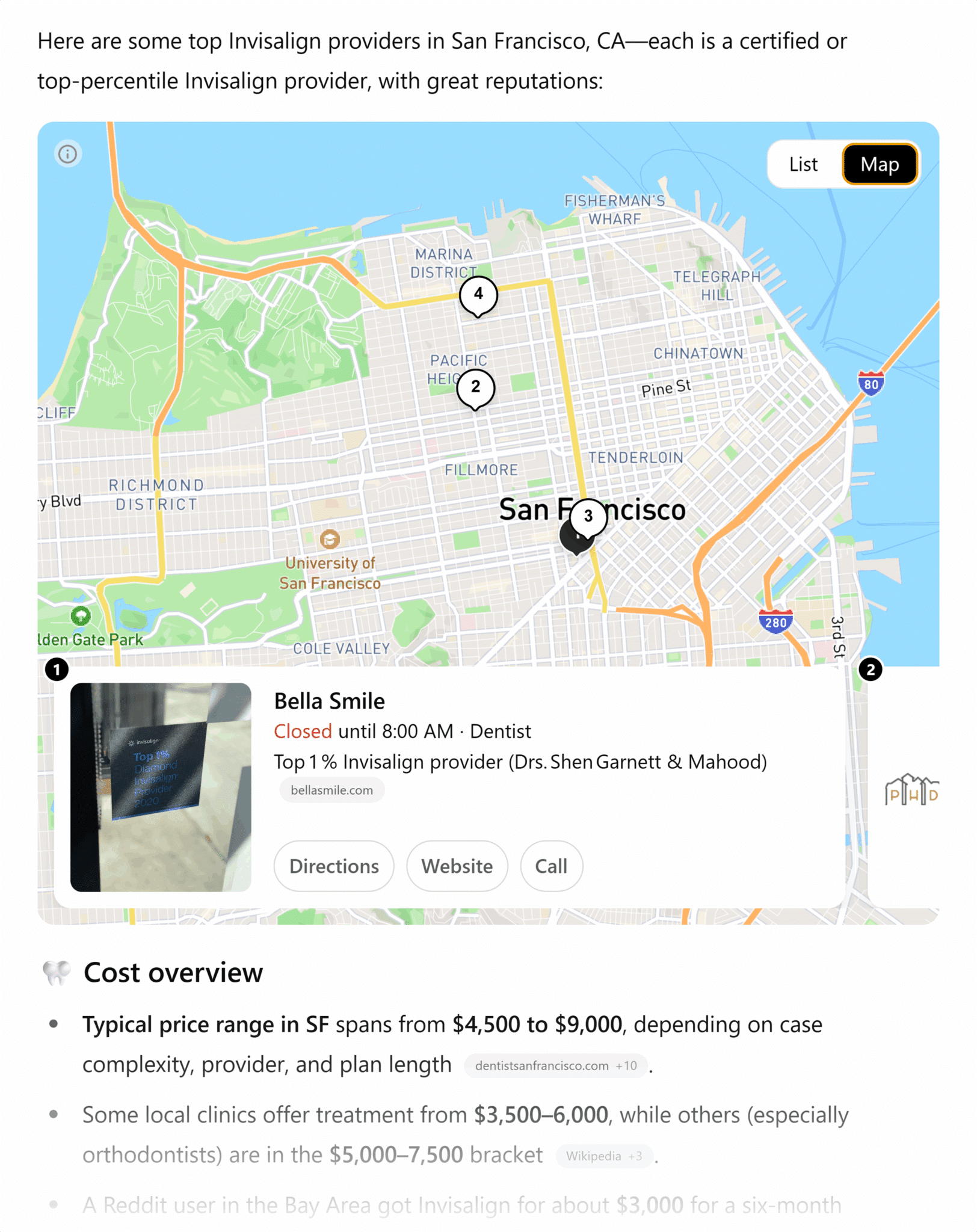
We can conclude from this that data has gone into its training that connects a “near me” language token with local business results. Bizarrely, ChatGPT kept insisting it wasn’t showing a map in its responses, but this screenshot proves otherwise, though it refused to disclose the source of the map.
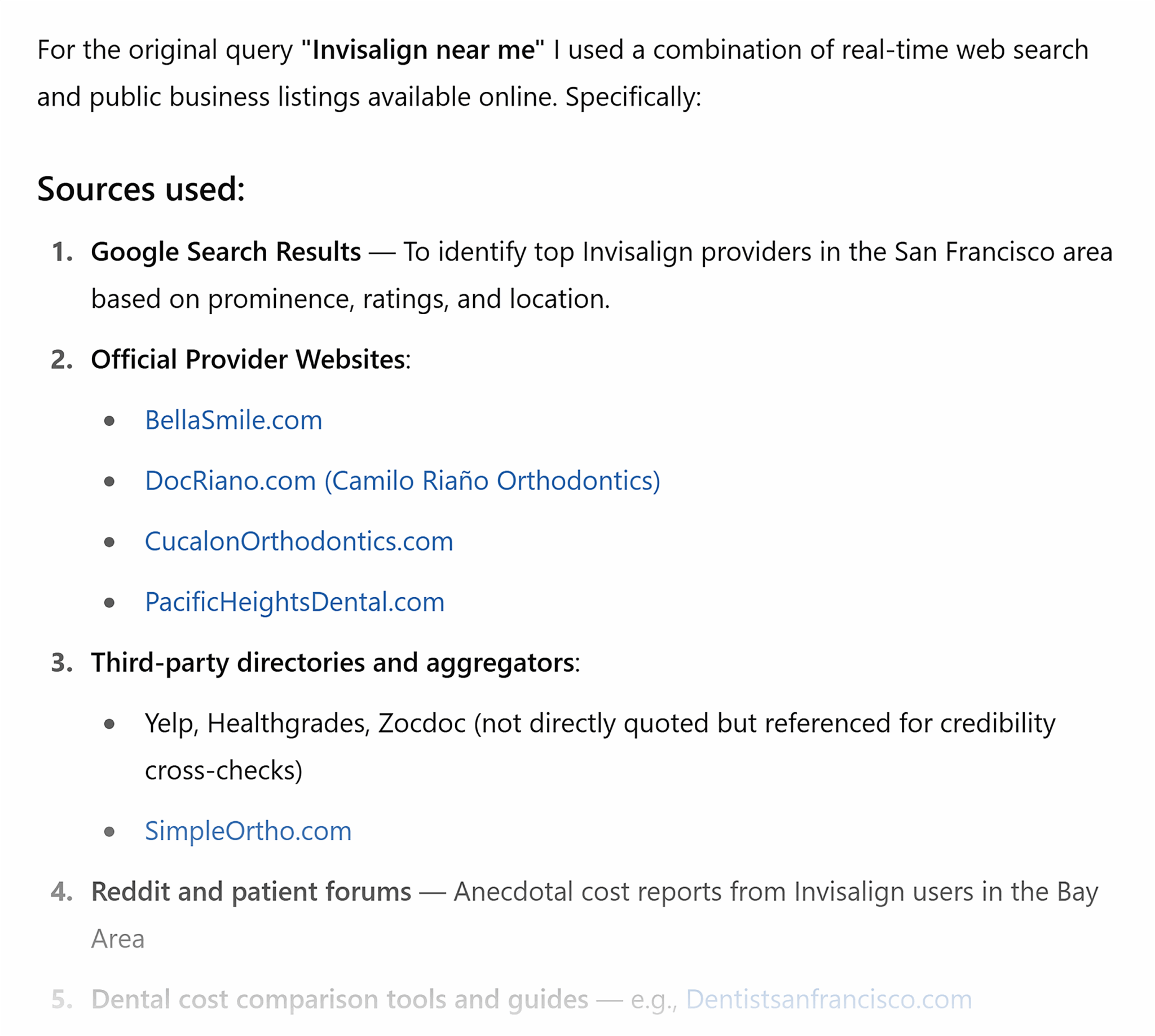
The above screenshot shows that ChatGPT is scraping information from a variety of organic sources, such as local dental web pages, business listings and directories like Yelp, and Reddit. It’s like a mashup of Google’s or Bing’s organic results.
How Google interprets “near me” intent
Typically, searchers don’t actually need to include location-specific modifiers like “san francisco” or proximity modifiers like “near me” to get Google to show them local business results. A simple search for a phrase like “dentists” will almost always be met with a local pack like this:

And the organic results that follow the local pack will generally contain a high proportion of local business websites for this same search:

Even without any type of modifier like “san francisco” or “near me,” Google understands that this query has a local intent. But how does Google know where searchers are located when they search?
Location awareness via device signals
Google discloses that it uses IP addresses, Google account information, web and app activity (if turned on when using Google sites, apps, and services), and search history to understand user location. Google states:
“When you search for something using a general area, your search will use an area of at least 3 sq km, or expand until the area represents the locations of at least 1,000 people.”
GPS and Wi-Fi information also reveal searchers’ locations.
This is why it is typically unnecessary to add any location-based keywords or similar modifiers to a search like “dentists.” Google already knows you’re looking in a location like San Francisco and their local and organic algorithms are designed to prioritize results nearest to you when your search is deemed to have a high local intent. Local customers like you get local content without having to think about it.
Understanding Google’s local algorithm
The Google document titled Tips to improve your local ranking on Google codifies these three pillars of their local algorithm:
- Relevance: how good of a match Google believes your Google Business Profile is for a user’s search terms
- Distance (aka Proximity): how near your business is to a searcher’s location
- Prominence: the degree to which your business is cited and reviewed by third parties
In considering the “near me” phenomenon, it’s the distance/proximity signal that is most important. Despite the fact that Google commonly knows searchers’ locations, keyword research tools prove that users regularly modify their searches with additional phrases that explicitly signal that they want to be shown nearby results.
Implicit vs. explicit location-based queries
Millions of keyword phrases have an implied local intent. Our example of “dentists” is a classic, demonstrating that Google has trained its algorithms to match local business information to queries like this that have a high local intent.
Other examples of implicit queries would be “Italian restaurant,” “grocery store,” or “cafe.” The fact that Google will typically return a local pack and highly-localized organic results for searches like these proves that they are confident that these searches are being performed by people who want to see local business results.
By contrast, explicit local searches take extra steps to signal to Google that a user is looking for local information. Explicit local results would include phrases like:
- “Italian restaurant San Francisco”
- “Grocery store near me”
- “Cafe nearby”
- “Dentist downtown”
- “Golf course 90210”
- “Tacos in the Mission district”
In each instance, the searcher is specifying that they want local business options tied to a specific geography, be that a city, a zip code, an area of town, a neighborhood, or simply near them.
This searcher behavior raises the question: why search like this when Google already knows where its users are located? Possible answers include:
- Some searchers may lack awareness that Google is already tracking their location and frequently doesn’t need extra phrases to show local results because local intent is implicit in a search like “dentists” or “cafes.”
- A searcher’s initial search may have resulted in Google throwing too wide a radius around their results. A searcher might specify that they want to see “cafes near me” if too many of the results for their “cafes” search were too far away for convenience.
- Some searchers will be using local search to find resources in remote locations. For example, someone planning a trip to San Francisco may look up “Italian restaurants San Francisco” while they are physically located in San Diego. Without adding a city modifier to their search language, Google will show them San Diego eateries.
- Countless searches don’t have a clear implicit local intent. For example, is a searcher who is looking up something like “granola” looking for a recipe, nutritional information, a place to buy granola offline or online, or even possibly a business named Granola? When local intent isn’t implied, searchers will naturally need to modify their search language to prompt Google to return local business results. It makes sense that a searcher in such a case might look up “where to buy granola near me.”
Clearly, there are many reasons why searchers modify their queries to be more explicit so that Google is prompted to show them results that better match specific, local intents.
The roles of mobile context and personalization
The emergence of smartphones created exciting new opportunities for local business marketers, as there was a natural fit between searchers “on the go” and nearby brands wanting to be prominently featured in Google’s local results. However, in 2025, our concept of mobile phone usage may need to be reconsidered in the light of stats like these:
- 91% of Americans own a smartphone and for 15% of US adults, these are their only internet-connected devices (source: Pew Research)
- On average, people spend more than 4 ½ hours on their phones every day (source: Exploding Topics)
Mobile phones have evolved from being on-to-go devices to being used everywhere at all times. While there is still a strong case to be made for local search being a great fit for mobile users, it’s important to be aware that people are using their mobile devices for many different activities–not just for navigating the nearby landscape while they are away from home.
Meanwhile, we can expect an increasingly personalized future on both mobile and desktop devices due to the rise of conversational AI applications like ChatGPT. In this scenario, potential customers will become more and more familiar with prompting AI to generate custom responses based on personal intent. The way in which consumers phrase and type their needs into these applications could potentially spill over into how people query older technology like Google’s search engine.
We could presume, for example, that people who become deeply accustomed to conversational AI would increasingly use question-format and long-tail searches in search engines. Google could potentially respond by personalizing results to prioritize local businesses that publish lots of answers to common questions (and use structured data). This is, of course, only speculation.
What won’t change anytime soon is the use of the internet by local consumers to find nearby offerings, and the need for local businesses to be visible to these prospects, regardless of whether the connection happens via mobile or desktop devices or as a result of a search query or AI prompt.
Should you optimize for “near me”
Now let’s look at the pros and cons of deciding whether to optimize local business websites for “near me” searches.
Pros
The best case studies on the value of “near me” optimization in 2025 hail from Sterling Sky. They have documented a significant correlation between optimizing clients’ titles, headers, and URLs and a meaningful lift in organic search engine rankings in Google. It’s important to note that they did not see local pack/Maps ranking improvements from this optimization tactic.
Further studies need to be conducted on the impact of “near me” optimization on AI inclusion. Because many conversational AI environments like ChatGPT are dependent on “tokenization” (matching the tiny building blocks of words to user prompts), there is good reason to theorize that optimizing local business websites for “near me” language could increase their chances of being served up in response to prompts containing “near me” phrases.
Cons
Google has taken a strong public stance urging online publishers to create “people-first” content instead of “search engine-first” content. Given this directive, the main objection to “near me” optimization is that it’s a tactic that appears to prioritize search engines over humans. Why? Take a look at this hypothetical header tag for a fictitious dentist:
We are the most trusted plumber near me in San Francisco
Does this read like natural language? No. No human would speak a phrase like this aloud. Examples like this give local business owners and their marketers good reason to believe that optimizing for “near me” searches could make their websites look spammy in the eyes of both Google and the very customers they are hoping to engage.
To do a gut check of your own, notice your initial reaction to Google SERP entries like this one from Angi.com, in which the title tag has been optimized for “near me” searches:

A similar example exists on the Better Business Bureau website:

The Sterling Sky case study (referenced above) correlates a rise in traffic to the BBB website following their implementation of “near me” optimization across their website.
Strong arguments can be made as to whether optimizing for “near” terms should be viewed as a search-engine first tactic (only implemented to boost organic rank) or a people-first tactic (implemented to better match how real humans search). This begs the question: is there a happy medium?
Track, optimize, and win in Google and AI search from one platform.
How to optimize for “near me” searches without looking like a spammer
Some local businesses will see the correlation between ranking boosts and “near me” optimization and dive right into implementing this language across their sites. But what about brands who are adamant about not looking robotic to the human website visitors they are serving? The good news is, there’s a compromise!
While a business you’re marketing may not be comfortable with writing a header tag that reads like our earlier example of:
We are the most trusted plumber near me in San Francisco
The same brand could be fine with this minor variant:
We are the most trusted plumber near you in San Francisco
According to Sterling Sky, Google treats “near me” and “near you” variants the same, so a possible escape route from having your content read awkwardly is to go with the “near you” version as it sounds much more like natural language.
Still hoping to find a comfortable way to incorporate “near me”? First-party testimonials may be your best fit. Ask some of your most loyal customers if they would mind telling the story of how they chose your brand when they were looking for a “dentist near me,” specifying that you would really appreciate them explaining how the proximity of your location to theirs contributed to them doing business with you. Publish these testimonials on:
- Your home page
- Your location landing pages (aka location pages), if applicable
- Your service area landing pages, if applicable
- Your reviews/testimonials page
- Your product/service pages
While it can be awkward for brands to talk about being “near me,” it’s perfectly natural for customers to use this voice. This can really take your positive reviews to the next level, helping customer reviews be more effective contributors to boost your local online presence.
One final thought to keep in mind when evaluating whether or not to incorporate “near” language into your optimization strategy: there is no evidence that Google currently views this tactic as spammy at present. However, this could change in the future. At any time, Google could decide that the type of optimization being done by sites like the BBB and Angi.com is a signal of low site quality. Should you engage in “near me” optimization and notice an organic ranking drop in the future, it may be time to rethink whether this tactic is no longer viewed as acceptable by Google. Time will tell.
Next steps in local marketing
“Near me” optimization is just one of the opportunities to be considered in promoting local businesses, but you need to take a holistic view of everything from schema markup through user experience and high-quality, helpful content.
Expand your horizons by learning how to win with your local marketing strategy (with AI, SEO, and Community).
Explore more on
Editorial disclosure
Search Engine Land is owned by Semrush. We remain committed to providing high-quality coverage of marketing topics. Unless otherwise noted, this page’s content was written by either an employee or a paid contractor of Semrush Inc.
About the author


