Lead generation: The evolution from spray-and-pray to precision targeting


Lead generation has transformed from broadcasting generic messages to thousands of prospects into orchestrating highly targeted, personalized campaigns that speak directly to individual pain points. Gone are the days when marketers could simply blast out cold emails, buy random prospect lists, and hope for the best (also known as the “spray and pray” approach).
Today’s landscape demands sophistication. Many marketers now prioritize lead generation as their top business goal, yet most still struggle to crack the code on what actually converts prospects into qualified leads.
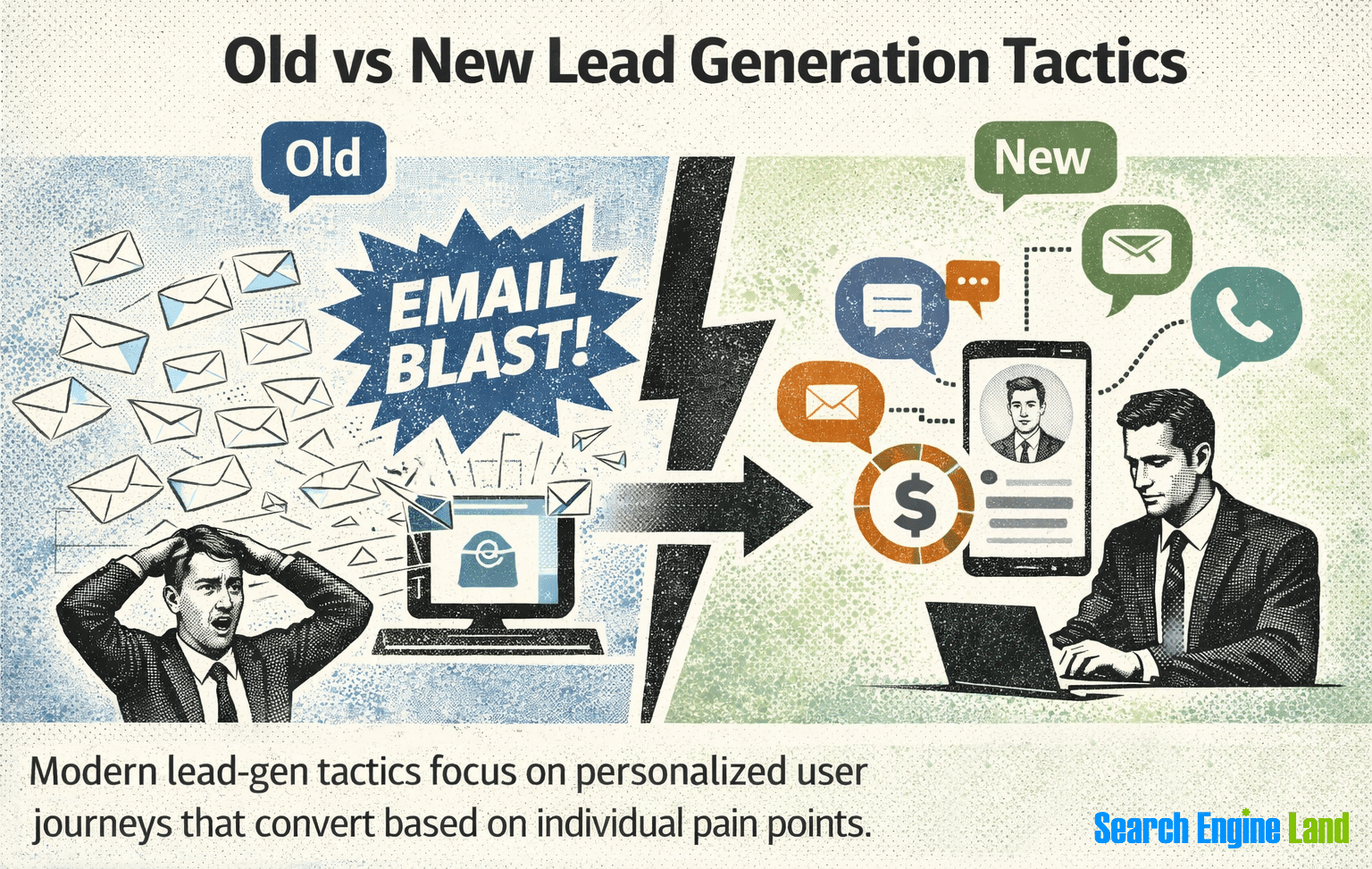
What’s fascinating is that despite having access to advanced marketing automation platforms, AI-powered personalization tools, and mountains of behavioral data, most lead generation campaigns still fall flat. A good email open rate hovers around 30%, cold calling conversion rates remain stubbornly low at around just 2%, and even well-funded campaigns typically generate more dead ends than qualified leads.
This disconnect isn’t about technology, however — it’s about strategy.
While we’ve moved from interruption-based marketing to permission-based relationships, many teams are still operating with an interruption mindset. They’re using precision tools to execute shotgun marketing tactics, like using a surgical laser to dig a hole in the backyard.
The SEO toolkit you know, plus the AI visibility data you need.

The most successful marketing teams have figured out that effective lead generation isn’t about casting the widest net — it’s about understanding exactly who you’re fishing for, where they spend their time, and what bait they actually want. This shift from quantity to quality, from broadcasting to conversing, from hoping to knowing, represents the fundamental evolution we’re seeing across modern marketing strategies.
What is lead generation?
Lead generation is the process of attracting potential customers and capturing their contact information or intent signals so a business can nurture them toward a sale.
Think about it this way: Someone visits your blog, downloads an ebook, subscribes to your newsletter, or fills out a contact form, providing you with the information you’ll need to market to them directly later. That’s lead generation in action. You’re not just getting eyeballs on your content — you’re getting people to raise their hand and say, “I’m interested.”

The point of lead generation is building a pipeline of people who are likely to buy from you. Raw website traffic is nice, but it doesn’t pay the bills. Leads do.
Here’s what makes lead generation different from general marketing: You’re capturing some form of actual commitment from the prospect. Maybe it’s an email address. Maybe it’s a phone number. It could be as simple as someone engaging with your chatbot or signing up for a webinar. The key is that you now have a way to continue the conversation outside of that single web session.
Pro tip: What matters most isn’t the channel — it’s understanding your audience well enough to offer something valuable in exchange for their contact details. Whether that’s exclusive content, early access to products, or simply the promise of useful updates, successful lead generation always starts with genuine value creation.
How lead generation works
Lead generation purposefully combines marketing channels, content offers, and conversion points to transform anonymous website visitors into identifiable prospects with known contact information and demonstrated interest in your solutions.
The goal of lead generation isn’t just capturing emails. You’re dealing with sophisticated buyers who’ve likely already done some research before coming to your website. They’re comparing competitors, reading reviews, and forming opinions about your brand — all before you even know they exist.
That changes everything about how we approach lead generation. It’s no longer about interrupting people with our message. Instead, it’s about being present with the right content at exactly the right moment in a prospect’s buying journey.
The strategic foundation separating successful lead generation from wasteful activity
Most lead generation fails because marketing teams mistake activity for actual strategy. They launch campaigns, create landing pages, and run ads, but in the end, they’re solving the wrong problem.
Successful lead generation starts with understanding that every anonymous visitor represents a potential customer who’s already researching solutions to their problems. Your job isn’t to convince them they need something; it’s to help them realize you’re the best option for what they already want.
Think about it: When someone downloads your ebook about “Five ways to reduce customer churn,” it’s not that they’re randomly interested in reading content. Rather, they’re dealing with churn problems on their website right now. They’re evaluating solutions, probably talking to vendors, and maybe even getting budget approval.
The strategic foundation of good lead generation requires designing every touchpoint around this reality:
- Your content needs to answer questions prospects are actually asking.
- Your forms need to capture information that helps sales have better conversations.
- Your follow-up sequences need to guide people through their evaluation process, not just blast them with product pitches.
Understanding modern buyer behavior and its impact on lead generation strategy
Buyer behavior has fundamentally shifted, and most marketing teams haven’t adapted to suit. Most B2B buyers now conduct their research independently before engaging with vendors. This means that they’re not waiting for your sales team to educate them.
This creates both a challenge and an opportunity:
- The challenge: You’re not controlling the narrative anymore. Prospects are forming opinions about your company based on what they find online — your content, your competitors’ content, review sites, and industry forums, just to name a few.
- The opportunity: You can influence their research process by being present throughout their entire consideration journey. Not just at the moment they’re ready to buy, but also when they’re first recognizing the problem, evaluating different approaches, and building an internal consensus.
In practical terms, your lead generation strategy needs multiple entry points that align with different stages of buyer intent, also known as the marketing funnel:
- At the top of the funnel, you might offer educational content like blog posts on industry trends, infographics about common challenges, or downloadable guides that require just an email address. These approaches appeal to prospects in the information-gathering stage of the buyer journey.
- Mid-funnel prospects are ready to compare solutions and vendors, so they respond better to comparison resources, case studies showing ROI, or webinars that demonstrate your expertise.
- Meanwhile, bottom-funnel prospects are ready to buy, so this is where product demos, free trials, pricing calculators, and consultation bookings come into play.
Each entry point should feel like the natural next step for wherever that prospect is in their research process. The most effective marketing teams create content clusters that support prospects throughout the entire research process. They’re not just capturing leads — they’re nurturing relationships with people who might not be ready to buy for six months, making sure they’re top of mind with the prospect when budget finally does get approved.
The economics driving the shift toward owned channel optimization
Customer acquisition costs are rising across paid channels, making owned media increasingly valuable for sustainable lead generation.
Think about the unit economics: A single blog post that ranks well for buyer-intent keywords can generate qualified leads for years without additional ad spend. Compare that to paid search, where you’re paying for every click, every impression, and every qualified visitor.
This isn’t just about saving money. It’s also about building sustainable competitive advantages. When prospects find you through organic search or AI discovery, they’re starting the relationship with trust. They’re not being interrupted by your ad. Instead, they actively sought out your solution or information.
The math gets even better when you factor in lifetime value. Leads from organic channels typically have higher close rates and longer customer retention because these channels are self-qualifying through the content discovery process. The prospect isn’t just clicking on an ad because it looked interesting — they’re actively researching solutions to problems they need to solve.
Smart organizations are shifting budget from paid media to content creation and SEO optimization for this very reason. They’re building systems that compound over time instead of requiring constant investment to maintain performance.
Building integrated systems instead of managing isolated tactics
The biggest mistake in lead generation is treating channels as independent campaigns instead of building integrated systems where every touchpoint reinforces the others.
Unfortunately, this happens constantly in digital marketing, such as when teams run separate campaigns for email marketing, paid search, content marketing, and social media. Each channel gets its own messaging, its own metrics, and its own landing pages. Multi-channel prospects get a fragmented experience, and resources get wasted because channels aren’t amplifying each other.
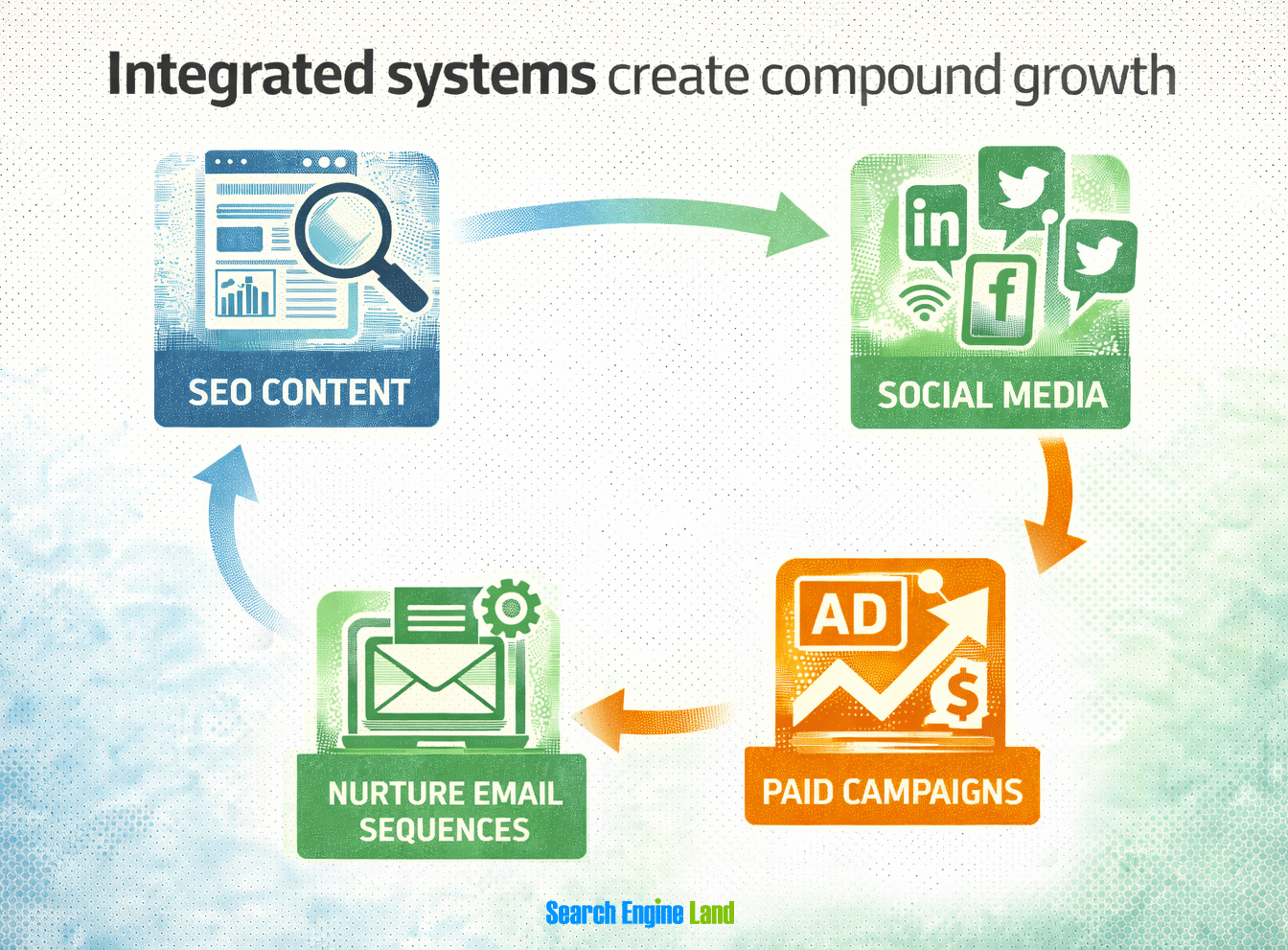
Integrated lead generation works differently. Your SEO content identifies which topics generate the most engagement, informing your paid campaign targeting. Your email nurture sequences reference content pieces prospects have already engaged with. Your sales team knows which resources prospects have downloaded before they call.
These are all compound effects that isolated tactics can’t achieve. A prospect might discover you through organic search, follow you on LinkedIn, attend a webinar, then convert on a targeted ad that references the webinar content. Each touchpoint builds on the previous interaction.
The key is starting with owned channels — particularly SEO-optimized content — as your foundation. These assets create the authority and trust that make other channels more effective. Paid campaigns perform better when they drive traffic to high-quality resources. Email nurture sequences are more engaging when they reference content prospects actually want to read.
What counts as a lead
A lead is any individual or business that has shown genuine interest in your company’s products or services by providing contact information such as an email address, phone number, or form submission. Think of it as the moment a stranger raises their hand and says, “Yeah, I want to know more.”
But here’s the thing — not all leads are created equal. The difference between a quality lead and website spam can literally make or break your marketing strategy. Companies that properly segment and qualify their leads are likely to see higher close rates compared to those using a one-size-fits-all approach.
We’re going to break down exactly what qualifies as a lead, how modern AI is transforming lead qualification, and why your current landing pages might be leaving money on the table.
Types of leads
Not all leads deserve the same treatment. Understanding these distinctions helps you prioritize resources and tailor your approach for maximum conversion rates.
- Marketing-qualified leads (MQLs) have engaged with your content but aren’t ready to buy yet. They’ve downloaded whitepapers, attended webinars, or repeatedly visited your pricing page. These leads need nurturing through educational content and strategic follow-ups.
- Sales-qualified leads (SQLs) have crossed the threshold from research to serious consideration. They’ve requested demos, submitted detailed contact forms, or explicitly asked about implementation timelines. Your sales team should prioritize these leads within 24 hours of identification.
- Product-qualified leads (PQLs) have actually used your product through free trials or freemium models. They understand your value proposition firsthand, making them significantly more likely to convert.
The “temperature” distinction matters with leads, too. Cold leads have minimal interaction history, while warm leads have demonstrated sustained engagement patterns. Warm leads are significantly more likely to convert compared to cold leads, but they require different messaging approaches.
With warm leads, you’re not starting from scratch, as the prospect already knows who you are. You can skip the lengthy introductions and focus on reinforcing value and addressing specific pain points they’ve already shown interest in. Your messaging should feel like a natural continuation of previous interactions, whether that’s referencing content they previously downloaded or problems they’ve indicated they’re facing. And timing matters — warm leads expect prompt follow-up while their interest is still active.
Artificial intelligence and predictive intelligence are transforming lead qualification
AI is fundamentally changing how we identify and qualify leads, moving beyond basic demographic filters to predictive behavioral analysis that actually works.
One case study showed that an AI outreach system increased leads by 40%. AI lead generation was also shown to save dozens of hours of manual work each week, freeing marketing teams to focus on more skilled tasks.
But the real power goes beyond just automating qualification. AI predictive scoring can analyze hundreds of micro-interactions that human teams would never catch at scale. This could include email open patterns, content consumption depth, website session duration, and even cursor movement behavior. Each data point feeds into a scoring model that identifies which leads are genuinely ready to buy versus those just browsing. Instead of your sales team chasing cold prospects, they’re connecting with leads who’ve already shown buying intent through their digital behavior.
Pro tip: Here’s something you can implement immediately: Set up behavioral triggers based on content engagement depth rather than just page visits. Someone who spends eight minutes reading your technical documentation is exponentially more qualified than someone who bounces through 10 product pages in two minutes.
The real power comes from combining first-party data with third-party intent signals. When your CRM shows a lead downloading competitive comparison guides while your intent data provider flags them researching “implementation timelines,” that’s your cue for immediate outreach.
This enhanced qualification enables the personalization required for effective account-based marketing approaches, where individual lead behavior informs entire account strategies.
Account-based marketing precision for enterprise lead generation
Account-based marketing (ABM) represents a complete reimagining of lead generation for high-value prospects, flipping the traditional funnel approach on its head by targeting accounts first and individuals second.
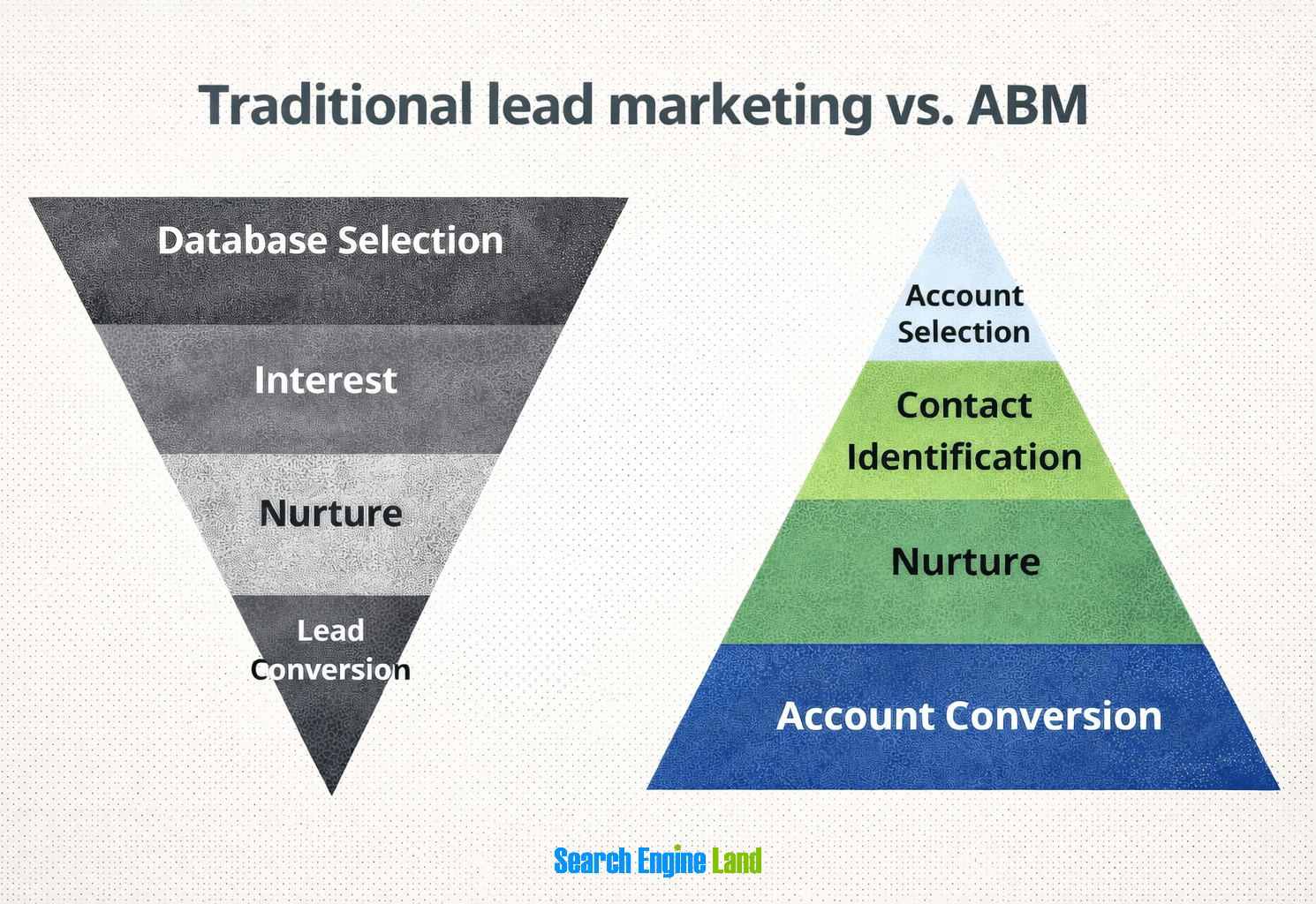
Trendemon states that 87% of research participants said ABM programs generate higher return on investment (ROI) compared to traditional marketing initiatives. But ABM success requires fundamentally different content strategies and measurement approaches.
Instead of casting wide nets, ABM focuses on deep account research and hyper-personalized outreach. You’re creating content for specific companies, addressing their unique challenges, competitive landscape, and buying committee dynamics. This might mean developing custom case studies, industry-specific ROI calculators, or even personalized video content for key stakeholders.
The measurement shift is equally crucial. Traditional metrics like cost-per-lead become irrelevant when you’re targeting 50 high-value accounts instead of generating 5,000 random inquiries. ABM success metrics include account engagement depth, stakeholder penetration, and ultimately deal size and velocity.
Sales-marketing alignment becomes non-negotiable in ABM environments. Your marketing team needs real-time feedback about account interactions, while sales needs marketing’s research insights to effectively personalize their outreach.
This precision approach requires sophisticated attribution and ROI calculation methods that can track complex, multi-touchpoint buyer journeys across entire buying committees.
Landing page optimization and conversion rate enhancement that compound results
The science behind high-converting landing pages challenges most conventional wisdom about what actually drives conversions.
Generic best practices fail because they ignore audience context. What works for B2B software buyers won’t work for ecommerce impulse purchases. A long-form landing page might convert enterprise clients at an impressive 12% while cratering conversions for consumer products all the way down to 2%. The audience determines the approach, not the other way around.
Testing reveals counterintuitive patterns that defy standard advice. Removing trust badges sometimes lifts conversions when they create decision paralysis. Adding friction through multi-step forms can increase lead quality and downstream revenue, even as top-of-funnel conversions drop. Longer load times on video-heavy pages occasionally outperform fast-loading text pages because the content itself drives stronger intent signals.
But these findings mean nothing without your specific audience data. A red CTA button isn’t universally better than blue. Urgency tactics don’t always increase conversions as they can trigger skepticism in technical audiences while working brilliantly for deal-seekers.
This is why rigorous testing and measurement matter more than following playbooks. You need controlled experiments that isolate variables, statistical significance that accounts for traffic patterns, and analytics that connect landing page behavior to actual business outcomes. Without this foundation, you’re optimizing blind.
Why lead generation matters for business
Lead generation isn’t just about filling your pipeline with names and email addresses. It’s about creating a predictable revenue engine that your business can count on. When you know how many leads you’re generating each month, what percentage convert to opportunities, and how many of those close into customers, you can forecast revenue with real confidence. That predictability changes everything from hiring decisions to marketing budgets to growth planning.
Businesses without a consistent lead generation system are essentially flying blind. They’re reacting to whatever walks through the door instead of proactively building their customer base. One month might bring a flood of inquiries, the next might be crickets. That volatility makes it nearly impossible to scale because you can’t invest in growth when you don’t know if next quarter’s revenue will cover payroll.
But when you’ve got lead generation dialed in, you shift from hoping for customers to systematically creating them. You can calculate that X amount of marketing spend generates Y number of qualified leads, which produces Z revenue within a specific timeframe. That’s when your business transforms from a guessing game into a growth machine. And that’s exactly why lead generation has become non-negotiable for companies serious about sustainable growth.
Common lead generation channels
Lead generation channels are the different touchpoints and pathways businesses use to attract and capture potential customers during their buyer’s journey. In B2B, for example, these channels typically fall into owned, earned, and paid categories, each offering unique advantages for reaching prospects at different stages of awareness and intent.
Smart lead generation isn’t about being everywhere — it’s about being strategic with your mix of channels. The companies that nail this understand which channels drive the highest-quality leads, not just the most volume.
Let’s break down the major channels that consistently drive results.
Search engine optimization (SEO)
SEO builds long-term organic visibility by optimizing content to rank for keywords your prospects are searching for. Unlike paid channels, organic search delivers compound returns. Your content can generate leads for months or even years after publication.
The key is matching content to search intent at every funnel stage. Top-of-funnel content targets informational queries (“what is marketing automation”), while bottom-funnel pages capture commercial intent (“best CRM for small business”). Companies with mature SEO programs often see organic search account for a substantial percentage of their qualified leads.
AI search optimization
AI SEO is changing how prospects discover solutions, and that shift has direct implications for lead generation. When Google’s AI Overviews or tools like ChatGPT synthesize answers at the top of the results page, fewer users click through to individual sites. That means your content needs to either earn a place inside those AI generated responses or rank strongly enough to capture the clicks that remain.
For lead gen, this makes structured, intent driven content even more critical. Pages that clearly answer prospect questions, establish entity authority, and include concise, citable statements are more likely to surface in both traditional results and AI summaries. The companies generating the most organic leads in the next few years will be the ones optimizing for both click based and zero click search experiences.
Social media marketing
Social platforms help you build relationships and nurture prospects through valuable content and community engagement. LinkedIn dominates B2B social media marketing, while X, Facebook, and industry-specific communities are more prominent in B2C.
The magic happens when you use social media for education and thought leadership and not just promotion. Share insights, engage in conversations, and consistently demonstrate expertise. Companies that treat social media as a relationship-building channel rather than a broadcasting platform see much higher conversion rates from social traffic.
Paid advertising
Paid channels like Google Ads, LinkedIn ads, and display advertising deliver immediate visibility and traffic when executed strategically. The advantage is speed and control: You can test messaging, target specific accounts, and quickly scale successful campaigns.
Account-based marketing through paid channels has become especially effective for targeting high-value prospects. Instead of broad targeting, you can create highly personalized campaigns for specific companies or decision-makers. The key is balancing cost per acquisition with lead quality (cheaper clicks don’t always mean better ROI).
Email marketing
Email remains one of the highest-ROI channels when done well, delivering a return of $36 to $40 for every dollar spent. But success requires moving beyond batch-and-blast approaches and on to segmented, personalized campaigns based on buyer behavior and characteristics. Modern email marketing leverages automation, dynamic content, and sophisticated triggering.
Lead-nurturing sequences are particularly powerful. You can guide prospects through educational content, case studies, and social proof based on their engagement patterns. Companies that excel at email marketing typically see a substantial percentage of their pipeline attributed to email-nurturing efforts.
Content marketing
Content marketing attracts prospects by providing valuable information that addresses their challenges and questions. This includes blog posts, whitepapers, webinars, podcasts, and video content designed to establish expertise and build trust.
The most successful content programs map content to specific buyer personas and funnel stages. Early-stage content educates about problems and solutions, while later-stage content provides product comparisons, ROI calculators, and implementation guides.
Referrals and word-of-mouth
Referrals consistently produce the highest-quality leads because they come with built-in trust and context. Happy customers become your best salespeople when you make it easy for them to refer others. Formal referral programs with incentives can boost referral volume, but the foundation is always exceptional customer experience.
Partner referrals are equally valuable, especially when you can establish relationships with complementary service providers or technology vendors. These partnerships create ongoing lead flow through mutual referrals and joint marketing efforts. The key is making the referral process frictionless for both the referrer and the prospect.
Events and webinars
Live events, whether virtual or in person, create high-impact touchpoints for relationship building and lead generation. Webinars offer scalable ways to demonstrate expertise and capture lead information. Trade shows and industry conferences provide face-to-face networking opportunities that can accelerate relationship building.
The secret to event success is follow-up. Companies that respond to event leads within 24-48 hours see significantly higher conversion rates than those that wait. Marketing automation can help sequence post-event nurturing based on engagement levels and interests expressed during the event.
Strategic partnerships
Partnerships create win-win scenarios where complementary businesses share leads and resources. This might include technology integrations, joint ventures, or formal channel partner programs. The advantage is accessing established audiences and leveraging partner credibility to accelerate trust building.
Successful partnership programs require clear agreements on lead sharing, attribution, and mutual promotion. Companies with mature partner ecosystems often see a considerable portion of their pipeline flowing through partner channels. The key is choosing partners whose audiences align with your ideal customer profile without direct competitive overlap.
Online vs. offline lead generation
Today’s marketers face a fundamental choice in lead generation between digital approaches like search engine optimization and social advertising versus traditional offline methods such as trade shows, phone outreach, and face-to-face networking events.
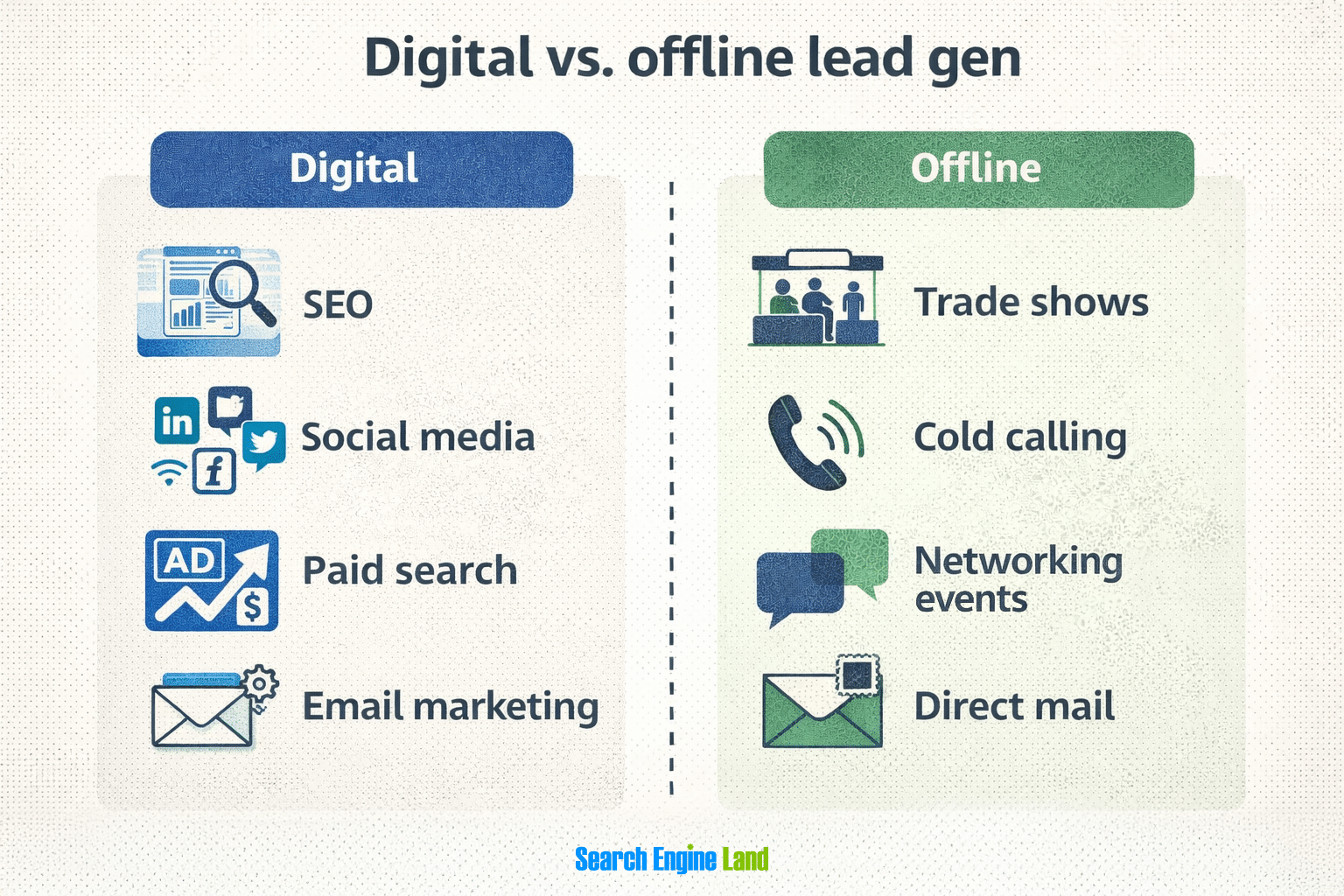
The landscape has shifted dramatically over the past decade. While digital marketing can generate leads 24/7, offline methods still deliver highly qualified prospects — but at different costs and scales. Modern companies blend both approaches rather than fully choosing one over the other.
Here’s what’s really interesting: The best-performing marketing teams aren’t picking sides. They’re orchestrating multiple touchpoints that move prospects from digital discovery to offline conversion, or vice versa.
Digital lead generation: Scale and automation
Online lead generation operates through websites, paid advertising, email campaigns, and social media platforms that can reach prospects at massive scale with measurable tracking.
Your website becomes your best salesperson, working around the clock. SEO and AI search drives qualified traffic to landing pages optimized for conversion, while paid ads target specific buyer personas across multiple platforms. Your Google Business Profile acts as a bridge, directing local customers to your physical location while also funneling online searchers straight to your website. Email sequences nurture prospects automatically, and social media advertising reaches people based on their behaviors and interests.
The data advantage is huge. You can track every click, conversion, and cost per acquisition. Tools like Google Analytics show exactly which channels deliver the highest-quality leads, allowing you to optimize budget allocation in real-time.
Offline lead generation: Relationships and trust
Traditional lead generation methods, including trade shows, cold calling, direct mail, and networking events, rely on personal relationships and human connections to build trust and credibility.
Trade shows let you demonstrate products hands-on and have face-to-face conversations with decision-makers. Cold calling, when done strategically, can break through inbox clutter and create immediate dialogue. Networking events build long-term relationships that often result in referrals and repeat business.
The quality factor is undeniable. Leads generated through personal interactions typically have higher close rates and larger deal sizes. There’s something powerful about looking someone in the eye and shaking their hand.
However, offline methods are harder to scale and measure. You can’t easily A/B test a trade show booth or track the ROI of every networking conversation. The costs are often higher upfront, and results take longer to materialize.
The hybrid advantage
Smart marketers use digital channels to amplify offline efforts and vice versa. They drive traffic to landing pages that capture contact information, then follow up with personal phone calls. Trade show attendees get added to email nurture sequences. LinkedIn connections turn into phone conversations.
This approach maximizes the strengths of both channels while minimizing their weaknesses. You get the scale and trackability of digital with the relationship-building power of offline.
The key is having systems that connect everything — your CRM needs to track both digital interactions and offline touchpoints to give you a complete view of the customer journey.
Lead generation vs. demand generation
Lead generation focuses on capturing contact information from prospects who are already showing purchase intent, while demand generation creates awareness and builds interest in your products or services before prospects are ready to buy. Think of it like the difference between catching fish that are already hungry versus feeding the lake to make sure fish will be there when you’re ready to cast your line.
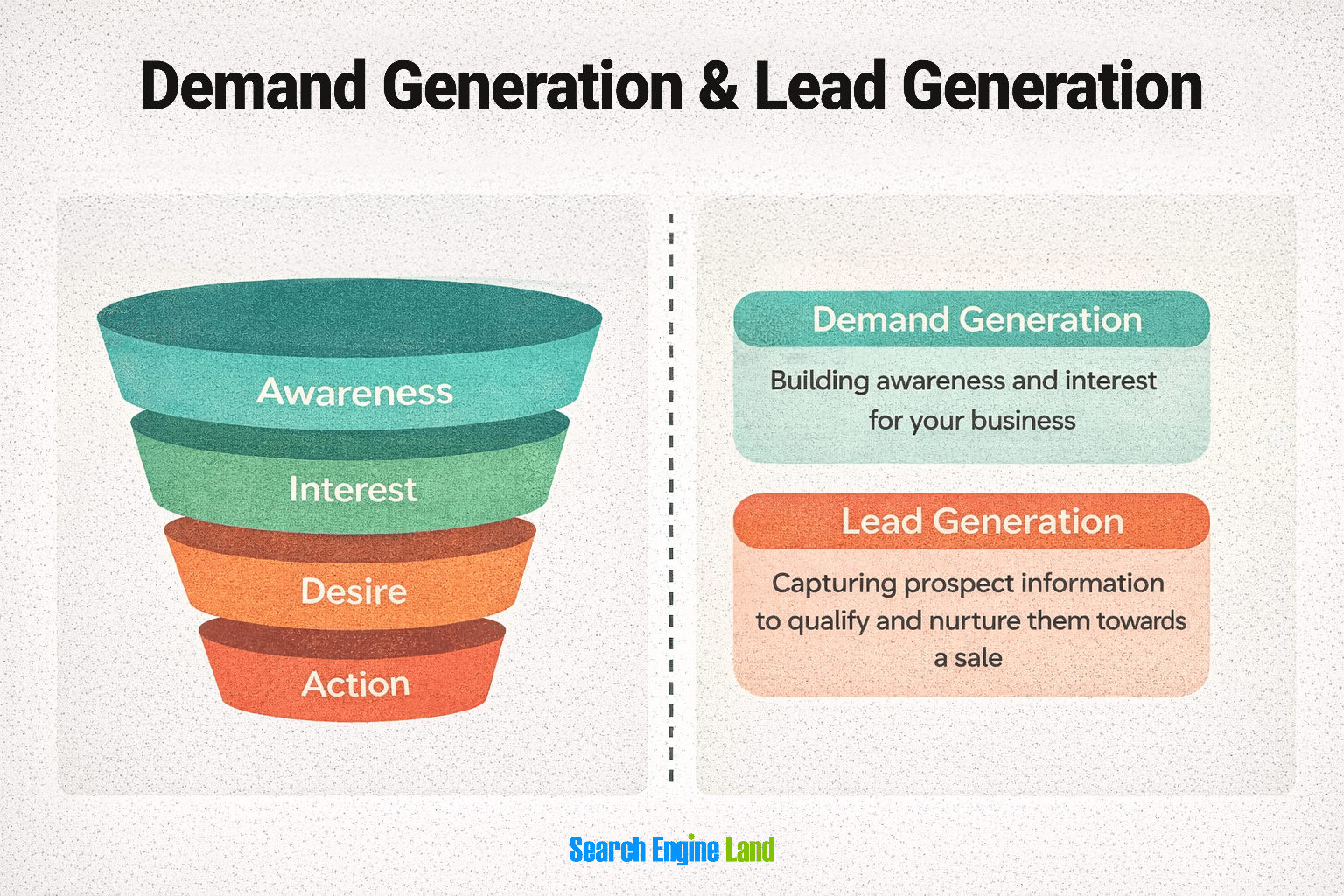
However, many marketers get these two mixed up. They’ll run campaigns focused purely on lead gen, wondering why their cost per lead keeps climbing and their sales team complains about quality. Or they’ll invest heavily in demand gen activities but struggle to prove ROI because they’re not capturing interest when it peaks.
Demand generation is about making your brand impossible to ignore when buyers enter your market. You’re building authority through content marketing strategies, showing up in search results for problems your prospects don’t even know they have yet, and establishing thought leadership. It’s a longer play, but when done right, it makes everything else easier.
Lead generation kicks in when someone’s ready to engage. They’ve consumed your content, understand their problem, and now they want to talk specifics. That’s when you present the demo request, the consultation booking, or the detailed buyer’s guide behind a form.
Smart marketing teams run both in parallel. Your demand gen efforts feed your lead gen funnel, while your lead gen data helps you understand which demand gen tactics actually move the needle. Companies that excel at this create educational content that builds demand around inbound marketing concepts, then capture leads with free tools and templates that demonstrate their platform’s value.
The measurement approach between the two differs, as well. Demand gen success shows up in brand awareness metrics, organic search visibility, and early-funnel engagement. Lead gen success is about conversion rates, cost per qualified lead, and pipeline velocity. You need both to build a sustainable growth engine that doesn’t just generate activity, but creates revenue.
Lead generation funnels and journeys
Lead generation funnels map the path prospects take from first awareness to final conversion, typically moving through awareness, consideration, and decision stages. Most successful funnels use automated nurturing sequences to guide prospects through each stage, delivering the right content at the right time to maintain engagement and build trust.
Of course, people don’t just stumble onto your site and magically become customers. They need time to get familiar with your brand, understand your value, and build confidence in your solution. That’s where the journey becomes crucial.
The awareness stage kicks things off when someone discovers your brand through search, social media, or referrals. They might not even know they have a problem yet, or they’re just starting to research solutions. Your job here is to provide helpful, educational content that positions you as a trusted resource — think blog posts on industry trends, guides, or tools that solve immediate pain points.
Once prospects move into consideration, they’re actively evaluating options and comparing solutions. They know what they need but aren’t sure who to trust yet. This is where targeted nurturing sequences really shine. Email workflows triggered by specific actions — like downloading a whitepaper or viewing pricing pages — can deliver case studies, product demos, and social proof exactly when prospects need it most.
The conversion stage is where prospects are ready to make a decision but might still need that final push. This could be a personalized demo, free trial, or consultation offer. The key is removing friction and addressing last-minute objections through targeted follow-up.
Modern lead generation relies heavily on marketing automation tools to manage these journeys at scale. Platforms like HubSpot and Marketo Engage can trigger different content sequences based on how prospects engage with your site, emails, or content. Someone who downloads an awareness-stage guide gets a different nurturing sequence than someone who requests a product demo.
The magic happens in the transitions between stages. Smart funnels use behavioral triggers to automatically move prospects forward. Maybe someone who’s been opening awareness content for two weeks suddenly downloads a comparison guide — that’s your cue to shift them into consideration-stage nurturing with more targeted, solution-focused content.
Don’t forget the follow-up workflows either. Not everyone converts on the first try, and that’s totally normal. Setting up re-engagement campaigns for prospects who’ve gone cold can bring back lost leads. Sometimes people just need more time or a different approach.
The most effective funnels also integrate with your CRM to track which content and touchpoints actually drive conversions. This lets you optimize the entire journey, from first impression to final handoff to sales. You might discover that prospects who engage with your ROI calculator convert 40% more often, or that adding a customer testimonial to your nurturing sequence boosts conversion rates by 25%.
Lead magnets and offers
Lead magnets are valuable resources or incentives, such as ebooks, free trials, demos, or discounts, that businesses offer in exchange for a visitor’s contact information, particularly their email address. Their function is to entice anonymous website traffic into becoming identifiable prospects in your sales funnel.

For example, the average visitor might land on your site, browse around, and leave without taking action. That’s basically throwing away most of your traffic. Lead magnets solve this problem by giving visitors something valuable in exchange for sharing their information.
But here’s where it gets interesting for SEO and content teams. Your lead magnets aren’t just conversion tools — they’re content assets that can drive organic visibility. A well-crafted ebook targeting your core keywords can rank in search results, attract backlinks, and position your brand as an authority.
The key is alignment. Your marketing strategy should seamlessly integrate lead magnets that appeal to the same search intent as your organic content. When someone searches for “enterprise SEO checklist” and finds your comprehensive guide, they’re already qualified traffic looking for exactly what you offer.
Smart teams layer their approach. You want to create premium content that stands alone as valuable resources, then gate the advanced sections or bonus materials. This allows you to capture leads while still providing enough value to earn organic rankings and social shares.
The beauty of modern lead magnets is their versatility. Interactive tools, calculators, and assessments often outperform static PDFs because they provide immediate value. Plus, they’re naturally linkable and shareable, extending their SEO impact beyond just the landing page.
How to measure lead generation success
Measuring the success of your lead generation efforts requires the systematic tracking and analysis of key metrics. You need to get a clear picture of how effectively your marketing efforts create qualified prospects and contribute to business revenue. Without proper measurement frameworks, you’re essentially flying blind and spending budget on tactics that feel productive but might not move the needle where it counts.
The truth is that many marketing teams track the wrong numbers. They get excited about lead volume when quality matters more, or focus on vanity metrics while missing the connection between marketing activities and actual revenue.
We’re going to walk through the measurement frameworks that actually prove marketing’s contribution to revenue, the attribution models that connect activities to outcomes, and the KPIs that separate signal from noise.
Measurement frameworks that prove marketing’s revenue contribution
Marketing accountability starts with establishing clear connections between your marketing activities and your business outcomes. The most effective measurement frameworks focus on pipeline contribution and not just lead volume (tracking how your prospects move through the entire customer journey).
The key is “revenue mapping” — connecting every marketing touchpoint to actual closed deals. This means tracking leads from first interaction through qualification, opportunity creation, and final purchase. You’ll want to measure conversion rates at each stage, time-to-close by channel, and the revenue value of different lead sources.
Here’s what makes this framework powerful: It shifts conversations from, “How many leads did we generate?” to “How much pipeline did we create?” Your CEO doesn’t care about MQLs — they care about revenue. When you can say, “Our marketing program generated $2.3M in pipeline this quarter,” you’ve got their attention.
Smart organizations implement what’s called “closed-loop reporting” — connecting marketing automation platforms directly to CRM systems. This lets you track individual leads from initial engagement through final purchase, calculating true ROI on every campaign and channel.
The most mature measurement frameworks also include leading indicators — metrics that predict future performance. These might include content engagement depth, email nurture progression rates, or sales qualification scores. By tracking both current performance and predictive signals, you can adjust strategies before they impact revenue.
Attribution models that accurately connect marketing activities to revenue
Multi-touch attribution has become critical as buyer journeys grow more complex. Depending on what stage of the journey they’re in, today’s prospects interact with anywhere from one to 50 touchpoints before converting, making last-click attribution practically useless for understanding true marketing impact.
The problem with last-click models is obvious: They give all the credit to the final interaction, completely ignoring the awareness content, nurture sequences, and touchpoints that actually influenced the decision. It’s like giving the closing pitcher credit for the entire baseball game. Sure, they finished it, but what about the innings that got them there?
Advanced attribution models distribute credit across the entire journey. Time-decay models give more weight to recent interactions while still crediting earlier touchpoints. Position-based models assign higher value to first and last interactions, with remaining credit spread across middle touches. The key is choosing a model that reflects your actual sales cycle.
The reality is that while perfect attribution is impossible, better attribution transforms budgetary decision-making. Start with position-based attribution (40% first touch, 40% last touch, 20% middle touches) and adjust based on your sales cycle length and buying patterns.
The most sophisticated teams also implement cross-device tracking and account-based attribution. Since modern buyers research across multiple devices and B2B marketing, in particular, can involve multiple stakeholders, you need attribution models that account for these complexities. Google Analytics 4’s data-driven attribution can help map these intricate journeys.

Key performance indicators that distinguish meaningful metrics from vanity numbers
The difference between vanity metrics and performance indicators is simple: Vanity metrics make you feel good, while key performance indicators (KPIs) predict business outcomes.
Website traffic feels impressive until you realize none of those visitors convert. Email open rates seem important until you track actual engagement and progression.
Here are some examples:
- Cost per acquisition (CPA) matters more than cost per lead (CPL) because it connects marketing spend to actual customers. A $50 cost per lead sounds great until you discover those leads convert at 0.5%, making your true CPA $10,000.
- Lead quality scores provide better insights than lead volume. Implement scoring based on demographic fit (company size, industry, role) and behavioral engagement (content consumption, email interaction, website behavior). A lead scoring system helps prioritize sales follow-up and measure the true value of different marketing channels.
- Pipeline velocity (how quickly leads move through your sales funnel) reveals channel effectiveness beyond volume. Leads from organic search might convert slower but close at higher rates. PPC leads might qualify faster but require more nurturing. Understanding these patterns helps optimize budget allocation and sales process.
- Revenue per lead by channel gives you the ultimate measurement of marketing effectiveness. Calculate the average deal size and close rate for each lead source, then multiply by volume. This metric cuts through all the noise and shows which channels actually drive business growth.
The most mature measurement programs also track leading indicators like engagement progression (how prospects move through your content journey), sales cycle acceleration (whether marketing-touched deals close faster), and account penetration (multiple contacts engaged at target accounts).
Common lead generation mistakes
Common lead generation mistakes are tactical and strategic errors that prevent businesses from converting prospects into qualified leads, often stemming from poor targeting, weak value propositions, and inadequate follow-up processes.
It’s highly likely that many companies are burning money on lead gen that doesn’t actually generate leads. They’re chasing vanity metrics, spraying content everywhere, and wondering why their sales team keeps complaining about junk in the pipeline.
And yet, these marketing teams keep making the same fundamental errors. This pattern repeats over and over — businesses that nail the strategy but fumble the execution, or worse, execute perfectly on a broken strategy.
Chasing quantity over quality
You know what’s worse than no leads? A thousand garbage leads that waste your sales team’s time and tank your conversion rates.
This mistake usually starts with good intentions. Marketing gets pressure to hit lead numbers, so they optimize forms for maximum captures, run broad targeting campaigns, and celebrate when the lead counter goes up. The problem is, they’re collecting email addresses from people who have zero buying intent or budget authority.
The solution: Define what constitutes a qualified lead before you launch any campaigns. Use progressive profiling, qualification questions, and marketing funnel automation to filter prospects. Better to have 50 leads that fit your ideal customer profile than 500 that don’t.
Weak targeting and audience mismatch
Nothing kills lead generation faster than talking to the wrong people in the wrong places at the wrong time.
This happens when companies use demographic data instead of behavioral signals, or they assume everyone in their industry has the same pain points. They’ll target “marketing managers at companies with 50-500 employees” and wonder why response rates are terrible. That’s not targeting — that’s hoping.
Real targeting means understanding buying triggers, content consumption patterns, and decision-making processes. Are you reaching people when they’re actively problem-aware, or just when they match your demographic checklist?
The solution: Build buyer personas based on behavior, not just demographics. Use SEO personas to understand search intent, leverage lookalike audiences from your best customers, and test micro-targeted campaigns before scaling.
Offers that don’t solve real problems
Your lead magnets are boring, and prospects can tell you don’t understand their actual challenges.
Most companies create lead magnets based on what they want to talk about, not what prospects desperately need help with. Generic whitepapers, industry reports that everyone else is publishing, or “ultimate guides” that skim the surface of every topic without diving deep into specific pain points.
The most effective offers address urgent, specific problems that keep your prospects awake at night. They provide immediate value while positioning your solution as the logical next step.
Instead of “The Complete Guide to Email Marketing,” try “5-minute audit: Why your email sequences are losing 40% of potential customers (with fixes).” Instead of “Industry Trends Report,” offer “ROI calculator: Prove email automation value to your CFO in 3 clicks.”
Poor follow-up and lead nurturing
You’re treating lead generation like a transaction instead of the beginning of a relationship.
Most businesses focus all their energy on lead capture and then hand prospects over to sales without any nurturing strategy. Or worse, they dump everyone into generic email sequences that feel like spam. By the time sales reaches out, prospects have either forgotten about you or moved on to a competitor who stayed engaged.
Real lead nurturing means staying valuable and relevant until prospects are ready to buy. That might be next week, or it might be next year. Your job is to remain top-of-mind with helpful content, industry insights, and personalized touchpoints that gradually build trust.
The solution: Map out your buyer’s journey from awareness to decision. Create content that matches each stage, deliver personalized experiences, and define clear handoff criteria between marketing and sales.
Misaligned content and messaging
Your content doesn’t match where prospects are in their buying journey, so they bounce instead of converting.
This happens when companies use the same messaging for awareness-stage prospects and decision-ready buyers. Someone researching “what is marketing automation” needs different content than someone comparing specific platforms. Yet most landing pages try to serve everyone with generic value props and feature lists.
The solution: Smart marketers create content pathways that match search intent and buyer stage. Early-stage content educates and builds trust. Middle-stage content demonstrates expertise and differentiates your approach. Late-stage content removes final objections and makes the next step obvious.
Pro tip: One of the biggest mistakes marketing teams make is thinking lead generation is about volume or tactics. Instead, it’s about understanding your prospects’ problems deeply enough to provide value before asking for anything in return.
Lead generation in the age of AI
AI isn’t just about automating the busy work anymore. With lead generation and AI, it’s about getting smart about who to target, when to reach out, and what message will actually resonate. AI-powered lead generation systems analyze buyer behavior patterns, predict purchase intent, and automatically optimize outreach campaigns to dramatically increase conversion rates and reduce acquisition costs.
The biggest is personalization at scale. While marketers used to batch-and-blast email campaigns and hope for the best, those days are basically over. AI can now analyze thousands of data points about each prospect — their website behavior, social media activity, company news, even the time they’re most likely to check email — and craft messages that feel genuinely personal.
Lead scoring got a major upgrade too. Instead of relying on basic demographic data and manual point systems, AI models can predict purchase intent by analyzing behavioral signals in real-time. We’re talking about systems that can tell you when a prospect is entering their buying cycle based on subtle changes in their digital footprint.
The channel optimization piece is equally impressive. AI doesn’t just manage your campaigns — it figures out which channels work best for different types of prospects and automatically shifts budget accordingly. LinkedIn might crush it for C-suite executives while email performs better for mid-level managers. The system learns these patterns and adjusts without you lifting a finger.
But let’s be real about the automation piece. We’re not talking about replacing human connection. The smartest companies use AI to handle the research, scoring, and initial outreach, then pass qualified leads to humans who can build actual relationships. It’s about augmenting your team, not replacing them.
The tools themselves are getting more sophisticated, too. Platforms can now integrate intent data from multiple sources, predict which content will resonate with specific prospects, and even suggest the optimal timing for follow-ups. Some systems can identify when a prospect is likely to be in-market for your solution months before traditional signals would show up.
What’s particularly exciting is how AI handles the feedback loop. Every interaction teaches the system something new about what works and what doesn’t. Your campaigns literally get smarter over time, automatically improving based on real performance data rather than gut feelings or industry best practices.
Emerging trends that forward-thinking organizations are already implementing
Emerging trends in lead generation focus on adapting to major shifts in privacy regulations, search engine algorithms, and user behavior patterns. Organizations that recognize and act on these changes early gain significant competitive advantages while others struggle to keep up with evolving digital landscapes.
Perhaps most significantly for lead gen, the privacy-first world isn’t just coming — it’s already here. Third-party cookies are disappearing, AI is reshaping search results, and the organizations making these shifts now are positioning themselves for long-term success. We’re seeing companies completely rethink their data strategies and search visibility approaches.
The cookieless future and first-party data strategies
Third-party cookie deprecation represents the most significant shift in digital marketing data collection since the rise of programmatic advertising. Organizations can no longer rely on cross-site tracking for retargeting, audience segmentation, and lead attribution, forcing fundamental changes in how we capture and nurture prospects.
Smart companies are building comprehensive first-party data ecosystems right now. This means creating value exchanges that encourage users to willingly share information — think gated premium content, interactive tools, personalized assessments, and exclusive member communities.
The practical implementation goes beyond just collecting emails. We’re talking about progressive profiling through multiple touchpoints, behavioral tracking within owned properties, and creating unified customer profiles that don’t depend on external cookies.
Here’s what’s working: offering genuine value in exchange for data. Interactive ROI calculators, industry benchmarking tools, and personalized audit reports generate willing data sharing. Then layer in website personalization, email sequence customization, and targeted content recommendations based on that first-party intelligence.
The privacy changes connect directly to search evolution. As traditional tracking becomes impossible, organic search visibility becomes even more valuable for lead generation.
AI overviews and optimizing for non-traditional search visibility
Google’s AI Overviews are fundamentally changing how users interact with search results, often answering questions directly in the search results without requiring the user to click through to a website.
Here’s an example of a traditional SERP on Google, and then an example of a Google SERP with an AI Overview:

The challenge? Your content might be informing AI responses without driving traffic to your site. The opportunity? Getting featured in AI Overviews can establish authority and brand recognition even when users don’t click through.
Optimizing for AI visibility requires a different content approach. Think concise, factual responses to specific questions rather than broad, keyword-stuffed pages. AI systems favor content that directly answers queries with clear structure: bullet points, numbered lists, and definitional statements perform well.
“Question-answer” content formats that mirror how people naturally search tend to see success. Instead of targeting “B2B lead generation,” create content answering, “How long does B2B lead qualification typically take?” or “What’s the average cost per lead in SaaS?” These specific, answerable queries are perfect for AI Overview inclusion.
The tactical approach involves restructuring existing content and creating new assets specifically for AI consumption. Add FAQ sections, create comparison tables, and write clear, definitive statements about your expertise areas.
This shift separates the leaders from the laggards. Organizations adapting to AI-first search visibility now will maintain competitive advantages as traditional SEO becomes less predictive of traffic volume.
Your roadmap for implementing sophisticated lead generation systems
Sophisticated lead generation systems create a unified approach where content, technology, and data work together to identify, nurture, and convert prospects at scale.
We’ve walked through the evolution from one-off tactics to integrated systems that actually move the needle. The gap between companies running fragmented campaigns and those with sophisticated, connected systems is massive — and growing wider every day.
Track, optimize, and win in Google and AI search from one platform.
Think about it. While your competitors are still manually segmenting lists and hoping for the best, organizations with integrated task automation are automatically scoring leads, personalizing touchpoints, and predicting which prospects will convert. They’re not just working smarter — they’re operating in an entirely different league.
Here’s your framework to start building sophisticated systems immediately:
- Weeks 1-2 (Foundation audit): Map your current tools, data sources, and handoff points. Document where leads get stuck or drop off. Identify your biggest integration gaps — these become your priority targets.
- Weeks 3-4 (Quick wins): Connect your highest-impact systems first. Link your form submissions to your CRM. Set up basic lead scoring. Create automated follow-up sequences for your top-converting content offers.
- Weeks 5-8 (Systematic expansion): Layer in behavioral tracking, progressive profiling, and cross-channel attribution. Start testing predictive models for lead quality and buying intent signals.
The companies winning in today’s environment aren’t just generating more leads — they’re generating better leads, faster, and with less manual effort. That’s the competitive advantage waiting for organizations that commit to building integrated systems instead of patching together disconnected tactics.
Ready to start? Pick one integration gap from your audit and solve it this week. Your future pipeline will thank you.
Explore more on
Editorial disclosure
Search Engine Land is owned by Semrush. We remain committed to providing high-quality coverage of marketing topics. Unless otherwise noted, this page’s content was written by either an employee or a paid contractor of Semrush Inc.
About the author