Why the SEO vs. PPC debate is finally over


SEO vs. PPC? SEO vs. PPC vs. AI? SEO vs. PPC vs. AI vs. (everything else)? I’ve been covering this question and its ever-changing answer for nearly 20 years.
The answer? It’s the classic SEO and marketing response: it depends.
It depends on the situation, goals, marketplace, keywords, year, location, SERP features, and myriad other variables, all working together to create utterly unique little marketing snowflakes.
When paid search is the better answer
I’ve run into this question with several clients over the last few months, and each had a different answer.
The first, an architect, ranked first for several seemingly important keywords. Their SEO agency celebrated the rankings, but they weren’t generating leads.
A quick look at the data explained why. They often ranked first organically, but only after four ads (many with sitelinks), a Find Results on Page feature, and four local listings, one of them paid. By the time users reached the organic results, they were about 20 links down the page.
Search Console told the rest of the story. These keywords generated roughly 300 searches a month with a click-through rate of about 1%. Three hundred searches. Three clicks. No wonder they weren’t seeing results.
With the data in front of us, the lack of leads wasn’t surprising. We shifted some budget from SEO to paid search, and performance improved quickly.
When SEO is enough
The second client couldn’t have been more different. She’s a clinical psychologist specializing in childhood bereavement and trauma. She left an NHS post to build a private practice.
She works a few days a week, her clients come weekly for months at a time, and she needs only two or three quality inquiries each week to stay busy. Quality matters more than volume here.
We rebuilt the website, dug into customer needs, refined the content, and finished with straightforward on-page and local SEO.
The budget left no room for ads. Instead, we focused on a well-optimized Google Business Profile, a website that clearly and warmly explained what she does and who she helps, a handful of local citations, and relevant vertical citations.
It worked. She gained visibility in Maps, localized organic search, and AI results. Leads now come from both prospective clients and private referrals, enough to keep the practice full.
What made this interesting wasn’t the lack of competition. It was the type of competition. The ads were dominated by large, impersonal therapy directories. Positioning her as a local, experienced psychologist who could genuinely help made her stand out. A relatively small amount of traffic generated more than enough business.
The wrong question
Two clients. Same year. Opposite answers.
Ask me, “SEO or PPC?” and those two examples show why the question doesn’t work.
I’ve revisited this debate several times over the years, and the answer always landed in the same place: a blended approach works best, with a big, fat “it depends” attached. It depends on your market, your margins, your competition, and your goals.
That answer is still technically correct. It’s just no longer sufficient.
In 2026, the question isn’t merely difficult to answer. It’s the wrong question, asked about a search results page that no longer exists, in a market where the click is no longer the thing you’re actually buying.
4 assumptions that no longer hold up
This debate has historically rested on a series of assumptions that I no longer think hold true.
1. The results page is a stable list of slots
It isn’t. It’s a synthesis engine that assembles a different answer depending on the query, the device, and the model driving it. AI Overviews now appear on a large and growing share of queries, and Google swapped Gemini 3 in as the default model behind them in January.
2. The click is the unit of value
In the first four months of 2026, 68.01% of U.S. Google searches ended without a click anywhere. Not without a click to your site. Without a click anywhere.
That’s up from 60.45% in 2024 and around 45% a decade ago. Clicks are still one measure of success, but influence matters more.
3. SEO and PPC are substitutes competing for the same visitor
That was the entire premise of the debate — one visitor, one click, two ways to win it. Pick your fighter.
The data now shows both channels being squeezed by the same force on the same page, while organic visibility measurably lifts paid performance. They’re not substitutes. They’re two parts of the same system.
4. Search happens on a search engine
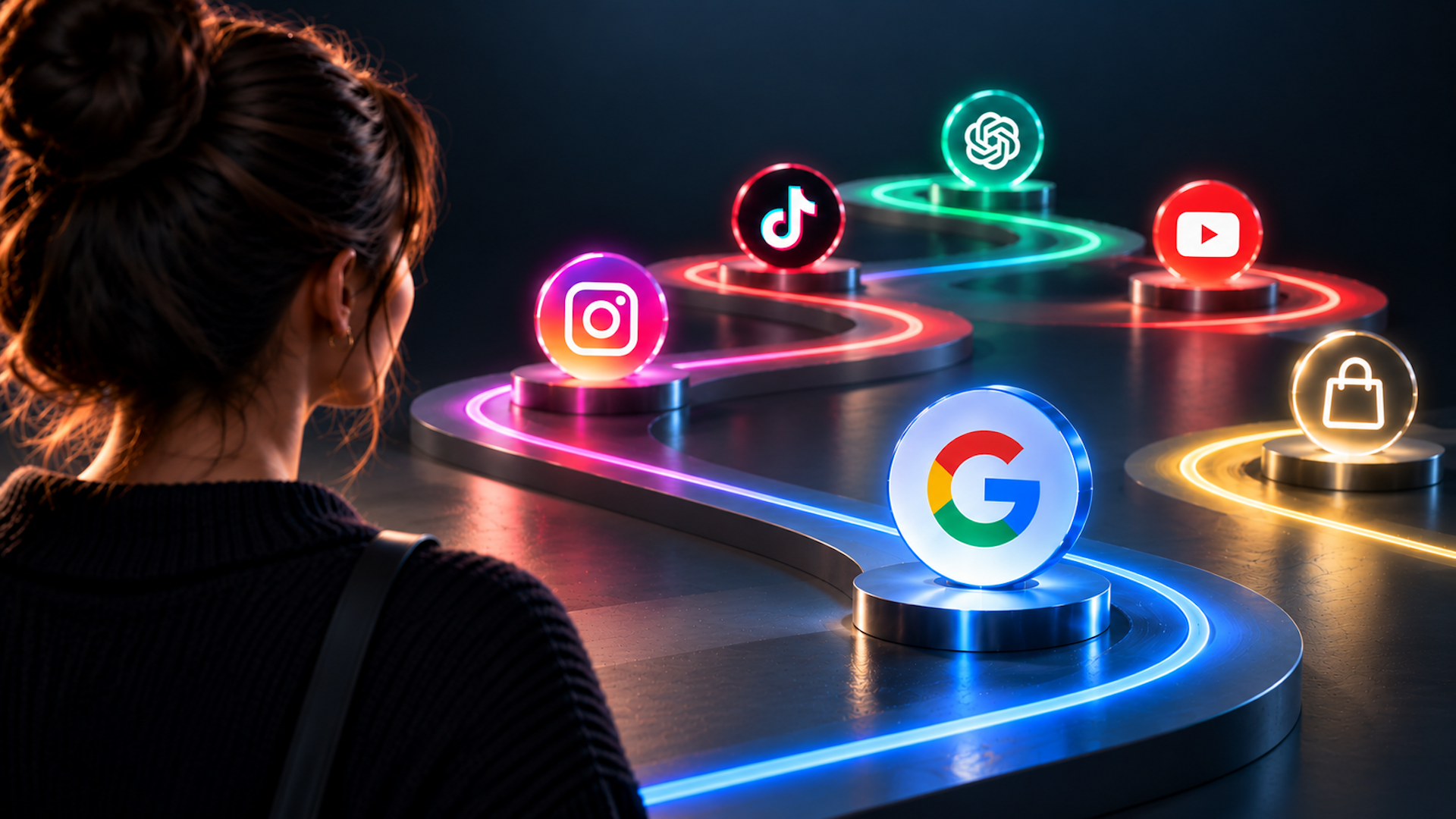
SparkToro and Datos looked at 41 major platforms where search behavior actually occurs. Google accounted for 73.7% of desktop searches. Traditional search engines together made up around 80%. Commerce sites accounted for roughly 10%, social platforms 5.5%, and AI tools 3.2%. Amazon, Bing, and YouTube each handled more search activity than ChatGPT.
Search is a behavior, not a channel, and it’s happening everywhere (hence the increasingly popular shift toward “search everywhere optimization”).
The assumptions behind the debate
Assumptions are another problem with the whole SEO vs. PPC debate.
Often, a client comes to us asking for SEO (and now AEO, or whatever you want to call it). They have a hunch it’s the right answer, that SEO can plug the holes Google Ads is punching in their marketing budget, and that the magic SEO/GEO wand can fix everything.
Those assumptions are dangerous. They send people down the wrong path, often for a long time, throwing good money after bad. Many agencies and consultants don’t help. Instead of embracing the shift, they cling to old approaches, massage the data, and eke every last drop of budget from the very people they’re supposed to help.
Remove those assumptions and any channel bias, and it becomes clear there is no better channel. The whole model has, to some extent, imploded.
AI: The new kid on the block
Historically, if traffic went to SEO or PPC, we could at least see how it was split between the two.
AI is different. It’s not chasing clicks. It’s shaping attention and influence.
Fortunately, correlation studies give us some visibility into what’s happening. Seer Interactive found that, across queries with AI Overviews, the average organic click-through rate for organic listings fell from 1.76% to 0.61%, a 61% decline.
That’s a grim number. Fewer than one in 100 impressions resulted in an organic click.
PPC, the big dog of search traffic, took an even bigger hit, falling about 68%, from 19.7% to 6.34%. Ouch.
It’s worth pausing to let that sink in.
AI Overviews did more damage to ads than organic results. They reduced clicks overall rather than redistributing them in the long-running battle between SEO and PPC.
For decades, the SEO vs. PPC debate has been a slow war of attrition, with PPC taking an ever-larger share while organic CTR declined year after year. AI changes that. Both paid and organic are now being squeezed as AI rapidly accelerates the rise of zero-click searches.
AI goes further still. It’s fundamentally changing the customer journey. SERP features like featured snippets chipped away at CTR, but AI means people often don’t need websites at all to get answers.
A single prompt can produce a refined response without users piecing together information from multiple sources.
The point is that AI isn’t just a third player in the SEO vs. PPC debate. It’s fundamentally changing how we access and consume information, reshaping both channels in the process.
The industry’s trusted source for essential news and analysis.
Sign up for our newsletter to receive exclusive insights and updates directly to your inbox.
- Daily breaking news
- Expert analysis from industry veterans
- Join over 200k subscribers
- Covering SEO, PPC and AIO
Why AI citations matter
The Seer study also found that brands cited inside an AI Overview earned 35% more organic clicks than uncited brands and 91% more paid clicks.
That can be a little difficult to unpack, so it helps to think of it as a funnel.
The AI Overview dramatically reduces the total number of organic and paid clicks.
However, if you’re cited in the AI Overview and also have a paid or organic listing below it, you’re much more likely to earn the click. Typically, that click isn’t on the AI Overview itself, if it’s even linked. It goes to the paid or organic listing below.
The user reads, trusts, skims, and clicks.
The process looks something like this: The user reads the summary, sees your brand cited as a source, then scans the page. When they decide to click, they choose the name AI has already presented as credible. The AI citation isn’t functioning as a link. It’s functioning as an endorsement that primes the click elsewhere on the page, whether paid or organic.
The AI citation primes the click on your paid or organic listing and sends you a warm visitor, much like a personal referral arriving through a branded search.
SEO, PPC, and AI
In previous attempts to unpack the SEO vs. PPC debate, the best general answer I could give was that they worked well together. Some laser-targeted PPC paired with complementary SEO efforts, whether local, upper-funnel, or lower-funnel. In some cases, SEO alone worked.
In others, PPC alone was enough. But if search was important to the business, a blended approach usually delivered the best results.
That was always general advice and always needed to be tailored to the situation. Today, though, I think we can make a much stronger case that the SEO vs. PPC debate is over. The conversation now is SEO, PPC, and AI.
To understand why, we have to look at how these channels intersect. A good example is Google’s new AI Max ad format. Think of it as an AI-powered evolution of Dynamic Search Ads. AI Max reads your website content and landing pages, expands your final URLs, and matches queries.
The targeting inputs for your paid campaigns are now, quite literally, your SEO assets. Ads in AI Mode are already in testing in the U.S. AI-powered Shopping ads read your Merchant Center feed and use Gemini to generate a tailored explainer for each shopper.
Work that once belonged to SEO (and perhaps CRO) now directly supports AI and PPC. Clear pages, structured content, and a value proposition machines can understand now feed your organic rankings, Quality Score, AI Max query matching, AI Overview citations, and LLM visibility. One well-executed asset now supports multiple marketing surfaces.
Meanwhile, the paid search picture is more interesting than the doom-posting suggests. WordStream’s 2026 benchmarks put average search CPC at $5.42, more than double the 2016 figure.
At the same time, conversion rates improved across 87% of industries, and cost per lead fell for the first time in five years. Paid search is becoming more expensive per click but more effective per outcome. That’s exactly what you’d expect when the click pool shrinks, and the remaining clicks carry higher intent.
Finally, I’m no conspiracy theorist, but if the book Supremacy is to be believed, Google developed an AI chatbot before OpenAI and ChatGPT brought the technology into the mainstream. The company reportedly held it back because of internal concerns about the impact on ad revenue, and perhaps accuracy.
That also makes a business case for why Google must integrate AI into its ecosystem to protect its core revenue. I also think it’s more useful to align with where Google is headed than spend your time chasing algorithms.
The trend was already underway
While this may feel like a revolution, I think it’s really the next step in an evolution that’s been unfolding for years.
We were talking about zero-click searches long before AI. The trend has been remarkably consistent: roughly 45% in 2016, 49% in 2019, 60% in 2024, and 68% today. Google has spent a decade building features that keep people on Google, and AI Overviews simply accelerated a trend that was already underway.
AI Mode accounted for about one-third of 1% of searches from January through April. It’s growing fast, with more than a billion monthly users and queries reportedly more than doubling each quarter. But it isn’t what got us here.
Google got us here, one SERP feature at a time, gradually transforming search from a list of signposts into a platform that provides answers. AI didn’t start that trend. It accelerated it.
Simply put, if you’re not on that list, you’re probably no longer in the running.
Why SEO still matters
The good news is that none of this makes SEO less important. It changes why it matters. SEO still matters because AI Overviews are grounded in Google’s index. Your search visibility still drives your AI visibility.
It’s not quite that simple, though. AI uses a process known as query fan-out to break a complex prompt into multiple smaller searches. It then combines those results, with the highest-ranking pages often receiving the most visibility in the AI summary. Rankings still matter across a broad range of topical subqueries in your space.
YouTube is a particularly strong opportunity because videos often rank for many of the subqueries that support those broader AI-generated answers. If your competitors haven’t invested there yet, they may be leaving visibility on the table.
Keywords aren’t what they once were. Topical visibility across search, both on your own site and across third-party platforms, remains highly important.
There is one caveat. This is still the Wild West. Studies from Ahrefs and BrightEdge reached slightly different conclusions, and measuring AI visibility remains challenging.
Just like the early days of SEO, success comes from thinking, tinkering, and experimenting to maximize your visibility across a topic, whether on your own site or on third-party platforms like YouTube and Reddit.
Dig deeper: Why AI still runs on search – and SEO still runs the show
SEO vs. GEO vs. PPC
The “SEO is dead” crowd is trying to sell you GEO. The GEO crowd says it sends no traffic and tries to steer you back to SEO. The anti-PPC crowd points out that click prices have doubled while total clicks have fallen.
The traffic data is fairly clear. Google still drives nearly 90% of referral traffic, according to Cloudflare Radar. All AI chatbots combined account for less than 1%.
But that’s only part of the story. Google still drives most referral traffic, but AI increasingly shapes the decisions behind those clicks. That means SEO, GEO, and PPC aren’t competing strategies. They’re different parts of the same decision journey.
By the time someone reaches your website or clicks your ad, they’re often a warm prospect, and the business is yours to lose. That’s why AI-referred traffic converts several times better than traditional organic traffic, even when it lands on the homepage, something PPC practitioners have historically avoided. There’s no magic here. People arrive already familiar with your brand and closer to making a decision than asking a question.
SEO and PPC are no longer just acquisition channels. They’re the mechanisms that help you become the answer.
That reframes what SEO and PPC are for. They stop being two ways to do the same job and become two parts of the same sequence. Your organic footprint, including content, coverage, videos, reviews, and what others say about you, helps you become the answer across search and AI. Your ads help you get chosen once you are. One earns the recommendation. The other converts it.
That’s why you can no longer trade them off against each other. You can’t choose between the thing that gets you onto the shortlist and the thing that converts you once you’re there.
This isn’t a budget decision or an either-or choice. These are two parts of a single system that work together in sequence to maximize results. Integrate them, or you’ll lose ground to competitors that do.
SEO vs. PPC: The debate is dead
Maybe this question had some merit in the past. Every time I tried to answer it, though, I ended up in the same place: for most businesses, an integrated approach worked best.
The real problem is that it was always the wrong question. It just happened to be a popular one because a simple question is easier to live with than a complicated one. “SEO or PPC?” is easy to answer in a meeting. “Where do my customers decide, and what would make them choose me?” takes real work.
Underneath it all, though, the fundamentals haven’t changed. Your customers still have problems to solve. They still build a shortlist. They still choose someone. The only thing that’s changed is who’s holding the pen when that shortlist gets written. Increasingly, it’s a machine reading everything the world has said about you.
I always come back to the restaurant example. Bob’s Burgers serves 100 customers a week. Ninety-nine leave happy. Every week, one customer, and there’s always one, leaves a bad review. Your job is to make sure the digital record reflects the experience of the other 99.
So get your own house in order first. Fix the offer. Fix the website. Fix the tracking. Then map the territory, choose your ground, and become genuinely, specifically, unsummarizably good at what you do. Then tell the world.
The SEO vs. PPC debate is dead. Long live integrated SEO, PPC, and AI.
Explore more on
Editorial disclosure
Contributing authors are chosen for their expertise and work under the oversight of the editorial staff. Search Engine Land is owned by Semrush. The contributor was not asked to mention Semrush; the opinions expressed are their own.
About the author