Free AI Agent Readiness Checker


People are increasingly turning to AI systems and summaries to find information instead of manually browsing through multiple search results. These AI systems work by crawling, interpreting, and evaluating content before deciding which ones to mention or cite.
Getting AI to surface your content requires a strategy that goes beyond traditional SEO. Our AI Agent Readiness Checker tool can help.
It highlights technical issues and content gaps that can affect whether your site is discovered, cited, or referenced in AI-generated answers, so you can optimize your site.
What is the AI Agent Readiness Checker?
Our tool evaluates how visible, accessible, and understandable your content is to AI systems like Google’s AI Overviews, ChatGPT, Perplexity, and other AI agents. It crawls, scans, and interprets your site’s code and content to see if it will be mentioned, cited, or recommended when someone asks a question.
The tool will give you a clear, scored breakdown of how well-positioned you are to show up in AI-generated answers, providing a report card with specific, actionable fixes.
It checks:
- Presence in AI search results
- Technical setup (Can AI bots access your site?)
- Content quality (Is your content structured in a way AI can quote?)
AI Agent Readiness Checker features
Here’s a breakdown of all the metrics the tool checks and reports.
AI Agent Readiness Score
When you run the checker, you’ll get three core scores, each rated from 1 to 100. The higher the number, the better positioned you are.
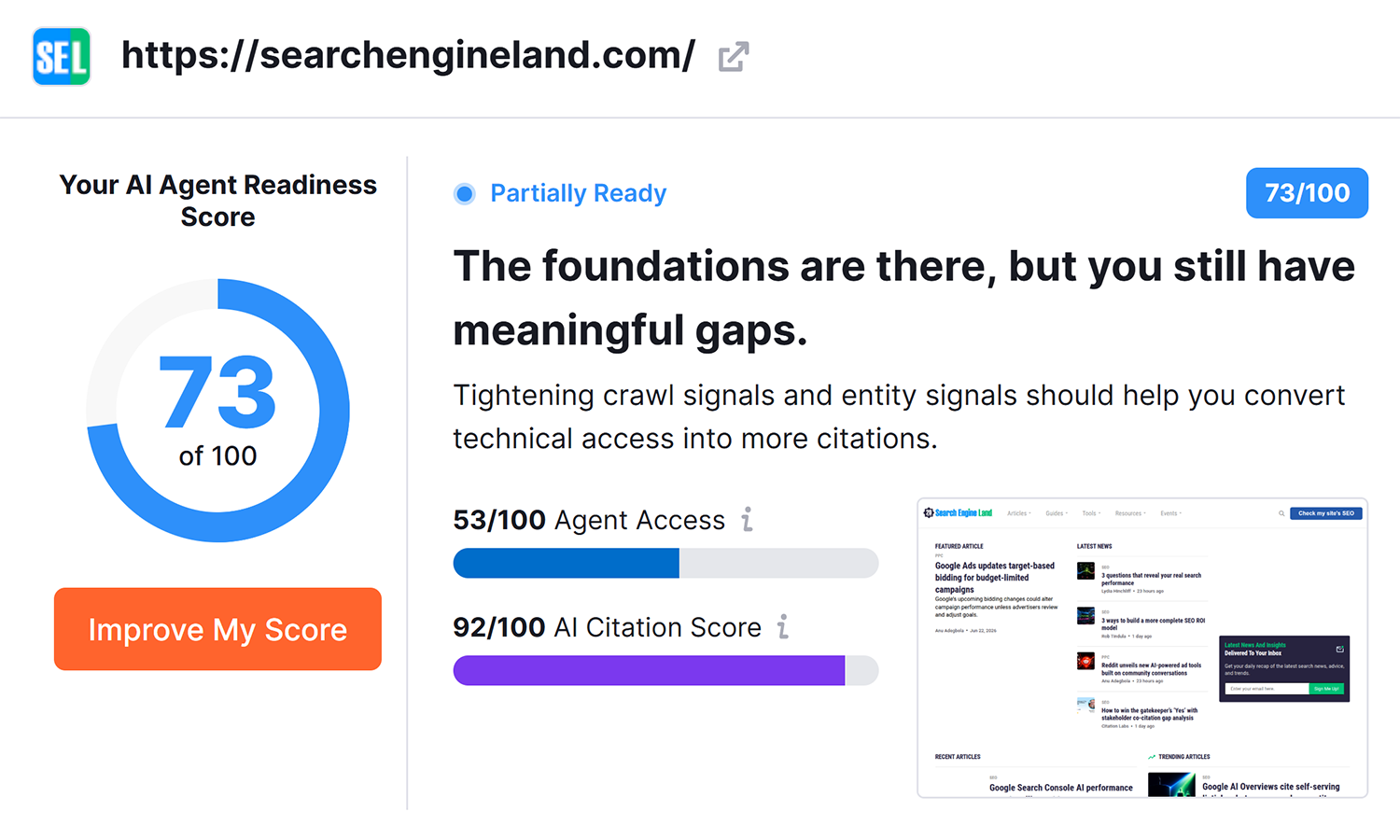
- AI Agent Readiness Score: Your overall score — it combines all metrics, giving you one number that tells how ready your site is for the AI-driven search era.
- Agent Access: This score reflects whether AI bots and crawlers can get into your site and read your content. If AI systems are blocked or can’t properly access your pages, this score will be low — and nothing else really matters until it’s fixed.
- AI Citation Score: This measures how often and how well AI tools, like ChatGPT, are citing or referencing your site when answering relevant questions. A high score means AI systems already see you as a trustworthy source worth quoting.
AI Readiness Signals
These individual signals feed into your overall AI agent readiness score. Each tells you a different aspect about how AI systems perceive your site.
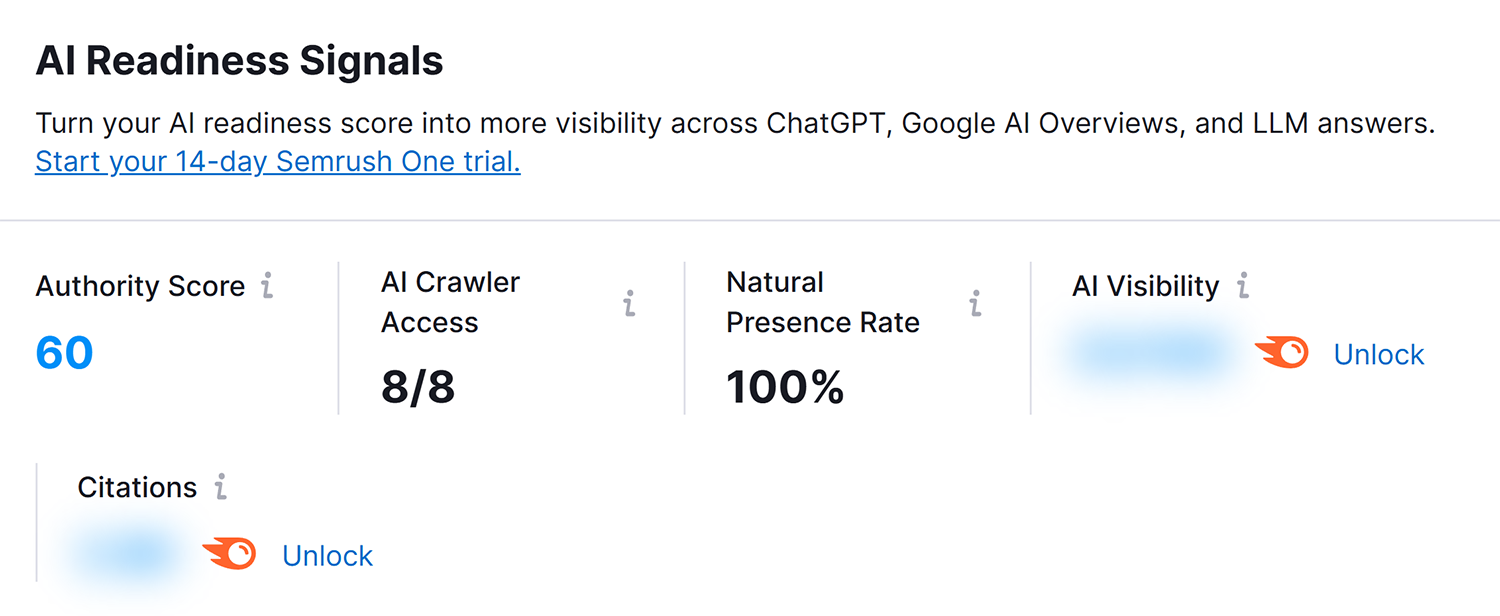
- Authority Score: Semrush’s Authority Score (0–100) reflects how trustworthy and credible your site appears to AI systems, based on backlink signals, domain quality, and more. The more authoritative your site looks, the more likely AI tools are to treat you as a reliable source.
- AI Crawler Access: The number of AI crawlers that are allowed into your site and are able to read your homepage based on robots.txt.
- Natural Presence Rate: The percentage of unseeded prompts where ChatGPT mentions or cites your site in its responses. A high rate suggests your brand is more naturally recognized and referenced in AI-generated answers related to your industry.
- AI Visibility: A broad measure of how often your brand shows up for AI search platforms. This tool is available in the full Semrush AI Visibility Toolkit so you can see the questions related to your industry, products, or services.
- Citations: The number and quality of direct citations — when an AI tool has pointed to your site as the source of information for an answer.
Technical Readiness Checks
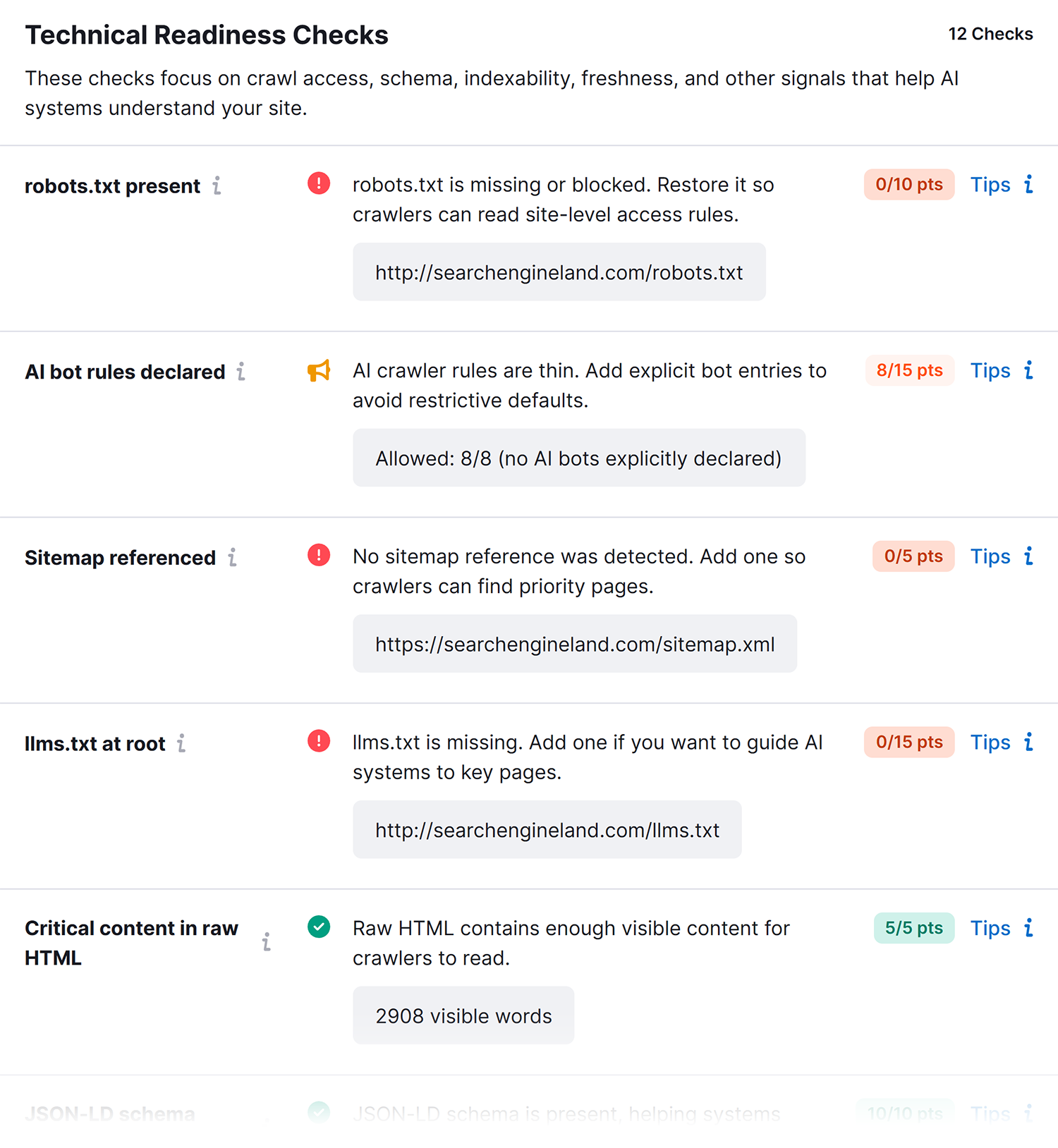
Here are some terms to get familiar with the technical setup of your website.
- Score: As shown in the image above, each item is rated Good, Fair, or Poor, shown using a color-coded icon — green for good, orange for fair, and red for poor — so you can tell at a glance which items need attention.
- Tips: Each item also has this clickable icon which opens up a short section below, walking you through the steps to fix or improve it.
Here’s what each technical readiness check means:
- robots.txt present: These small text files on your website tell crawlers (including AI bots) which parts of your site they’re allowed to visit. If these files are missing, crawlers may not know what they’re allowed to do, causing issues.
- AI bot rules declared: Without these rules, AI bots may be blocked by default or may not know they’re welcome. This metric checks whether your robots.txt file specifically includes rules for AI crawlers, like the ones used by GPTBot, ClaudeBot, and PerplexityBot.
- Sitemap reference: This checks whether your sitemap is referenced in your robots.txt file or available at the standard /sitemap.xml location, making it easier for crawlers to discover your site’s content.
- llms.txt at root: A new type of file, similar to robots.txt but specifically designed to give AI systems a summary of what your site is about and which content is most important. “At root” means it should be placed at the main level of your website, e.g., yoursite.com/llms.txt.
- Critical content in raw HTML: AI crawlers often have trouble reading content that’s loaded dynamically through JavaScript, since they typically only see the initial HTML response. This check verifies that your most important content — headlines, key text, product info — appears directly in the page’s raw HTML, so it’s visible to AI bots without extra processing.
- JSON-LD schema present: JSON-LD (JavaScript Object Notation for Linked Data) is a way of adding structured, machine-readable information to your pages which explicitly tells AI systems and search engines what your content is — for example, marking up a product, article, or organization. This check confirms whether structured markup exists on your site.
- same-As entity links present: A specific type of markup called “sameAs” links your brand or organization to trusted external profiles, such as Wikipedia, Crunchbase, or LinkedIn. This metric helps AI systems recognize if your website and other profiles all refer to the same entity, building trust and recognition.
- HTTPS and valid access: Secure, accessible pages are trusted more by both search engines and AI crawlers. This confirms that your site uses a secure connection — HTTPS, shown by the padlock icon in browsers — and that pages load successfully without errors.
- Page is indexable: A page can load perfectly fine for a person and still be marked “do not index” behind the scenes, making it invisible to systems. This checks whether your page is allowed to be added to the index that search engines and AI tools pull from.
- Largest contentful paint: This page speed metric measures how long it takes for the largest visible piece of content on a page to fully load. It’s a core performance metric, and slow loading can affect how both users and crawlers experience your page.
- Agent protocol readiness: This checks whether your site publishes machine-readable files, for example, agent descriptors, that help AI agents understand how to interact with it, not just read it.
- Freshness signal: AI systems use these signals to judge how current and reliable your information is. This metric checks whether your structured data includes publication dates showing how recently your content was created or maintained.
Improve your AI Readiness Score
For each technical readiness check, our tool gives you an expandable tip explaining exactly how to fix or improve it.
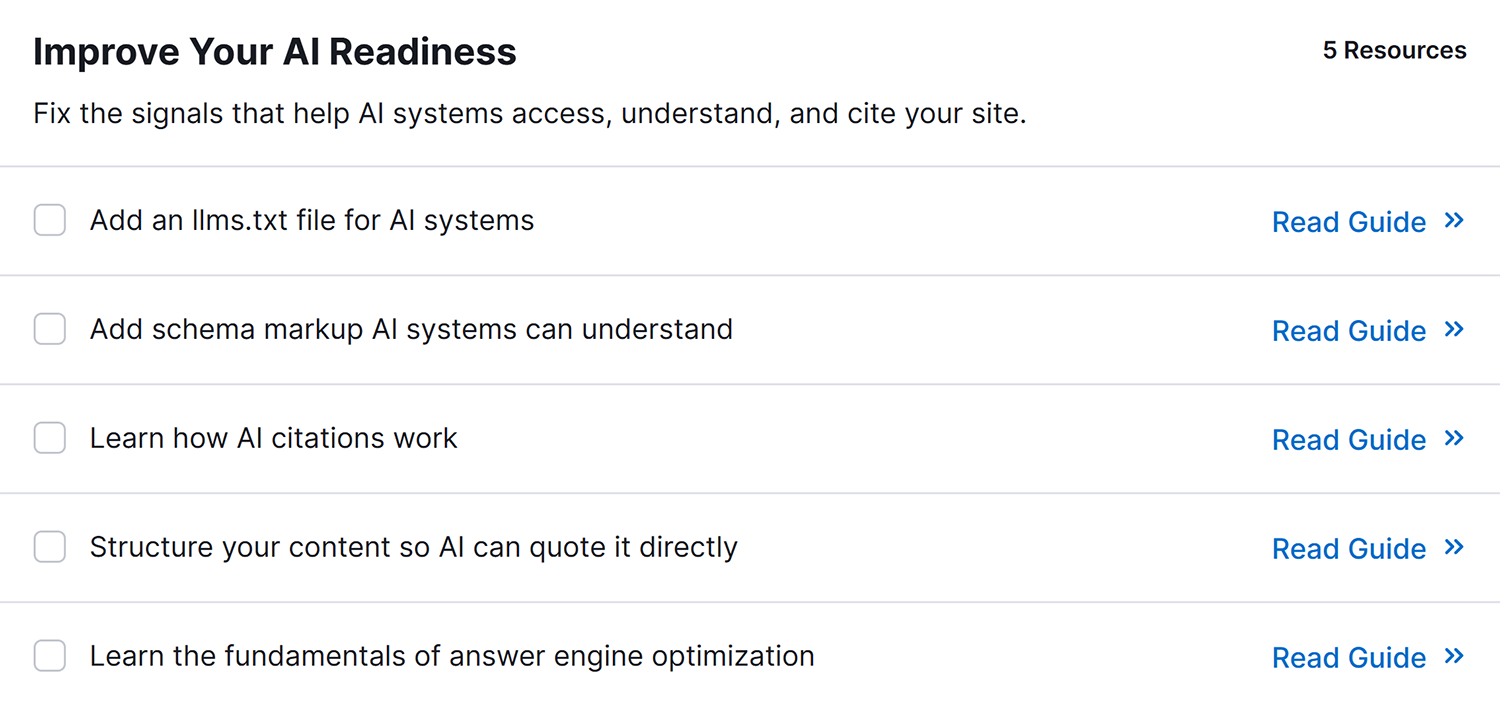
Broadly, here’s what recommendations focus on:
- Add an llms.txt file: Create this file so AI systems have a clear, organized summary of your site’s most important content right from the start.
- Add schema markup AI systems can understand: Implement structured data (like JSON-LD) so AI tools can clearly identify what your content is about, like products, articles, FAQs, and more.
- Learn how AI citations work: Understand what makes AI tools more likely to quote your content directly.
- Structure content so AI can quote it directly: Write in a way that makes it easy for AI to pull out clear, standalone facts and statements — think clear headings, direct answers, and well-organized sections.
- Learn the fundamentals of answer engine optimization (AEO): AEO is the AI-search equivalent of SEO. Learn to optimize your content to be the answer that AI tools pull from instead of optimizing solely to rank in a Google SERP.
ChatGPT Prompt Checks
This feature tests real prompts — the questions people actually type into ChatGPT — and shows you how ChatGPT responds when it comes to your brand or industry.
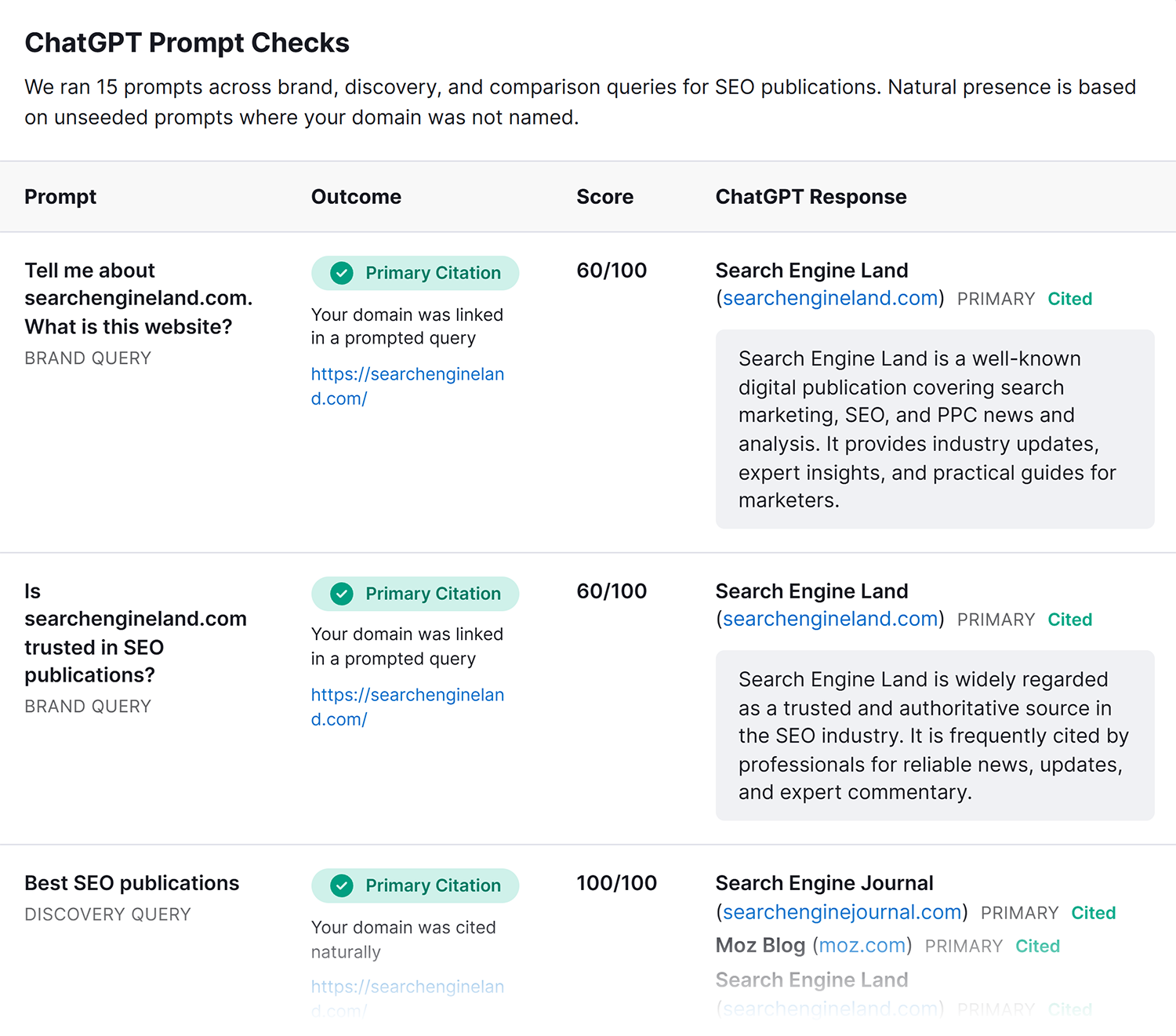
Results appear in a table with the following columns:
- Prompt: The actual question or request that was tested in ChatGPT, written how a real user would type it.
- Outcome: A label describing how your brand appeared (or didn’t appear) in ChatGPT’s response. Here’s a list of the possible outcomes for the ChatGPT prompt checks:
Outcome What it means Primary Citation Your site was the main source ChatGPT pulled information from and referenced directly. Primary Mention Your brand was the main site ChatGPT talked about, even if it wasn’t formally cited as a source. Cited Your site was referenced as a source but not the primary one. Mentioned Your brand name came up in the response but without being cited as a source. Competitor Only ChatGPT answered the question but only referenced competitors — your brand didn’t come up at all. Could Not Verify The test couldn’t clearly determine how (or whether) your brand appeared, often due to inconsistent or unclear responses. Absent Your brand did not appear anywhere in ChatGPT’s response, and no competitors were specifically named either. - Score: A number from 1 to 100 reflecting how strong your presence was in that specific response, based on the outcome and how prominently you were featured.
- ChatGPT Response: Shows you exactly how ChatGPT described or referenced your brand in response to a prompt, including the source name, its outcome label (such as Primary or Cited), and a short summary of what ChatGPT says about it.

Share your AI Agent Readiness report results
You can share your results directly to LinkedIn or X (formerly Twitter), or generate a shareable URL to send to colleagues, clients, or your team.

Use cases for the AI Agent Readiness Checker: What to do with your results
Here are different ways of using the tool to get started on optimization projects.
GEO and AI search visibility audit for marketing teams
GEO stands for “generative engine optimization” — the optimization of content so it performs well in AI-generated answers, not just traditional search results.
If you’re on a marketing team, run the checker as a baseline audit to understand where your brand currently stands in AI search before starting a new campaign.
Use the AI visibility, natural presence rate, and citation scores together to get a clear before-and-after picture. This is also a great way to show leadership concrete numbers as to why investing in AI search visibility matters.
AI crawler access diagnosis when a brand is invisible
If your brand doesn’t appear in AI tools, even for searches where you expect to show up, the issue might be technical and not about content quality. If AI crawlers are blocked at the technical level, no amount of great content will help until that’s fixed.
Run the checker and look at your agent access score and the technical readiness checks, especially robots.txt present, AI bot rules declared, and Page is indexable.
Fixing this opens the door, allowing AI crawlers to get into and read your site.
Technical AEO readiness check before a content push
If you’re about to invest in a big content push — new blog posts, product pages, guides, and so on — run the checker first to make sure your site’s foundation is solid.
Check items like JSON-LD schema present, critical content in raw HTML, and largest contentful paint. If AI crawlers can’t properly read or load your existing pages, there’s no point publishing new content.
Fixing technical basics first will give new content the best chance of being picked up and cited.
Agentic readiness assessment for forward-looking sites
AI agents are increasingly able to take actions on websites, such as booking appointments, checking prices, or filling out forms on a user’s behalf. This is the next wave of how people will interact with the web: instead of visiting a site themselves, they’ll send an AI agent to do it for them. If you want your site to be ready for this, focus on the Agent Protocol Readiness check and the llms.txt file.
The Agent Protocol Readiness check tells you whether your site exposes a machine-readable descriptor — like agent.json or .well-known/mcp.json — that AI agents use to understand what your site can do and how to interact with it.
Your llms.txt file works alongside this, giving a plain-language map of what your site offers and where to find it.
This helps ensure that when AI agents start acting on behalf of users at scale, your site is one they can work with.
Competitive AI presence benchmarking
Run the ChatGPT prompt check using prompts relevant to your industry, e.g., primary citation, mentioned, competitor only, etc., and compare your outcomes against your competitors.
If competitors consistently get “Primary Citation” while you get “Competitor Only” or “Absent” for the same prompts, that’s a clear signal of where to focus your optimization efforts.
Ready to see if your site is ready for AI crawlers and agents?
All your content should have the opportunity to be seen, cited, and recommended by AI. Try our AI Agent Readiness Checker to scan your website, surface where AI crawlers are blocked, and show you how visible your brand is in AI-generated answers.
Explore more on
Editorial disclosure
Search Engine Land is owned by Semrush. We remain committed to providing high-quality coverage of marketing topics. Unless otherwise noted, this page’s content was written by either an employee or a paid contractor of Semrush Inc.
About the author