The AI visibility index: Which brands are vanishing from AI search?


Some of the brands with the strongest SEO footprints barely appear in AI answers. Others with much smaller search footprints show up again and again.
Fractl analyzed how consistently AI models recommend brands, which brands disappear despite strong SEO footprints, and which signals separate the brands that overperform from those that under-index. (Disclosure: I’m the co-founder of Fractl.)
The short answer: organic authority still matters, but it’s not the whole map.
More than 9 in 10 brands in the dataset behaved the way most SEOs would expect: stronger traditional search authority generally tracked with stronger AI visibility. But the outliers are where the findings get interesting.
The gap between traditional search authority and AI recall is where the visibility challenge gets more complicated.
AI answers have default brands
Some brands with high domain ratings, large keyword portfolios, and millions of monthly organic visits barely surfaced in their own categories. Others with smaller traditional search footprints appeared far more often than their SEO metrics would predict.
Every industry we reviewed had a short list of brands that surfaced again and again, regardless of how the prompt was phrased.
Those default answers weren’t always the biggest companies in the category. They weren’t always the brands with the most traffic. And they weren’t always the companies a traditional SEO leaderboard would put first.

We noticed a few patterns emerge immediately:
- Travel was the most concentrated category: Booking.com (285 mentions), Airbnb (227), and Expedia (215) accounted for roughly 20% of the sector’s total mention volume. Three brands accounted for one out of every five recommendations.
- HealthTech had a runaway leader: Teladoc (275) led Amwell (220), the runner-up, by roughly 25%. The models have settled.
- Wellness had the deepest bench: Peloton, Headspace, Calm, Whoop, and Oura all cleared 168 mentions. No single brand dominates, which means the category-leader slot is still up for grabs.
- Insurance broke the way industry watchers should have expected: Lemonade (213) ranked above State Farm (172). Root Insurance (165) ranked above Progressive (114). The models cited the digital-native carriers first and treated the legacy ones as the alternatives, rather than the default.
- Lifestyle was the loudest signal of the methodology working: Patagonia, Allbirds, Eileen Fisher, and Everlane (sustainability-coded direct-to-consumer brands) outranked Sephora, Samsung, and Whirlpool. Whether that’s a function of how product roundup articles get written or a deeper bias in training data, the result is the same: The models prefer the brand story that gets told in third-party content.
The pattern held across every sector. A handful of categories do have winners the models clearly recognize, but plenty of the time, those picks don’t line up with what you’d expect. Stripe wins in FinTech, Notion in SaaS, Coursera in Education, and so on. Most of the time, though, the default names aren’t the ones you’d predict.
That’s the first strategic shift for SEO leaders.
The competitive set inside an AI answer is much smaller than the competitive set on a search results page. If your brand can’t crack the top five to 10 names the model recalls for your category, ranking well in Google may not be enough to get you into the AI-generated consideration set.
Dig deeper: Hidden gem publishers outperform major media on audience affinity: Study
Traditional authority doesn’t guarantee AI recall
More than 9 in 10 brands in our dataset were broadly aligned: strong traditional search authority usually tracked with stronger AI visibility. That’s the expected outcome. It’s also why marketers shouldn’t throw out every SEO principle they’ve spent the last decade building around.
But the edges of the dataset show where the strategy changes. About 5% (471 brands) were underexposed in LLMs. These were companies with high domain ratings, very high organic traffic, and a deep keyword portfolio that still drew almost no references from the models.
On SEO infrastructure, they look like market leaders. On LLM references, they look like companies nobody has ever written about.

About 4% (377 brands) were AI overperformers. The models referenced them far more often than their modest traditional signals would suggest, much more aggressively in their verticals than Ahrefs data says they should be.
Roughly 9% lined up with how often a brand appeared in third-party content that it did not create. Brands that showed up disproportionately in roundups, expert lists, and comparison reviews tended to be far more visible to the models because that kind of coverage gets ingested into the training data. Brands with plenty of search authority but little third-party coverage tended to land in the underrepresented group, regardless of vertical.
That’s the strategic shift: What a brand says about itself matters less for AI recall than what the rest of the web has repeatedly said about it. Owned content still matters. Technical SEO still matters. But for AI visibility, the corroboration layer is becoming harder to ignore.

Some brands are miscategorized
The brands underrepresented in AI are, in many cases, the blue chips of their categories by most traditional measures. These brands have domain ratings above 80, millions of monthly organic visits, and hundreds of thousands of keywords ranked. But the models don’t even mention them in their own sectors.
The issue is categorization.

A few of the patterns we spotted:
- Microsoft and Spotify topped the list in FinTech: They’re the giants of traditional visibility, but the models didn’t categorize them as fintechs when prompted with fintech queries. That’s not a bug. Microsoft is heavily cited when you ask about productivity software or cloud platforms. It’s a categorization gap. The models have decided what counts as a fintech, and Microsoft wasn’t on the list.
- Legacy insurance carriers got displaced: Aetna, Cigna, Humana, Liberty Mutual, and Trustpilot all sat at DR 80+ with millions of monthly visits. The models barely cited them. Lemonade and Root sat higher in the same prompts despite a fraction of the traditional footprint.
- Legacy retail brands got displaced: Sephora, Samsung, Whirlpool, and GE Appliances. The models preferred Patagonia, Allbirds, and Eileen Fisher when the prompt asked for lifestyle recommendations. This is the most visible signal that the training data heavily weights direct-to-consumer brand narratives over legacy retail.
- Healthcare giants were under-indexed. Medtronic, GoodRx, Humana, and 23andMe. The models cited telehealth-native brands like Teladoc, Amwell, and Doxy.me instead.
Low recall doesn’t always mean the model doesn’t know your brand. It may mean the model has filed your brand under a different category than the one your buyers are searching.
More content alone won’t fix that.
You need stronger category signals in the places models are likely to encounter and reinforce those associations: analyst content, industry publications, comparison pages, partner pages, customer stories, review sites, and category-specific media coverage. Before you chase more AI mentions, make sure the models understand which category you’re supposed to win.
Dig deeper: What 1 million keywords reveal about AI’s impact on search
The industry’s trusted source for essential news and analysis.
Sign up for our newsletter to receive exclusive insights and updates directly to your inbox.
- Daily breaking news
- Expert analysis from industry veterans
- Join over 200k subscribers
- Covering SEO, PPC and AIO
The AI overperformers show the playbook
The other side may be even more helpful to marketers, since it shows how brands punching above their weight actually pull it off. Smaller Ahrefs profiles. Larger model recall. And all 377 of these brands show up repeatedly in the third-party material the models were trained on.

This list tells the story:
- Monday.com was the biggest overperformer in the dataset, with an AI Visibility Score of 0.71. Monday.com already has a lot of traditional traffic, close to 1 million organic visitors, and more than 50,000 ranked keywords. Its overperformer status tracks directly with how much more often the models referenced it than its SaaS peers.
- Root Insurance owned the insurance category outright, drawing more AI references than any of the legacy carriers despite being a fraction of their size.
- Six of the top 15 overperformers were in education: Stanford, MIT, Khan Academy, LinkedIn Learning, IBM Data Science, and Google Career Certificates. The models cited these for their credibility, not because they run high-Domain-Rating commercial platforms.
- Smaller players followed the same pattern. Doxy.me, Nike Training Club, and Google Flights all got pulled into product roundups, showed up heavily on expert lists, and drew an outsized number of LLM references as a result.
The common thread isn’t just “good SEO.” It’s category-level presence in other people’s content. That pushes AI visibility work closer to digital PR, content distribution, and category authority building than many teams want to admit.
If you want to know why a competitor with less than half your organic traffic shows up in the model’s answer while you don’t, the question to ask isn’t, “What’s their SEO strategy?” It’s, “What’s their press coverage, and how did they earn it?”
You’re not just optimizing your own site. You’re shaping the set of sources AI systems use to understand who belongs in the category.
Most brands exist in only one model’s world
Only 900 brands in our dataset, or 11% of the total, were referenced by all three models. Another 12% appeared in two. The overwhelming majority, 77%, were referenced by only one model.

That’s a major measurement problem. A brand can win in ChatGPT and lose in Gemini. It can show up in Claude and disappear from ChatGPT. It can own one model’s answer set while barely registering in another.
Each model also had a different fingerprint.
- Claude leaned more heavily toward SaaS and insurance brands, with Notion, Linear, and Lemonade appearing more often there than in the other two models.
- Gemini leaned toward travel and healthcare, with Booking.com, Teladoc, and Livongo appearing at a much higher rate.
- ChatGPT was the most consensus-driven of the three, with the most overlap between its top brands and the other models.
The heatmap shows how unevenly distributed even consensus brands are:
The gaps weren’t always subtle. Notion was cited 17 times more often by Claude than by Gemini. Whoop appeared almost four times more often in Claude than Gemini. State Farm drew almost half its mentions from ChatGPT and only about a quarter from Gemini.
This is why aggregate AI visibility scores can mislead senior teams. If a dashboard says your “AI visibility” improved, your first question should be: Where?
A single blended score can hide the actual problem. You may not have an AI visibility problem broadly. You may have a Gemini problem. Or a Claude problem. Or a category prompt problem. Or a source problem.
Measure each model separately. Track prompts by category and intent. Look at which sources appear repeatedly. Then decide where the gap is worth closing.
Some sectors have already been re-sorted
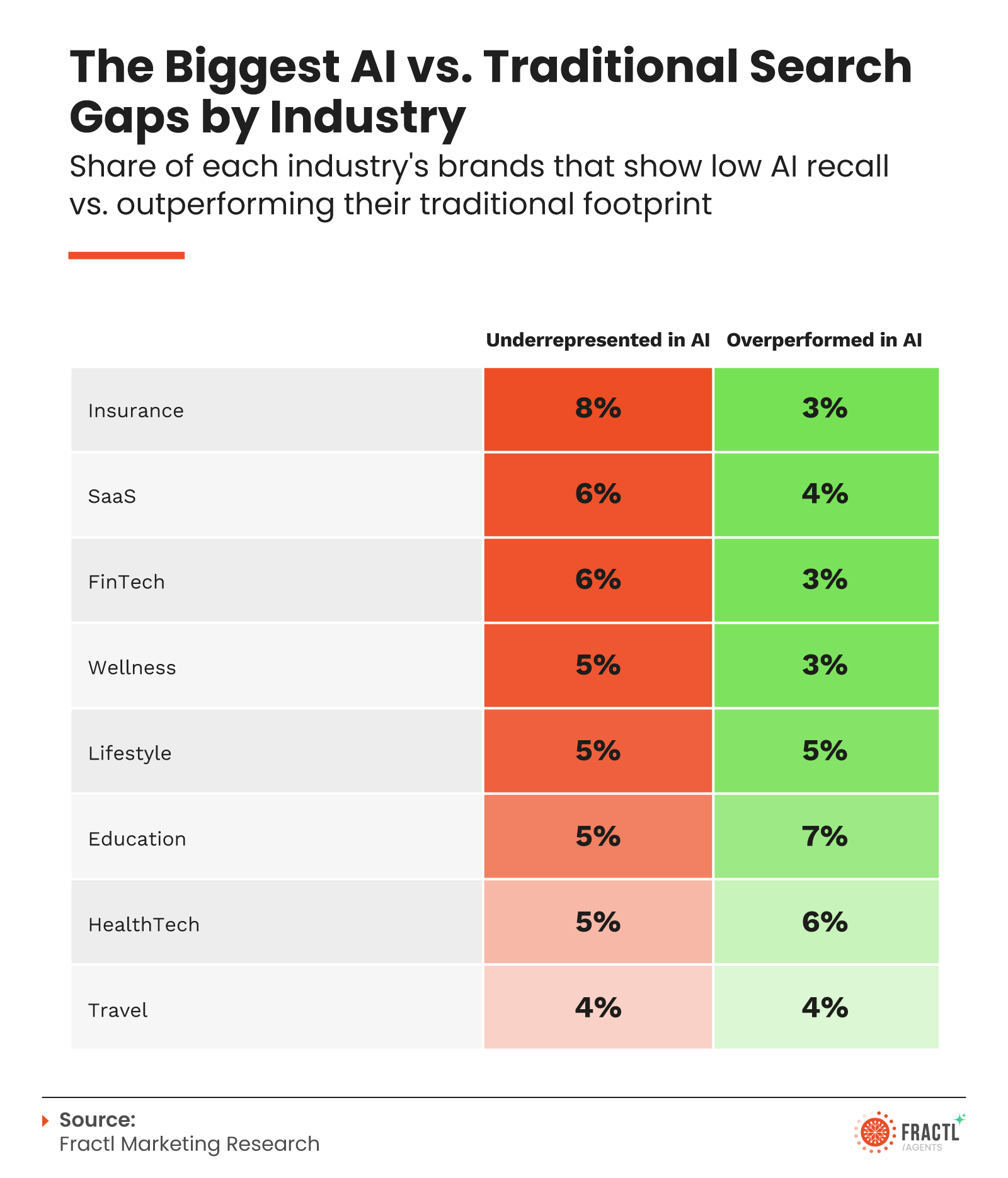
The disconnect between traditional authority and AI recall wasn’t evenly distributed across industries. Some sectors still look a lot like Google, while others have been almost completely re-ranked by the models.
The pattern breaks down differently by sector:
- Insurance was the least represented, at 8%. Legacy carriers like Aetna, Cigna, Humana, and Liberty Mutual were replaced by digitally native carriers. If you’re an established carrier, you have the largest gap between your Google authority and your AI recall.
- Education had the highest overperformer rate, at 7%, with Stanford, MIT, Khan Academy, IBM Data Science, Google Career Certificates, and LinkedIn Learning dominating. Professional education and institutions do better here than the commercial platforms because they generate credibility content.
- HealthTech was neutral (underrepresented by 5%, overperforming by 6%), with a shift underway from pharma and medical device companies to consumer-facing digital health.
- Travel had the smallest disconnect (4% under, 4% over) because LLM recall and traditional awareness lined up closely. In travel, Booking.com, Expedia, and Airbnb are the best-known names to both Google and the models. Travel’s top performers are stable.
- SaaS and FinTech sat between 3% to 4% over and 6% under. That’s because in these categories, the story is one incumbent replacing another (Stripe vs. PayPal, Notion vs. Microsoft) rather than new entrants displacing the old guard entirely.
The pattern across sectors mirrors the broader finding. Where the legacy authority of a category was built primarily on SEO and traffic, the models have re-sorted. Where the category was built around brand stories that circulated in third-party media, the alignment is tighter.
What this means for brand strategy
These are my five main lessons from the study, roughly ordered by how quickly you can act on them.
Measure traditional search authority and AI recall separately
Domain rating, organic traffic, and keyword rankings still matter. They just don’t tell the whole story.
A brand can rank well on Google and still fail to show up in AI answers. Another brand can have a smaller traditional SEO footprint and still become a default recommendation. Track both.
Measure where you rank in Google and where you appear in AI responses. Then look for mismatches. The mismatches are where the strategy lives.
Build third-party validation, not just owned content
The brands that outperform in AI responses tend to appear repeatedly in other people’s content. That includes:
- Roundups.
- Best-of lists.
- Comparison articles.
- Expert reviews.
- Analyst pages.
- Podcasts.
- YouTube transcripts.
- Community discussions.
- Category-specific publisher coverage.
Owned content can help clarify your positioning, but it won’t replace external corroboration. If AI systems are building answers from the broader web’s understanding of your brand, digital PR becomes one of the most practical levers for AI visibility.
Track each model separately
Only 11% of brands were referenced by all three models. That should kill the idea that “AI visibility” is one clean metric. Measure ChatGPT, Gemini, and Claude separately. Break prompts out by product category, buyer intent, and comparison set.
Track whether your brand appears, how it’s described, which competitors appear with it, and which sources seem to support the answer. A model-specific miss gives you a much clearer action plan than a blended visibility score.
Fix categorization before you chase volume
If your brand has strong overall awareness but weak recall in your target category, the issue may be categorization. The model may know who you are. It just may not think you belong in the answer set for the queries that matter. That requires a different strategy.
You need more category-specific proof: media coverage, comparison content, partner references, customer stories, awards, reviews, and third-party pages that repeatedly connect your brand to the category you want to own.
Move before the default-answer slot hardens
Some categories are still wide open. Wellness, lifestyle, and parts of HealthTech still have room for new default answers.
Others are already consolidating. Travel, major SaaS categories, and parts of FinTech are much harder to break into because the models already return a tight set of familiar names.
The earlier you build category association, the easier it is to influence recall. Once a model repeatedly sees the same brands attached to the same category, dislodging them gets harder.
What the web says about your brand matters
Your next brand visibility audit shouldn’t stop at your site. It should map the sources that teach models who belongs in your category: roundups, comparisons, expert lists, publisher coverage, reviews, partner pages, and community discussions.
That’s where the overperformers in this study separated themselves, not by being the biggest brands in organic search, but by being repeatedly reinforced in the places AI systems use to understand, compare, and recommend companies.
Methodology
Fractl analyzed AI visibility across eight industries using GPT-4o, Gemini 2.5 Flash, and Claude Sonnet 4.6. Each model received the same 96 industry-specific prompts, with each prompt run 15 times per model. The analysis produced 4,320 responses and more than 8,500 unique brand references.
Fractl then mapped the brands identified in those responses to Ahrefs data, including domain rating, organic traffic, referring domains, and keyword volume. This made it possible to compare each brand’s traditional search authority with how frequently it appeared in AI-generated responses.
The analysis grouped brands based on how their AI visibility compared with their traditional search performance. Brands that appeared less often than their SEO metrics would suggest were classified as underrepresented, while brands that appeared more often were classified as overperformers.
Explore more on
Editorial disclosure
Contributing authors are chosen for their expertise and work under the oversight of the editorial staff. Search Engine Land is owned by Semrush. The contributor was not asked to mention Semrush; the opinions expressed are their own.
About the author