SEO vs. GEO, AEO, LLMO: What marketers need to know
If you do any kind of marketing, you’ve probably seen these pop up:
- GEO: Generative Engine Optimization
- AEO: Answer Engine Optimization
- LLMO: Large Language Model Optimization
- AIO: Artificial Intelligence Optimization
Here’s the truth: they all mean essentially the same thing.
They’re just different lenses on one emerging discipline: AI SEO, the next evolution of search optimization.
AI SEO builds on traditional SEO by expanding what visibility means — not just ranking in search results, but being retrieved, cited, and recommended by AI systems.
The fundamentals of SEO still matter: relevance, authority, and clarity. And the underlying goal hasn’t changed — you still need to create great content and show up in the moments when your audience is ready to be influenced.
What has changed is how those signals are interpreted. AI systems now connect your brand’s content, mentions, and context across the entire web. That evolution affects how you plan strategy, structure teams, develop skills, and allocate budgets.
That’s why the refrain “it’s all just SEO” isn’t helpful when you’re talking to your boss or client stakeholders.
This article breaks down where things overlap, where they diverge, and what actually matters for marketers right now.
SEO vs. everything else explained
At their core, GEO, AEO, LLMO, and AIO all aim for the same thing: helping your brand show up inside AI-generated responses — in tools like ChatGPT, Perplexity, and Google’s AI Mode.
So if they all lead to the same goal, why does this new language matter?
Because the way search works has changed.
AI systems don’t just rank results — they synthesize, summarize, and cite. That means your visibility isn’t just about what’s on your site anymore. It’s about how your brand shows up across the entire web and how those signals feed large language models.
This shift changes how marketers need to think — not just tactically, but organizationally.
- Strategy: SEO can’t live in a silo anymore. Your content, PR, and brand teams need to collaborate around entity clarity and message consistency.
- Team Structure: You’ll need people who understand how to optimize for retrieval and credibility — not just rankings.
- Skills: Writers and SEOs need to know how AI systems source, interpret, and credit information.
- Resources: Budgets have to stretch beyond “organic traffic” to include AI visibility, brand monitoring, and data enrichment.
So yes, the acronyms overlap in definition. But they signal a bigger change in how we approach visibility as a whole.
Why All the Acronyms?
Because the industry is evolving in real time and everyone’s trying to name the same shift.
People from SEO, content, PR, and data science are all approaching the same problem from different angles. Naturally, they’ve coined their own terms along the way.
And in most cases, it comes down to positioning:
- They want to look ahead of the curve
- Their boss told them to “figure out AI”
- They’re selling a new service or offer
There’s nothing wrong with that. But it does make things confusing for the rest of us.
And clearly, interest is growing fast. Search demand for these new terms has exploded over the past year:
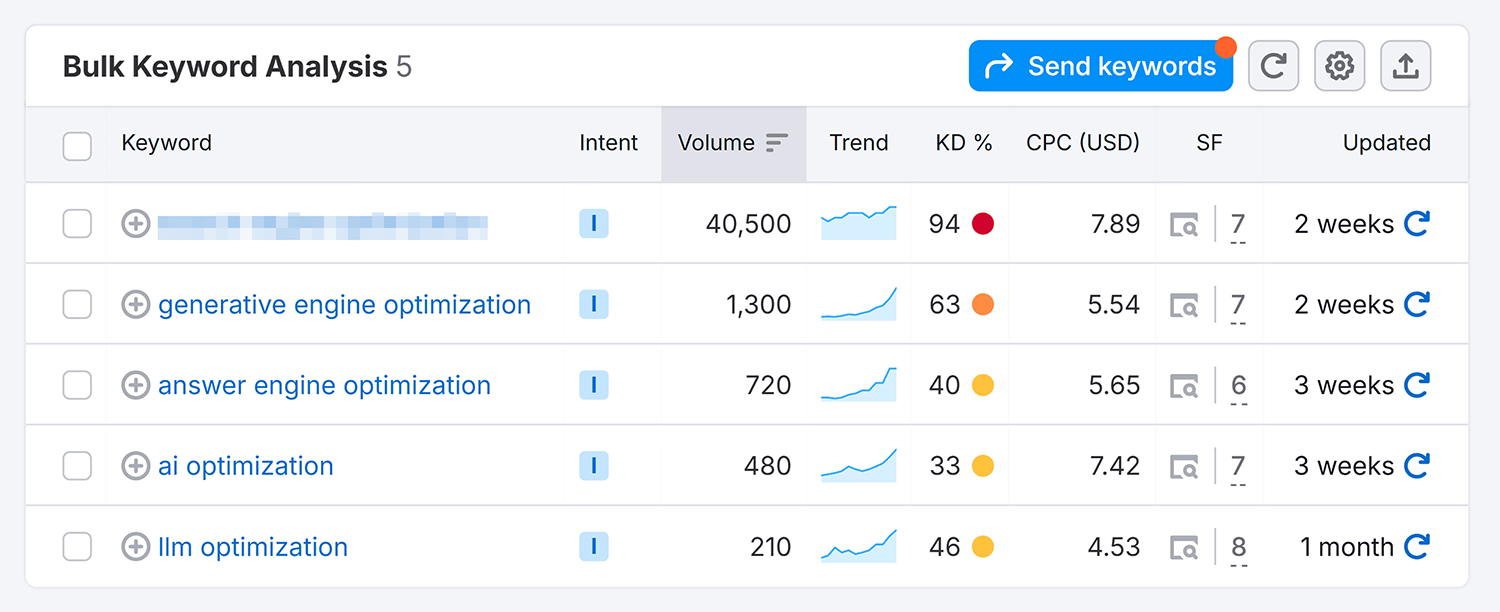
And the trends over time are clear too, as search demand for these new terms has skyrocketed in the past year:

One term in particular, “AI Optimization,” has really exploded:

Are they replacing SEO?
Short answer: no.
Can you guess which keyword I blurred out in the first screenshot above?
That’s right: search engine optimization.
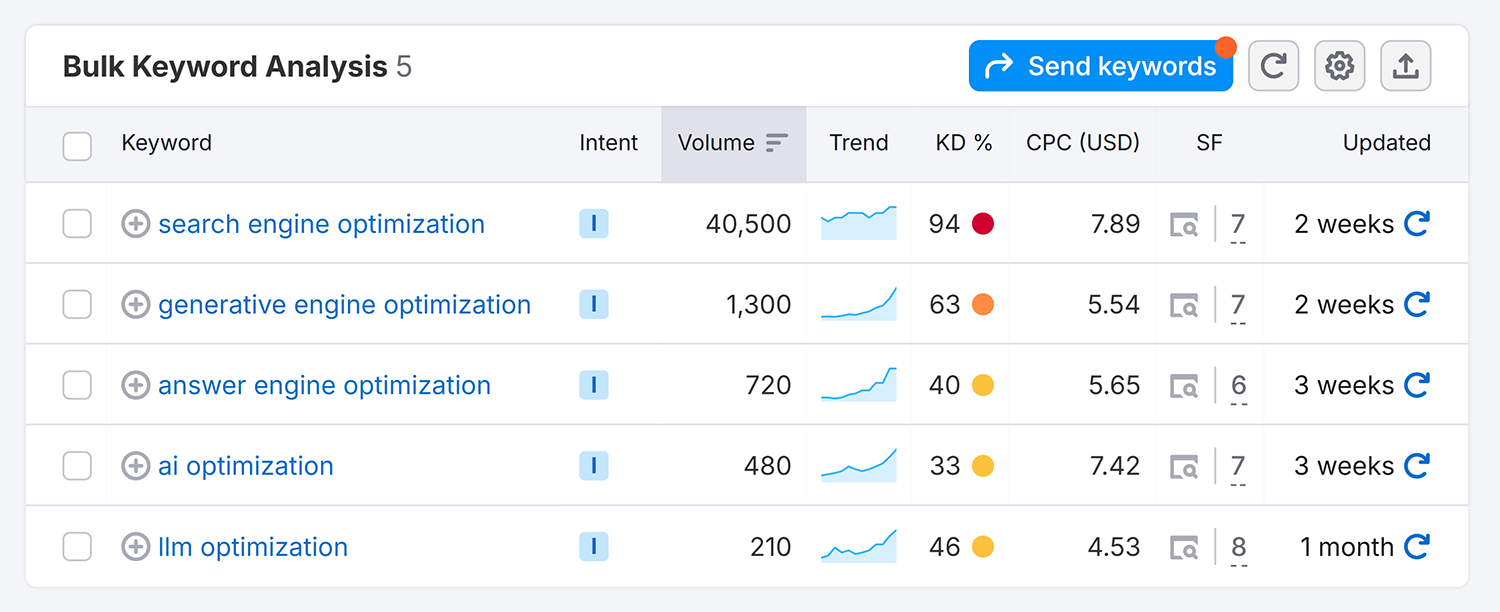
More than 40K searches each month. And the acronym “SEO”?
Almost a quarter of a million searches each month in the US alone:
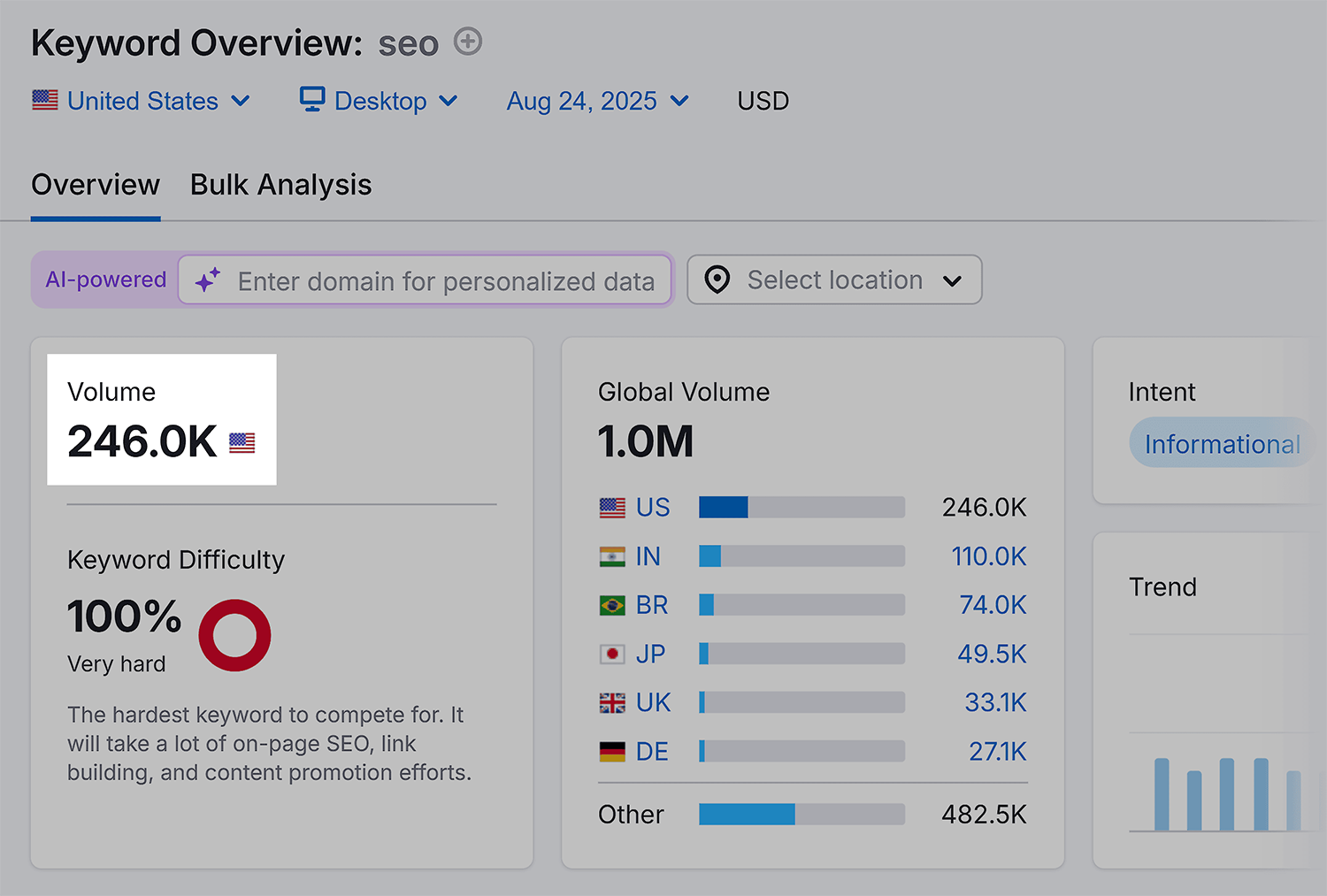
(The other acronyms aren’t “mainstream” enough to use as a data point here. For example, AEO is American Eagle Outfitters, and GEO can mean a hundred different things.)
Clearly, search volumes don’t tell the whole story, but SEO is definitely still the more popular term right now.
And the Google Trend graph is the final nail in the “Is SEO Dead?” coffin:

That’s right, search demand for SEO has actually grown over the past year. But you’ll see here that “AI Optimization” is arguably “trendier” right now than SEO.
And that makes sense, because people and businesses are concerned about how to optimize for AI systems. There is a shift in the industry from pure SEO to some form of optimization for the likes of ChatGPT and AI Mode.
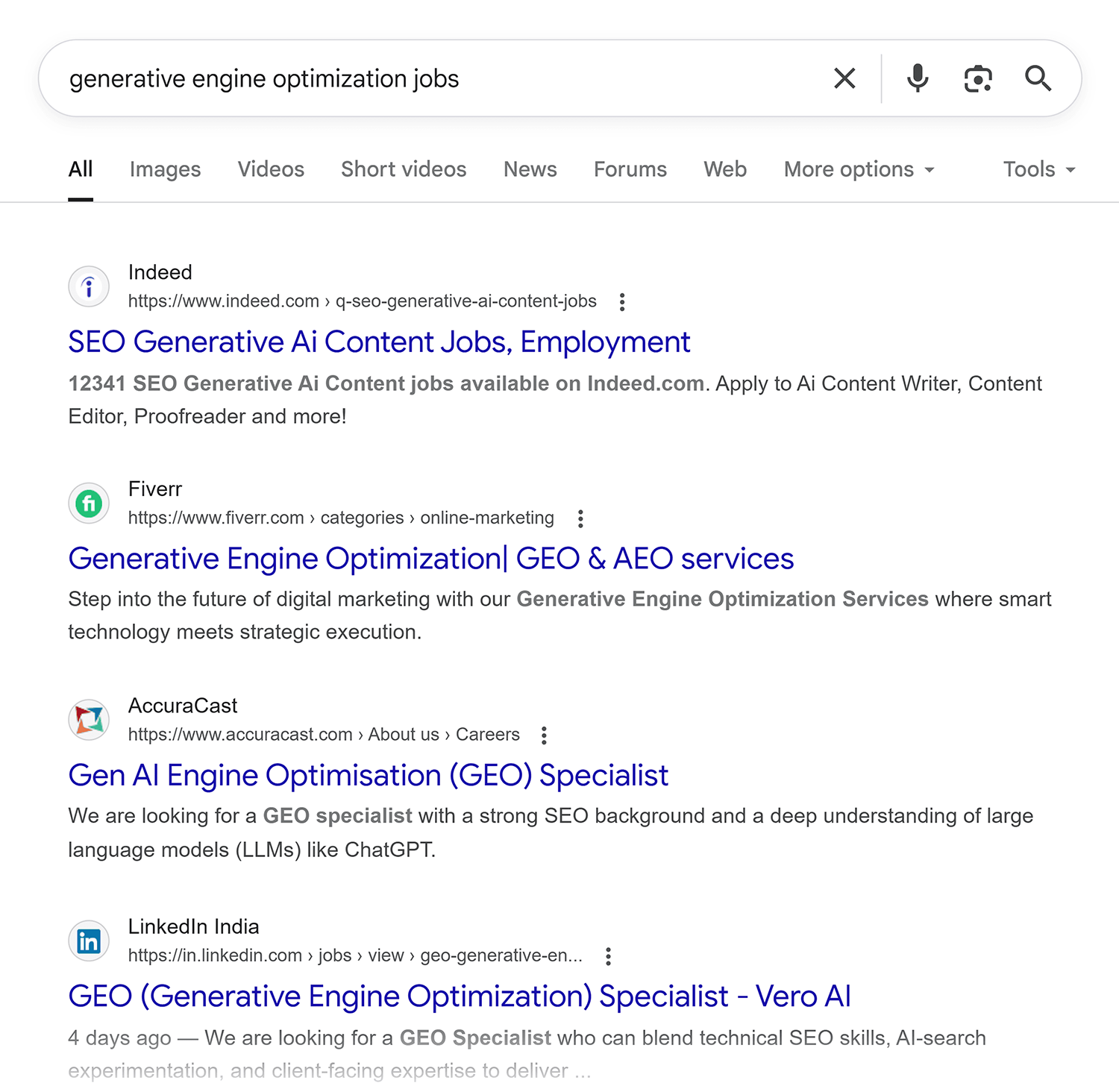
Businesses are even hiring for “GEO Experts”:
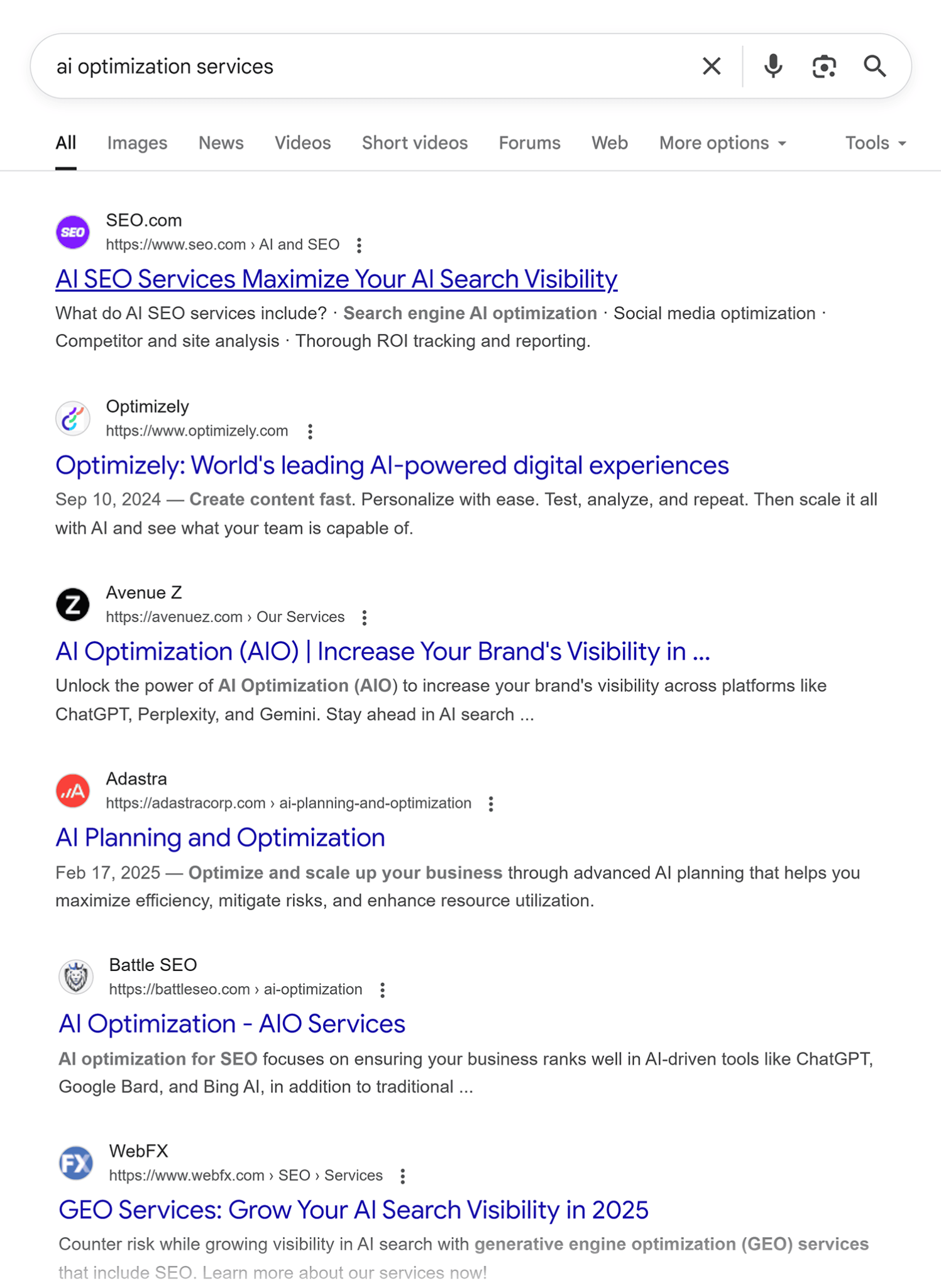
And agencies are pivoting to offer AI search services:
So what these acronyms are all about is a very real thing. But it’s not a complete revolution when you compare it to search engine optimization.
Quick summary of SEO vs. GEO/AEO/LLMO/AIO
Here’s what’s actually happening. There are really only two distinct approaches, SEO vs. the rest:
| Aspect | Classic SEO | AI Optimization (GEO/AEO/LLMO/AIO) | Insight |
|---|---|---|---|
| Goal | Rank high in search results | Get cited in AI-generated responses | Both matter. Create content that ranks AND gets cited. |
| How Users Search | Keywords and short phrases, like: “email marketing tools” | Complete questions and context: “Which email marketing tool is best for a small nonprofit?” | Research actual questions your audience asks. Don’t just rely on keywords with high search volume. |
| Success Metric | Click-through traffic to your site | Being quoted/referenced by AI | Go beyond website visits and start tracking brand mentions across AI tools. |
| User Journey | User clicks > visits your page > converts | User gets answer > may never visit your site, may click through for details, or may visit directly later | Make your brand memorable through a compelling product, service, or content — even in brief AI mentions. |
| Content Focus | Optimize full pages (titles, headers, meta tags) | Create clear, quotable passages that answer specific questions | Write self-contained sections. Each paragraph should make sense on its own. |
| Main Platforms | Google, Bing search results | ChatGPT, Claude, Perplexity, Google AI Mode, AI Overviews | You need visibility across all platforms where your audience seeks information. |
| Key Factors | Links and overall authority | Citations and brand sentiment | Build authority through quality backlinks AND consistent messaging everywhere. |
| Where Content Lives | Primarily on your website | Websites, plus YouTube, forums, and social platforms | One thoughtful Reddit comment might drive more AI citations than five blog posts. |
| Measurement Tools | Google Analytics, Search Console | Brand monitoring tools, AI citation tracking | Set up tracking for both classic SEO and AI visibility. |
Where they’re actually the same (Spoiler: Almost everything)
Despite the different names, these approaches share most of the same features and tactics:
- The goal is the same: While visibility is perhaps the word you’ll see associated with success in the AI era, the goal for businesses is still to get more customers and drive revenue. Whether that’s from search engines or ChatGPT, it’s still the bottom-line number that business owners care about.
- Content quality is paramount: All of these optimization methods prioritize high-quality, authoritative content. Whether you’re targeting Google’s search results or ChatGPT’s responses, you need genuine expertise and accurate information.
- Structure matters everywhere: Clear headings, logical flow, and well-organized information help both search engines and AI systems understand your content. A messy blog post won’t rank well anywhere.
- Authority signals are universal: Backlinks, domain authority, and expertise signals matter across all platforms. AI systems often rely on the same trust signals that traditional search engines use (although citations, not just links, matter more for AI optimization).
- User intent drives everything: Whether someone types a query into Google or asks ChatGPT a question, they want a useful answer. Content that genuinely helps people will generally perform well regardless of the platform.
Where they actually differ (The few real distinctions)
The differences between these approaches are smaller than the marketing suggests:
- Links vs. citations: In traditional SEO, a big driver of your authority and whether you’ll rank is the quality of your backlink profile. In AI optimization, where you’re cited across the web matters more than just the links you have.
- Traffic vs. citations: The broader business goals are still the same (to get customers and make money). But SEO is clearly more focused on driving traffic while AI optimization is, at least on the surface, about getting cited in AI responses.
- Response format: Keyword-optimized, long-form content was often the winning strategy for SEO. AI-optimized content focuses on direct, quotable answers to specific questions.
- Measurement challenges: You can easily track your SEO performance with tools like Google Analytics. Measuring AI visibility requires newer tools and different metrics, and it’s not always possible to accurately map out the customer journey.
But here’s what’s important: you don’t choose between these approaches. A well-optimized piece of content will perform across all these platforms simultaneously.
What this means for your business
Now you know where there is and isn’t overlap between SEO, GEO, AIO, and all the other acronyms.
But what do you actually do with this information?
Content research gets more complex
You can’t just look at keyword search volume anymore. You need to understand what questions people are asking AI systems and what answers those systems are currently providing.
This means your content team needs to research across multiple platforms:
- Google search results
- ChatGPT responses
- Perplexity citations
- AI Mode and AI Overviews
You need to understand where you’re being cited and where you’re not. But you also need to understand why other sites are being mentioned. This way, you can create content that’s also more likely to get cited.
Writing becomes answer-first
Writers need to structure content so AI systems can easily extract quotable segments for their answers.

That means:
- Descriptive subheadings
- Clear transitions between sections
- Direct answers early in each section
- Simple language where possible
- Short sentences and paragraphs
Editor’s Note: This is one that we feel quite strongly about at Backlinko. This is NOT new: it’s just good writing practice. But it is more important than ever, and if you weren’t already doing these things, you need to start now.
Content investment increases
Creating content that performs well across multiple search platforms requires more time and expertise. And you might even need to start creating content on different platforms too.
Why?
Because appearing in AI responses isn’t just about writing great blog posts. These tools love to reference user-generated content, forums like Reddit, and YouTube videos.

This means you’ll need to consider creating content beyond your website.
New KPIs to track
Website traffic is still important, but it’s not the only success metric. You need to start measuring:
- Brand mention frequency in AI responses
- Citation accuracy across AI platforms (i.e., are the tools saying the right things about your brand?)
- Share of voice in AI-generated answers
- Brand sentiment in AI outputs
A tool that does all four of these is Semrush’s AI SEO Toolkit.
It’ll show your brand’s overall visibility and share of voice in AI tools like ChatGPT, Google AI Mode, and Perplexity:

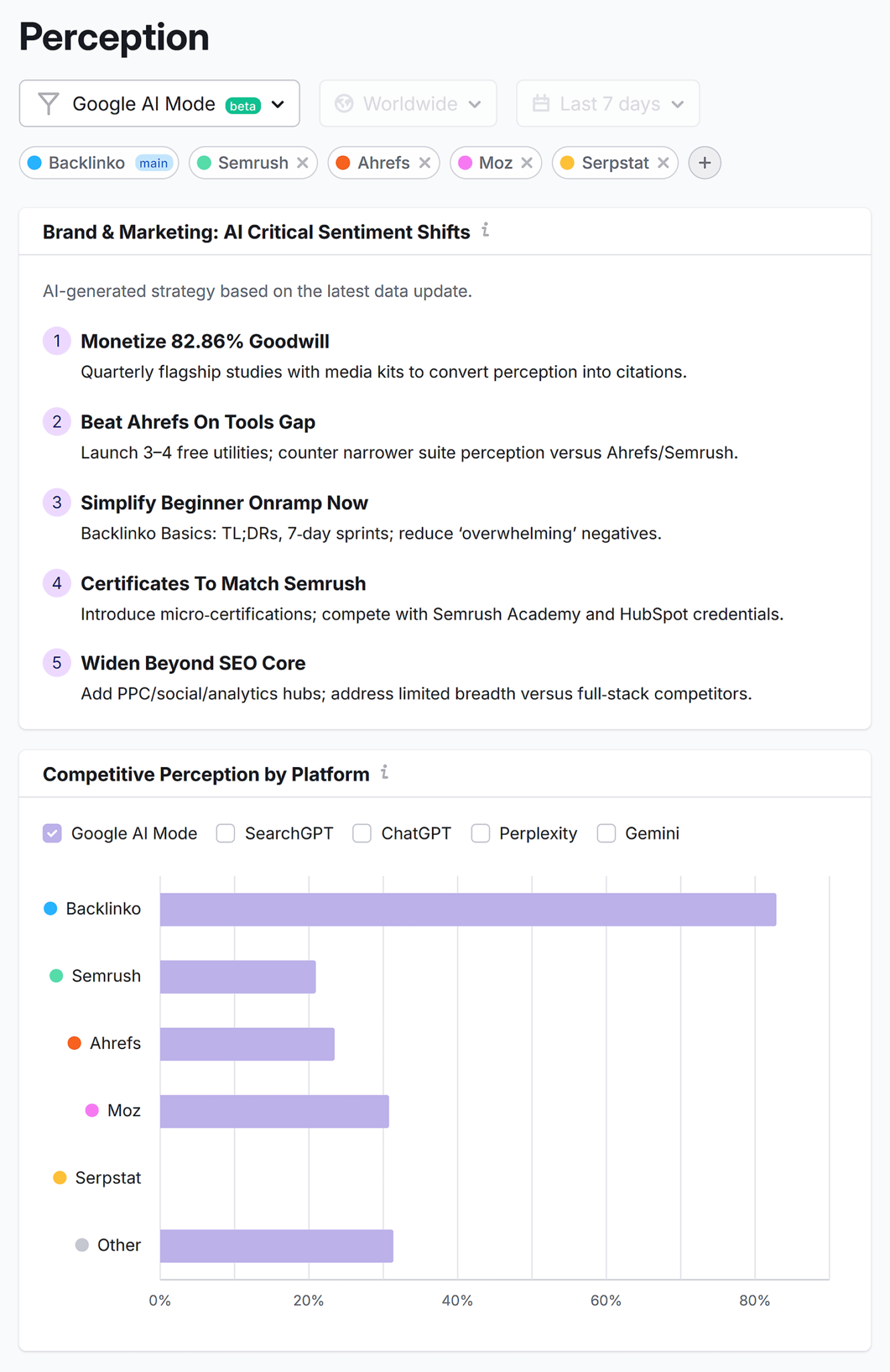
You can also see how these tools perceive your brand versus your rivals:
The tool also shows you how often you’re cited compared to your competitors:

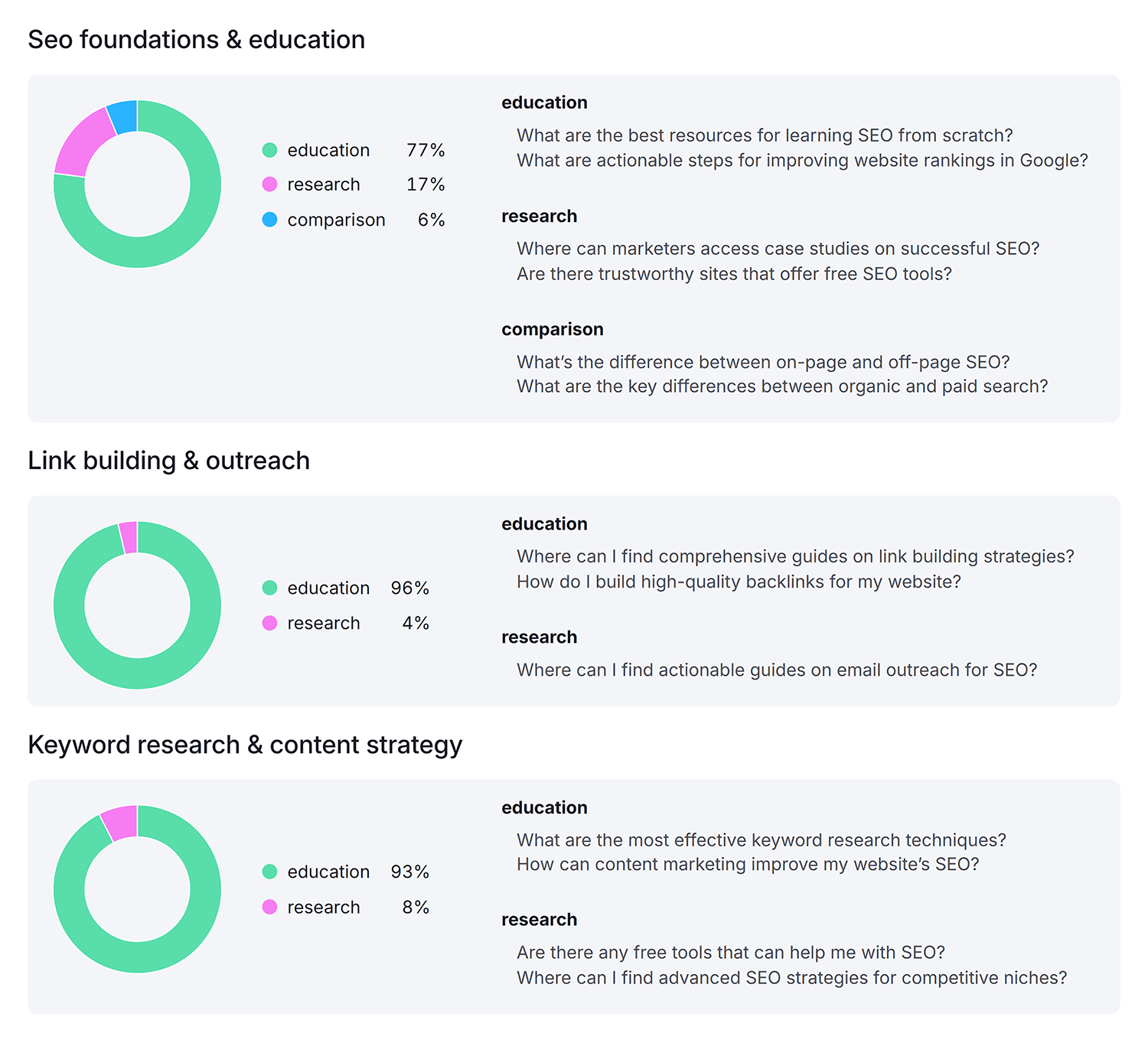
Finally, you can also find out the questions real users are asking about your industry:
You can use the AI SEO Toolkit’s insights to create and optimize your content for the questions users are asking. And you can optimize your overall visibility to ensure AI tools are saying the right things about your brand.
How to explain it all to your boss or stakeholders
Your boss and stakeholders in your business are going to hear about the likes of GEO and AIO and have questions for you. There’s no avoiding that.
This means you need to be able to explain the shift in plain business language — without the jargon and without triggering panic.
Here’s how to do it.
Lead with the reality, not the acronym
Your CMO doesn’t care if it’s SEO, GEO, or AEO.
They care if your brand is visible when it matters.
Don’t start with “We need to do GEO now.” Start with “Our customers are getting answers from AI systems, and we need to make sure we’re part of those answers.”
This immediately connects to business outcomes instead of marketing tactics.
Be honest about the uncertainty
Don’t pretend you have a perfect read on how AI engines source answers. (Nobody does.)
Say:
“Some factors are proven — authority, relevance, clarity, and trust. Others are emerging, and we’re still testing things. Here’s what we know, and here’s what we’re learning.”
That honesty builds more trust than overconfidence.
Leadership teams have seen too many “revolutionary” marketing tactics fizzle out. Make it clear you’re being strategic, not just chasing trends.
Anchor to business impact
Shift the conversation from traffic to results that leadership cares about:
- Revenue from organic sources
- Pipeline influenced by organic visibility
- Brand lift and share of voice
- Cost per acquisition trends
- Customer lifetime value from organic channels
Instead of saying “We need to optimize for ChatGPT,” say:
“We expect fewer casual visits but higher conversion rates from people who find us through these new channels.”
This frames the expected change as quality improvement, not traffic loss.
Highlight the win-win investments
Lay out the actions that are worth investing in, no matter what:
- Deeper audience research: Understanding exactly what questions your prospects ask (across all platforms) improves everything from product development to sales conversations
- Answer-ready content: Content that directly addresses customer questions performs better everywhere: traditional search, social media, sales enablement, and AI systems
- Brand and topic mentions in trusted sources: Getting coverage and citations from authoritative websites helps with traditional SEO, brand awareness, and AI visibility
- Strong UX and review presence: Better website experience and more customer reviews can improve conversion rates, regardless of where the traffic comes from
- Measuring what matters: Tracking brand mentions, share of voice, and conversion quality gives you better business intelligence for any marketing channel
These efforts are likely to work in SEO, GEO, or any other flavor of optimization. They’re just good marketing practices.
Highlighting these gives leadership confidence that you’re not betting everything on one unproven tactic. And it tells them that no matter what, these are things you should be doing anyway.
Position the expansion as an advantage
Make it clear this isn’t about more work for the same payoff.
It’s about capturing market share while competitors are still figuring things out:
“Most of our competitors are still focused only on traditional search. We have a 6-12 month window to establish authority in AI systems before they catch up.”
This positions your team as forward-thinking, not reactive.
Address the obvious concerns
You’re going to get questions, no doubt about it. Here’s how to answer the most common ones:
Question: “How much will this cost?”
Answer: “Most of the work builds on our existing content strategy. We’re expanding our definition of search optimization, not replacing it.”
Break down the investment:
- Content creation (already budgeted)
- New monitoring tools (modest monthly cost)
- Team training (one-time investment)
- Testing and optimization (part of ongoing marketing)
Question: “How do we measure success?”
Answer: “We’ll track traditional metrics plus brand visibility across AI platforms. Success means maintaining our current organic performance while building presence in emerging channels.”
Set up a dashboard that shows both traditional SEO metrics and AI citation tracking side by side.
Question: “What if this is just a fad?”
Answer: “The underlying strategy — creating authoritative, helpful content and offering a great user experience — is the foundation of good marketing. We’re just making sure that our content performs well across more search platforms.”
Frame it as good marketing practices and risk mitigation, not trend-following.
Provide a clear timeline
Month 1-2 (Foundation):
- Audit existing content to understand its AI optimization potential
- Set up monitoring tools for AI citations
- Train team on new optimization principles
Month 3-4 (Testing):
- Optimize select pieces of content for AI systems
- Measure performance across traditional and AI search platforms
- Refine approach based on results
Month 5-6 (Scaling):
- Apply learnings to broader content strategy
- Expand monitoring and optimization efforts
- Report on impact to organic performance overall
Scripts for explaining what you do
When your job involves optimizing for AI systems, explaining what you actually do can be tricky. Here are a few ready-to-use scripts for different situations.
For your boss or senior stakeholders
“I’m expanding our search optimization strategy to include AI-powered platforms. We’re making sure our brand shows up when people ask ChatGPT, Perplexity, or Google’s AI Mode about our industry. The same content quality that drives our current organic success will now work across multiple new discovery channels.”
For family and friends
“You know how people used to only Google things? Now they ask ChatGPT or voice assistants as well, or even instead. I make sure our company shows up in those AI answers when people ask about our industry. It’s like SEO but for AI. Instead of trying to rank #1 on Google, I’m trying to get our company mentioned when AI gives people recommendations.”
For professional profiles (LinkedIn, resume, etc.)
“I help companies maintain and expand their organic visibility as search evolves beyond traditional engines to include AI-powered platforms like ChatGPT, Claude, and Google’s AI Mode.”
For prospective clients or customers
“We help companies get found by customers regardless of how they search — whether that’s Google, ChatGPT, or any other AI tool. Our approach combines traditional SEO with optimization for AI systems that are increasingly answering customer questions.”
For industry peers or conferences
“The fundamentals of search optimization haven’t changed — authority, relevance, and user value still matter. But we’re now optimizing for systems that synthesize information rather than just ranking it. A lot of the tactics are familiar, but the platforms we’re optimizing for are expanding.”
How to thrive in the AI Era of search
Whether you call it SEO, GEO, AIO, or LLMO, the fundamentals of optimization and creating great content don’t change.
The goals shift a little, and how you measure success will differ compared to pure SEO.
But how you win in the AI era of search just requires an evolution of how you were doing things before.
To stay ahead of the game, check out these resources for more information:
- LLM prompt tracking: How to monitor generative AI prompts more accurately: Where prompt monitoring breaks down today, what it is still good at, and how to combine it with Google Analytics, Search Console, Bing Webmaster Tools, and server logs for a fuller picture of AI visibility.
- How to create answer-first content that AI models actually cite: A 10 step process for structuring content so AI systems can extract and cite it. Covers leading with the answer, using Q&A headings, anchoring entities, adding schema, and testing pages through AI bot previews before publishing.
- New SEO KPIs you’re missing: How to measure SEO beyond clicks: The metrics that now sit alongside traffic, including AI mentions and citations, share of voice in AI answers, brand authority signals, and on page engagement. The measurement layer this article tells you to build.
Explore more on
Editorial disclosure
Search Engine Land is owned by Semrush. We remain committed to providing high-quality coverage of marketing topics. Unless otherwise noted, this page’s content was written by either an employee or a paid contractor of Semrush Inc.
About the author