How to build topic clusters for SEO and AI search

Ranking well in search isn’t just about targeting individual keywords. It’s about building authority around topics that matter to your audience and your business.
Topic clustering is my preferred approach. It organizes related content around a central topic. This helps you better cover user intent, strengthen connections between pages, and make your content easier for people and search engines to navigate.
That foundation matters even more as search behavior changes. Google’s AI Overviews and AI Mode can synthesize information across multiple queries and sources. At the same time, more people are using tools like ChatGPT, Gemini, Grok, and Perplexity to find answers.
A strong topic cluster needs to do more than help individual pages rank. It should cover the related questions, intents, and subtopics that search engines and AI systems may use to understand and answer broader queries.
This guide will show you how to research, build, and connect topic clusters around your audience and what you sell. It will account for both search intent and AI answer behavior.
It will also cover common mistakes that can weaken a cluster. These include poor internal linking, gaps in topical depth, choosing the wrong content approach, failing to promote your content, and letting clusters become outdated.
Why topic clusters carry more weight in AI search
Google introduced a “topic authority” system in May 2023 for news, though SEOs had discussed topical authority for years. In March 2024, it folded its helpful content signals into core ranking.
AI Overviews and AI Mode use those same core ranking and quality systems. From Google’s perspective, AEO and GEO are “still SEO” (Google’s guide to optimizing for generative AI search).
Both features may also issue “multiple related searches across subtopics and data sources” to build an answer. Google calls this query fan-out. Those subtopics are the same ones a cluster plan starts from (AI features and your website).
Pages that ranked for the main query and at least one fan-out query were 161% more likely to be cited in AI Overviews than pages that ranked only for the main query, according to a Surfer study of 173,902 URLs across 10,000 keywords. But fan-outs aren’t stable. Only about 27% remained consistent across repeated runs in the same study.
So I focus on depth: covering recurring subtopics instead of building a page for every fan-out.
On informational queries, brands cited in an AI Overview earned about 120% more organic clicks per impression than uncited brands on the same SERPs (Seer Interactive’s 2026 AI Overview CTR study).
Getting cited helps, but it doesn’t restore old click rates. Cited brands still received 38% fewer clicks per impression than queries without an AI Overview. So I plan traffic targets around that lower number.
ChatGPT, Perplexity, Copilot, and Grok use some version of fan-out, too. I plan for Google first because Google still sends the volume. I also assume each spoke will be read by a model more often than by a person.
Dig deeper: Evolving SEO for 2027: What still needs to change
Research the cluster around what you sell
Let’s say a pet brand sells grooming products and wants to build a cluster under dog care.
Start by mapping the topic: your core product and every related subtopic. I still use Google Trends, Keyword Planner, Ahrefs or Semrush, and competitor site architecture. Competitive analysis is important here. How category leaders organize their navigation shows how the market thinks about the topic.
Next, research your customers and what they want to know at each stage. Keyword tools help, but so do community discussions. I look at Reddit threads, X, and YouTube comments to see the language people use when nobody is selling to them. Support and sales call notes are useful, too.
I also run buyers’ questions through AI Mode and ChatGPT. I note which sub-questions each answer covers and which sources it cites.
You’re in hunter-gatherer mode here. Collect more than you need, then pare it down later.
Why ‘best dog breeds for apartments’ is the wrong spoke
Our pet brand could try to rank for “best dog breeds for apartments.” It might pull traffic, but how many of those shoppers are ready to buy dog shampoo? In a hyper-competitive space, that may be too Top of Funnel.
It’s tempting to go broad and capture as much traffic as possible. But there’s always more depth in a niche than you think. It’s better to drill down and own that niche. Think narrow, but expert.
The 2024 Google documentation leak referenced attributes like siteFocusScore and siteRadius. They appear to measure how tightly a site sticks to its core topic. Nobody outside Google knows how they’re weighted, so I use them as a tiebreaker when someone wants to publish an off-topic post for traffic.
Dig deeper: Advanced SEO: How to level up your keyword strategy
Design hubs and spokes by intent and answer behavior
My preferred structure is still hub-and-spoke. For our example, dog care is the hub, with spokes for grooming, exercise, gear, and nutrition.
Each spoke can have its own offshoots, and they don’t need to be equally deep. Grooming might have six subtopics, while exercise has three.
This structure lets you expand while still owning the niche.
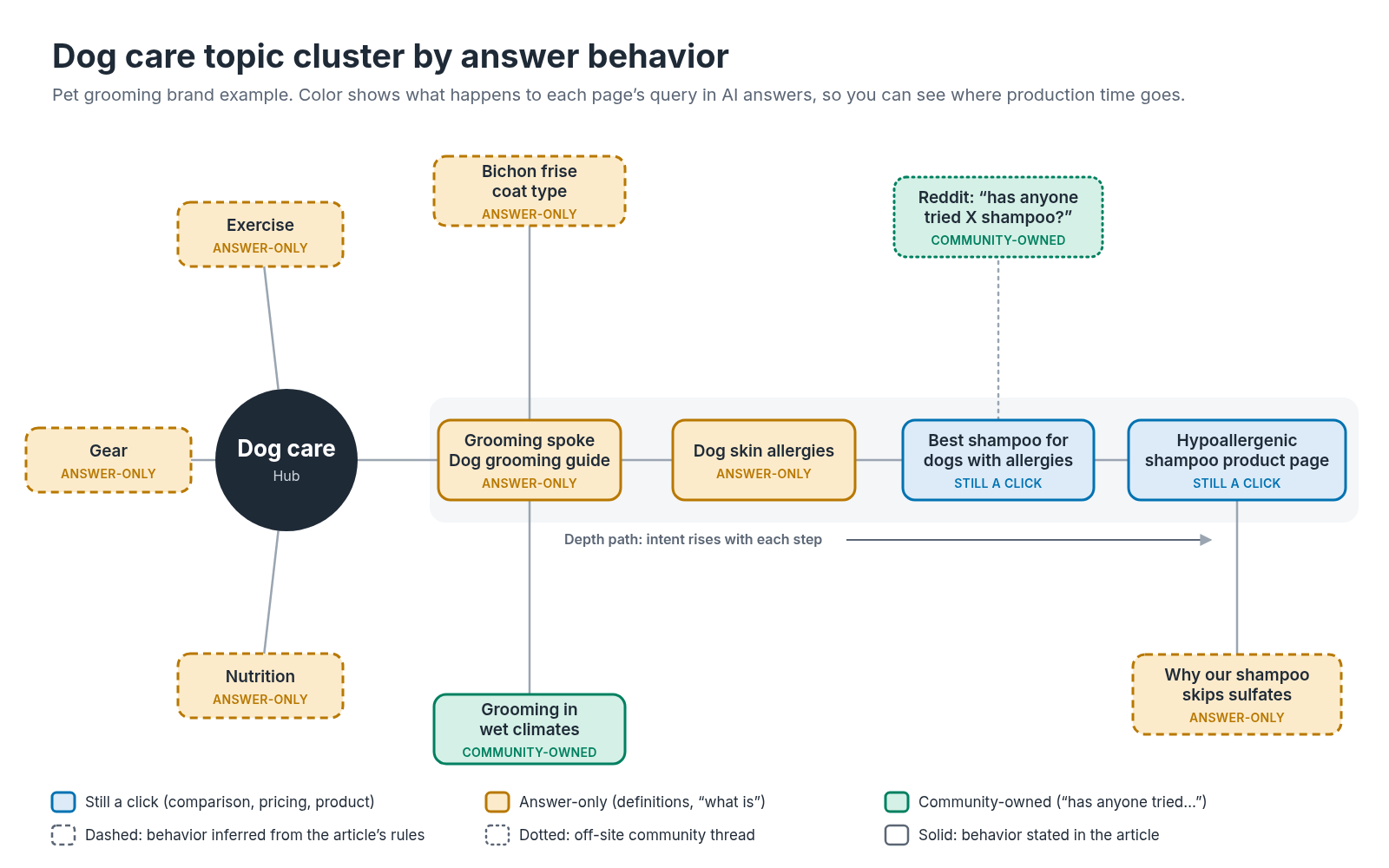
Each spoke gets pages for every funnel stage. That might range from “bichon frise coat type” at the top to “buy hypoallergenic dog shampoo” at the bottom.
I also sort every planned page by what happens to its query in AI answers. Comparison, pricing, and implementation queries can still earn a click. Definitions and “what is” queries are mostly answered on the SERP.
“Has anyone tried X shampoo?” belongs on Reddit. The job there is to show up as a person in the thread.
Informational comparison queries triggered an AI Overview 95.4% of the time in Seer’s data, even though I’d put them in the click bucket. Question-format queries triggered one 85.9% of the time. For transactional queries, that dropped to about 5%.
On comparison pages, give the model something to quote, such as your own test notes. Put the click work — reviews, pricing, and shipping — on product pages.
I hand content teams a sheet like this for every cluster.
| Page | Stage | Example query | Format | Answer behavior | Links to | Success metric |
|---|---|---|---|---|---|---|
| Dog grooming guide (hub) | Top | how often should you groom a dog | Guide with jump links to spokes | Answer-only | Every grooming spoke, shampoo category page | AI impressions, assisted conversions |
| Dog skin allergies | Top/middle | why is my dog itchy after a bath | Vet-reviewed explainer | Answer-only | Allergy shampoo comparison | Citations, clicks to comparison page |
| Best shampoo for dogs with allergies | Middle | best dog shampoo for allergies | Comparison with our own test notes | Still a click (expect an AI Overview) | Product pages | Product page visits, add-to-cart |
| Grooming in wet climates | Middle | how to dry a dog’s coat when it rains | Use-case guide plus video | Community-owned | Grooming guide, product page | Engaged sessions, video views |
| Hypoallergenic shampoo product page | Bottom | buy hypoallergenic dog shampoo | Product page with reviews and ingredient explainer | Still a click | Ingredient explainer, comparison page | Revenue, conversion rate |
An example of this planning sheet as a working Google Sheet with real rows filled in.
If you want to rank for “buy dog shampoo for allergies,” don’t make a bathing video or grooming buying guide. I wouldn’t. That query calls for a product page with reviews and a clear ingredient explanation.
Going from dog care to grooming to skin allergies to allergy shampoo takes a few steps. Intent tends to rise with each one. Most clusters I audit stop at grooming. They never reach the allergy shampoo pages, where intent is highest.
Breed-specific pages are where our brand could overdo it. They only make sense when there’s real search volume and something breed-specific to say. According to Google’s generative AI guide, building a page for every fan-out variation to manipulate AI responses violates its scaled content abuse policy.
When a spoke falls below half of its parent’s engaged sessions for two quarters, stop drilling down. Answer that question on the parent page instead.
Pointing every query at a product page
Paid teams know the temptation to send every query to a product page—or, in B2B, to “book a demo.” But someone asking whether hypoallergenic shampoos are as clean as regular ones needs an ingredient explainer first. Put the product link at the bottom.
Dig deeper: Content mapping: Who, what, where, when, why and how
Wire the cluster into your site
I link the hub to every spoke, and each spoke back to the hub using descriptive anchors. Then I link bottom-funnel pages to explainers that address buying objections. Internal links are also on Google’s short list of fundamentals in its AI features documentation.
After adding the links, I run Screaming Frog on the cluster folder. I look for orphaned spokes and pages buried four or more clicks deep.
If our pet brand has a strong post explaining why its shampoo skips sulfates, surface it on the product page near the reviews. That’s where shoppers are deciding whether the formula is right for their dog.
Put a vet’s name on the allergy spokes
Every allergy spoke in our cluster gets a named vet reviewer. Every author also gets a bio page linking to their other work. An About page explains who makes the formulas.
That addresses the “Who” in Google’s “Who, How, and Why” questions from its helpful content guidance. One of those questions is whether it’s clear who wrote the page.
The vet review and our own bath-test results are also the kind of “non-commodity” content Google describes in its generative AI guide. A model can’t get those details from generic dog allergy explainers.
Dig deeper: Internal links and SEO: Best practices, examples and tips
Measure the cluster against pipeline, then refresh it
Report at the cluster level. Group URLs by folder or regex so the grooming cluster appears as a single line item in each report.
| Signal | Where to get it | What it tells you |
|---|---|---|
| Clicks and impressions | Search Console Performance report, filtered to the cluster | Classic organic reach |
| AI Overview and AI Mode impressions | Search Console generative AI performance report (Pages tab) | Whether the cluster appears in Google’s AI answers |
| AI referral sessions | GA4 custom channel group (chatgpt.com, perplexity.ai, gemini.google.com, etc.) | Traffic from answer engines off Google |
| Citations and mentions | Prompt tracking in a tool like Profound or Semrush | Whether LLMs name you for your core prompts |
| Conversions, revenue, or pipeline | GA4 and your CRM | Whether the cluster is worth funding |
Search Console’s generative AI report rolled out to all sites on Aug. 31. It reports impressions by page, country, device, and date, but not clicks or queries. GA4 also misses AI app visits that strip the referrer. I treat both as trend lines and compare them with the previous quarter.
Clicks from results pages with AI Overviews tend to be higher quality, meaning people spend more time on the site, according to Google.
AI-referred sessions to Shopify storefronts grew 197% year over year in Q2 2026. They also converted at roughly twice the rate of organic visitors in research-heavy categories (Shopify’s data, via Search Engine Land). Shopify didn’t say how many merchants were included, so treat that finding as directional.
Expect answer-only spokes like the grooming guide to lose clicks. Judge them instead on assisted conversions to shampoo pages.
Set a quarterly review. Add spokes for questions you find in AI answers or support tickets. Merge spokes that never earn engagement. Over the past two years, I’ve watched most tech brands either add an AI spoke or work AI into every existing spoke.
When you review performance, look at clicks and impressions separately. In fall 2025, Seer saw cited brands’ CTR drop sharply as impressions more than doubled while clicks stayed flat. Seer’s best explanation was that brands were getting cited across more queries, making CTR alone look like a decline.
Start with one cluster you can tie to revenue
Pick the cluster closest to revenue and give it a quarter. Map its fan-outs in AI Mode and ChatGPT. Then write the two or three spokes where you have test data or expert input nobody else has.
Link the hub to the spokes, and the spokes to the product pages. Give the cluster its own line in the pipeline report.
After that, if a spoke earns no clicks, citations, or assisted conversions after two refresh cycles, merge it into its parent.
Explore more on
Editorial disclosure
Contributing authors are chosen for their expertise and work under the oversight of the editorial staff. Search Engine Land is owned by Semrush. The contributor was not asked to mention Semrush; the opinions expressed are their own.
About the author